

Für den Hauptraum der Wiener Secession entwickelt Iza Tarasewicz die Installation „Moving Cause“. In der Galerie des Polnischen Instituts Wien wird der Entstehungsprozess des Projekts präsentiert.
Vienna - Exhibition

Für den Hauptraum der Wiener Secession entwickelt Iza Tarasewicz die Installation „Moving Cause“. In der Galerie des Polnischen Instituts Wien wird der Entstehungsprozess des Projekts präsentiert.
In his work, Hubert Kaufmann explores when we can still trust an image and questions an image before it reveals anything. Works are currently on view in the exhibition “Grundrauschen”.
Jonas Höschl arbeitet als Konzeptkünstler und Fotograf mit Druckgrafik, Sound, Video und Installation. Aktuell ist seine Ausstellung „Polizeipferde für Österreich“ im Bildraum 01 in Wien zu sehen.
“Unfolding Memories” at the Draiflessen Collection places the private photo albums of the Brenninkmeijer business family in conversation with artists working in the medium of photography.
From retracing Walter Benjamin’s escape route through the Pyrenees to collecting Soviet prison souvenirs, Anna Jermolaewa talks about how hope, migration, and memory shape every medium she works in.
Drawing on Helmut Zambo’s collection, the exhibition, curated with Nikolaus Kratzer, explores parallels in the artists’ early works and new perspectives on their oeuvres.
Die Fotoausstellung „BÄNG! Radikale Künstlerinnen aus dem Archiv Sohm“ folgt dem flüchtigen Moment: Über 100 historische Schwarz-Weiß-Fotografien halten seltene Augenblicke.
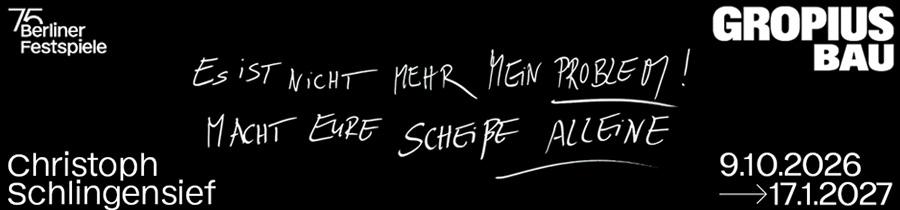
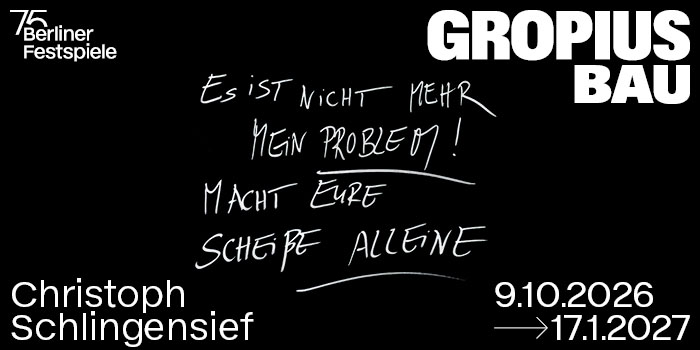
Through striking political actions and projects spanning theatre, opera, film and the visual arts, Christoph Schlingensief (1960–2010) turned an unflinching gaze upon the absurdities of the present.
Michał Budny’s solo exhibition „RANDZONE“ at PEAC Museum is constructed as an inner landscape consisting of over twenty-five works in different media, welcoming visitors to engage and explore.
Born in Klagenfurt in 1946, Meina Schellander is a distinctive voice in Austrian contemporary art. fjk3 presents a solo exhibition spanning nearly six decades of her work.
In 1896, the Parisian physician Hippolyte Baraduc published a strange and beautiful book, The Human Soul: Its Movements, Its Lights, and the Iconography of the Fluidic Invisible.
„Daylighting: aber es ist Wasser, das spricht“ is Zaituna Kala’s first solo exhibition at a German institution, following presentations in Rennes (2025) and Brussels (2026).
The Alexander Tutsek-Stiftung presents the large-scale exhibition „Photography in Flux. 20 Years C/O Berlin Talent Award“. Curated by Veronika Epple, featuring fourteen positions.
Ab dem 16. Oktober 2026 zeigt die Alexander Tutsek-Stiftung in der BlackBox und im BlackBox FirstFloor in Münchens Parkstadt Schwabing „Photography in Flux. 20 Years C/O Berlin Talent Award“.
Linda Ebert discusses her solo exhibition at the gezwanzig showroom; she explains the processes behind her works and asks whether the grid can shape social structures beyond the realm of art.
Kolekcionart presents the solo exhibition “THE SAME PLACE” by Croatian artist Alba Miočev at its Gallery in Zagreb. Miočev’s work deals with the concept of time and memory.
Auf LED-Screens laufen zwei Animationsfilme. Auf den Bildschirmen sind abstrakte, kaleidoskopartige Assemblagen aus Farben, Bewegungen sowie Licht- und Schattenimpulsen zu sehen.
At the Reutlingen Art Museum, the exhibition “Love Will Tear Us Apart” explores how diverse and political love can be, taking Edvard Munch’s woodcut The Kiss as its starting point.
Since the 14th century, the landscape has been a cultural construct. But what happens when the landscape itself becomes artificial? Does culture then lose its connection to its human creator?
“ANATOMY OF PRESENCE”, curated by Dr. Svenja Frank and Jérôme Sans at SCHAUWERK, features monumental installations by Vivian Caccuri, Lucia Koch, and Henrique Oliveira.
The artist Marwa Arsanios talks about her process of filming and production, and how her view on ideology changed throughout the making of the film series “Who Is Afraid Of Ideology?”.
Ausstellung: Sophia Mainka – where things stay too long. Abgestreifte Schuhe warten vor der Haustür, eine ornamentale Tränke lockt Vögel, ein Trampolin erinnert an ausgelassenes Kinderlachen.
Anna Jermolaewa’s art reveals hidden mechanisms of everyday life with empathy and subtle humour. Kunstmuseum Liechtenstein is devoting a major solo exhibition to her work.
How do people define “Heimat” in the 21st century? Can we still speak of home in the singular now that our ideas of home have grown so plural? In conversation with curator Uta Ruhkamp.
The exhibition „persona. fragments of identity,“ curated by Barbara Horvath, with works by Odie Lap Chun Chow, Edith Karlson, Jakob Lena Knebl, Yein Lee, and Paulina Semkowicz.
Questions such as “How do we eat today, and how do we want to eat and live in the future?” are addressed in the exhibition “Politics at the Kitchentable” at the Wilhelm-Hack-Museum.
With Closed Eyes Cinema, filmmaker and sound artist Ganaël Dumreicher explores cinema at the threshold of material visibility, where image, sound and perception converge.
From September 18, 2026, to January 10, 2027, the Lentos Kunstmuseum Linz will present Katrin Plavčak’s solo exhibition, titled “Painting Reality in Surreal Times”, curated by Hemma Schmutz.
Kunsthalle Dortmund (formerly HMKV) opens with the exhibition „INDUSTRIAL: Silk Roads 3000“ on September 11, 2026 Featuring 20 international artist positions.