Season 2, Episode 5: Roman Signer
‘Don’t write under the line’ is indicated on the back of a postcard depicting a volcano. Roman Signer signs his name right underneath. The artist doesn’t read the small print. Only the curator does. But to Signer, disobeying must come as second nature. On the remaining blank spot, left open for his name, Signer’s daughter Barbara, also an artist, draws a volcano spewing fire.
We’re attending the fourth edition of Volcanic Attitude Festival, an event bringing artists and scientists to the volcanic territories of Naples and the Aeolian Islands. Signer and I are both wearing Stromboli caps and slurping lemon granitas at the local bar, appropriately-named Il Malandrino (the Italian word for a transgressive figure). We’re chilling, after the artist’s first ‘action’ on Stromboli that morning; Aktion mit Stiefel (Action with Boot).
The day before on June 24, Volcanic Attitude launched at the Mineralogical Museum in Naples. There, in the magnificent palazzo filled with lava stones and volcano bombs, I caught Signer standing at the window to contemplate Vesuvius. In the room, a small-scale model of the same volcano completed the scene. Throughout the festival’s itinerary, I will see him again and again in that position, eyes directed skywards, towards a volcano. This force of nature, with its eruptive processes and fire-breathing capacity has fascinated the artist from the very beginning of his long career.
Our postcard with the volcano is addressed to Eugen Blume, former director of Hamburger Bahnhof – Museum of Contemporary Art in Berlin. This is where I first met Signer in the early 2000s. Back then, the exhibition catalogue featured on its cover a 3D postcard with a volcano (an artificial one, based in the south of Germany).
In German, this kind of postcard is called a Wackelkarte, since you have to wobble it back and forth to see the moving image. It’s the perfect card for shaking grounds like those of the volcano.
Today, two decades later, we are on Stromboli, considering producing more of those Wackelkarten, selling them in a pop-up Roman Signer Museum at the harbour. As its director, I’d be driving around in one of the island’s three-wheeled mini-trucks that Signer finds amusing. “I’d like to go back to Stromboli,” the artist told Blume in 2007 on the occasion of his museum exhibition, “Strangely enough, Stromboli is the only volcano I really know… I think it has a classic form. Because it juts out of the sea, like a cone.”
In his twenties (Signer says he was 28), the artist travelled for the first time to Stromboli. There, next to the crater, he bumped into a volcanologist. There are a few volcanologists here, attending Volcanic Attitude, mingling and collaborating with the artists. But Roman’s initial encounter was less successful. The volcanologist called out in surprise when he saw the artist walking around without any protective gear close to the actual crater. The scientist thought Signer was mad. “I thought he was mad”, Roman retorts, “The way he was leaning on his stick into the crater, he could have been swept away at any moment. I wouldn’t have saved him,” the artist laughs. There’s a pause. “I couldn’t have”, he corrects himself.
In 1992, an action by Signer on Stromboli was, for the first time, recorded on film. Today, on the ferry from Naples to the Aeolian Islands, this film is looping on a screen in the lobby. Two ladies are playing cards, unaware that on the television, something formidable is happening: a red ribbon attached to a rocket shoots across a crater. Signer tells me that he waited for exactly the right moment to do it. Once the volcano started spitting, the ribbon would be propelled into the sky. “Did you have fun?” I ask him. “Yes,” he says, “but that’s only part of it.” For Signer, his work is also a gift to the volcano. A red ribbon dancing on its fumes as a cadeau.
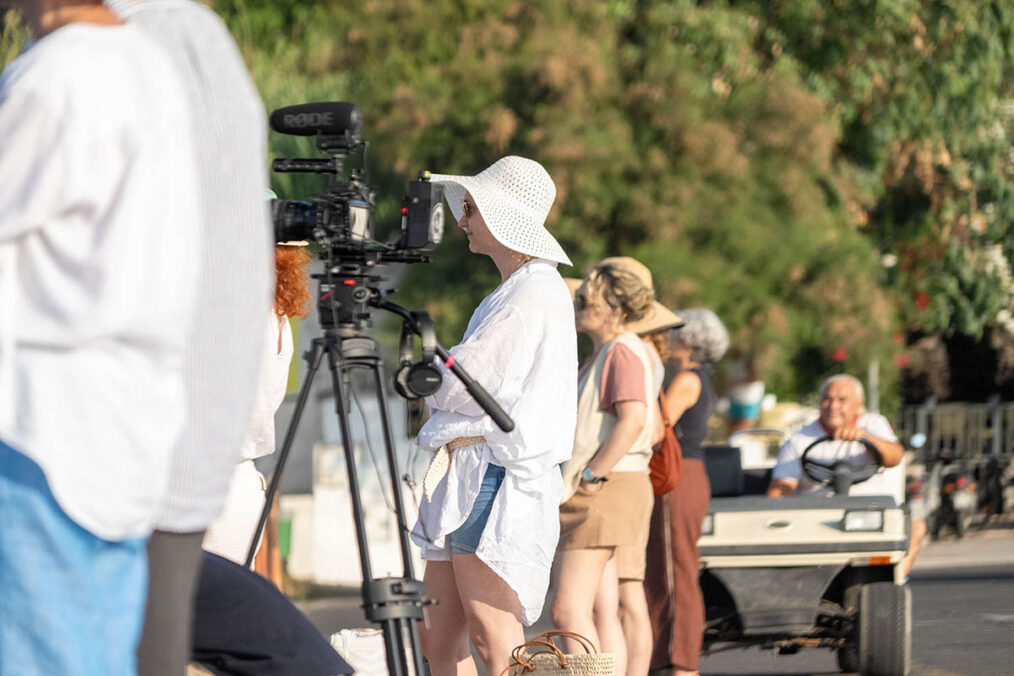
Since then, Signer has returned with other gifts: red gym balls (Ledragomma balls made in Italy) in 1997 and, in 1998, car tyres to be rolled into the crater where they vulcanised. Yet, in 2025, such artistic experiments at Stromboli are no longer possible, as the Italian carabinieri are policing around, vigilant for maverick artists. But on this early morning at 6 am, the 87-year-old Signer casually leaves the ferry, with a black rubber boot under his arm. Tomasz, his brother-in-law, who has been accompanying Signer around the world for 25 years, carries a fire extinguisher. An audience of about thirty artists, scientists, art and volcano lovers, trot along, still half asleep, agog with anticipation.
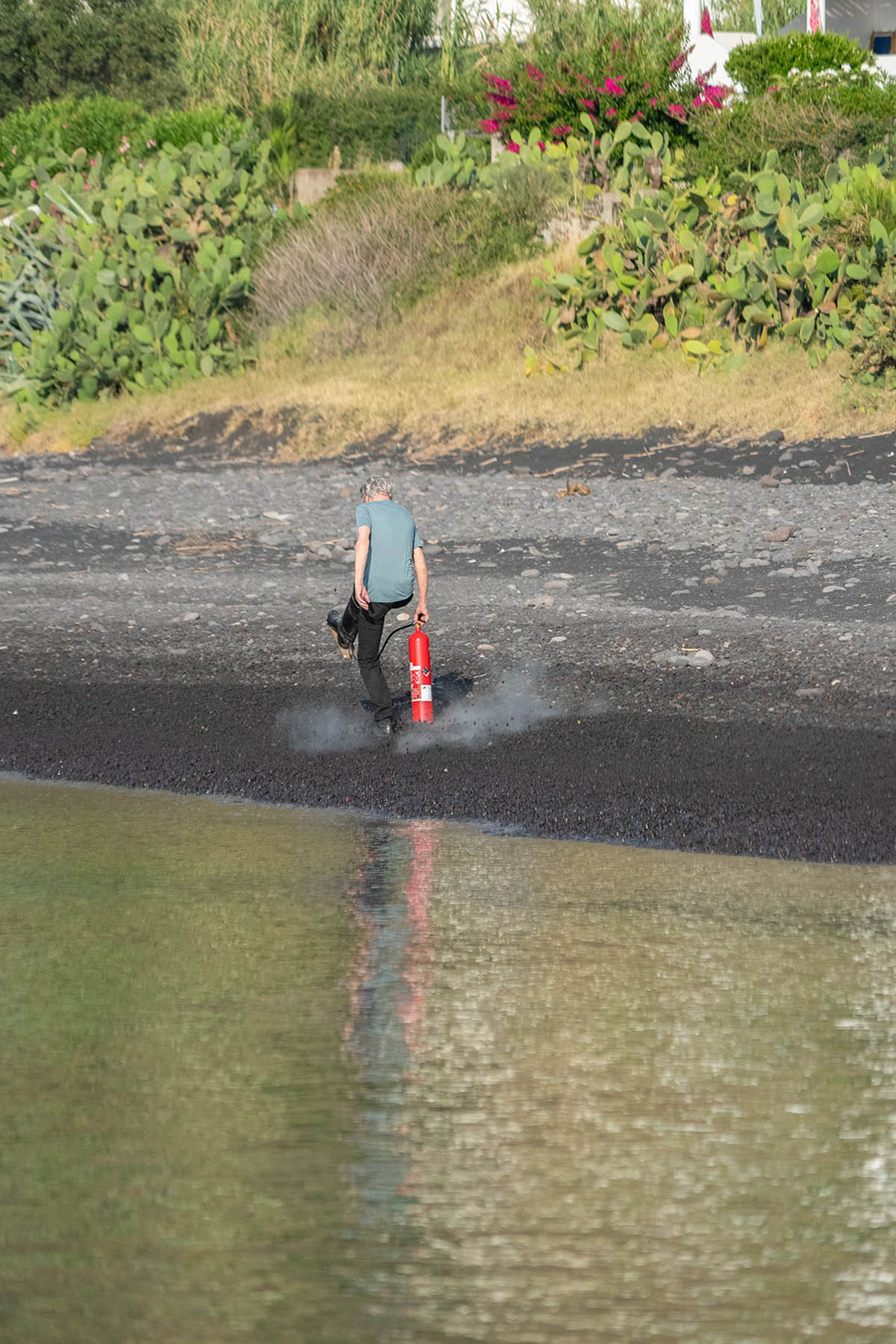
After a coffee at Stromboli’s harbour, we gather on the bridge where we have a view of the beach. The volcano is breathing plumes, creating a scenic backdrop, while an early-morning bikini-clad sunbather is already lying on the beach. In between volcano and sunbather we see the strange sight of a man walking on the beach, one foot in the big boot, on the black volcanic sand, handling the red fire extinguisher. With a loud, sizzling sound, it squirts puffs of carbon dioxide gas at his feet. Each time, the boot is lifted high in the air. It is a comical sight, yet none of us laugh. We watch on, perplexed.
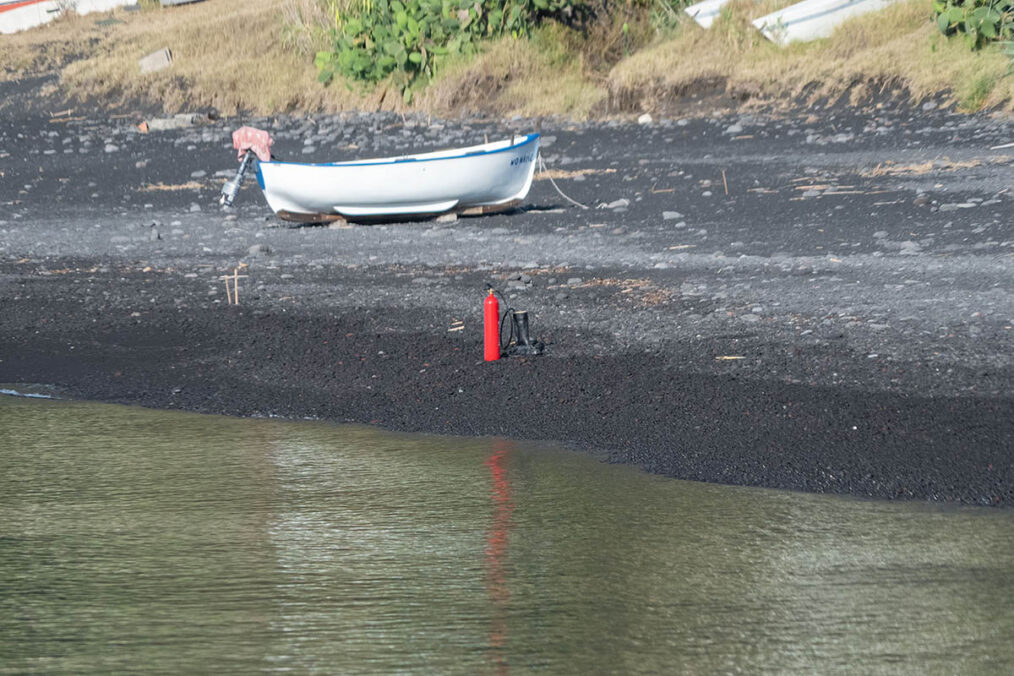
Signer tells me later that using a fire extinguisher like this, with small squirts, is not without risk. The company from where he bought it warned the artist about its safe use. The high pressure of the CO2 also makes it hard to keep one’s balance. You can easily be catapulted on your back. But actions with a certain element of danger are familiar to Signer. His next action, Aktion mit Pfanne, which is planned on Vulcano Island, so impressed his local fire brigade, they now use it to show the risks of fireworks. “They needed an artist to come up with the experiment,” Signer smirks, not without pride.
The risk-taking also extends itself to his daily interactions. On an evening out at a restaurant, he was the only one of the many diners to choose the Stromboli pizza. It is an extra spicy creation, abundantly topped with red peppers. Halfway through the pizza, the artist gives up. “Stromboli wins!” he laughs. This echoes Signer’s humour in his work, defying self-aggrandising, heroic gestures. There is an innate absurdity to his actions, yet there is a poetry too.
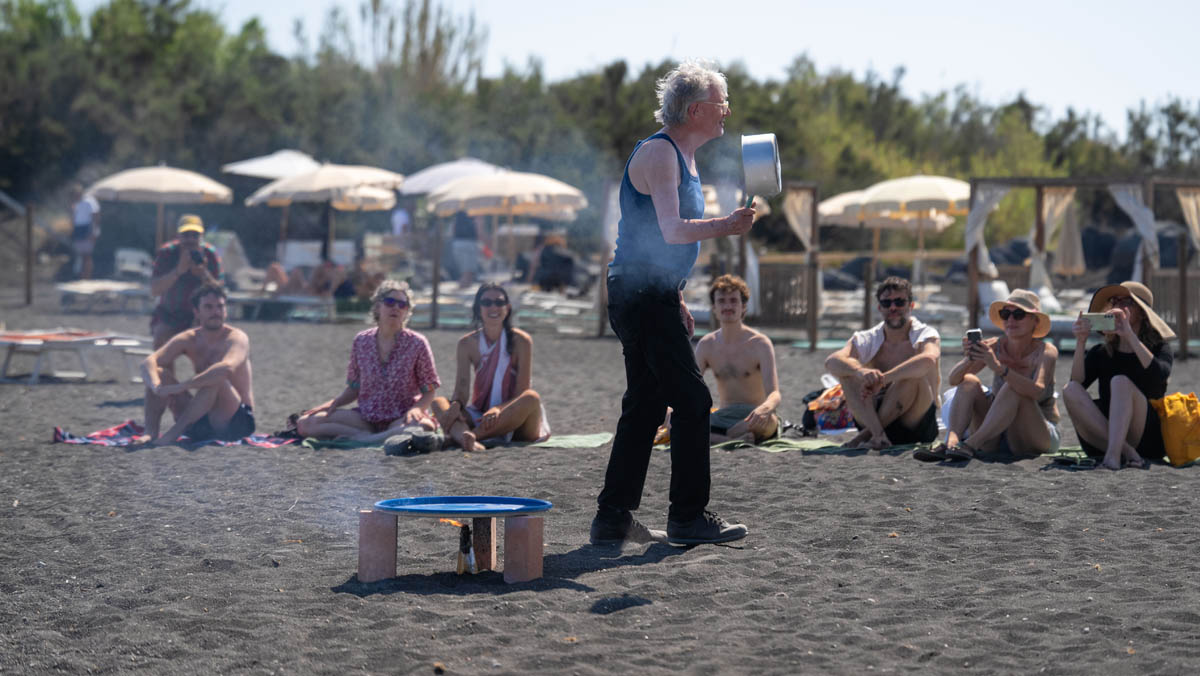
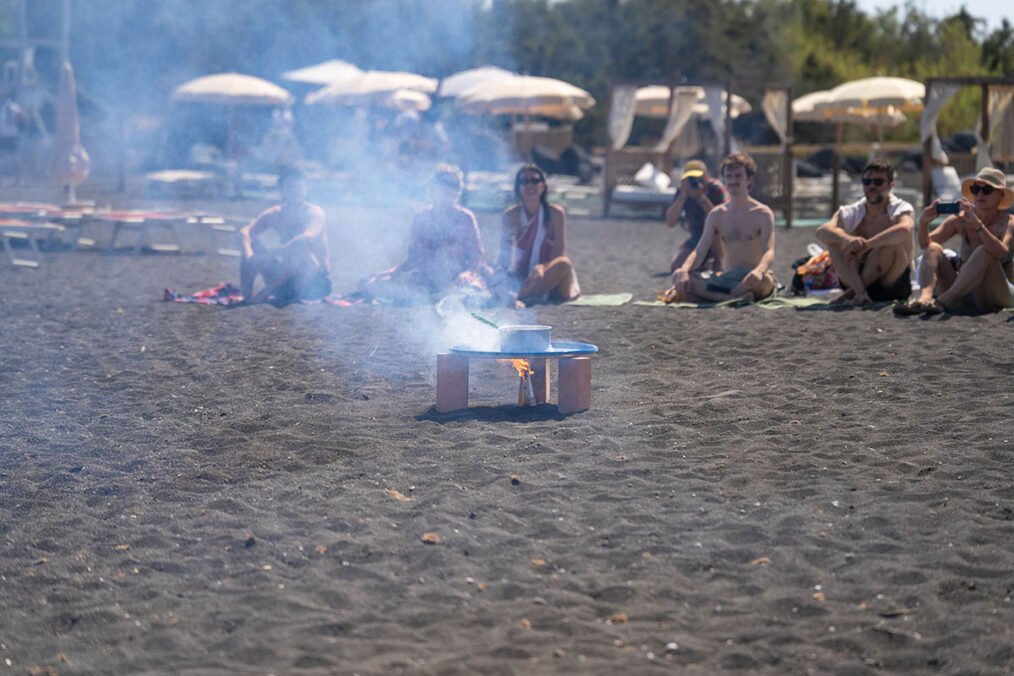
While the Action with Boot was structured with a dynamic that required walking, Signer wanted his second action to be still and sculptural. The following day, we gather on Vulcano Island beach at 10.30am. On the black sand, Signer lights a conical firework positioned beneath a blue metal platter, holding a kitchen pan. I expect it to fly up in the air. But instead, the sizzling firework causes billows of smoke to roll out from under the platter.
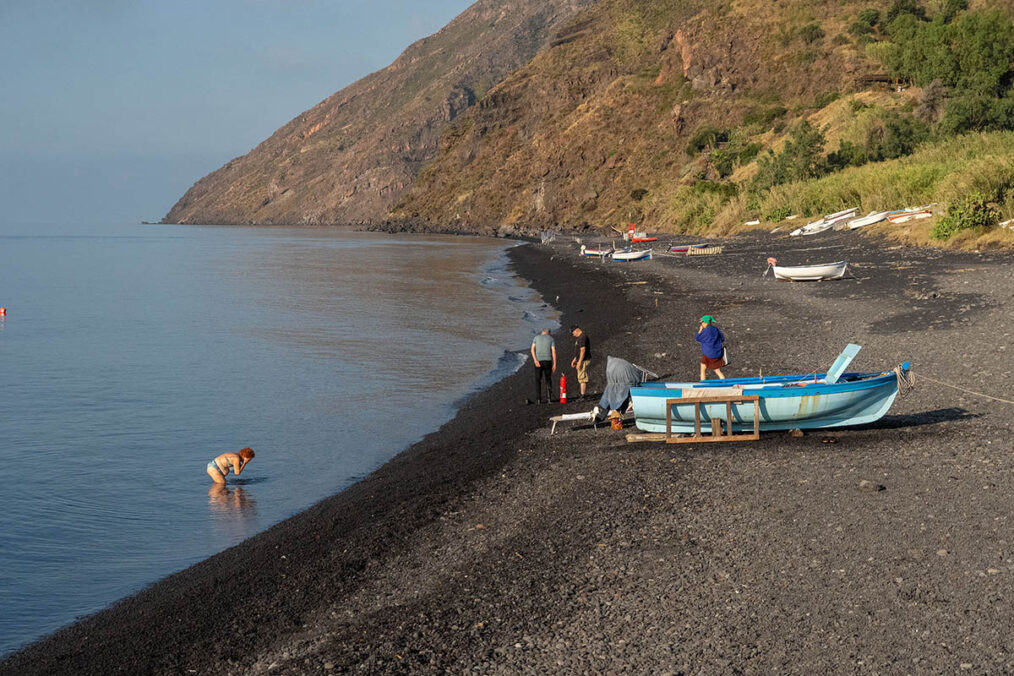
When the fumes subside, a deadpan Signer approaches the pan, lifts it up and shows us the hole burnt in its bottom, to the bafflement of the beachgoers. Enjoying the moment, Signer decides to improvise, Carrying the cooking pot to the sea and removing his shoes, he enters the water and takes a scoop with his defective pan. The water drains through the hole. The lost function of an everyday item has turned into play.
The following night, I sleep with the firework cone on my bedside table. Signer has baptised it Etna, which is the name of this particular firework, accompanied by a small Swiss flag on its wrapper. It’s Signer’s favourite brand, used for his explosive work. In the morning, the tip of the ash cone has fallen. When I tell Signer at breakfast, he likes the fact that the volcano is not yet stable.
During the remaining days of the festival and despite a heatwave, Signer joins in with the festival’s activities, even walking into the Valley of Monsters on Vulcanello. Helga Franza, the initiator of Volcanic Attitude, asks Signer what he thinks about the topic of this year’s event, ‘Magnetic-Magmatic’. He picks up on the wordplay. Franza adds that both are mostly invisible, whereupon Signer chimes in with a story about a Siberian mountain, whose magnetic power pulls in everyone who walks by. The artist grins at the thought.
Our final coffee break is in the harbour at Vulcano Island, as we wait for the ferry to arrive. On a tiny sheet of paper, the artist sketches Aktion mit Pfanne and its improvisation in the sea. “AQUA”, he writes, and: “für An”. His own name goes where it touches the paper’s border: Roman Signer.
Volcanic Attitude Festival – www.volcanicattitude.org
Link to preview episode: www.les-nouveaux-riches.com/standing-still-moving-fast/
About the Series: Curating, writing, and teaching takes An Paenhuysen to many places across the art world, but lately she has been working towards living and working between Berlin and Italy. In November 2024 she became the director of The Boxing Gallery in Milan, an art space under the auspices of the Fondazione Arthur Cravan, dedicated to happenings in the spirit of the dadaist, boxer, and poet Arthur Cravan. In this second season of interviews, An invites you to experience conversations with some of the interesting people and initiatives she encounters on her journeys through the Italian art scene, like young Italians or an art foundation that is more than real.