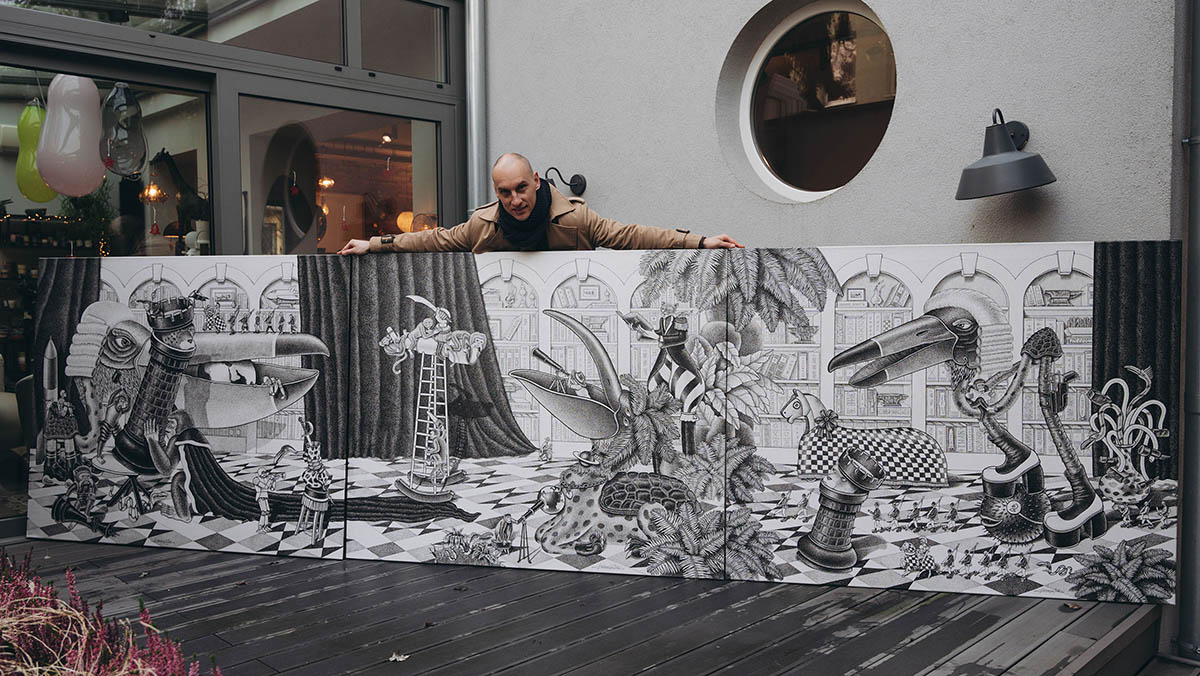
In your works, one can sense the space of an “inner theatre,” where the characters seem to exist within enclosed chambers of consciousness. Is this a way of structuring personal experience, or a way of hiding behind metaphor?
My inner dialogue, along with an often intense and sometimes excessive self-criticism, has been a constant companion in my life. These internal conversations naturally flow into the theatrical spaces I create in my work. In part, this is a way of processing and preserving personal experience through narrative. It is also a protected space where I can reflect freely and later express these thoughts in metaphorical form. At times, my characters leave these enclosed “theatre zones” and enter open, boundless spaces, only to return with new impressions and emotions to be examined and understood. This inner theatre also helps me endure life’s hardships. Formed in childhood, it became a way to color reality and to preserve myself emotionally.
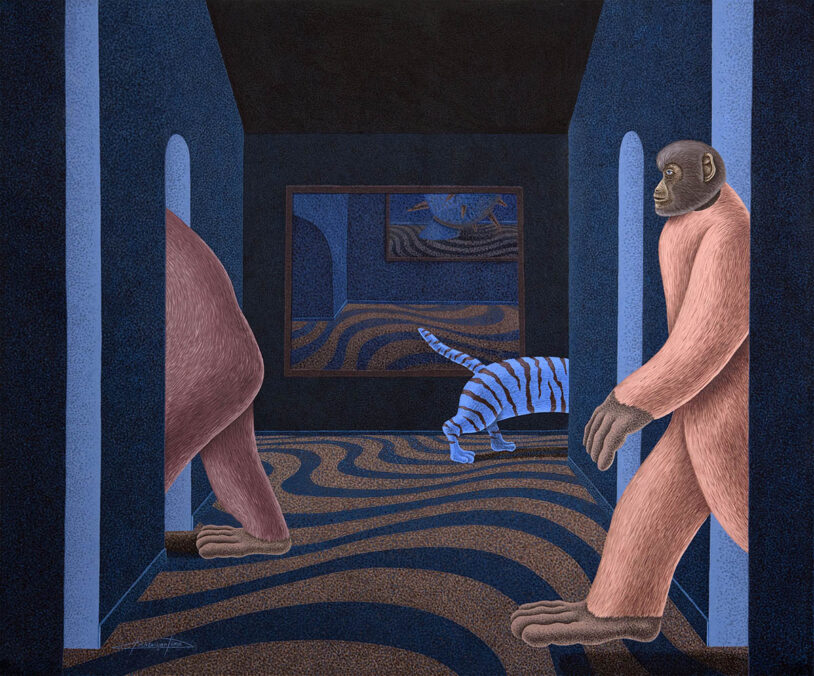
Your symbols, like towers, heavy boots, and fragile vessels, appear to be elements of a personal myth. Do you consciously construct this system, or does it form intuitively? And are there moments when a symbol begins to live independently of you?
These symbols emerge mostly intuitively, shaped by my life experience and personal sensibilities. For instance, large boots symbolize stability and support. I’ve always preferred solid ground, and by enlarging footwear, I emphasize the character’s firm contact with the world, confidence, control, and a desire for certainty. At the same time, some symbols develop almost independently. I constantly collect images and combinations of ordinary objects that resonate with me. They remain in my mind until, at the right moment, they surface and become part of a narrative. Once, while lying on the floor, I noticed a ceiling lamp that resembled a drone. I imagined two magpies riding it south for a holiday, adding small details like a camera and a sun hat. This is how familiar elements can transform into a new, metaphorical story.
Your visual language is already recognizable. How do you see its next evolution? Will it be a deepening of the existing world, or a radical shift?
I try to constantly observe my visual language and question whether I am evolving or standing still. I am always open to development, exploring new approaches and growing with my characters while making sure my work remains recognizable and true to who I am. Its exact trajectory is hard to predict, because both my artistic practice and my personality continue to change. These personal and creative shifts naturally reshape my visual language over time. I don’t expect a radical break, but rather a gradual deepening and transformation within my existing system. I instinctively see the world through this lens, constantly searching for ways to reinterpret and transform what I observe. I hope to develop this language as fully as my abilities and circumstances allow.
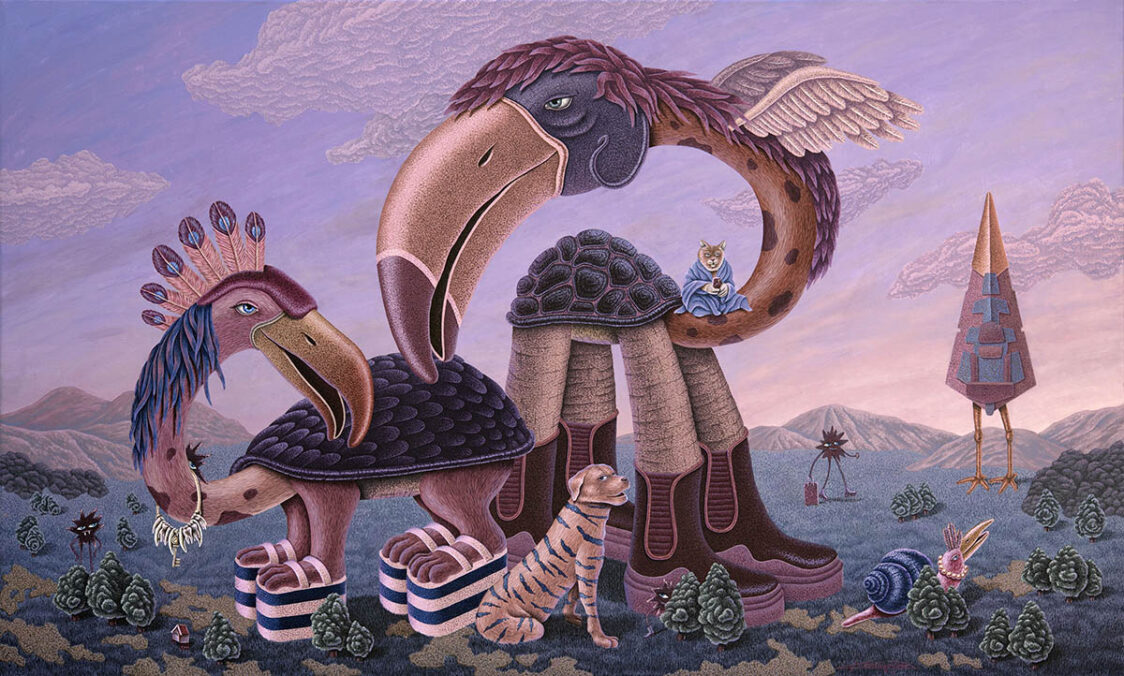
You have participated in international exhibitions and worked in different contexts. Have there been collaborations with curators, galleries, or institutions that genuinely influenced your artistic position, rather than simply expanding your geographic reach?
I belong to the group of artists who deeply value curators, gallerists, art historians, journalists, publishers, collectors, and everyone who supports the art world beyond the artists themselves. I am grateful for their work and enthusiasm, and I recognize their importance in shaping both artists and the industry.I can say that who I am today as an artist, and the way my style and approach have evolved, have been influenced by interactions with art professionals, participation in international projects, and exchanges with colleagues. Dialogue, feedback, and collaboration with other professionals are what truly foster growth. Rather than highlighting specific institutions, I’ll share a pivotal moment: within one week, two artists profoundly influenced my practice. Visiting Valery Slauk’s solo exhibition and a group show featuring Nicolas Barrome-Forgues exposed me to highly detailed graphic work. Inspired, I attempted my first fully developed graphic piece. Before this, I had only done sketches and small studies. The process thrilled me, and I realized I had found a technical language that suited me. That week marked the start of a professional phase in my creative life, leading me to develop the detailed, fully realized narratives I continue to explore over a decade later.
How much do you control edition sizes and production volume? Rarity is important for the market. How do you find the balance between accessibility and exclusivity?
I would say I face the opposite challenge: rather than limiting editions to enhance the exclusivity of my work, I have to pace myself, restrain my drive for dense detail and find technical compromises in order to produce slightly more works than I naturally would.
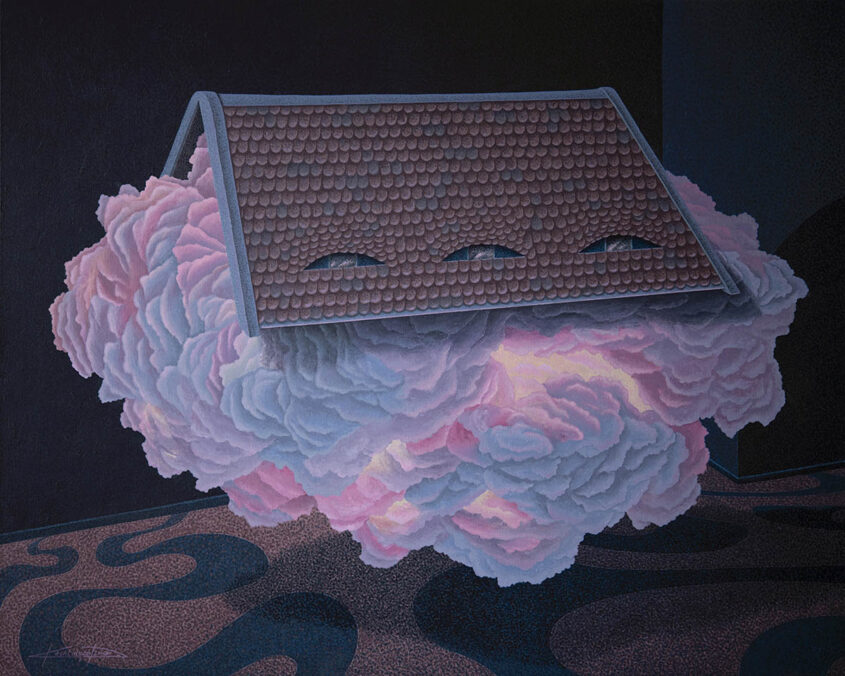
You work with vulnerability and sincerity. How do you maintain that honesty when the market demands recognizability, repeatability, and clear positioning?
Maintaining honesty in my work goes back to the very start of my artistic journey. The first rule for me has always been to create wholeheartedly, without regard for audience, institutions, or recognition. Genuine passion and belief in the practice itself are essential, and this is how I began, fully immersed in drawing, and I continue over 20 years later. I first became fascinated with art at 13 to 15 through classical graffiti. Materials were expensive, so I saved every penny to pursue what I loved, without expecting any return. This taught me that dedication, personal investment, and love for the process itself are the foundation of authenticity. Developing as an artist requires years of experimentation, learning, and effort. I also recognize the enormous competition among professional artists, and that only a tiny fraction achieves real recognition. Accepting this helps me focus on growth and the practice itself rather than external rewards. At this stage, I balance pure artistic exploration with projects that have commercial or external goals. I find ways to satisfy clients without compromising my style or integrity. Working on recognizability and consistency does not feel limiting; it helps me remain visible, access interesting projects, and continue developing as an artist. Ultimately, honesty comes from aligning opportunities and feedback with my internal compass, staying true to my principles while learning from industry professionals. With this balance, I can present my work in the best possible way while preserving its sincerity.
Exhibition: Dima Kashtalyan – Ancient Creature
Exhibition duration: 19.02.2026–15.03.2026
On view: PROM Kultury Saska Kępa, ul. Brukselska 23, Warsaw / Poland
Dima Kashtalyan – www.kashtalyan.com, www.instagram.com/dkashtalyan/
Dima Kashtalyan is an international artist, illustrator, and street artist based in Warsaw, Poland, known for his detailed dotwork, pointillism, and stippling techniques. His work has been exhibited globally, including Art Rotterdam, Art Taipei, and Bankside Gallery in London, and he has collaborated with major brands and publications such as The New York Times and Harper’s Magazine.