You mentioned in one of our conversations that you took part in one of Nitsch’s actions. Did that experience help you understand his work better? And do you think participation is necessary when working so closely with his work?
For me, it was very important to experience the different levels of reception, because that was also a key part of my research; understanding how people perceive and respond to his work. So my participation was essential. It was also important on a personal level. The first time I was taking part in the performance was in Naples, Italy. Some aspects of Nitsch’s work involve blood, and I used to be afraid of it. So being part of the action meant confronting that fear. I think it’s always valuable to face something like that. I participated again a year later, during his 80th birthday celebration at the nitsch museum Mistelbach.
Could you tell me more about those experiences?
The context, the surrounding played a huge role. Naples was very special. The atmosphere, the energy of the city, the intensity of life happening directly in the streets, matched Nitsch’s work. Everything felt raw and immediate.
At the museum, it was completely different. We had a full week of rehearsals, and everything was very structured. I was part of a group that included many of Nitsch’s long-time assistants. I was constantly trying to balance being involved and remaining reflective. It turned out to be one of Nitsch’s later actions, where he focused more on music. It was a very physical and emotional process. It felt almost like doing intense physical exercise for hours. Something shifted in my mind, even in the days that followed.
How did you approach selecting the works, and how was it to plan conceptually? The exhibition focuses on a later period: from the 1980s until Nitsch died in 2022.
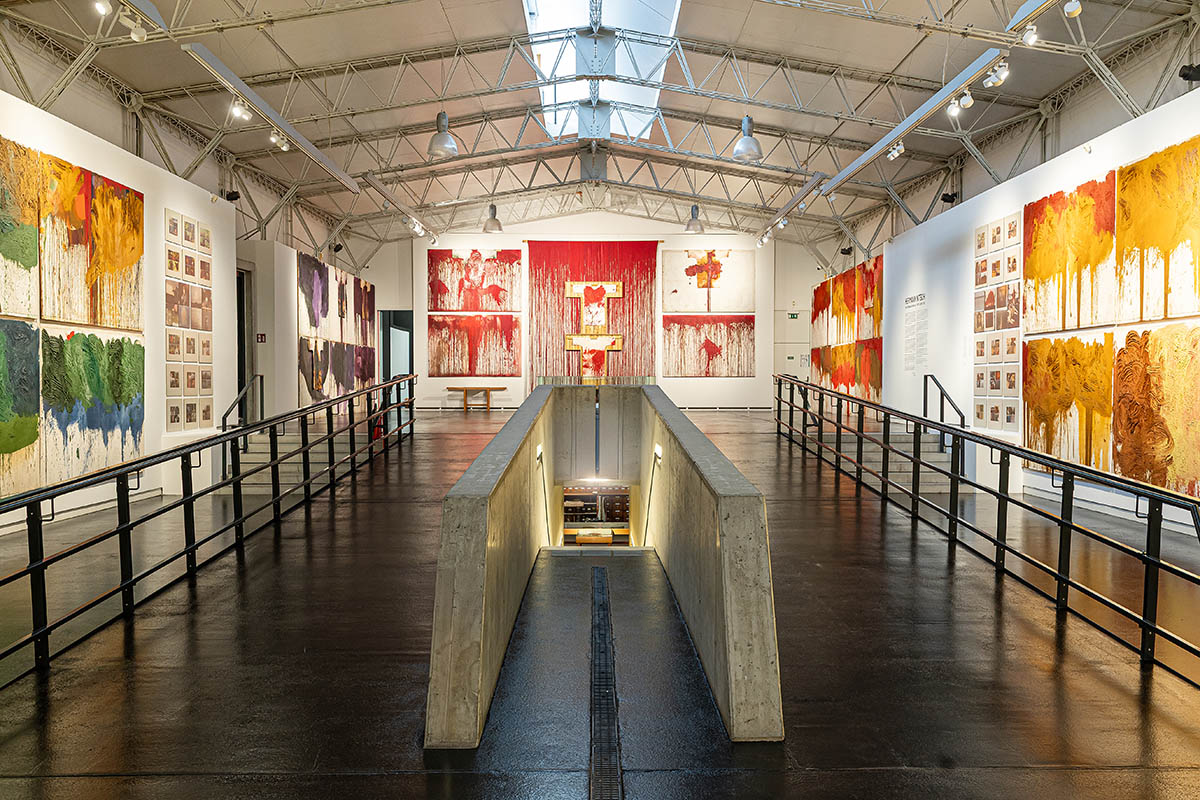
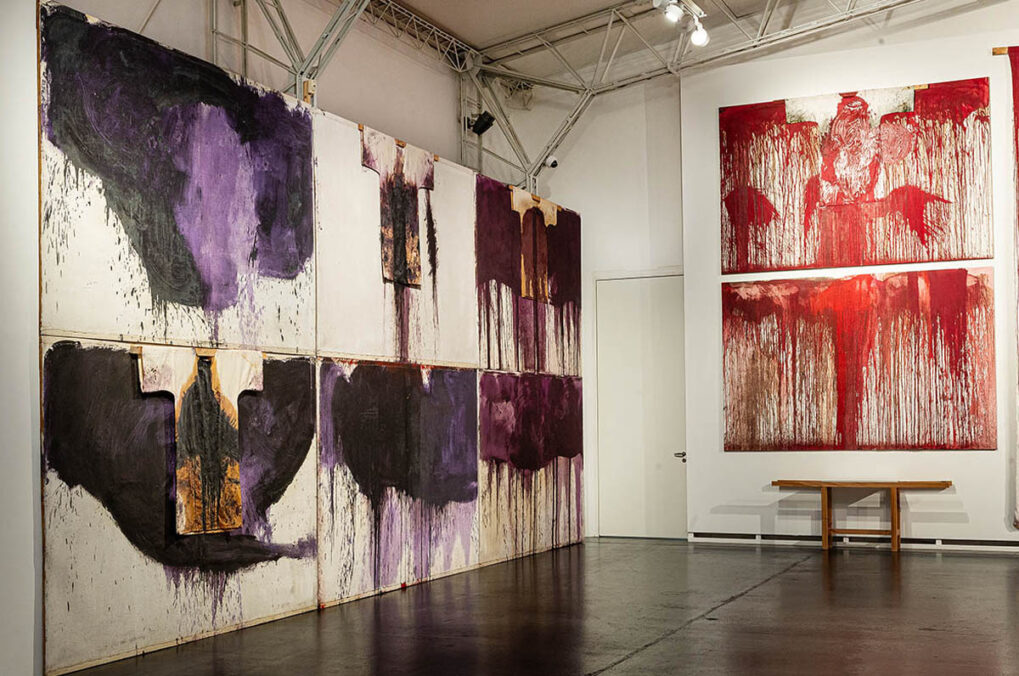
For this exhibition, I’m focusing on the idea of experience within landscape and color, and I think that connects directly to what I lived through. I selected around eighty paintings based on their color. In the 1980s, Nitsch worked with a specific palette much connected to spirituality and religion: violet, yellow, white, red, black, and green. I arranged them to create a powerful visual flow throughout the space, so visitors feel completely immersed.
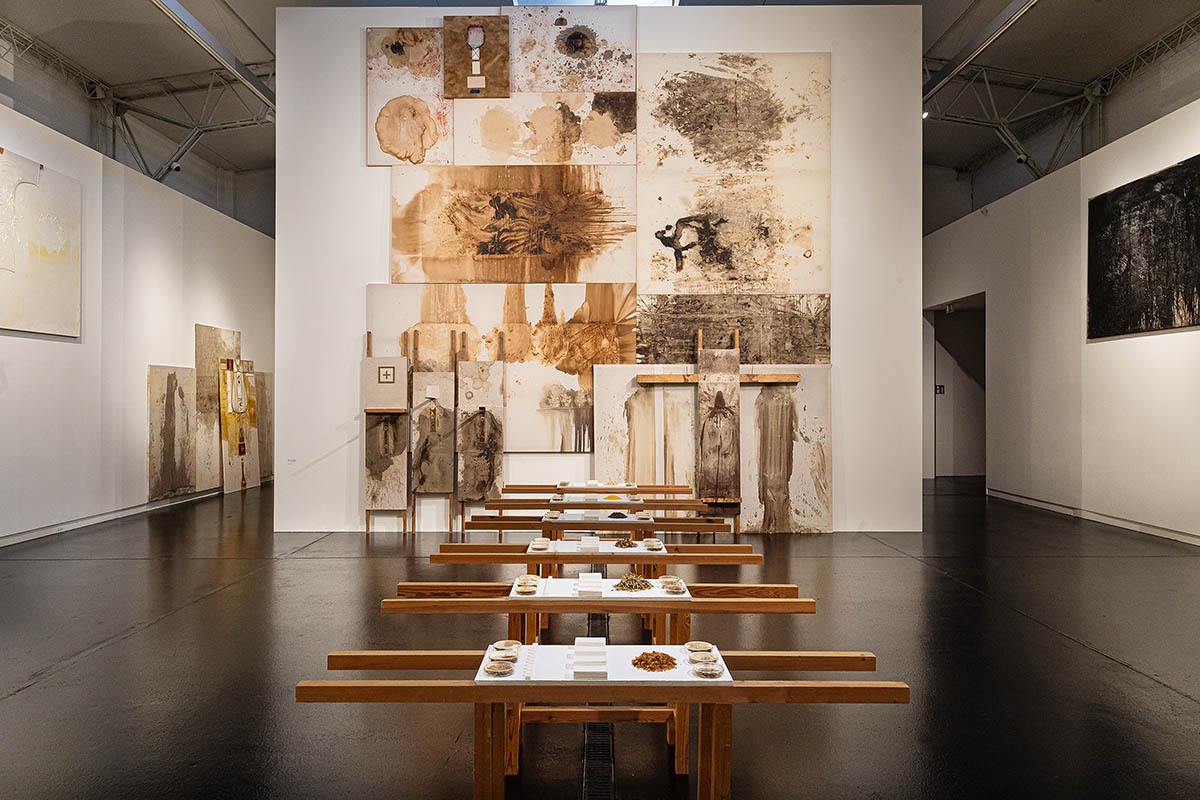
From the beginning, my goal was to present as many works as possible to create an overwhelming experience. That meant filling the space as much as possible.
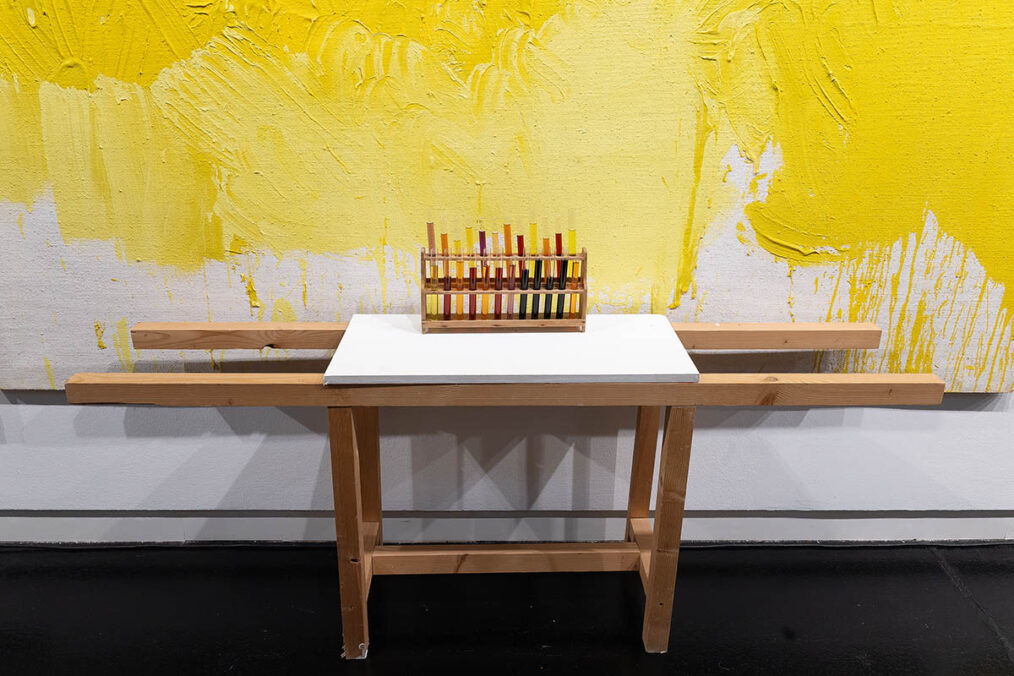
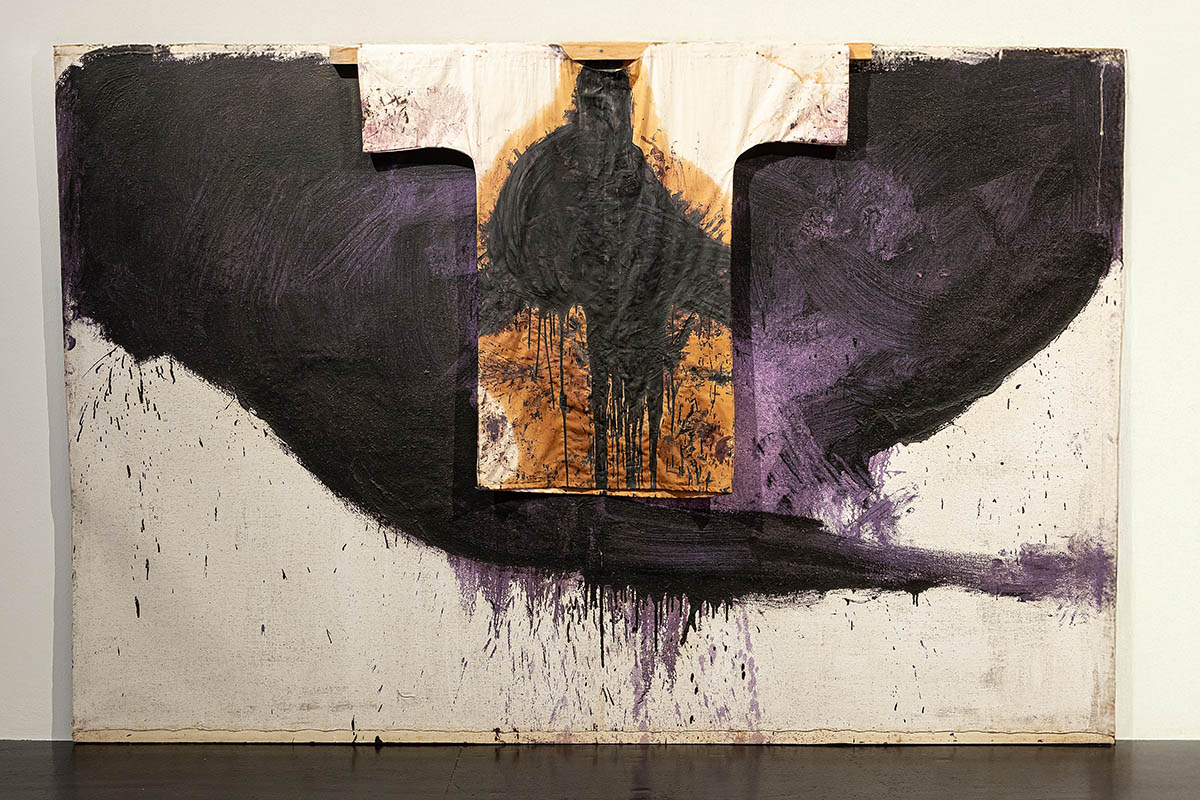
There are also two altar-like installations: one with red works, and another with older relic-like objects in brown, white, and black. The idea was to create a sacred atmosphere through the display itself, not just by showing symbols, but by making visitors feel something.
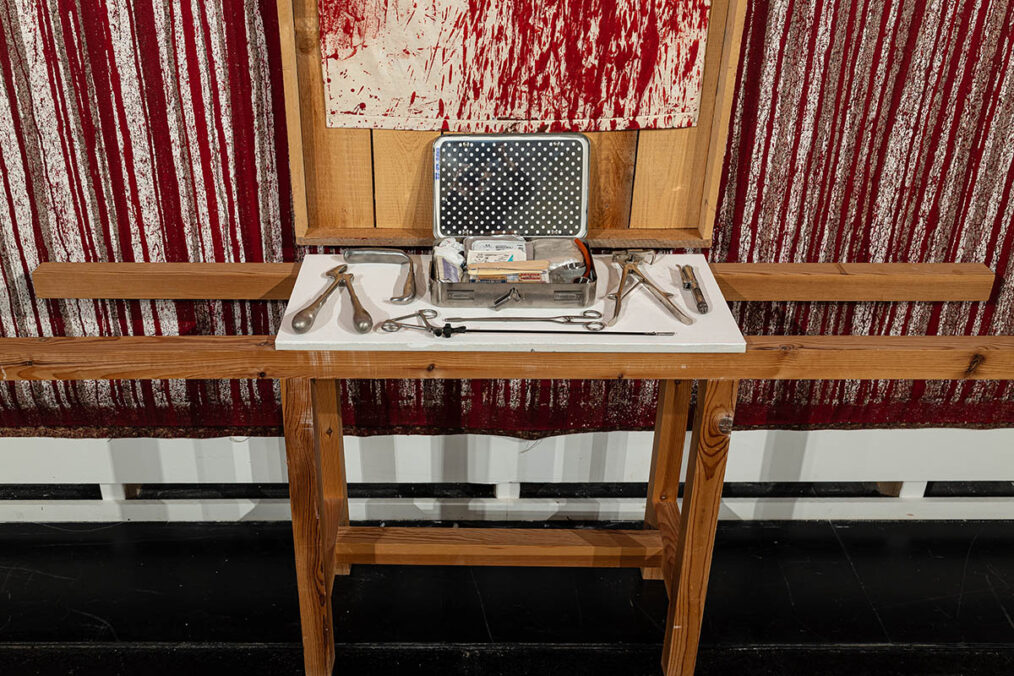
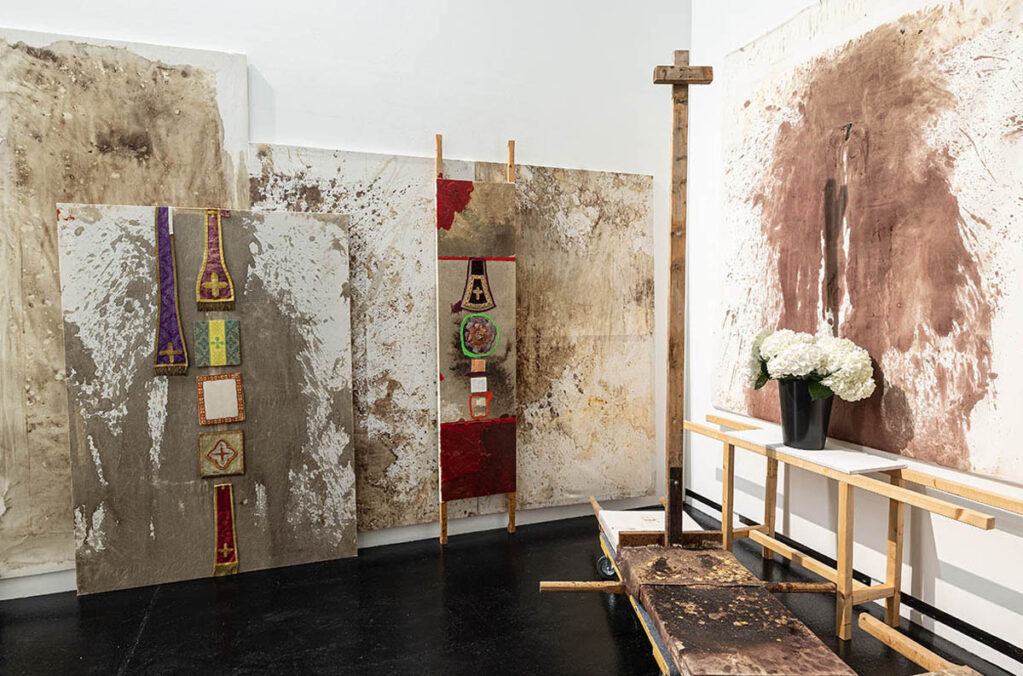
Then I asked myself: what else is sacred in Nitsch’s work? And I realized: it’s landscapes. I also discovered some previously unseen short films he made in the 1980s. They became part of the exhibition and are to be seen in the projections. The films were done in a way that he would place a camera on the ground and record long, quiet scenes: sunrises, sunsets, and everyday moments in places like Prinzendorf. In one film, he’s sitting at a table in a wine tavern, and you can sometimes hear people talking, and the camera just observes.
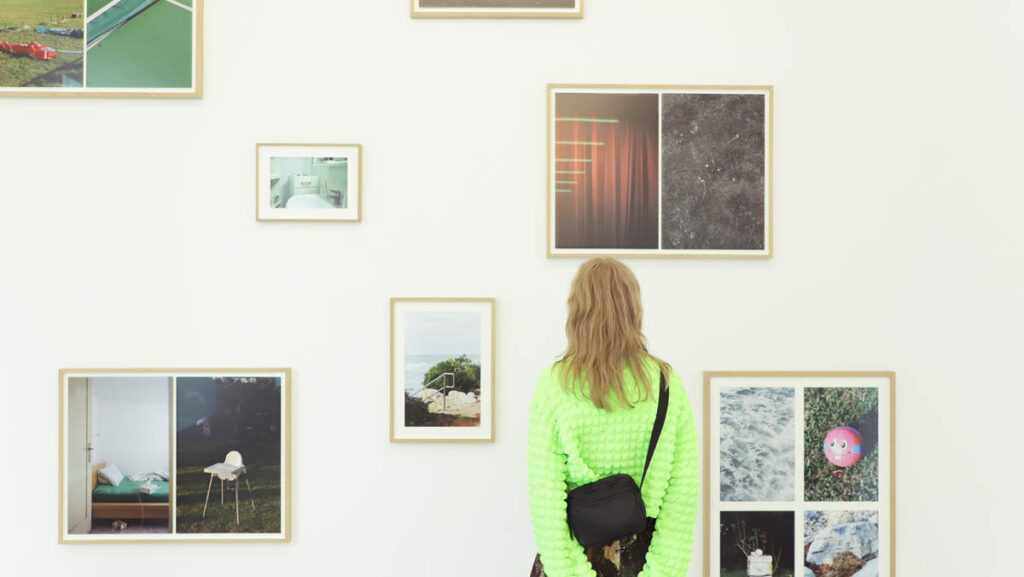
I’ve combined the films with photographs from Heinz Cibulka; for every showing of Nitsch’s Orgien Mysterien Theater, it’s always important to include the iconic action photography. The works of Heinz Cibulka are not only those of a close friend of Nitsch but also of one who worked alongside him in the 1960s. In the late 1970s, he created what he called picture poems or photo poems. Each consists of four single photographs arranged together. The mood is very similar in spirit to Nitsch’s work: rhythmic, ritualistic, and associative.
When I was first looking through Cibulka’s photos, one in particular caught my attention. It showed a woman eating a slice of honey bread, and for three days afterward, I kept dreaming about honey bread! I don’t usually even like it for breakfast, but the image was so strong, it stayed with me. That’s what I mean by atmosphere, it’s about feeling. When I made my selection, I was guided not just by subject matter but by color. I matched the photos to the colors in the paintings in the exhibition, the red, brown, yellow, violet, and purple areas. It was very intuitive, almost like composing music or building rhythm through color and light.
How did you decide on the title von Sonnenaufgang an (English: „From Sunrise On„) for your exhibition?
It originally comes from the Orgies Mysteries Theatre. Each day of the cycle begins and ends with the words „von sonnenaufgang an“. It reflects the core themes of landscape, light, time, and temporality. To me, this ties everything together, the idea of merging all the senses and uniting environment and experience into one complete organism, which was always central to Nitsch’s vision. That holistic, sensory approach inspired my choice of title.
How long did the preparation for this exhibition take? You mentioned working closely with the museum team and consulting archives and collaborators.
My research into Nitsch’s work began about ten years ago. So everything I do with his work is part of an ongoing process. I was invited to curate this exhibition about a year ago, and by the second day, I already knew what I wanted to focus on: the sacred development visible in his color paintings and relics. After that, it became a fluid process, visiting the castle again, selecting, and working through details.
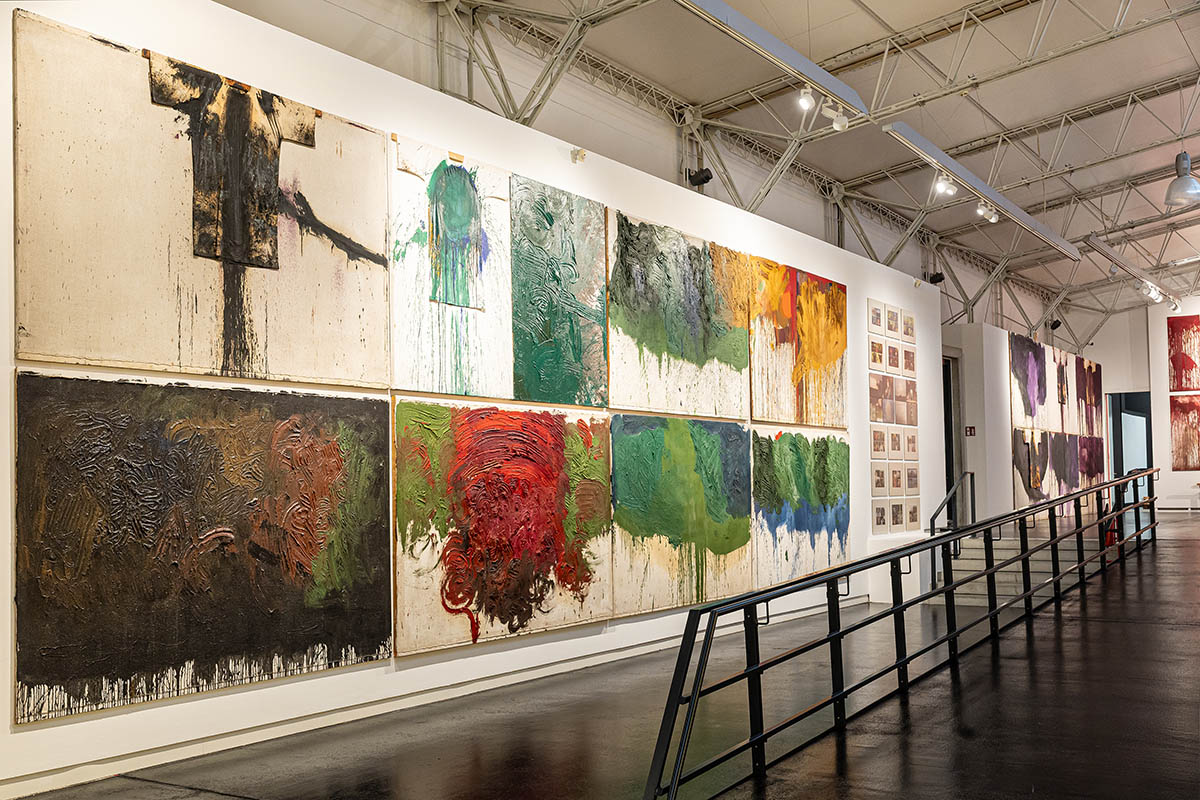
The process of setting up the works wasn’t easy, because we used his original old wooden panels, which are irregular, heavy, and require care. I made the final hanging plan last autumn, around September or October.
Precision is useful; it helps audiences understand specific phases of his work. Nitsch often insisted that “people must understand me the way I want to be understood,” but I think interpretation is an ongoing conversation.
Speaking of senses, Nitsch’s performances famously engaged all of them. In your exhibition setting, what represents smell and what presents sound?
There will be lots of flowers in the space, especially at the opening, flowers that Nitsch himself loved, such as hortensias and lilies. But to me, it’s not about recreating a specific scent. Every visitor already brings their own sensory experience, the person standing next to them, and even the air itself. It’s personal and always changing.
Some of the video footage naturally includes sound, ambient noises, conversations, and the environment itself. There will also be a sound performance as part of the public program during the exhibition. It connects back to the idea of rhythm and the organic flow between sound, image, and body.
In the films, sometimes there are quiet sounds, chatters, trees moving, a moment of sunrise, or a sundown. But there will also be a sound performance at the opening. Tell us more about it.
The piece “Mysterium Tremendum” that they wrote themselves will be performed by Ina Aloisia Ebenberger & Amar Priganica. Amar plays the organ, and Aloisia plays the harp, and they mix both instruments with electronic sounds. When I first heard their music, it immediately reminded me of Nitsch’s connection to the organ. This physical, bodily sound, almost as if you could feel it move through you.
I asked them to study Nitsch’s work and create their own composition inspired by it. That’s what they did, and they’ll perform it at the exhibition opening. Afterward, we’ll record some elements. Not the whole piece, but some sections and install them in the crypt beneath the exhibition hall, so that there’s always a subtle sound present when visitors walk through. The music is fascinating; it starts with a deep, heavy organ sound, then shifts into a softer harp passage, and gradually builds again until it feels almost as if the organ itself is growing and enveloping you, then opening back up.
Since you knew him personally and worked with him, do you ever find yourself thinking about what he would say about your curatorial choices?
We now have to deal with his ideas as living concepts—still respectful, but evolving. I always try to honor his vision while respecting my own intuition. I hope that brings a fresh perspective. I know he wouldn’t have curated certain shows, like those taking place now in WAM (The Vienna Actionism Museum), because it focuses so precisely on five years of his life and practice. It made me think differently about the symbolism in his early works from the 1960s and ’70s. Nitsch was exploring symbolism, though through very different means. That idea is something I’m also bringing with me into the exhibition.
With every exhibition, you learn something new. What did you discover, maybe about Nitsch’s work, or even about yourself, while curating the exhibition?
I always trusted my intuition during the curation, and once everything was in place, I realized I could rely completely on my initial instinct.
Exhibition: Hermann Nitsch. von sonnenaufgang an
Curated by: Julia Moebus-Puck
Exhibition duration: March 22 – November 29, 2026
Opening hours: Tuesday to Sunday, 10:00 am – 5:00 pm (Closed Mondays except on public holidays.)
Accompanying Program
April 18, 2026, 6:00 pm: Teaching Action. Curator Julia Moebus-Puck with renowned Nitsch experts and former assistants
May 20, 2026, 7:00 pm: Artist Talk on the Pentecost Play. Florentina Holzinger in conversation with Almuth Spiegler
October 24, 2026, 6:00 pm: nitsch and … Religion. Michael Fleischhacker in conversation with Cathedral Priest Toni Faber
November 21, 2026, 6:00 pm: Liturgical Intervention with Father Friedhelm Mennekes SJ
Address and contact:
nitsch museum
Waldstraße 44-46, 2130 Mistelbach
www.nitschmuseum.at
Hermann Nitsch (1938–2022) is one of the most important Austrian artists of the postwar period and a central figure of Viennese Actionism. With his Orgien Mysterien Theater, he developed a total work of art that combines art, ritual, and existential experience and has received international recognition.
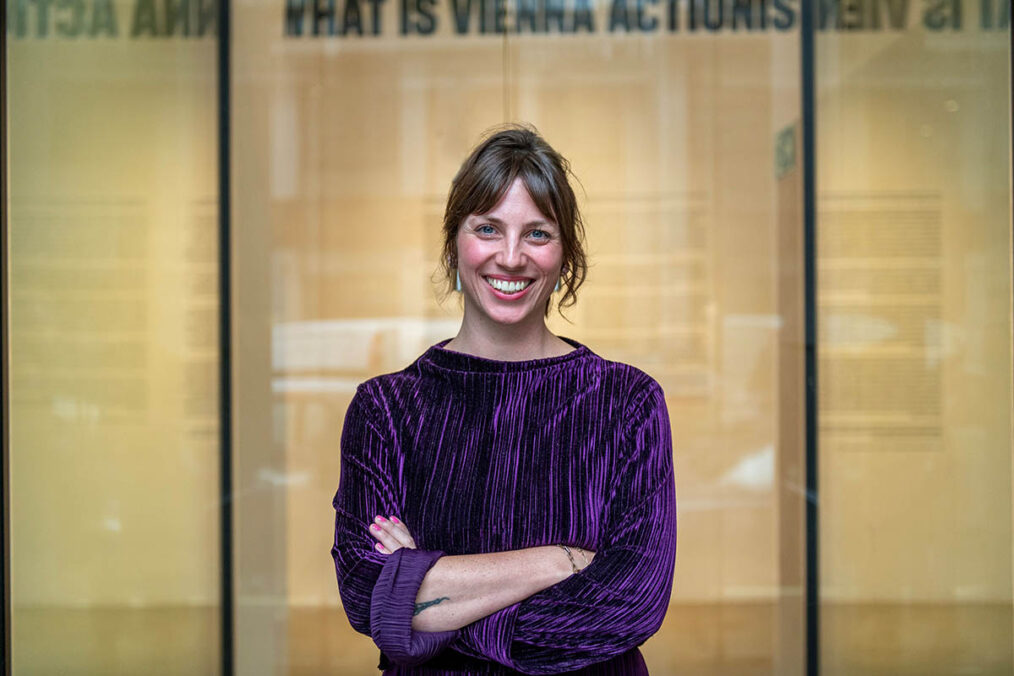
Julia Moebus-Puck is a curator and art historian with a focus on performance art and Viennese Actionism. Moebus-Puck studied photography at Dortmund University of Applied Sciences and Arts until 2013. Since 2016, her art studies have focused on the development of performative art and its reception, particularly Viennese Actionism. To this end, she has curated numerous exhibitions, including at the Osthaus Museum Hagen and Galerie Schönewald. In 2023, she was appointed director of the Vienna Actionism Museum.
The nitsch museum Mistelbach is one of Austria’s largest monographic museums. It is located in the Weinviertel, where Hermann Nitsch lived and worked, and was conceived in coordination with the artist. The architecture is inspired by the ideal of a monastic complex. In addition to presenting his work, the museum also shows contemporary positions in dialogue with Nitsch.