
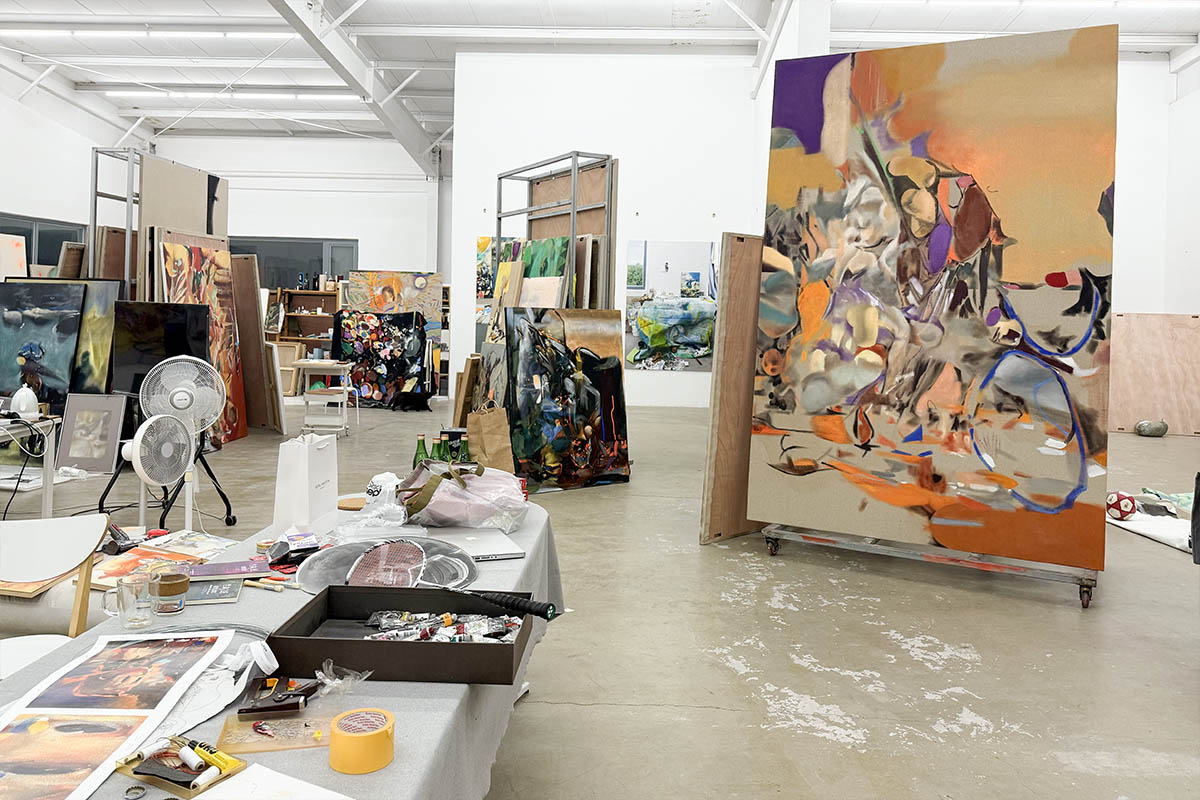
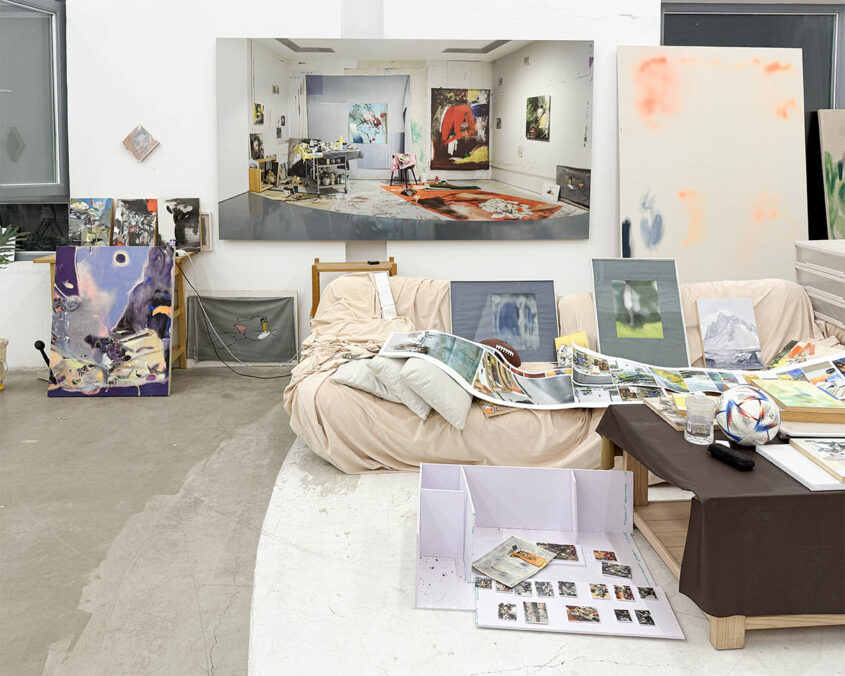
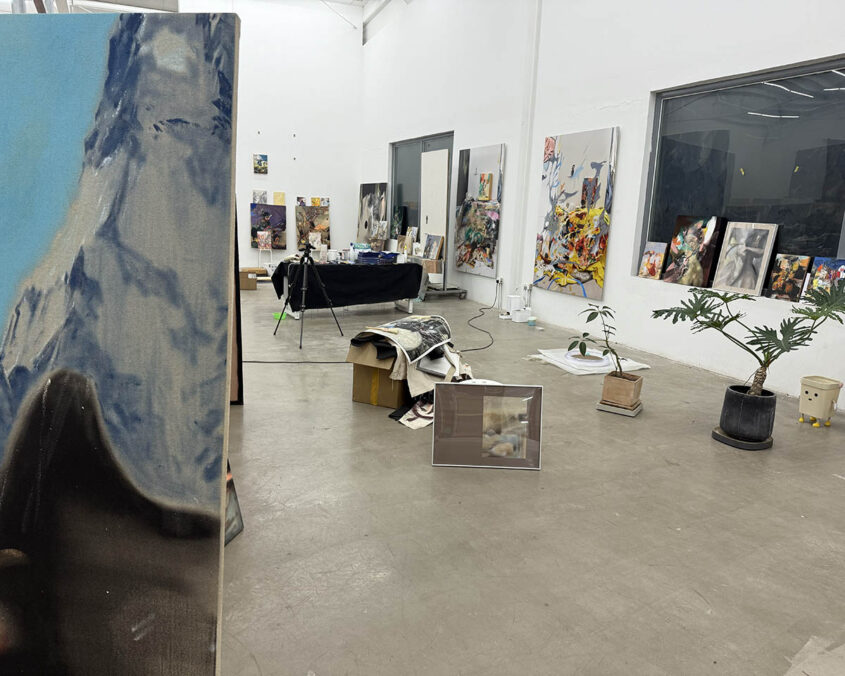
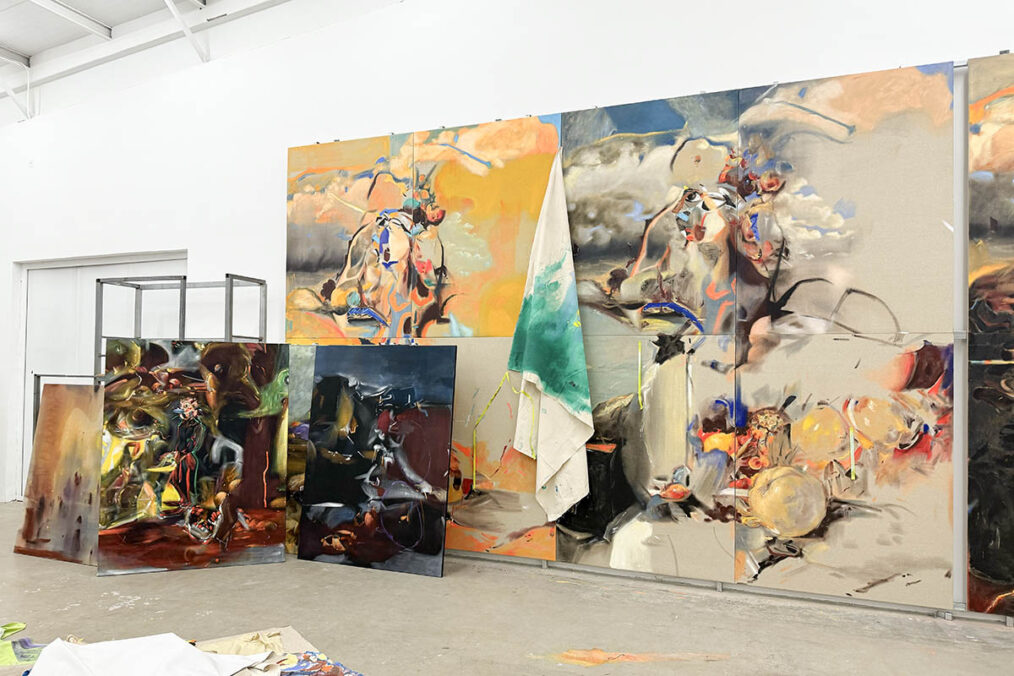
In an overwhelming assemblage of working materials, finished and still-in-progress paintings, printed out reproductions, installation views, and personal items, his studio makes it impossible to get an overview within the first hour of entering it. Only after assimilating oneself with the densely charged 450 m² Terminal 3 of Beijing Capital Airport, can one get an idea of the powerful mindset of this 1985-born artist.
How did the idea of combining photographs of your studio with real elements and collages come about?
It emerged gradually over time, through life experiences and the act of survival. While recuperating from an injury from a football match in 2013, I passed the time by collaging and smearing magazines or photographs, using readily available materials to express my emotions – a necessity given my limited mobility. From the outset, I found myself utterly captivated by the process. In those moments, time both raced by and stood still, as if my soul had left my body, reborn anew. This period spanned three years. Each stroke of paint and each snip of scissors—each act of disruption or intervention upon the image—felt fresh, decisive, resolute, and unwavering… Gradually, my emotional expression grew more measured. Between immersion and restraint, I sensed a delicate equilibrium, a grasp of balance and imbalance. This distinct state of flow was complex yet unmistakable, like a guiding force. During this period, my body gradually recovered, from wheelchair to crutches. I rented a house where I had studied painting in my youth as a studio. While tidying, I discovered that over twenty years of childhood companions who had learned painting here had left traces throughout the space, from the walls to the ceiling. Perspectives I’d never noticed before suddenly seemed fascinating, brimming with vitality and memories, as if echoing the sounds of our youthful play… The walls, thick with the smears of time, compelled me to linger and survey them. I resolved to preserve the sections that particularly captivated me, repainting the rest white. Each square, large or small, preserved from floor to ceiling, seemed like a deliberately arranged artwork. It felt as though I’d stepped into an exhibition hall, and I thought to myself, this was my first solo exhibition in spirit. By late 2016, my injuries had healed considerably, and I resolved to relocate to Beijing. I wanted to cut out every preserved patch from my studio walls to take with me, but the practical risks proved too great—alas, it never happened. Upon moving into my Beijing studio, I heard demolition threats on my very first day. Reality struck with brutal, inescapable force. What could I do? Thus, I designed the studio’s main painting wall to be segmented and demountable. This way, the traces of painting and work could be salvaged should demolition occur. To inject a touch of romance and warmth into reality.
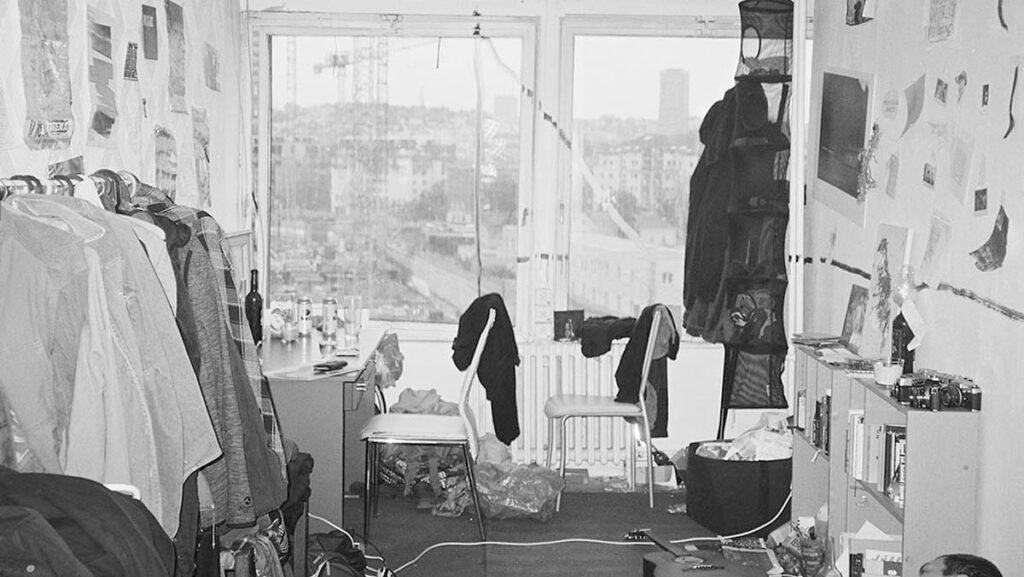
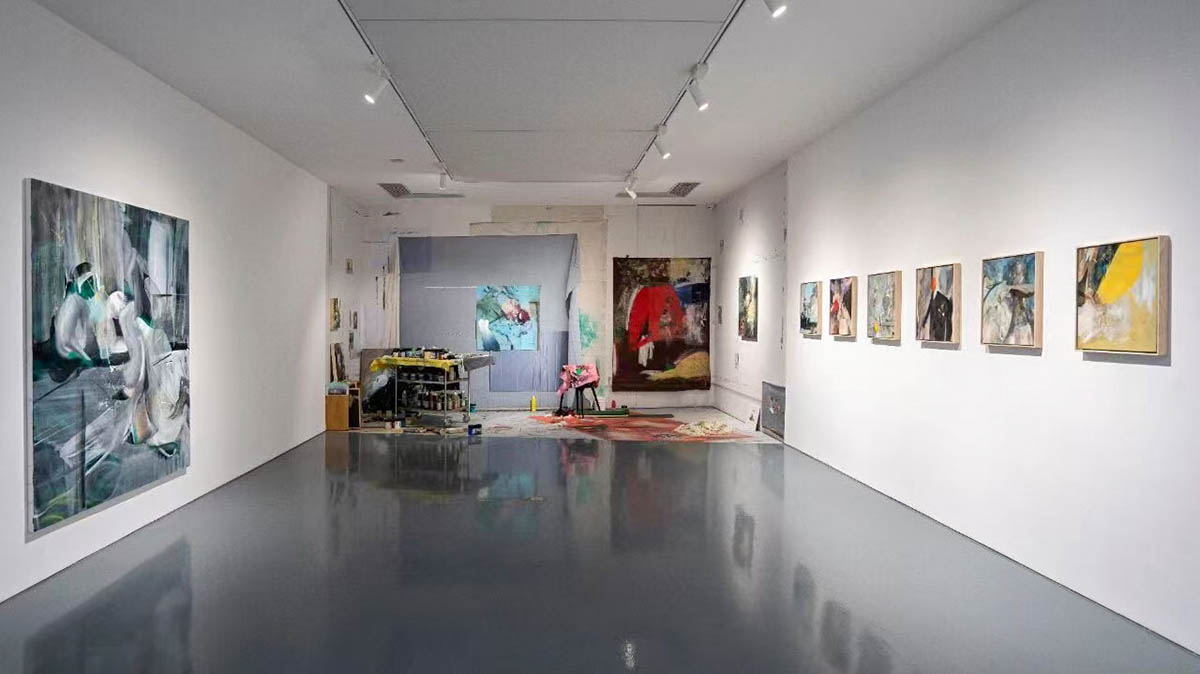
Time swiftly passed from 2017 to 2020. Over the past three years, friends jokingly likened the studio to a battlefield—from walls to floor—as if the studio’s consciousness flowed freely. For a 2020 project at Spurs Gallery Beijing, I extended the concept of the studio’s consciousness flowing into the gallery space. Presenting the studio’s original state through home renovation would be unsustainable, so I opted instead to photographically recreate a corner of the studio in the gallery space at actual scale. Paintings were arranged to interweave between the two spaces. Before the exhibition closed, I documented the gallery’s recreation of the studio corner through documentary photography. That’s how the whole thing came about.
What does the boundary between photography and reality mean to you in these works?
Photography serves merely as a means of documentation for me—a faithful reproduction of the traces generated in my studio. From smudging existing images to generating new ones, then scrutinising these fabricated pictures, the process cycles endlessly. This boundary remains blurred for me personally, perpetually traversing between the two.
Why did you choose to make your own studio the central motif?
All practice originates here; it is the real-world training ground for the spirit and mind.
When was the first piece created, and what led to its creation?
The very first piece might not even qualify as a work in my own eyes—this requires stepping back to observe objectively. I place greater emphasis on spiritual perception, which is difficult to articulate. For instance, scribbling on magazines held a certain perceptual significance for me. Such experiences may fade over time, yet this is precisely what I seek to uncover. It demands coming to terms with oneself at the opportune moment, looking back upon one’s journey. It stems from a yearning of the soul, born of an unrelenting longing.
What role does the theme of „transience“ play in your art?
Transience is a deeply fractured presence in my work—it embodies speed, exhilaration, and a bright, bold, fresh quality. Yet for the most part, it is also tangled, involved, laborious, and draining. Simultaneously, it is perpetually accompanied by rebirth; it is delayed, demanding stillness and a belated realisation only after one has paused. For me, this word should be deconstructed: “short” and “transient” are not merely temporal; they represent a certain experience. This experience seems to be addictive.
What significance does the medium of photography hold for you, in contrast to painting or installation?
Painting is an inward journey, an internalised expression of one’s perception of external reality. Photography, for me, is about documenting reality – and reality is often truly surreal. Thus, each medium possesses its own purity; it simply unfolds naturally.
What role does the studio play as a subject in your work? Do you see it as a stage?
The studio seems like a protagonist, and I am the director who orchestrates the protagonist.
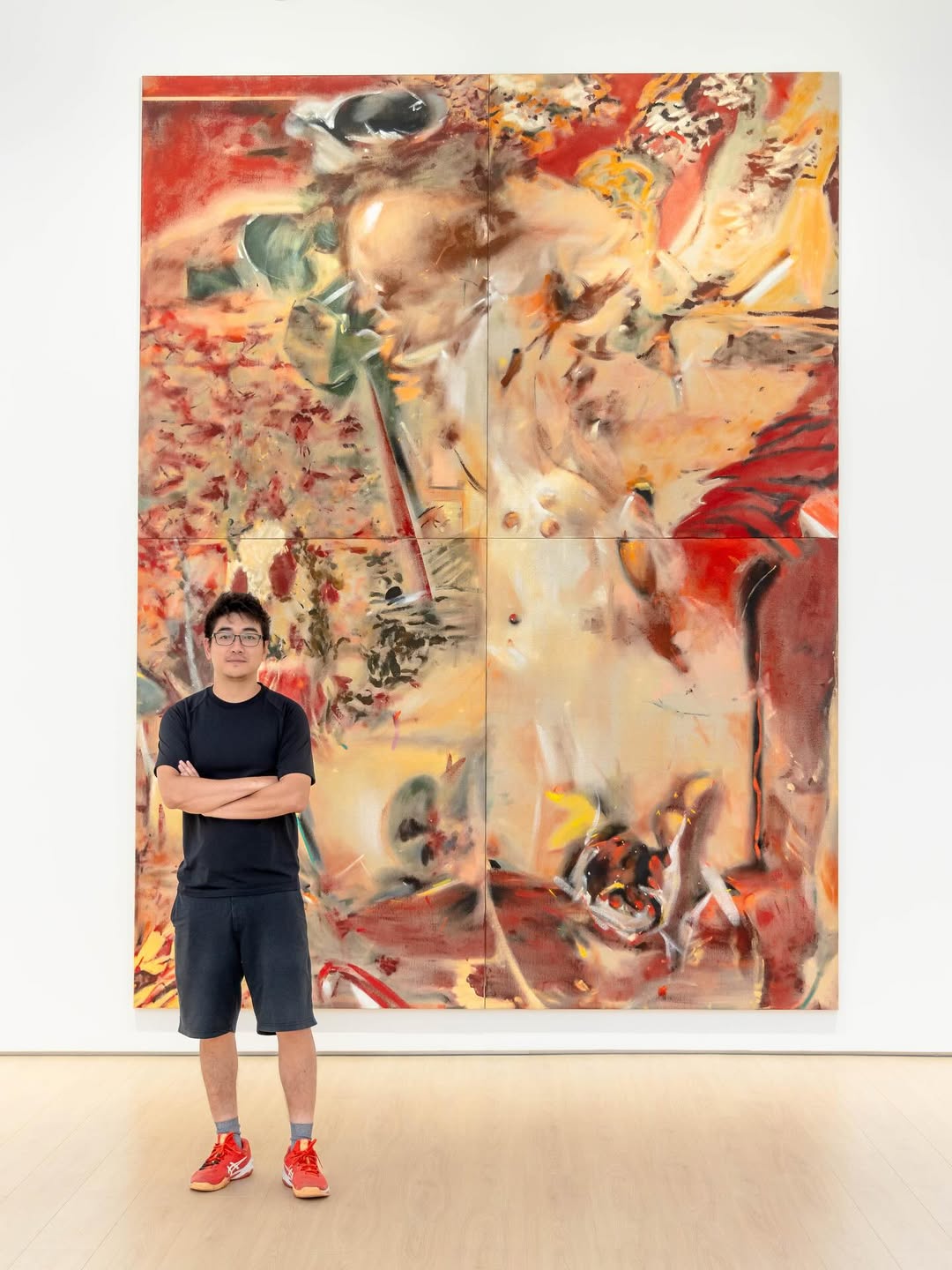
To what extent do you plan an image, and to what extent do you let chance, or the painting process, decide?
It’s as though a certain god’s-eye view has been activated, or as though playing a game of Go. where prudence and immersion coexist, this process, like the era itself, is brimming with variables, the unknown, and repetition.
How does the rhythm of your movements influence the composition of your work?
The composition is guided by bodily coordination, something I never intentionally emphasised; it developed naturally.
What does „own space“ mean to you? Why do you always choose the studio and not other private spaces?
Having one’s own space naturally means doing as one pleases. Immersed within it, one treads cautiously. At present, there are no alternatives to the studio. Were there others, I’d be rather curious to see what state they might be in.
Liu Ourui – www.instagram.com/liuourui/
Blue Mountain Contemporary Art (BMCA) – www.bmca-art.com