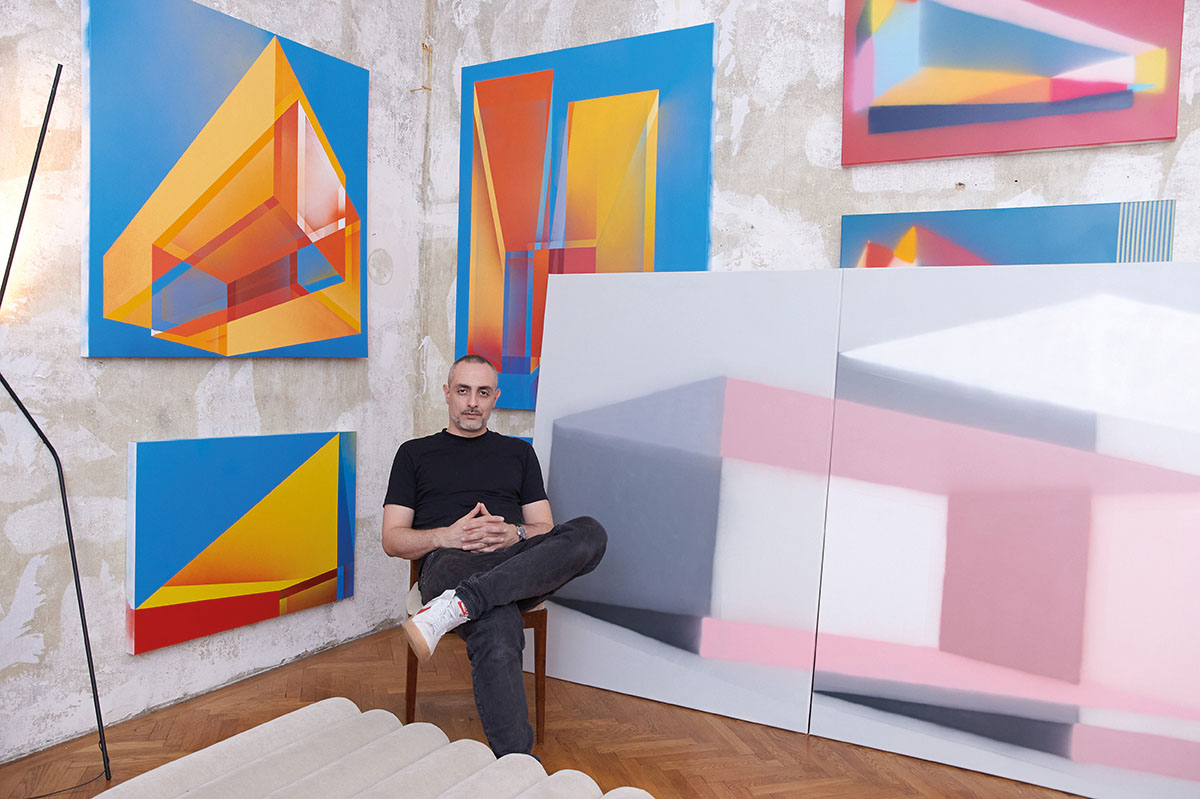
You are a trained architect. Tell us about your way into painting.
I always wanted to be a painter. I’m a child of immigrants, and for them, that wasn’t considered a real job; they wanted me to do something substantial. So I landed in architecture. When I was younger, I was also a graffiti artist, which is one of the reasons I’ve recently returned to spray-painting.
I didn’t really have a concept of what architecture was beyond the environment itself. I went through architecture school, and during my studies, I spent a year in France, which really opened my eyes to what architecture means historically and contemporarily. Then, in graduate school I had very strong mentors who shaped me. That’s when my belief really crystallized: architecture is not just an act of building, it’s an intellectual act. It has a deep history and a discipline. It’s not simply the sum of its parts; it’s not just a wood floor and a window that suddenly make architecture. I believe architecture can exist beyond the built environment. Many famous architects produced more books and ideas than actual buildings. So there are other media through which the discipline of architecture can be explored.
Architecture could also be understood as a theory of how people live, move, and inhabit space.
Broadly, it can be defined in many ways. As you study the field, you realize there are important works that were never built when they were conceived, yet their ideas translated across generations. Take the constructivist architects in 1920s Russia—they created extraordinary projects that never materialized at the time. Decades later, architects such as Zaha Hadid rediscovered these drawings and modes of thinking from the 1960s and 1970s, and suddenly they came back into focus. That shows how malleable architectural work is over time. I fell in love with the idea of producing things that might resonate later. Perhaps even beyond my lifetime. Many great artists think this way. I’m not claiming to be one, but I became aware that this kind of temporal dimension exists in creative work: ideas can gain importance later, be rediscovered, or become relevant in the future.
When did you move to Vienna from the U.S. in the first place?
I moved to Vienna because I had a professorship at the University of Applied Arts Vienna. I was there for a while. I met my wife in Vienna, we got married, and later moved back to the U.S. I continued teaching and started my own practice.
My focus was always on big design ideas, large buildings. The partnership I was in was structured around that scale, and we still have several buildings currently being built in Italy. But those projects take years to begin. Five years, sometimes more. During that time, I became really frustrated. There was no immediacy to the creative process. You work and work and work, and then it becomes technical, meetings with engineers, problem-solving, adjustments. At some point, I thought: when am I actually going to see something? That’s when I turned back to painting.
Was that after you moved to Austria to stay?
Around 2021, 2022, I really started painting seriously again. I realized: I can see something in eight hours if I want to. My approach is largely architectural. I plan everything—sketches, hard-line drawings, 3D models. I render, then return to it, translate it onto large-format canvases, test colors, and perceptual effects. And then I start making. Eventually, I kept painting until I had what I’d call a body of work. And then someone came along who was interested.
What do you mean by “a body of work”? Is it about quantity?
Not exactly. I painted throughout my twenties, but it was always sporadic: one idea, one painting. I lived in New York in small apartments. I’d make a single piece, something completely unlike anything before or after it. Then months later, another idea, another painting. They were disconnected. I kept them, though, because they were part of an early settling—something that was going to happen, even if I didn’t yet know what.
When I say “body of work” now, I mean that the focus sharpened. There’s continuity, a conceptual thread. Some of that is probably age. I’m often shocked by very young artists—not in a dismissive way, but I wonder: what can you really know yet about sustained conceptual development? Since returning to painting, I’ve become friends with older painters here and across Europe. I’m very flattered by their response. They often say the work feels conceptually clear, more refined than someone who just started painting. I think that comes from architecture, working with ideas over long periods, testing them through iterations, and building a sustained practice around a core concept.
I do have space in my apartment, and at the same time studio and a society around me that allows for stability. Space was crucial: to make large works, to keep them, to look at them from a distance, then make another, and another.
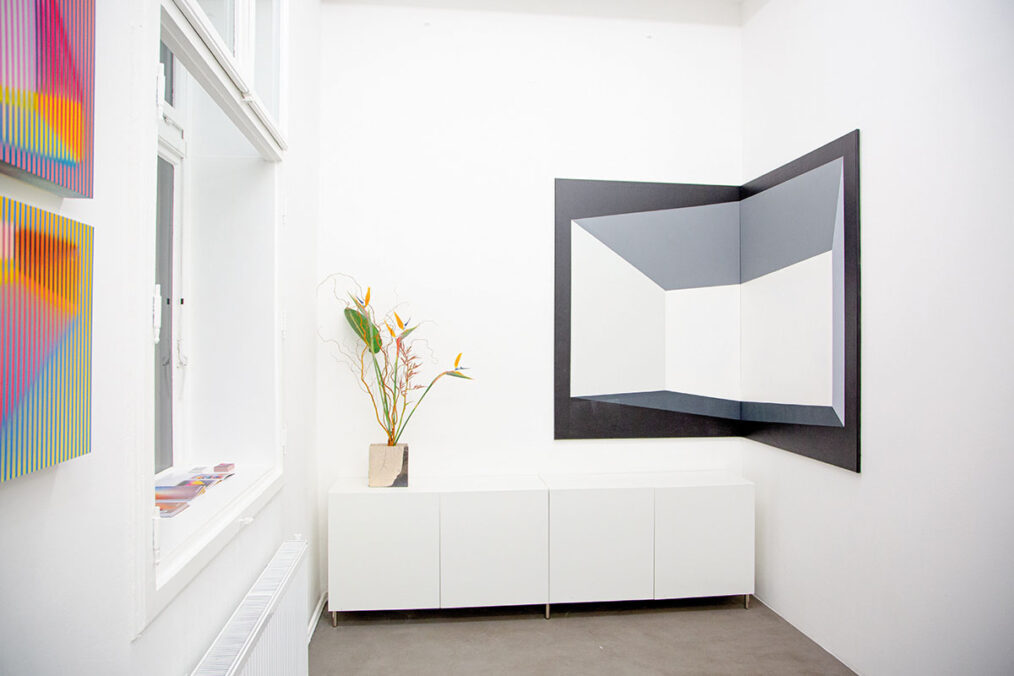
That’s interesting, because space, both physically and conceptually, runs through your whole story. Even graffiti was a way of finding space for expression.
Honestly, I’ve also grown frustrated with architecture. It’s expensive, privileged, and incredibly complicated. I deeply respect architects who have a vision and execute it. For most projects, costs change, materials shift, clients intervene, consultants intervene, and users intervene. The process becomes layered with compromises. When it works, it’s incredibly meaningful. But it doesn’t happen that often. And practically speaking, I can’t build here. I’m licensed in the U.S., not in Austria. I still collaborate, I help friends, do renderings, work on projects—but I can’t run a full architectural practice here.
It’s always about defining space. Whether it’s a wall, a sketchbook, or a canvas, it’s about creating a site for something to exist.
And what about your routine? How do you structure your time between painting and architectural work?
At the beginning, it was very simple: the only way to do anything was to just shut up and do it. No complaining about time, no excuses. I gave everything else up for painting. I would work in the office during the day, start around nine, and finish around six. Come home, spend time with my daughter, and once she goes to bed, I’ll start painting. Every night from nine until one in the morning. Saturdays too. Sundays. No vacations. It was the only way to get another thirty or forty hours a week to test ideas and actually produce something. Since ending my architectural practice in the U.S., things shifted. My ego detached from the profession. I don’t need my name on a door that says “architect.” That feels bureaucratic.
Now I collaborate with people on projects I find interesting, where I can contribute meaningfully. After my first exhibition, my perception of painting changed. Usually, the works are stacked here, leaning against each other. But seeing them installed in a proper space, standing on their own, with people coming specifically to look at them, them not being a backdrop to my domestic life, that changed my motivation. I realized I needed to dedicate more time to it. Now it’s closer to fifty-fifty.
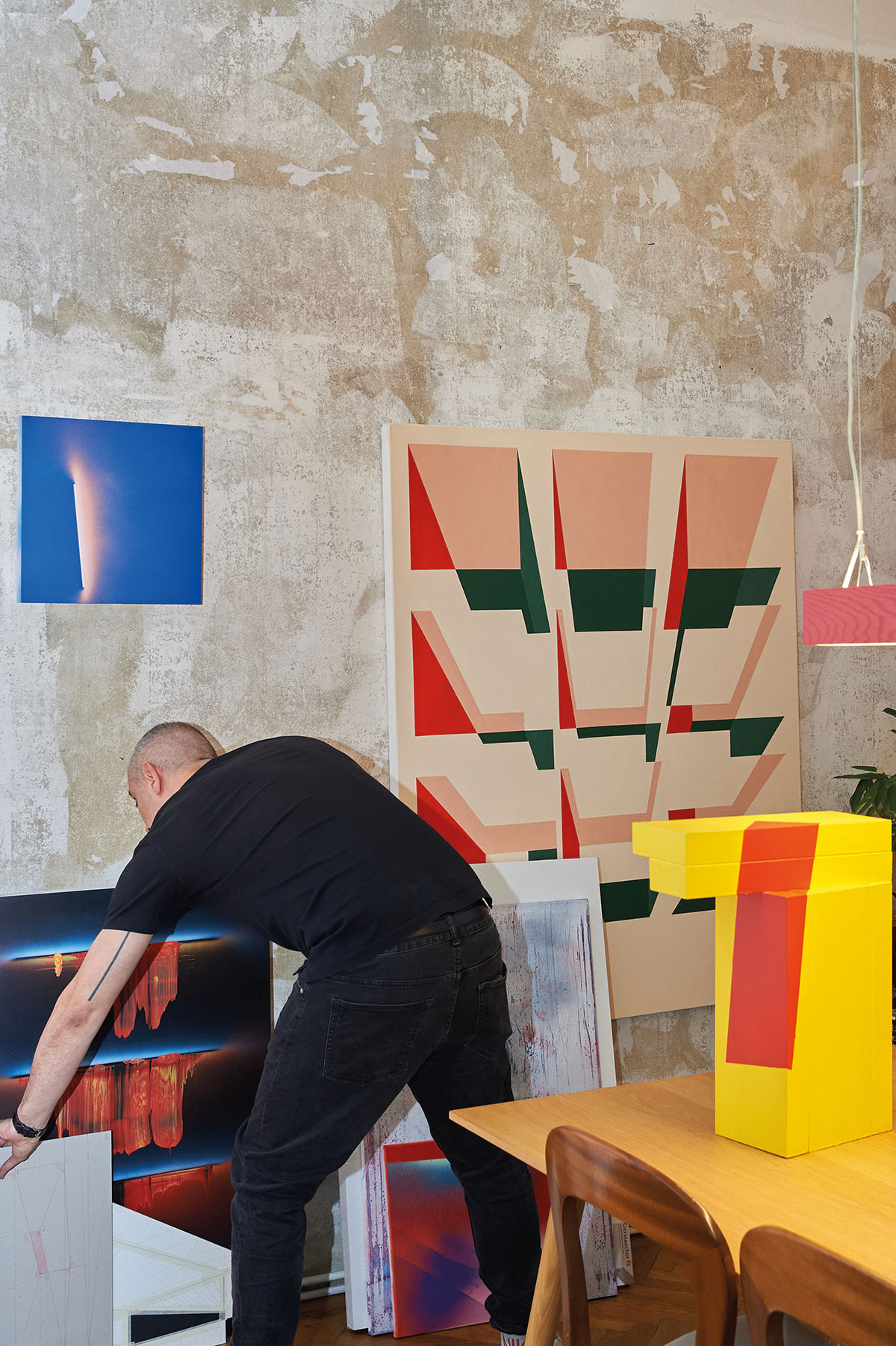
Some days are entirely about art; others about architecture. But every night, when everything quiets down, I take over this room and paint. I often paint at night, which has influenced my use of color. A lot of it came from working in artificial light—neon, darkness, limited perception. I didn’t have a grand theory of color; it was more a tool to understand form and space. Now I’m realizing I need to develop a theory of color if I want to keep working this way.
You mentioned the importance of making the work. How would you describe your process?
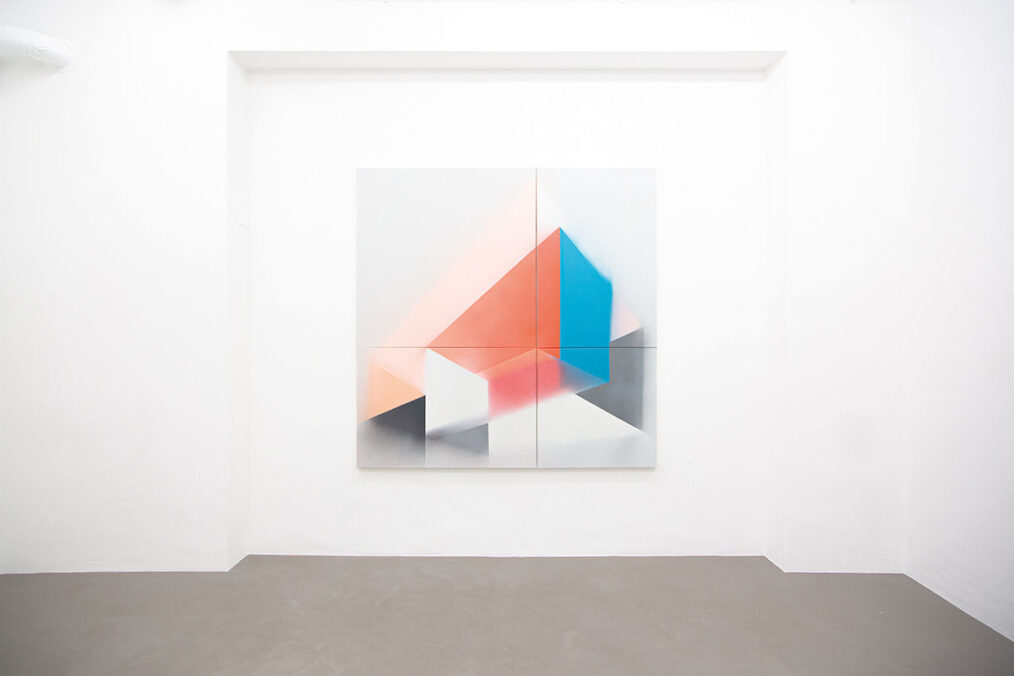
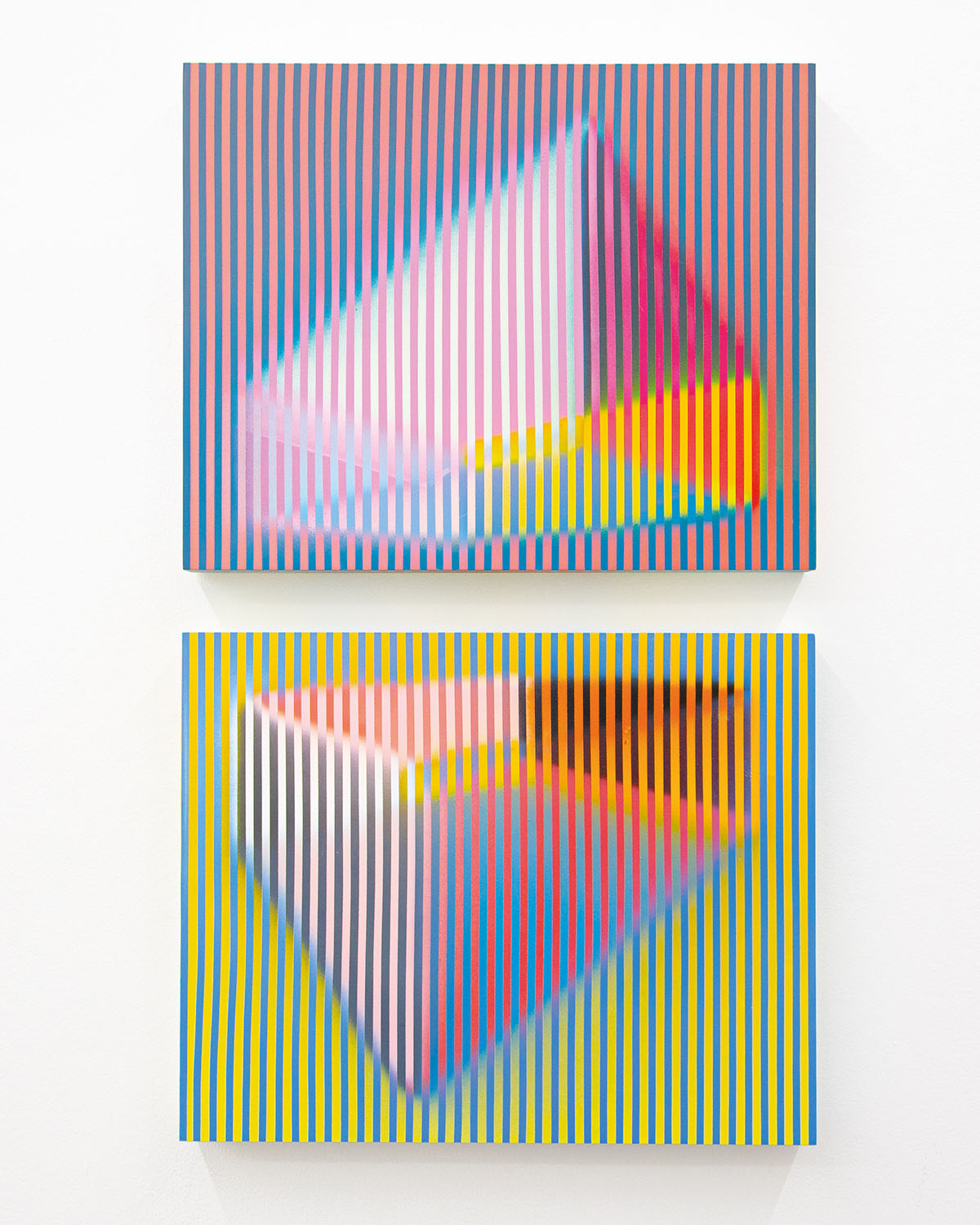
I just paint all the time, as much as I can. I don’t think it’s always good, but you have to get it out. You have to test ideas in full scale, because ideas on paper don’t mean anything. They might matter conceptually, but they’re not really there until they exist in their full form. And the problem is: my paintings have to be big, because I’m trying to make space. Small pictures of space are nice, but they stay “pictures.” I want the painting itself to produce space. One of the works that Canonical showed is a corner painting—I’ve made several of them. I haven’t really seen this kind of painting before, although I’m sure others have done similar things without having a platform. But it opened this idea for me that I can construct space inside space through painting, in a very calibrated way.
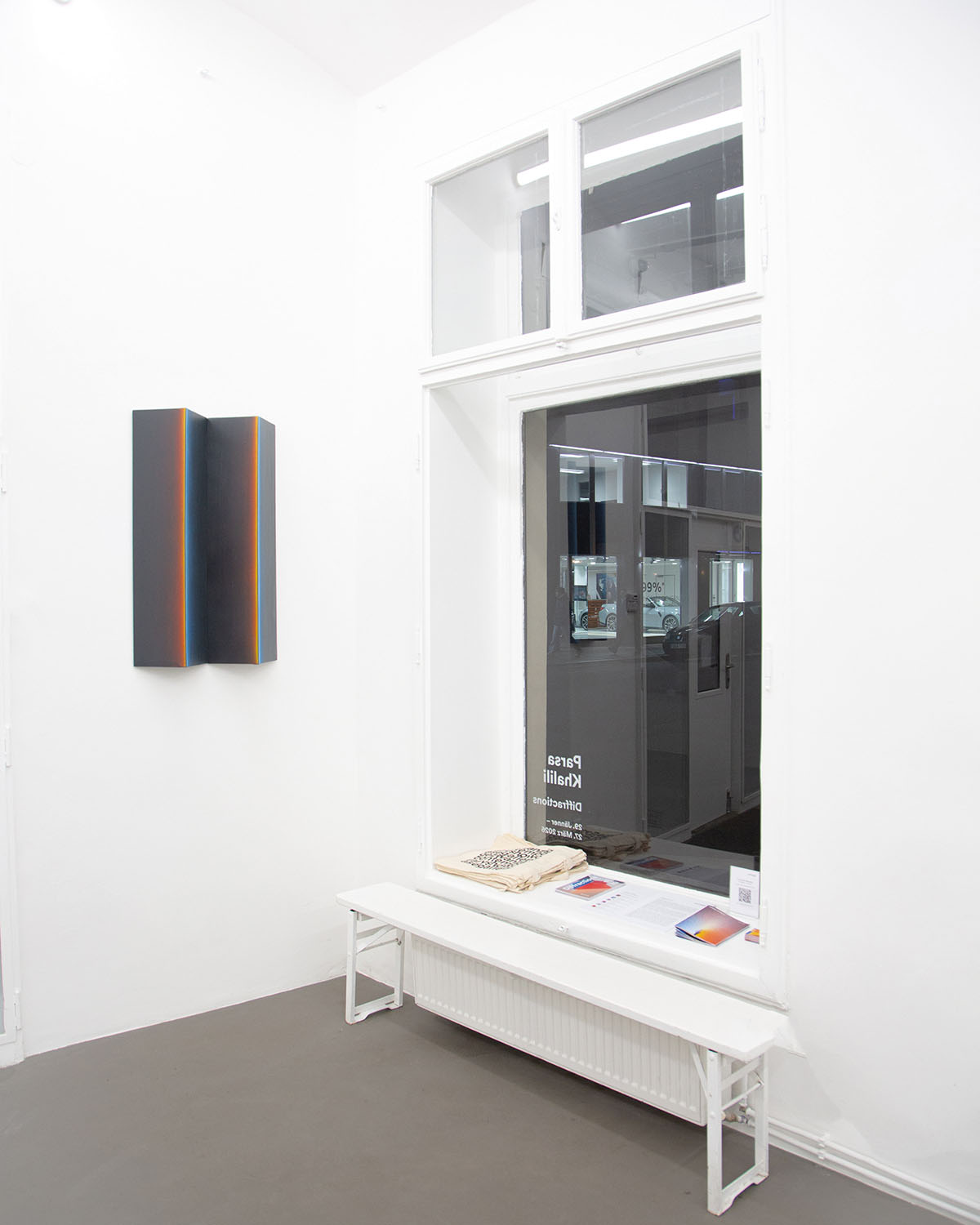
When you say “building space in the painting,” do you mean creating an illusion of space- something optical for the eye?
Some of the effects I’m pursuing are optical, how the eye registers them, how they shift when you move. It’s not quite like historical trompe-l’œil or perspective painting. It’s closer to something like an anamorphic projection.
I do like reading Malevich on Suprematism; he talks about pure feeling. That abstraction comes from searching for something before meaning. For me, it’s not about what a painting means, but how it operates. It produces an effect. Similar to walking into a carefully designed architectural space, perspective, alignment, and proportion.
Do you write down your thoughts while working? Since reading and painting seem to be in tension for you.
I used to write a lot. When I worked and taught as an architect, I had to publish articles, books, and texts. Writing is a parallel medium to visual art. It is important to contextualize what you’re doing before someone else does it for you. If you don’t take a position, someone else will define your work. And then you have nothing to stand on.
But some artists resist that, right? Who refuse to explain their work.
There’s something powerful about saying: “I make the work. You like it or not.” But I also think that’s a privilege, especially today. Before the internet, access to work was slower and more controlled. You saw a sculpture in a curated context. Now images circulate freely- you lose control over the message and the medium. So it makes sense to try to shape your own narrative, even if you can’t control everything.
Do you think writing strengthens the work?
Yes. Written and visual language have different responsibilities. The more they align—what you see, what you read, what you hear—the stronger the work becomes. Whether that makes it more marketable, I don’t know. But if the work has integrity, it deserves a clear position from the artist who made it. Right now, that’s my turning point. I’m planning a book timeline, figuring out how it can resonate with the work. But it also means I have to start reading again to write again. There are only so many hours in a day.
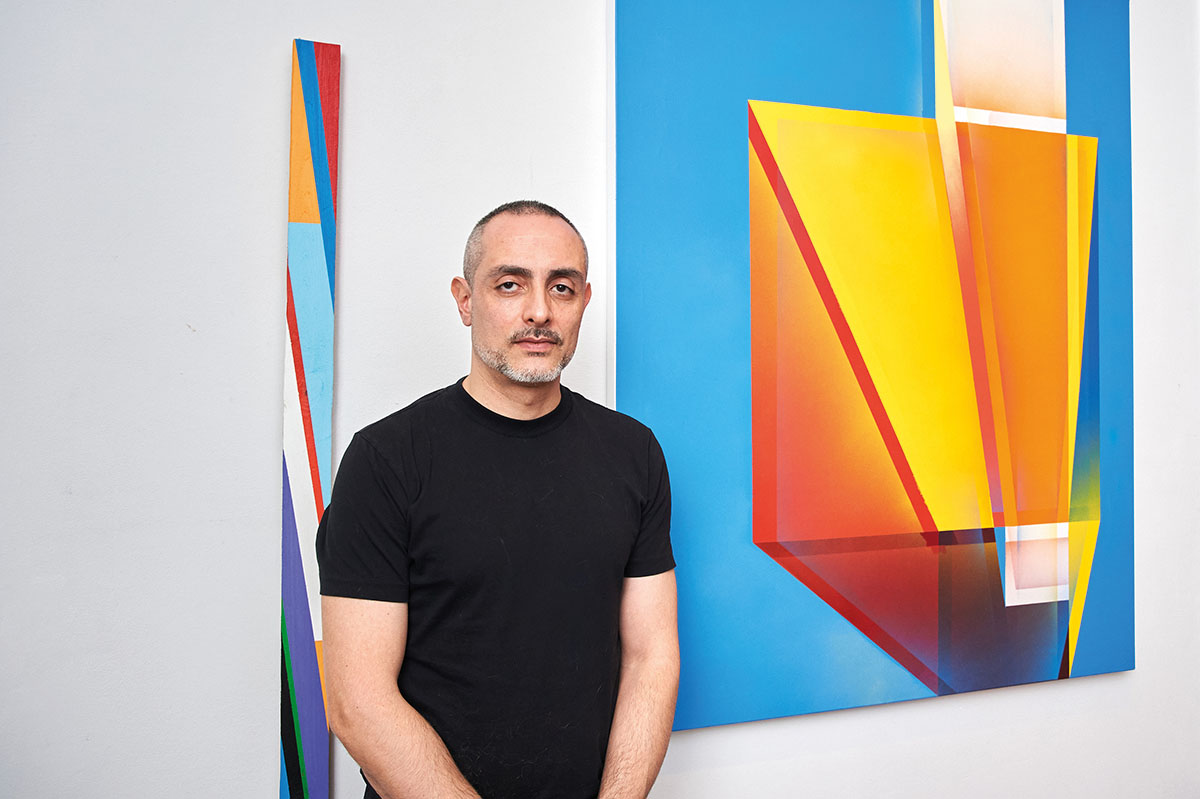
You’ve shown work in the white cube; have you noticed a shift in how color behaves between studio, screen, and gallery?
Lighting should theoretically be standardized; we know color temperatures, and in principle, we should anticipate how work appears. But I haven’t fully resolved that yet. It’s still something I’m trying to understand through making.
People often ask how I choose colors. And honestly, I don’t know. It sounds simplistic, but they just feel right. It’s intuition. But intuition also has to be disciplined. The process of disciplining intuition is something we have to do with color as well. Maybe it leads to a color theory, or a body of work where form becomes primary—where you could put the painting anywhere and still read it structurally, not chromatically. But at the same time, you can’t control perception. You can’t tell viewers: “Don’t look at it this way—look at it that way.” So maybe the task is to refine the work and also mediate it through text or context.
What about titles: of paintings and exhibitions. How do you approach them?
I’ve never understood narrative titles. Even as a kid in museums, I’d think: why is it called Shadowy Afternoon in April? What does that add? I struggle with attaching narrative meaning through language. I actually envy painters who can work purely intuitively, just express a feeling. For me, every line has to belong to a system.
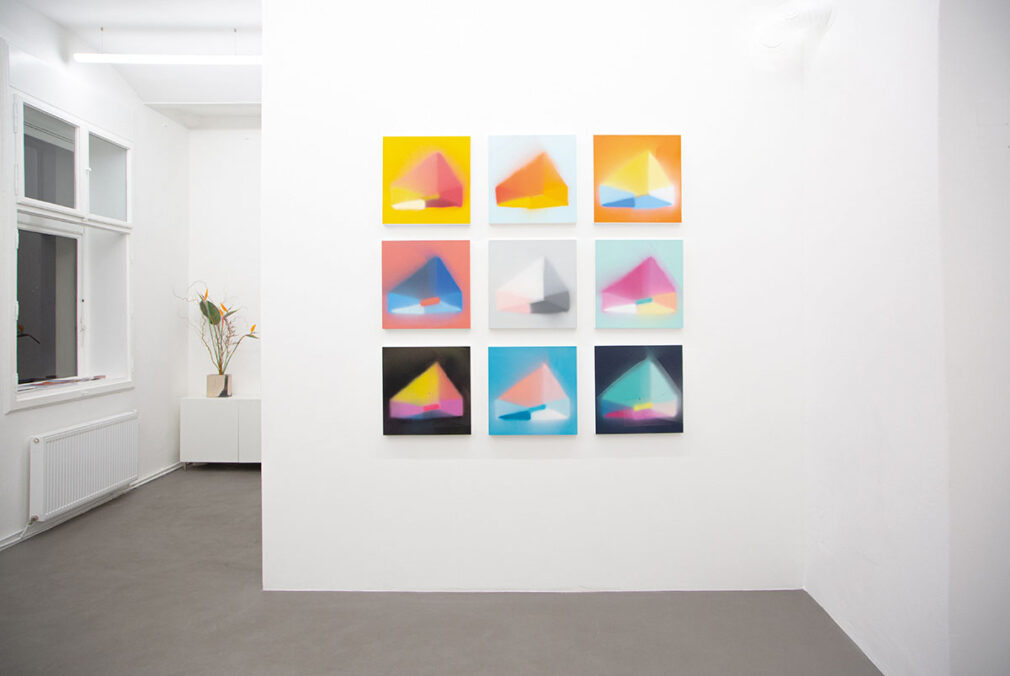
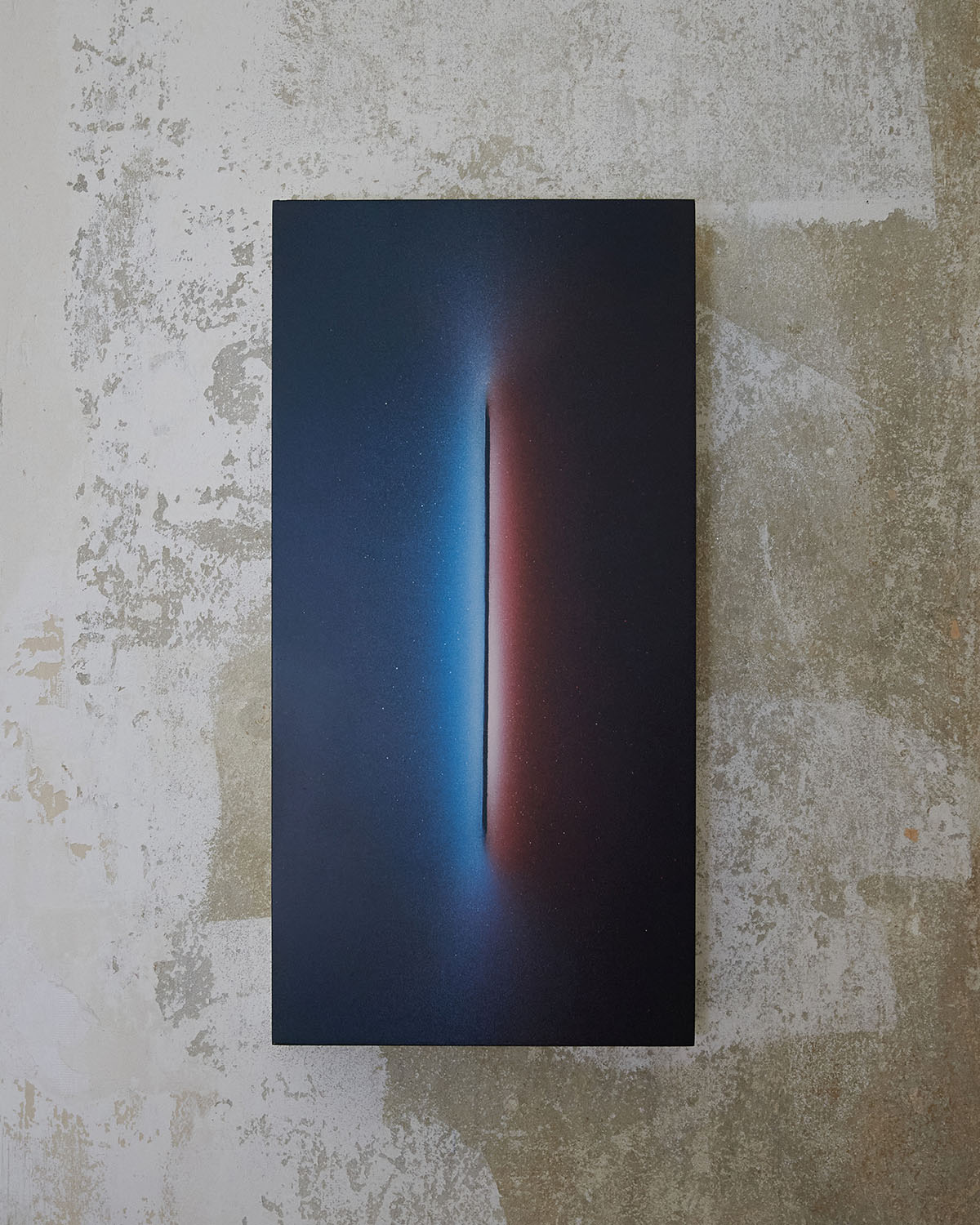
The works are experiments within one or several threads of ideas. So I number them, or title them through operational terms—intersection, parallax, diffusion, diffraction. These are optical processes, not emotional ones. They’re keys to how the painting operates, not what it represents. I think the work should represent itself, not something else. There’s a code: geometry, optics, physics, and formalism. The painting is about itself.
What about when you clearly see a body, a figure, a symbolic scene, even if the artist says it’s not „real“?
That comes down to the nature of the image. I’m interested in non-referential work, where and what you see is exactly what it is. No analogy, no symbol, no metaphor. Here’s a hot take: I respect artists dealing with political or social issues, but I separate that from what I’m trying to do. Art that functions as activism, or addresses identity and current events, operates distinctly. For me, this is closer to what I’d call pure art, not in a hierarchical way, but in the sense that it’s not trying to make you feel something about the world. It’s trying to exist on its own terms.
Non-referential.
The challenge is to make something meaningful that comes from “no meaning.” Like the origin of the universe from nothingness. My paintings feel like endless, gridded space—an image before you decide what it is. Before it becomes a dog, a body, a symbol. That moment of emergence interests me. I respect artists who paint feelings or narratives. I respect the craft and discipline that underlie it. But I can’t do it. And I’m wary of work that too easily pulls emotional strings—it can feel superficial, close to our lived experience, but not necessarily deeper. Historically, art served the church, then the state. We thought we moved beyond that, but now art often serves society in another way. I’m interested in stripping that away—working instead in relation to physics, optics, objecthood. That feels like the most fundamental ground. And through exhibitions, conversations, even arguments with other artists, I’m starting to see more clearly what I’m after.
Solo exhibition: Parsa Khalili – Diffractions
Exhibition duration: 29.01-27.03.2026
Opening times: Wednesday to Friday: 11 AM-6 PM | Saturday: 11 AM-3 PM
Address and contact:
gezwanzig gallery
Gumpendorfer Straße 20
1060 Vienna, Austria
www.gezwanzig.com
www.instagram.com/gezwanzig.gallery
Parsa Khalili – www.parsakhalili.com, www.instagram.com/studio.parsakhalili
Parsa Khalili (b. Tehran, Iran) is an architect-artist based in Vienna. Spanning buildings, installation, sculpture, digital rendering, and painting, Khalili’s work explores ideas of form and space at the intersections and limits of artistic research and architectural design. His hybrid approach pushes disciplinary boundaries to foster creative transferences between artistic and architectural modalities.