
Loppa had been the famous mentor of the Antwerp Six, the group of graduates who, between 1980 and 1981, made Antwerp the isolated alternative fashion capital it is now known to be (an exhibition at MoMu in Antwerp is currently revisiting the legacy of the Antwerp Six). What called me back then was a desire to study fashion but also to be off the radar, in a city that, similar to Antwerp, had a savoir-faire that was less about glamour and more about a permanent beauty and manual artistry that touched everything that found its way into it.

Somewhere between an anonymous business hotel and a stretch of near-nothingness lies a vast communal park, the largest in Antwerp. It appears almost abruptly. The Belgian greenery, unexpectedly, feels pushed to the margins; the city itself reads as a site still under construction, dense with cement and interruption. And yet Antwerp retains its peculiar charm, a small, Calvinistic jewel, restrained and self-contained, quietly insistent in its identity.
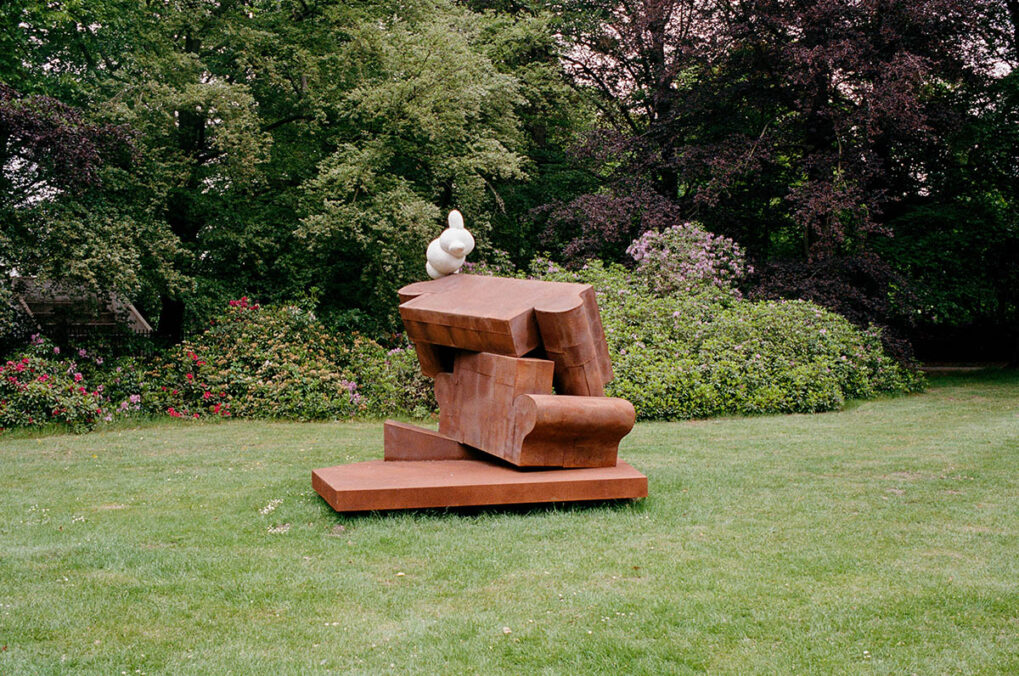
What emerges from this expanse is not just a park, but a deeply ideological space. Established in November 1950, Middelheim was born from a distinctly social ambition: to make sculpture public, accessible, and embedded in everyday life. Over time, it has evolved into a hybrid entity, part art collection, part landscape, part architecture, where more than 300 works are permanently installed across the grounds. Unlike the traditional museum, this is also a form of open-air storage. Works are exposed to weather, time, and the unpredictability of human presence.


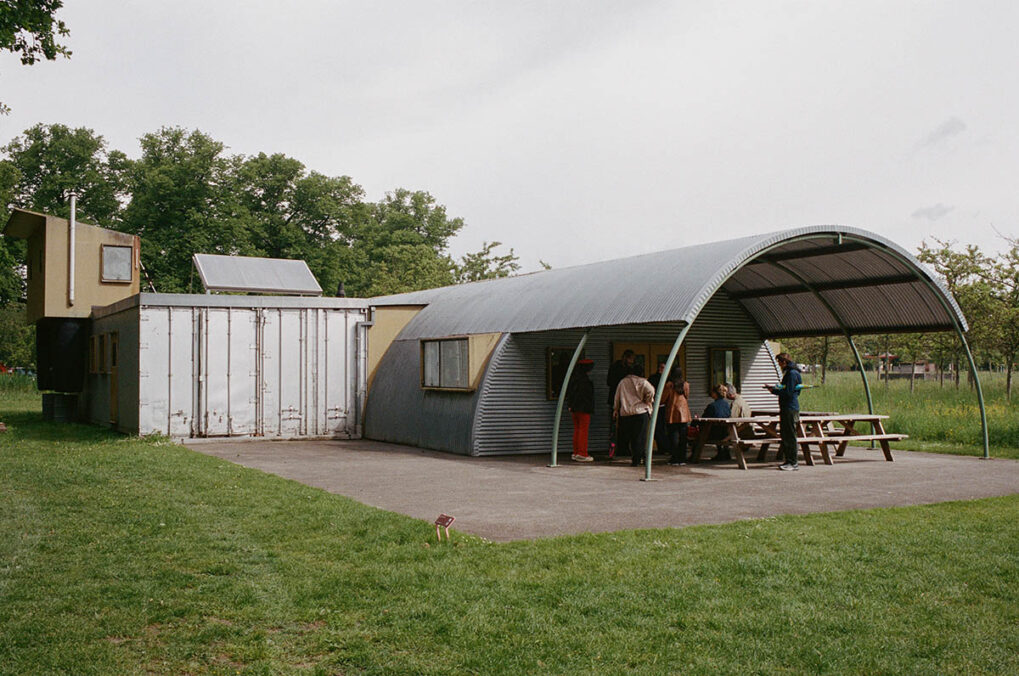
Within this expanded landscape, architecture plays a quieter but essential role. Scattered across the park are pavilions designed by renowned architects and designers, hosting a library, workshop spaces, and sites for learning and production. These structures extend the logic of Middelheim beyond sculpture alone, turning the park into a space of knowledge as much as display, where making, reading, and exhibiting coexist within the same porous environment.
The sculptural landscape is equally shaped by its artists. Alongside canonical figures such as Auguste Rodin, Henry Moore, Carl Andre, and Berlinde De Bruyckere, the park also holds works by artists like Barbara Hepworth, Lynn Chadwick, and Alicja Kwade, whose approaches to form, space, and perception subtly destabilize the idea of sculpture as a fixed monument. Their presence shifts the park away from a purely masculine canon and into a more complex, relational field of modern and contemporary sculptural thinking.

The experience of sculpture – as it should – shifts with the seasons, the light, and the movement of bodies through the park. Certain areas retain a romantic, almost picturesque quality, while others foreground biodiversity, allowing tall and short grasses to coexist and resisting overly controlled landscaping. Human intervention and nature collapse into one another, producing a space that is at once constructed and organic.
If anything, as the museum’s director, Sara Weyns, explains to me during the tour, the pandemic made this logic impossible to ignore. As indoor institutions closed, Middelheim’s relevance intensified. It offered a model in which art, nature, and public life could coexist without hierarchy. With hundreds of thousands of visitors annually, the park functions not only as a cultural destination but as a form of social infrastructure.


This connection to well-being is not incidental. The museum maintains an active relationship with nearby medical institutions, including a youth psychiatric hospital, where therapy sessions are sometimes held within the park. Here, art is not framed as something to be observed at a distance, but as part of a broader system of care, something to move through, to inhabit, to share.
Walking through the park with director Sara Weyns, whose attention moves effortlessly from overarching vision to the smallest detail, this ethos becomes tangible. Middelheim is not simply a place to visit, but a place to be maintained collectively, a space intended to be enjoyed by all, for all, and cared for by many.
It is within this context that Monster Chetwynd’s A Friends Making Machine, inaugurated in May 2026, unfolds. Her first large-scale outdoor exhibition feels less like an intervention and more like an amplification of the site’s existing logic.
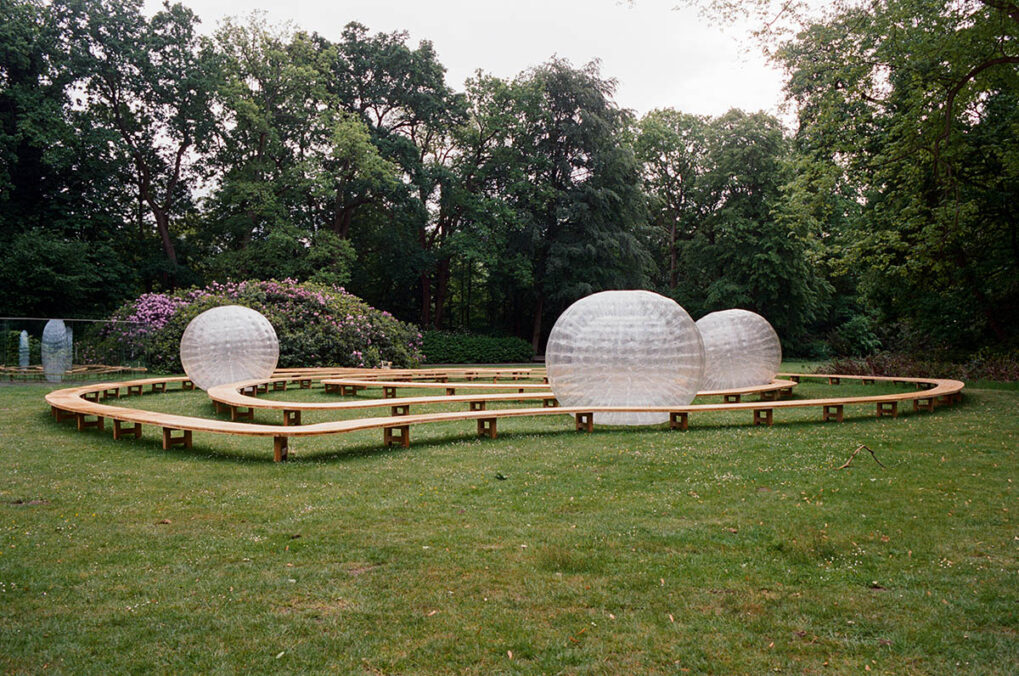
At its metaphorical centre stands the Salamander Portal (2026), a newly commissioned structure in cement and metal that operates both as an entrance and a proposition. Developed in dialogue with young people connected to psychiatric care, the work functions as a threshold, linking the museum to its surrounding institutions while also staging a symbolic passage between states: fiction and reality, isolation and collectivity, vulnerability and transformation. The salamander, capable of regeneration, becomes an apt figure for this continuous process of becoming.
Chetwynd’s practice has long resisted categorisation. Emerging from performance, her work moves fluidly between theatre, sculpture, film, and installation, often constructed through collage and low-cost materials. There is a deliberate roughness to her aesthetic. Cardboard, fabric, and paint recall both amateur theatre and the hidden infrastructures of cinema production, the backstage of Hollywood rather than its polished surface. This interest in staging extends to her engagement with the fourth wall. In the theatre, it separates the audience from the action. In Chetwynd’s work, it is persistently broken down. At Middelheim, that boundary dissolves almost entirely, as visitors do not simply view the work; they enter it, move through it, and become entangled in it.
Across the park, a loose bestiary emerges: salamanders, bats, and moles. These creatures, often associated with darkness, underground life, or transformation, populate the exhibition as shifting presences rather than fixed symbols. They suggest alternative ways of sensing and inhabiting the world, decentering the human perspective without fully abandoning it.
Performance remains central. During activation weekends, works such as Glow Worm Glue (2026) bring together bodies, light, and narrative in a choreography that draws on ideas of bioluminescence and invisible connectivity. Elsewhere, references to earlier pieces such as Hell Mouth (2005), with its costumed figures emerging from grotesque openings, resurface in new forms, linking past and present within an ongoing practice of reinvention. Workshops and participatory moments extend this logic further. Play is structural, a method for producing relations. The exhibition, as its title suggests, operates as a machine, not in the industrial sense, but as a system for generating encounters, affinities, and temporary communities. Isn’t that what parks were originally made for?

If Middelheim has always positioned itself as a space where art and life intersect, Chetwynd pushes this proposition toward a more explicit engagement with care, not as a theme, but as a condition. The result is an exhibition that resists closure, remaining open, contingent, and dependent on those who pass through it. To care today is to be.
That first evening in Antwerp, I found myself dining at Bar Misera, the new restaurant by Belgian sensation chef Nicolas Misera, already spoken about as one of the country’s rising culinary voices. The space was understated but precise, the kind of place where ambition is expressed through collectiveness and an understated care towards ingredients, conviviality, luxury of dining, and the preciousness of simple objects. It felt aligned with the city itself: quiet, self-assured, and attentive to detail.
The idea of care after visiting Middelheim lingers beyond the park itself. It is something I carried with me back in Milan, something I have carried with me since forever (first as a Capricorn and second and most importantly as a very sensitive and sometimes ‘malfunctioning’ being), sharpened rather than resolved. The Care Crisis by Emma Dowling comes to my mind, a beloved book that reframes care not as an abstract virtue but as a political and material condition, fragile, uneven, and deeply embedded in how we structure collective life. In that sense, Middelheim cannot and shall not be identified as a museum, or maybe it carries the essence of what museums should stand for in the first place: staging collective care as a concept and as a space. Exposing how urgently it needs to be renegotiated, for us all.
Exhibition: Monster Chetwynd – A Friends Making Machine
Exhibition duration: 16.05.2026 – 11.10.2026
Address and contact:
Middelheim Museum
Middelheimlaan 61, 2020 Antwerp
www.middelheimmuseum.be/en