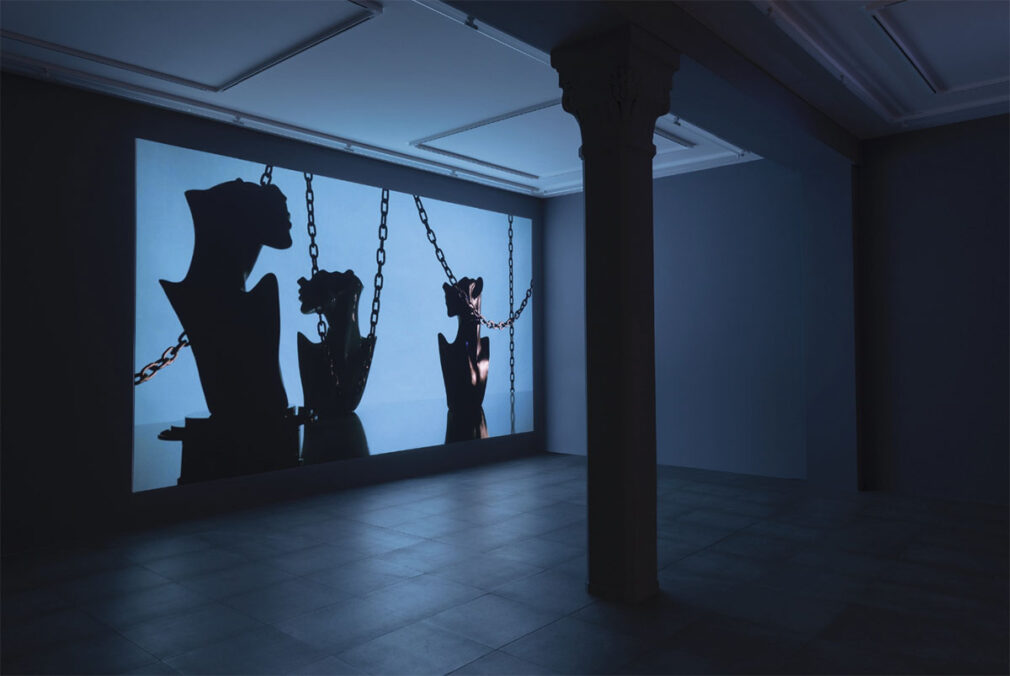
Courtesy of the Artist and VISTAMARE, Milan – Pescara
I’d like to start from the time when you were maybe not strongly associated with fine arts but more with film. Still, how was it for you at the very beginning?
It probably all started when I was graduating from my master’s degree. Around that time, I had already been studying cinema theory and was attending a film school. At the end of the year, we had to present a diploma project. At that time, there weren’t many options. You could either make a fictional short film with the school’s equipment and the help of your colleagues, or you could do something more documentary-like.
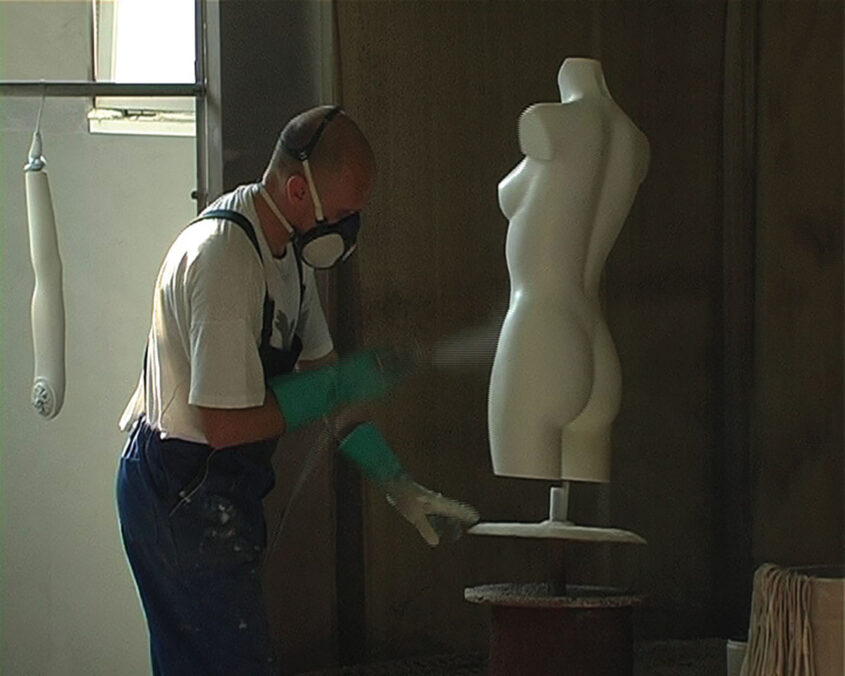
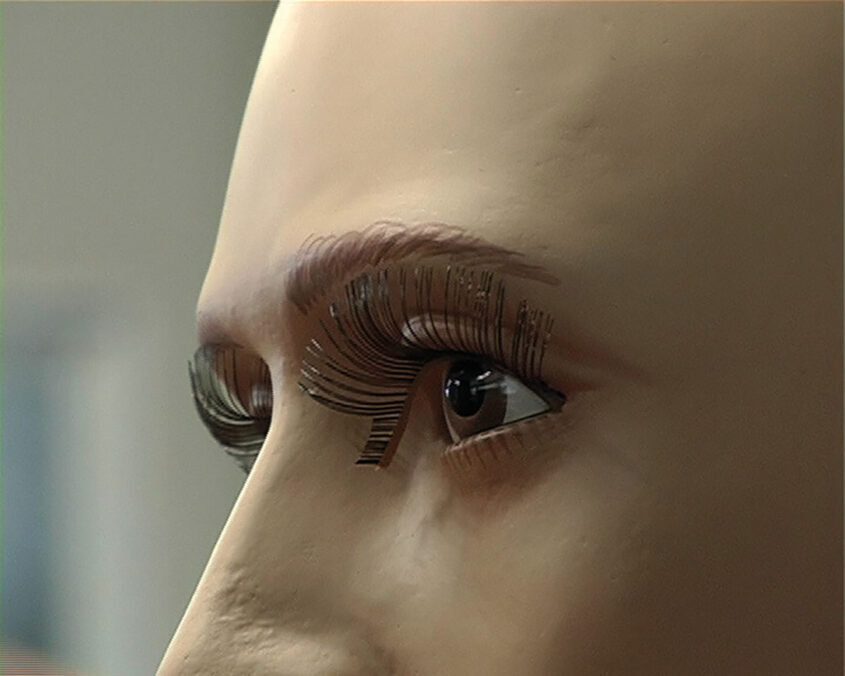
I immediately chose the documentary option and made a very short film — about twelve minutes long. It was about a factory that produces mannequins for storefront windows. The factory belonged to the uncle of another student who attended the school with me. I first went there just to help her with her short film. But when she showed me the place, I immediately understood that it was exactly what I wanted to do — to film the production process of these anthropomorphic objects. I shot part of it myself, with the help of a cameraman who was studying with us. Another student recorded the sound. I collaborated with Diego Marcon at the editing of „Polistirene“, who was also attending the school back then.
Was there dialogue in the film, or was it mostly sound following the images?
I stayed there for a few days. The film was purely observational. The place itself was very beautiful, and somehow it didn’t need anything more than simply being shown. I was just observing people working, objects being made, and sound following that notion; there is no dialogue.
My professor was also happy with the result, so he sent it to the Locarno Film Festival. At that time, there was still a section dedicated to hybrid short formats. The film was already considered a bit “arty,” not really a classical documentary. That’s when I started thinking that maybe this could become a path for me. After that, I made a few more documentary-like pieces. One of them was a one-hour documentary produced with a small production company. It took place in the care home for retired musicians and theater artists; it featured interviews and dialogues with them, but for me, the subject was still mainly space: how space is navigated by its occupants, and how these very elderly people, who might also be diagnosed with dementia, used the architecture around them.
So the preparation process must have been quite long since you were also in very close contact with residents?
Yes, very long. I spent about a year doing observation, and I mostly spoke with the psychologists who worked there. So the preparation really happened in the field. And I took time to get to know the residents, just being there without filming. The place itself was complicated for me; it was one of the few projects where I worked directly with people, and the residents had very particular conditions.
The rest home was very unusual: it was specifically dedicated to people who had careers in classical ballet, opera singing, or orchestral music. It was founded by Giuseppe Verdi; he created it to support artists who had less financial stability later in life. In a way, you apply almost like for an artist residency: you show your CV and your artistic career, and if accepted, you can stay there. It’s located in a beautiful area, and the building itself is very beautiful, and then there was the strong medical reality underneath. You enter that place knowing that you won’t leave it again. There were a few moments during filming that I had to confront emotionally. We’re talking about people who had once performed on stage, and being in front of the camera made them feel alive again. That became another layer in the documentary. You never really know what fiction is and what is not. The residents were constantly performing for the camera. They were looking forward to being filmed.
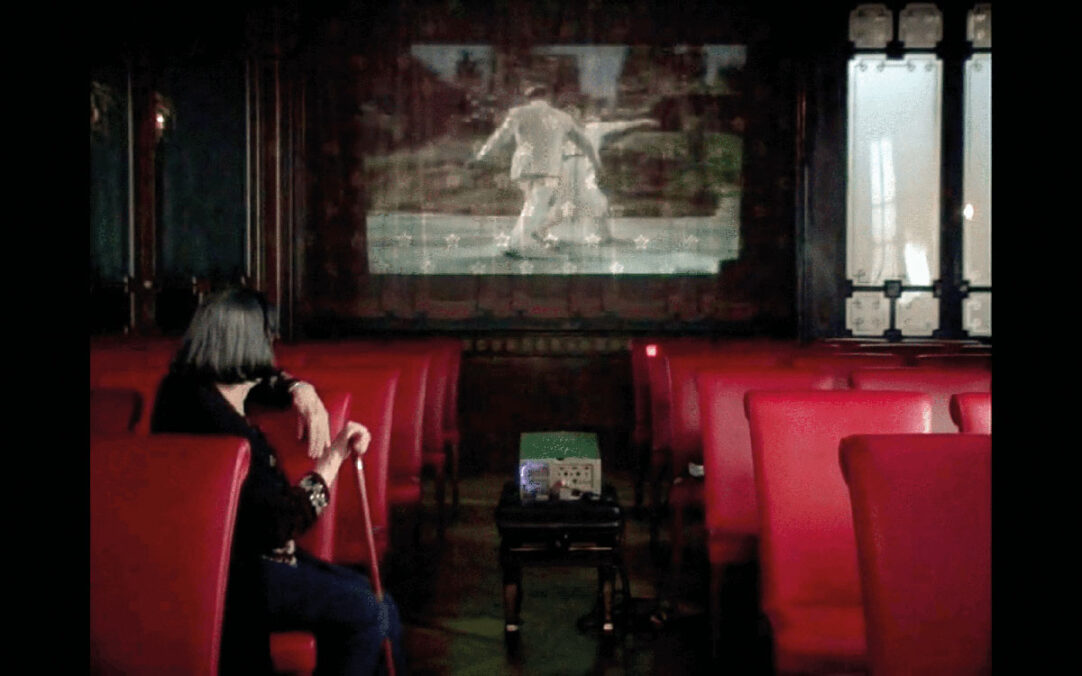
Courtesy of the artist, Vistamare Milano/Pescara, and Emanuela Campoli Gallery, Paris.
That project became the longest and most documentary-like work I ever made. The focus was on the people, but also on the architecture- the relationship between bodies and space. At some point, I struggled with how to film the building as a whole — how to connect the different floors. The solution was actually very simple: the elevator. You see the camera going up and down in the elevator, with the doors opening and closing. That’s how the residents actually experienced the building, because many of them couldn’t move freely.
The elevator became a kind of spine of the place — the structure that organizes everything. Then, for longer shots showing the space, I used the same movement horizontally with a small camera dolly — like a miniature rail system. While I was working on that project, I wanted to have an experience outside Milan and outside Italy. So I applied to the residency program at the Rijksakademie in Amsterdam. At that time, it was already structured as a residency, even though it was quite long — about two years.
The Rijksakademie was almost like a postgraduate experience for you?
Yes, exactly, it was considered a kind of postgraduate program. You received a small stipend and had access to facilities. When I applied, I applied strictly as a filmmaker, not as a visual artist. But once I was there, I came into closer contact with artists working in different media. That’s where I started to think about film and video differently — not only as something projected in a dark cinema, but as objects that could exist in space and be experienced in different ways by different people. There, I began to see myself more as an artist and less as a filmmaker. Afterwards, when I returned to Milan, my work shifted more toward objects and spaces rather than human presences; focusing on what humans leave behind, or what surrounds them.
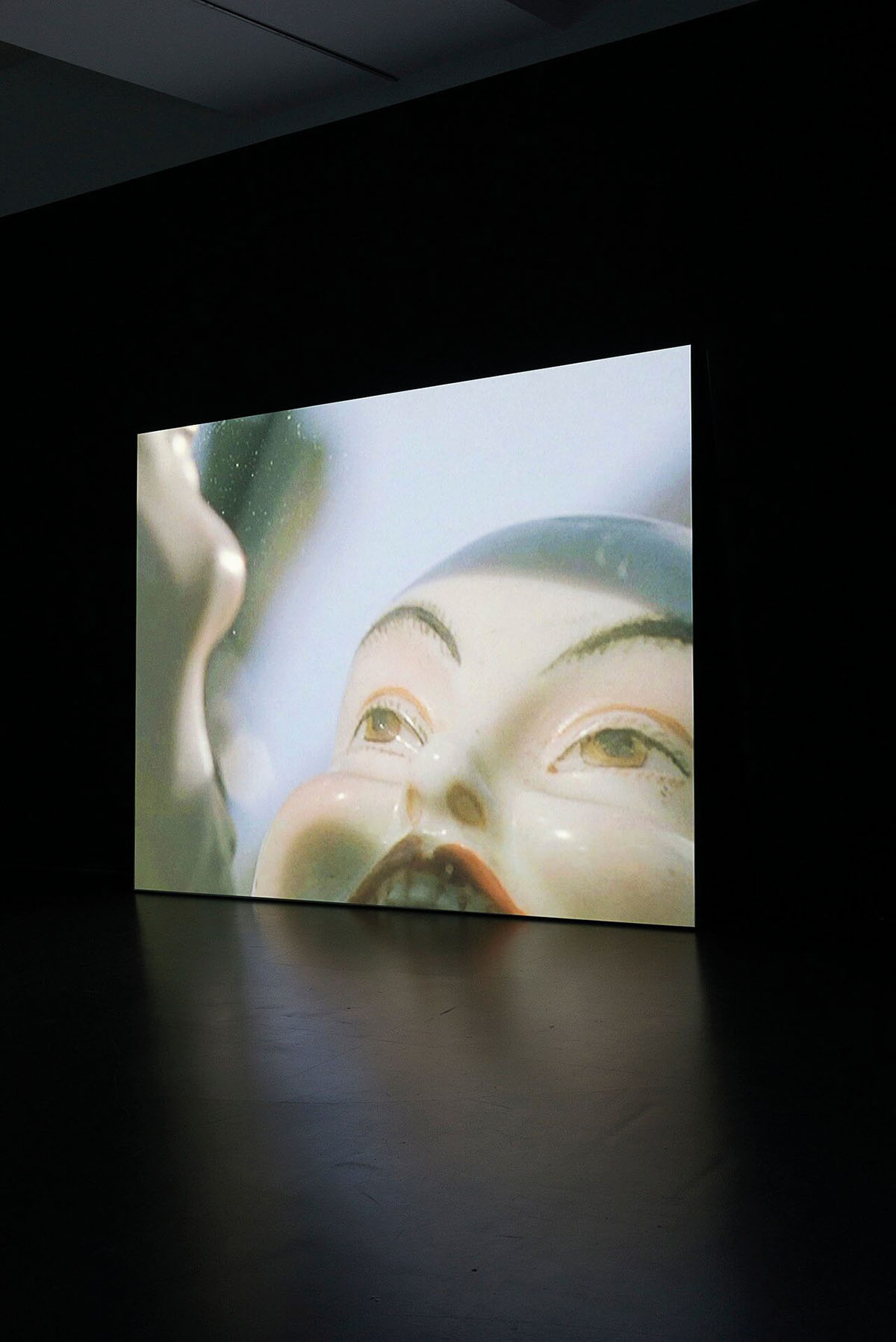
But the cinema always stayed the reference point in your practice?
Yes, very much. I’m still interested in cinema as an industrial medium, something that is reproduced in many copies. Every film is a prototype but also a mass-produced object.
Cinema started as a machine before it became an art form. Very early on, it also became an industry and a way of making money, and I have nothing against that. In the beginning, cinema wasn’t considered intellectual at all. You saw it at fairs and amusement parks alongside attractions and mechanical spectacles. The real magic was simply seeing things move. You pay for a ticket and watch images. That’s perfectly fine.
People sometimes assume early spectators were naive, but they weren’t. It’s like visiting a technology fair today — you go to see what the machines can do. You don’t go there expecting Shakespeare. You go out of curiosity. That same curiosity exists in my work, especially toward industrial production and automation.
The mannequins in your diploma work are already illusions of human bodies, made out of plastic in the factory. I feel that your work often has this strong sense of industrialization — maybe a kind of post-industrial atmosphere. Postindustrial not in a sense of technology or media, but more in terms of materials and production processes; building materials, fabricated objects.
When I started, what really interested me most was the relationship we have with the things we make. Most of the time, I think about these things as minorities. I am more interested in objects that are not flamboyant or highly designed — everyday things, things that surround us. I have this conviction that we cannot avoid thinking about the enormous quantity of objects that we produce. If we speak in terms of species, manufactured things are probably one of the most widespread populations on the planet. And we continue producing them even when we don’t need them.
Since we’re already talking about production, I was also wondering about the materials and ready-made objects you use in your work now. For example, the wigs you use in your sculptures: those are existing objects you don’t produce extra for the sculpture, right?
I buy wigs that are already made, or I find them, but they are synthetic, not made from natural human hair. Using real human hair would open up a completely different political and ethical level.
Human hair is often connected to poverty and economic necessity; there are auctions where people sell their hair. If you want a very realistic wig, for example, if you need one for medical reasons, you use human hair. That serves a very different purpose from what I am doing.
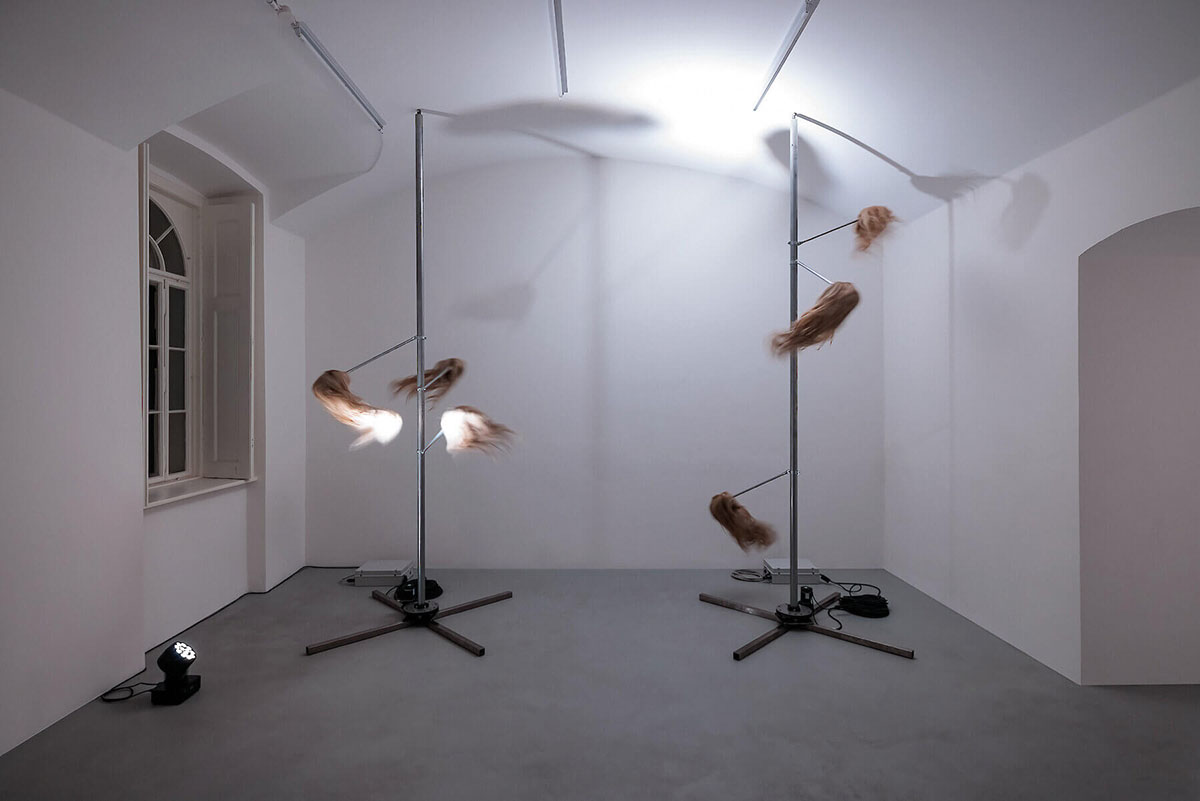
Installation view. Photo: kunst-dokumentation.com.
You also don’t try to hide the artificiality of it. For example, in the exhibition ‘NIGHTS OUT’ at Kunstverein Gartenhaus here in Vienna, it’s quite clear that the hair is synthetic. That is also significant for you; you don’t try to make the artificial materials look natural and fully believable. More generally, your works often feel quite raw. That’s what I meant earlier by “post-industrial” — the materials you use are very direct in what they are, not made more convincing or forced decorative. The focus isn’t on colors or patterns or surface effects; it feels more about function and dysfunction play.
Well, we usually only pay attention to objects or machines when they stop working. You notice your refrigerator, your washing machine, or your dishwasher when something goes wrong.
Same as we are becoming more aware of our body when it is in pain.
It’s the same with the body, exactly, you notice it when it stops functioning properly. It’s also the same with relationships. You remember that you have a partner when something is missing or when there is conflict. It’s a very human mechanism. I’m not criticizing it — we are what we are.
Do you think this also relates to presence and absence, or maybe even to the positive and negative sides of things?
It depends on perspective — on what we consider positive and negative.
From a human perspective, objects that don’t work are negative. But if you imagine objects as a kind of minority, as entities with their own existence. Then maybe malfunction is a way of asking for attention. Maybe they have their own needs. Maybe they need to be repaired or cared for. So in a way, this becomes a reflection on how we relate to the world, to other humans, animals, plants, and also technical objects. At the end of the day, everything on this planet comes from the same chemical basis — carbon. So the distinction between living and non-living is not as absolute as we often think.
One thought I often have is that paying more attention to the things we produce might even help to limit extreme capitalism. If we take care of objects, maybe we produce less. Taking care of things can also be a way of taking care of ourselves and of our relationships with the world.
Also, some terrible people take excellent care of their belongings. It’s not that simple. It’s more a general reflection on how we relate to everything else, which in a way is also part of ourselves. That’s why my attention often goes to overlooked objects — mass-produced things, souvenirs, everyday items. Souvenirs especially interest me because they are often produced on other continents and then sold as representations of a city.
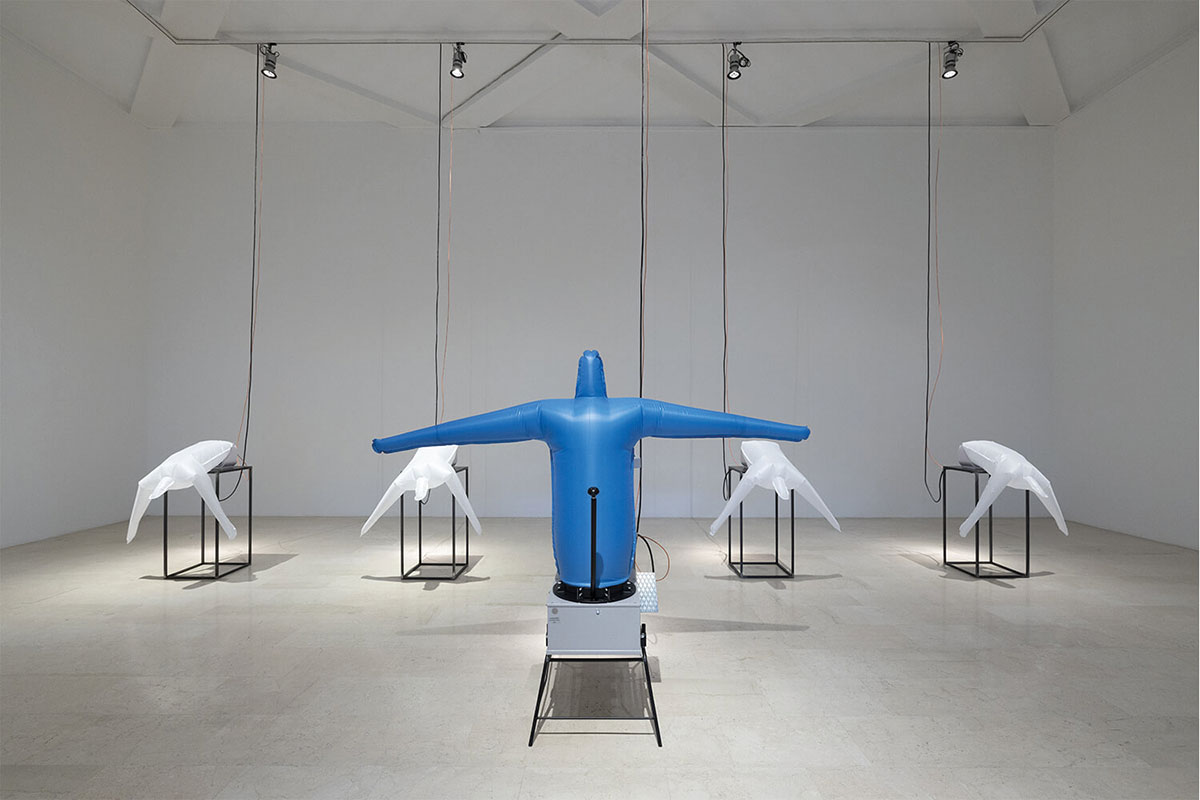
Courtesy of Triennale Milano. Photo: Andrea Rossetti.
Yes, that is completely fascinating. I remember one of your souvenir works, the enlarged I Love Milano mirror.
That piece was made in a very casual way for an exhibition. But it worked surprisingly well.
The phrase “I love Milano” has several layers for me. It can hint at drug culture, “Milano” associated with cocaine, and the wild 80s, but also at vanity and the fashion system. The mirror implies looking at yourself, appearance, and beauty. It became a kind of metaphor: fashion, vanity, self-image, but also excess.
Milano also has that history and culture turning around finance, fashion, and entrepreneurs.
In the 1980s, there was a moment when Italian fashion really rose internationally — designers like Giorgio Armani and Valentino Garavani became major figures. Fashion remained, but that era ended. There were huge political scandals that marked the transition from the First Republic to the Second Republic. Corruption was everywhere — beyond imagination. So that small mirror with I Love Milano also refers to that historical moment, metaphorically. It suggests cocaine use, vanity, fashion, and beauty — all condensed into a small object. You look in the mirror because you want to look good.
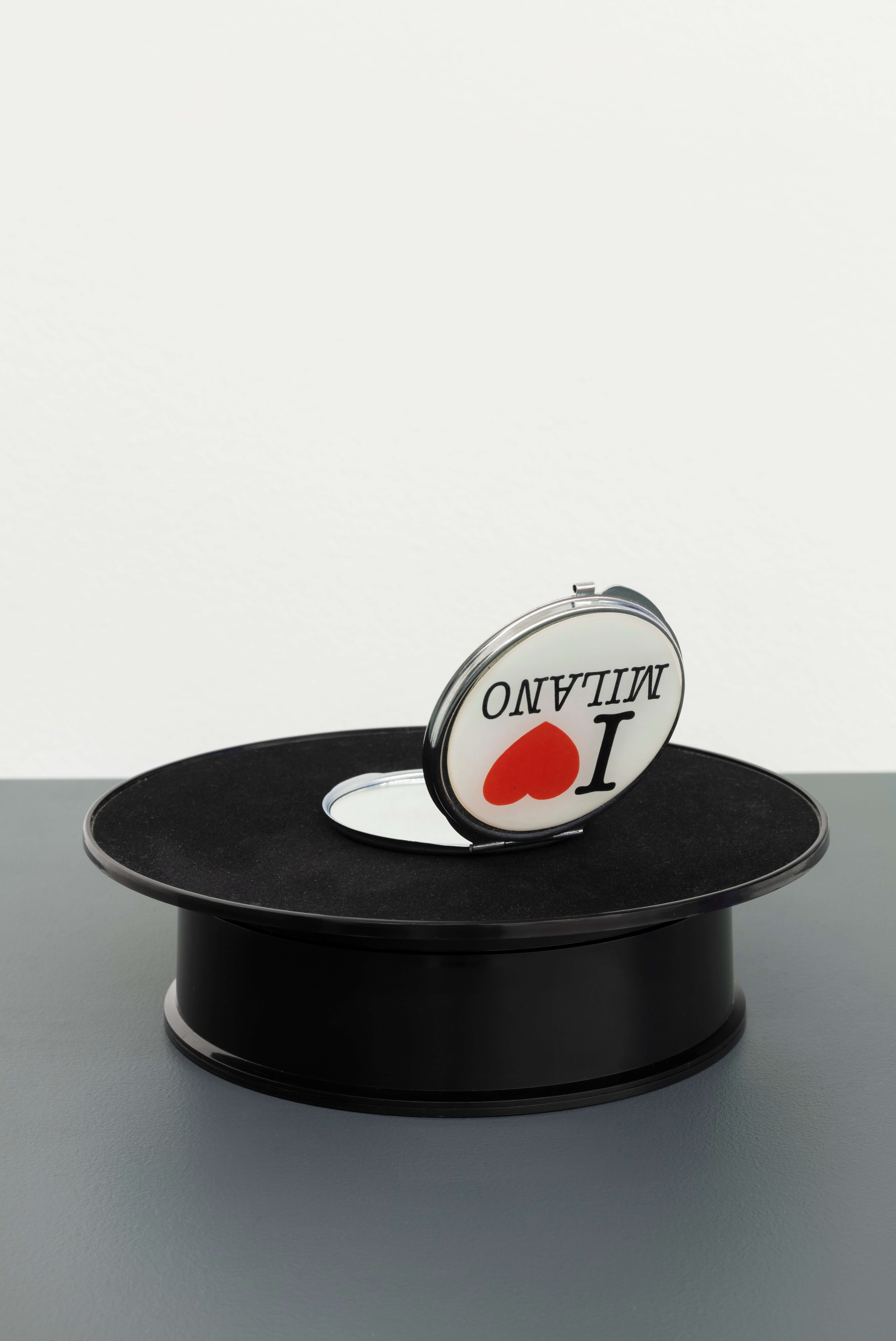
Courtesy of CfAlive, Milano. Photo: Andrea Rossetti
I feel that the relationship to fashion in Milan is particularly elegant for Italy. Even people who are not working in fashion, art, or creative fields often look amazing.
Yes, I am based in Rome. Milan is a very urban city. Yesterday it rained, today it’s dry, so you can wear a beautiful coat without worrying it will be ruined. The context makes a difference.
Your studio is in Milan, right? How does your working situation look there?
Yes, not far from my apartment, and I work there together with architects. It’s very convenient, people pass by, galleries are close, and it’s right across from another gallery. It creates a nice working environment. It’s more like an office now. I used to have a very beautiful industrial studio, an amazing space where we even had exhibitions curated there; it was huge and extremely expensive to heat. It just wasn’t sustainable. That space is still sometimes used as a pop-up location during design events. It’s a very beautiful place, and I’m still friends with the owners.
But you also need workshops for the production of your pieces. Tell us more about it.
I don’t produce everything in the studio because many works require machines that simply cannot be installed there. I have to go to workshops for welding, polishing, cutting, or fabrication. It’s impossible to have everything you need in one place. Even professional workshops often have to outsource certain processes. I also work with found materials, which is part of my approach. We buy existing objects, metal parts, and industrial components, and rework them. Sometimes I go “shopping” for materials with one of my fabricators at large industrial recycling yards.
For example, I recently worked with an old aluminum table foot that I polished; it was originally part of another object. I like reusing materials whenever possible. It’s not always feasible, but it’s something I care about for sustainability reasons.
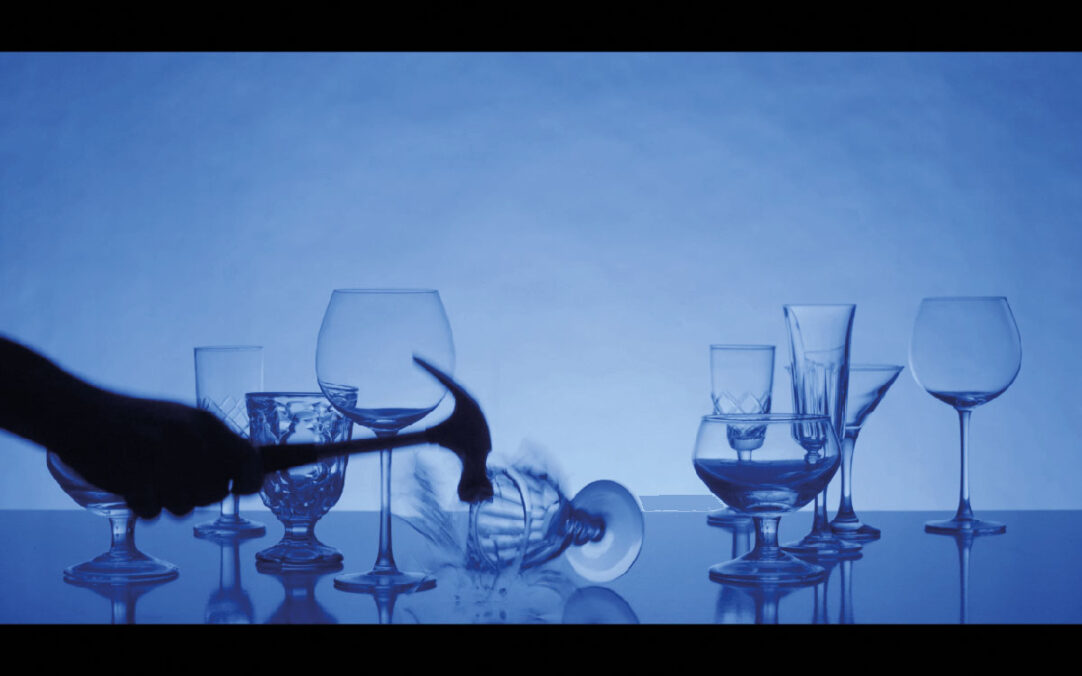
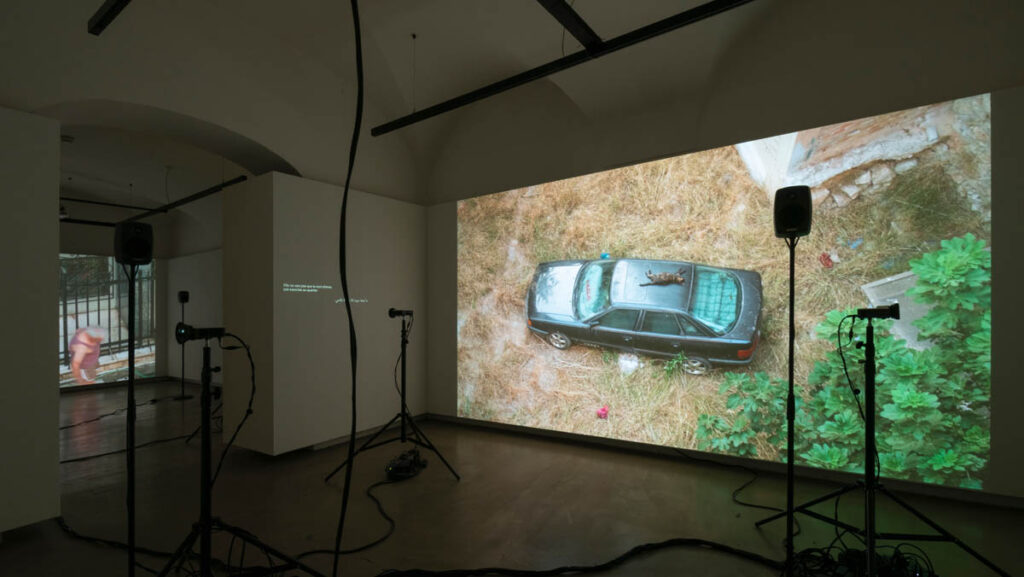
Video still. Courtesy of the Artist and VISTAMARE, Milan – Pescara
These industrial sources seem very important to your visual language.
Yes, absolutely. Some of the objects for the Paris exhibition will probably come from these places. You find incredibly beautiful structures, industrial tools, mechanical parts, and forms from factories. For example, there are these large industrial devices that were used to handle dough in factories, huge mechanical arms with sliding elements. They’re fascinating sculptural forms. Recently, I also found metal decorative elements shaped like flowers — ornaments for gates and fences. When you see them in bulk, displayed in large trays or baskets, it creates a beautiful image: flowers as commodities.
I’ve also seen that you write about other artists. I remember discovering a show by Davide Stucchi, “Falli (Phalluses)” years ago. I just reread it when I prepared for our talk today. It made me realize how strongly fashion relates to many of the themes you work with — especially this constant production of new objects. Fashion almost embodies this endless cycle of production that has existed since the late nineteenth century. So what is your personal connection to fashion?
First of all, it comes from my family background. I come from a town where many people worked in shoe production — including both sides of my family. I remember my grandfather drawing shoe designs. He had started as a pattern maker and designer for a company, and later opened his own business with his sisters. When I was little, to keep me occupied, he would draw shoes and ask me to color them. Then I started drawing myself.
I drew a lot, especially dresses. I remember drawing dresses hanging on racks. In my drawings, there was always a rack with garments hanging from it. I loved shops and store displays.
I had two main passions as a child: flowers and fashion. For a while I even thought I might become a botanist, I drew flowers constantly. But at the same time I followed fashion magazines and cut out images.I wanted to study fashion, but my mother didn’t want me to.
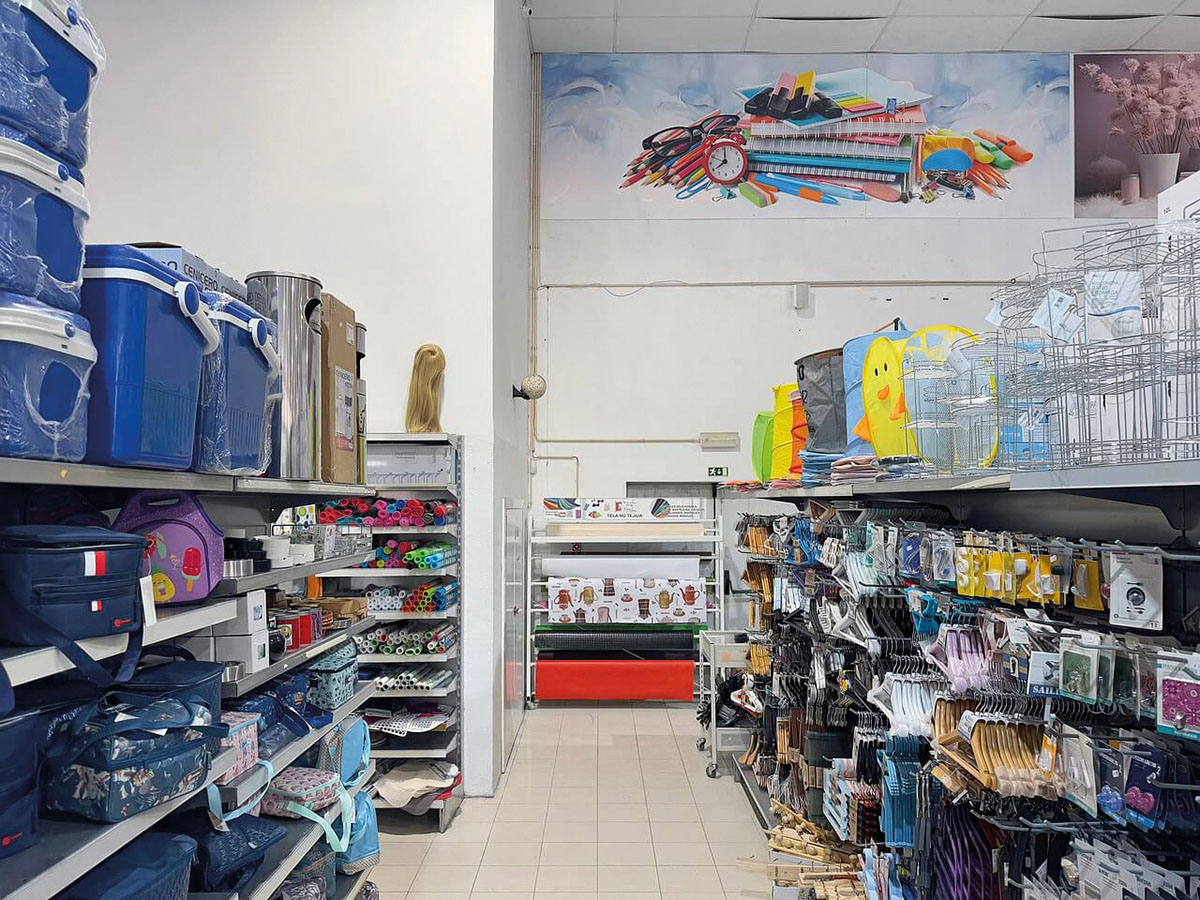
Exhibition view. Courtesy of the artists and A MAIOR.
Why not?
Perhaps she wanted me to have more options. Eventually, I entered the art system instead, but in a way, as we Italians say, when the door closes, you just enter back through the window. Fashion came back into my life anyway. In my hometown, companies produce for major brands, for example, Manolo Blahnik and Louboutin, producing in Vigevano. There was specialized knowledge about certain shoemaking techniques. For us, it was simply a job, a craft. I had boxes with pieces of leather and textiles to play with. I was an only child for many years, and also the only grandchild for a long time, so I spent a lot of time alone playing with objects.
Only later did I realize how important that was: playing alone with things. I think that connection to objects remained and became part of my work.
I feel something similar in my own experience. I first studied fashion and then art, and only later did I realize why fashion interested me so much in the first place.
Yes, sometimes understanding comes later. Because of my family background and the local context, I understood fashion primarily as work, without too much aura. Of course, fashion can be beautiful and fascinating, but it is also a profession, with expertise and technical knowledge. In Milan, many artists collaborate with fashion in one way or another, installing fashion shows, making scenography, designing books, or producing visual material. So we are not “enchanted” by fashion; we see it as a discipline and as something you can think about seriously. There is a history and a legacy that you can study.
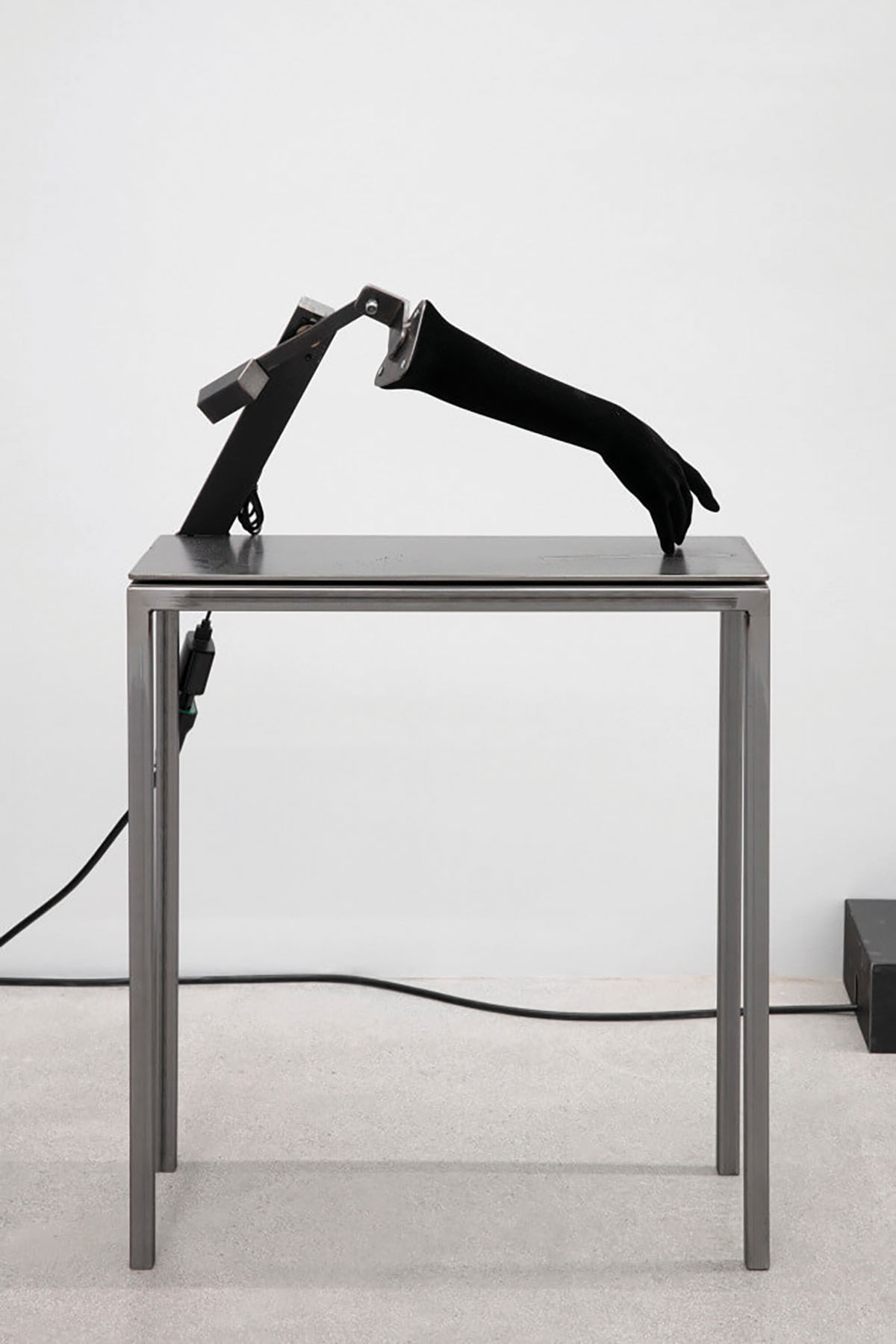
For me and for friends like artist Anna-Sophie Berger or Davide Stucchi, fashion was actually one of the first things that connected us. We share an understanding of fashion as a subject that can be approached from many angles: critically as well as appreciatively. We respect it because we believe it can be an art form.
I remember one of my early projects where I collaborated with a fashion brand on a performance. The costumes were made from the textile used for cinema projection screens. I wanted to connect screen technology with the body, and I projected images onto the garments. Some curators reacted very negatively. That was about ten or fifteen years ago. At least in certain contexts in Italy, fashion was still considered intellectually minor, not something serious. There was a strong prejudice against it. Even in academic contexts, speaking about fashion often meant speaking about something considered superficial. Today, the situation has changed. I teach at my old university now, and they have had to take fashion seriously — partly because it’s the program that most students want to apply for. It seems to promise a possible professional future, even though that promise is increasingly uncertain. Fashion is currently in a deep crisis. Still, the prejudice about fashion in the art context hasn’t completely disappeared.
Fashion still doesn’t automatically imply intellectual work in the minds of some people. The situation is definitely better than before, but the stereotype still exists.
And of course it’s also true that you don’t always encounter extraordinary intellectual environments in fashion — that’s reality. But at the same time, if you look at contemporary creative production, fashion can sometimes be more meaningful than the art system. Students notice that. Some of my most brilliant students are actually in the fashion department. They are curious and open — often less “snobbish” than art students.
I never really questioned my relationship to fashion. Even during my cinema studies, costume design was a major component. Cinema itself is deeply connected to appearance: to how bodies are presented. The idea of „The Diva“ is already a construction of an almost sacred, ephemeral body.
For me, the connection between fashion and art has always been obvious. I was mostly surprised that other people questioned it. It’s simply something that was always given to me, and it’s not about luxury or price at all. I think you have to be genuinely interested in fashion; otherwise, it’s simply not your topic. You cannot force yourself into it. Why should you?
What is your thinking about editions in the fine art context and production of more market-oriented works?
For me, it’s about finding a structure that works without compromising the ideas. Editions can be a way to make the work circulate differently and to create another level of accessibility. At the same time, they allow you to question what exactly is being sold.
I try to keep that ambiguity alive because it reflects the way my work operates between sculpture, display, and fiction. Editions are not only practical — they are also conceptual tools, I feel.
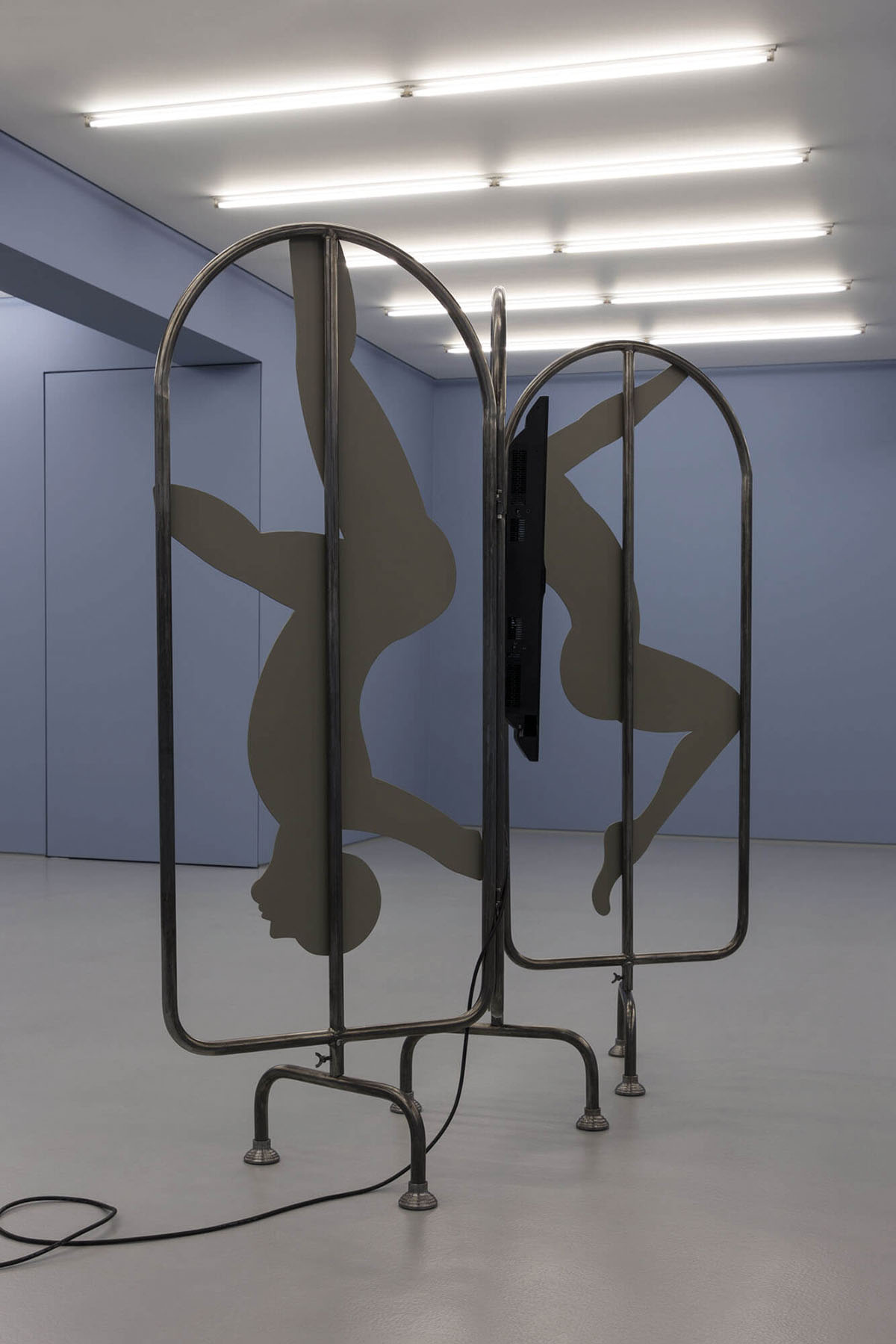
Could you give an example of a project like that?
I once produced a piece of soap. It was called ‘AVANT-GARDE’. I told the curator: if you want the next avant-garde, the previous one has to disappear. So while you wash your hands, the text on the soap slowly vanishes. It’s a simple gesture, but I like that idea — the work literally disappears through use. I’m actually a big fan of that piece.
You have an exhibition coming up in Paris. Could you tell us about your upcoming projects?
The most recent exhibition will be in Paris at the end of May, at my gallery, Galerie Emanuela Campoli. There, I will continue working on the idea of display. We already explored this in a previous exhibition through a dining room-like installation, and now this new version might be closer to the idea of a mini-shop.
I’m preparing sculptures that originate from props I photographed on Polaroids. I had the opportunity to work with the Polaroid Foundation, which allowed me to use an enormous Polaroid format, around 50 by 70 centimeters. It was an incredible experience.
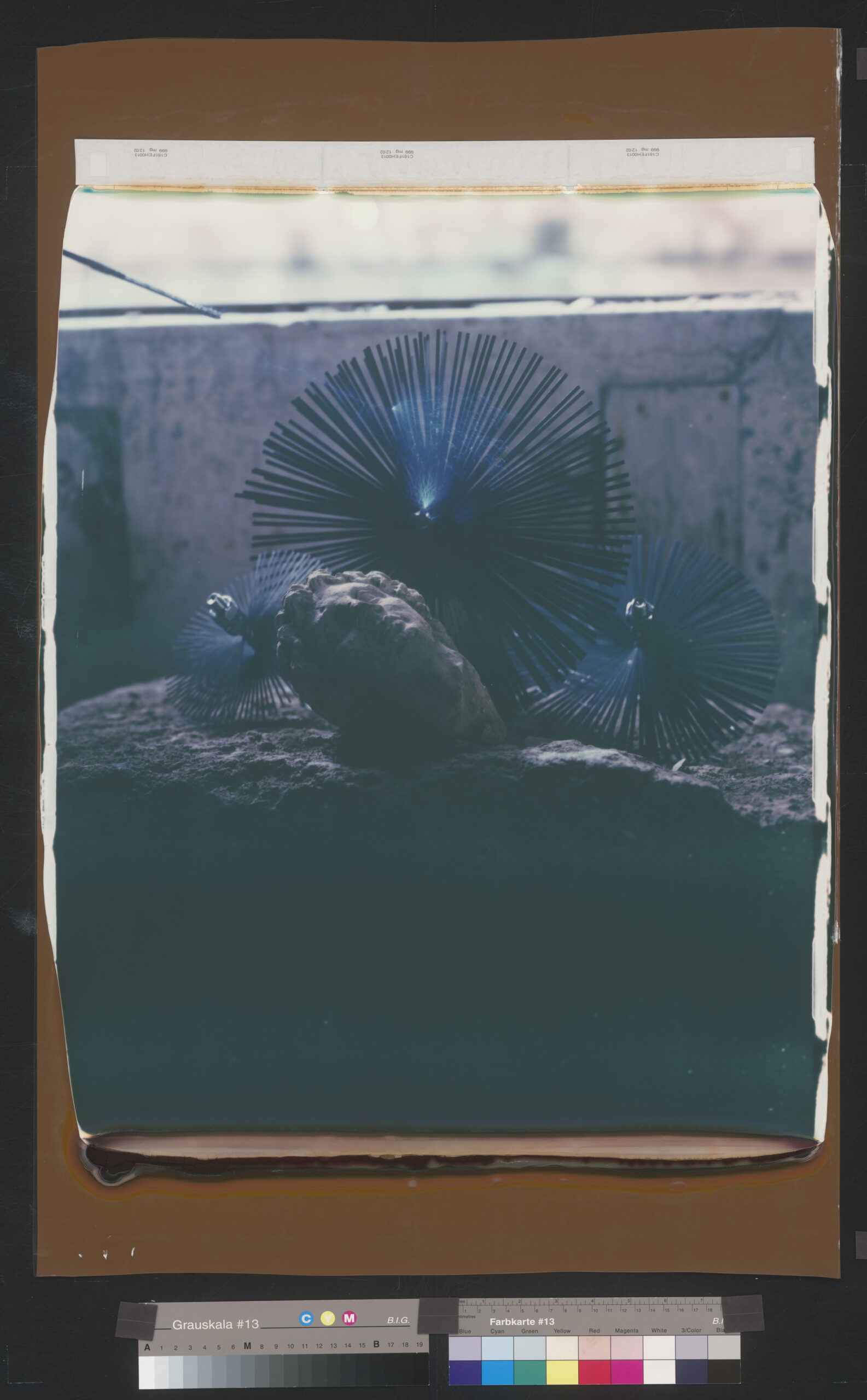
I shot the photographs in an archaeological site in Italy. The site was originally a sanctuary, later transformed into an electricity power plant and then into a paper mill; at one point, it was even used by the papal state to produce weapons. There are traces of all these transformations; the site contains many historical layers that are still visible, and that complexity interested me a lot. Some of the objects in the photographs were animated using electrical machines, which create visible electrical discharges, almost like artificial lightning. The blue light creates a kind of aura around and inside the objects.
And how will the polaroid’s be displayed?
I’m designing a specific display system that can be operated by hand. They relate to shop windows and storefront displays. It becomes a space where things are opened, closed, revealed, and stored. In this way, the exhibition becomes something like a shop. It questions what a sellable object is, what an artwork is, what a prop is, and what an edition is. The gallery itself already feels like a natural environment for this kind of display.
Your first publication is coming as well soon, right?
Yes, I’m preparing a publication with LENZ Press. It’s about my practice more broadly. It will be my first monograph, and I am very excited about it! We are currently working intensively on editing and layout, and it will probably be published later this year. I would also love to have a book launch in Vienna as well!
Anna Franceschini – www.annafranceschini.net
Anna Franceschini (lives and works in Rome) works across film, performance, kinetic sculpture, and photocopy. Her films have screened at major festivals, including Locarno Film Festival, International Film Festival Rotterdam, and Torino Film Festival, among others. She has presented solo exhibitions and performances at institutions such as Triennale Milano, Istituto Svizzero (Milan), Kunstverein für die Rheinlande und Westfalen (Düsseldorf), Spike Island (Bristol), and Museion (Bolzano), and has participated in group shows at venues including Tinguely Museum (Basel), Mudam (Luxembourg), MAXXI (Rome and L’Aquila), and the Quadriennale d’Arte 2020 (Rome), among others. A finalist for the Mario Merz Prize 2025, she received the Pollock–Krasner Foundation Grant in 2022. Her works are held in major public and private collections, including Centre Pompidou (Paris). She holds a PhD in Visual and Media Studies and teaches at NABA, Nuova Accademia di Belle Arti in Milan.