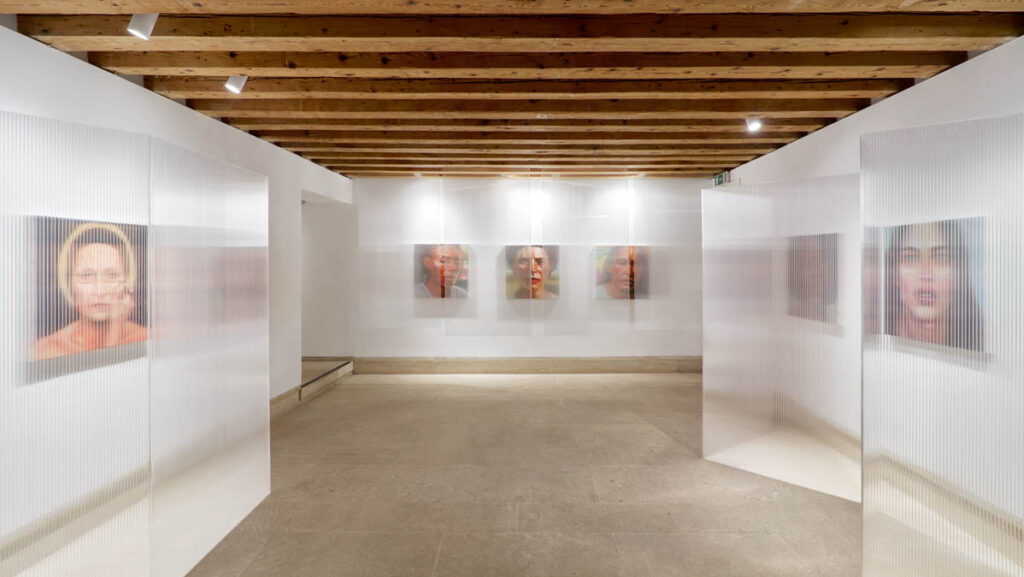
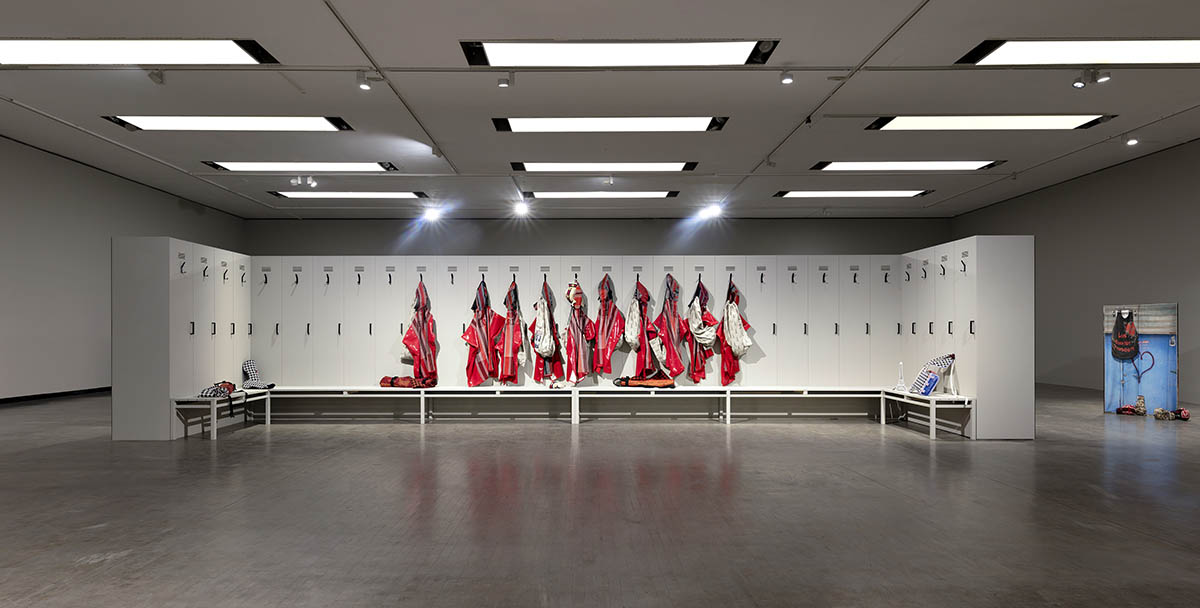
The exhibition space of the Kunsthalle Wien feels as if it is framing your works. The built–in structure of the changing room, and lockers with mirrors became stations for your work to lean and hang. How you embraced the space and how the idea and the Zurkhaneh (House of Strength) is visible in the exhibition design.
The exhibition ‘Octogone’ first took place in 2025 at Palais de Tokyo, also titled ‘Octogone’. The exhibition traveled to Vienna and is now on view with new works I did specifically for the show here in Austria. When I was invited to do a show in Palais de Tokyo, the space that was given to me had an octagonal shape, which immediately reminded me of my grandfather, who was a wrestler and a boxing fighter.
He was training Varzesh-e Pahlavani (a martial art rooted in pre Islamic period, which was long dominated by men, but it has been claimed by women in the context of the emancipatory movements in Iran) in Zurkhaneh (training space) with all his cousins and friends. That was the place where he built his strength and masculine figure, but also where he learned what it means to be a man. I understood my grandfather much better now; For him, the body was so important; it was not just for the looks; it represented the spirit and power of a person to protect and to be strong; he was training until the end of his life. He was a person who would go and search the whole city to find the perfect color of the suit to match the color of his car. This is how important harmony with the body and the soul was for him. He was impressive, looking maybe stereotypically masculine, but also the man I saw most often crying in my life. He was also very vulnerable, and that’s why I was fascinated inside the Zurkhaneh that lets humility, justice, and all these values and senses express themselves.
What makes ‚Octogone‘ especially interesting is that you did not limit your position to critiquing the male gaze. Instead also embraced and celebrated its positive sides, and highlighted the values that are important to you.
Yes, I am also giving an example of the situations where men are together, which can also allow some beautiful things to happen, and not only the bad ones.
You graduated not long ago, only five years ago. In which class did you study, and how did that shape the practice you have now?
I was studying at the Beaux-Arts de Paris. I was in the studio of Jean-Michel Alberola. And it was a painting class, but he is not only a painter; he is making films and many other things. I would describe his practice as a very conceptual one. It was weird at the beginning because yes, I was drawing, but I also had all these images, I was taking and doing collage with them.
I was clipping pictures to the clothes hangers, and then I started working with garment covers, the ones you have only to save the wedding dresses that you would never wear again, or the suits that you wear very rarely. I remember Alberola asked me, “What are you waiting for? Make garments.” He convinced me that I was “allowed” to make them, because I was unsure. He took a hood I made and looked at it from all sides, saying, “Ah, it’s cubism. What you are doing is cubism!”
I’m just trying to make paintings differently, and that’s why I’m saying there is a pictorial aspect in my work, even if there are garments in form. I want these image garments to be seen and not to be worn.
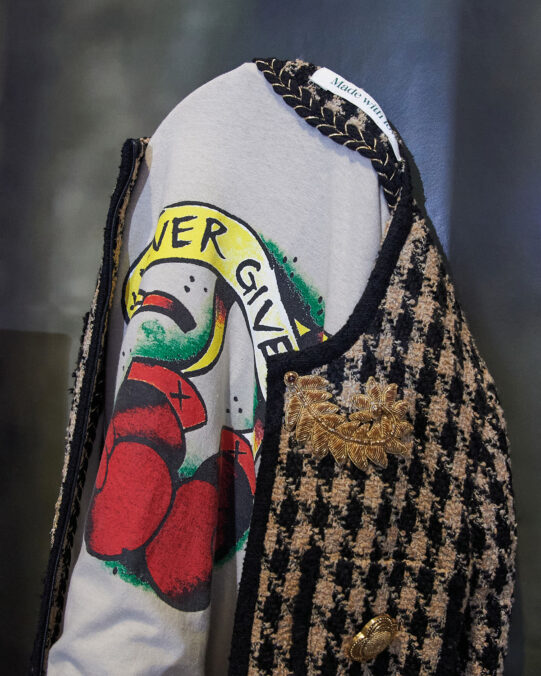
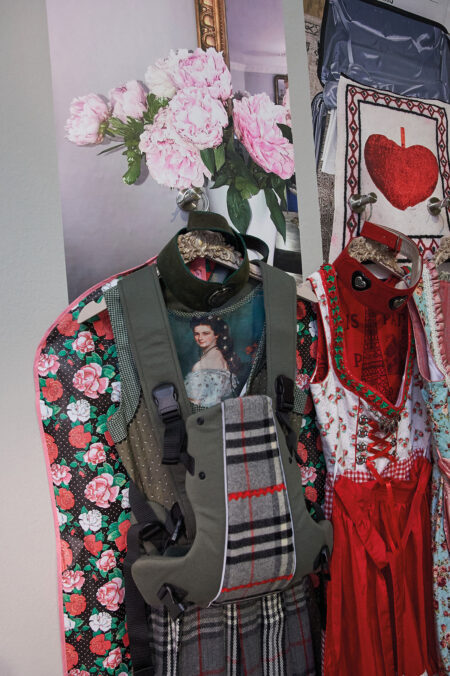
You make the clothing done in such a way that it could easily be worn, with such an intension on details. You don’t leave anything unfinished. Form in the opposite of function. Can you elaborate more? Did you ever think of pursuing a career in fashion design?
For me, there is a tension between the idea of the sculpture and a living painting. I think we see paintings or sculptures the same as we see bodies, as we were learned to see them and not as we really see them, so I like to play with this tension and what you see and what you project. I have many layers of references, but also many layers of forms that come together in my work.
I really wanted to make art. I was always passionate about fashion, but I was satisfied with just dressing every day; I didn’t need to go deeper into the industry. Art was always the way I wanted to tell stories. I work really intuitively on the image garments I make, just the way I dress; accessories are also a part of the bigger drawing.
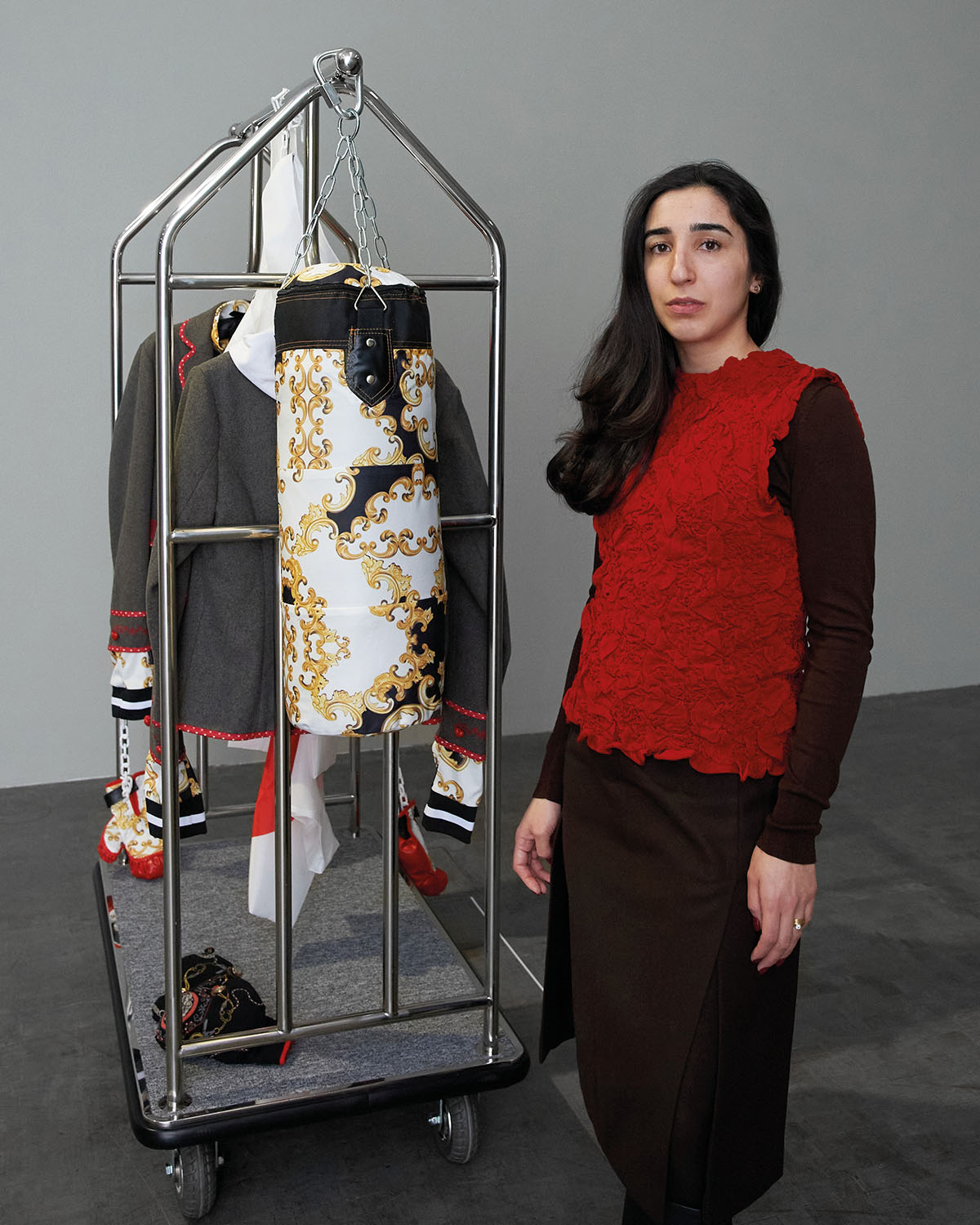
There are a lot of references and a lot of preparations before the production part of the work. Do you make everything yourself?
I work with my mother. We do everything by hand or with the help of a sawing machine. And then there are some elements, like a print on a suitcase that is commissioned.
Were you already in contact with sewing when you were little trough you mom, how did it come to your love for clothing and fashion?
My parents really gave me this love for dressing. I just always loved to dress myself, to this day. There is an aesthetic part of it, of course, but also a political aspect. My mother always told us to be well-dressed, wherever we go. We were not white, and I’m French and Iranian, in a society, sometimes racism exists.
She learned us that if you’re well dressed, if you present yourself well to others, it’s a kind of protection. And it’s your password to go into every social circle.
I can understand that, really well, and also now I better understand these Louis Vuitton logos, or Prada, Versace logos on the boxer gloves that we don’t know if they are real or not.
I’ve always played with the notion of fake and authentic, as well as with the social power games and prestige that come with logos.
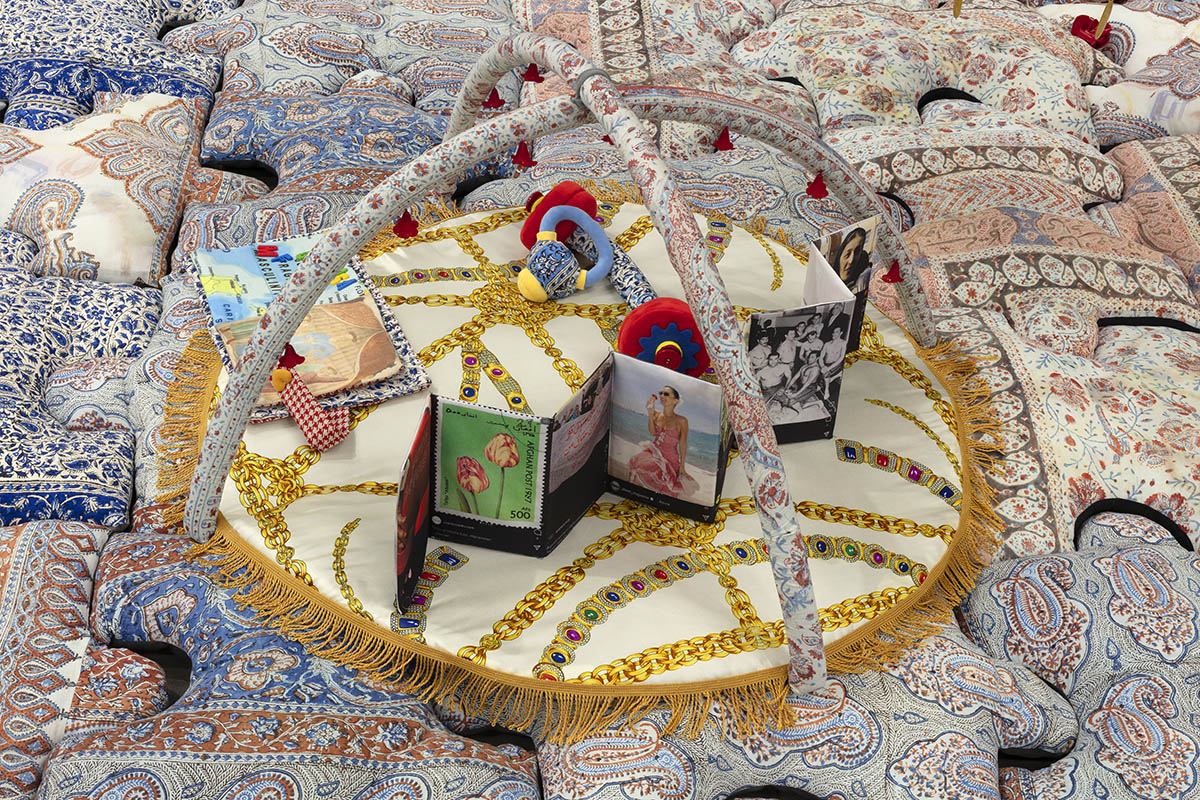
Do you think that ornamentation in textiles or architecture is generally still perceived as something feminine?
My background is Iranian. I grew up with Persian rugs everywhere, so ornament was part of my eyes; I was making my first steps walking on ornaments literally. I like to play in my work with this by seeing extremes in society, stuff that society sees as very female-coded and stuff that is very male-coded, and I like to question why it is like that.
I remember reading Adolf Loos’s Ornament and Crime“ during my studies, at first I felt like a black sheep, and as I was doing something wrong, of course, that changed.
Some people might want to make us think that ornament is feminine, but I don’t think it belongs to women specifically. I think it belongs to everyone.
I see this cliché that blue is for boys and pink is for girls is now even more problematic since I have a son. I feel there are no clothes that are sold in the “boy” section of the store that are covered in ornaments of any kind or patterns in general. I would love my son to wear leopard print, but even I am sometimes questioning if it is okay for him to have long hair with hair clips and to wear flowers or leopard print.
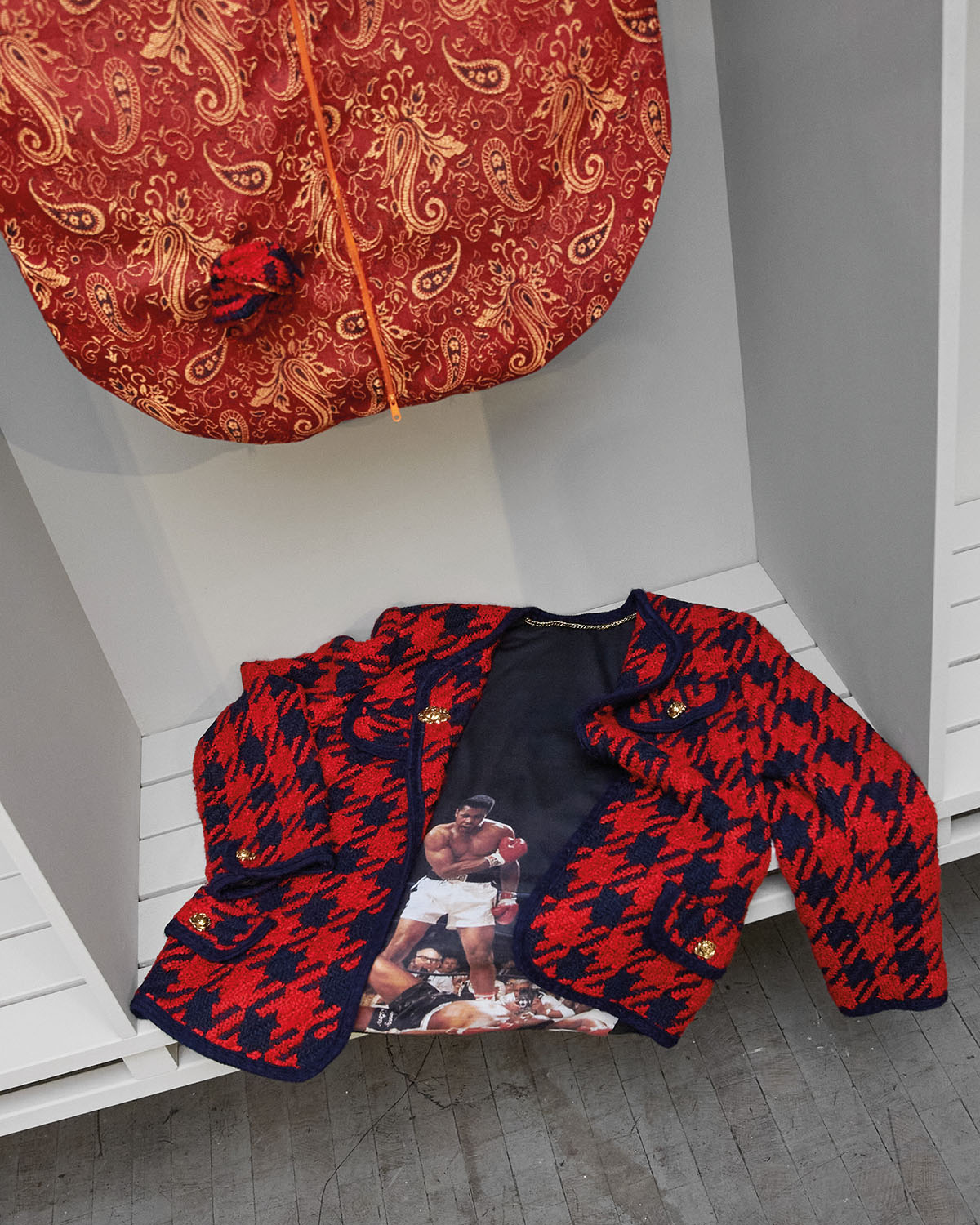
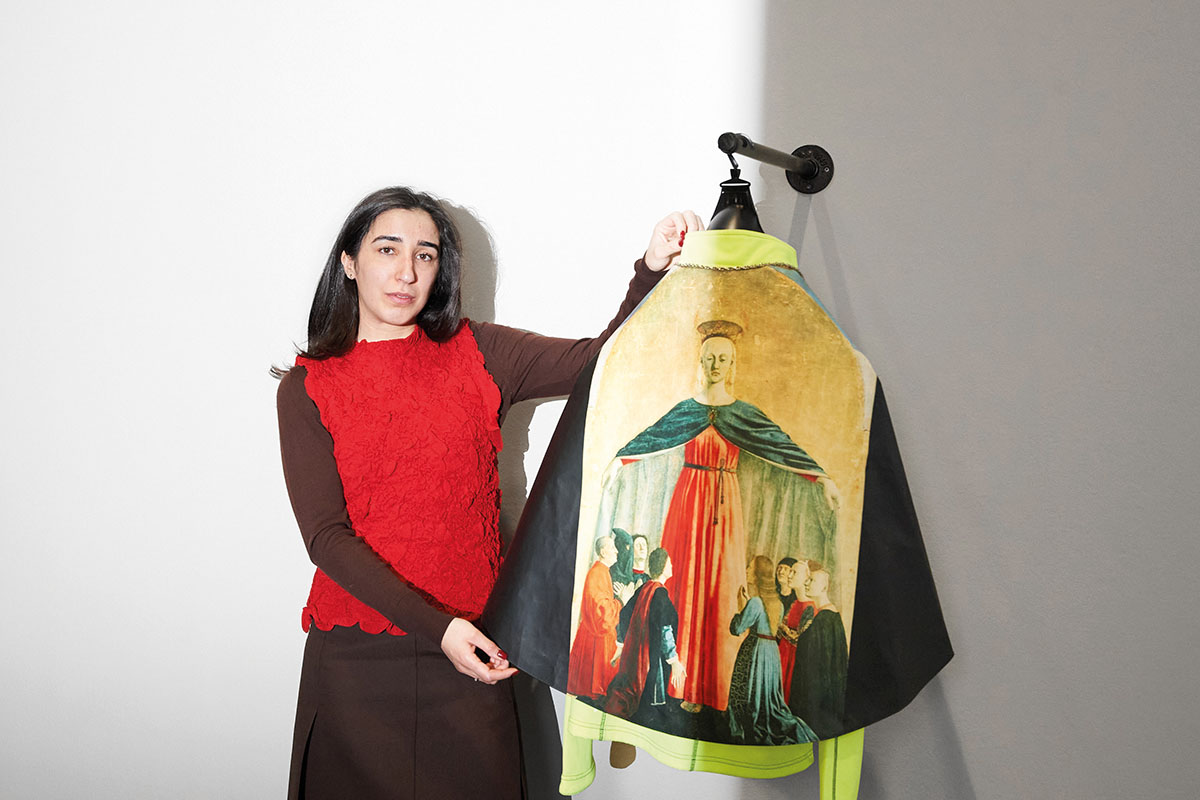
Yes, your work is talking about the social and political dimensions of how we perceive clothing, trough it performativity capacity and way of presenting yourself to others. Can we talk about the “religion coded tracksuit”, the work ‘Cape et gilet jaune, 2020’, and its front, the couple in a hug, a moment similar to the one from the movie ‚Titanic‘.
The picture of a white couple is actually an advertisement for a French brand of cashmere. Every time I was taking a specific bus in the city, there was this advertising picture that may be so angry, and the picture made me angry every time because it had these two white people wearing white pullovers, hugging each other on a white background. But on the other side, you had Gilets jaunes protests happening everywhere in the same year. The image is actually a screenshot of a screenshot, captured and reposted several times as a story. It shows a photograph of a cashmere advertisement displayed in a bus shelter. During a Gilets jaunes demonstration, someone spray-painted the white sweaters of the two protagonists in yellow.
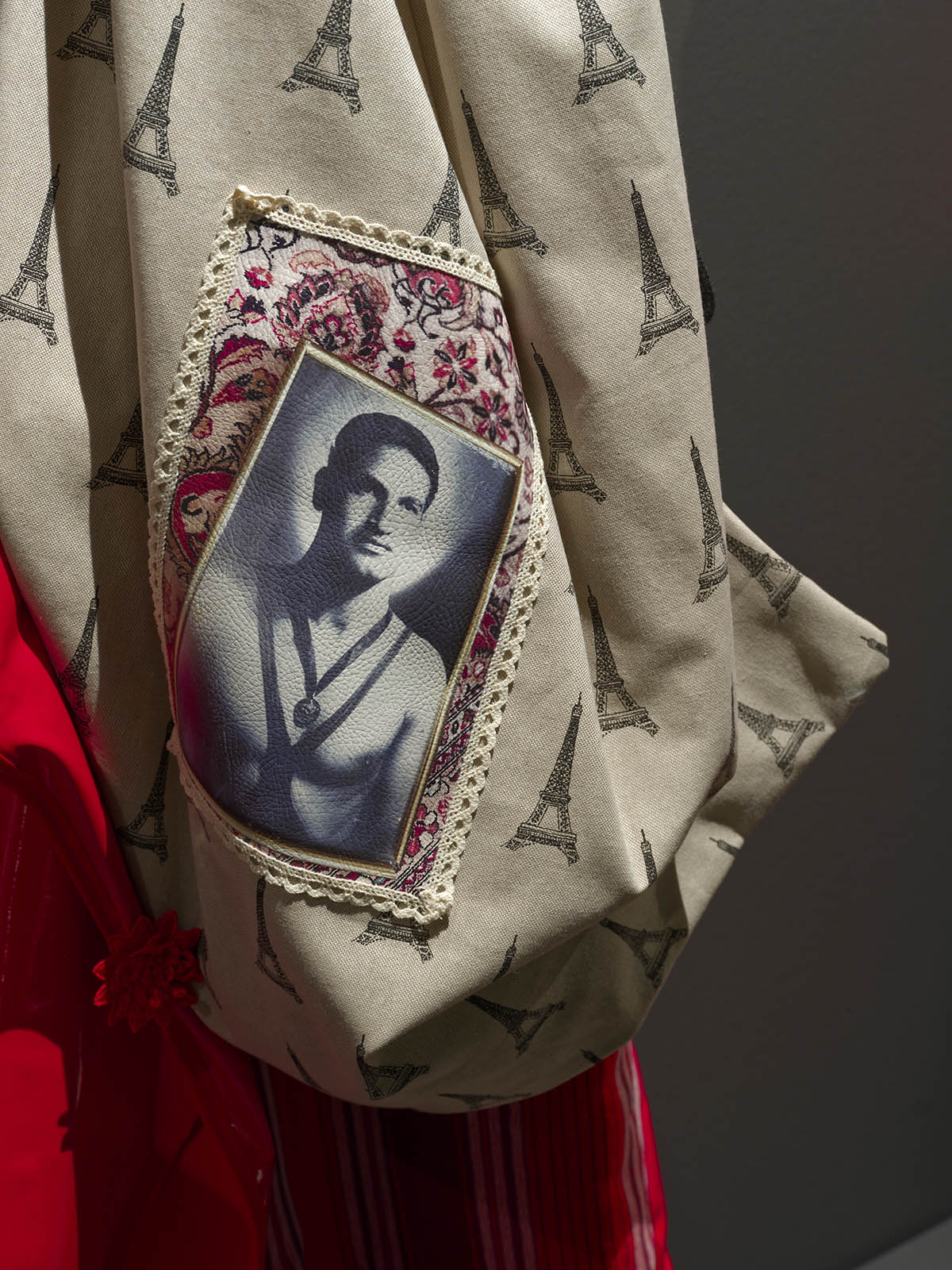
There are pop culture references in your work, but also tourist attractions and tourist shop references. On one side, these suitcases are lying with the picture of your grandparents hanging from them, clashing between migration and just visiting places touristically.
Exactly. That’s really what I want from the luggage at the beginning of the exhibition, the works talk about migration and exile, and in the end, the bellman carts represent this circulation and true tourism, when you choose to go somewhere to visit, and then you come back home.
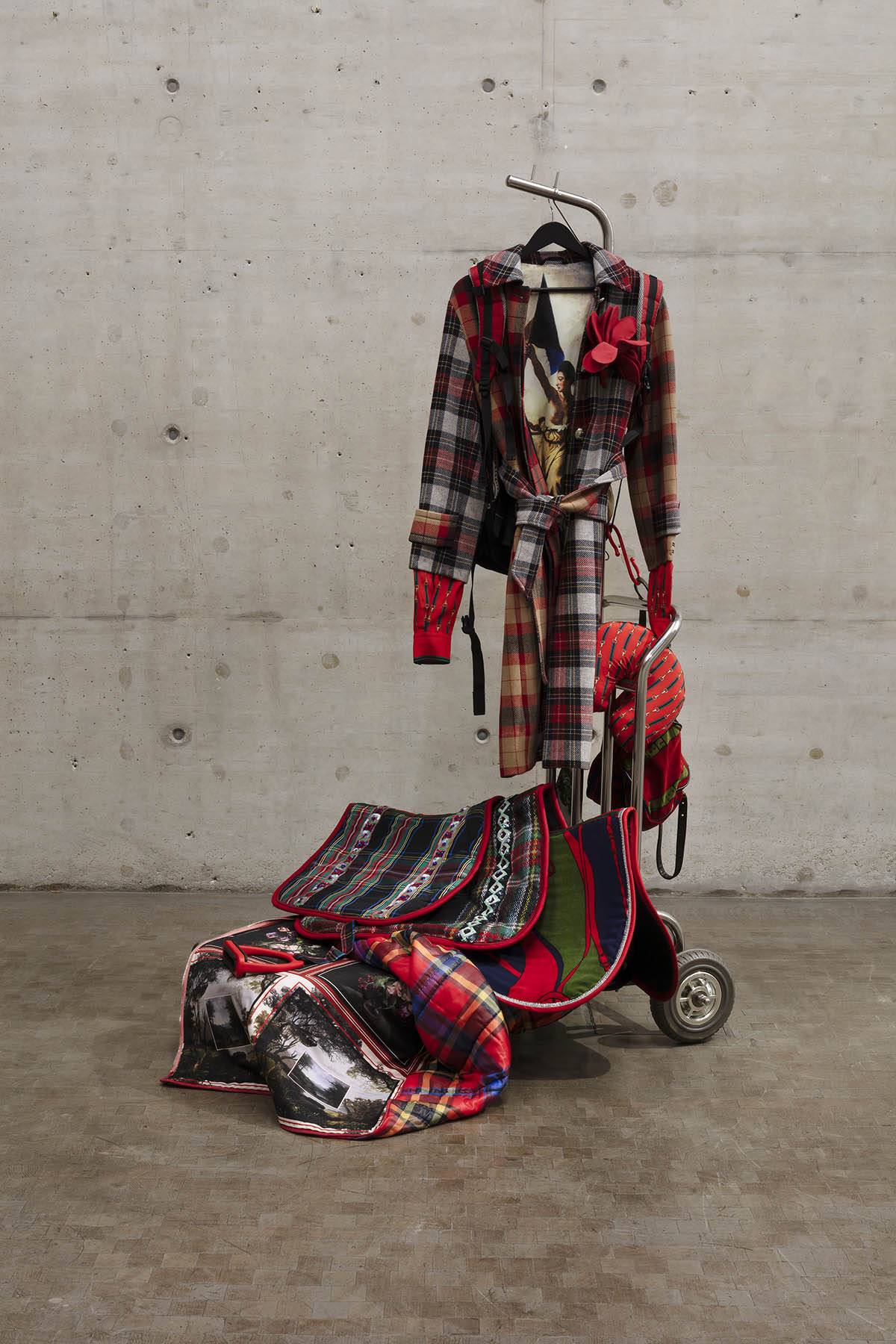
You often refer to Instagram in your works, do you think that the unlimited feed you are going through and this amount of information is present in your image garments? The image garments also wear so many different motives, details, sides of them, notions of inside and outside. Do you think that this is what makes the works so engaging with the spectators? It’s almost like a flirtation that is being born.
It is definitely about layers and layers of perception. When you have many layers, you have so many points of view, and that’s why I like the three-dimensional object. It is also about this idea of plurality.
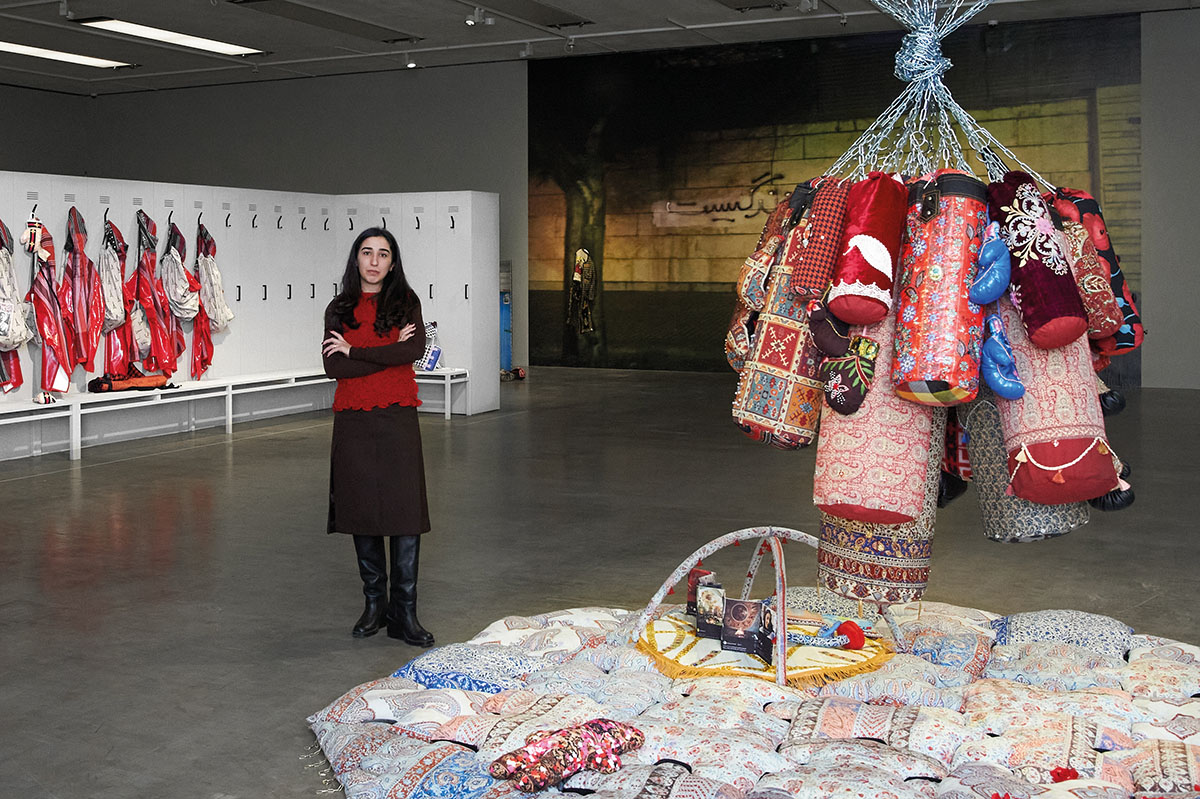
There is this term used in the context of your work, “Ultra Baroque.” Do you like to connect with it?
Yes. We live in the Ultra Baroque, the digital world. Instagram is just one example; you have next to it many other things that are ultra-baroque. All the emojis, all the memes, all the double-clicking on hearts in the apps. It’s like an infinite perspective of mosaics of images; if you click on one, you go to the other one, and then you can slide again and again to infinity.
Exhibition: Chalisée Naamani: Octogone
Exhibition duration: 29 January–6 April, 2026
Address and contact:
Kunsthalle Wien Museumsquartier
Museumsplatz 1, 1070 Vienna
www.kunsthallewien.at
Chalisée Naamani – www.instagram.com/chaliseenaamani/
Chalisée Naamani (b. 1995, Paris) has held solo exhibitions at Palais de Tokyo, Paris (2025) and La Galerie – Centre d’art contemporain de Noisy-le-Sec (2021). Her work has also been exhibited at institutions including Le Delta, Namur (2025); Hangar Y, Meudon; FRAC Champagne-Ardenne, Reims (both 2024); MUDAM Luxembourg; La Friche La Belle de Mai, Marseille (both 2023); and the Biennale de Nice (2022). Naamani received the Pista 500 Prize from the Pinacoteca Agnelli, Turin (2023), and the Benoît Doche de Laquintane Prize (2021). Naamani lives and works in Paris.
The first solo exhibition outside France by the French-Iranian artist Chalisée Naamani. Entitled Octogone, the exhibition includes a series of new commissions alongside recent sculpture, print, and textile works. Naamani describes her sculptures as ‘image-garments’, produced via a process of layering and collaging images, fabrics, and text from diverse sources. While her objects often resemble items of clothing or refer to the history of fashion, they are never intended to be worn.
The exhibition is organized in collaboration with Palais de Tokyo, Paris.