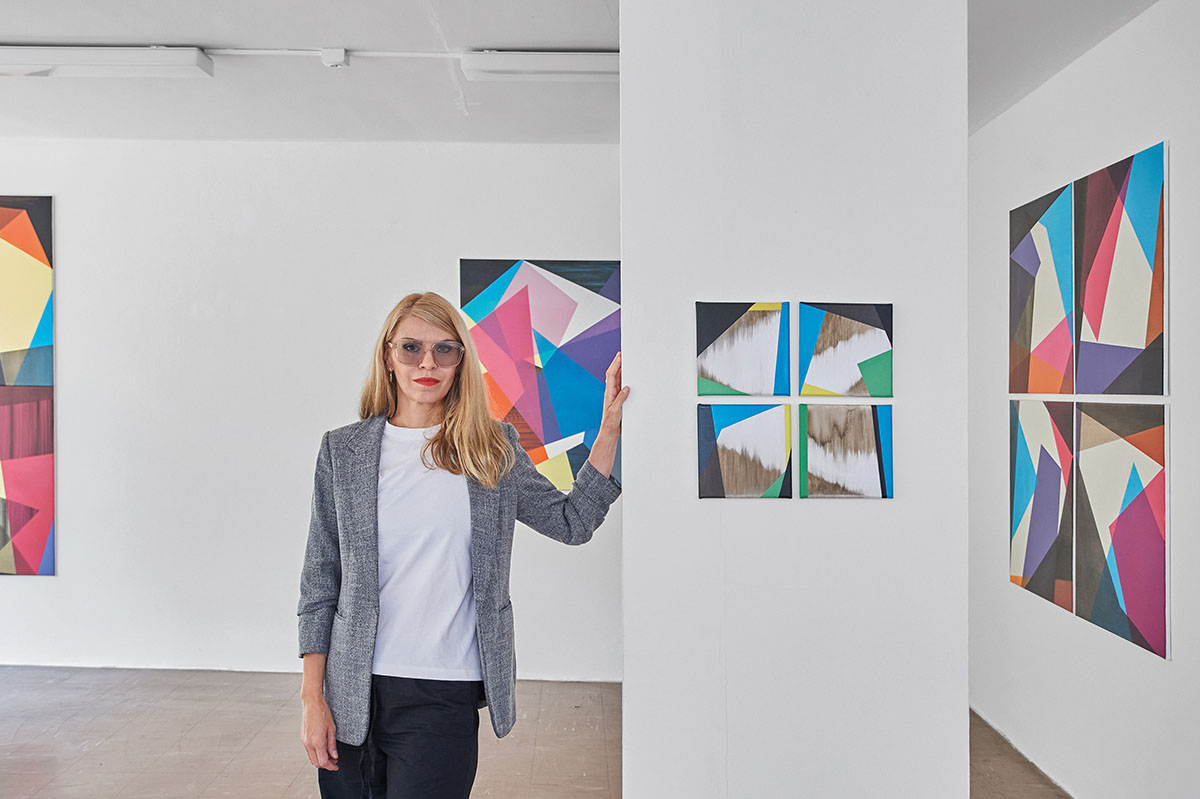
Can we start with the colors you used in the paintings and what their significance is in connection to the title of the exhibition?
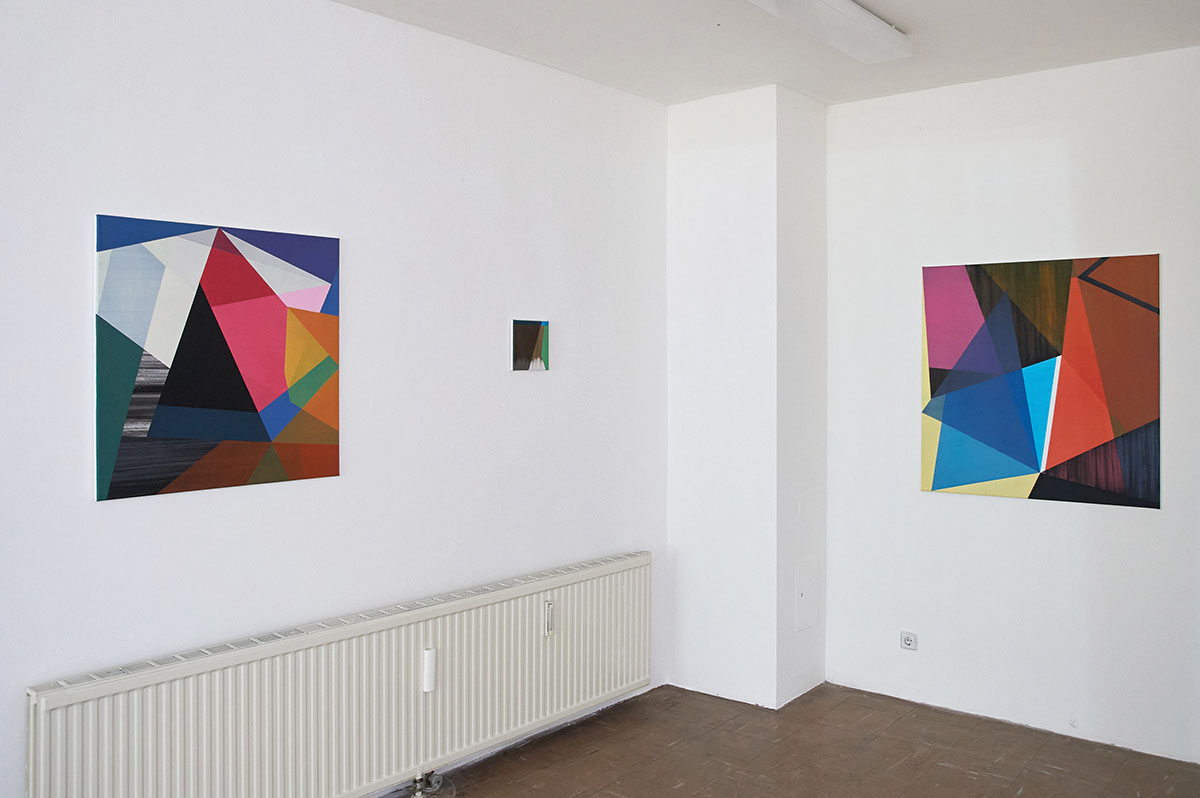
I’ll start with the exhibition title, because it relates to the colors “Geometrische Gefühle” or in English “Geometric Feelings”. The colors describe how I feel. The colors are an expression of the emotions, of my state of mind when I sit down in front of the canvas. It depends on my mood that day, which colors I choose, just as much as how the forms emerge. I’m not someone who plans a painting. I use painter’s tape directly on canvas, and at the beginning, I try to divide the surface with lines in an interesting way. Then, with the decision of colors, a situation develops more deeply, and I continue working on it.
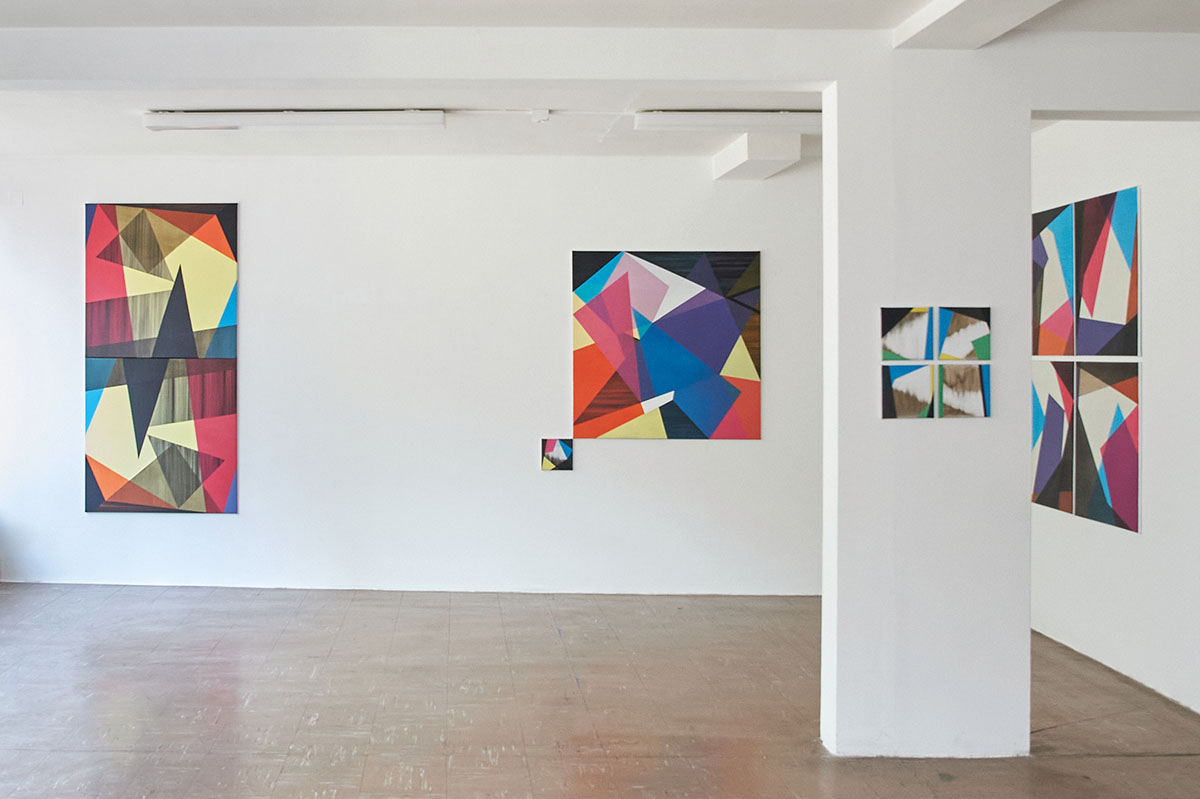
Why the square format of the canvas?
It gives me much more freedom while composing. During the process, I can rotate the canvas in any direction. It might even happen that I start a painting and later realize it’s standing upside down, and then I continue working on it in the way I see it as good. I only decide it’s finished from one specific position. After that, I can’t just rotate it again. That freedom exists only during the process.
What’s exciting for me about this way of working is that before painting, I worked a lot with architecture and film installations, very conceptually. In the end, it’s still very connected to it. Back then, the installations were highly architectural and geometric. I worked with film strips and needed a lot of light. Light already played an important role there, just as it does now in painting. And my working method is similar, too. I don’t paint one picture after the other; I work on six or even ten at the same time. It’s very series-based. Just like in film, where movement emerges from multiple frames. For me, during the working process, that cinematic element comes back again. Movement is essential.
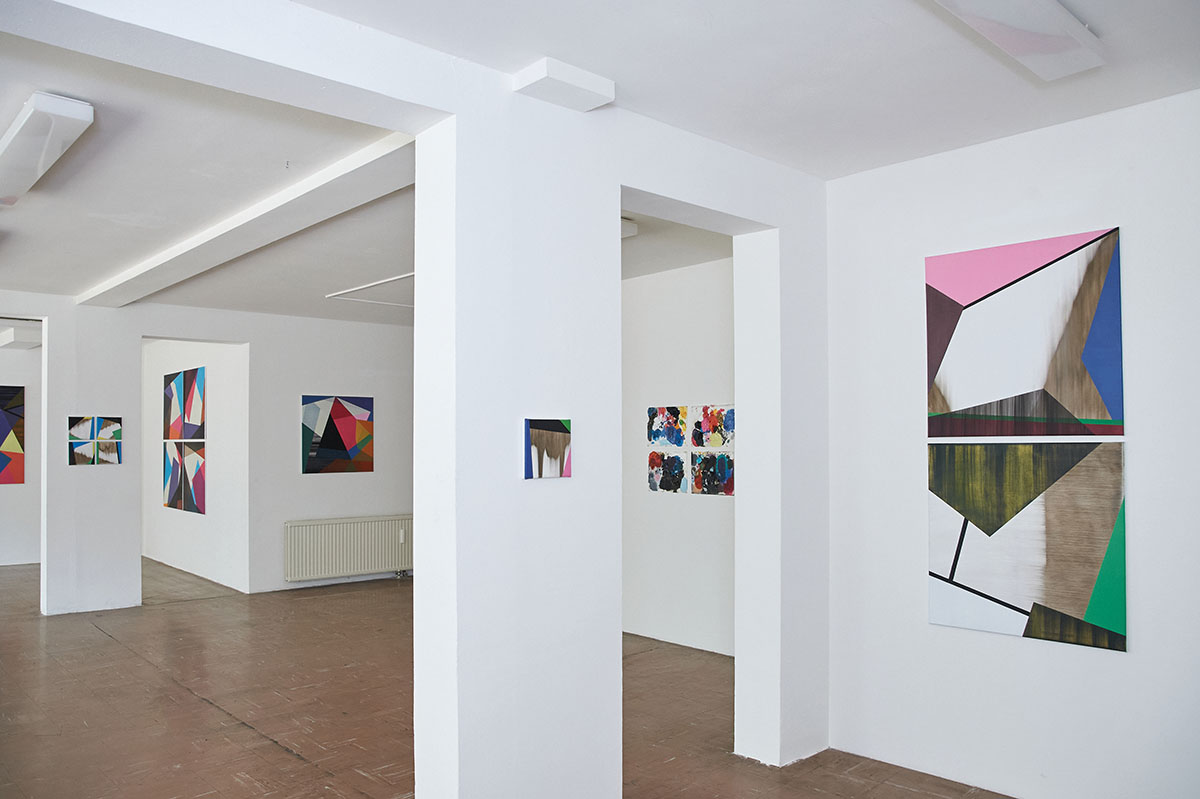
How important is for you the setup part of the show to you, and how the works are reacting in connection to the space.
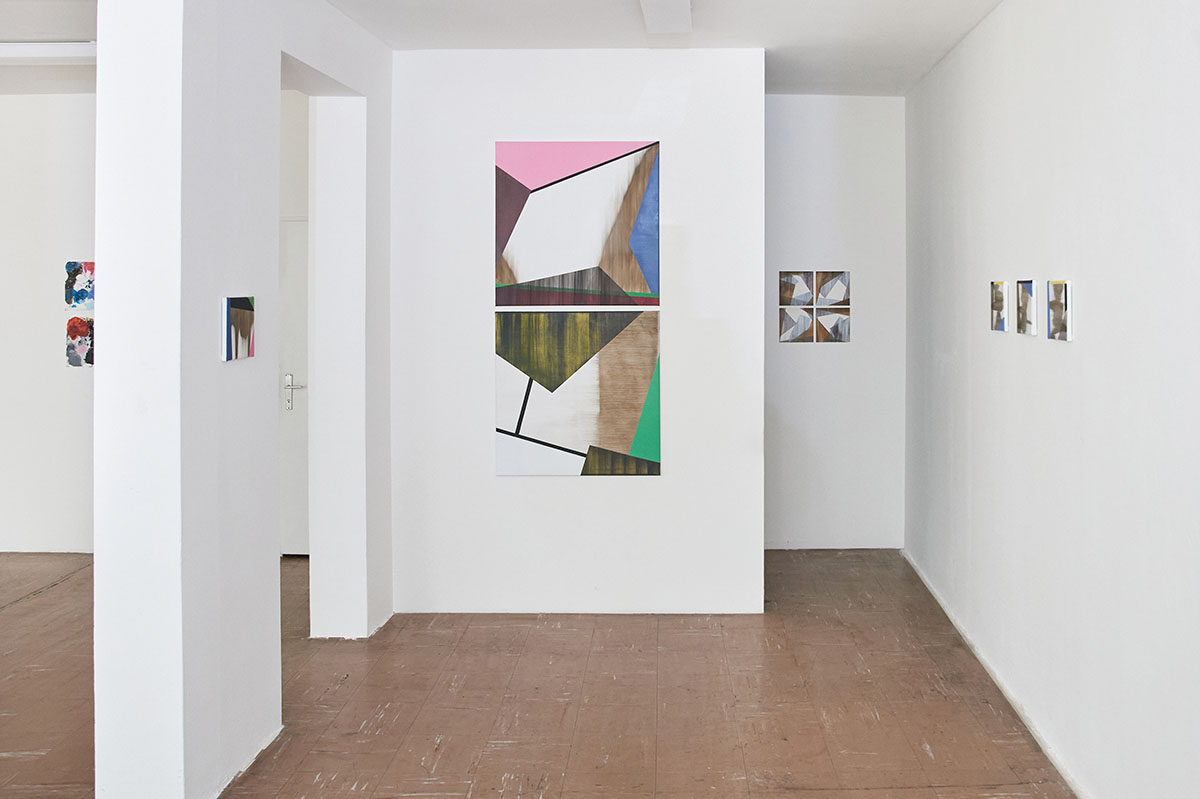
Every exhibition I do with my paintings, I have a good sense of space, so I insist on doing the hanging myself. It’s a crucial part of the artistic process. I hang the works in sequences. Small series belong together: sometimes three in the group, sometimes four. I want some of them to hang in pairs. When you walk through the exhibition, there should be a certain flow. I’m quite strict about that. I know exactly how to work with a room that’s two and a half meters high. And I once had a space with walls over four meters high—that was completely different. You hang in another way. There I worked almost entirely installatively, treating the whole wall as one surface. The wall becomes like a painting that I compose into. In the end, hanging the works is the same process as painting them. You can paint the best pictures, but if they’re badly hung, it’s over.
You mentioned sequences. The format is square, but what about the relationship between large and small works? For example, with a quite large canvas touching the edge of a very small format. Could you speak about that?
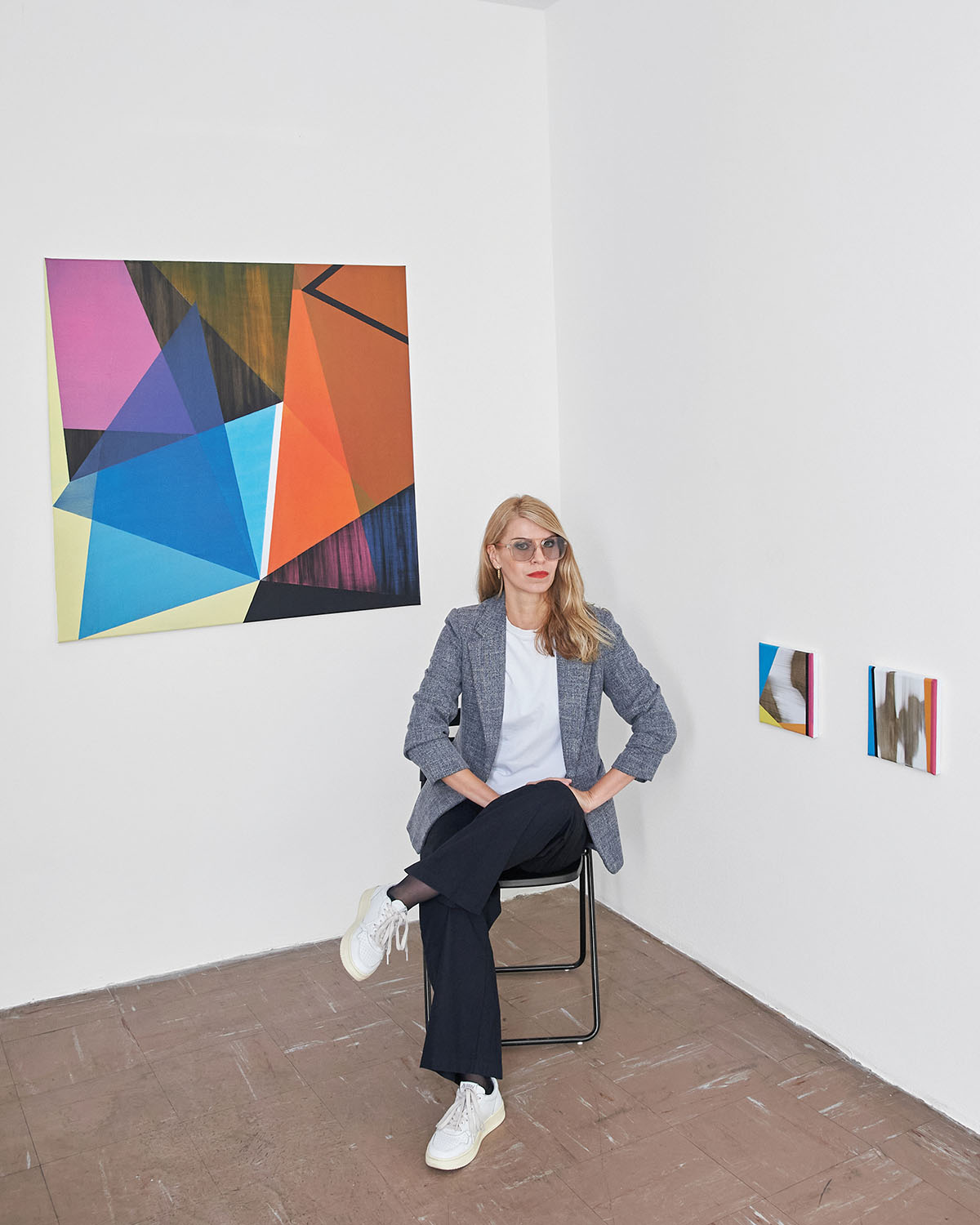
I love working in both large and small formats. The smallest was once 10 x 10 cm, next to 120 x 120 cm or even larger. Switching between these proportions is incredibly exciting for me. Sometimes, a very small format can feel very large; there’s a beautiful balance between the two works I placed together. They harmonize in color and composition. I only knew it had to be hung this way once I saw them together. Like a director or editor knowing exactly where to cut.
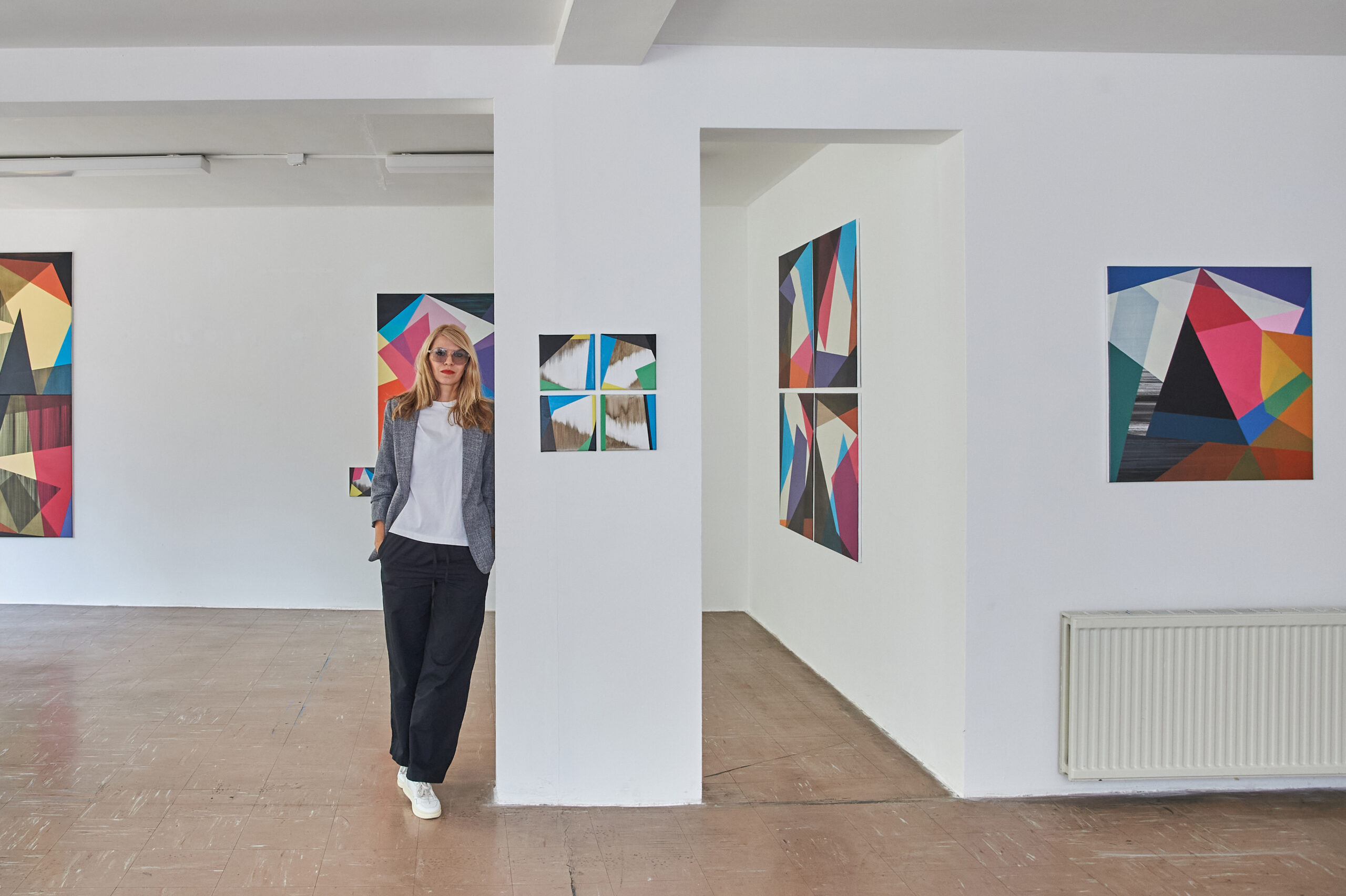
You spoke about setting the composition of the painting with painter’s tape. But there’s always a first layer, a base on the canvas, right?
Yes, depending on how I feel, I tape off two or three areas and choose colors according to my mood. Since I work with oil on canvas, it needs time to dry. So while one layer dries, I begin the first layer on four other paintings. Then I return. It’s always serial, always several works at once. That’s why, when they’re shown together, they hold each other. There’s harmony and coherence. They never fall apart.
Can you elaborate more on the palette papers, being exhibited as well?
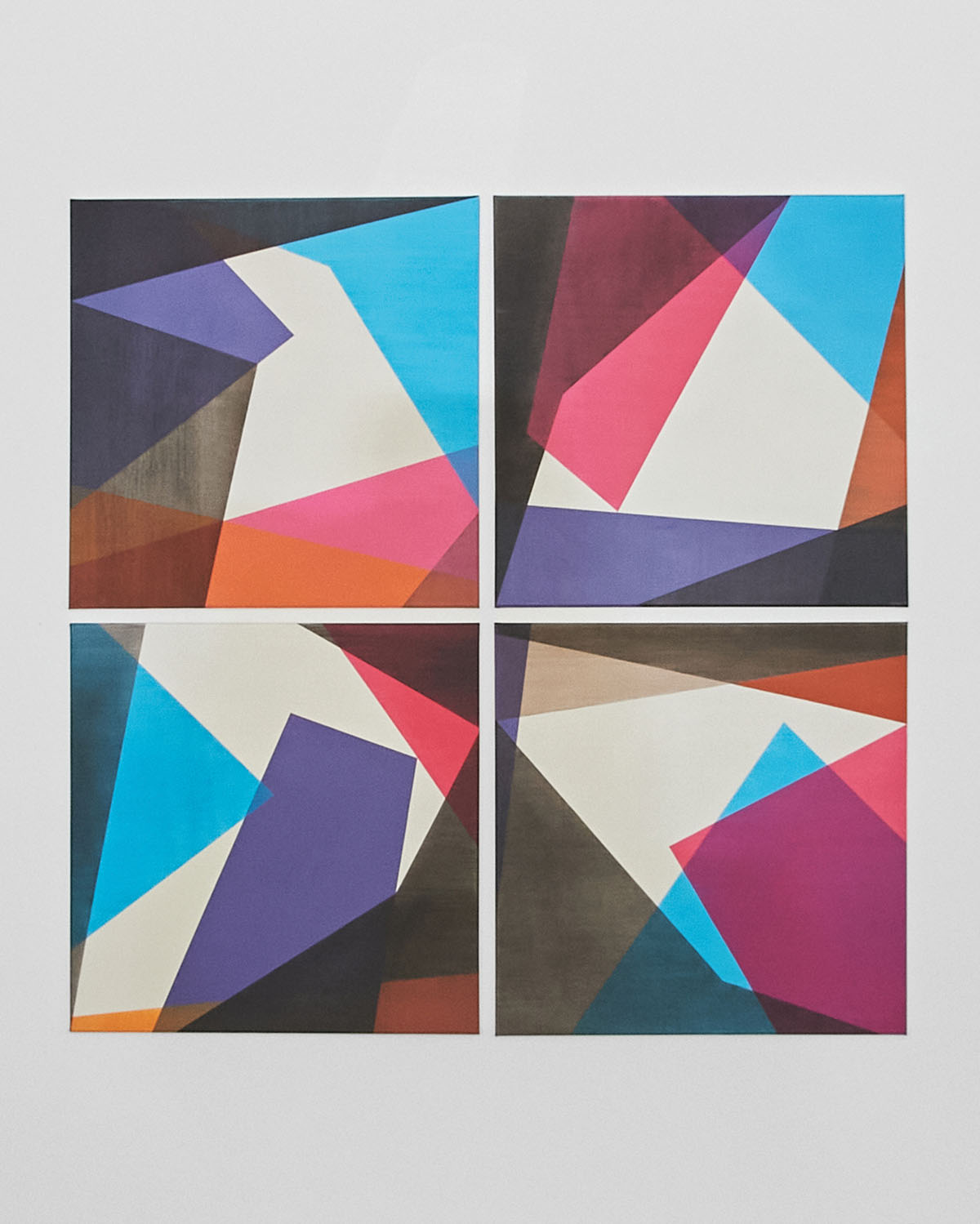
I actually use a very smooth paper palette where the paint doesn’t get absorbed. And I decided to show them this time, they remind me of makeup palettes a lot. On one palette, I might paint five large works. I work in very thin layers, so earlier layers shimmer through. I paint flat, not in a modulating way. And yet, even though it’s flat, it becomes spatial through transparency and overlapping. Perspectives emerge.
Triangles are repeating themselves in your work constantly. Can you tell us more about it?
I just love triangles. The triangle is an important symbol in feminism. I’m a very feminist artist; I advocate strongly for women’s and children’s rights. The shapes are very pointed. You see these harmonious colors, but when you look closely, they are sharp forms, like weapons, resistance, and defense. I say: with the weapons of a woman. The painting seduces you, but everywhere there are sharp edges. In a way, it’s like a make-up palette—the seduction happens on the canvas.
In the text by Thomas Mießgang, written for the exhibition, he emphasizes the feminist part of your practice. Tell us more about it.
It is not the first time that Thomas has written about my exhibition; he emphasizes feminism in the context of my work more clearly. Feminist art can also exist in geometric abstraction. I don’t have to paint a nude body to say I’m a feminist artist. Not at all. If you look at catalogues of museums and collections, much of the feminist avant-garde work is strongly body-oriented. Of course, that was another decade. But the triangle, the feminist symbol, has historical significance. You can research that easily.
My works are full of triangles; that cannot be a coincidence. Politically, I’m very engaged, especially regarding children’s and women’s rights. Recently, I did a four-part radio series with Thomas Mießgang for the Ö1 program called Radiokolleg. It aired over four consecutive days at 9:30 a.m. The topic was “After Violence,” addressing different aspects of violence against women in Austria, from femicide, which is only the tip of the iceberg, to the structures that precede it. All of this is connected. Art and activism are not separate for me; they inform one another.
How did you plan to expand painting in the space?
This time, I wanted to move more into space itself. Those black lines in these works will continue onto the wall in acrylic paint, all the way until it hits the ceiling. I feel something new is happening there. I could continue it onto the ceiling and beyond; it should expand into the space. And these brown smears everywhere in these paintings, something organic. That came back subconsciously. I used to work a lot with Polaroids, especially sepia-toned ones. That memory somehow returned in the paintings as well. The brown often has this particular aesthetic that comes from photography. I will take this brown shape from the painting and make it run out of the image onto the floor. I’ll melt chocolate and let it flow out here.
Why chocolate?
Because it matches the color beautifully. It works better than black; it stands out more clearly from the floor. The whole exhibition will smell like chocolate. That’s something film can’t do. When I watch a movie or a series, I don’t smell anything. I often think about that when I see documentaries about Hermann Nitsch. It’s a pity you don’t smell it. You have to be physically present. Blood, scent—smell is a fascinating subject. With chocolate, I can work very organically, echoing forms from the composition. It connects back again to the organic traces of the paint palette. The circle closes.
How did the contact with Hollerei Galerie happen, and how did it come to the exhibition?
We met and immediately understood each other. Then we decided to do an exhibition. Margit and Andre Stolzlechner are collectors and already own my works. A beautiful relationship developed. I also really appreciate the kitchen at Hollerei. In a way, the exhibition is also a kind of nourishment. That connection immediately appealed to Margit Stolzlechner. And it’s a wonderful space. I like that people can look into the exhibition from outside at any time. Here, you also attract walk-in visitors. I have nothing against that—on the contrary, I love it.
Exhibition: Sabine Aichhorn. Geometrische Gefühle
Exhibition duration: 03.03. – 29.03.2026
Address and contact:
HOLLEREI Galerie
Hollergasse 12, 1150 Vienna
www.hollerei-galerie.at
Sabine Aichhorn – www.sabineaichhorn.at, www.instagram.com/sabine.aichhorn
Sabine Aichhorn, born in Linz, lives and works in Vienna. From 2004 to 2007, she studied painting, animation, and tapestry at the University of Applied Arts Vienna under Professor Christian Ludwig Attersee. From 2000 to 2004, she studied textile art and design at the University of Art and Design Linz, and from 1999 to 2004, she studied economics at the Johannes Kepler University Linz. In addition to her artistic work, she is committed to women’s and children’s rights as a founding member of FEM.A. Extended stays abroad in California and the Netherlands, as well as numerous travels across Europe, to Cuba, Nepal, Morocco, and Egypt/Sinai, have significantly influenced her thinking and working methods.
About Gallery Hollerei: Margit and Andre Stolzlechner ran the café in the Essl Museum for years and have always been art lovers and collectors. Art has always been presented in the Hollerei restaurant. When the shop above the restaurant was up for rent in 2015, they did not hesitate for long and opened the Hollerei Gallery to combine gastronomy and art. Since then, Margit and Andre Stolzlechner have run the gallery together. The exhibitors are both local and international artists. The gallery not only presents art but also creates special experiences by combining fine art and culinary delights, exclusive art dinners, and events that take place in the exhibition rooms. The Hollerei Galerie not only focuses on the acquisition of artworks but also on the creation of a cultural meeting place that brings together art lovers of all kinds. Hollerei Galerie is located opposite their restaurant, „Hollerei“.