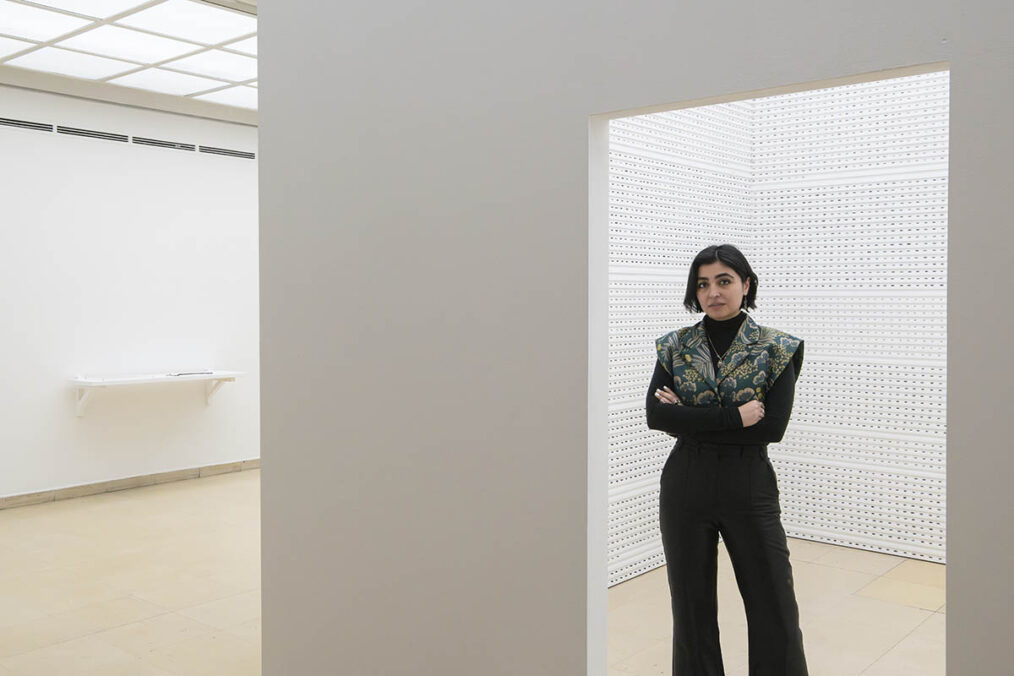
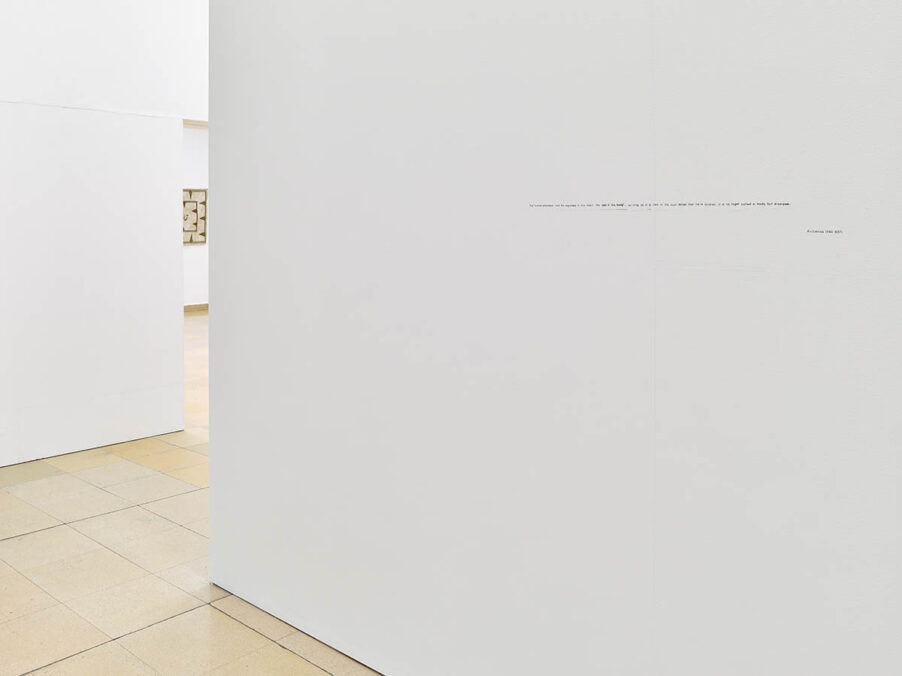
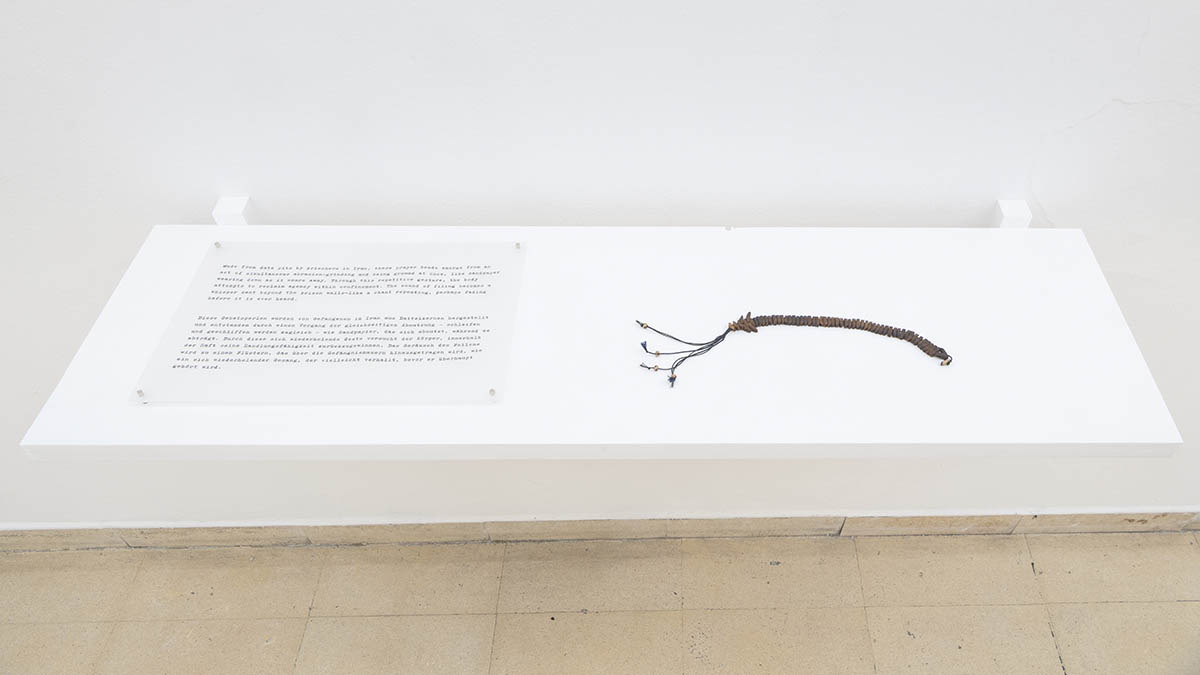
For Corpse, Aleph created a 3.8 x 3.8 x 4 m walk-in archive of 27,277 carved date pits in the centre of the Kunstpavillon. The pits, divided into 30 collections, were modified for the project over a period of six months by 18 prisoners at a prison on the outskirts of Tehran. The practice of filing date pits to create prayer beads has a long tradition in Iranian prisons. Especially in solitary confinement and isolation, without access to tools or permission to create things, collecting and carving date pits can become an act of survival. The reshaped kernels often serve as currency or gifts and represent a small gesture of self-determination in a closed system. Lined up individually on the walls, they create an archive of faded moments and absent bodies—a landscape of repetition in which the manual work of carving the pits leaves only subtle traces. Similar to the poem by the Persian philosopher and physician Avicenna (also known as Ibn Sina), which is displayed on the outer wall of the archive, the artist writes in reference to her work: “In the absence of the contained (soul), the container (body) turns into a corpse.”
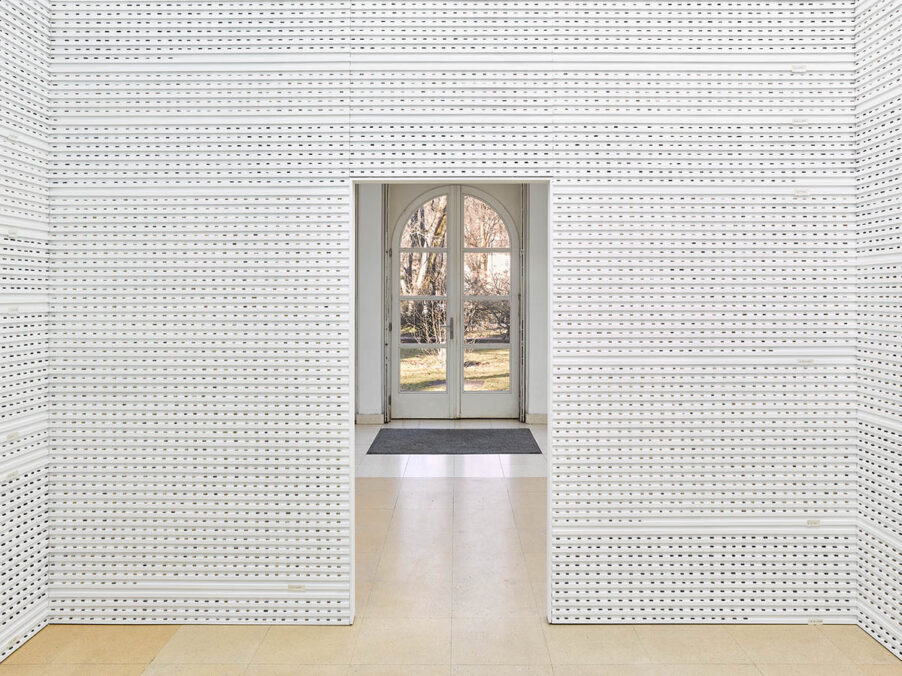
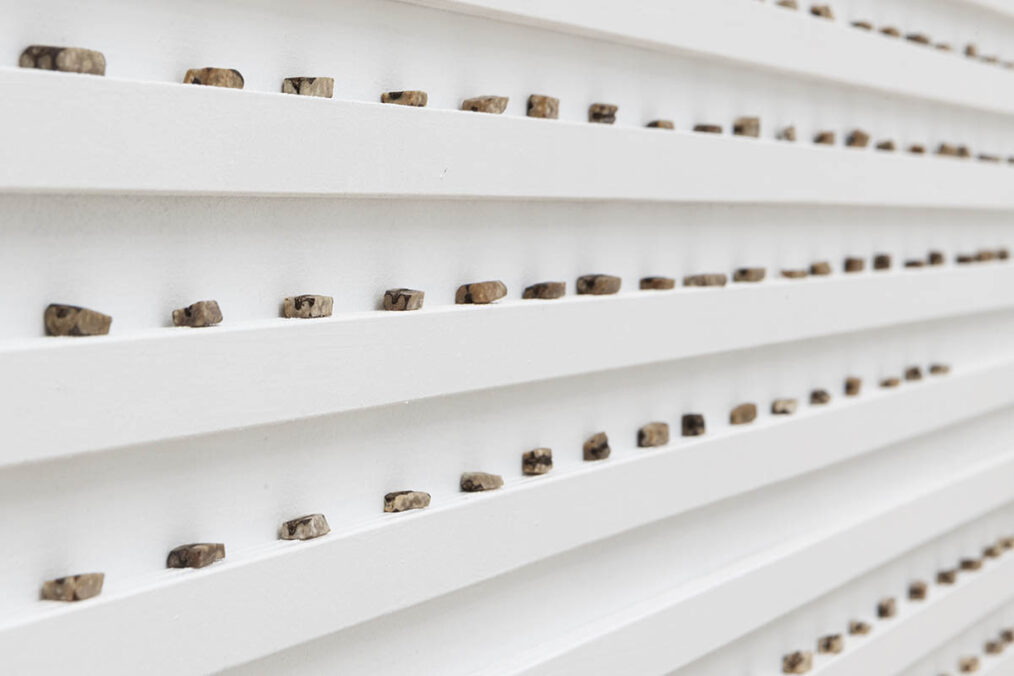
On the other hand, in order to imbue something with meaning, it must first be wiped clear of its previous meanings. The archive, a recurring element in Mahsa Aleph‘s oeuvre, resembles a game of codes: an arbitrary relationship between the materials and the signs hidden in the writings on the walls.1 The process of archiving is one of preservation and conservation, but also of removal, detachment, and exclusion. Each preserved piece of information carries traces of what has been omitted or left out. The archive set up in the Kunstpavillon neither asks questions nor provides answers, it merely makes its contents tangible. For Aleph, this silence is one of the most significant characteristics of an archive—it allows the archivist and visitors to immerse themselves in their thoughts, thus positioning itself in contrast to the basic assumption that an archive‘s collection is always structured according to a specific logic in order to shape our understanding of a particular topic.2
The mind behaves in the same way as a physical archive when it attempts to gain insights from its collection of memories: personal experiences, lived reality, and significant events shape the logic behind how our memories are stored. Our minds constantly rearrange and mix this data.3
Aleph‘s artistic work often originates from observations, followed by writing; two methods for filling the gaps between seeing and revealing things. Writing serves as the artist‘s first step toward de-familiarizing a particular phenomenon. The process of translation and alienation, as well as the joy of renaming and rediscovering certain things, are also evident in her approach to the banner in the rear room of the Kunstpavillon. It is reminiscent of decorated banners with moral messages that can be found in public buildings such as schools, mosques, and prisons in Iran. The artist has hand-embroidered the mixture of plastic and burlap, traditionally used to package flour or rice, with the quote „Watching is the act that transforms you into landscape. If you’ve never been part of the landscape, then you’ve never watched,“ from her own notebook. This playfulness on the part of the artist is also apparent in the way people practice home in the film Reanimation.
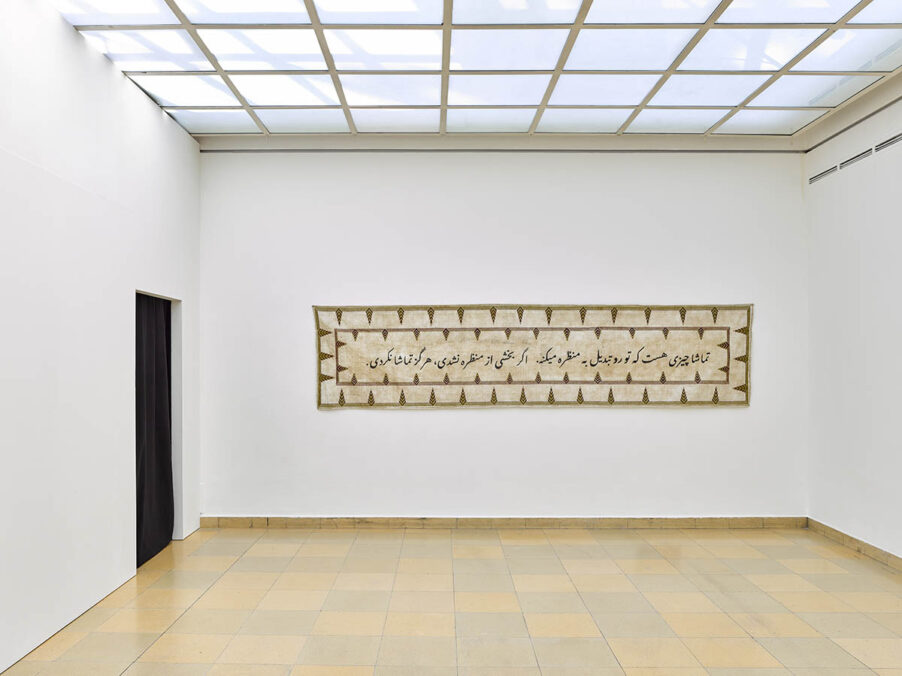
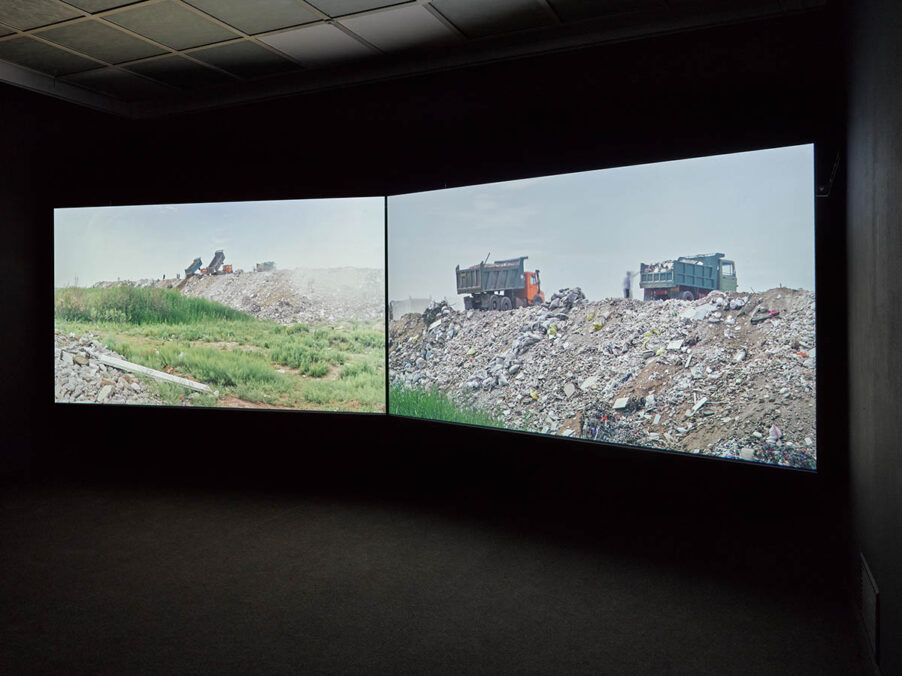
Today‘s Tehran is characterized by interplay between traces of the past and longing for the future. In Reanimation, the plot moves from the vibrant centre of the city, with a view of Mount Damavand, further and further into the city‘s outskirts; to the eastern edge, which was once home to a small community of factory workers. Today, most of the factories have been shut down and the majority of the people now work elsewhere or earn their living by recycling garbage and construction waste. A door, which the film follows from the demolition of a residential building onto an orange truck going to landfill, is exemplary of the debris that often serves as building material in these neighbourhoods. As a continuation of her work Remnants: Myth of House, the film illustrates how exploited classes live on the margins of cities and societies and their material remains. She effectively reminds us that even the periphery is characterized by different levels of marginalization.4 The filmic work is complemented by embroidery that Aleph found during the demolition of an apartment, which is now displayed here in the exhibition space, oscillating between the status of narrator and narrative, between reality and simulacrum. After the Corpse bears witness to Mahsa Aleph‘s intense engagement with complex cultural and geographical uprooting. Rather than focusing on loss, her work raises questions about human agency, dignity, and the subtle gestures through which individuals assert free will within restrictive systems. In her practice, words and rituals become acts of insistence — quiet yet powerful affirmations of presence.
Exhibition: Mahsa Aleph. After the Corpse
Curatorial Support: Bettina Siegele
Exhibition duration: 27.02.–25.04.2026
Address and Contact:
Künstler:innen Vereinigung Tirol*
Kunstpavillon
Rennweg 8a, 6020 Innsbruck
www.kuveti.at
Mahsa Aleph – www.mahsaaleph.com, www.instagram.com/mahsa.aleph/
Mahsa Aleph is a Berlin-based installation artist who studied fine art at Tehran Academy of Fine Art. Her projects engage with classical Persian literature, which she reinterprets in physical form, as if transforming the abstract essence of words into something concrete and tangible. Her work focuses on existential questions about human identity and its nature, the relationship between any being and its environment. The “historical memory” of materials and objects is a key motif in her installations.
- Misagh Nemat-Gorgani, “Mahsa Aleph – The Aleph Archive”, ZARD, Mohsen Gallery (Teheran), 2018, p.34. ↩︎
- Mahsa Aleph and Adrianos Efthymiadis, “Aleph Archive (An Open Letter)”, organized by Arts Letters & Numbers, Archive; Infinite Fragile Double, 8.12.2023. https://www.youtube.com/watch?v=c0nLOphbzAE&t=192s. ↩︎
- Ibid. ↩︎
- Sinthujan Varatharajah, “Two Screens Merging into One“, Akademie der Künste, The Breath of a House is the Sound of Voices Within, 2024. https://junge-akademie.adk.de/articles/voices-within/. ↩︎