‘Mobile Energy’, curated by Hana Ostan-Ožbolt-Haas at RAVNIKAR Gallery, brings together a younger generation of artists alongside the Slovenian group OHO and the collaborative practice of Ulay and Marina Abramović through a shared commitment to perpetual change, unintentional outcomes, and continuous becoming—destabilising sole authorship and the notion of an autonomous self across material, relational, and performative practices.
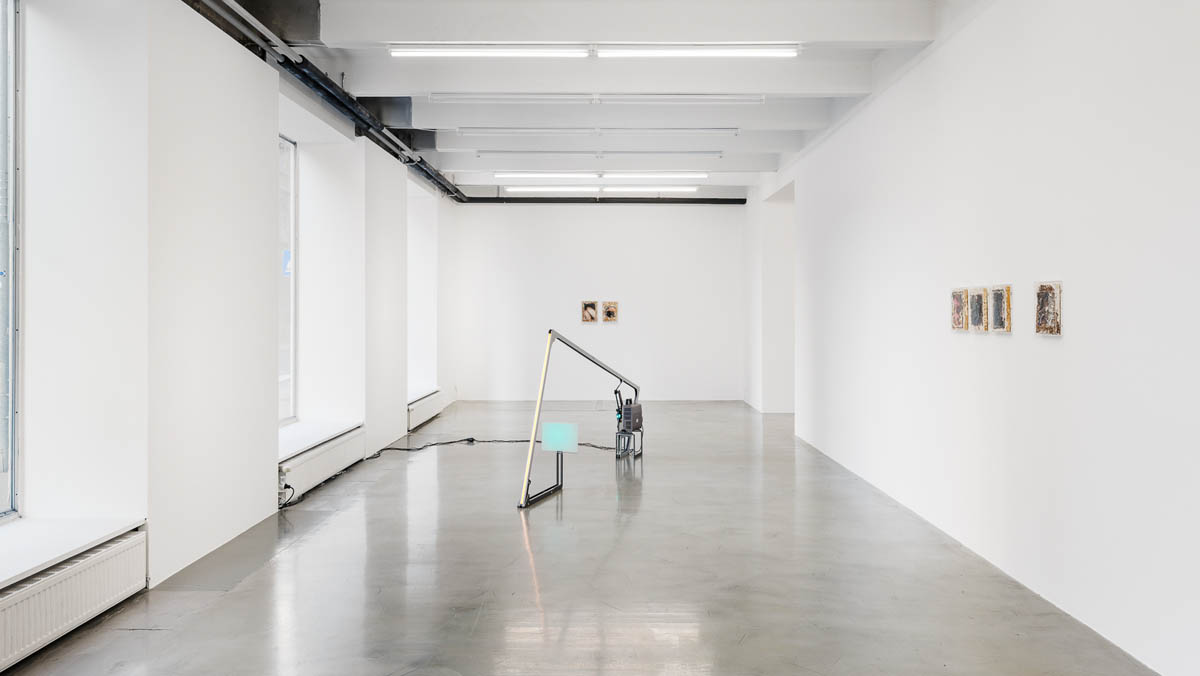
The first work to arrest my attention in the white cube gallery space is the Film Sculpture (2025) by Philipp Fleischmann. An aluminum line emerges from the projector, stretches through the room, and ends in a square of plexiglass. The analogue film strip, usually hidden, can be observed here through different angles as it continuously runs, exposed to the space and light, performing in front of the eyes. There is a satisfying feeling of rebellion in this openness and exposure, as Fleischmann combines two media—film and sculpture—and, with this, opposes the predominant gaze, a frame, a standardized view— embedded in the logic of the industrial camera. Ever-changing flashes of color fields, gaps, and patterns, following one another within the film strip as a single entity, seem to be a celebration of many different forms within a fluid self. The resulting abstraction in Fleischmann’s work can be seen as an opposition to representational logic and, more extensively, as a resistance to the norm.
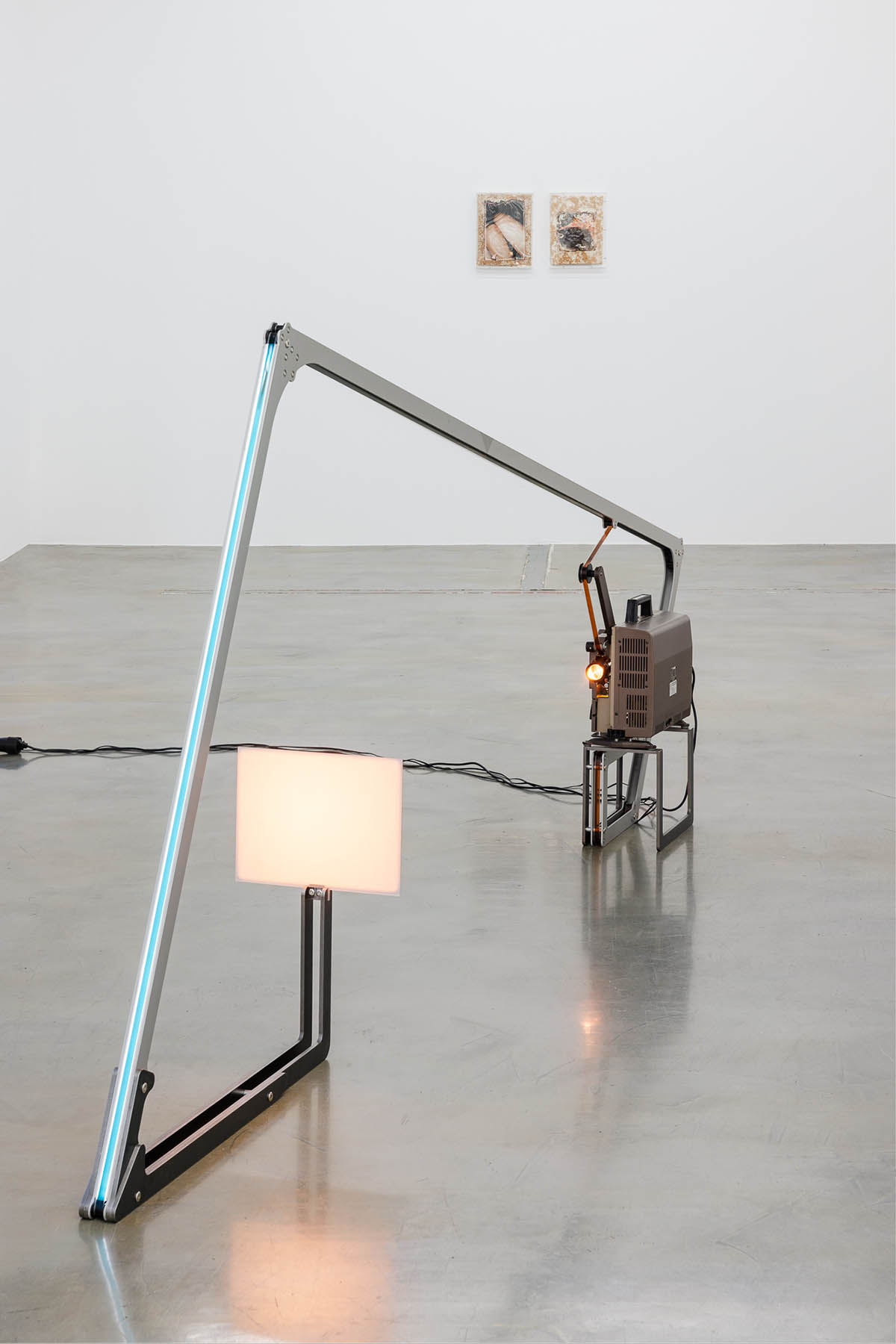
140 x 35 x 340 cm/dimensions variable. Courtesy of the artist. Photo: © kunst-dokumentation.com / Manuel Carreon Lopez
Perpetual change continues in the series, causing each other (2022-2023) and Exposure (2024) by Angelika Loderer. The works appear as “terrariums,” plexiglass boxes, within which inserted photographs — fragments of naked legs, a flower, the street at night — are continuously overtaken by the living, expanding colonies of mycelium. Eluding control, they create abstract patterns on the human-made works, at times fully dissolving them with thick gouache-like layers. Loderer shares her authorial voice with the fungi, evoking Donna Haraway’s concept of “making-with” rather than “self-making,” rejecting the notion of the autonomous and enabling rhizomatic, non-hierarchical relations.
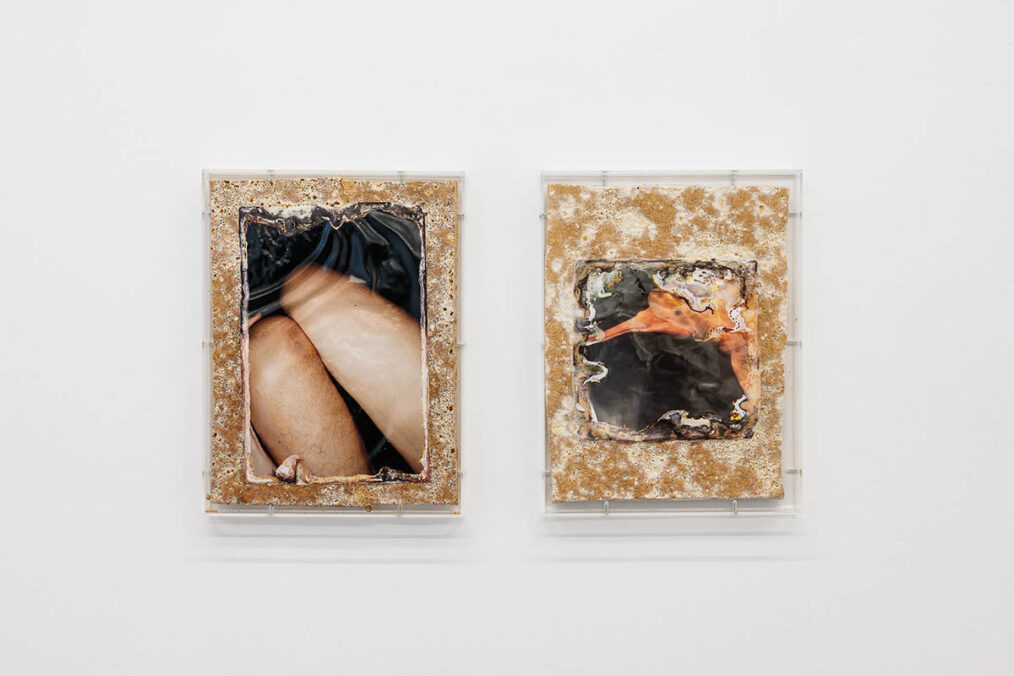
37 x 28 x 4 cm, Courtesy of the artist and SOPHIE TAPPEINER, Vienna. Photo: © kunst-dokumentation.com / Manuel Carreon Lopez
The room behind the main gallery space is fully inhabited by Nika Erjavec’s sculptures, which form the installation Third Landscape (2021–2025). Suspended in the air or lying on the floor, they are composed of dry branches bent together with plastic parts, collected from overlooked or abandoned sites—places of great biodiversity, where nature quietly reclaims what was left behind to create new environments and conditions for renewal. Within the installation, the objects become self-sufficient agents: when I disturb their ecosystem with my presence, they respond with convulsive movements and a buzzing sound.
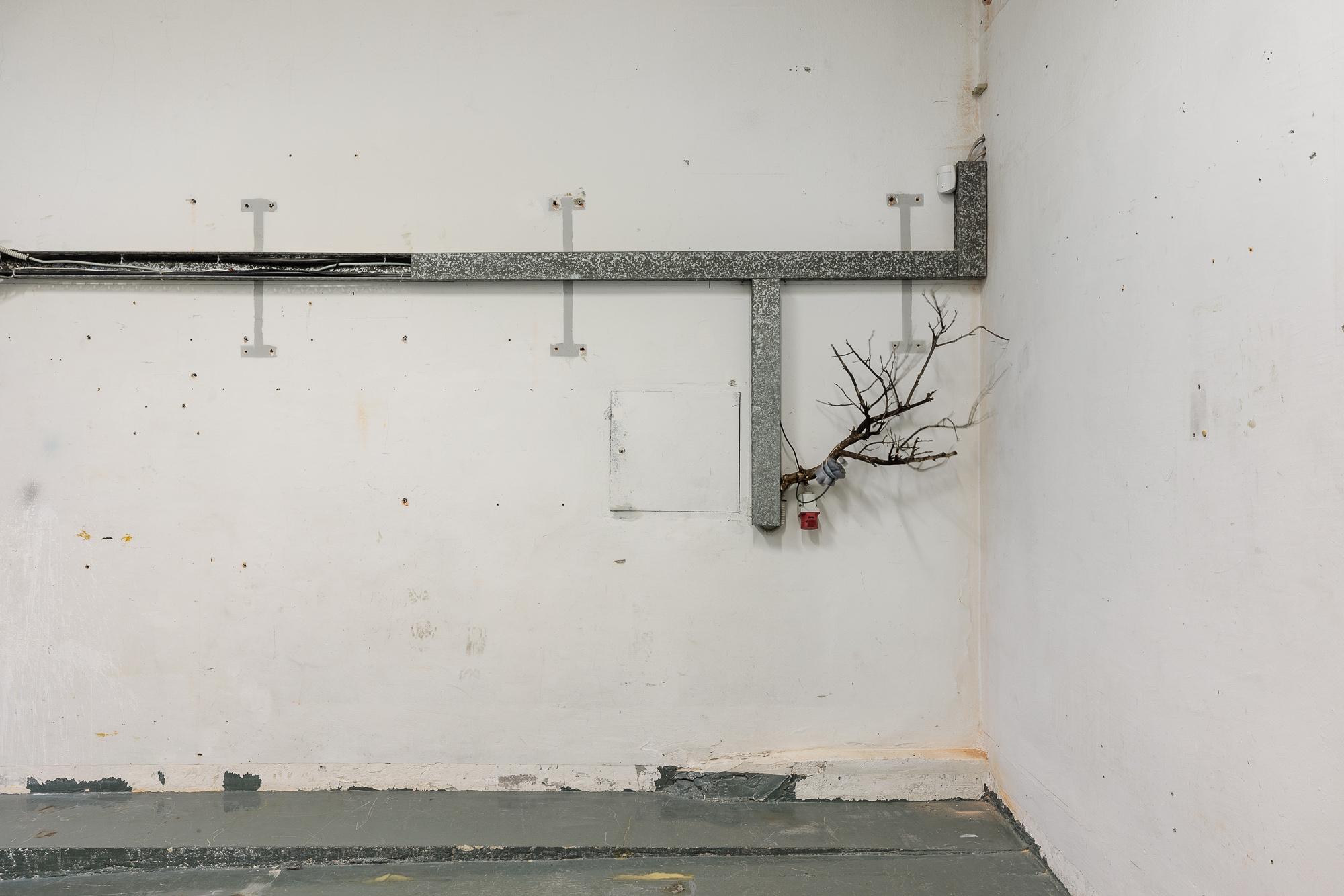
Further into the exhibition, the refusal of sole authorship emerges through unconscious, spiritual, and processual practices. Josef Strau’s works include canvases bearing stone magnets or a chocolate-box tray coated in burnt metal, yet the core of his practice appears to be text. Presented as large printed posters on the windows or as part of a floor-lamp sculpture, Strau’s writing resists easy comprehension. It consists of densely printed, unrevised text whose subjects range from philosophical revelations to intimate thoughts or fiction. This unintentional writing instils trust in thought as something that can emerge by its own power. Strau seems attracted to what is inconsistent or unresolved, resulting in the potential for meaning, which reflects his commitment to the non-productive attitude of an artist.[1]

Courtesy of the artist and LAYR, Vienna. Photo: © kunst-dokumentation.com / Manuel Carreon Lopez
Nearby—and across the gallery—black-and-white photographs document the collaborative, ephemeral actions of the Slovenian group OHO in the Zarica Valley: the burning of candles on a field, mirroring a constellation of stars (Arrangement of Candles on a Field, 1970); the exploration of time and space—a flare of light leaping into the air and falling back down, tracing circles against the night sky and bursting into abstraction (Time-Space Structures, 1970). The curatorial focus on the works of the OHO group from the late 1960s and 1970s supports the exhibition’s permeating idea of the relational: at that time, OHO’s spiritual practices aimed to achieve unity among humans, nature, and the cosmos. One of the members, Marko Pogačnik, recalls their increasing interest in telepathic connections, through which the body became a channel between different spaces. [2]
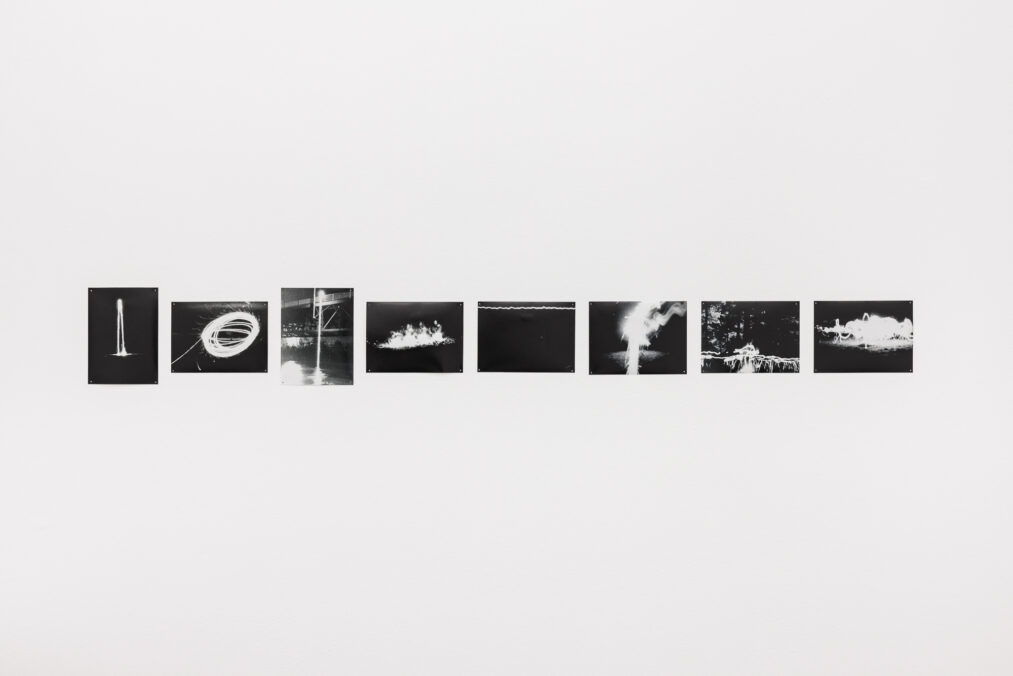
Courtesy of Moderna galerija / Museum of Modern Art Collection, Ljubljana. Photo: © kunst-dokumentation.com / Manuel Carreon Lopez
This spiritual charge intensifies in the basement of the gallery through filmed documentation of performances by the collaborative practice of Ulay and Marina Abramović. In one of the two videos, Nature of Mind (1980), Abramović stands at the edge of a concrete wall, her arms stretched upward. At a certain moment, Ulay jumps into the water, lightly grazing her body mid-air. The encounter unfolds like a spark, a moment of ignition. At the time, the artists were interested in the merging of their energies, giving rise to what they called “That Self”: an autonomous entity that carries vital energy and acts beyond their control.

The opening night was followed by radically personal and intimate performances by Mira Mann, Hannah Koselj Marušič, and Luca Büchler. In After the End, Before the Beginning, under orange light, Luca Büchler creates a liminal space outside the confines of linear time, taking the golden hour as its conceptual basis. His movements oscillate between repetitive dance gestures and rapid walking through the audience, coursing like an electric discharge to Paul Ebhart’s beats. Within this in-between moment of constant becoming, Büchler’s body fragments, falls apart, and gathers again, forming hybridized shapes with shadows and the bodies of the audience, staying open to limitless multiplicities. This performance crystallizes the core of Mobile Energy, revealing how relinquishing control, linearity, and the single self becomes a liberating condition that resonates throughout the exhibition.
Group exhibition: Mobile Energy; Curated by Hana Ostan-Ožbolt-Haas
Artist participating: Marina Abramović/Ulay, Luca Büchler, Nika Erjavec, Philipp Fleischmann, Hannah Koselj Marušič, Angelika Loderer, Mira Mann, OHO, and Josef Strau. With performances by Luca Büchler, Hannah Koselj Marušič, and Mira Mann
Exhibition duration: November 28. 2025 — January 17. 2026
Venue: RAVNIKAR, Ljubljana, Slovenia
RAVNIKAR – www.ravnikar.org
[1] In 2006, Josef Strau published an essay on the idea of “the non-productive attitude,” reflecting on the Cologne art scene of the 1980s. See: Josef Strau, “The Non-productive Attitude,” in Make Your Own Life: Artists In and Out of Cologne (Philadelphia: Institute of Contemporary Art, University of Pennsylvania, 2006).
[2] Beti Žerovc, “The OHO Files: Interview with Marko Pogačnik,” ARTMargins Online, July 27, 2013.