

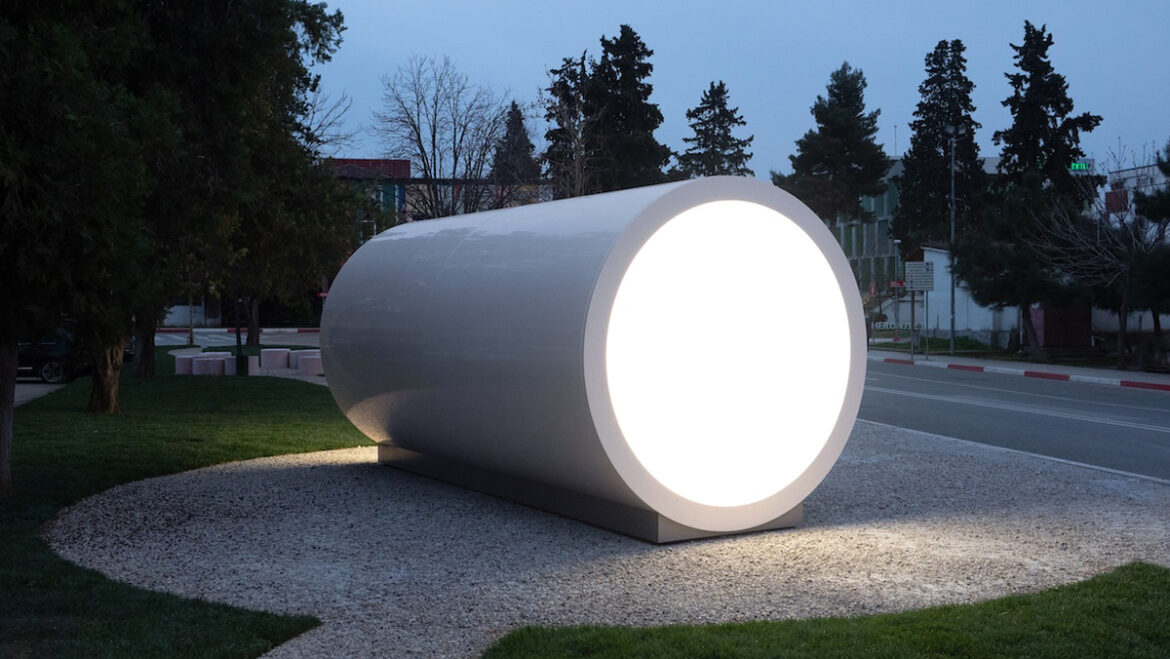
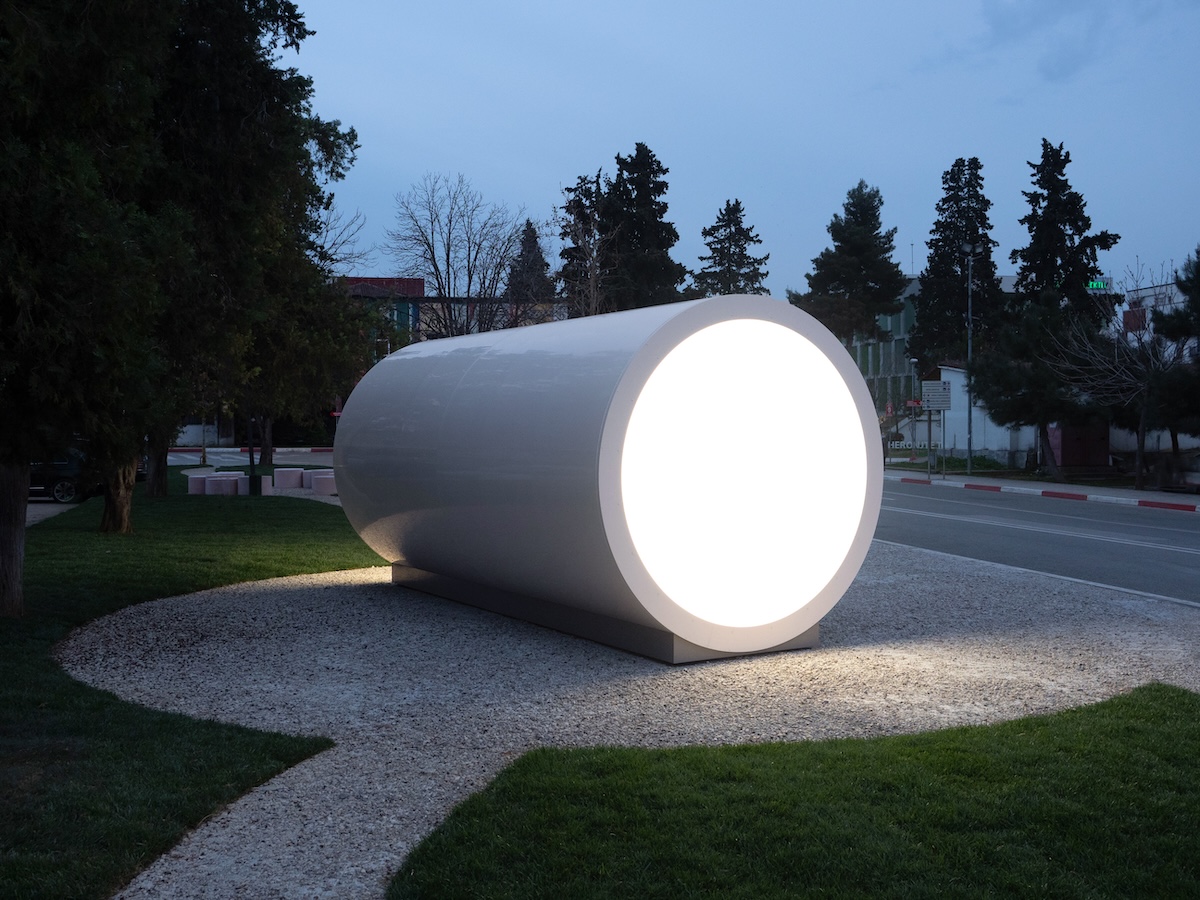
This site-specific installation draws inspiration from the profound recollections of patients experiencing near-death experiences (NDEs), creating thus a space where art, spirituality, and science intersect. Terminal for Tirana offers a contemplative space where visitors can experience a sense of euphoria, peace, and the feeling of transcending physical boundaries.
About the artwork
Terminal for Tirana
Art Work in Public Space by Karolina Halatek
2024, Polyethylene, LED, aluminium, wood, 6m x 3m (diameter)
Location: https://maps.app.goo.gl/K6tdm2RnCafew6yg8
Halatek’s brilliant sculpture is composed primarily of a single polyethylene cylinder of 6m by 3m diameter, illuminated from within by solar-powered LED neons. This tunnel of light invites visitors to step into an otherworldly experience, reminiscent of those reported in NDEs – a journey through a dark tunnel towards an enveloping, radiant light. The artwork finds its roots in echoing common experiences recorded in the databases of the Near-Death Research Foundation (NDRF), adding a profound exploration of human consciousness and mortality to the stunning visual spectacle.

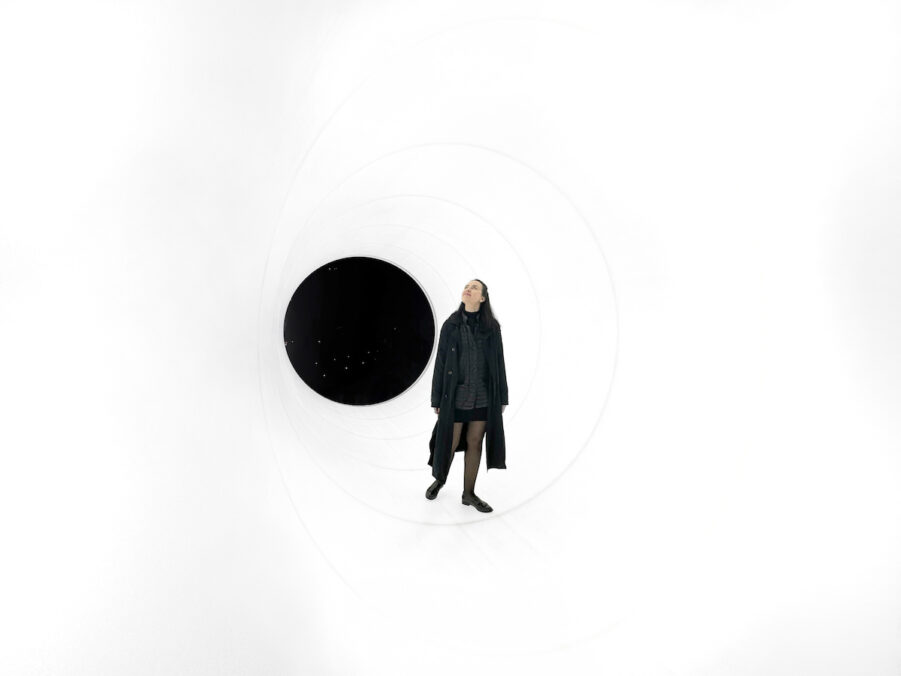
Terminal for Tirana reaches further than an art installation; it is a meditation on life, death, and the persistence of consciousness. Situated at the entrance of the University Hospital Center Mother Teresa, Tirana, the work gains an added layer of significance, resonating with those contemplating life’s fragility and the mysteries beyond. This approach is also reflected in the site’s transformation which has been designed by Elian Stefa and Dea Buza to create a variety of moments of intimacy and pause. Accessible from both sides the installation, placed as a crown jewel, invites viewers to immerse themselves in the transformative power of light, offering a glimpse into what might lie at the threshold of life. It is a reminder of the eternal continuity in the world of light, urging the audience to reflect on our existence and the universe’s boundless mysteries.
Architectural concept
While analyzing the location, the presence of three relevant elements for the site were identified:
1. The trees and vegetation already present
2. The curved wall / door to the north of the site
3. The pedestrian sidewalk
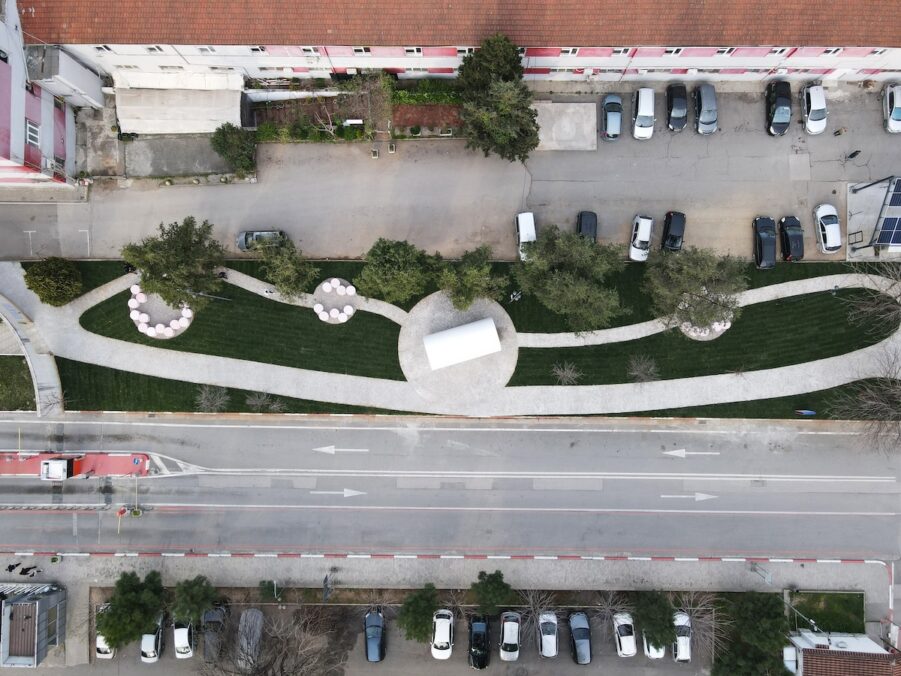
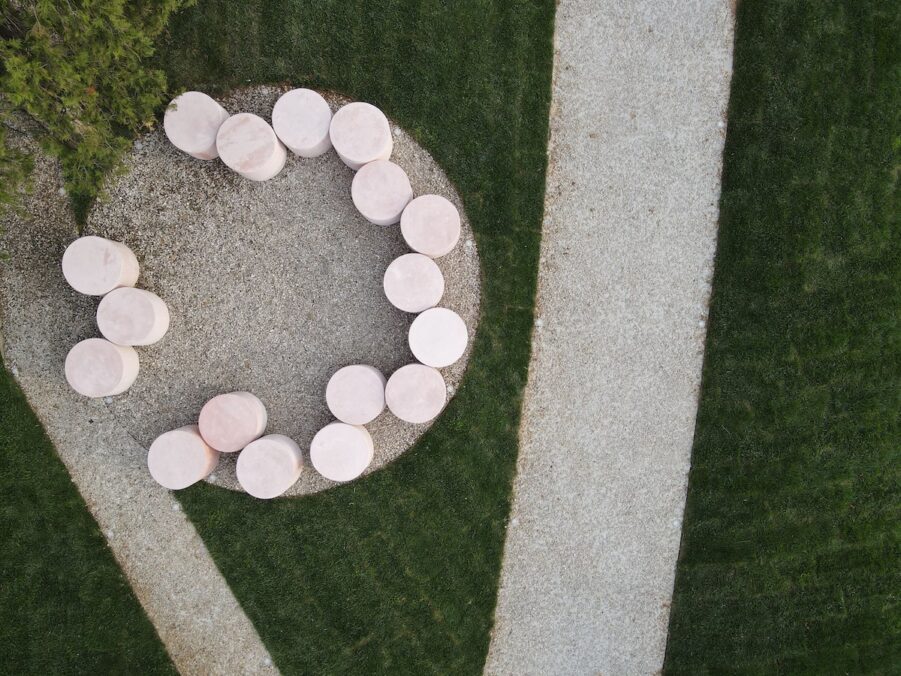
The landscape on which the artwork is placed presents itself as a playful group of circular shapes of varying sizes, spanning from the curved wall element, until the parking of the hospital to the south, like an archipelago in between a surface of natural grass.
Through this strategy, the principal aim is to minimize the impact on the surrounding presence of nature, by not only preserving all of the trees, plants and vegetation already present in the site; but also by adding to the surface of grass-covered space in this small urban environment.
The sidewalk is split in two paths: one remaining straightforward and functionally quick through the space, while the other taking a more indirect flow towards encountering the artwork which lies at the center of the site. Ultimately, a minimal artificial geological transformation also presents the possibility of more intimate spaces of pause and intimacy in an urban setting characterized by troublesome moments and difficult emotions.
By moderately shaping the topography while keeping in mind the ergonomics of the human body, this small space previously used exclusively for transit becomes a possible location for a moment of peace. Another goal of the landscape intervention is to symbolically separate the artwork and the audience from the acoustic and visual noise of the pedestrian level. By removing surrounding clutter and lightly elevating the artwork from the ground, it gains a more dominant role in the nearby visual landscape. The light of the artwork then takes the essence of a lighthouse, guiding wandering souls towards a moment of presence and inner peace. Furthermore, the axis on which Terminal for Tirana is positioned, is independent from the axis of the urban fabric; separating the object from the infrastructure of the city and raising its sculptural presence.

Artist: Karolina Halatek
Curator: Adela Demetja
Architecture studio: Apparat Studio
Landscape architect: Elian Stefa
Managing Institution: Tirana Art Lab – Center for Contemporary Art
Location: Mother Teresa University Hospital of Albania, Tirana/Albania
Commissioned by: Ministry of Economy, Culture and Innovation of Albania, as one of the winning projects of the competition ‘Art in Public spaces’
Photos: Ilir Tsouko
Karolina Halatek is a polish artist who uses light as her primary medium to create experiential site-specific spaces that incorporate visual, architectural, and sculptural elements. Halatek forms installations with immersive characteristics, which are often the result of collaborations with quantum physicists, superstring theorists, and precision mechanical engineers. Halatek’s fascination with light as a medium has been shaped by her studies at the University of Arts London and Berlin University of the Arts, as well as her participation in Olafur Eliasson’s workshops. Influenced by the Light and Space Movement and artists like James Turrell, Halatek uses light to create experiences that are minimal yet profoundly impactful. Her works have been exhibited globally across Europe, USA, Asia and the Middle East. www.karolinahalatek.com
Tirana Art Lab – Center for Contemporary Art is a contemporary independent art institution, founded as a non-profit organization, in 2010 by Adela Demetja. TAL aims at promoting emerging artists and contemporary art from Albania as well as from Central, Eastern, and South Eastern Europe. The center initiates and supports new productions by national and international artists, and projects critically engaged with artistic, cultural and social issues of transitional and contemporary societies.
For more information, please visit www.tiranaartlab.org, www.karolinahalatek.com