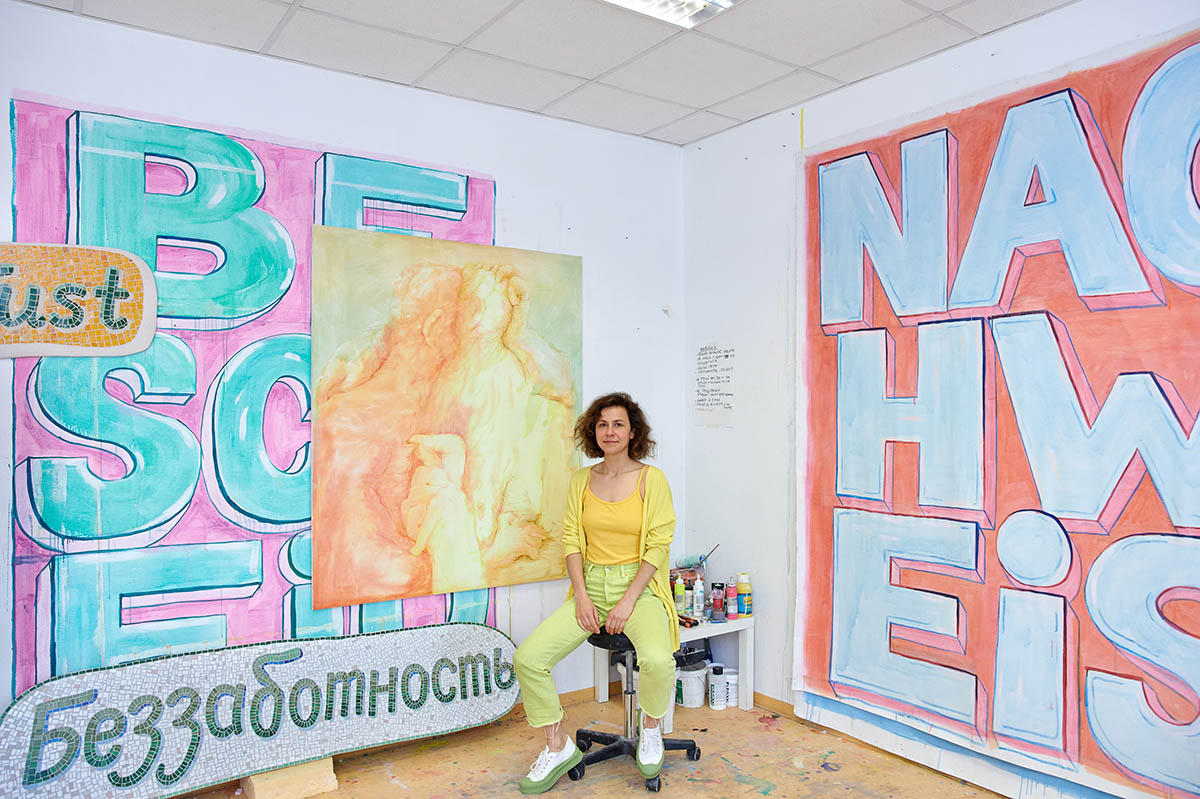
From the perspective of the artist leading the workshops, how do you see the project evolving?
The project consists of 10 workshops that are primarily directed at the Hollabrunn community but open to everyone aged 14 years and above. Before agreeing to lead the program, I was already familiar with the AIR InSILo residency and how it operates; it has a clear position and way of working. The program is part of the festival framework. I was invited to create a community artwork; the idea itself was open. I proposed this project, which was then accepted.
I proposed the project “Gemeinsteine”, as the residency title AIR InSILo includes the term “silo”, which refers to a structure used for storing bulk materials such as grain or silage, and is often associated with particles that can trigger allergies. This connection led me to explore my allergy to hierarchical structures!
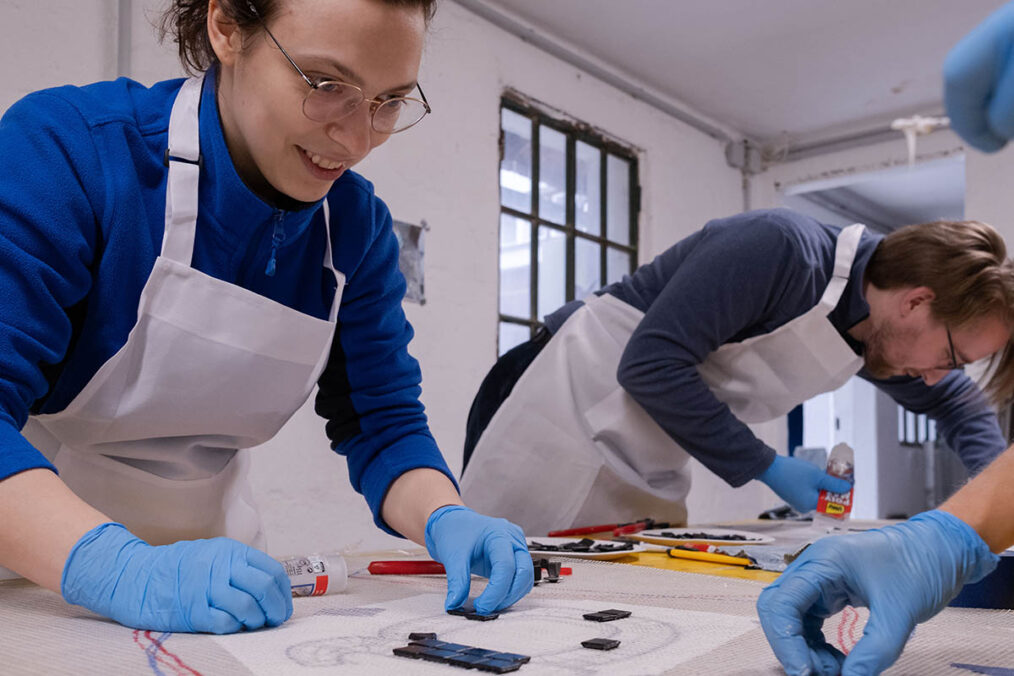
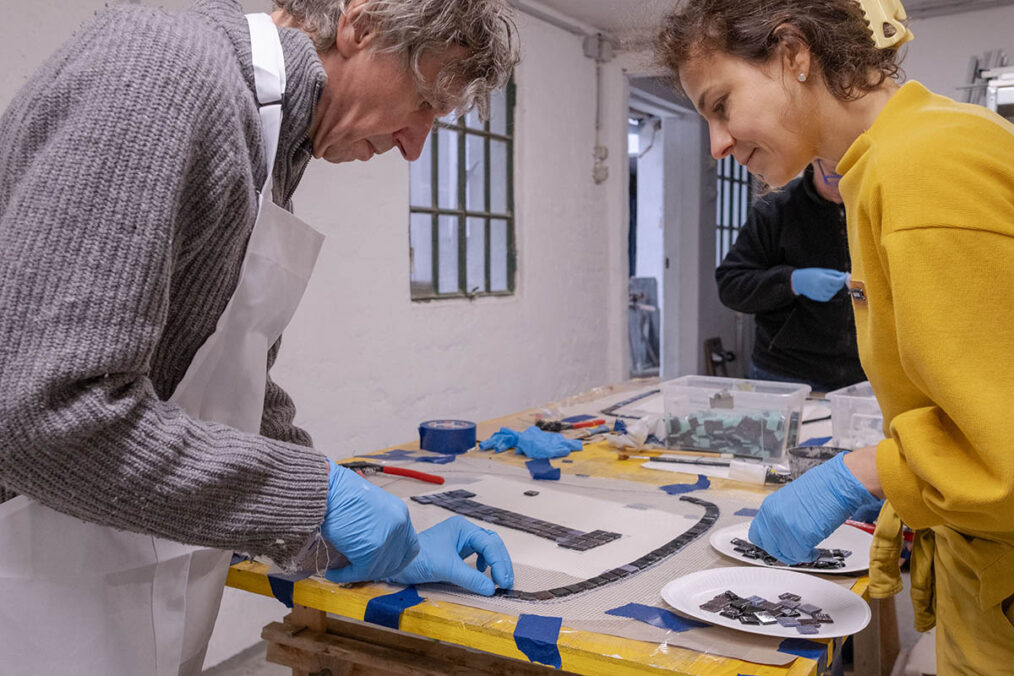
I’ve done other community work before, but it looked quite different. In this format and in combination with the WEIN/4-Festival, I had to develop a specific process. We are making a large-scale floor mosaic. The final work will be installed outdoors in a courtyard at AIR InSILo in Hollabrunn. Since we have just started, I will not be revealing the full motif yet; it’s a bit of a surprise, and the unveiling will be on 18 July after we finish our workshop programs.
Can people still join the upcoming workshops?
Yes, it is still possible to apply. Applications open approximately two weeks before each workshop. The exact dates are announced on the website, after which registration becomes available. Each session is limited to a small group of approximately four to eight participants.
How long does one workshop last?
The workshops take place on weekends, from 12 to 6 pm, so it’s a full day. But we take breaks and have snacks, lunch, and coffee; it’s a nice atmosphere around. The idea is to spend a day in Hollabrunn while working together. So far, everyone has enjoyed it. We’ve had great conversations with people from very different professions and backgrounds.
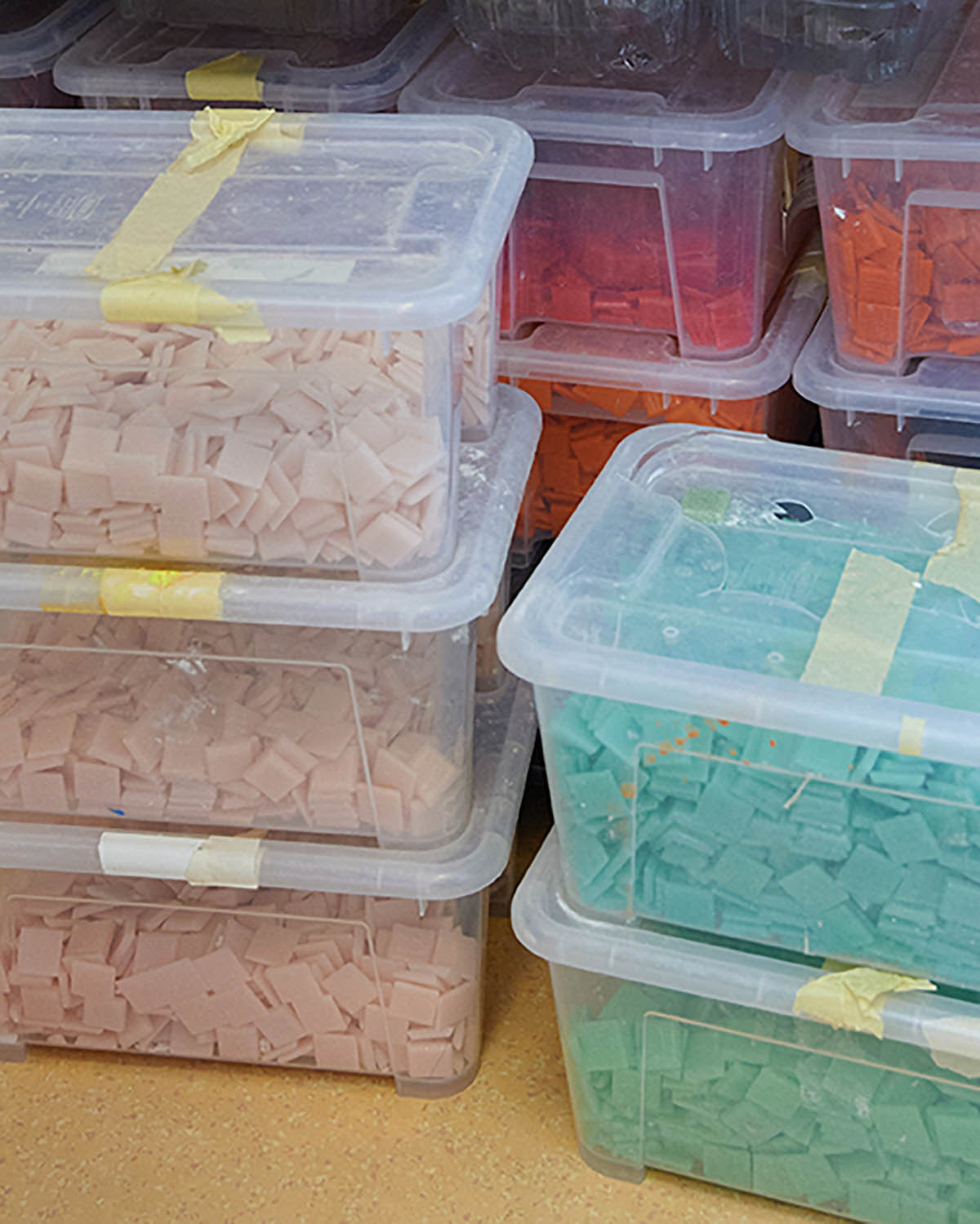
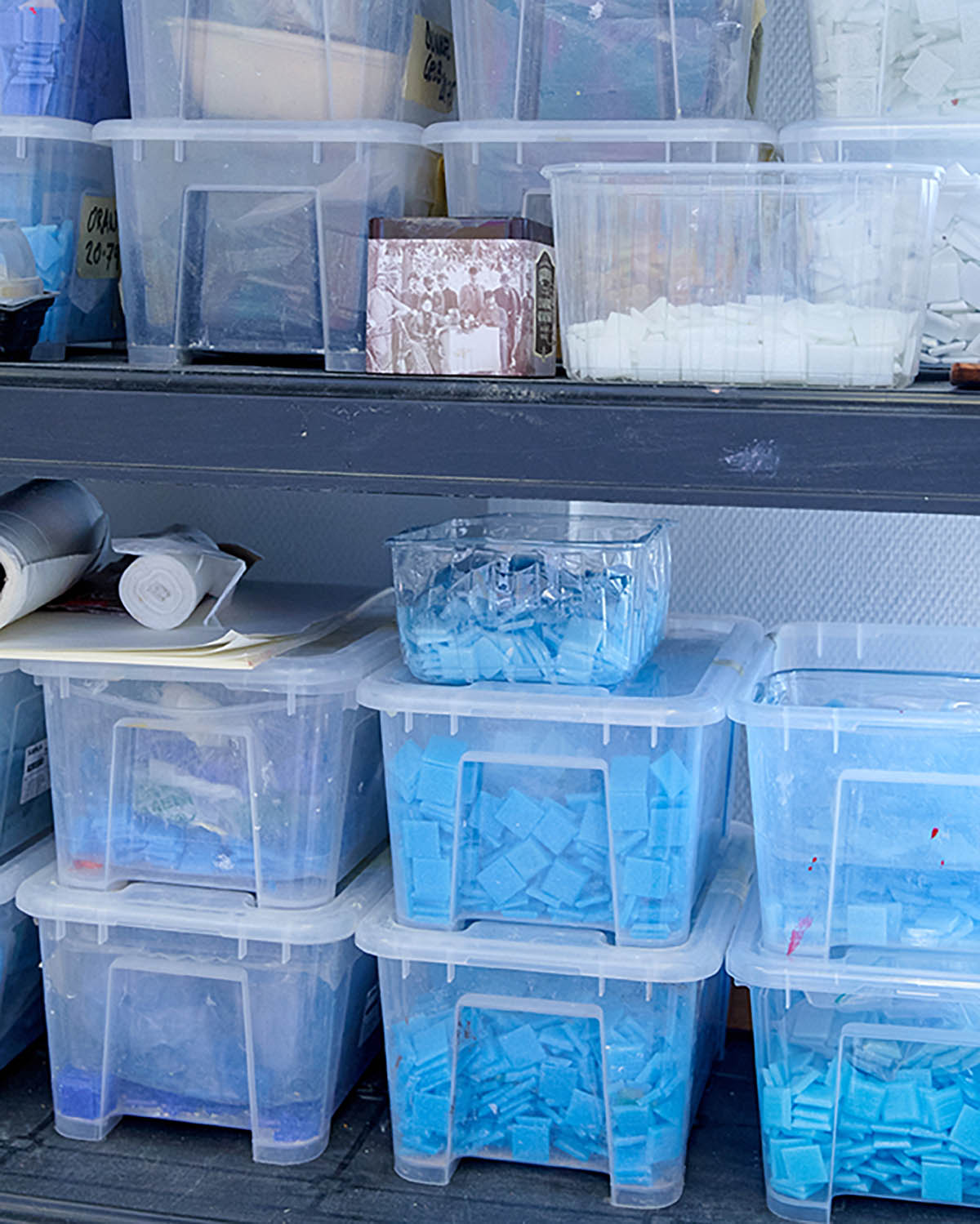
What about the materials: what are you working with?
For each project, I do specific material research. This is my first floor mosaic of this kind, so I had to think carefully about the technical aspects. A floor mosaic differs from a wall piece because it has to withstand being walked on. Interestingly, many of the oldest surviving mosaics are floor mosaics, because they are not affected by gravity in the same way as wall mosaics. In this case, I’m working with glass. In the medium of mosaic, you can also use ceramics, natural stones, or many other materials, but I prefer glass because of its intensity of color. Glass keeps a kind of brightness and clarity that I like.
How many participants are involved? Are participants involved in the creation of the work, actively shaping it and adding their input?
Usually, between four and eight participants are present per session. The setup is quite simple: I have two large tables where we work. Each participant, or sometimes two people, can work on a part of the whole mosaic from two sides. They work with the sketch and orient themselves around it. But there’s still space for individual input; they can surely slightly influence the design.
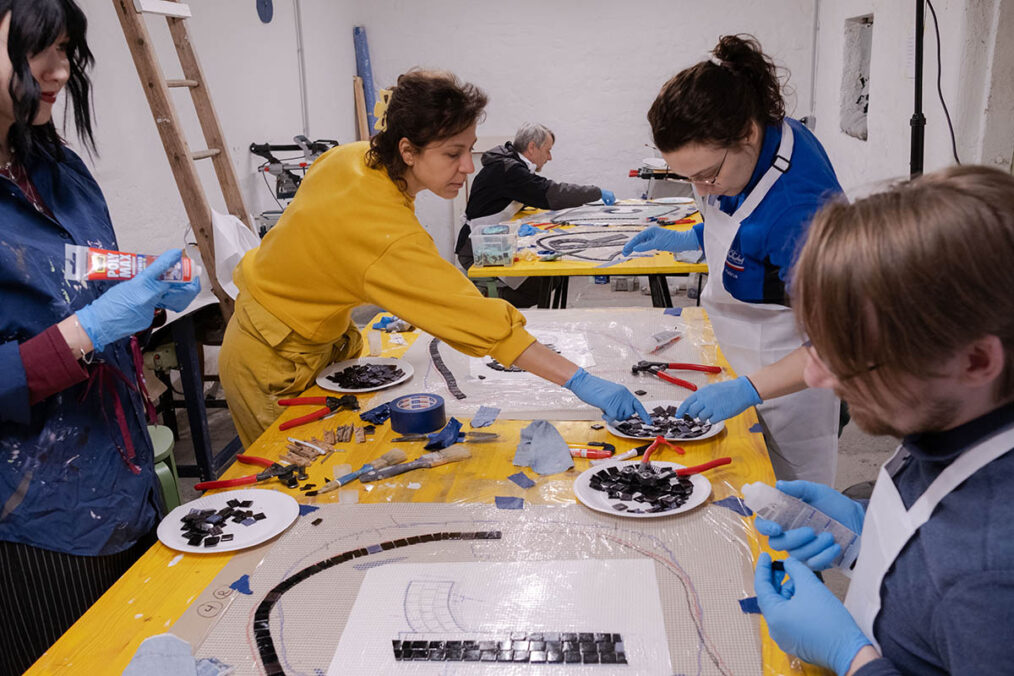
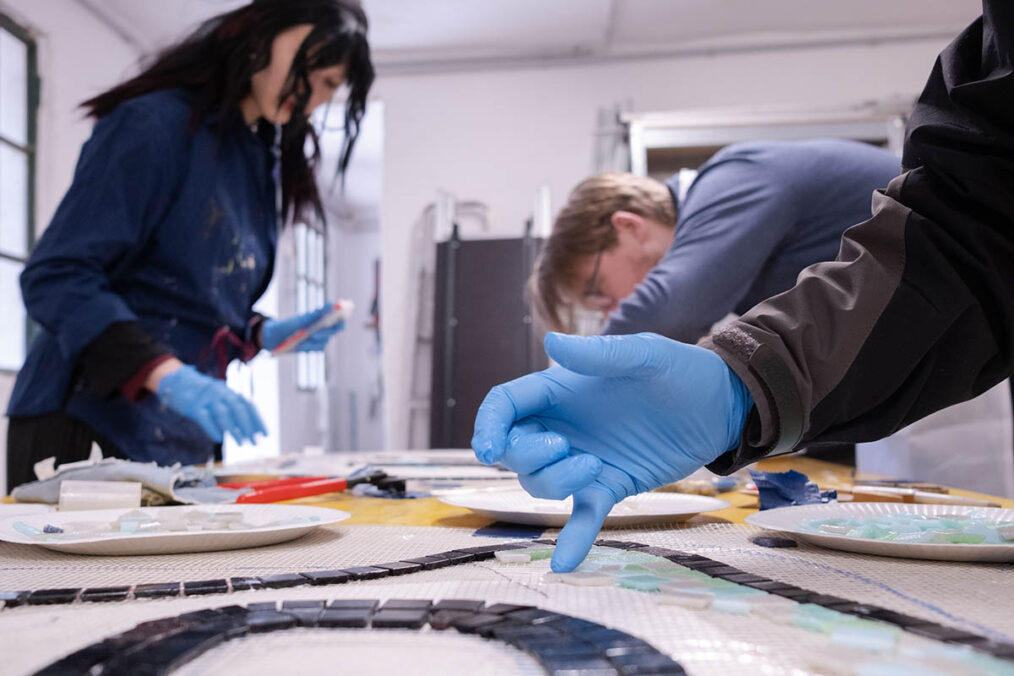
So there’s room for intervention during the process?
It’s my project and my concept, but it is also a collaborative process. Making a mosaic is inherently creative, and participants contribute their input. I propose a structure and a few variations within it, and we discuss them together. We also work on different parts simultaneously, not in a strict chronological order. The process must not be hierarchical.
How does working collaboratively fit into your overall practice?
It developed over time. I had an earlier project that involved more than seventy participants over a period of three months. The final piece is still in the 10th district of Vienna. Titled „More Yellow! / Mehr Gelb!“, it was conceptually quite simple: abstract shapes on a yellow background. Participants could contribute by creating an abstract shape. In practice, abstract thinking was quite challenging for many people. We also spent some time talking about the nature of abstraction.
The encounters with so many different people greatly influence my practice. I’m actually more interested in listening than in talking. I ask a lot of questions. It’s also interesting to understand what motivates people to join. I’ve worked with people from all kinds of fields: from teachers to astrophysicists. For example, one participant was interested in architecture and had independently started noticing mosaics in the city, similar to how I did. They found my work through research. Others are residents of Hollabrunn, festival visitors, or teachers looking for new approaches for their students, or those who were following my practice, exhibition activities, and were curious to become part of it. It’s a very mixed group.
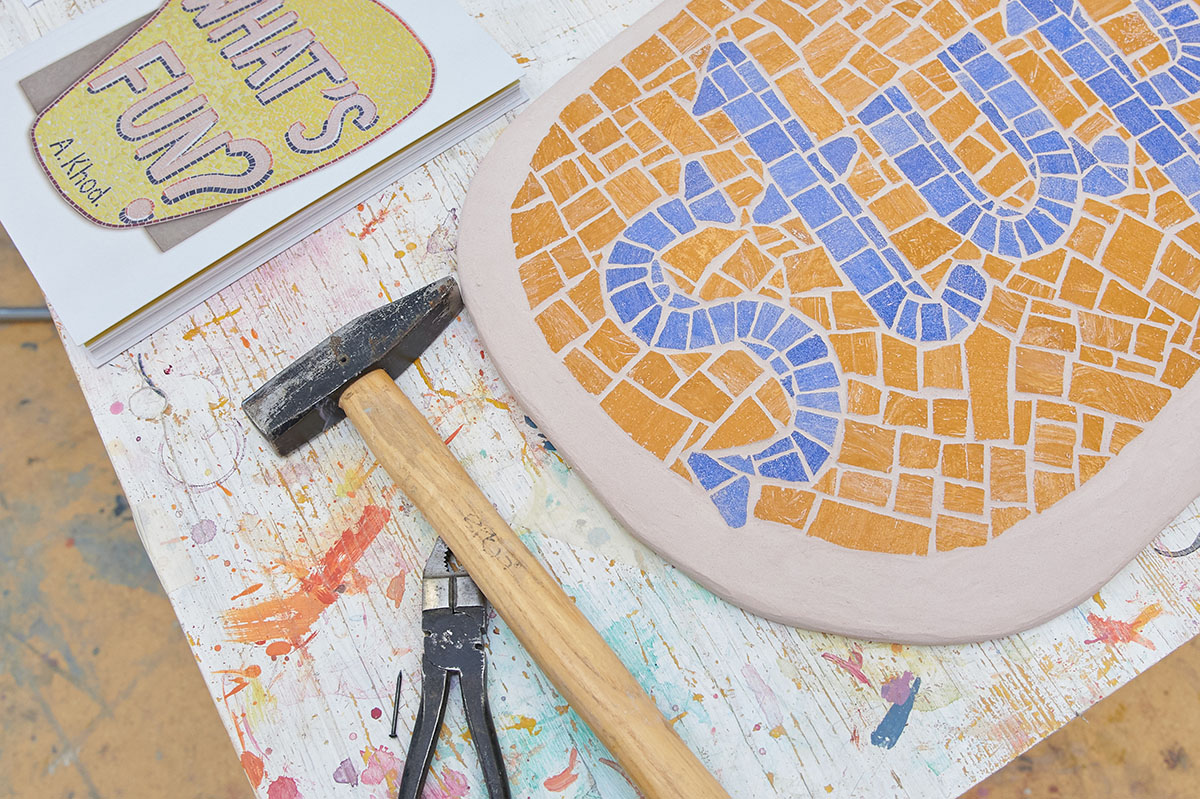
You work with quite a range of materials: glass for mosaics, but also paintings and other media. How do you decide which medium to work with?
I wouldn’t say I’m fixed to certain materials. It depends on the idea and also on the need for balance. Mosaic is highly technical, with little room for improvisation. In contrast, watercolor feels like freedom to me; it allows for more experimentation. Drawing and painting are often considered the “queen of disciplines”, and for me, painting is something very intense. Each material opens a different field of research.
There are two aspects to how I work. One is the influence of mosaic as a medium itself, which leads me to an interest in public space and people. The other is my general interest in language and communication. I work a lot with text and different languages, and also in painting; I think about communication and interaction. My recent series of paintings is figurative and refers to “language-based systems.”
Working with people is also about discovering a language for each individual. For me, that part of the process is very meaningful.
It also sounds like a shift from your more solitary practice.
My practice moves in different directions, but often it’s about stepping out of a comfort zone. In the studio, painting can be very introspective and sometimes uncomfortable in its way. But going out and working with people is another kind of challenge; it also pushes you out of your comfort zone. I think that might even be part of the role of an artist, to constantly place yourself in unfamiliar situations.
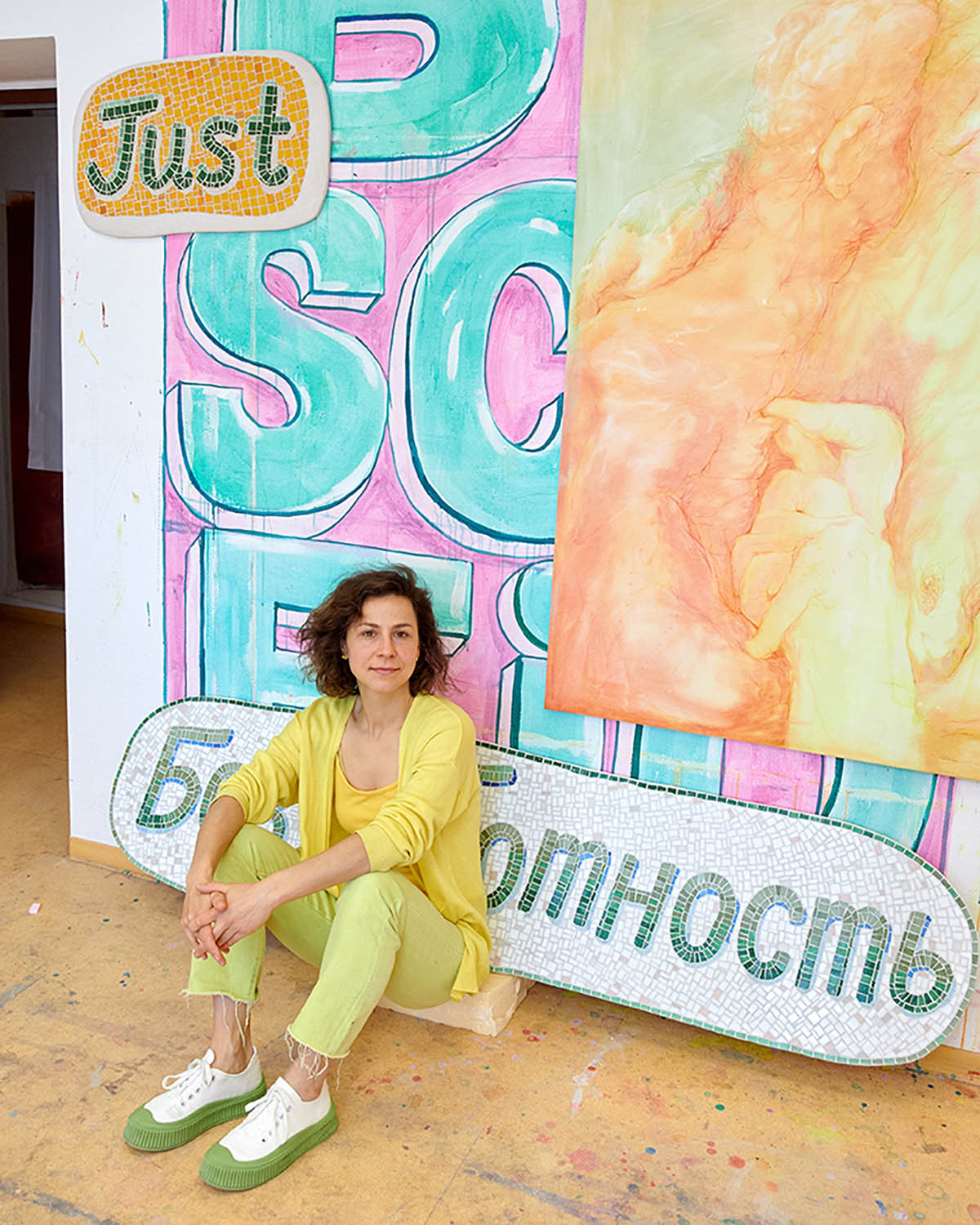
How did you first start working with mosaic as a medium?
It actually began in a very personal way. My interest in mosaic started in 2016, when I became a mother. I spent a lot of time walking through the city with my child. At some point, I got bored with taking the same routes every day, so I made a kind of game: I would choose a new street each day and mark it on a map of Vienna. Suddenly, I noticed how many mosaics there are in Vienna, things I had completely overlooked before. Many of them come from the same period, especially the 1950s to 1970s, after the Second World War. That led me to research their social and historical context: architecture, materials, motifs, and also the artists behind them. Many were made by women or by artists whose names are now almost forgotten.
I began experimenting, and my first major series became my diploma project at the Academy of Fine Arts in Vienna. Later, I had the desire to create a permanent, site-specific mosaic in public space, which I realized in 2021 with the project “We are HERE! / Wir sind DA!“ located in Gemeindebau Wildgarten-Hof.
Did that experience change your approach?
Yes, I realized how much I value art in everyday life when people encounter it while walking, when it becomes part of a living environment outside of exhibition spaces. Sometimes I go to places like Reumannplatz and ask people if I can draw them. We talk, and I make portraits. It’s another way of engaging: through conversation and drawing.
Workshop: „Gemeinsteine“ led by Anna Khodorkovskaya
May 16 – July 5 (12:00 – 18:00):
May 16, 17, 30, 31 (Saturday – Sunday)
June 6, 7, 20, 21 (Saturday – Sunday)
July 4, 5 (Saturday – Sunday)
Venue: AIR InSILo, Mitterweg 30, 2020 Hollabrunn, Austria
Public presentation: July 18, Saturday (14.00 – 21.00)
Transport: From Praterstern or Landstrasse, take REX 3 in the direction of Floridsdorf > Retz, Unterretzbach, or Znojmo. It runs every hour.
More about the project and free workshop registration: www.in-silo.com/gemeinsteine
With a program that defies categorization, the WEIN/4-Festival offers new and unexpected experiences. Many of the art and cultural projects are unique events, and some mark the beginning of an even more exciting cultural offering in Lower Austria in 2026.
Further information and the complete program can be found here: www.viertelfestival.at