The connection feels anything but accidental. Reus grew up near the North Sea, in Den Haag, and the building’s history as a place built to hold water sets up a subtle resonance with the exhibition’s title, Salt. There is, too, a local thread running beneath the surface: one of Freiburg’s main streets, the Salzstraße, takes its name from the salt once carried through the Black Forest on carts from Swabia, sold at the city’s salthouse that stood along this very route. The street, probably home to Freiburg’s oldest houses, dates back to the time of the Zähringer family, when this salthouse first gave it its name. The pool that once held bathers now holds something else: objects that lure, even seduce and finally hook the viewer, much like the sea itself.
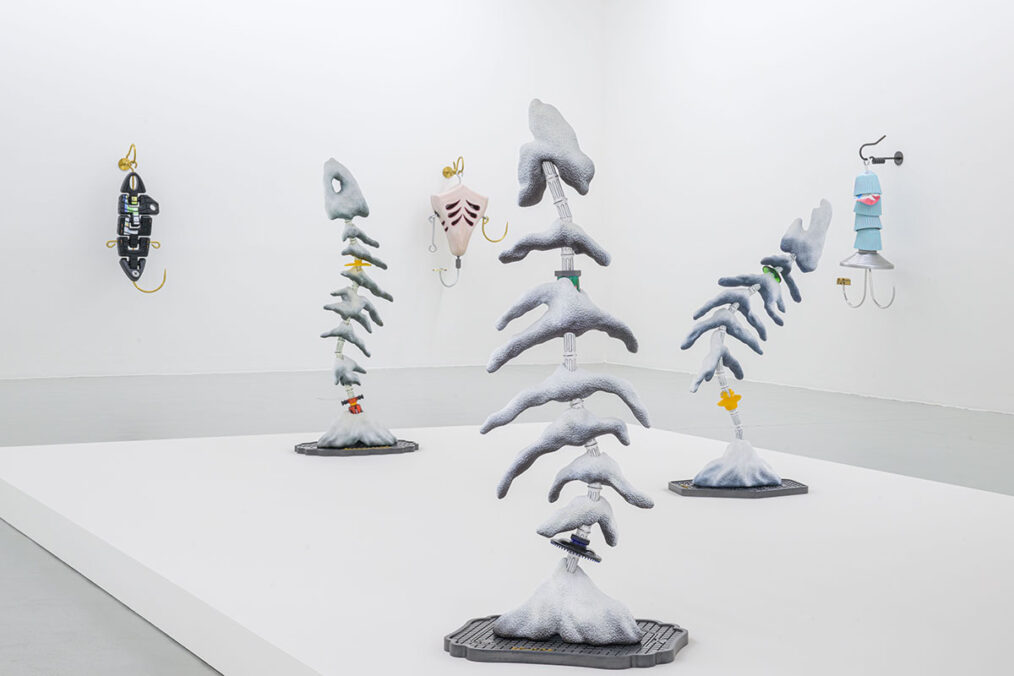
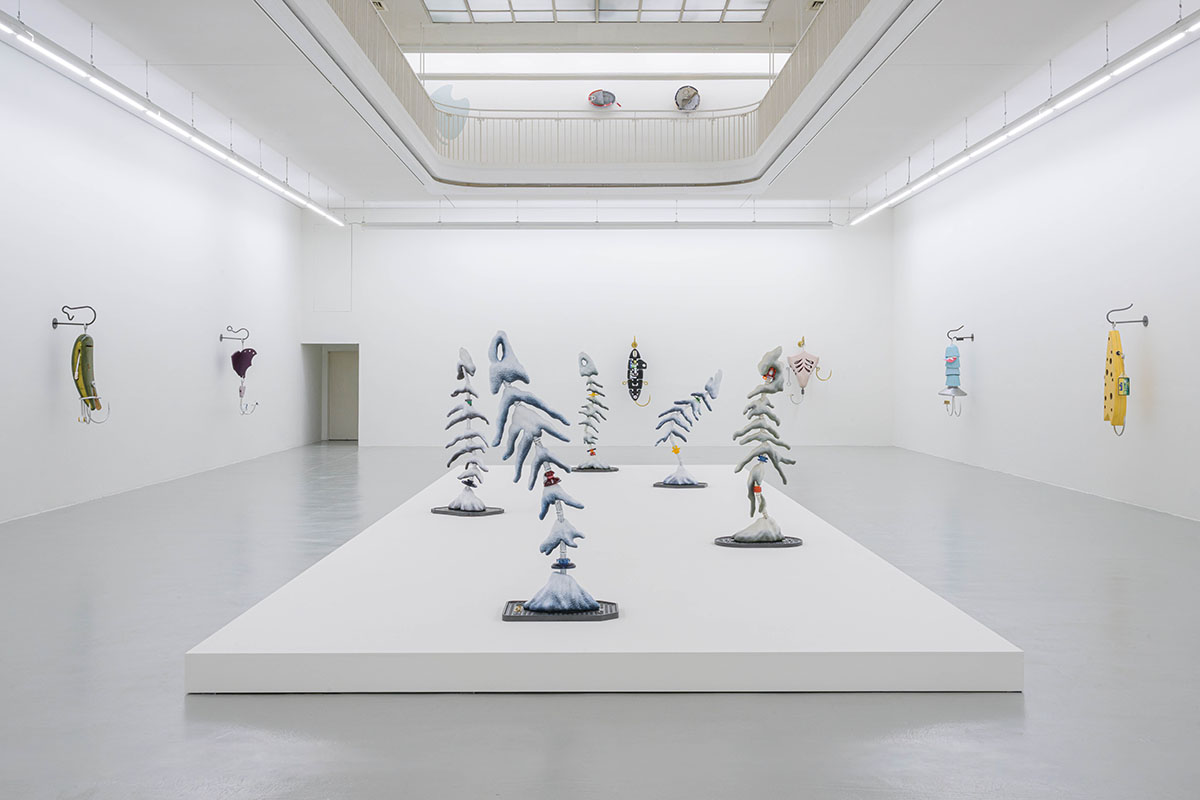
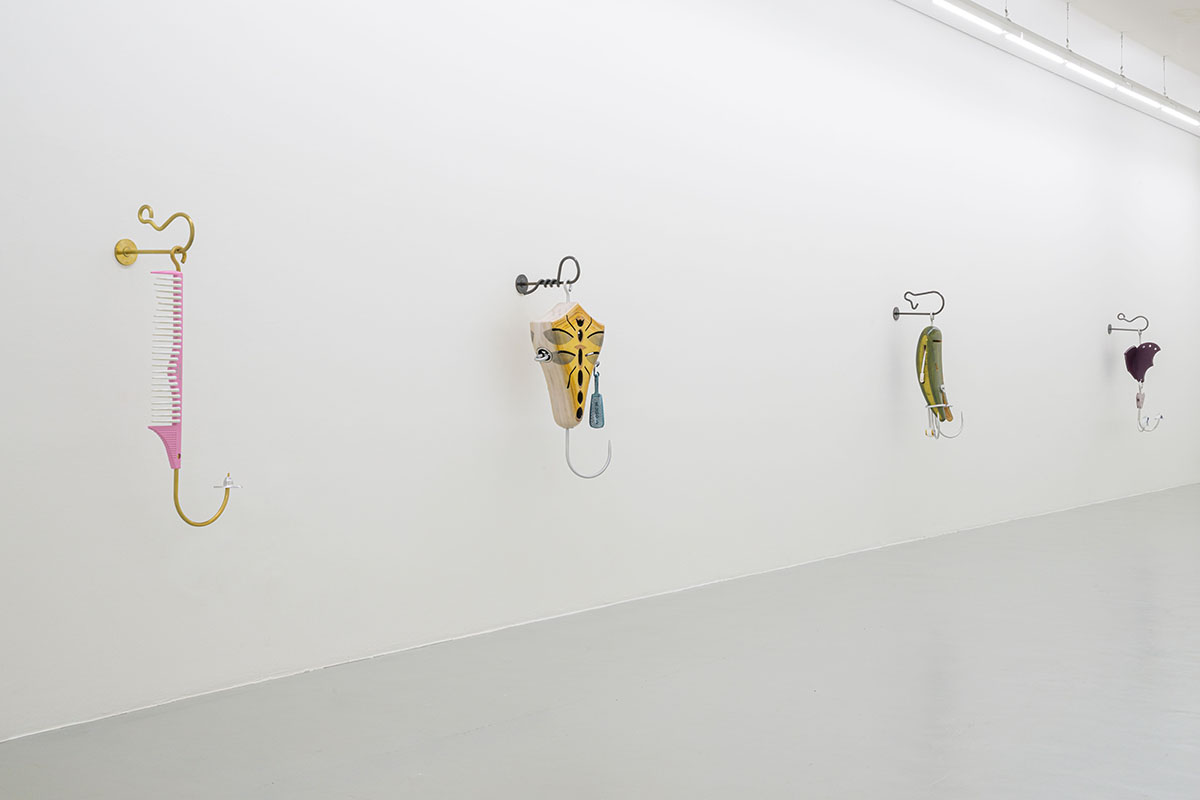
Downstairs, the works from the Rig series hang along the walls. At first glance, they resemble oversized fishing lures or earrings, but the longer you look, the more ambiguous they become. What strikes me most is the contrast between their muted colouring and their sharp, almost surgical physicality. The colours, pinks, blues, yellows, never shout. They speak in a warm, quiet register, almost coaxing rather than demanding attention. Reus uses colour with a restraint I find particularly compelling. It never competes with form. It supports it, lets the shapes themselves carry the weight of the work.
I find myself drawn to individual elements: an oversized screw nut, surfaces that appear coldly metallic but turn out to be wood, each component built with its own internal logic. There is an almost unbelievable precision in how these pieces are made. Every part of every Rig reflects a long, exacting process of fabrication, the kind of attention to detail that rewards close looking rather than a passing glance. I could stand in front of these objects indefinitely and still keep noticing something new, a joint I hadn’t seen, a colour shift I’d missed, a texture that turns out to be something other than what it first appeared to be.
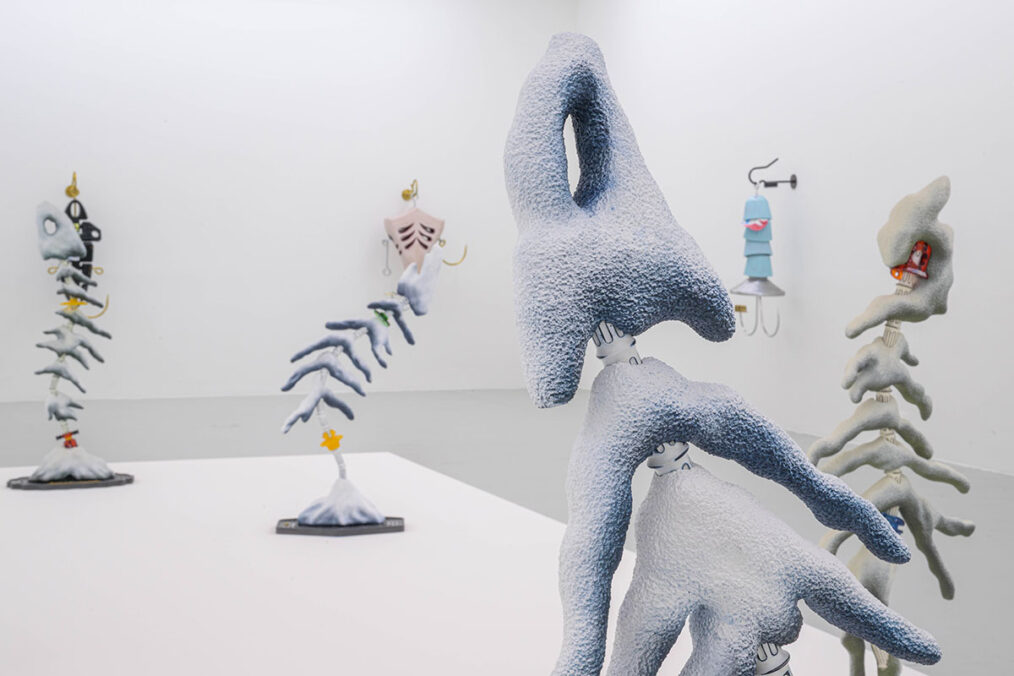
The Streamers stand on a podium at the centre of the lower hall, each resting on a coaster shaped like a manhole cover. They are figures that hold two readings at once. On one hand, they recall the pine trees of the Black Forest, their branches dusted with something like snow, nodding to the region surrounding the Kunstverein itself. On the other hand, they resemble fish skeletons, the kind you might find washed up on a beach, or left over after a barbecue once the flesh has been picked clean. In this second reading, the white coating becomes salt rather than snow, and the work turns toward themes of transience and consumption: what remains once something has been used up, devoured, discarded.
There is a melancholy to these bleached, bone-like figures, but Reus does not let it settle too heavily. Tiny heart symbols are hidden on the manhole-cover coasters beneath each Streamer, and threaded through the skeletal bodies themselves are joints and fittings in neon colour, small flashes of brightness breaking through the pallor. These details soften the work’s undertone of decay, introducing tenderness and humour into what might otherwise read as purely elegiac.
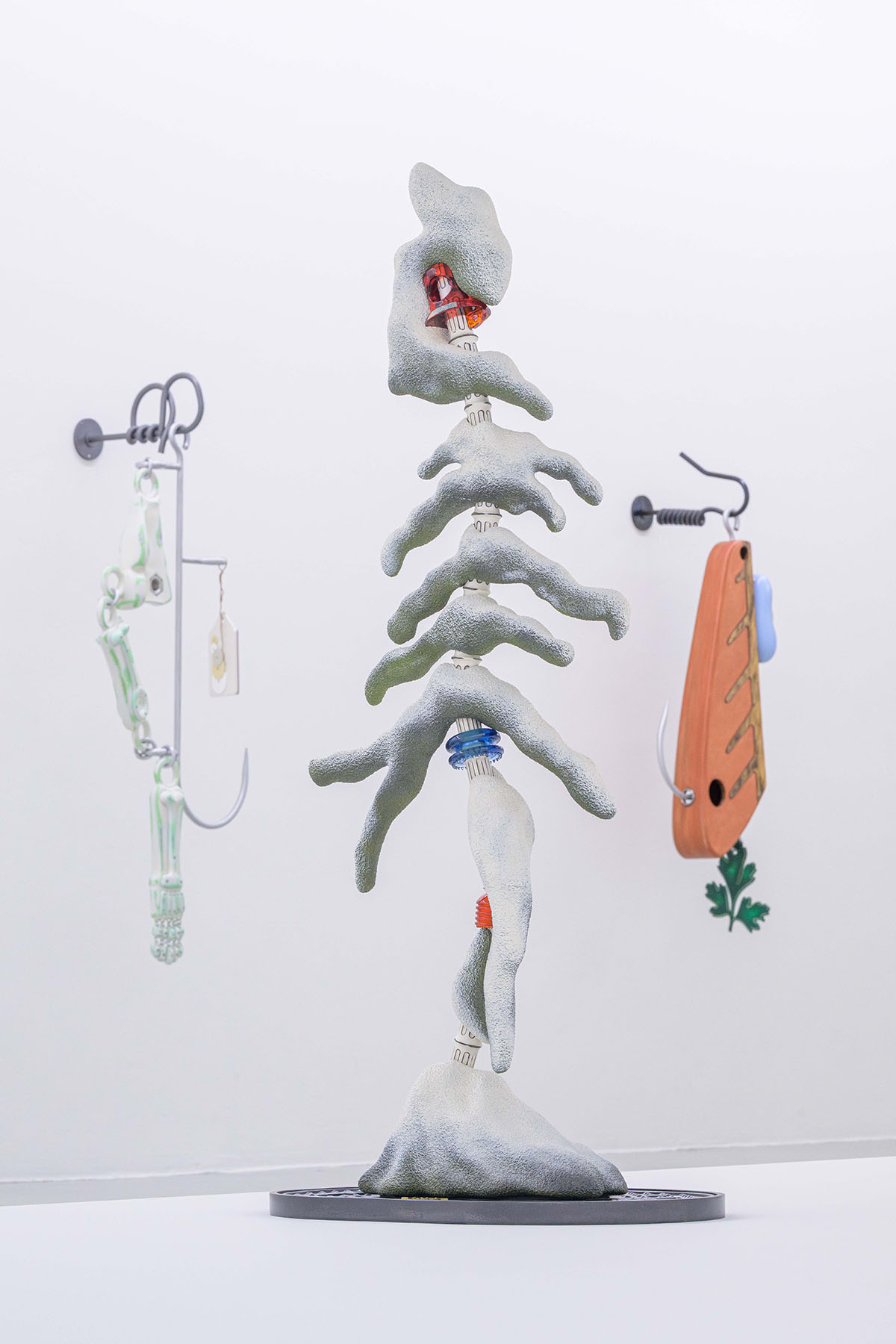
The craftsmanship is, again, extraordinary. Looking closely at the threading and joinery of each “bone,” it becomes clear how much labour, technical skill, and precision went into giving these skeletal forms their unsettling, intricate physicality.
What I find most compelling about the Streamers is the ambivalence they hold. They radiate something unsettling and something familiar at once, an apparent contradiction that, on reflection, does not feel contradictory at all. It mirrors the human condition rather precisely: we are drawn to what disturbs us, comforted by what we recognise, and often these are the same thing.
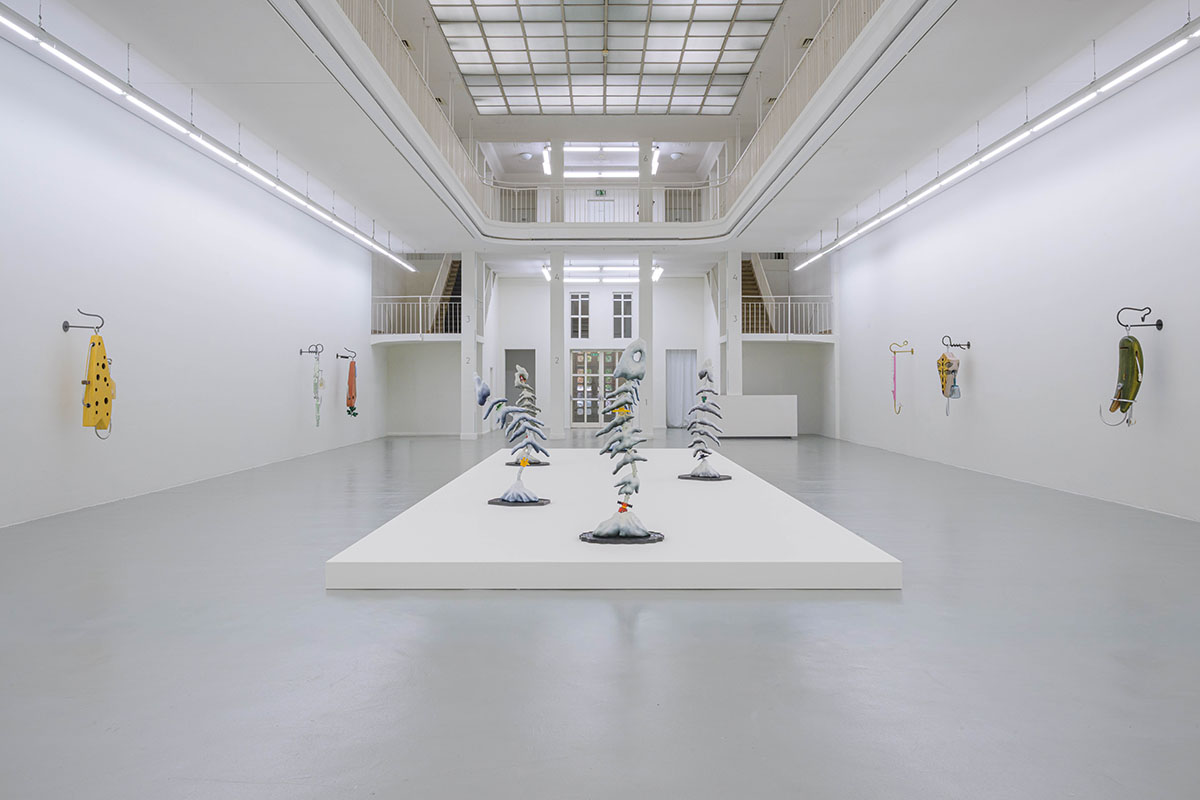
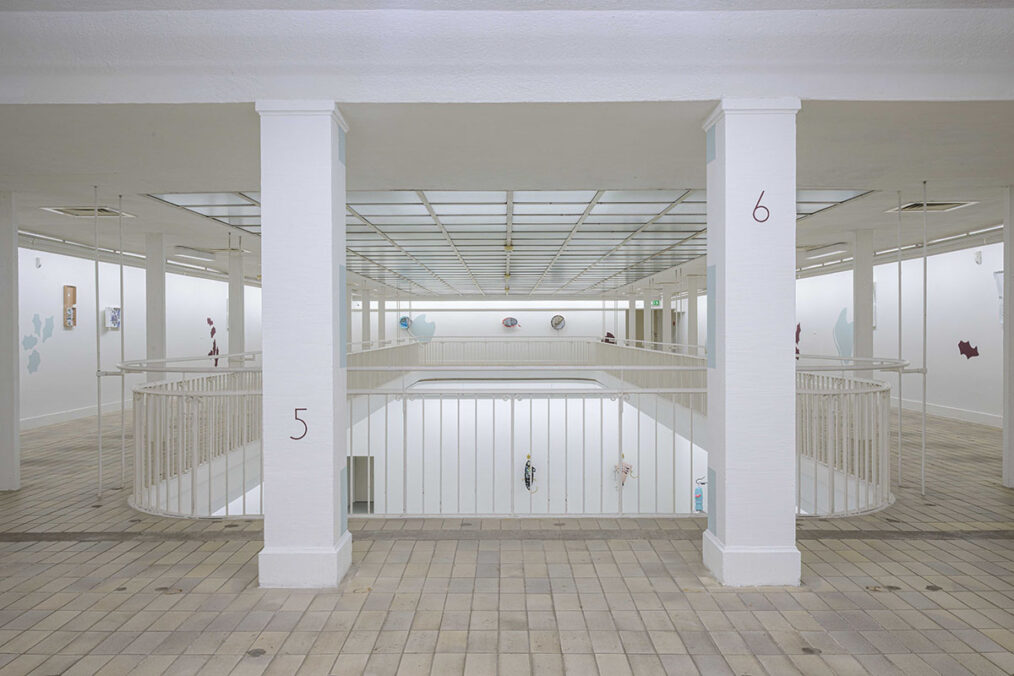
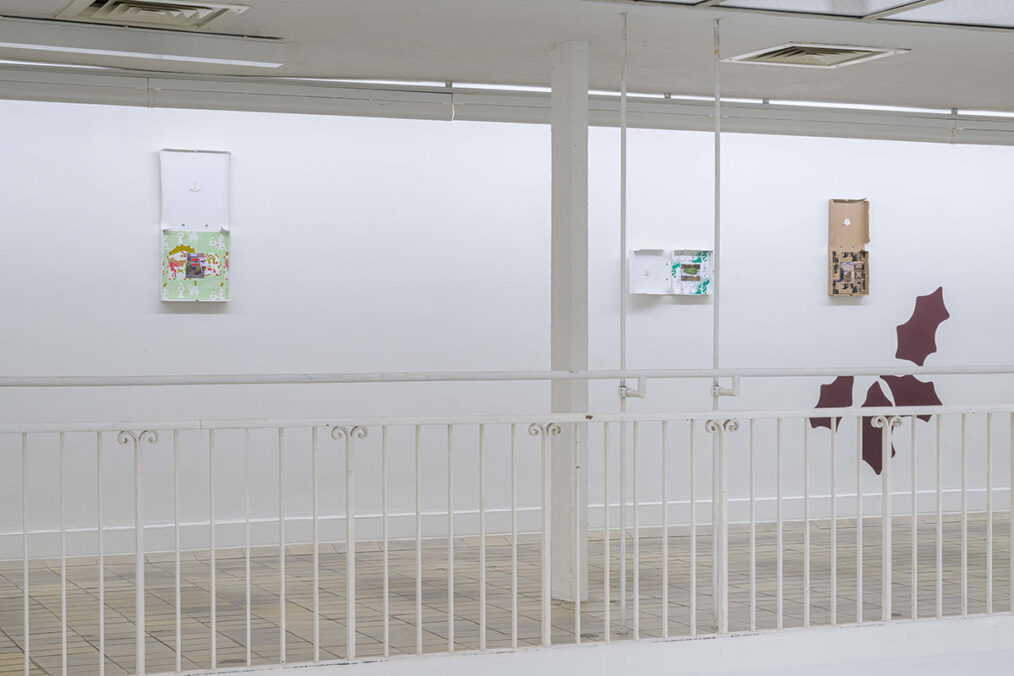
Upstairs, along the gallery that wraps around the old pool, hang the Subs and Merlins. The Subs take the form of aluminium pizza boxes, each adorned with details like pizza savers, screen-printed motifs reminiscent of Christmas wrapping paper, and photographs of post-Christmas trees, already stripped of ornament, waiting to be discarded on the curb. The Merlins are oversized tin cans, large enough that an actual animal could fit inside them, each concealing an unexpected interior.
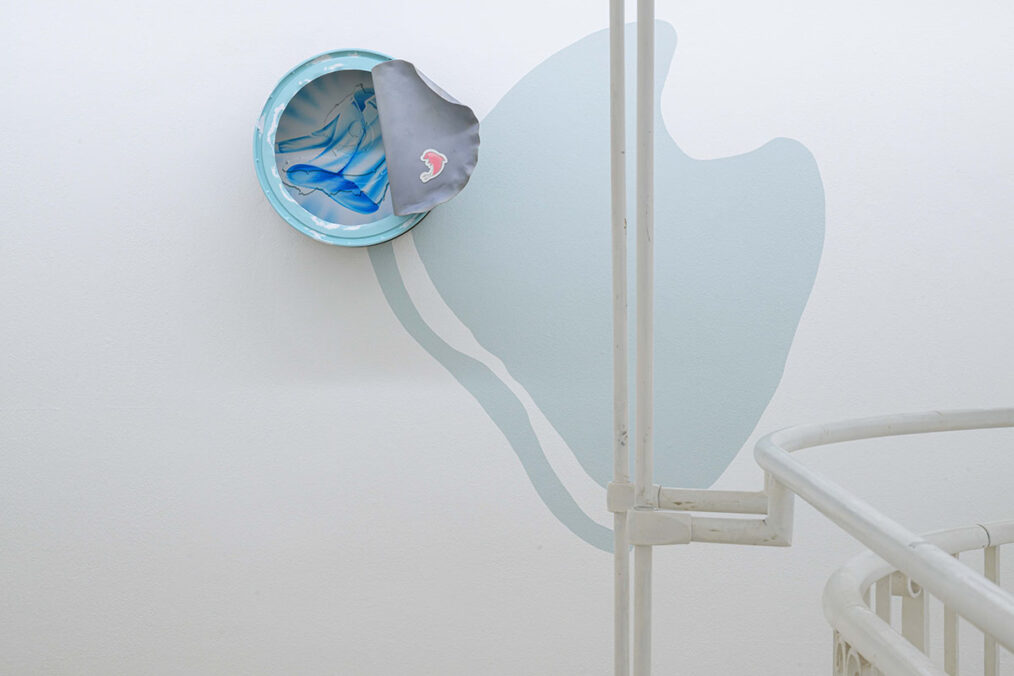
One Merlin, titled The Tide, takes the shape of a washing machine drum, with a shirt placed inside it. On the underside of the can’s peeled-back lid sits the imprint of a dolphin. The work invites multiple readings without insisting on any single one. There is something here about waste and decay, perhaps even water scarcity, the washing machine as a symbol of resources we use without quite reckoning with their cost. The shirt seems to want absolution, a clean cycle that erases whatever it has been through. But a wash programme rarely settles anything so simply. And the absolution we seek often comes at someone else’s expense, here, quite literally, on the back of a marine creature. The dolphin pressed into the lid feels less like decoration than evidence, a quiet reminder that our attempts to cleanse ourselves of consumption rarely happen without consequence for something else.
Reus does not insist on this reading. The work could just as easily be approached as a private, almost domestic image, washing as a small daily ritual stripped of any larger implication. But the option to read it as social critique sits there, available, never forced.
The artist has a habit of hiding small surprises throughout her work, easter eggs in the truest sense: small rewards for paying attention, for staying with the work longer than seduction alone requires.
Magali Reus calls her objects “unreal things.” They do not try to pass as something they are not, do not pretend toward authenticity they don’t possess. Instead, they open a third space, somewhere between the real and the surreal, a kind of interval that holds what is able to endure only through imagination. They make room for the things we can sense but never fully name, the half-formed associations that flicker between memory and invention. By the time I reached the end of the exhibition, I realised I had been thoroughly drawn in. It is the sheer variety of materials, the countless details and small surprises, the layers of insinuation tucked into every object, that allow Reus to pull you into her world. Her work claims mental space. It asks something of you, attention, curiosity, patience, and gives back something rare in return: the sense that looking closely is never wasted time.
The building remembers water. The sculptures remember the sea, the forest, the table after a meal, the curb after Christmas. Reus does not offer answers so much as objects that hold multiple truths simultaneously, asking us to sit with the discomfort of not fully knowing what we are looking at, and to find, in that uncertainty, something beautiful that resists easy naming.
Exhibition: Magali Reus: Salt
Exhibition duration: May 23rd – July 26th 2026
Address and contact:
Kunstverein Freiburg
Dreisamstraße 21 79098 Freiburg
www.kunstvereinfreiburg.de
Magali Reus – www.magalireus.com, www.instagram.com/magalireus/