Tell us in great detail about one of your newest works.
Utopia Gym grew out of Try, out of a question that Try kept asking without answering. In Try, I displace a sport from its arena into the city, stage it once, and walk away. What stays is the image and the tension of that displacement. But at some point, I needed to go further into its internal logic. The training. The repetition. The moment the body fails, something else appears. Utopia Gym is that investigation. It concerns itself with apparatuses: both the literal ones of gymnastics and the invisible structures that organize bodies into systems of production, discipline, and display. What happens when a trained body is asked not to perform but to exist inside those structures differently?
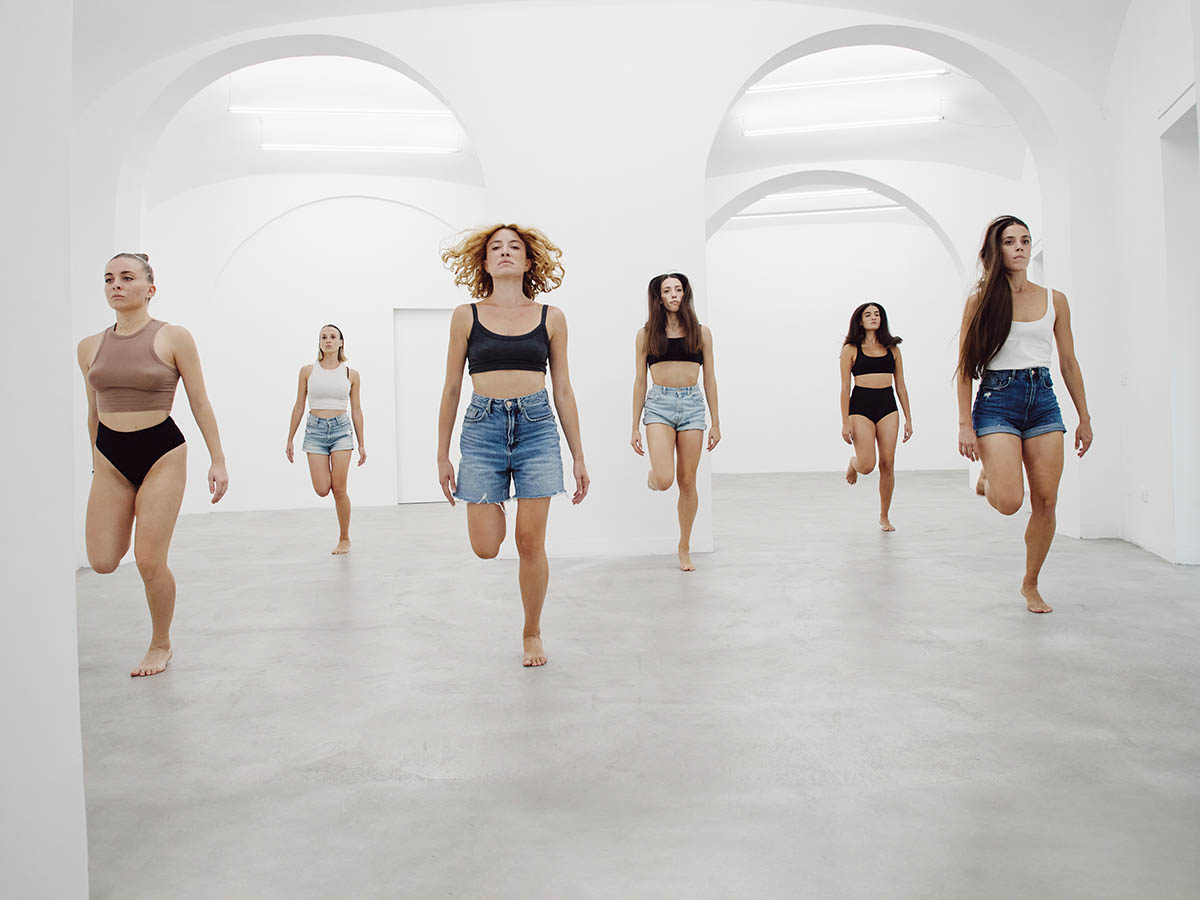
Like all my work, the project doesn’t stay in one form. It explodes into several constructions that orbit the same core. Les Dormeuses is a video work of artistic gymnasts asleep in a field, still wearing their competition leotards. The trained body, finally unguarded, surrendered to a state it cannot choreograph. Everything that the apparatus demands of them—tension, control, grace under scrutiny—dissolved into grass and breathing. The performance at Bagni Misteriosi in Milan reversed this: the same gymnasts awoke, executing exercises, but allowed to make mistakes, the error no longer a failure but a crack where something unscripted could enter. At Palazzo Forti in Verona, the project shifted discipline entirely. Rugby players interpreted positions and actions drawn from a match, the tackle, the scrum, the sprint, then froze mid-gesture, suspended between force and stillness, the collective body caught in a state it was never meant to hold. What connects these iterations is not a narrative but a proposition: that the body might be the last site where utopia is still thinkable—not as perfection, but as the physical and conceptual space where falling is allowed, where error opens rather than closes, where the collective rehearsal of effort becomes something we don’t yet have a word for.
The role of the body in performance is not the same as that of one in a video or a photograph. What makes it so important when it comes to live presence?
The body is my primary medium. The body is not a permanent matter. Everything starts there, before the site, before the concept, before the camera. And it never gets boring, because it is never the same thing twice. I treat a body like an object, placing it, positioning it, and asking it to hold a form the way a sculpture would. And sometimes I treat an object like a human, an aluminum table, a balance beam, a tennis ball left on a gallery floor, as though it might still move. The body borrows the stillness of the object; the object borrows the tension of the body. A photograph holds a body in place. Video lets it perform within a frame that has already decided its beginning and end. Both are essential to my practice, but they operate after the fact, even when they pretend not to. When a gymnast holds a position for minutes in front of you, her trembling is not an image of effort; it is effort, happening at the same speed as you’re watching. You cannot fast-forward through the discomfort. You cannot crop the moment she loses balance. The failure belongs to both of you. The audience and the body are stuck in the same present tense, and neither can control what happens next. I think that’s where the political dimension of performance actually lives.
And that’s the thing about performance as an idea; it is fundamentally chaotic. I can build a score, set a duration, choose the athletes, and know the space. But the living body will always exceed the plan. Someone breathes too loudly. A muscle gives. The rhythm drifts. The audience moves in a way that changes the geometry of the room. I’ve learned to need this chaos rather than manage it. The work is not what I intended; it is what happens when intention meets a body that has its own logic and its own ways of refusing.
You also work site-specific. Can you elaborate on the process when working so closely with the site?
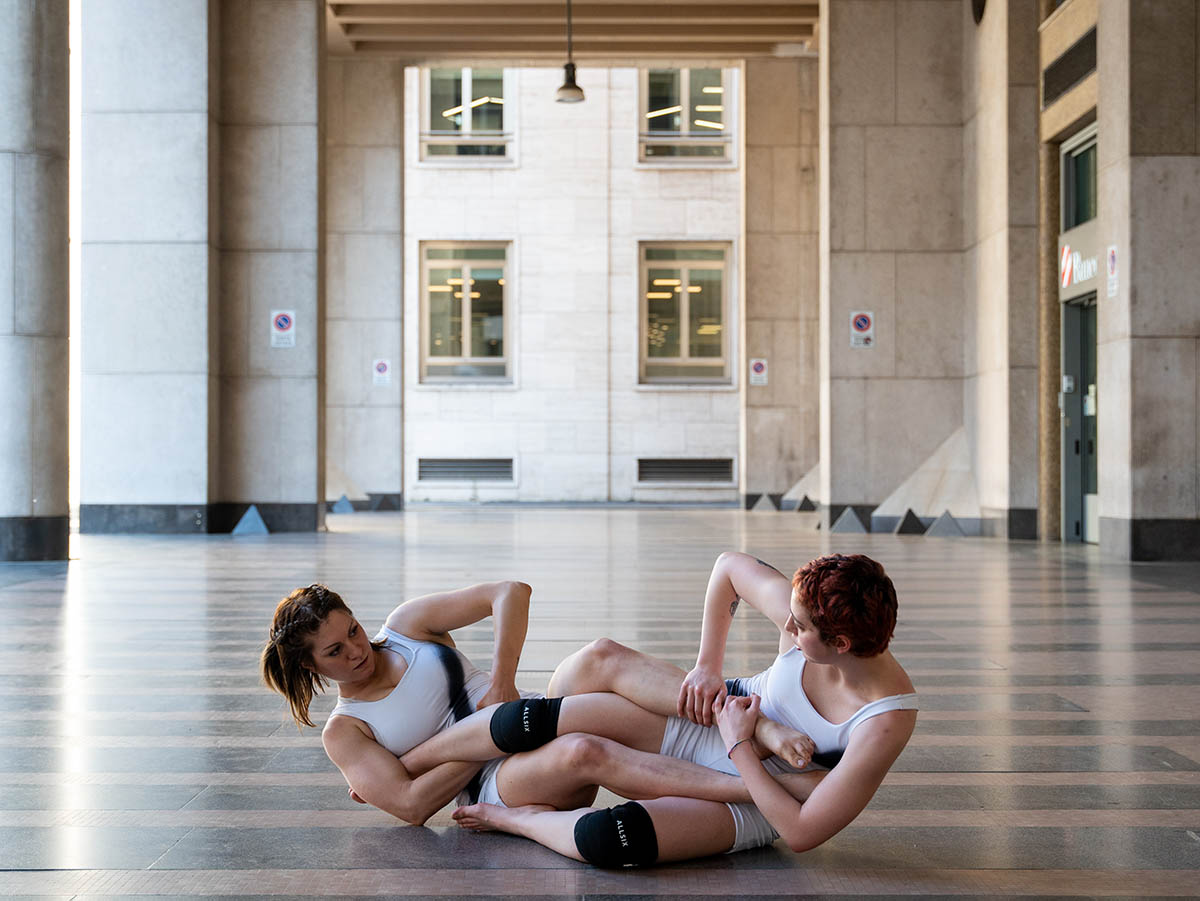
I never adapt a work to a site. I let the site tell me what it already knows about power, and then I place a body inside that knowledge. A highway underpass has its own acoustics of marginality. A deconsecrated church still holds the choreography of worship in its walls. Piazza Affari already speaks of conflict before a single wrestler touches the ground. The site is never neutral.
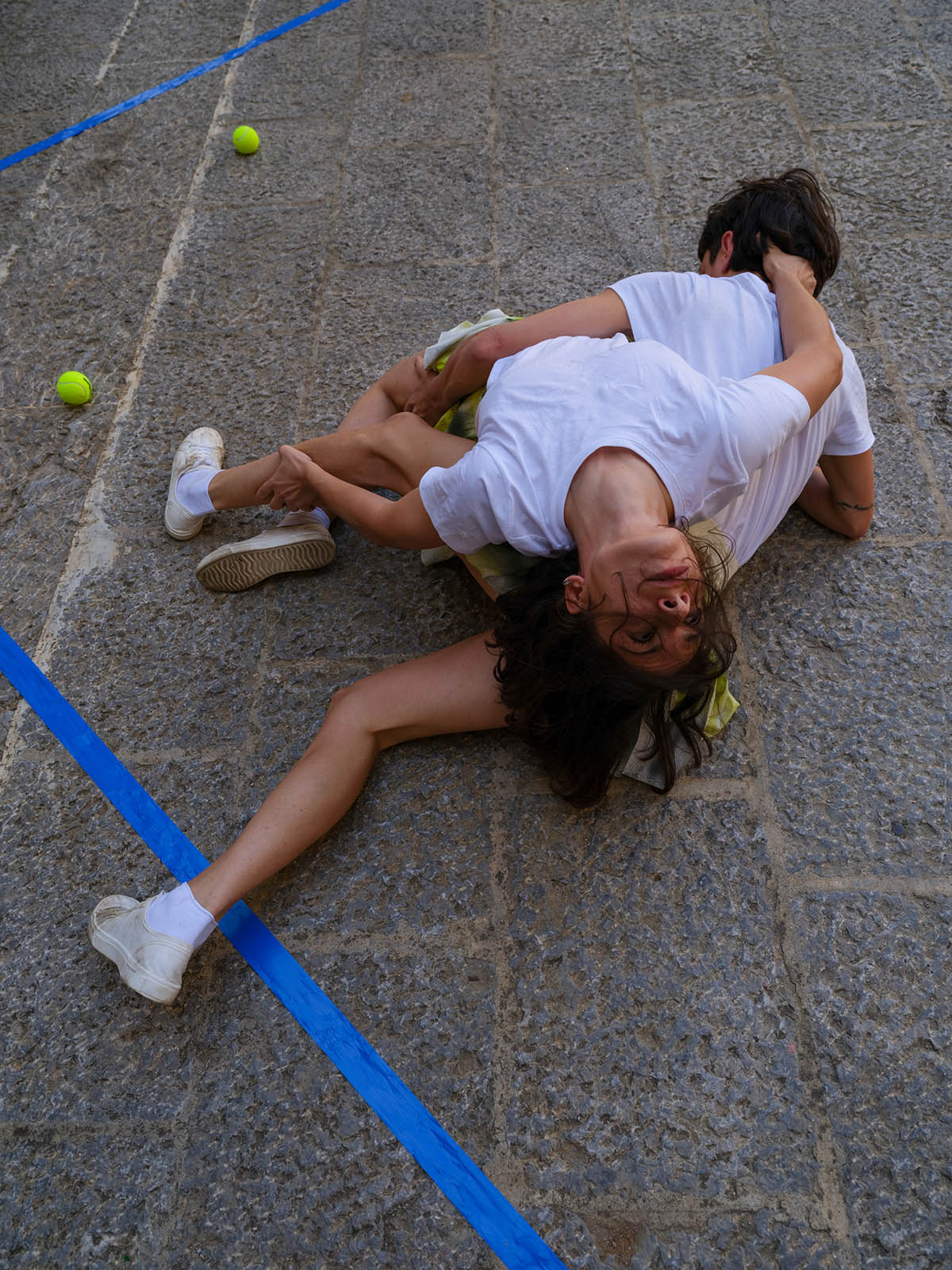
The choice is not always rational but always theoretical; it follows a logic that becomes clear only after the fact. What can this gesture mean in this place? The question is never about decoration or scenography. It’s about what happens when a gesture is pulled out of the context that made it legible.
What is the role of the audience? Are they spectators or participants?
I don’t ask the audience to participate. There are no instructions, no invitations to join. But spectators, in the passive sense. They are not that either. Many of my performances happen in public spaces. Someone driving or walking by encounters two boxers fighting under a highway.
In a gallery context, I’m interested in the audience as a body among bodies. When you stand close to athletes in constant motion, running, falling, catching, and repeating, something happens.
Your practice addresses themes of power, family structures, and collective identity. How do you navigate between personal and larger social narratives in your work?
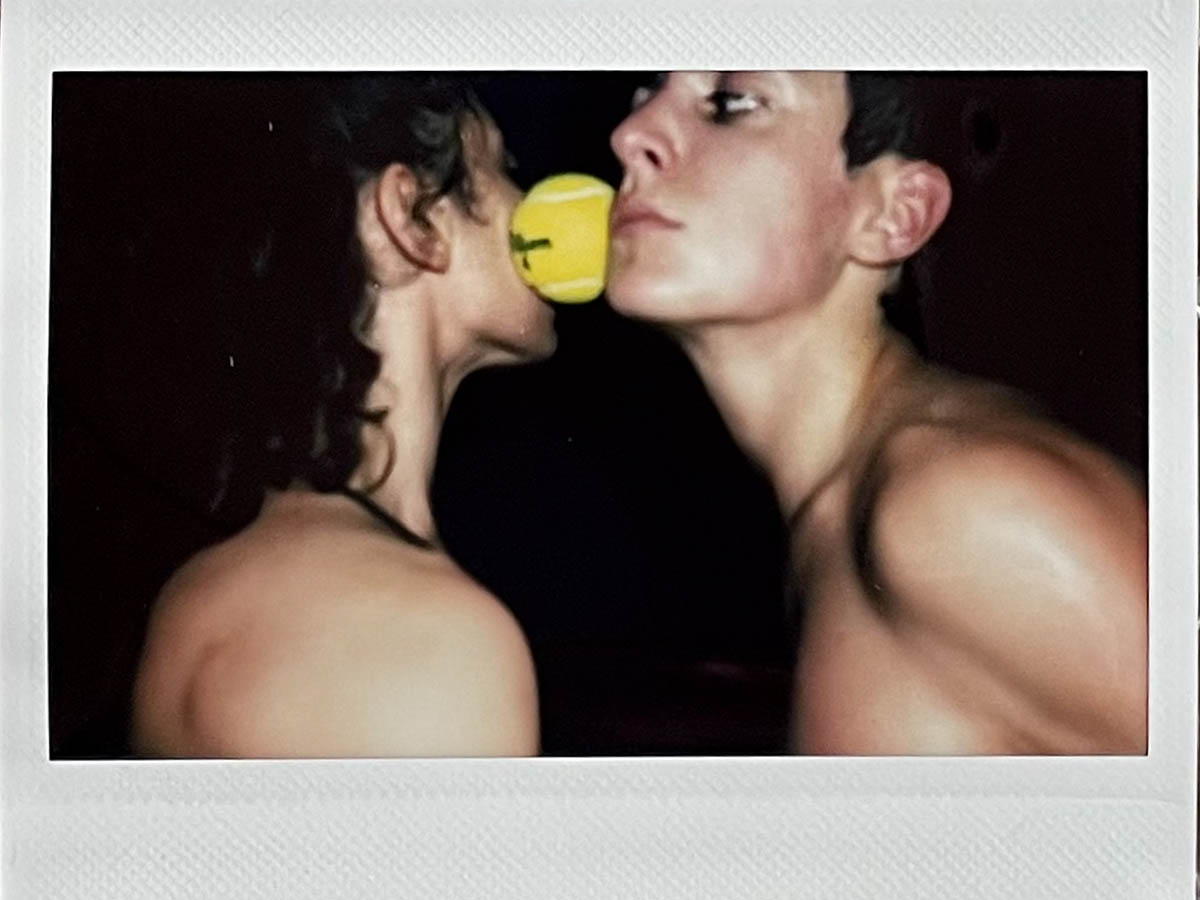
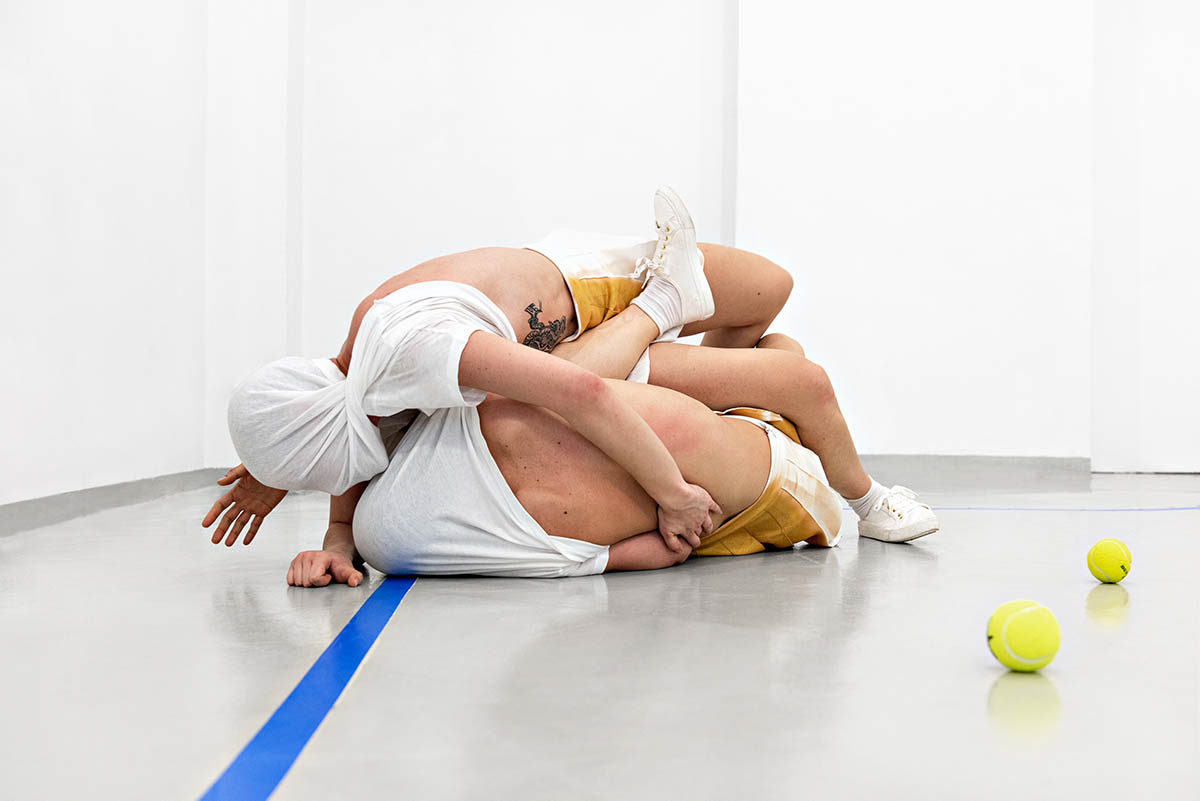
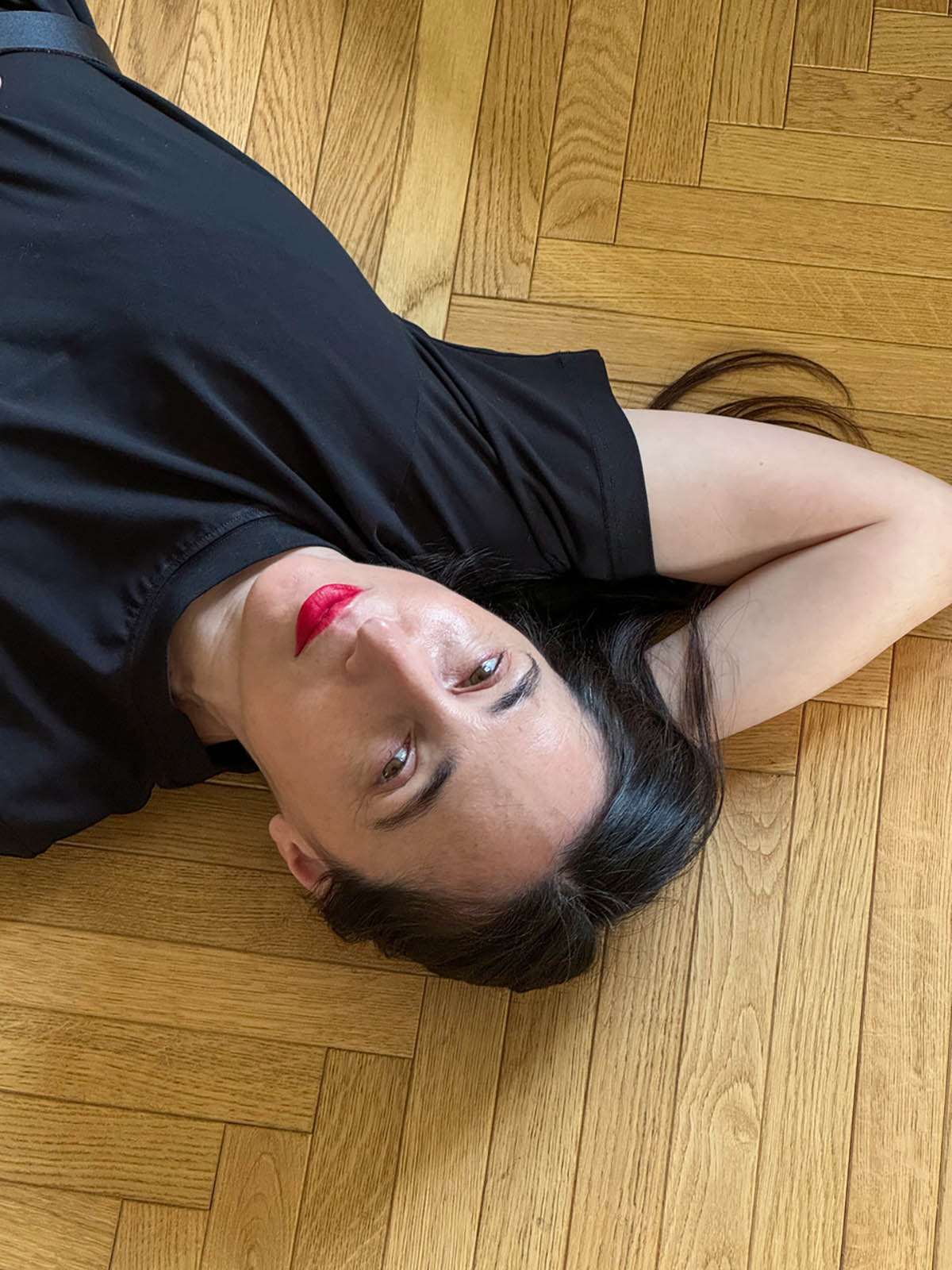
Power is intimate. It begins in the family before it reaches the institution: the same hierarchies, the same rituals of obedience, and the same silences that hold everything in place. My work operates at the seam where one becomes the other. Where the way someone stands, obeys, resists, or performs reveals the apparatus that shaped them long before they entered the room. When I say „apparatus,“ I mean it in a concrete sense. The gymnasium is an apparatus. The stock exchange is an apparatus. The American dream is an apparatus. They don’t exist in isolation; they reinforce each other and produce the same body in different costumes. The athlete, the worker, the woman, and the citizen are all trained by overlapping systems that are easier to feel than to name. The personal narrative is never only personal. What I do is observe these narratives and describe them, but description, in my practice, is never a single gesture. A performance happens once. Then what it produced keeps working across other forms: a photograph, a video, a drawing, an installation that preserves what the performance left behind. The aluminum table, the scattered tennis balls, the competition leotard worn in sleep. Each is a remnant that carries the narrative forward into a different temporality.
Marilisa Cosello – www.marilisacosello.com, www.instagram.com/marilisacosello/
Marilisa Cosello is a Milan-based artist who started as a news photographer before the document gave way to the staged, the choreographed, the collectively rehearsed. Her work now moves between performance, video, installation, and photography — though the real medium might be the body itself, and the question of what it can still refuse. Her long-term projects place bodies inside the architectures that claim to organize them: the gymnasium, the stadium, the city, the myth. Athletes appear not as icons of achievement but as figures caught between discipline and desire, where the collective rehearsal of effort starts to look like something else entirely. Each chapter of Try is a sport staged once in a place that was never meant for it — then left behind. In American Dream, it is the culturally colonized body that surfaces — a body written over by ideological fictions it never agreed to. Power, its apparatuses, and the slow construction of female mythology as historical artifact: less chosen subjects than the ground her work keeps returning to. Somewhere between Judson Dance Theater’s insistence that any movement could be dance and her own choreographies staged in highway underpasses, deconsecrated churches, and imaginary tennis courts, a line runs — not straight, but persistent. She has exhibited across Italy and internationally.