You started the project “Developments” in 2006. What was the original impulse behind it?
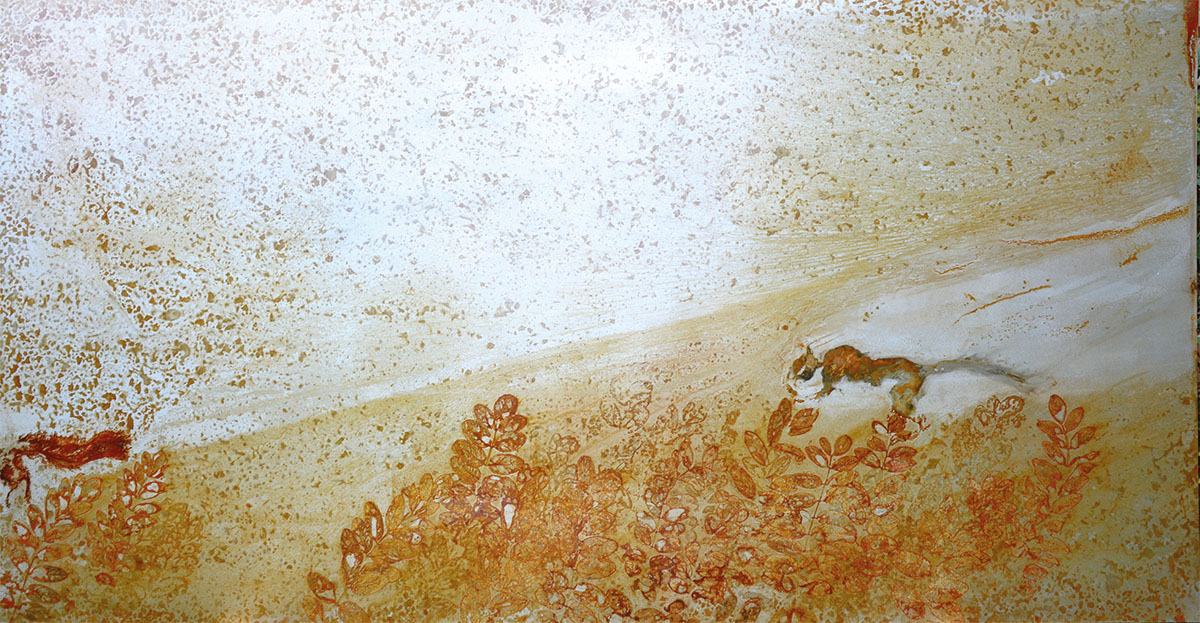
The whole concept came more from observation. In the garden in front of my studio, I had stored steel plates originally intended for another project. In the autumn, leaves fell onto these sheets. And in the spring, I noticed that the leaves had left their marks on the steel plates. That’s how I began experimenting. At first, I worked with rose petals and other blooms; later, I started incorporating dead animals I had found in nature.
How long was the process of testing and experimenting? How did you arrive at the final result?
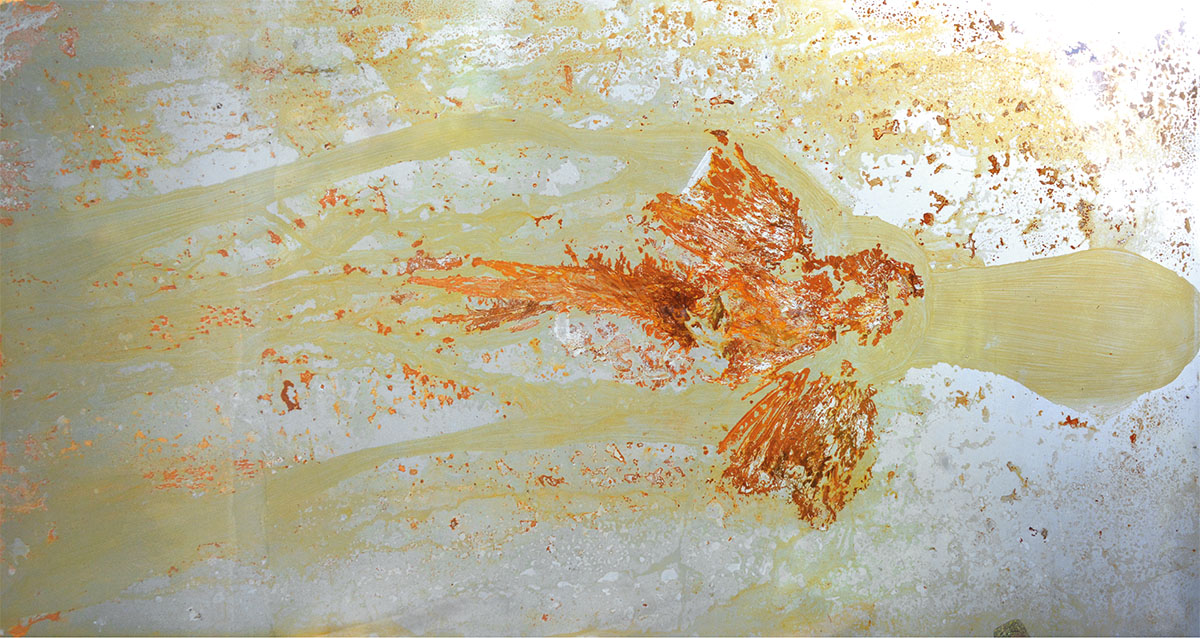
Steel was not a new material for me. At that time, I was working extensively with steel, but more in a sculptural way. This approach to steel was also new to me. Painting on steel becomes an image development process, a chemical reaction. That is why I call them “Developments,” as each work captures and preserves a moment in time.
What role does chance play in your work?
Observation always involves elements of chance. Allowing yourself to embrace chance is a central point, especially when it comes to exhibition sites. This opens up many new things and learning processes. Opportunities often arise only when you challenge things, for example, in situations with limited resources.
Shortage creates dynamics, new life, and further development. This can also be mirrored socially: progress often comes from situations of resource scarcity, which, of course, can also be tragic. Working with chance also means being open to new things. Chance is a kind of trust in the world, and I find that very beautiful.
Can you describe the technical process of the work on steel plates?
It starts with a steel plate as the base, which is first degreased. The composition is then applied, depending on the animals or plants I am working with, and the objects are placed on the plate. Environmental factors then play a crucial role: water, heat, duration, and weather conditions all influence the outcome. How is the plate stored? Does water accumulate or run off? Is the plate inclined? From the interplay of these factors, composition, environment, and time, the image gradually emerges. It is shaped by external influences such as animal fats, blood, fish oils, plant chlorophyll, as well as heat and the passage of time.
How long does the process take?
It varies greatly; some works take up to two weeks.
“Developments” is a journey through Europe. In what way does it connect to earlier works?
It has no direct connection to my earlier works. In general, exhibiting in various, even experimental spaces has always been important to me. For example, in 2011, I pursued this concept through “Anhänger der Kunst”, an exhibition taking place in urban spaces. With “Developments”, it is more about engaging directly with the immediate surroundings of the exhibition space.
If you look at your earlier works, you can already see parallels. The public space seems to be an essential part of your work. Would you see that as a point of connection?
Yes, public spaces have always been important to me and are definitely a recurring element. Perhaps that is the real point of connection: not the material or the technique, but the location and the mode of presentation. In public spaces, I can reach a very diverse audience. For me, however, my works must have an impact, because I use them to make a statement and address certain themes.
Where was the installation first shown? Let’s talk about the different stations.
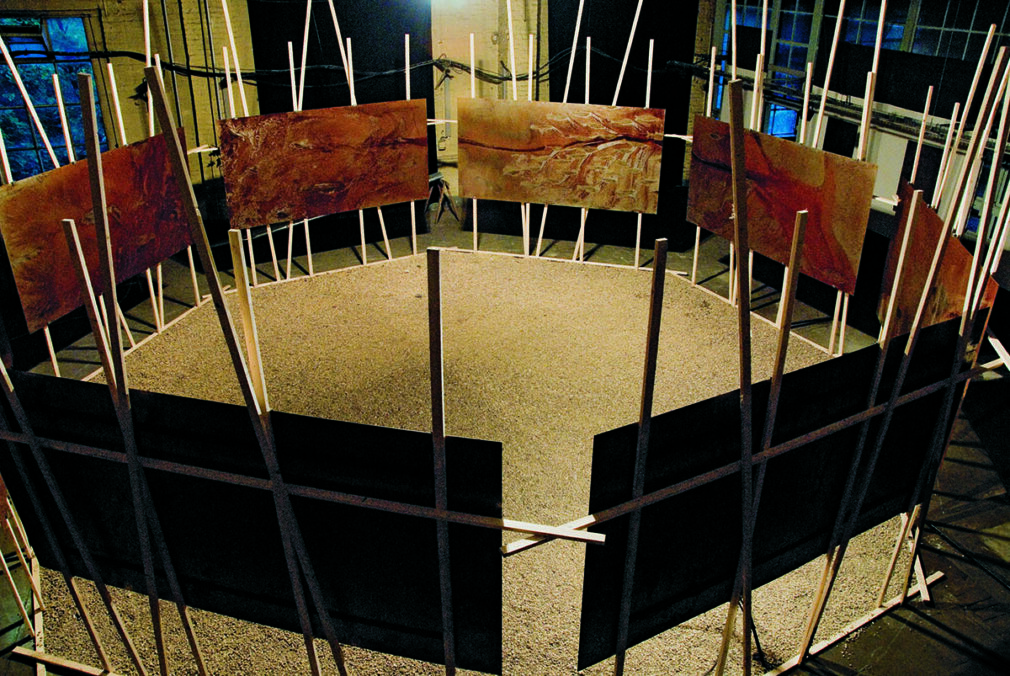
I launched Developments in 2006 with its first installation in my Berlin studio, featuring Fish, bycatch from Hanstholm, Denmark. The installation presented the works as a circular rotunda with a small passageway allowing access to the centre.
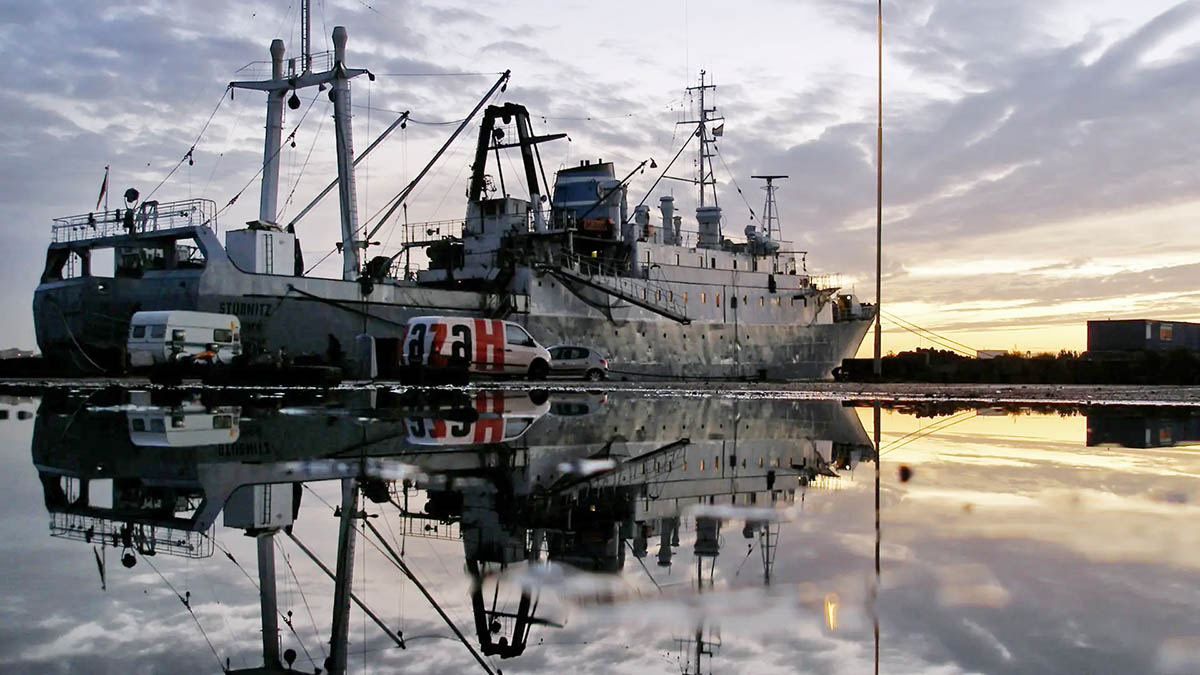
In 2017, I exhibited “Developments” on the MS Stubnitz. After departing from Rostock, the ship visited Copenhagen, Amsterdam, and Hamburg, where it now lies at Kirchenpauerkai in Hamburg’s HafenCity, operating as a vibrant club and cultural venue. The MS Stubnitz was an 80-meter-long vessel, built in 1964 for the East German fishing industry. It formerly served as a refrigerated ship in the East German deep-sea fishing fleet, used to store large quantities of caught fish. This reflects our consumption habits and draws attention to the relationship between humans and food. In the supermarket, we only see small packages of fish. Still, in reality, we are dealing with enormous quantities, a fact that becomes evident when entering a ship like this tanker. MS Stubnitz was also an excellent exhibition space, because at the beginning, the project focused heavily on underwater worlds and fish.
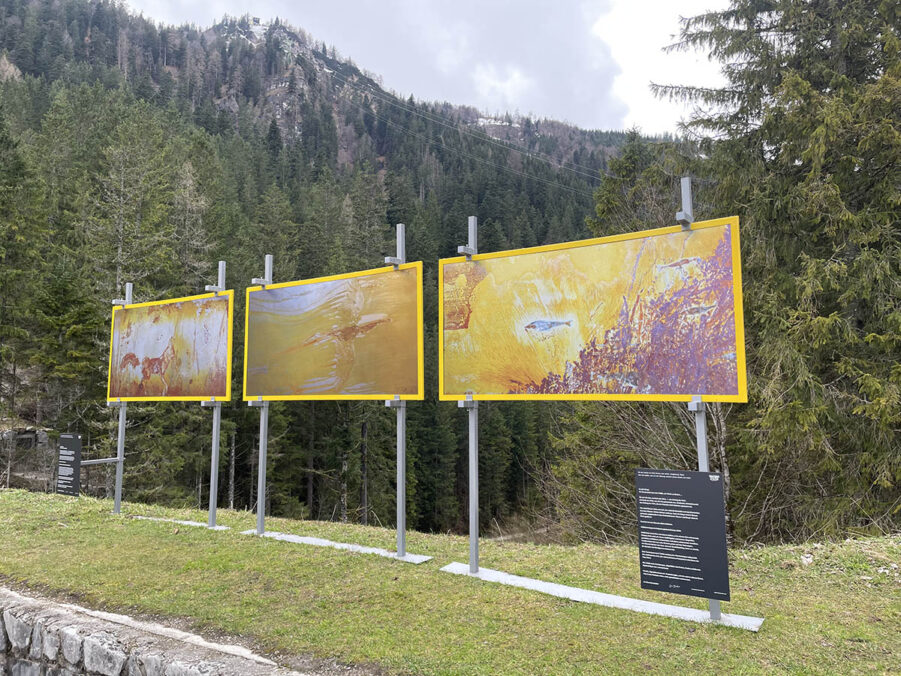
More recently, in spring 2024, three panels, Fish, Heron, and Fox, were exhibited in Gosau, in the Salzkammergut region, as part of the European Capital of Culture program in Bad Ischl. In autumn 2024, under the patronage of UNESCO, 20 panels were displayed in Schönbrunn: Danish fish, rose petals from Berlin, vine leaves from “Weinviertel” (Wine Quarter in Lower Austria), and a frog from the Salzkammergut region. In 2025, I presented works from Developments at Parallel Vienna, the contemporary art fair, marking the beginning of a multi-year European tour that took me to La Villette in Paris.
In Vienna, I found a fox by the roadside and took it with me. Schönbrunn is a place where wild animals are kept and admired by people. At the same time, in public space we treat wild animals in a very precarious way.
In Paris, you chose La Villette in the 19th arrondissement as an exhibition site. How did you perceive this place?
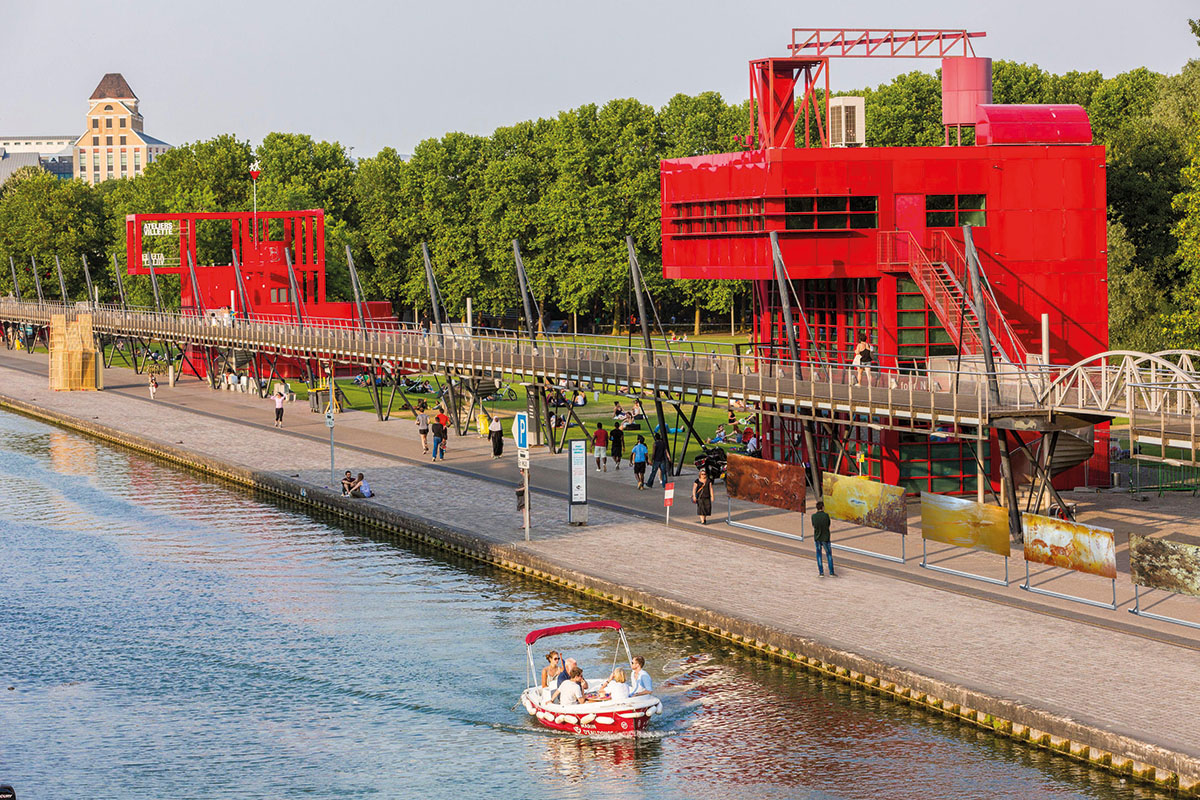
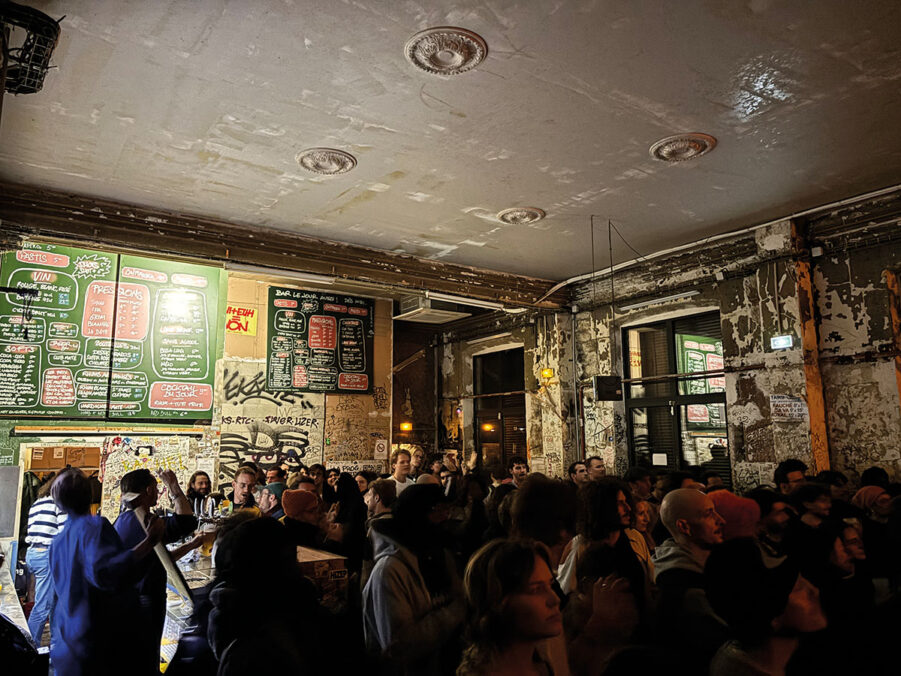
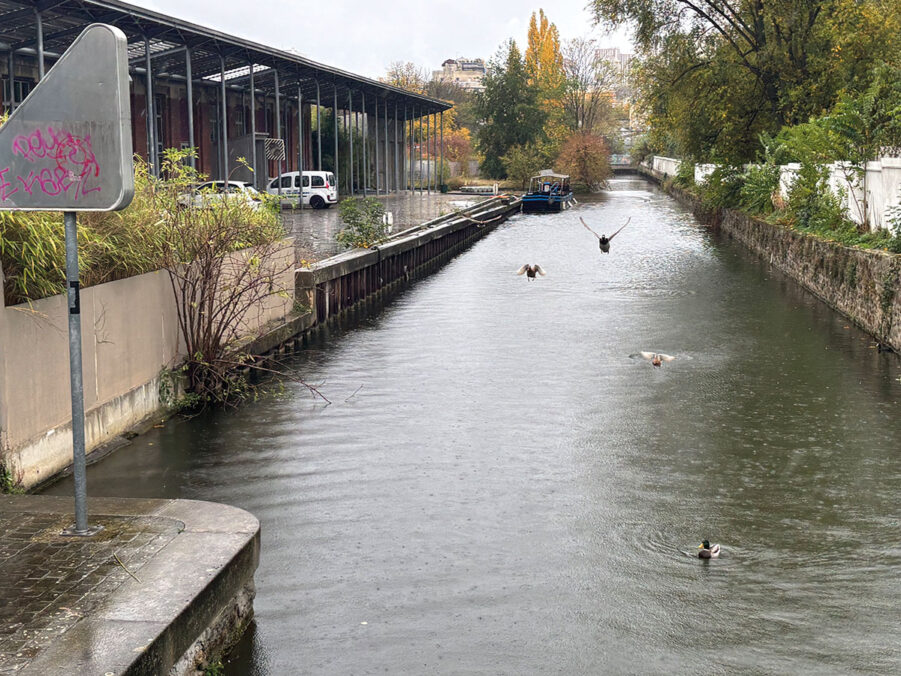
I wanted to bring the project further across Europe. I spent several days in Paris, exploring the city. For me, the Parc de la Villette had a special appeal. Located in the 19th arrondissement, the park is a place of striking contrasts, where architectural “nobility” and socially sensitive issues exist side by side, creating a socially diverse area with a very varied audience. It was this diversity that I found so interesting, which became the starting point for the photo series.
How does the exhibition site affect your work when it comes to the conceptual side?
When I discover a location, I first try to capture the atmosphere of the place. In the next step, I begin my research. During this process, I found that the site of today’s Parc de la Villette was formerly a slaughterhouse, founded in 1867, which had served as Paris’s main center for meat supply for over a century. That makes even more sense now, I thought to myself. It is important to draw attention to the transformations that have taken place, from slaughterhouse to cultural park. Such transformations are not uncommon, but they are important to address. Raising awareness changes how people perceive the place. They move through it differently. Art and cultural spaces can change neighborhoods, positively and negatively. Negatively, this can lead to gentrification. Art can sometimes romanticize development, so we must remain critical. For me, this closes the circle with the work itself: the place is not just a backdrop but an integral part of the content.
Art shouldn’t be just entertainment. From the very beginning of my work, this has been a central element: making things visible. For me, art as a purely decorative object is not possible. Art should engage with something and, ideally, create an impact.
A major challenge is logistics. That’s something rarely discussed in art. How do you deal with resources and practicality?
I often ask myself these questions: What is possible, and how can I bring it to life? I handle much of the planning and organization myself. For me, every element is connected, from the creative process to the logistics to the final presentation. Logistics are not secondary; they are an essential part of the work.
For example, in 2011, I bought a van with a trailer so that I could transport everything. I use battery-powered lighting systems, which allow me to work independently of fixed power sources. The music is streamed through construction-site radios, giving the installation a raw, mobile quality.
What does the term “resources” mean to you concretely?
Especially today, we are reaching the limits of resources; maybe that’s why we discuss it so intensely now, more than ever. Resources mean a limited availability of something. If we had unlimited resources, we probably wouldn’t even need to talk about them. In the past, many things were considered taken for granted or unlimited. Only through shortage, whether gradual or sudden, does the world become relevant. For me personally, it also means drawing from my own resources, that is, creating and realizing my own possibilities.
How do you see the relationship between environment, context, and perception, including in relation to viewers and the location where the works are shown? What role do visibility and communication play?
I would find it meaningful if something shifted in their perception if they became aware of certain things. Art should provide cues. I wouldn’t say it ‚opens eyes,‘ but it can spark engagement. I make less visible aspects visible. In my works, there is an interplay between the hidden and perception. On the other hand, the viewer may see things I didn’t consciously represent, which emerge from their own context and personal history. They bring something of themselves into the work. The works are meant to be in dialogue with the viewer, and making things visible happens through this communication.
Erik Tannhäuser – www.eriktannhaeuser.com, www.instagram.com/skulpturengarten_wien
Developments – www.developments-europe.eu
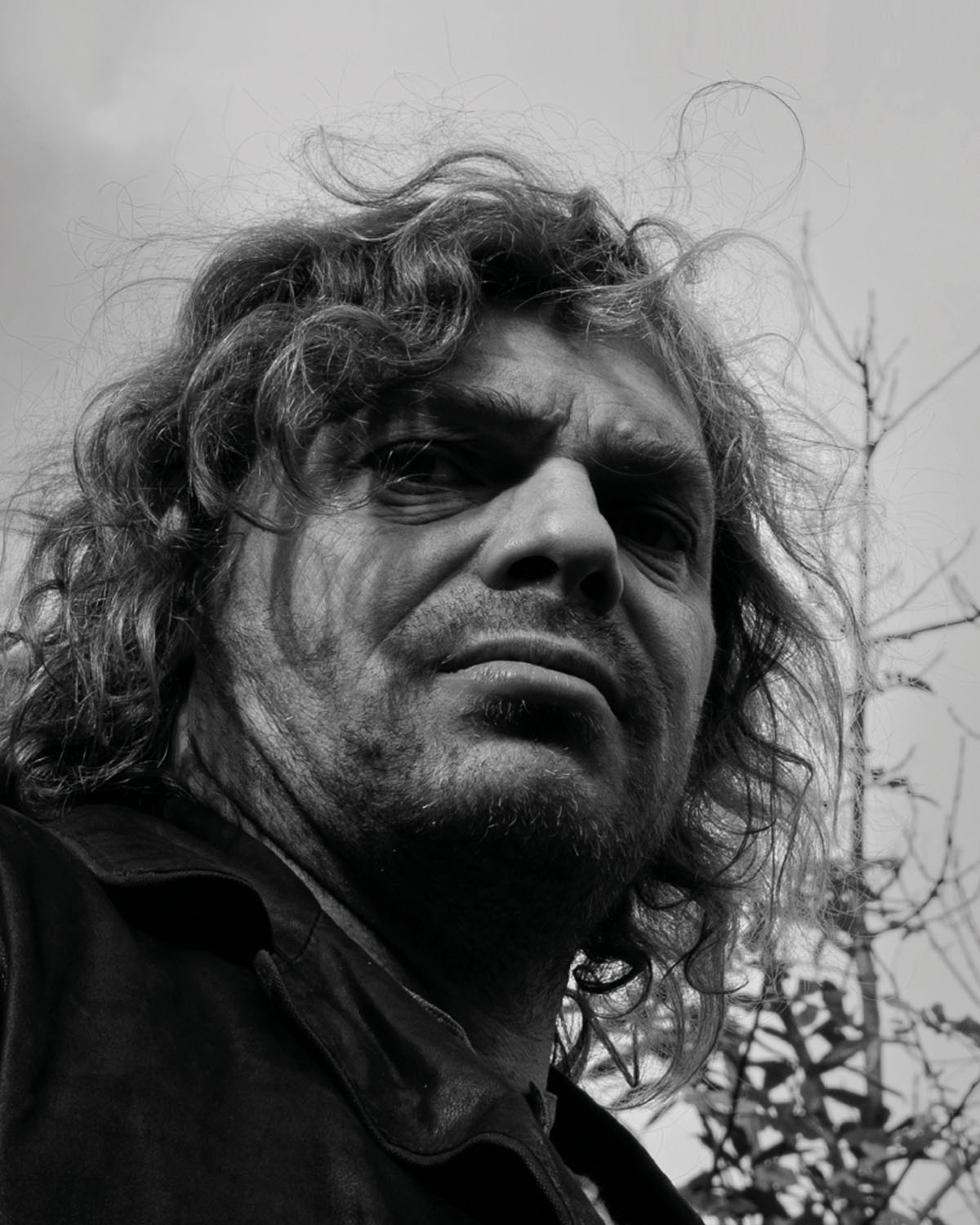
Erik Tannhäuser (b. 1974, Altenburg, Thuringia) is a German-Austrian sculptor and installation artist based in Berlin and Vienna. His large-scale and often interactive works address human rights, environmental issues, and social responsibility, combining precise craftsmanship with strong political and ethical engagement.