
Developed this year in collaboration with Los Angeles-based Lightstruck programmers Mark Toscano and Zena Grey, the programme Expanded Cinema: A Tribute to Gene Youngblood’s Book proposed a comparatively stripped-down version of the more extensive Los Angeles iteration from which it derives. Works by Stan VanDerBeek, Nam June Paik, Lillian Schwartz, John Whitney, and Jordan Belson articulate a shift from photochemical representation toward electronically synthesized, algorithmically generated, and perceptually immersive visual forms. Situated at the intersection of countercultural aesthetics, Bell Labs computer research, psychedelic perception, and post-McLuhan media theory, the selection reconstructs a historical moment in which the moving image became an experimental site for reconfiguring consciousness, spectatorship, and the ontology of cinematic space. What becomes striking across the programme presentation is the explicitly articulated fatigue vis-à-vis the contemporary visual economy on the part of the programmers themselves, and the extent to which this affective register already permeated many of the films shown.
This is somewhat unexpected for at least two reasons. First, within the collective imagination, the Los Angeles countercultural milieu attached to Youngblood tends to be positioned in opposition to the austerity of New York structural film: more libidinal, ecstatic, technologically affirmative. Second, these works emerge precisely at the moment of video art’s earliest explorations, that is, at a historical conjuncture usually understood through the rhetoric of expansion, experimentation, and media liberation. Yet beneath this horizon one already encounters a diffuse anxiety regarding what Youngblood, borrowing from Ritchie Calder’s notion of “speed of change,” identified as a phenomenological and psychic destabilisation produced by the acceleration of televisual and informational experience. Seen from the present, these works appear less invested in the celebratory expansion of cinematic form than in the psychoanalytic and political consequences of media saturation itself. Youngblood himself described his book as a “discussion of the individual’s relationship to the contemporary cultural environment” and the “way in which an irresponsible attitude toward the intermedia network contributes to blind enculturation, confusion, and disharmony”.
BROADCASTING THE SPLIT SUBJECT
On the one hand, the 2026 EMAF programme implicitly revisited Expanded Cinema as a historically situated account of media consciousness around 1969 — a mapping of the perceptual, technological, and political conditions emerging at the threshold of cybernetic culture. On the other hand, the screenings suggested a more unsettling possibility: that these works still resonate today not simply because they anticipated contemporary mediated visual culture, but because, in certain respects, we have not moved far beyond the political and psychological anxieties from here they were born. If the programme at EMAF occasionally felt haunted by a form of disappointment toward the present visual economy, this may be because Youngblood himself already understood media expansion as inseparable from psychic destabilisation.
The chapter that interested me the most while re-reading Expanded Cinema between the two screening nights was “The Audience and the Myth of Entertainment”. Expanded cinema here does not designate an expansion of the cinematic apparatus into architectural space, but a transformation of consciousness itself under new technological conditions of perception. Television, cybernetics, psychedelia, space travel, hallucinogens, and information theory all collapse into a single epistemological horizon in which “reality” becomes inseparable from mediation. “We were seeing nothing but videospace,” Youngblood writes of the televised moon landing, identifying in the event the emergence of a new perceptual regime in which simulation supersedes the distinction between objective and subjective experience. The collapse of reality into mediation is thus framed as the precondition for a new form of consciousness, articulated through the prophetic language of the counterculture:
Dylan swears he sees his reflection so high above the wall upon which he once drew conclusions. Seeing that reflection is the revolution. It tells us that the old reasons for doing things no longer exist. „There’s less to do because circumstances do it for us: the earth. Art has obscured the difference between art and life; now life will obscure the difference between life and art.“ We no longer need to prove our right to live. We’re struggling in the toil of old realities, stranded from our conscience, doing our best to deny it. We are tragically in need of new vision: expanded cinema is the beginning of that vision. We shall be released. We will bring down the wall. We’ll be reunited with our reflection.
Countercultural messianism, media theory, and cybernetic utopianism converge in a rhetoric of perceptual transformation structured by a fundamentally musical logic. Youngblood’s recurring invocations of Bob Dylan indicate the extent to which expanded cinema emerges not only from experimental film culture but from the perceptual regimes of psychedelic music and electronically amplified sound. The line drawn from I Shall Be Released (1967), introduces a messianic vocabulary of emancipation in which expanded consciousness becomes inseparable from collective sonic experience:“Yet I swear I see my reflection / Some place so high above this wall / I see my light come shining / From the west unto the east / Any day now, any day now / I shall be released”. The revolutionary horizon imagined by expanded cinema thus depends less on technology alone than on a broader reconfiguration of perception already articulated through counterculture music, amplification, and altered states of listening. The organisation ofExpanded Cinema then can be read as a movement from alienation to imagined reintegration, but what is crucial is that this movement never proceeds simply as a teleological history of experimental technologies. It is staged as a progressive reconfiguration of the subject’s relation to its environment: first as a diagnosis of estrangement, then as a transformation of perception, then as a passage into increasingly immaterial, networked, and finally metaphysical forms of communication (the release).
Revisited today, the seminal text produces a strange temporal short-circuit. On the one hand, its rhetoric remains deeply marked by the countercultural optimism of the late 1960s: the reconvergence of art, science, and metaphysics; the promise of consciousness expansion; the dream of planetary subjectivity. On the other hand, one already detects the contours of our own exhausted media condition. Youngblood repeatedly invokes acceleration, sensory overload, alienation, and the collapse of stable perceptual coordinates under the “speed of change.” What gradually becomes legible across the 2026 EMAF programme is that the expansion of perceptual regimes described by Youngblood is never reducible to a celebratory narrative of technological liberation. It is structured instead by a constitutive ambivalence between intensified connectivity and its persistent failure. Kaprow’s HELLO, as Youngblood notes, operates as a “sociological conduit,” in which electronic communication is staged less as a vehicle for information than as an experimental field for relationality itself. Youngblood begins his book from a split between “interior realities” and “exterior realities”, between what one is and what one does, between art and life. The book opens from a divided subject, one alienated from itself by the cultural and commercial systems through which it comes to recognise its desires. Entertainment functions almost like a misrecognising mirror.
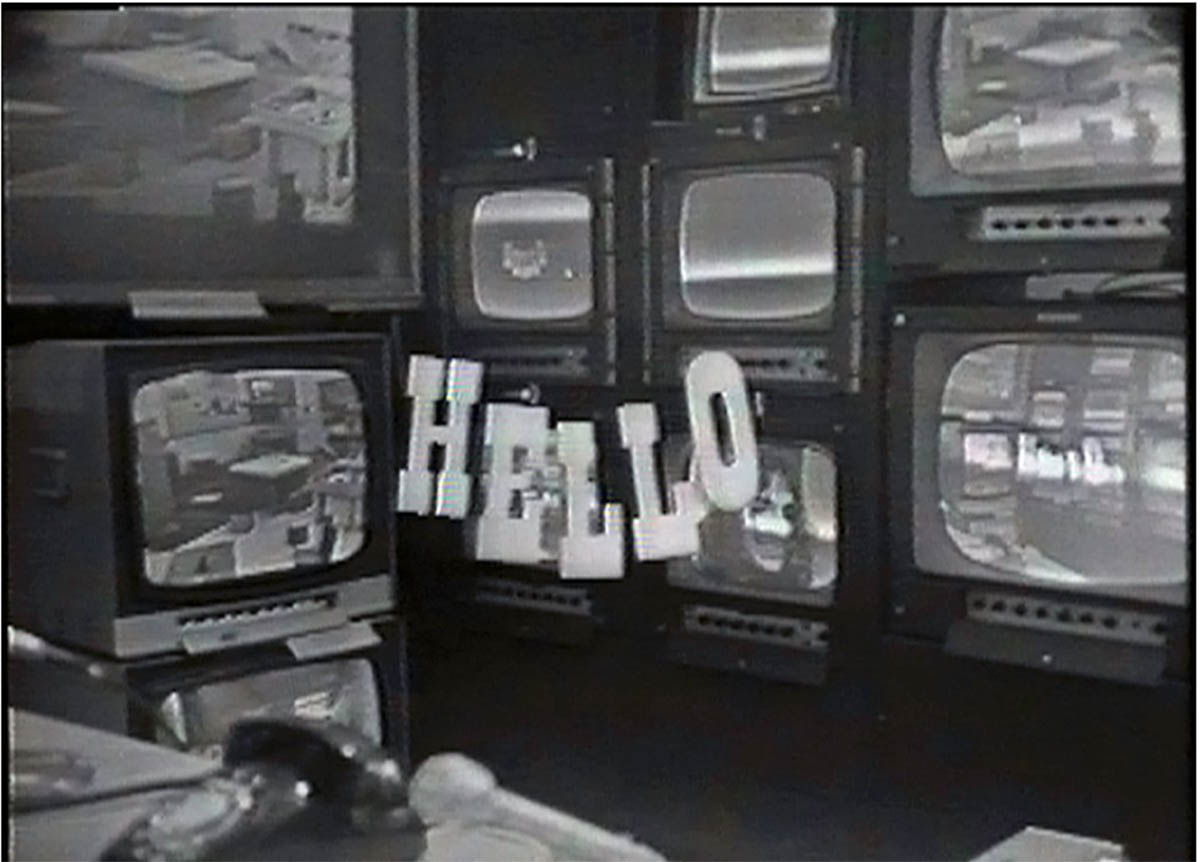
‘Hello’ was the first film screened on the second night of the programm. In this happening created for The Medium Is the Medium in 1969, a thirty-minute experimental television program featuring six visual artists, Allan Kaprow used five cameras and twenty-seven monitors to connect four separate locations through a closed-circuit television network. Participants stationed at different sites were given simple scripted phrases, such as “Hello, I see you”, to acknowledge either themselves on screen or other participants. Acting as director from the control room, Kaprow intentionally disrupted conventional communication conventions: a conversation between someone at the airport and someone at M.I.T. could abruptly shift to doctors in a hospital. Through these interruptions, Kaprow explored the paradox of “communications media as non-communications,” emphasizing not the efficiency of technological exchange but the awareness of “oneself in connection with someone else.” In this respect, communication is no longer organised around representation or discourse but around the exposure of connection as such, including its delays and breakdowns. The term Hello, screamed so many times during the video, is slowly starting to lose its meaning in favor of the pure sonic quality of its interjection. The technological medium appears simultaneously as a condition of intersubjective relation and as its obstruction.
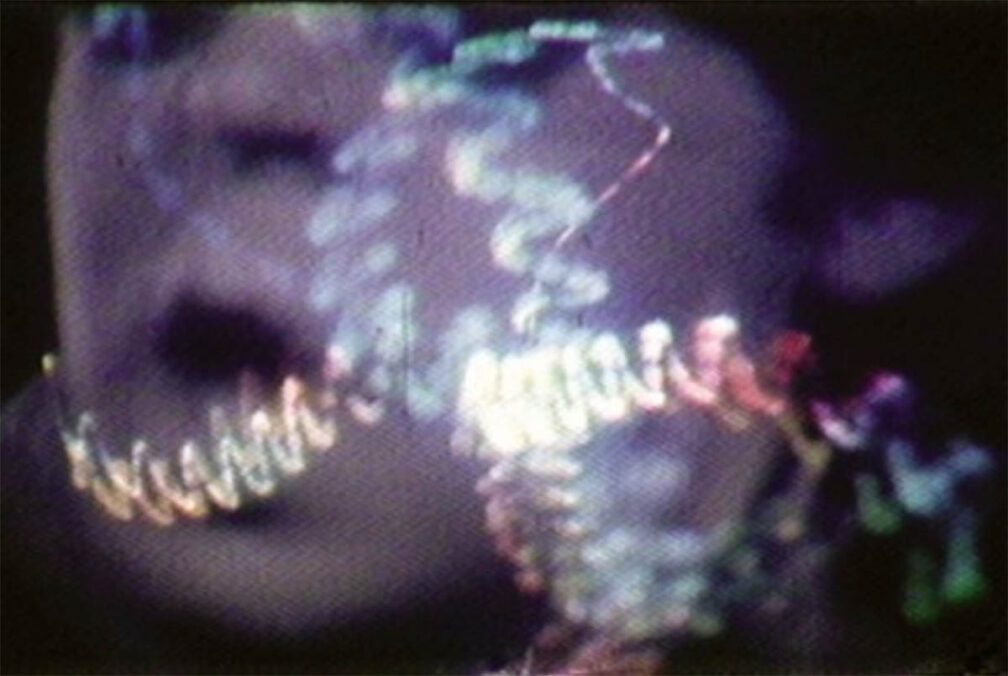
A comparable reconfiguration of presence is at stake in Paik’s Beatles Electroniques, where the figure of the four musical performers is fully absorbed into televisual mediation. Beatles Electroniques was produced in black and white using live television broadcasts of the Beatles as source material, which Nam June Paik then manipulated in real time through electromagnetic interventions applied directly to the receiver. Additional sequences were generated by filming a video monitor displaying material recorded during earlier experiments involving a Sony videotape recorder. The resulting work has a duration of approximately three minutes and is paired with an electronic score by Ken Werner, Four Loops, which itself is constructed from four layers of Beatles sound fragments subjected to electronic processing and repetition. The Beatles are no longer construed as historical or performative subjects but as effects of electronic circulation, described by Youngblood as “an eerie portrait of the Beatles not as pop stars but rather as entities that exist solely in the world of electronic media”. What emerges here is a displacement from subjectivity to signal: identity is no longer grounded in embodied performance but distributed across the infrastructural continuum of television. The work thus stages an early form of what might be termed a phenomenology of broadcast existence, in which presence is indistinguishable from its transmission.
Contemporary institutional uses of the term ‘expanded cinema’ frequently refer to the displacement of moving images beyond the black box toward the white cube, or more generally to the spatial redistribution of cinematic dispositifs across installation practice, exhibition formats and its integration to the global art market. The corpus reactivated at EMAF instead pointed toward another genealogy, in which expanded cinema concerns the expansion (and fragmentation) of consciousness under late technological modernity.
DEATH ON TV
Youngblood’s reflections on televisual perception also acquire a different resonance when read against the historical proximity between the writing of Expanded Cinema and the Vietnam War. The utopian promise of a planetary consciousness emerging through telecommunications already coexisted with the mass circulation of mediated violence. In the United States, the political horizon of expanded cinema in 1969 cannot be separated from the antiwar media practices, especially the work of Newsreel, which treated film less as an autonomous artwork than as a collective instrument of counter-information and mobilisation.This proximity complicates any purely technological reading of Expanded Cinema: in the U.S. around 1969, the expansion of media forms was also bound to the imperialist war in colonized Vietnam, racial struggle, student militancy, and the search for collective modes of address:
Within the larger context of radical evolution there are many local revolutions. One of them is the revolution of expectations that burns in the minds of the new consciousness. […] Young Dyaks in the longhouses of equatorial Borneo listen to the Beatles on transistor radios. Teenage Bedouins wandering the Sahara hear Nasser’s radio telling how Vietnamese children are being slaughtered half the world away.
If, as Paul Virilio argued, modern warfare is inseparable from regimes of perception, then the “videospace” described by Youngblood marks not only an expansion of consciousness but also the emergence of a permanently mobilised spectatorship. The transistor radio carries the Beatles into Borneo, signalling the planetary reach of commercial popular culture, but it also carries Nasser’s account of Vietnamese children being slaughtered, allowing distant listeners to perceive imperial violence as part of a shared political present. Youngblood’s cybernetic imagination continues in the historical configuration of today’s media regime inside which perception itself is integrated into the real-time circulation of military violence in Gaza and Lebanon. Images circulate continuously across smartphones, feeds, and livestreams, producing what Susan Sontag identified as the simultaneous saturation and anaesthetisation of political affect, while simultaneously opening a space for the strategic production and circulation of counter-images which contest the visual monopoly of state and corporate media.
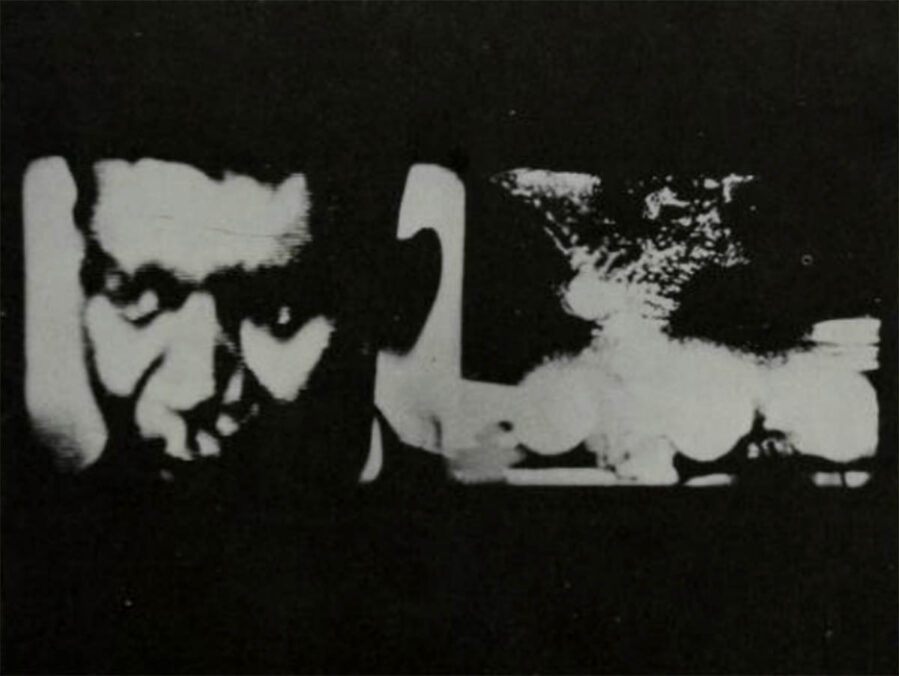
It is precisely this tension between dispersion and integration that reappears, in a more explicitly technological form, in Black TV. The work stages a split-screen environment in which perceptual unity is systematically fractured by the simultaneity of the double projection and the distortion of reused TV footage. As Youngblood writes, “Black TV is about perception in the intermedia network. It generates a pervasive atmosphere of the process-level perception by which most of us experience the contemporary environment”. The aesthetic condition it produces is one of distributed attention, in which perception is no longer centred but continuously divided across concurrent streams of information. Tambellini’s formulation reinforces this diagnostic dimension: “Black TV is about the future, the contemporary American, the media, the injustice, the witnessing of events” (Aldo Tambellini, quoted in Expanded Cinema). What is at stake is less a representation of events than the constitution of a perceptual regime in which witnessing becomes infrastructural.
Read through Samuel Weber’s account of television in Mass Mediauras as a medium that produces presence through distance, relay, and technical transmission, Beatles Electroniques and Black TV appear as two variations on the same crisis of mediated subjectivity. In Paik’s treatment of the Beatles, the performer is not simply represented by television but reconstituted as a televisual effect: a figure whose recognisability survives only through the electronic processes that distort, repeat, and circulate it. Presence is therefore no longer grounded in bodily performance, but in the unstable continuity of the signal. Yet this technical displacement also has a psychoanalytic implication. If, for Lacan, the subject is split by its dependence on an external image that both forms and alienates it, these works transfer that division into the circuitry of broadcast itself. Black TV radicalises the condition by shifting from the mediated icon to the perceptual field, where simultaneity, interruption, and feedback prevent the viewer from occupying any stable point of recognition. What Weber helps clarify is that broadcast does not merely carry an image across distance; it makes distance internal to the image’s mode of appearing. What Lacan helps clarify, in turn, is that this mediated distance is also a structure of subjectivity: the self appears only through an image that divides it. In both works, television becomes the site where subjectivity is technically produced and psychically displaced, where the promise of connection is inseparable from dispersal, delay, and fragmentation.
REUNITED WITH OUR REFLECTION
The subsequent chapters of Expanded Cinema can then be understood as attempts to overcome that split through successive models of mediation. “Synaesthetic Cinema” names the possibility of a perceptual reorganisation in which cinema no longer addresses the subject as a spectator of dramatic representation, but as a sensory organism embedded in a field of signals. This is where the desire for release becomes the desire for movement itself: the book moves away from drama, genre, and official communication structures toward decentralisation, synaesthesia, exchange, and flow. Youngblood presents communication technologies as instruments of liberation, and still the media that promise fusion also operate through distance, relay, and technical mediation. Expanded Cinema does not move from cinema to television to computers to holography as a neutral technological sequence. It moves toward ever more total fantasies of integration: art with life, perception with environment, communication with consciousness, cinema with “the life of the mind.” Each section promises to close a gap opened in the first part, but each closure requires a further expansion. The book is therefore structured by the same logic as lacanian “desire”: liberation is always projected forward, always reconducted through another medium, another perceptual regime, another technological threshold.
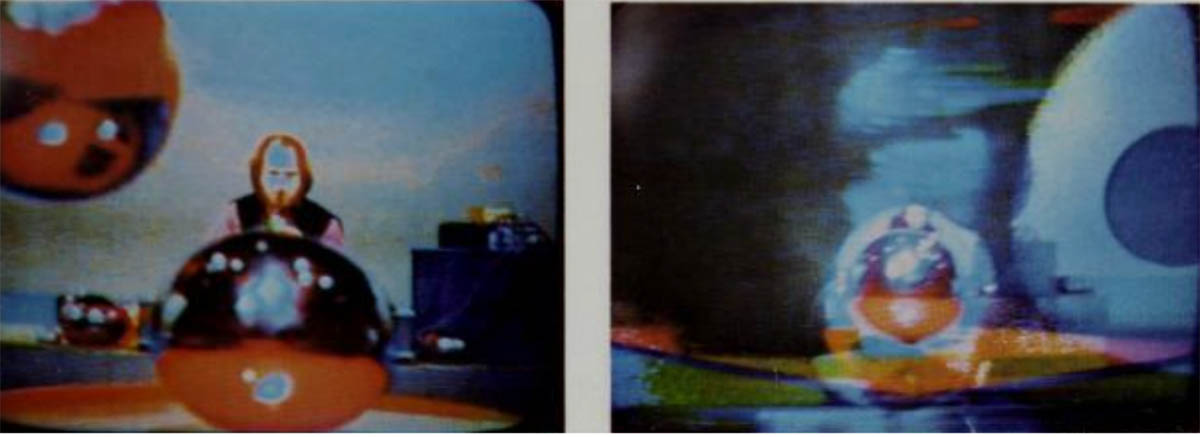
The final work in the programme, Music with Balls, appears to momentarily resolve these tensions through a model of synaesthetic convergence. Conceived by Terry Riley in collaboration with Arlo Acton and John Coney, the piece is described by Youngblood as “a transcendental composition” in which music, sculpture, cinema, and video are integrated into a single perceptual environment. It “inundates the beholder in megabits of experiential design information, aural, visual, and kinetic” (Gene Youngblood, Expanded Cinema). The work thus proposes a form of total composition in which heterogeneous media are subsumed within a unified experiential field. Yet this synthesis remains structurally unstable: the “balls” that organise the visual field retain a latent volatility, suggesting that integration is never fully secured but constantly threatened by disaggregation. Do we know fear that the glass balls swinging endlessly across the screen end up crashing into one another? What the EMAF programme ultimately renders visible is that expansion is never a neutral increase in perceptual capacity, but a historically and technologically situated reconfiguration of the conditions under which perception itself becomes possible.
Dylan’s promise of “release” carries a psychoanalytic charge that complicates Youngblood’s rhetoric of liberation. It suggests both political emancipation and the discharge of a pressure that has been held within the subject as a projective movement from repression toward expression. In this sense, the word recalls Breuer and Freud’s account of abreaction, in which psychic relief depends on the release of affect that has remained bound to an unassimilated experience (Breuer and Freud, 1895). Expanded cinema’s promise is therefore not simply to free vision from older aesthetic forms, but to release the subject from the psychic structures that have organized perception itself. The wall, the reflection, and the promise of being “reunited” with that reflection all imply a fractured relation to the self: consciousness is imagined as separated from its own image, alienated from what it might become. “Release” therefore names a fantasy of psychic integration, the hope that technological and sensory expansion might overcome repression, division, and estrangement. Yet this fantasy is also unstable, because what is released may not be pure liberation, but desire itself, with all its contradictions, projections, and dependencies. Expanded cinema thus appears as both cure and symptom: a promise to free perception, and at the same time an expression of the very psychic lack that makes such freedom imaginable. The book dreams of overcoming the split subject through expanded mediation, while at the same time revealing that the desire for such overcoming can only persist by passing through new forms of mediation. Its organisation is therefore not linear but spiralic: each part promises release, and each promise produces the need for another release.
Across these films, expansion – the pressure point where what cannot be contained in the mainstream communication flux manifests as latency, screen and subject splitting, desynchronization, and loops – is the qualification adequate to our time: not because it represents contemporary time but because it is contemporary time. Duration structured by political violence, motion composed of loops, ghostly figures that arrives only through mediated technology…. Release is therefore not a promise of arrival but a desire for motion itself. Its psychic and political force lies in the fact that it can never be fully settled as an accomplished state; it remains an interrogation, a horizon that must be posed again and again. In Dylan and Youngblood’s words: Shall we be released? Will we bring down the wall?
European Media Art Festival – www.emaf.de