
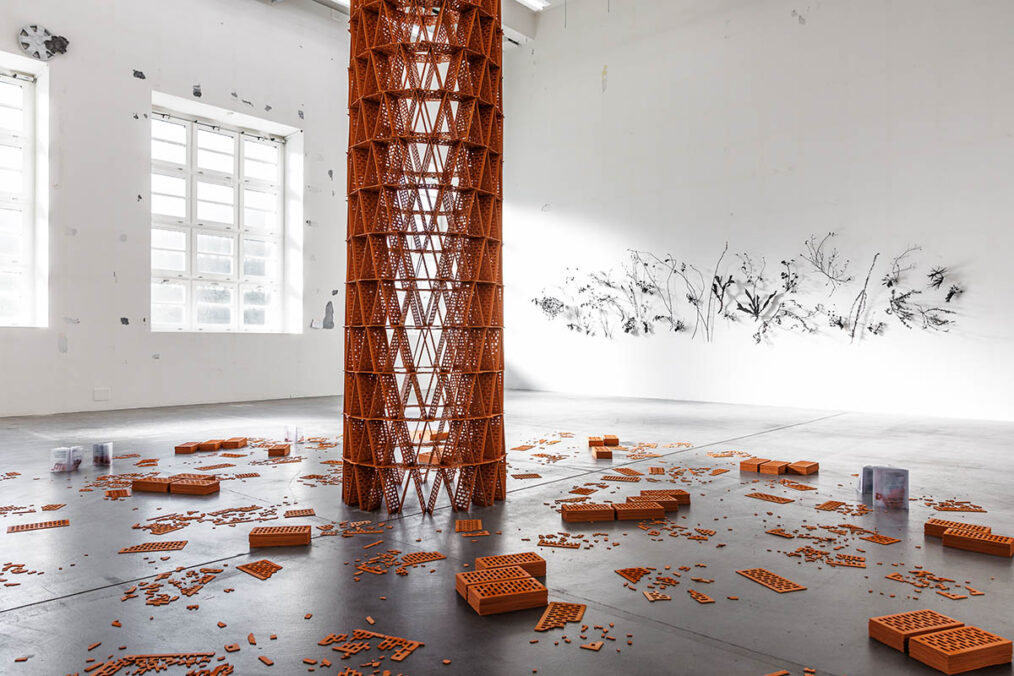
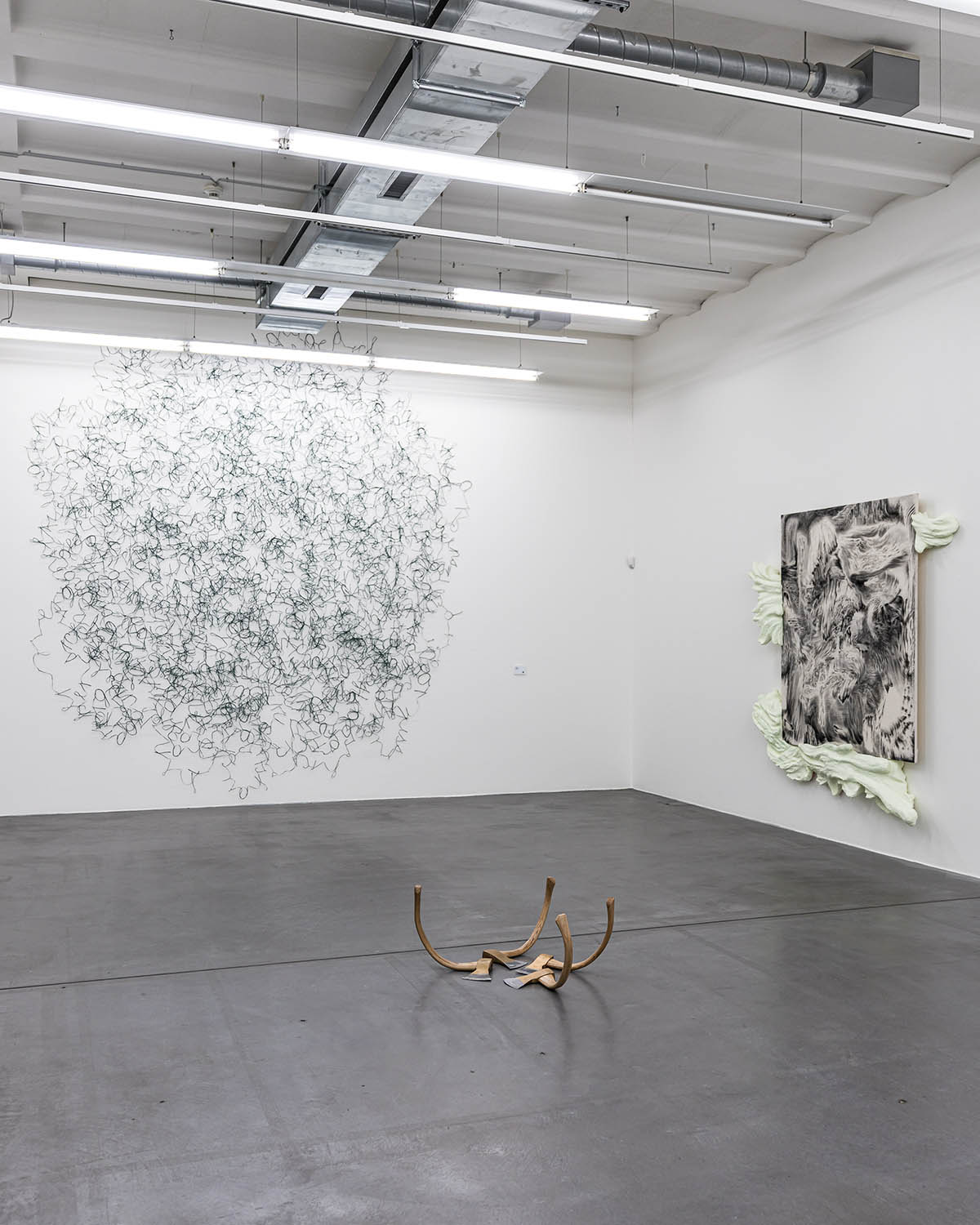
Occupying the former museum’s 1,200 square meters of exhibition space across five floors — and expanding into more than 2,000 square meters by activating the cellar, offices, storage areas, shop, café, and rooftop — the collective takeover reclaims a site that for decades housed an established art institution and recasts it as a field of coexistence. Within this newly formed terrain, distinct artistic positions meet, diverge, and hold their ground together without submitting to a single order, turning coexistence itself into an intervention in the conditions of artistic production and visibility.
Alongside 6½ — a nomadic artist-run platform known for large-scale interventions in vacant urban spaces — the project brings together Hotel Tiger, an independent artist-run space dedicated to experimental formats and community-building across disciplines through exhibitions in public and alternative spaces; Die Diele, an innovative vitrine-based exhibition space focused on site-specific artistic encounters; and Papillarya, which develops transdisciplinary exhibitions beyond the white cube. It also includes MATERIAL and volumes, both central actors within Zurich’s independent publishing and discursive art scene, alongside zwischentext, a multilingual, feminist, and (post)migrant literary collective that connects cultures and languages through poetry, essays, festivals and interdisciplinary practices. Together, these collectives represent some of the most active and interconnected positions within Zurich’s contemporary art field.

Conceived by Peter Baracchi, “Oceans Flow Upwards” grew from his own multilayered experiences as an artist, curator, project manager, and co-founder of 6½, as well as from his early career roles at Haus Konstruktiv as museum technician and exhibition photographer. Having worked inside the former museum’s premises, Baracchi closely followed the relocation of Museum Haus Konstruktiv to the Areal Löwenbräukunst and recognized that the interval before reconstruction would leave the Selnau building temporarily empty. This vacancy struck him as impossible to ignore. “The art scene is struggling every day to find places, to get visibility, to exhibit, to do projects,” he says; an empty museum in the centre of Zurich, he insisted, “cannot happen.” He therefore contacted EWZ and the City of Zurich early on, trying to learn more about their plans and to push for the building’s temporary cultural use. After months of uncertainty, the City of Zurich informed him in February that an interim use might be possible. He began developing the entire concept while the project was still only a tentative possibility, before it was formally secured in March.

From the beginning, the symbolic force and scale of the building mattered to Baracchi because they opened a possibility too large for 6½ alone. The project’s significance for Zurich’s wider independent art scene led him to invite other collectives into the process. Collaboration, however, did not mean dividing the museum into separate territories. “I don’t want to divide the museum into different off-spaces, because then it will be like an art fair. I don’t want an art fair. I don’t want the competition.” Artists were invited by the collectives rather than selected by open call or jury; “we didn’t choose the artworks. We chose the artists,” he explains. Baracchi and Mischa Camenzind, one of the three co-founders of 6½, developed the placement of works on site, while the public program grew from proposals by the collectives and artists themselves. His vision for the exhibition remains the clearest: “one exhibition, and not seven different exhibitions.”

That the project remains open through Zurich Art Weekend, with a full public program, is not incidental. Baracchi pushed for the exhibition period to extend into mid-June because, in his view, “the off scene, the alternative art scene, is also part of the Zurich Art Weekend. It shouldn’t be only for the big galleries.” Indeed, one of Zurich Art Weekend’s distinctive qualities is the breadth of what it gathers into one compact public constellation: museums, galleries, universities, foundations, off-spaces, editions, publishers, and public and private collections. In 2025, the event brought together 71 venues, more than 75 exhibitions, over 150 events, and more than 180 artists; its 2026 edition expects more than 45,000 visitors.1 By entering that frame with 80 artists and seven collectives, “Oceans Flow Upwards” enlarges what Zurich Art Weekend can hold in view at once. Measured against the city’s population, Zurich Art Weekend has a striking density, with roughly 100 visitors per 1,000 residents, compared with about 38 for Berlin Art Week.2

Yet this density exists within a city where cultural space is increasingly scarce. In its four-year cultural policy framework, the Kulturleitbild 2024–2027, the City of Zurich describes the lack of available, suitable, and affordable spaces for cultural production and presentation as a pressing problem, noting that high rents make it increasingly difficult for the independent scene to remain in the city centre. The report explicitly recognizes off-spaces as vital to a living art scene and acknowledges that support for these self-organized spaces is currently insufficient. It therefore proposes a broader “Räume für die Kultur” strategy, with additional annual funding rising from CHF 450,000 in 2024 to CHF 1.3 million in 2027 for the preservation and creation of cultural spaces, including recurring operating support for new presentation venues and increased funding for off-spaces.3
Josh Kline’s recent essay, “New York Real Estate and the Ruin of American Art,”4 makes clear why the struggle over space extends beyond the immediate problem of securing studio and exhibition spaces. Although Kline writes from New York, the conditions he describes cannot be confined to New York alone. They speak to a broader art-world reality in which real estate shapes what artists can make, where their work becomes visible, and who remains able to continue producing. For Kline, artist-run spaces matter because it is there that artists retain the authority to decide “who exhibits, what a show is, and what art can be.”5 Their disappearance narrows access and weakens the conditions from which new practices and movements emerge. When space contracts, artistic production contracts with it: politically, culturally, and institutionally.
Economist and Nobel laureate Daron Acemoglu identifies shared prosperity and self-government as two foundational promises of liberal democracy: prosperity must extend beyond those already in positions of power, while communities must retain the capacity to organize and shape the conditions of their own lives.6 Seen from this perspective, “Oceans Flow Upwards” becomes more than a temporary exhibition. It responds to an art world in which access to space, visibility, funding, and institutional recognition remains unevenly distributed, shaping who can continue producing, who becomes visible, and whose practices enter public circulation. The collective takeover exemplifies the force of independent artist-run spaces precisely because off-spaces already carry the habits of self-organization: they gather communities, create access, build visibility, and produce value through participation. Yet such forms of self-government require material conditions in order to become visible at scale. In this case, the City of Zurich’s decision to make the vacant building available through Raumbörse Zürich, its platform for temporary cultural uses, provided the infrastructural opening, while the collectives transformed that opening into a living field of shared agency.

For Baracchi, the project’s afterlife matters as much as its scale. He wants “Oceans Flow Upwards” to remain in memory “in a good way,” as something people continue to speak about in the coming years. Within those memories, he also wants the visibility created by the project to keep moving outward: artists and collectives meeting new audiences, small bubbles of competition beginning to burst, Zurich’s wider independent art scene becoming more willing to collaborate, and visibility becoming less solitary. “Working with joy,” he says, is central to that process. “So is celebration”, he adds: a celebration of art, of Zurich’s art scene, and of the chance to create together a space whose force could only emerge through collaboration.
Oceans Flow Upwards is on view until June 14, 2026, at EWZ Unterwerk Selnau, Zurich. Full exhibition program, including special opening hours for Zurich Art Weekend: www.selnau.space
Curation and Organization:
6½ — www.sechseinhalb.ch — @6einhalb
Hotel Tiger — www.hoteltiger.ch — @hotel.tiger
Die Diele — www.diediele.format.com — @die_diele_die
Papillarya — www.papillarya.com — @papillarya
MATERIAL — www.materialismus.ch — @material_zh
volumes — www.volumeszurich.ch — @volumeszurich
zwischentext — www.zwischentext.ch — @zwichentext
Concept and Initiative: Peter Baracchi in collaboration with Raumbörse @pbaracchi
Supported by City and Canton of Zurich, Cassinelli-Vogel Stiftung, Raumbörse of City of Zurich — @stadtzh @kantonzuerich www.raumboerse-zh.ch, www.cassinelli-vogel-stiftung.ch
Zurich Art Weekend – www.zurichartweekend.com — @zurichartweekend
- Zurich Art Weekend, “About,” accessed May 11, 2026, https://zurichartweekend.com/about/ ↩︎
- Zurich Art Weekend, “About,” accessed May 11, 2026, https://zurichartweekend.com/about/; Stadt Zürich, “Bevölkerungsentwicklung,” accessed May 11, 2026, https://www.stadt-zuerich.ch/de/politik-und-verwaltung/statistik-und-daten/daten/bevoelkerung/bestand-und-entwicklung/aktuelle-bevoelkerung-und-entwicklung.html; Berlin Art Week, “Berlin Art Week 2025: Final Review,” September 14, 2025, https://berlinartweek.de/en/press/; City Population, “Berlin (Germany): Boroughs & City of Berlin,” accessed May 11, 2026, https://www.citypopulation.de/en/germany/cities/berlin/. ↩︎
- Stadt Zurich2024–2027 (Zurich: Stadt Zürich, 2023), 41–44, 51–53, 84–85, https://www.stadt-zuerich.ch/content/dam/web/de/aktuell/publikationen/2023/kulturleitbild-2024-2027/kulturleitbild-2024-2027.pdf ↩︎
- Josh Kline, “New York Real Estate and the Ruin of American Art,” October 195 (Winter 2026): 91–109, https://doi.org/10.1162/OCTO.a.539 ↩︎
- Kline, New York Real Estate,” 95 ↩︎
- Daron Acemoglu’s definitions across books, talks, and essays on institutions, shared prosperity, self-government, and liberal democracy. See Daron Acemoglu and James A. Robinson, Why Nations Fail: The Origins of Power, Prosperity, and Poverty (New York: Crown Business, 2012); Daron Acemoglu, “Visions for the Future with Daron Acemoglu,” LSE Festival: Visions for the Future, London School of Economics and Political Science, June 18, 2025, video, https://www.lse.ac.uk/lse-player/visions-for-the-future-with-daron-acemoglu; and Daron Acemoglu, “Liberalism Can Win Back the Working Class. Here’s How,” Financial Times, November 29, 2025, https://www.ft.com/content/96aadc56-d99e-463a-b95c-d5cab088cacc. In the Financial Times essay, Acemoglu also states his arguments in relation to his forthcoming book, What Happened to Liberal Democracy?, scheduled for publication in August 2026. ↩︎