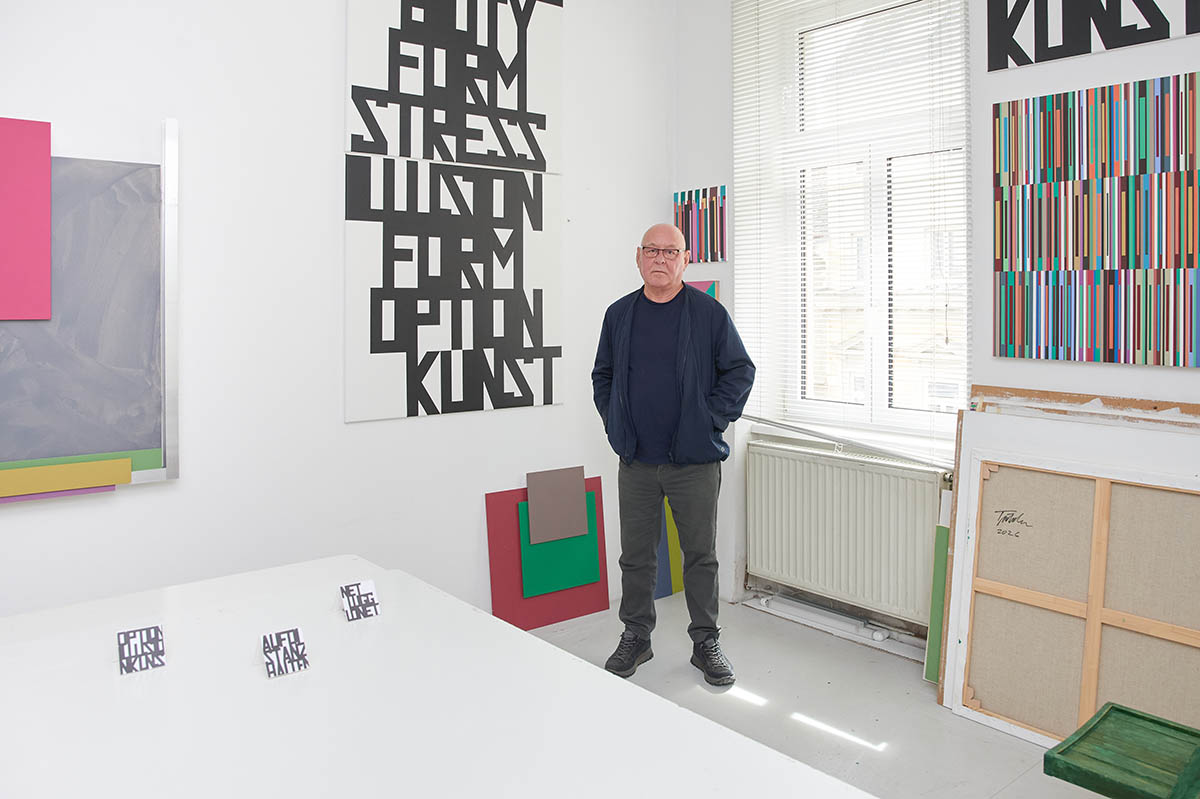
You moved from Dornbirn, Vorarlberg, to Vienna for art studies. What was the atmosphere in Vienna back then? What was your earliest contact with art?
From the very beginning, in primary school, the world of images was for me the most fascinating. Visual worlds fascinated me as an inexhaustible source from a very young age. Today, I see visual worlds as a form of communication: a way of expressing oneself. While still in school, I redrew many of the images I saw. At some point, I also began cutting images out of newspapers and pasting them into books, collecting them. It was a deep connection with something beyond what was immediately present. Kind of transformation into a reality that means more than the present moment.
I came to Vienna and studied at the University of Applied Arts, which was then still called the “Hochschule für angewandte Kunst.” I studied under Oswald Oberhuber, a well-known Austrian artist with very interesting teaching methods. He attracted a certain kind of alert and unconventional people. At that time, there were many historical currents; there was the women’s emancipation movement. There was a group that essentially turned emancipation into an art form and lived it in a very pure way. Some musicians later went on to have international careers. All of this existed within the so-called “Oberhuber graphics class.”
How did you experience that atmosphere?
I felt very comfortable, because it was an extremely open and discursive field. It was a very fruitful and meaningful time, especially because I was surrounded by like-minded people. I had a scholarship, which allowed me to fully focus on my studies and take many courses. And of course, when you’re 20 years old, there’s also that age itself; you’re full of energy and ideas about the future. After my studies, I immediately tried to make it as an artist. I managed, though, with various jobs along the way: architecture, shop design, and all sorts of things.
What influences your work most, outside of art itself? Are there recurring themes or motifs?
I would say it’s my concept of the OFFENER RAHMEN (“open frame”), because it allows for the greatest flexibility and openness. I strongly dislike fixed, unchangeable views and dogmas. Unfortunately, we’re surrounded by them in every respect. History shows again and again that such rigid systems are ultimately doomed to fail if people don’t recognize changing times and adapt, especially in political and economic contexts. All of this has probably shaped me through my studies and through growing older.
It’s about remaining open, listening, reflecting, and then acting. These are basic principles for meaningful communication.
Please tell us more about the “open frame”.
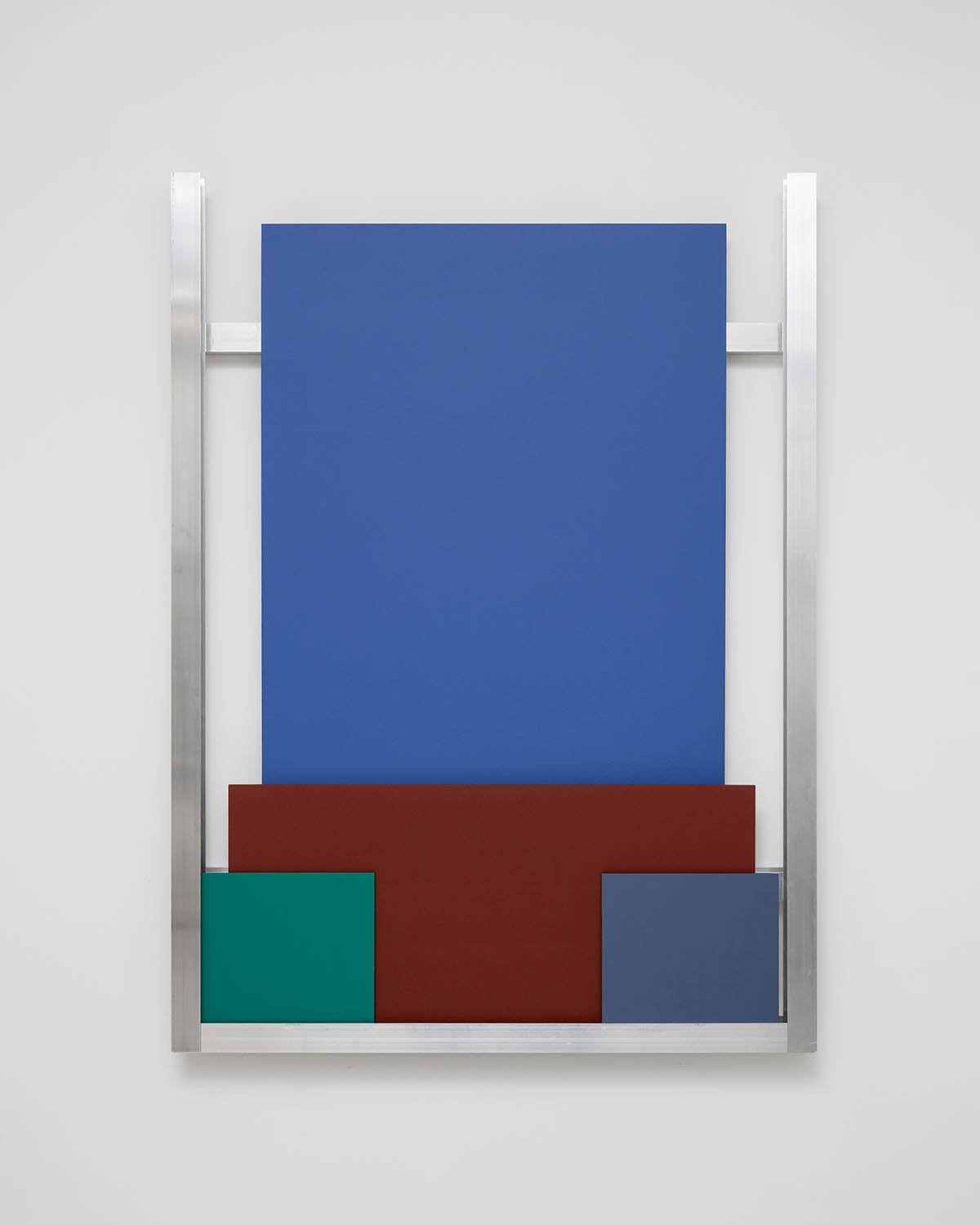
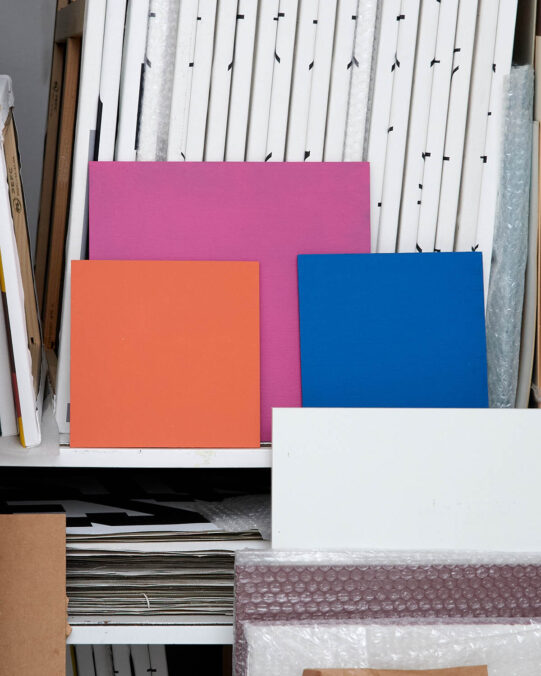
A conventional frame encloses an image and focuses on a center, on the image surface. The “open frame” is the opposite. It is open at the top; it can take something in and let something out. It suggests a process and invites participation or simply remains open. The background becomes part of the image because the surface is never fully closed. Different panels are inserted or mounted in a relief-like manner. All these points suggest continuous change, or at least the possibility of it: it is allowed and encouraged. Because it is open at the top, it extends into the surrounding space. The surrounding space becomes part of the image.
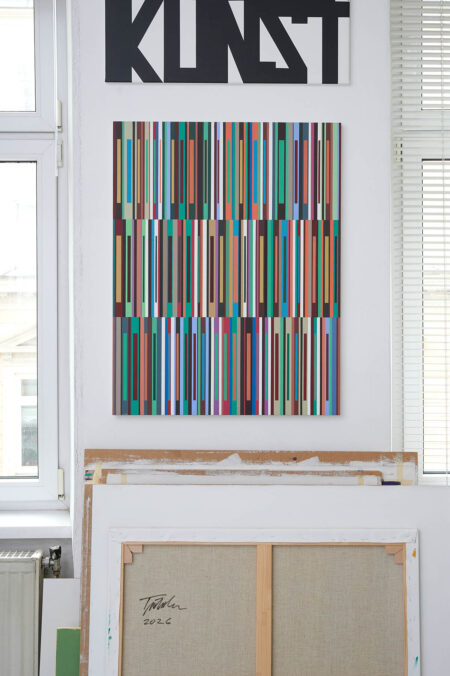
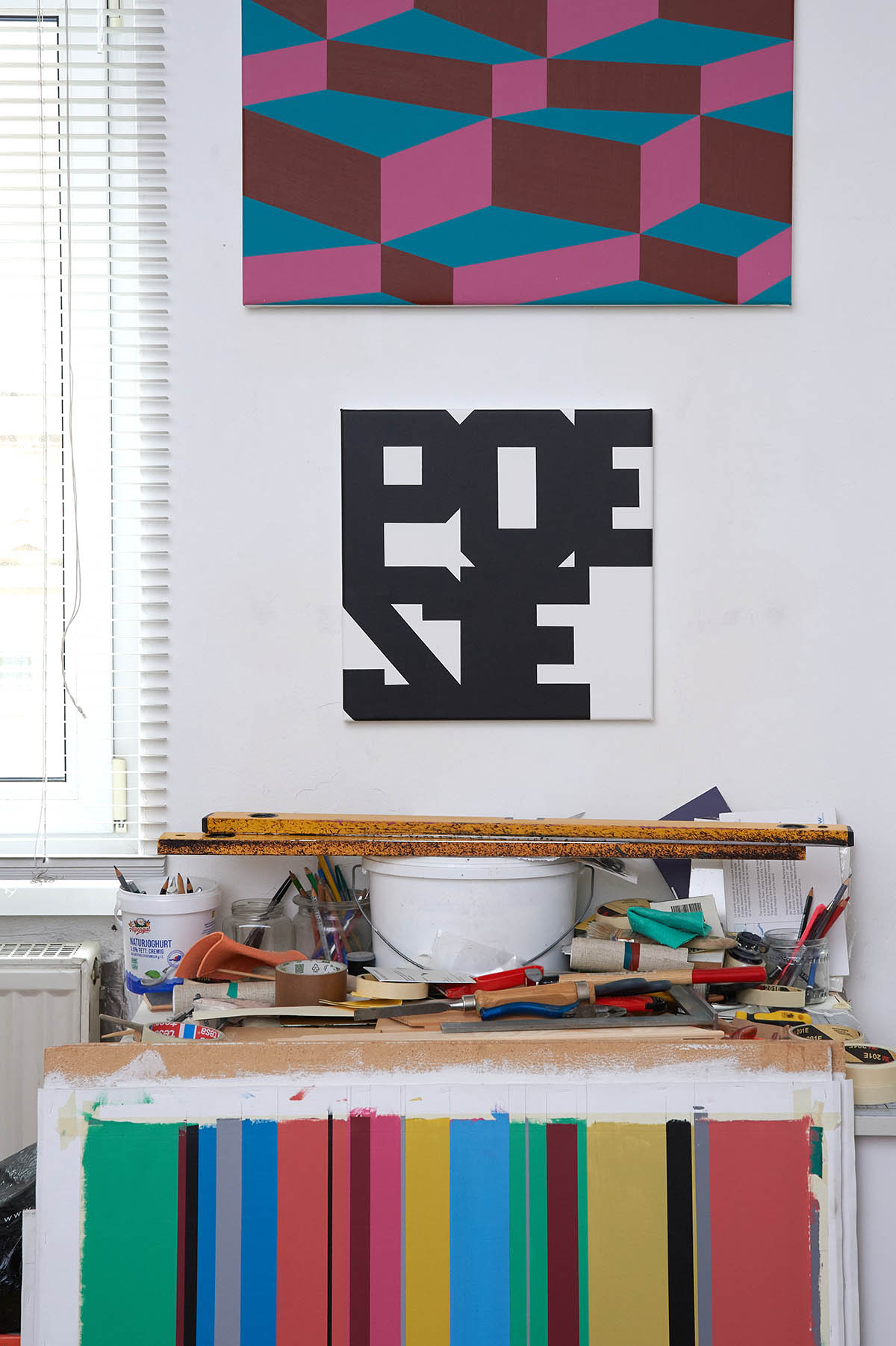
On the other side, in painting, especially with color, the potential is enormous. In my color works, I call KONTRASTE “contrasts.” I also call it a kind of transcription of life. In these stripe paintings, which have different dimensions, I explore the effects color can produce: complementary contrasts, dissonances, harmonies, pure colors, dotted colors, and mixed colors. All these possibilities, interwoven and placed side by side, create a new reality: one that runs parallel to lived reality.
Life offers a whole spectrum of beauty and cruelty, and I try to translate something similar into a kind of color composition.
How did the idea of the „open frame“ come about?
It comes from my way of thinking: an unfinished, questioning way of thinking. I try to remain open, not to believe everything immediately, to proceed within myself, and to constantly question myself.
You often reduce it to black and white. What draws you to that?
Reduction to black and white comes from clarity. Black and white offer just two pieces of information. It’s the opposite of color, which is sensual and pure.
And to work on a painting with such a strong use of color?
The process is quite similar to my other works. There is generally a concept and a draft, although in the end, things almost always turn out differently. I begin by creating a computer sketch. Then I start the painting process, largely following the draft. But at a certain point, the work starts to develop a life of its own. When I feel a painting is halfway finished, I photograph it and bring it back into the computer. I continue working on it there because making mistakes is much more forgiving digitally. That’s a wonderful part of the process. It frees me; I can push the image in one direction or another, and it allows for more experimentation. That’s also one reason for my diversity, for working in different groups of images: there’s an enormous amount of creativity in that, in the truest sense of the word. Intuition plays a big role.
Before working with computers, did you use sketches for your objects?
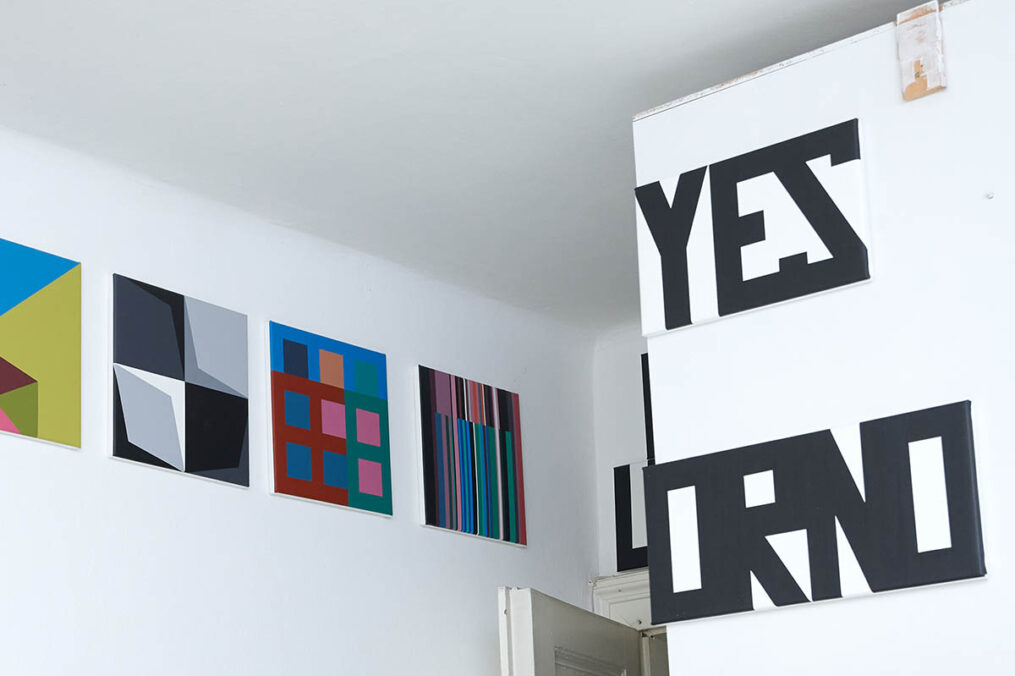
Yes, there are sketches, especially for the black-and-white grid works. In those, I deal with the vertical and the horizontal. The vertical is open upward toward the universe and downward toward the center of the earth, toward gravity. Our entire existence is structured by this. It grounds me; it creates a sense of calm. Within this tension between vertical and horizontal, I find a kind of orientation. It’s about acknowledging the conditions in which we live. And within that system, there are always variations and possibilities. It appears repeatedly because it’s such a useful term: for thinking further, for describing life, for sketching a process. It’s about allowing for possibility in general.
Your exhibition at gezwanzig gallery in Innsbruck ran until May 8. What works were you showing there?
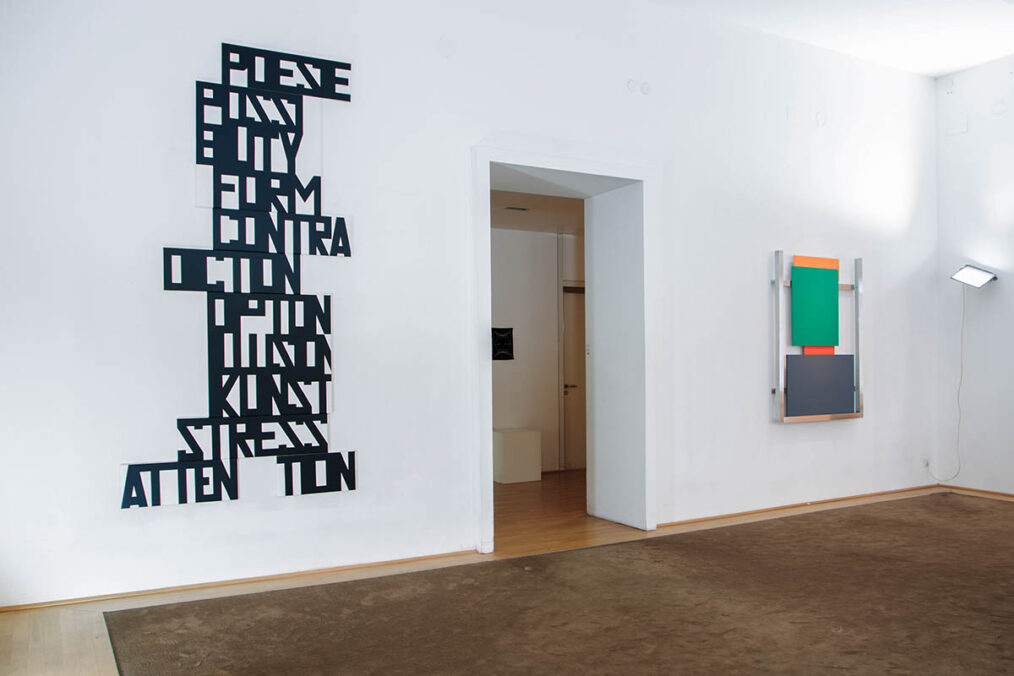
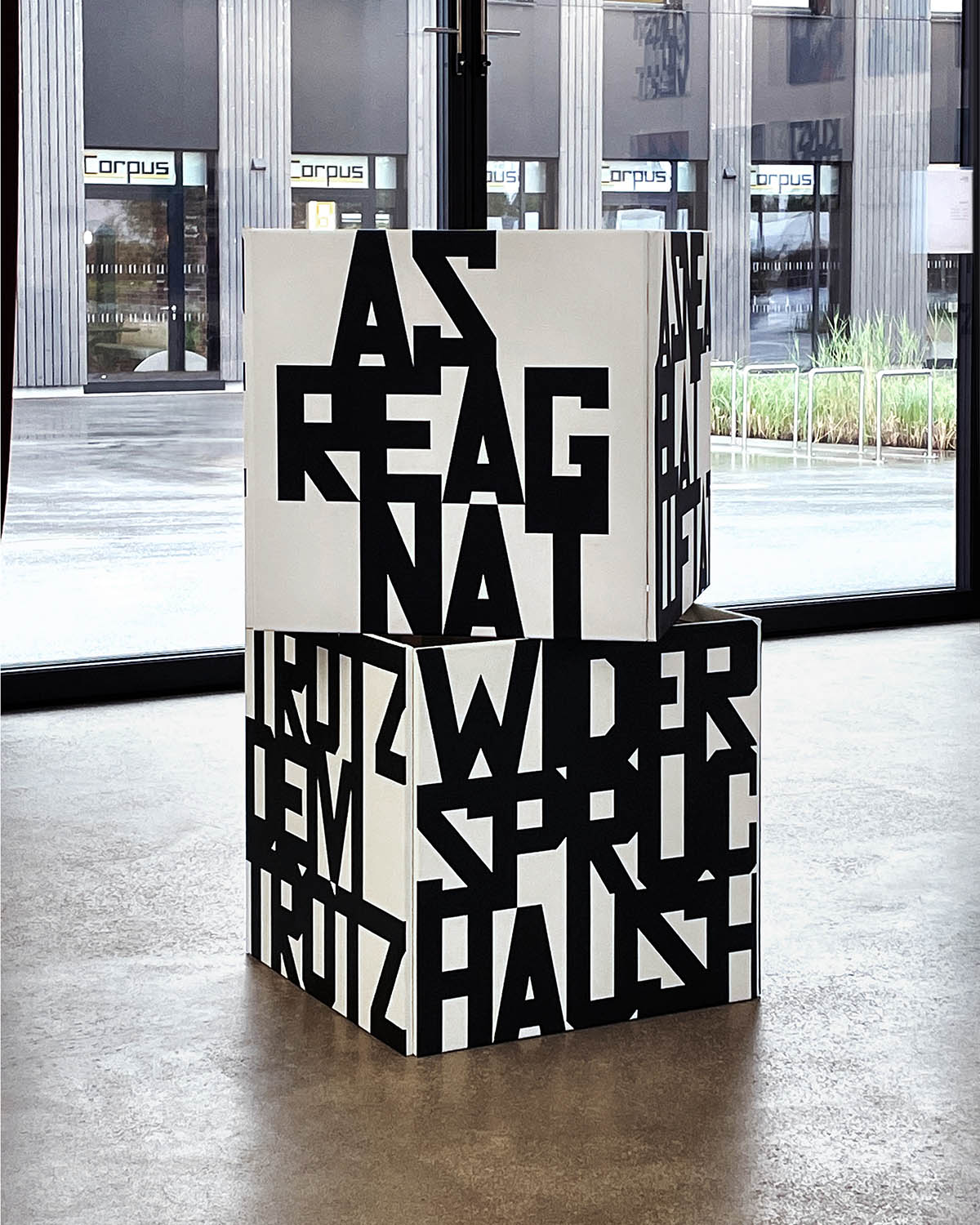
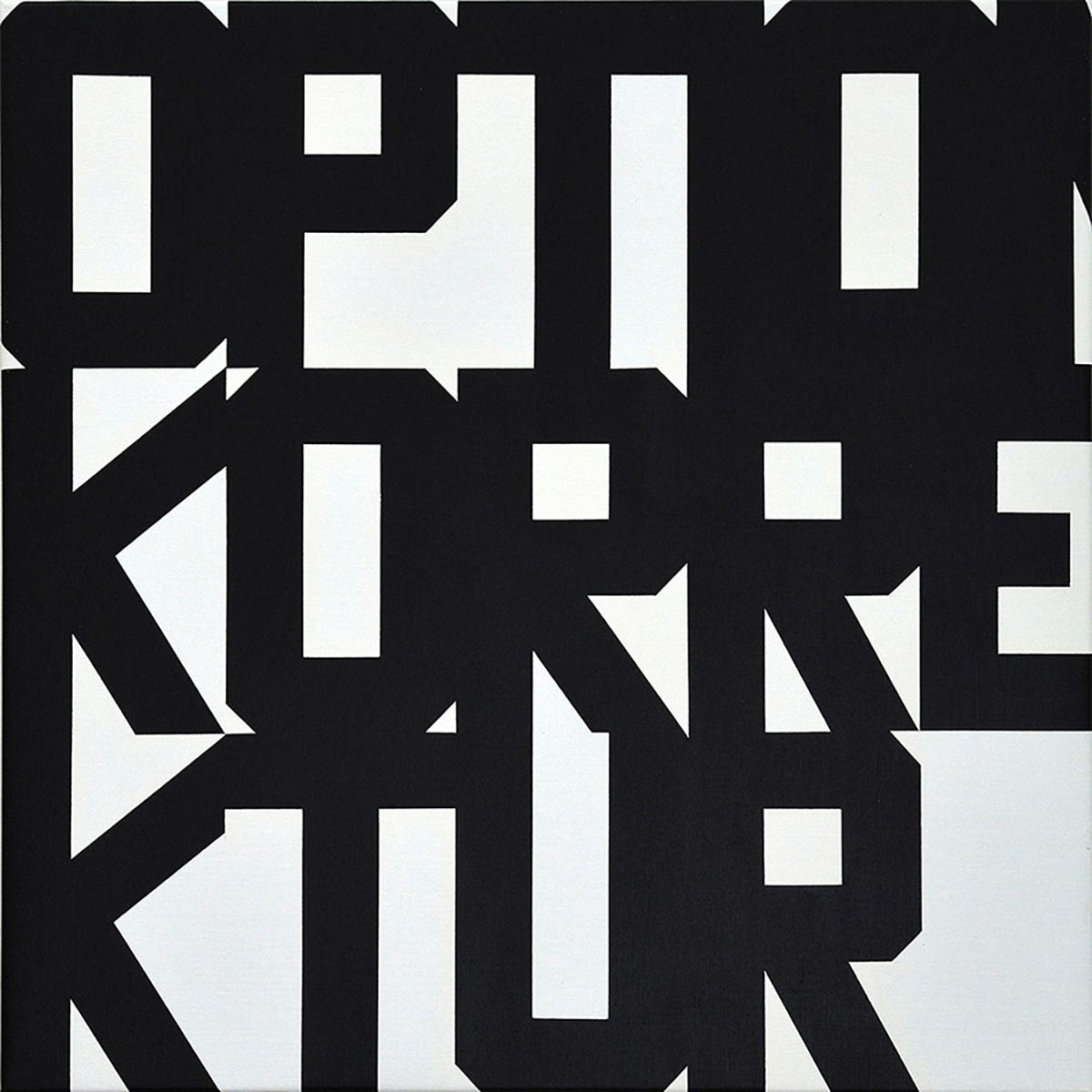
I exhibited works from the series “open frame”: one large and one small, and a work from the series SCHRIFTBILDER (typographic images). The “typographic images,” as the title already suggests, are where writing becomes image. I push the letters together and leave no spaces. This makes the text partially difficult to read; sometimes, people almost give up. But at last, it can still be deciphered. Because the letters are compressed like this, entirely new graphic elements emerge. Across two or three lines, straight lines can form, for example, combining a “T” and an “L.” It should function as an image, with a strong symbolic quality. A compelling graphic form, but also content.
What kind of words do you use?
The works I showed in Innsbruck, for example, the piece titled SB oik, include the words “Option,” “Illusion,” and “Art.” They function almost like a stop sign or a book cover—an invitation to reflect. I sometimes describe them as working like a recipe, a kind of formula.
What does “option” mean to you personally?
It indicates that I have a choice. I can decide for this or for that. I chose the word because it applies to everything—it applies to the image architecture, to the openness, and to the possibilities. It always comes back to this idea of multiplicity and openness.
And that also connects to intuition, right? Even if you have endless choices, intuition still plays a decisive role.
Yes, I would say so. There are definitions of concrete art that deny that, but I would never agree with that. There is always a great deal of intuition involved. Those stricter views come from rather orthodox perspectives. Even when there are countless options, so much emerges intuitively. The human element remains crucial. I think that’s how we live in general. Those who claim to act rationally very often do the opposite. That’s just how it is. And that’s why art is already a kind of security. The word “illusion” is typically seen negatively in everyday language, but that’s not my intention. I have the option to choose illusion. I dream, I daydream, I fantasize, and I have the courage, not for the image itself, but for exhibiting it. The image has to hold up in context, in dialogue with the space.
Solo exhibition: Franz Türtscher – Option
Exhibition duration: 11 March – 8 May 2026
Venue: gezwanzig showroom, Leopoldstraße 41, 6020 Innsbruck, Austria
Address and contact:
gezwanzig gallery
Gumpendorfer Straße 20, 1060 Vienna, Austria
www.gezwanzig.com
www.instagram.com/gezwanzig.gallery/
Franz Türtscher – www.franztuertscher.at, www.instagram.com/tuertscherfranz/
Franz Türtscher was born in Dornbirn in 1953 and is an Austrian conceptual painter. He lives and works in Vienna and Dornbirn. From 1975 to 1981, he studied at the University of Applied Arts in Vienna under Professor Oswald Oberhuber. His artistic practice encompasses conceptual painting, spatial painting, abstract painting, objects, and installations.
The solo exhibition “Option” presented works ranging from concrete art to typography and spatial image architectures. The central focus was the group of works entitled “Image architecture – open frame.” Türtscher develops spatial, relief-like image structures with a modular character. His open-top frame reflects the surrounding space. Geometric elements are assembled in aluminum frames like modules to form three-dimensional wall objects—a system for change and variability. Collage-like word combinations such as “KUNST FORM POESIE” (ART FORM POETRY) create tension-filled structures. Missing spaces allow the typography to merge into heterogeneous surfaces that can only be deciphered at second glance. The letters are transformed into a network of lines—writing turned into images.