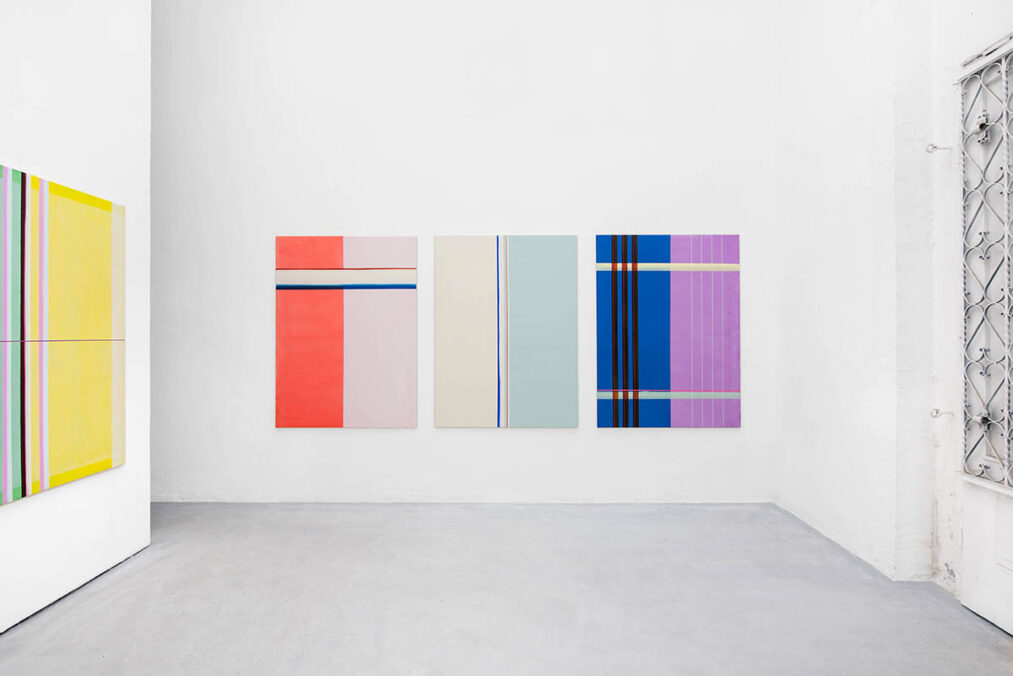
Color and form are given equal, and only through their interplay can the compositional expression of these pictorial panels be experienced as a whole. Composition therefore provides an appropriate point of entry to these works, applying equally to both formal and chromatic composition.
From the perspective of form, the works—whether painting, drawing, or lithography—are initially linked serially through identical formats. Through concentrated engagement, series emerge that might be described as geometric abstractions. In the large-scale works presented here, two rectangular planes meet across the entire pictorial field as a starting condition.
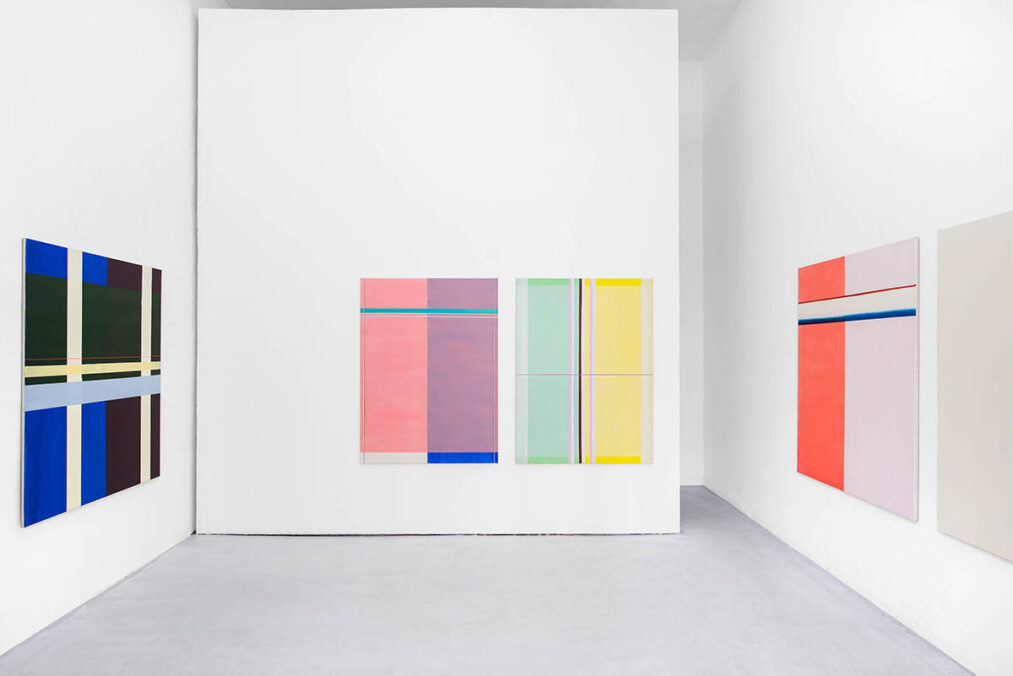
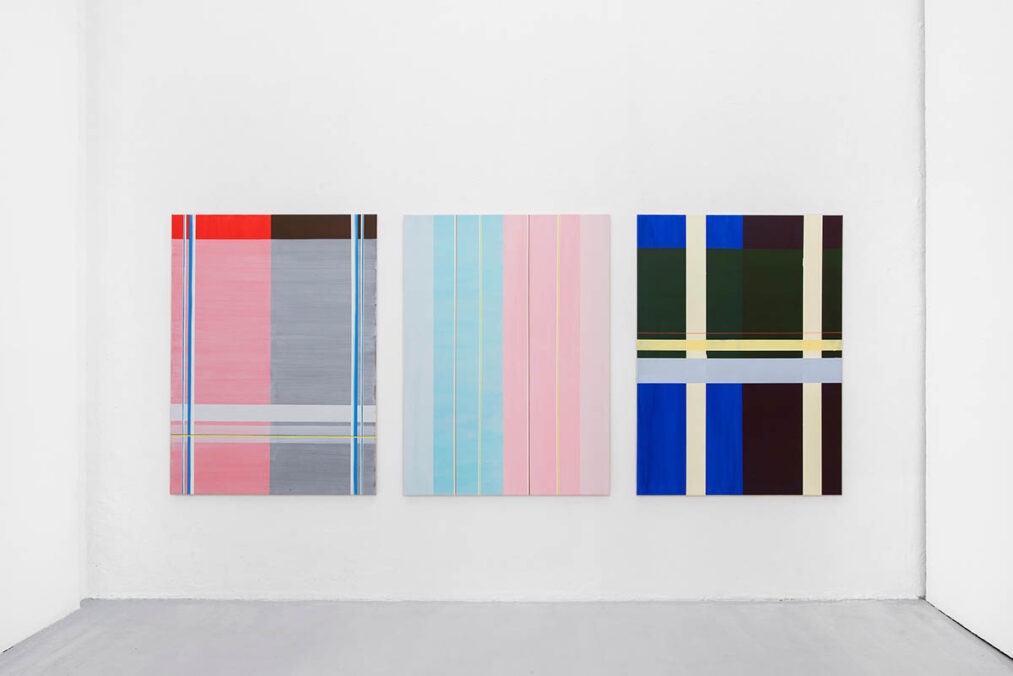
This in itself constitutes a compositional decision familiar from color field painting and Hard Edge painting. However, in Myriam Mayer’s works, a second structuring element is introduced: she overlays these initial forms with grid compositions. The grid generates new shapes and areas that enter into relationships and communicate with one another. Through layering, plasticity and structure emerge. Smaller areas peel away, acquire their own value as phenomena, differentiate themselves anew, define above and below, and form a painterly fabric. Order arises within the compositional arrangement of forms. With Goethe, the great empiricist, one might say: “The best order is that in which phenomena simultaneously become one great phenomenon whose parts relate to one another.”1 This optimal order applies both to the individual works and to each series as a whole.
If we return to the metaphorical notion of a “painterly fabric,” abstraction begins to dissolve and a narrative element enters the image. The references for Mayer’s painterly explorations are almost tangible, revealing a fascination with textile design. Suddenly, one perceives objects of everyday use such as handkerchiefs or dishcloths. Through painterly appropriation and translation, these acquire an aesthetic value of their own, freeing them from their utilitarian function without reducing the painting to mere decorative wallpaper.
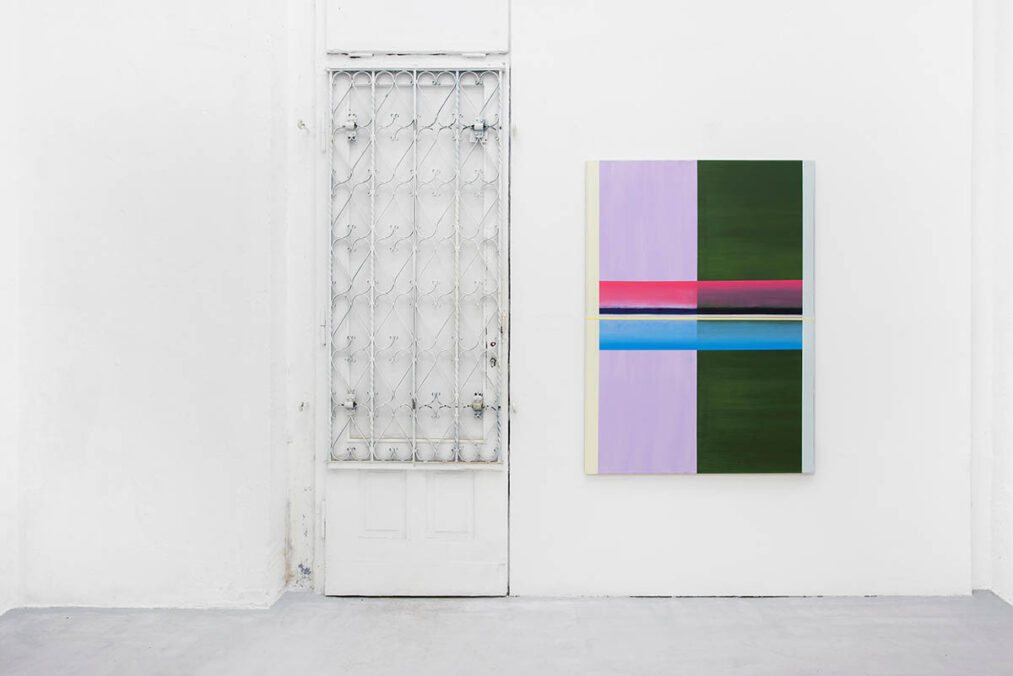
But what role does color composition play? the impatient viewer or reader might ask. “Everything here is so beautifully colorful. I’m staring—MM,” might be a contemporary update of Nina Hagen in response to Mayer’s painting—along with the inevitable question: can MM be addictive?
To anticipate: there is indeed addictive potential in sustained engagement. As is well known, the dose makes the poison. The point, then, is not to consume it indiscriminately, but to look in measured doses at what resonates. Color can serve as an anchor here.
MM deliberately relies on color harmonies in her compositions, thereby creating consonance, calm, and coherence. This is also achieved through subtle variations within the color space. One repeatedly observes gradients and color blends created through semi-transparent overpainting. In contrast, the structuring grids often introduce irritation through their coloration, thereby heightening attention. They keep us alert in the face of the topologies of emerging color landscapes. Corresponding colors reflect moods and open a voyeuristic access to the emotional world of the artist. Such painting and color composition function both as a therapeutic medium and as a form of introspective self-exploration.
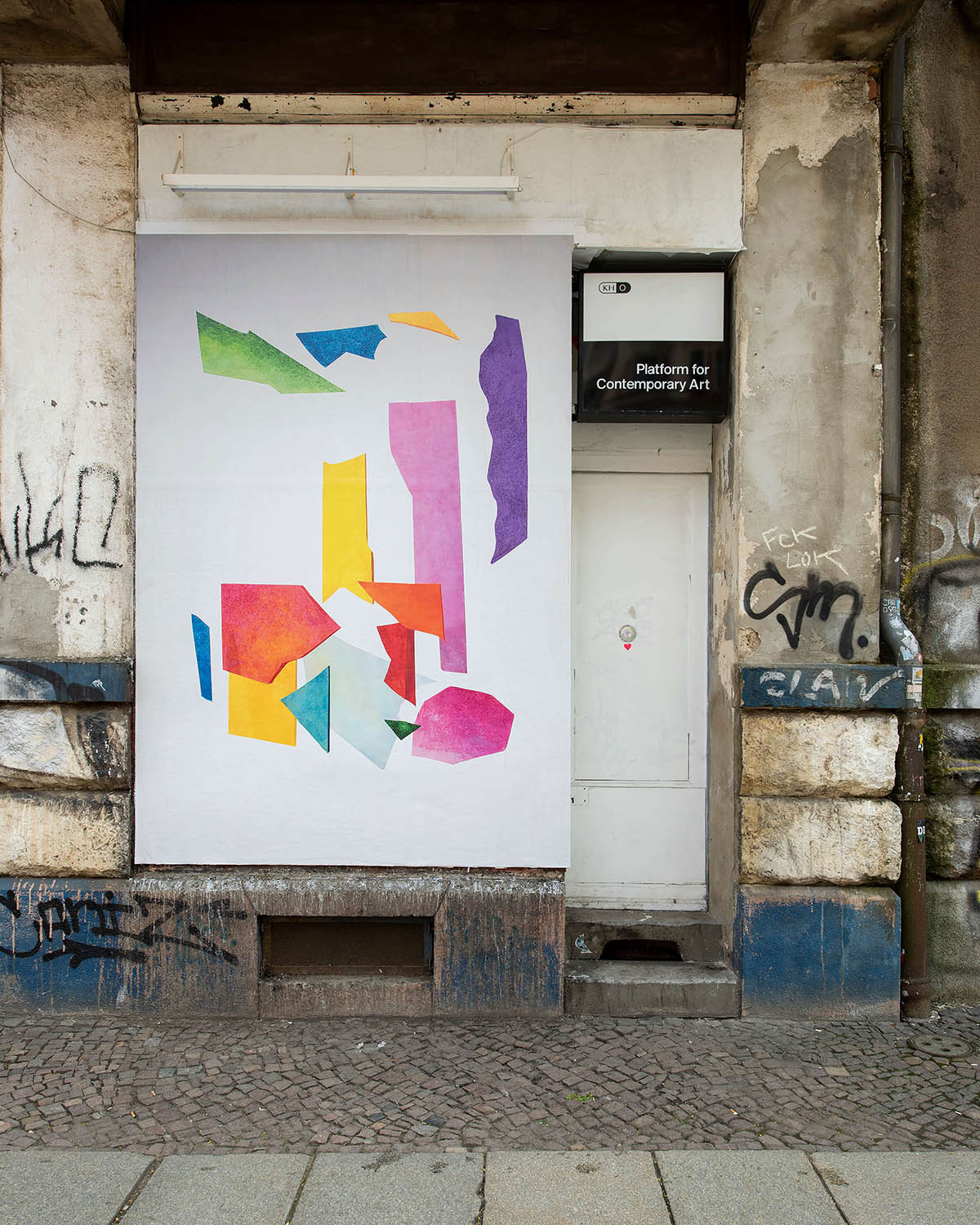
Myriam Mayer’s contemplative work within the color space resembles a kind of painting-prayer, in which artist and viewer alike may find illumination, immersion, and support. This is first and foremost experienced through direct perception, and any attempt at verbalization must necessarily reach its limits, for: “Images are acts of the eyes, and with an image not everything is said; yet a thought always pretends to have exhausted the entire chain—and thus paralyzes.”2
In this sense, each individual should enter this space of contemplation for themselves—engage actively through looking at Mayer’s works—and experience painting as an original mode of understanding the world.
Exhibition: Myriam Mayer – Chromos
Exhibition duration: 10 April to 10 May 2026
Closing: 10 May, 2-4pm
Venue: Kunsthalle.Ost, Riebeckstraße 19, 04317 Leipzig, Germany
Myriam Mayer – www.myriammayer.net, www.instagram.com/mayermyriamm
Exhibition partners: The show is made possible with the friendly support of the Cultural Office of the City of Leipzig and Liebelt-Stiftung Hamburg