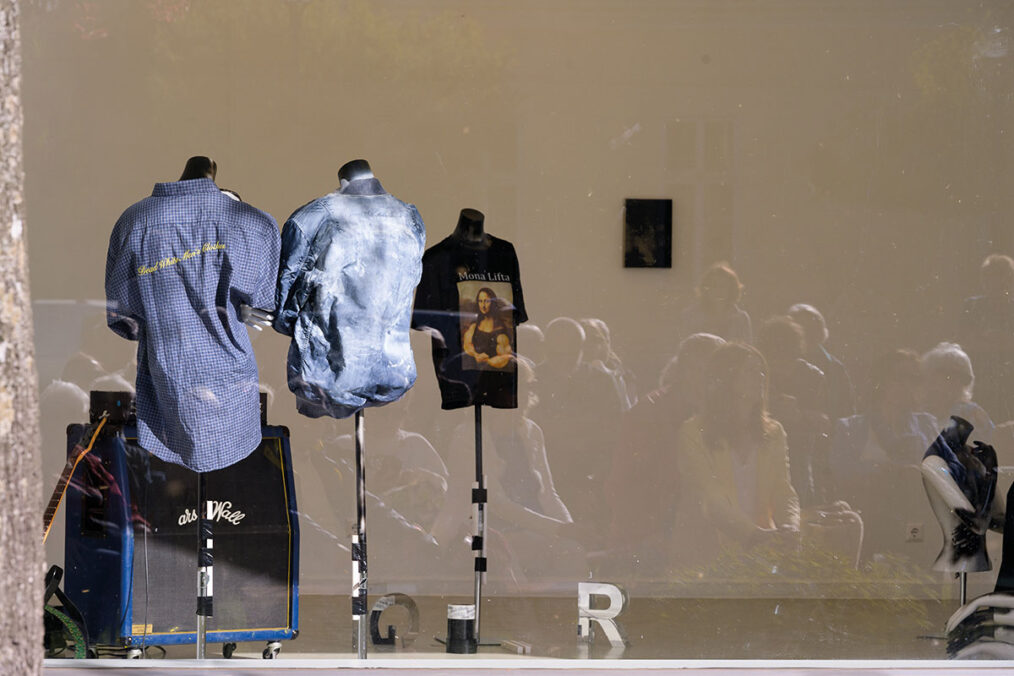
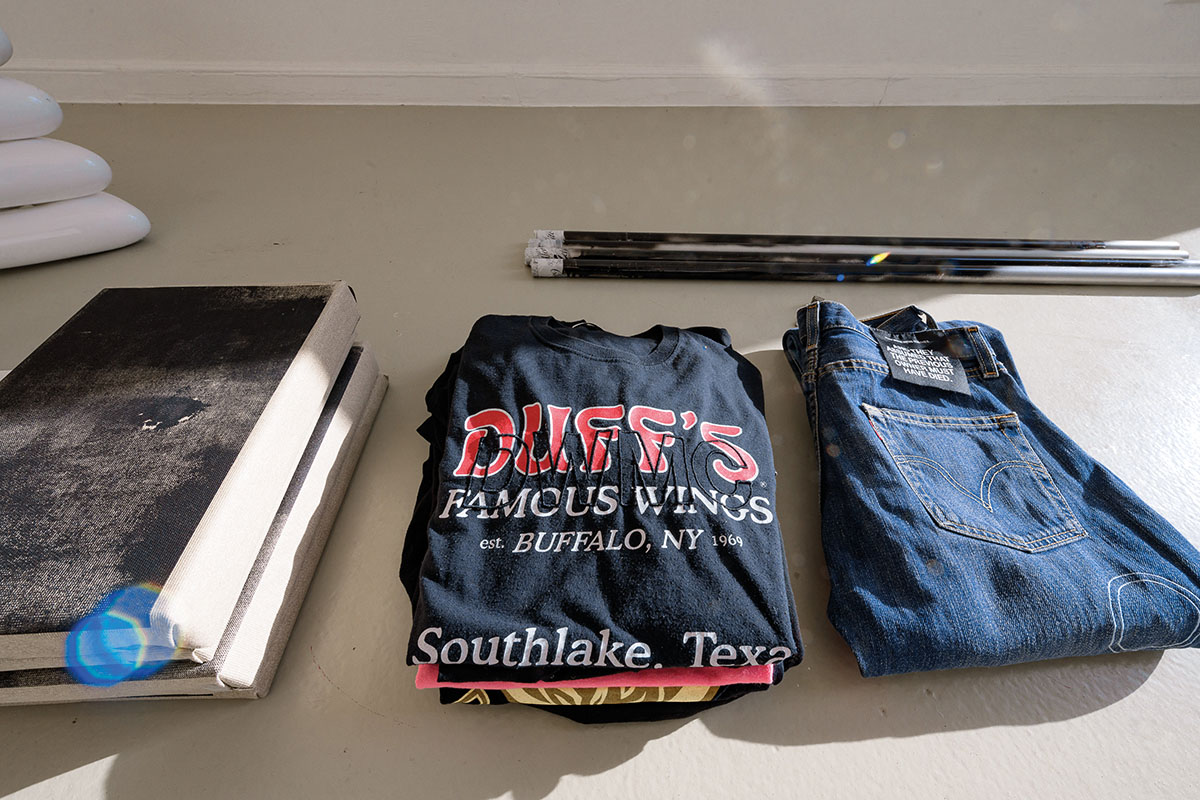
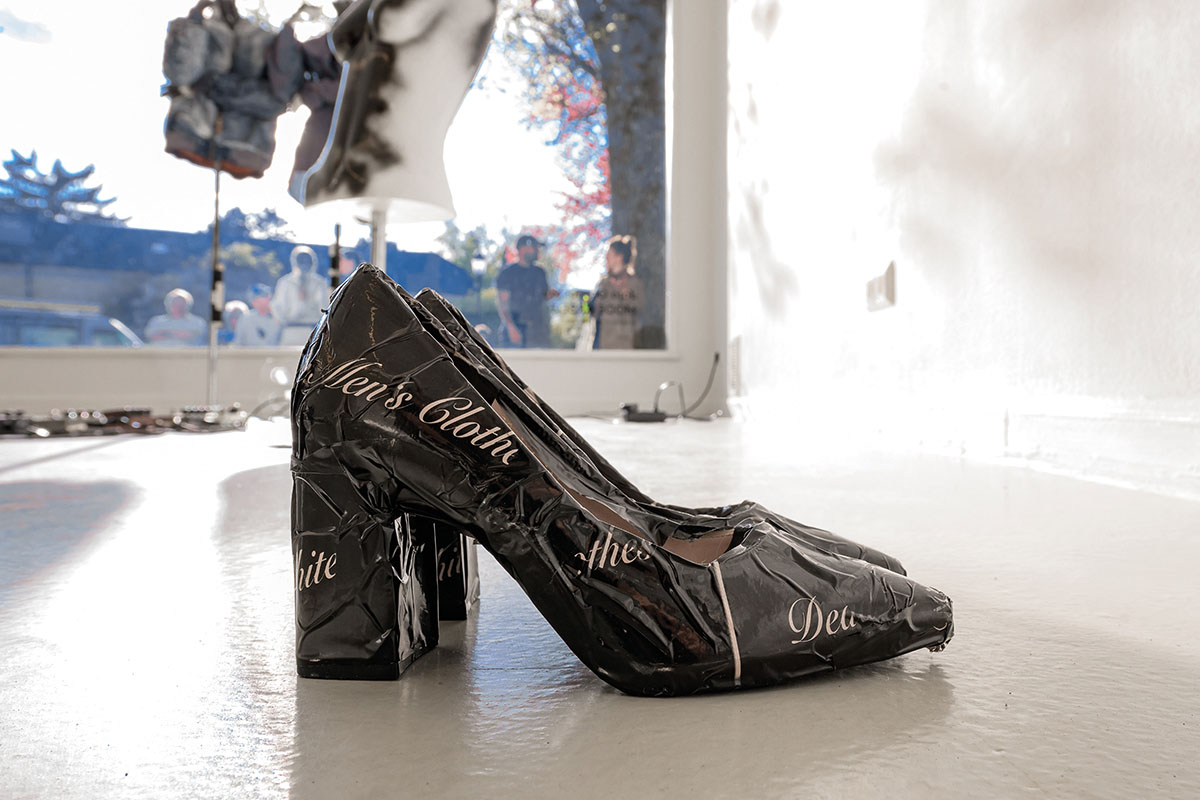
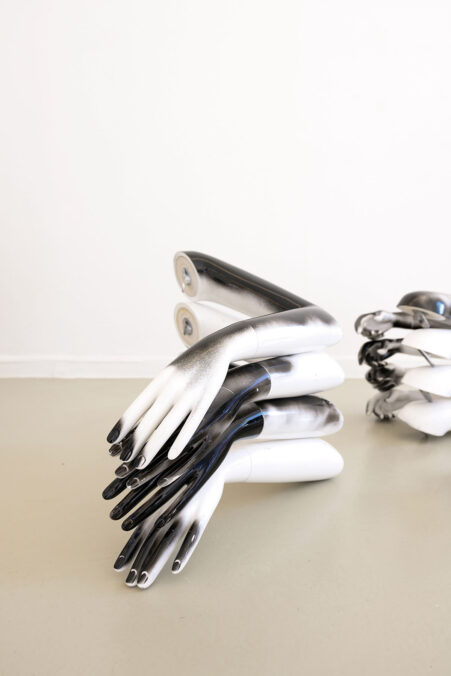
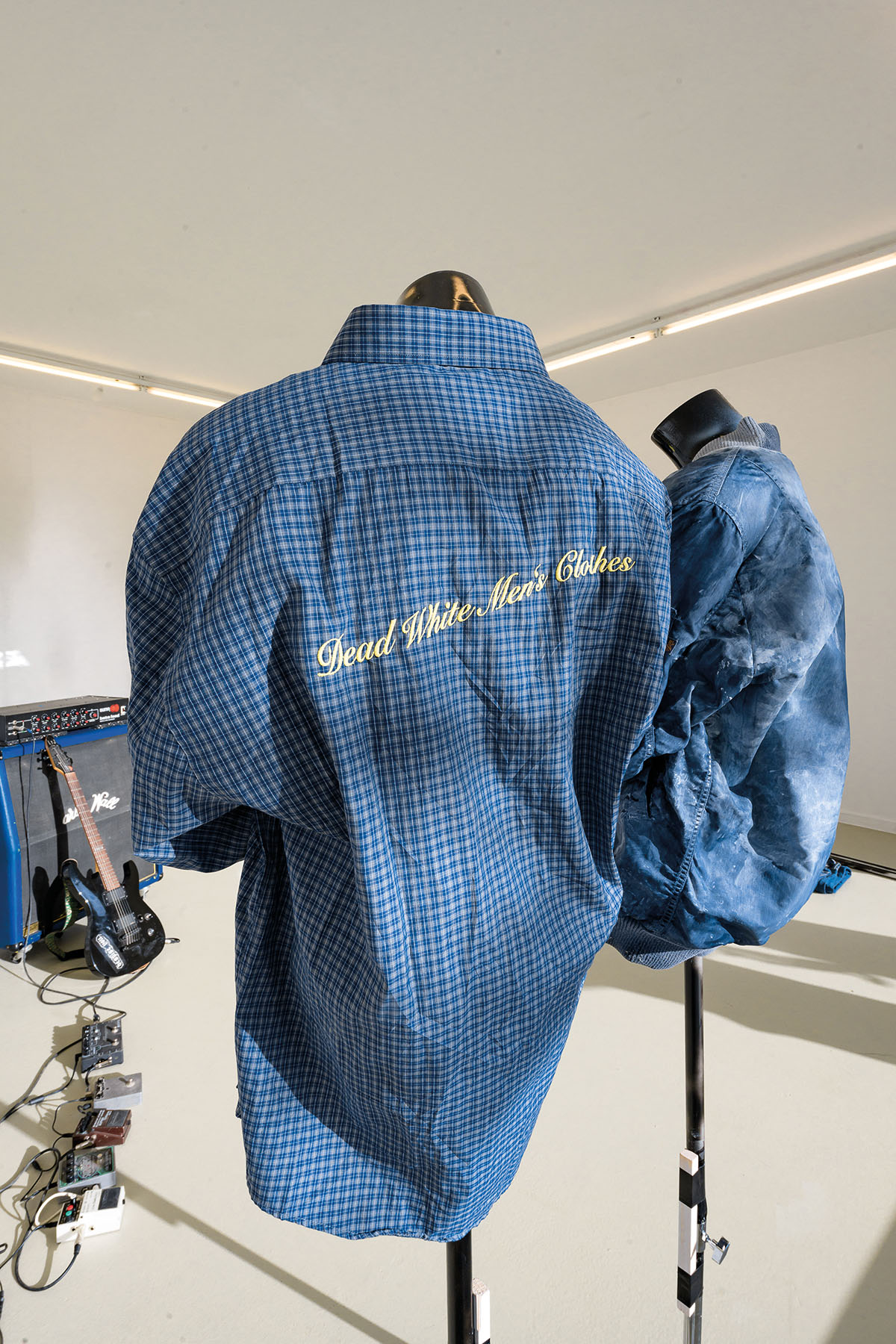
Inside the window: heels wrapped in „Dead White Men’s Clothes“ (DWMC) shipping tape. T-shirts carrying slogans like “Mona Lifta” and “paranoid”, where a Mona Lisa appears reworked through gym-built arms. Mannequin arms stacked, almost archival. Torsi without clothing. Canvas that reads less like finished work than like residue of production. Bleached denim. Broken screen prints.
The strongest impulse, the artist notes, comes from what leans against the institution itself: two containers, banal and exact. A Humana clothing bin and a 24/7 postal station. Circulation, logistics, and afterlife in the movement of clothing through retail, donation, and resale become curatorial logic. The exhibition does not represent them but adopts their rhythm.
This sensitivity to the everyday as a structural condition has precedent here. In 2015, Hans Schabus realized one of the most radical gestures at Kunstraum Weikendorf by sweeping leaves from a Vienna Gemeindebau courtyard and relocating them into the exhibition window. The reaction at the time was immediate and strong; the gesture read as too direct, too close, too unresolved. Inside and outside collapsed without mediation.
Gronostay’s intervention operates differently, but the underlying logic persists. What is discarded, what is exhibited, and how value is assigned become the key variables of the work. His practice moves through global systems with a form of calibrated collecting, operating at the intersection of identity, trade, and worth, where surplus is constantly displaced and reabsorbed elsewhere.
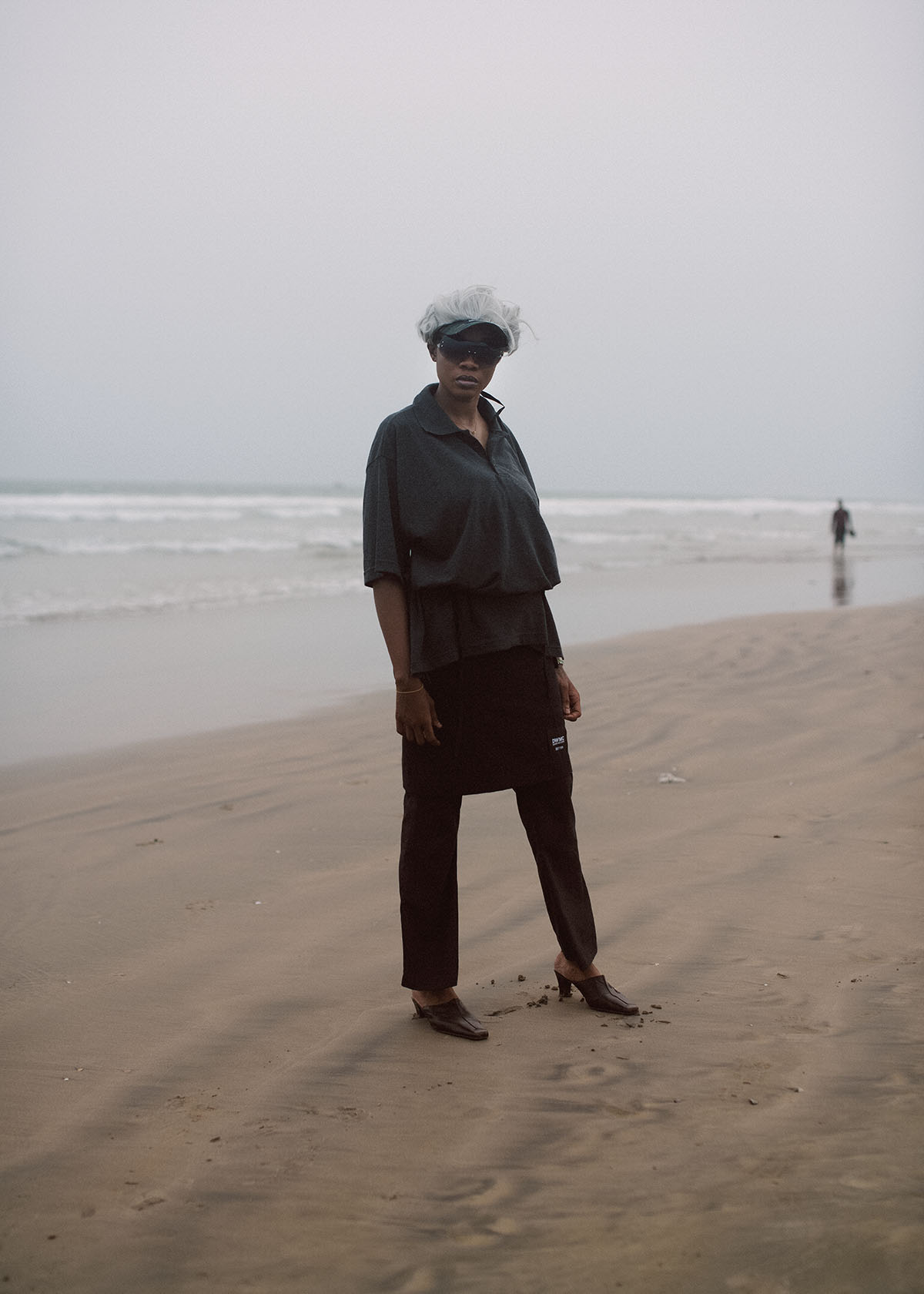
His long-running project Dead White Men’s Clothes functions as both method and infrastructure. It extends into Kantamanto Market in Accra, where discarded garments from the Global North arrive in continuous cycles. Imported secondhand clothing is known locally as obroni wawu, “dead white men’s clothes”, a term that emerged in the 1970s.
Gronostay does not collect in a conventional sense. He intercepts. The distinction matters less as method than as refusal: collection implies possession, interception, interruption without guarantee of return. Each material enters as evidence rather than a resource. Every garment carries traces of preceding circulation – economic, geographic, bodily. His studio becomes a site where objects are not preserved but redirected.
DWMC reroutes these garments back into Western contexts, where they reappear in unstable form: clothing, sculpture, document. It operates like a brand that simultaneously exposes its own logistics. Value is never fixed; it shifts with context, framing, and movement.
What appears in the exhibition window has already circulated. These are not simply secondhand garments but objects with prior trajectories, handled, displaced, and reinserted into different economies. Alongside them are newly produced T-shirts, sometimes altered only minimally, at times reduced to the application of the DWMC logo, inserted later into the same circuit. The effect is not an opposition between reuse and production, but their collapse into a single system of exchange. This collapse is not neutral. It produces a zone where authorship, labor, and circulation can no longer be cleanly separated.
The exhibition extends into print through an accompanying magazine featuring photographs by Eric Asamoah, produced in Ghana. The focus on wig caps, everyday objects charged with cultural and historical meaning, traces contemporary circulation back into longer histories of extraction and textile economies. Texts by Nuna Adisenu-Doe and Monica Titton frame DWMC as a counter archive, a structure that continuously reorganizes how worth in fashion is produced and destabilized.
The archival question is central, though not in a traditional sense. If Jacques Derrida describes the archive as a site of authority – Archive Fever as both structure and compulsion – DWMC does not oppose this stability; it exploits it. It functions less as storage than as circulation, less as preservation than as controlled leakage, still dependent on archival desire. Objects move in and out of meaning without settling into fixed interpretation.
Another starting point for the artist and for this exhibition is the closure of a shop (Gerry Weber), which anchors the project in the restructuring of the fashion industry and the ongoing displacement of physical retail by online systems and consolidated distribution networks. In the rural infrastructure of places like Weikendorf, these closures mark a wider erosion of physical retail, leaving behind store letters as fragments of dissolved commercial identities. What remains is not surplus, but latency: a condition produced when retail visibility collapses faster than value can be reabsorbed elsewhere.
From there, the shop window is adjusted monthly, following retail rhythms while subtly undermining them. Some garments are removed and returned to the clothing container outside. Others may reappear in the artist’s DWMC web shop. Assigned worth, withdrawn worth, reassigned worth.
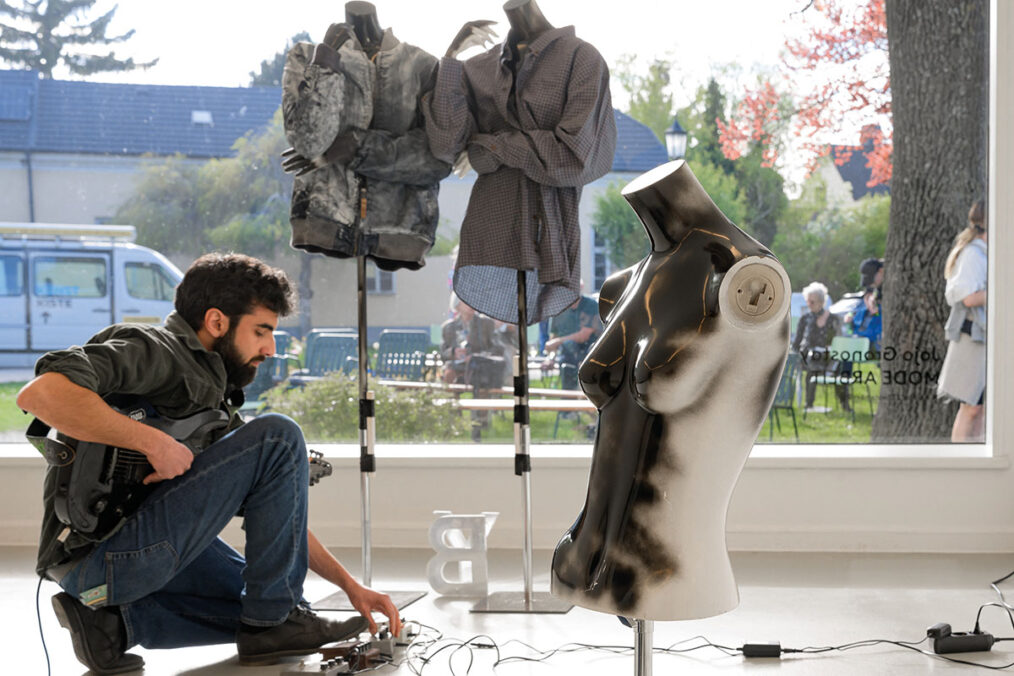
Gronostay does not simply collect; he reroutes. This is where “outlaw collecting” becomes legible: a practice in which ownership is temporary, value is unstable, and objects never fully arrive. At the opening, this instability found an acoustic counterpart in Sami Mandee’s performance. His guitar work, unfolding in long, distorted, and at times melodic lines, functioned as an auditory value drift. Just as the garments fluctuated between the anonymity of the shipping container and the prestige of the showroom, Mandee’s sound occupied a liminal, garage-like rawness attuned to the room yet perpetually unanchored. It provided a temporal layer to the exhibition’s refusal to settle: a sequence of notes that, much like the retail display, resisted resolving into a static or finished form.
(A further reactivation is scheduled for 18 July 2026)
Gronostay’s practice does not position itself as a critique in a moral sense. It operates more like infiltration by entering existing systems and slightly shifting their internal logic.
In Weikendorf, the structure becomes simple again: a window, a container, a loop.
Value enters.
Value exits.
And in between, it does not stabilize; it accumulates friction.
Exhibition: Jojo Gronostay – MODE ARBEIT
Duration: April 19 – September 27, 2026
Venue: Kunstraum Weikendorf, Rathausplatz 1, 2253 Weikendorf
Jojo Gronostay – www.instagram.com/jojogronostay/