
Your works are often the result of intuition. Which decisions do you make intentionally, and which ones emerge during the process?
When I try something for the first time and experiment with ideas, it typically naturally results in a finished piece. That’s why I think I couldn’t sketch a painting; a repeated idea would already be an interpretation, which is obvious in itself and can also be interesting, but I find the first try to hold some special meaning. Probably because it’s the most hectic, and it can feel uncomfortable; exciting, honestly, it’s scary, and I’m not sure what is going to happen.
I did try to paint from my drawings, and every single time, the quickly sketched-out idea was better and more complete. Precisely with a sketch, it gets very complicated when you’re attempting to “rewrite,” repeat, or mimic this energy. Drawing, hand movement, and the short amount of time for restraint, which reveal a lot of interesting and crucial information, are lost; the language difference is big even in visual languages like drawing and painting. Trying to convey one into another and ending up with something probably separate from both is a good compromise. I wouldn’t execute an idea knowing how it’s going to turn out from the get-go; this seems imitative and reproductive. There is craftsmanship in this sort of approach that I could appreciate still as a viewer, but I would get tired without the experimental, curious part of the process. I think of pieces done beautifully, almost masterfully, but with a precise game plan, almost as a different kind of discipline. When I’m about to start a new body of work, I have a vague idea of what I want to do, and I usually consider it to be a pretext. I know I will change my mind a lot, and that’s something I’m hoping for; if I make a mistake and try to fix it, a new context will emerge.
Is there a point at which the emotional dimension takes up too much space for you?
Clearly, this isn’t a question that is connected only to making art, probably people who are good enough at living their lives are figuring this out constantly. I like the feeling that my life is bigger than me, that I cannot process everything, and I get overwhelmed, sometimes even sick, from both negative and positive emotions. In my opinion, I manage pretty well.
Color is often used very sparingly in your works. What role does the use of materials play in making the invisible visible?
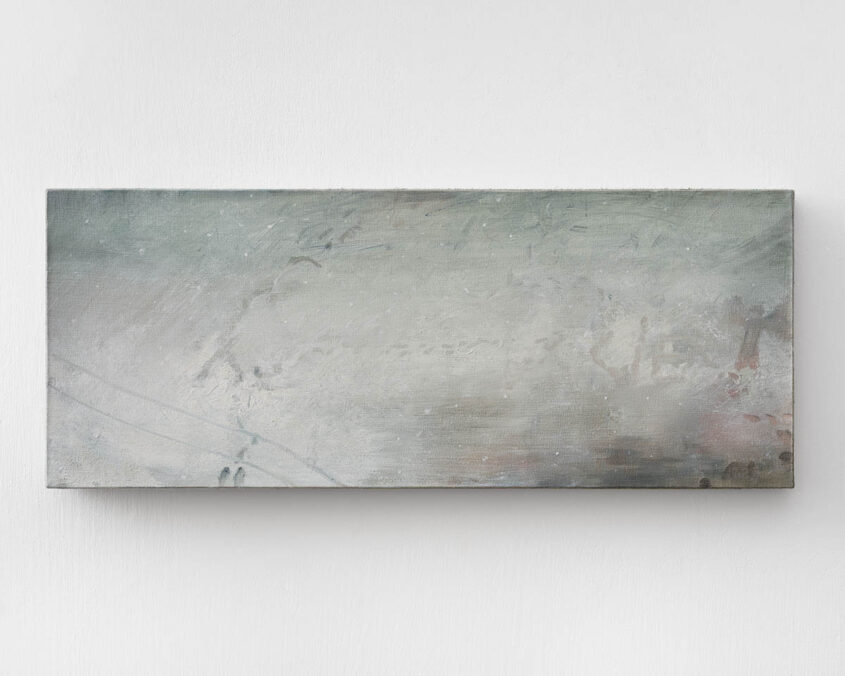
I’m using a lot, maybe not the cleanest or the most saturated ones, but I find there is a lot of range; it’s not spectacularly visible from the beginning. Every color is mixed, and what I get on the finished piece results from washing away the layers of paint, painting over, blending, and cleaning up previous layers. Not sure what making the invisible visible means in this context; what we see is what we’ve got; some paintings are more open to adding to them by the viewer or need a longer inspection.
Can you tell me more about the work “How to behave and how to amuse”?
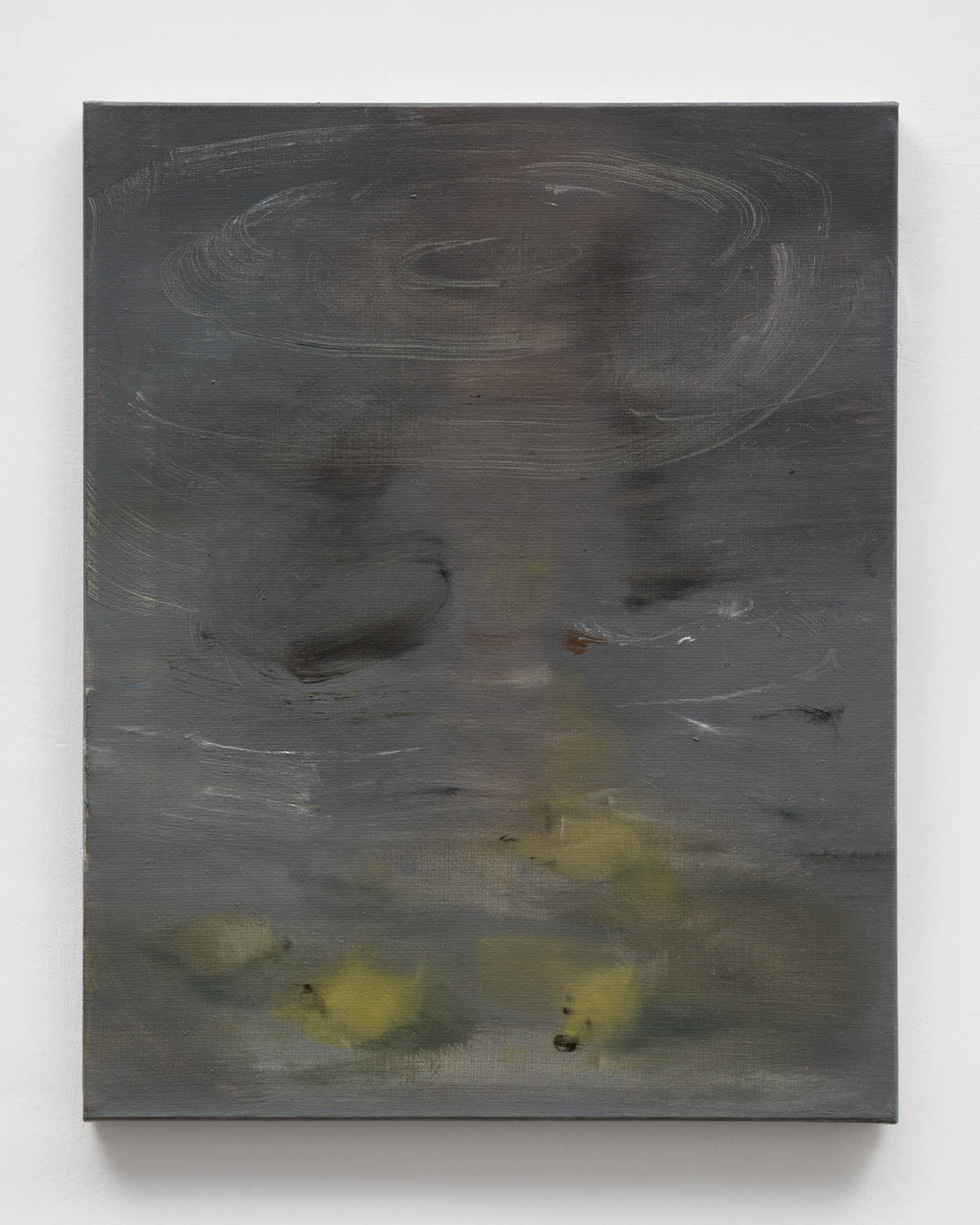
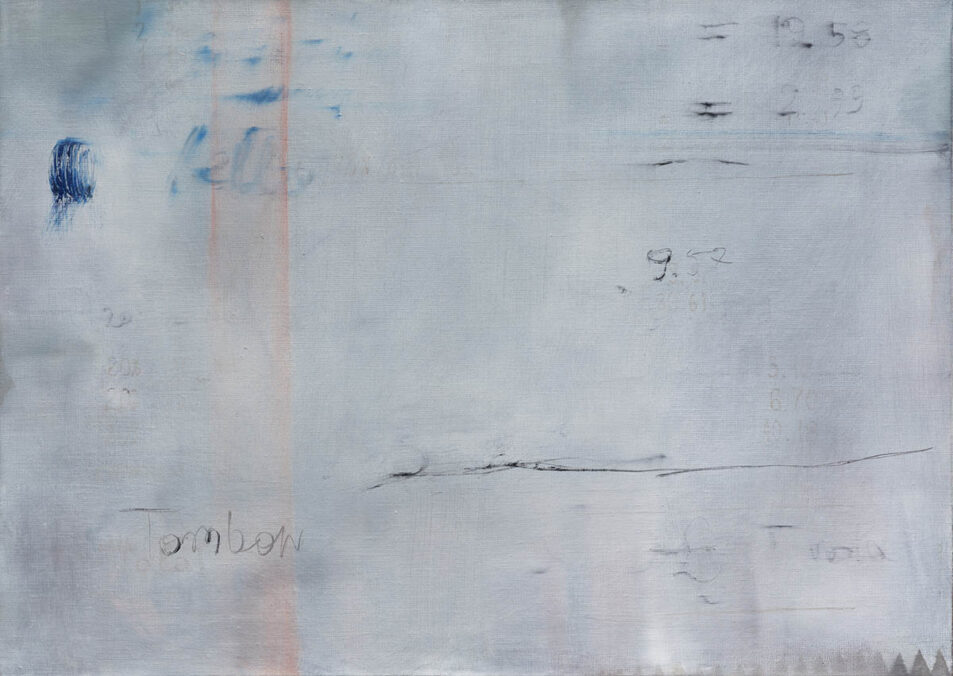
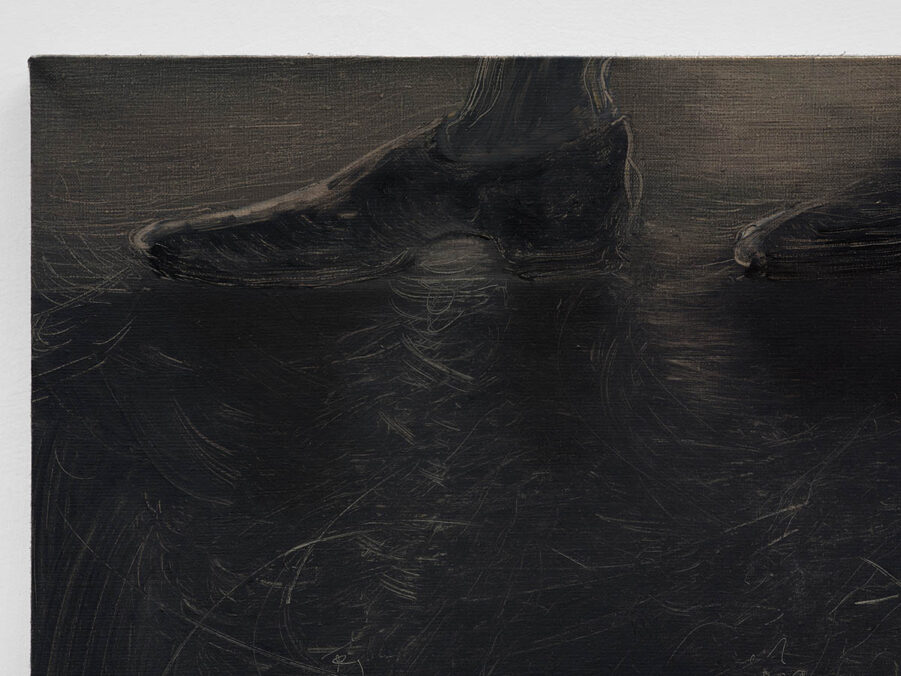
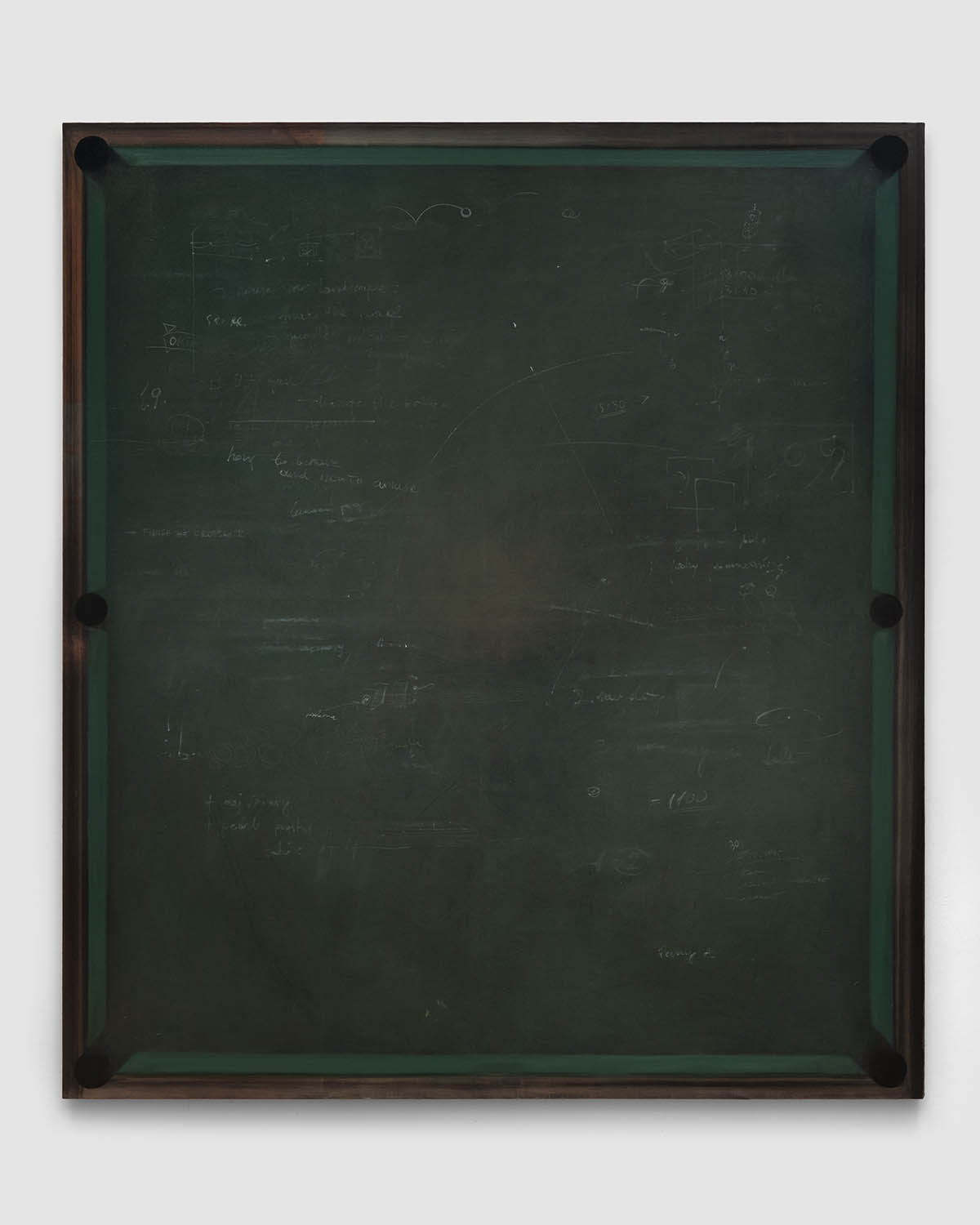
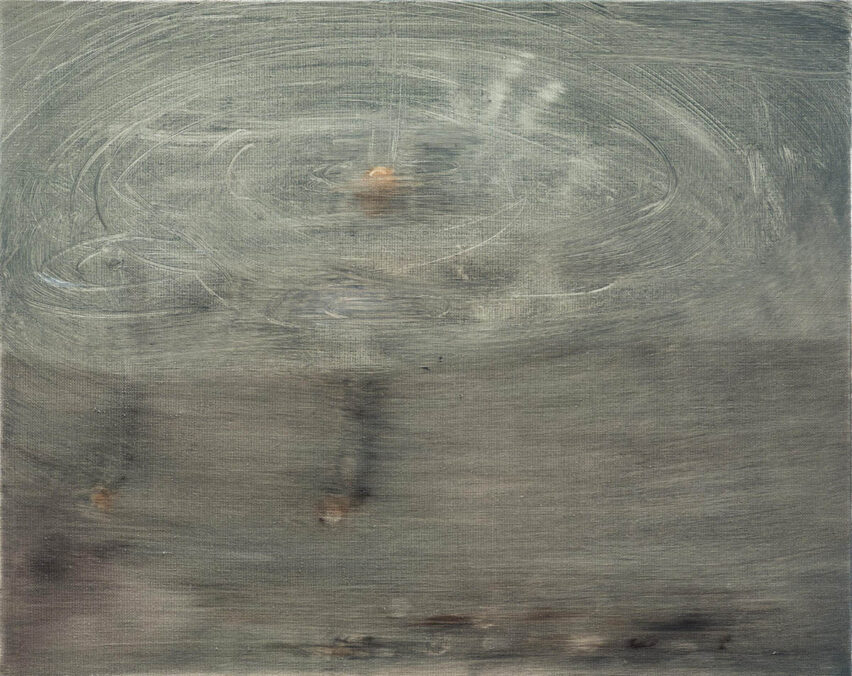
It is a work I did while looking through The Compleat Gamester, a guidebook for playing pool, horse racing, and other “games” for a distinguished fellow at the beginning of the 18th century. The thing I found strange was that many authors who wrote about pool or carom ended up being interested in water and fishing, an unusual connection that I understood only partially. I was making a lot of work about skill- and luck-based games up to some point; it still is a theme in my practice, but I started painting these watery, semi-abstract backgrounds around that time. Simultaneously, I found (or rather discovered through some internet recycling; I think it was an Instagram post with a screenshot from Wikipedia) lemon pigs—little guys made from lemons, with toothpicks for legs, clovers for eyes, and a golden coin for the mouth. They were supposed to be crafted around January 1st and stay with you for the whole year, probably rotting, for good luck. In 2025/2026, it had its renaissance; people connected this to recent years being especially unlucky and turning to some magic-adjacent solutions to woo the good vibes back. The original idea was inspired by a newspaper article from 1882, and the title of my painting is derived from a book written by George Henry that talks about this entertaining little object. In the painting, the lemon pigs are submerged in the water. I see a figure escaping the situation or walking past it. People read different things here, which is always significant for me. You can see this work in Beijing now at the Inside-Out Art Museum as a part of the group show, Setting the tone of the exhibition, curated by Jacob Fabricius.
How significant are the titles of your works to you?
The titles are another context. I usually have a few topics that I research and collect notes and phrases for. My titles come from books, overheard conversations, internet forums, and anything I find interesting metaphorically or linguistically. Every so often they are basic; other times they are pretty specific, polysemantic, or unclear. I could go through my notes, see a sentence I found some time ago, and realize it matches a painting I’m working on. I’m not afraid of being literal as well; some paintings need to be titled without fireworks or any convoluted theory behind them. There are cases where I’m adding substantial info in the brackets, which feels a bit strange, but it is intuitive, and I know it has to be like that. Or maybe it’s me escaping something, trying to signal a sense of mystery? Anyway, the painting should work without the title as well, as a separate thing.
Can you describe the feeling you have when a work is finished?
Finished work gets forgotten; it disappears from the troubleshooting list. In my mind, the most important part happens during the process, so when it’s finished, it vanishes from the task list. I can see, from a distance, on the timeline of all the works, what it meant, but the first feeling I have is similar to relief, not quite the right word, still. The painting I feel good about is the one that I had finished before I realized what actually happened. I like to surprise myself, to find quality in something done in excitement or during the trial of fixing things I didn’t quite like. Semi-intentional missteps or questionable aesthetic choices are very significant when your practice is systematic. Painting day after day can create a convenient place to create pieces that are similar to each other and safe, which, if left unattended, can result in stagnation. Of course, there are things that I have planned, and it simply has worked out, but then I have to deal with a specific type of disappointment. I remember discovering a possibility of repetition coming from my experience. I remember thinking, “Okay, now it doesn’t seem like such a big leap of faith when I’m working on a new piece,” and this was truly frustrating. I need to panic and to solve a problem. In painting, a recipe can spoil the whole experience. I tend to look at how other artists make decisions, think about how quickly they got to the point. I love to compare two or three versions of the same motif, and if the versions are not dated, conceivably there still is an assumption about which came first—I find this very fascinating.
Which questions interest you the most at the moment?
Everything, which is both wonderful and regrettable. I’m living a very full life; I am in love, and entertainment always finds me.
In 2025, you were also in Vienna, presenting with Bliss Gallery at the viennacontemporary art fair. How did you experience your time at the fair?
That was the first time in Vienna as an adult. I was travelling alone, met the gallery already on-site, and had a lot of time on my hands during the three days of my stay. The fair itself went okay; it is good to have this sort of experience somewhere at the beginning of the career. I recalled the Empress Sisi from my childhood and read some articles about her customs, the dramatic self-discipline, and all. I had a bittersweet time with it.
My mother spent some time in Vienna before I was born, especially in her 20s, and it seems a strong pillar of her personality to this day. She was an opera singer, like my aunt, who used to perform at the Wiener Kammeroper and give concerts at Schönbrunn Palace. As a child, I remember going to the Prater, having a tour of the opera, and the vinegared potato salad and the saccharine apartment we were staying in, lent to us through the Janineum Foundation. I traveled with my mother, my aunt, and my sisters. I saw a rosette for a lamp for the first time. Furthermore, I remember the high ceilings, the porcelain toilet flush was hanging from a long chain, and the bed was in the middle of the room—how I imagined an elegant, romantic house for a young, promising woman. It is grandiloquent, but I like being tacky and unrealistic. I would love to do something in Vienna and hope for a longer stay than a couple of days, especially since I picked up playing piano again. I feel like the imagined atmosphere I have regarding the city would fit me perfectly now.
What’s next for you in 2026?
Recently, I opened my first group show at Galerie Elsa Meunier in Paris. I’m going to Basel in June. The gallery that represents me, Turnus Gallery, is participating in the Liste Art Fair Basel, and we are going to present my works at the Basel Social Club. In June, there is also an opening in Portland, where you could see some of my works. It is a group collaboration show between the gallery ROMANCE from Pennsylvania and Adams and Olman, the latter of which is hosting the exhibition. I have never been to the US, but I’m excited to say I’ll spend three to four months there in 2027. Before this happens, still in 2026, I have an upcoming solo show in Paris, a show in Antwerp, and we are also going to Japan with my gallery in the late autumn. Some other things are also in the works. I try to prepare for everything in advance, but we will see how it goes. About having so many opportunities is extraordinary, and I am truly grateful to all the people helping me, both organizationally and mentally. I am very well supported by my loved ones.
Karolina Szwed – www.karolinaszwed.com, www.instagram.com/k.arolinaszwed/