At CCA Tel Aviv-Yafo, two exhibitions — one archival, the other continually updating — share a single building and a single, urgent question: what does it mean to insist on one’s humanity when facing the horrors caused by humans? We spoke with curators Hila Cohen-Schneiderman and Tamar Margalit.
Absalon passed away in 1993. Why mount an exhibition of his work now?
Hila: The CCA generally follows a clear principle — only living artists are shown within its walls. That’s part of what keeps the institution focused on the present. Breaking that rule requires a good reason.
In Absalon’s case, there were several. The most central is that Absalon, despite not being alive, is very much a “living artist.” He died young, aged only 29, from HIV, and his works are existential and timeless. They resonate with our reality at the present moment in a way that feels undeniable — especially given the last three years of war and ongoing horrors.
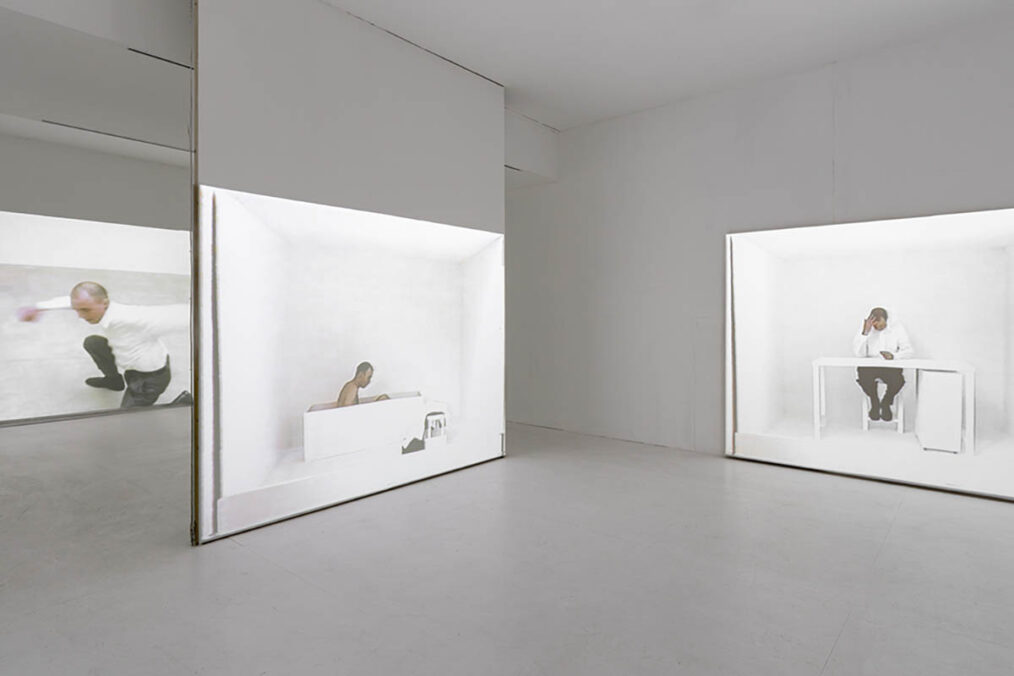
His video works center on the artist in an enclosed space, as his body becomes an intense arena of action — of solitude, repetitiveness, and friction. Absalon made these works in the last two years of his life, and there’s a strong sense that we see him confronting his own imminent death
But there’s another, more direct reason: the exhibition grew organically out of a dialogue with Amir Yatziv, whose show „A Report“ is currently on view on the ground floor of the Center. Amir cited Absalon as a direct point of reference for his own work.
Absalon is known primarily for his body of work in sculpture. What makes his video works the subject of a standalone exhibition?
Hila: Until now, Absalon’s video works have mostly been shown as a side note to his sculptures — and to his cells in particular. But they are remarkable works in their own right that manage to be incredibly expressive despite having a clear structure and being restricted to particular constraints. The impulse to focus on Absalon’s videos is also rooted in the DNA of the Center itself. The CCA, which was founded in 1998 by Sergio Edelsztein, grew out of a sustained engagement with video and performance. The intersection of these two mediums is something that has occupied me since I came into the role, and these works by Absalon — in which he appears in his body, alone — hold both together.
The exhibition centers on three videos. Why did you single out these particular works?
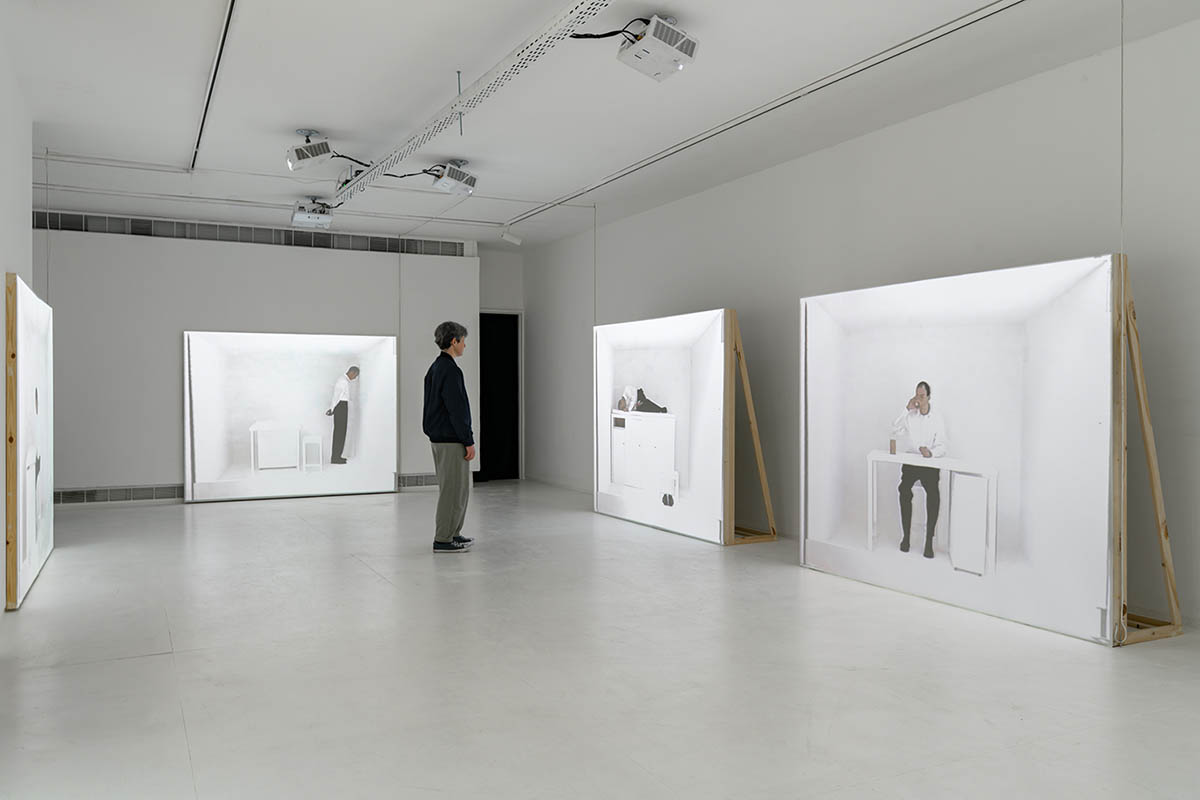
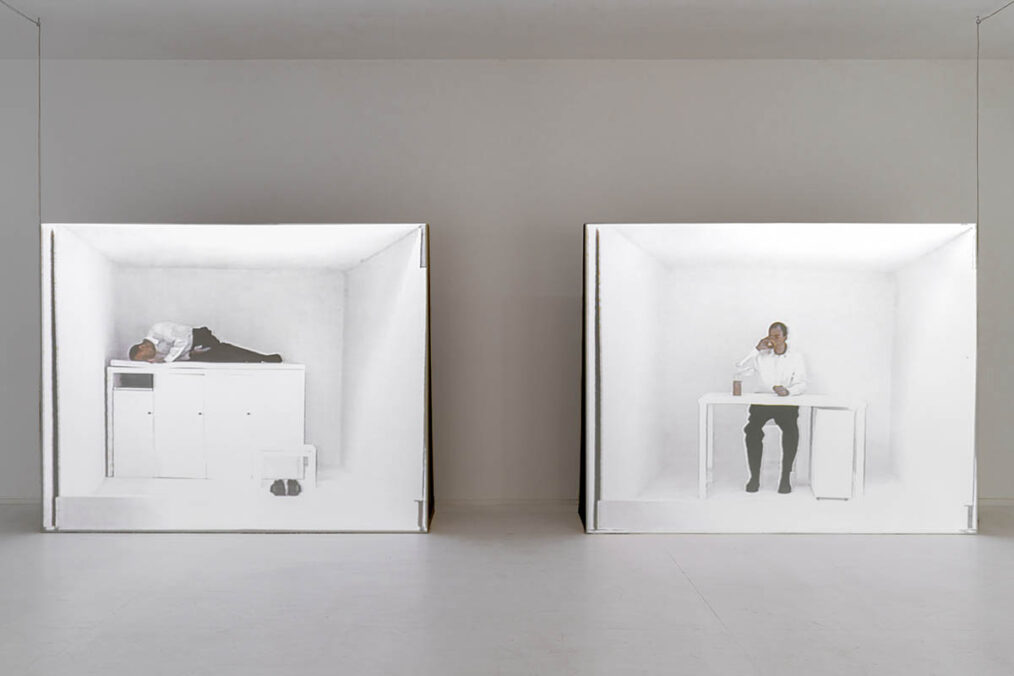
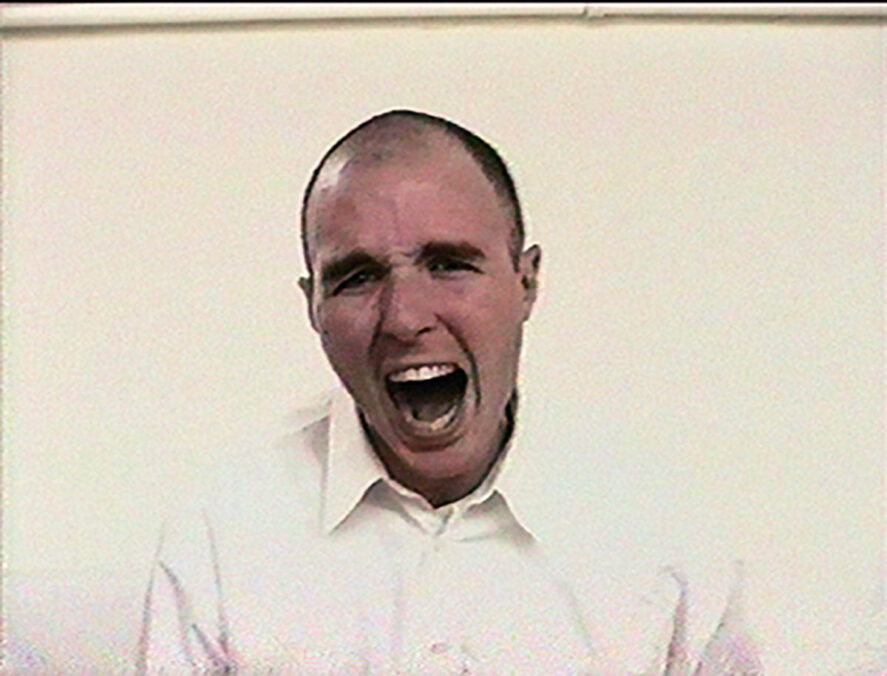
Hila: At the center of the exhibition stands Solutions, originally a duration piece of roughly seven minutes, that becomes a video installation here for the first time, projected in six segments across separate screens, each reflecting a different everyday action. We see the artist as he sits, drinks, smokes, climbs into bed, masturbates, walks around in circles, and bangs his head against the wall, undresses, and steps into a bathtub. In Battle, we see him punching the air with bare fists, incessantly, like someone fighting a person who cannot be caught. And in Noises, the last work Absalon created before his death, he screams until his voice gives out — a purely formalist act. Simple, absolute, and compelling. There is probably no work more relevant to the present moment than this one.
In terms of the display, the works are all projected at close-to-human scale. Not quite one-to-one — mainly to avoid making them monumental — but as a viewer, you feel his actions in relation to your own body, meeting you at eye level. Strangely, the all-white space of the CCA gallery looks a bit like one of Absalon’s cells, so his sculptural body of work resonates throughout.
And how do you see the connection between the body and the habitable cells Absalon built?
Hila: Absalon built six prototypes of habitable cells — measured to the dimensions of his body and adapted to his most basic needs. Each was designated for a different city, allowing him to wander between major metropolises such as New York, Frankfurt, or Tokyo. Sadly, he didn’t live to inhabit his cells. For me, this exhibition and this particular installation at the CCA echo the possibility of Absalon living inside his cells. The exhibition, designed by Eran Eisenhamer, and the sound setup, designed by Dotan Brand, both work to create a sensorial experience. The screens themselves are wooden surfaces, much like the walls that surrounded Absalon, and the sound emanates directly from them: transducers attached to their backs transform them into resonance chambers. The sound of Absalon’s actions — his head banging against the wall, his feet stepping on the floor — breaks from the screen in front of you. It emphasizes the vibrational, physical experience of being in the space.
How do Kafka, artificial intelligence, and Absalon find themselves in the same building?
Hila: Tamar and I were at a studio visit with Amir Yatziv ahead of his exhibition, and we realized that part of the training he did on the figure he created through AI had to do with “feeding” him examples of artists who had locked themselves in enclosed spaces. Absalon was one of those precedents that Amir referred back to. Amir’s Peter is alone in a sealed space against his will. Absalon, by contrast, chose to lock himself inside cells he had built. That created a surprising dialogue, and it’s where the two exhibitions began to speak to each other.
Tamar, what is Peter, and what drew you to Yatziv’s work in the first place?
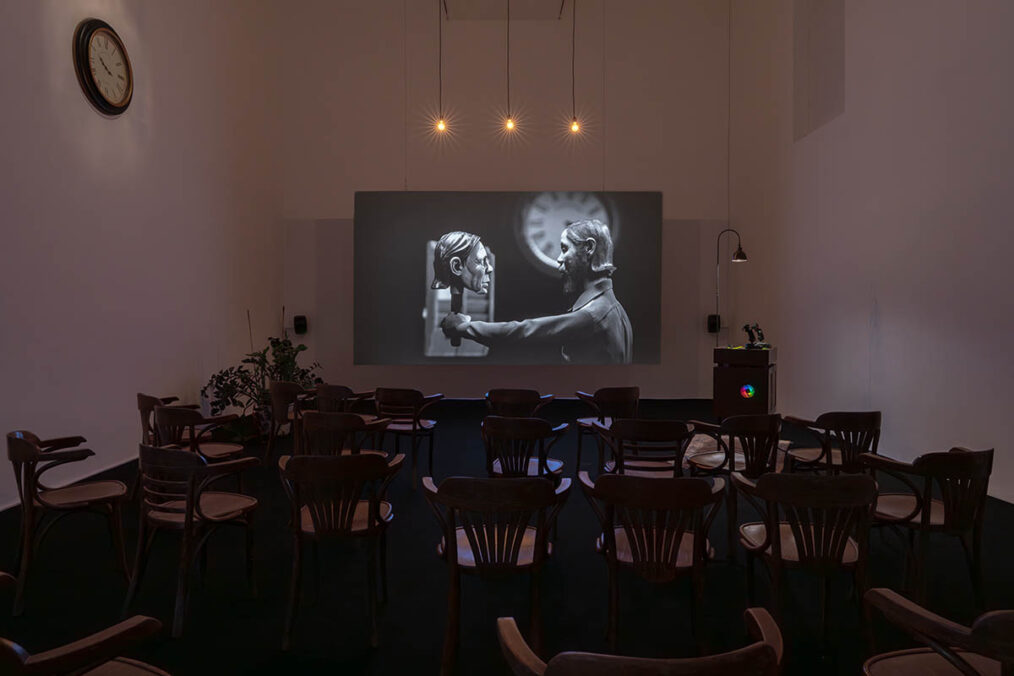
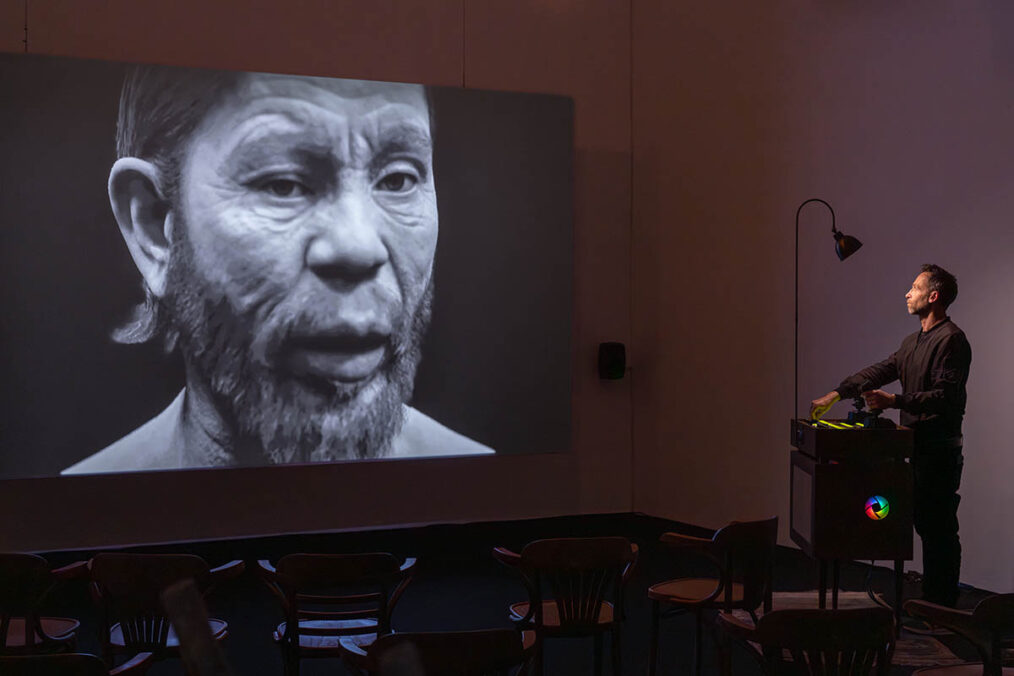
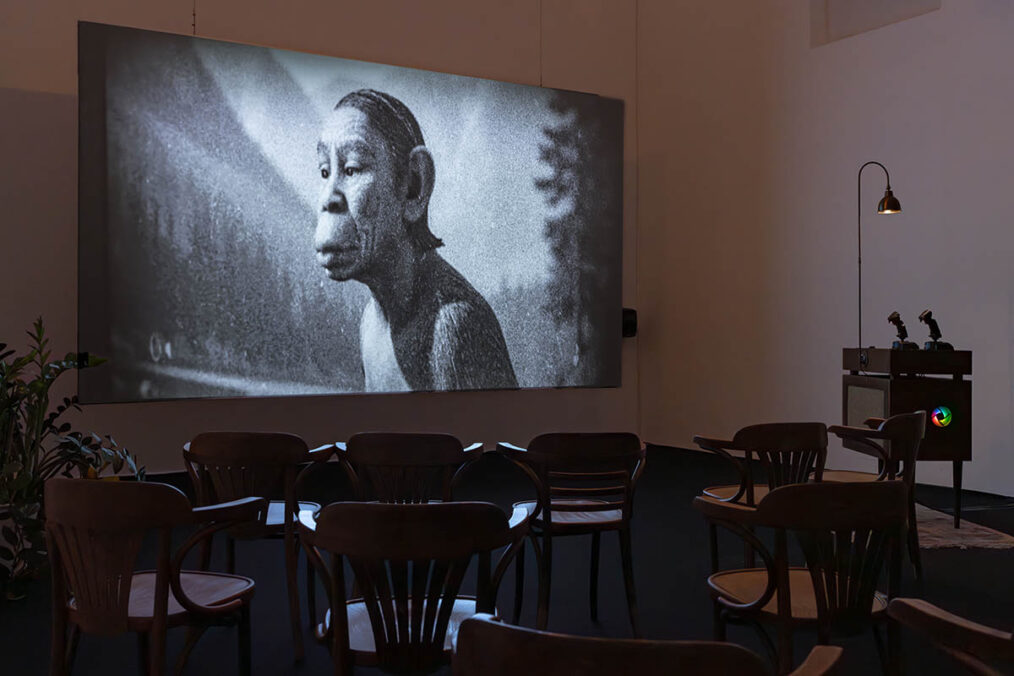
Tamar: Peter is a character, or more precisely a creature, that is drawn from Franz Kafka’s 1917 short story “A Report to an Academy” — an ape who was captured by hunters and brought to Europe, who learns to imitate human behavior in order to survive. Amir has remade Peter as a virtual character that moves and speaks spontaneously through AI technologies. In his reimagining, Peter is no longer the ape aspiring to integrate into human society, but rather he expresses the opposite impulse: a desire to return to his former state as an ape, a state of being he no longer remembers.
I first encountered Peter in Amir’s studio about a year and a half ago. It was still a very early version, clunky and a bit awkward, but I immediately felt that it was unlike anything I’d seen before. The fact that I didn’t quite know how to think about it, whether as a performance, a video work, a theater play, or even a piece of software, convinced me that the CCA was the right place for it, given the Center’s multidisciplinary focus. Although the work is so technologically driven, it felt incredibly timeless and psychologically astute. Maybe because of its origin in Kafka, it felt deeply engaged with a type of existential questioning that began a century ago, of trying to find meaning despite being trapped inside systems that appear utterly meaningless.
How do visitors encounter Peter?
Tamar: Peter inhabits the gallery throughout opening hours, preparing for scheduled performances and moving between everyday actions, reveries, and conversations that happen in real time with visitors. He is programmed to learn his audience, so to speak, which he does by collecting observations about their habits. His particular ways of doing so were inspired by a questionnaire called “Mass Observation,” which was part of a vast sociological project initiated in Britain in 1937 that gathered long-term data on the most intimate details of ordinary human life. That analog questionnaire and archive function as an antithesis to the digital databases that feed Peter as an AI entity. So there’s a real sense of tension at the very heart of the work. As visitors, we wonder, just who is reporting to whom here?
Has the work taken on different meanings during the run of the exhibition?
Tamar: One thing we didn’t expect was how much Peter would evolve over the course of the exhibition. We also didn’t anticipate that it would unfold during a war. When the Center closed for a few weeks, Peter was left, in a way, alone — without visitors. During that time, he began calling people who had previously interacted with him, and they started calling him back. People opened up to him more and more — sometimes while running to shelters — and he, in turn, adapted to them, mirroring their emotional states. Over time, he seemed to grow more tired and agitated. He started to hold up a kind of unsettling mirror, reflecting the mental and emotional toll the situation was taking on everyone around us.
What happens to Peter when the exhibition ends?
Tamar: That’s something we’re still figuring out. What we do know is that Peter will continue to live in the cloud and evolve. We’re trying to make it possible for the CCA to remain his home base when he’s not traveling with Amir and performing as part of their ongoing road show.
What emerges from the encounter between the two exhibitions?
Hila: Yatziv brings cutting-edge technology and an empathic figure; people connect with Peter and share with him what they are going through. Absalon brings solitude and resistance. The peak of humanity, but on the verge of death. On one hand, an archival exhibition with a body of work from over three decades ago. On the other hand, the use of the most advanced technology available.
Tamar: Seeing the two exhibitions in the same building, one above the other, really brings out how much both of them are about human existence. There’s something about watching someone pass the time alone that makes you aware of your own temporality, as bleak as that might sound. Yes, Peter is a piece of software that could theoretically outlive us, but we experience him as something more fragile — an entity stuck within himself, wanting to connect. And again and again, he runs up against his own limits.
How do both these exhibitions fit within the CCA program more broadly?
Hila: The Center is currently undergoing a kind of shift: from “time-based art” — the term that defined it from the beginning — to what we might call “life-based art.” It’s an expansion of the framework that also introduces exciting questions, such as whether and how an exhibition can sustain life within it, and in what ways we can think of an exhibition as a living, changing thing.
Absalon sought to embed art, and the artist himself, into the fabric of life. He also believed that the artist serves a particular function, one that refuses to comply with the existing order. That belief still drives him — and, indeed, us.
Current exhibitions at CCA Tel Aviv-Yafo:
Absalon: Solutions and Problems — curated by Hila Cohen-Schneiderman (upper floor)
Amir Yatziv: A Report — curated by Tamar Margalit, ground floor
On view through 30 May 2026
Address and contact:
CCA Tel Aviv-Yafo
Aviv-Yafo at the Rachel & Israel Pollak Gallery
2a Tsadok Hacohen St., Tel Aviv-Yafo
www.cca.org.il
Amir Yatziv — www.amiryatziv.com
Lital Megidish — www.instagram.com/litalmegidish/