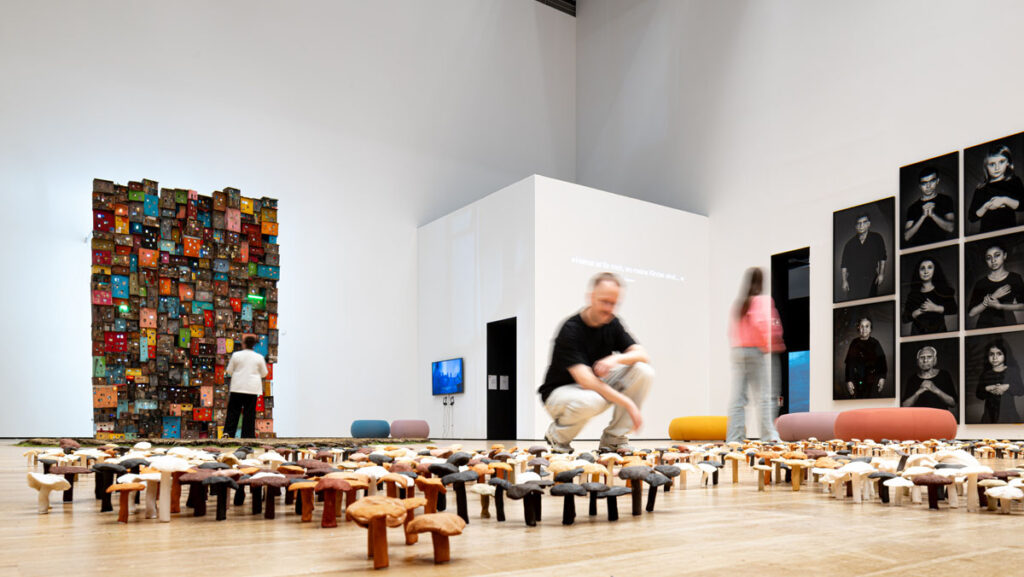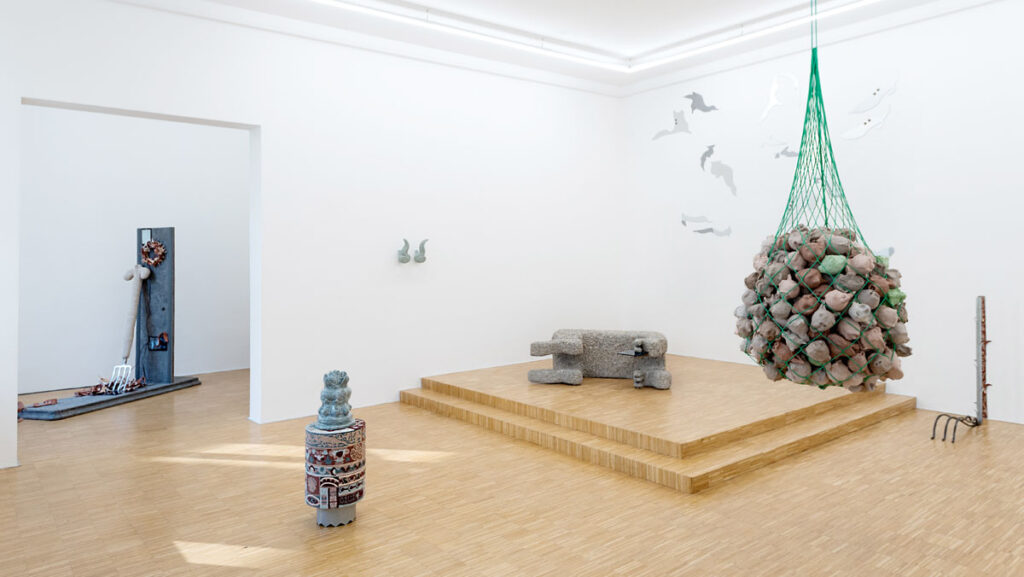

Radical Hope combines selected earlier works with numerous new pieces created especially for the exhibition in Vaduz. Jermolaewa is currently researching for the show in France and Spain, as well as on the Channel Island of Jersey.
With Anna Jermolaewa’s artistic practice intimately linked to her biography, she creates works that are often based on personal experience and that expose complex societal and political realities. The exhibition is shaped by three main aspects: collecting, works that have evolved over extended periods of time, and the narrative thread of flight and migration. The latter is also informed by the artist’s own escape from the Soviet Union in 1989.

A central body of work is the title piece, Radical Hope: a collection of little everyday objects made by Soviet prison inmates that Anna Jermolaewa collected over the course of several years. They include hand mirrors and combs, along with door handles or lighter cases. Created in artificial resin and other materials, these objects are characterised by careful craftsmanship and beauty. Radical Hope adds further depth to the artist’s engagement with social memory, how it continues to affect the present and the individual’s scope for action in repressive systems.
Another theme is Anna Jermolaewa’s connection with animals. In the series of watercolours LAST SEEN SINCE 1970 (2025–ongoing), she catalogues animals that have not been sighted since 1970 – the year of her birth – and that are regarded as extinct. For Radical Hope she is expanding the series with new large-format drawings based on sketches from 2025, as well as with footage filmed on Jersey over the summer. In doing so, she is exploring the legacy of naturalist Gerald Durrell, whose books and commitment to species protection inspired her as a child.

Radical Hope affords a comprehensive insight into Jermolaewa’s conceptual artistic practice, which spans a broad range of media: video, installation, photography, performance, painting and sculpture. Of particular interest to her are the subtle mechanisms of influence that shape our everyday lives. “Many of my works deal with manipulation”, says the artist. “Who or what is being manipulated almost always remains outside the image. The mechanisms of power that influence or control individuals today are becoming increasingly subtle and invisible.”
Anna Jermolaewa has previously featured in two group shows at Kunstmuseum Liechtenstein: Parliament of Plants (2020/2021) and On the Street (2025). The collection includes two of the artist’s works, both part of her contribution to the Austrian pavilion at the 2024 Venice Biennale.
The title Radical Hope is a reference to the book of the same name by philosopher Jonathan Lear, in which “radical hope” is described as a special form of hope that endures even in the face of profound and cultural destruction.

About the artist: Anna Jermolaewa was born and grew up in Leningrad in the former USSR. At the age of eighteen, she was accused of anti-Soviet agitation and propaganda because of her involvement as one of the founding members of the “Democratic Union”, the Soviet Union’s first official opposition party, and as co-editor of one of its newspapers. In 1989, she fled via Poland to Vienna, where she has since been living and working. From 2005 to 2011, she was a professor of Media Art at Karlsruhe University of Arts and Design. Since 2018, she has been a Professor of Experimental Art at the University of Arts Linz. Her work has been shown at numerous international solo and group exhibitions, and she is represented in several renowned collections, including Stedelijk Museum Amsterdam; Museum of Contemporary Art Kiasma, Helsinki; mumok Museum Moderner Kunst Stiftung Ludwig Wien or Belvedere, Vienna. The artist has been awarded several residencies, including the MAK Schindler Scholarship (2017), and prizes such as the Austrian Art Prize for Fine Arts (2020) or the Otto Breicha Award (2021). She recently gained wide international recognition as Austria’s representative at the 2024 Venice Biennale.
Exhibition: Anna Jermolaewa – Radical Hope
Exhibition duration: 30 October 2026 – 29 March 2027
The exhibition is accompanied by an extensive catalogue. A Kunstmuseum Liechtenstein production curated by Christiane Meyer-Stoll with Henrik Utermöhle.
Opening with artist talk: Thursday, 29 October 2026, from 6 pm
Press conference: Wednesday, 28 October 2026, 10.30 am, Kunstmuseum Liechtenstein, Skylight Galleries
Address and contact:
Kunstmuseum Liechtenstein
Städtle 32, 9490 Vaduz, Liechtenstein
www.kunstmuseum.li
Anna Jermolaewa – www.jermolaewa.com

Kunstmuseum Liechtenstein is the state museum of modern and contemporary art, an open place for encounter and exchange. Instead of a permanent collection display, it develops changing exhibitions that enable new dialogues with works from the collection and focus on current topics. In terms of its collecting, research and exhibiting activities, the Museum’s goal is to demonstrate fresh perspectives and reflect on the issues of our day. The art education programmes invite people of all ages to actively experience art, to join the conversation and get hands-on. Designed by the renowned architects Meinrad Morger & Heinrich Degelo with Christian Kerez, Kunstmuseum Liechtenstein was opened in November 2000. Taking the form of a dark cuboid with hand-polished façade, it has meanwhile become a distinctive landmark of Vaduz, contributing significantly to the international profile of Liechtenstein. The Hilti Art Foundation building has been situated alongside Kunstmuseum Liechtenstein since 2015. The private foundation is devoted to art from classical modernism to the present.