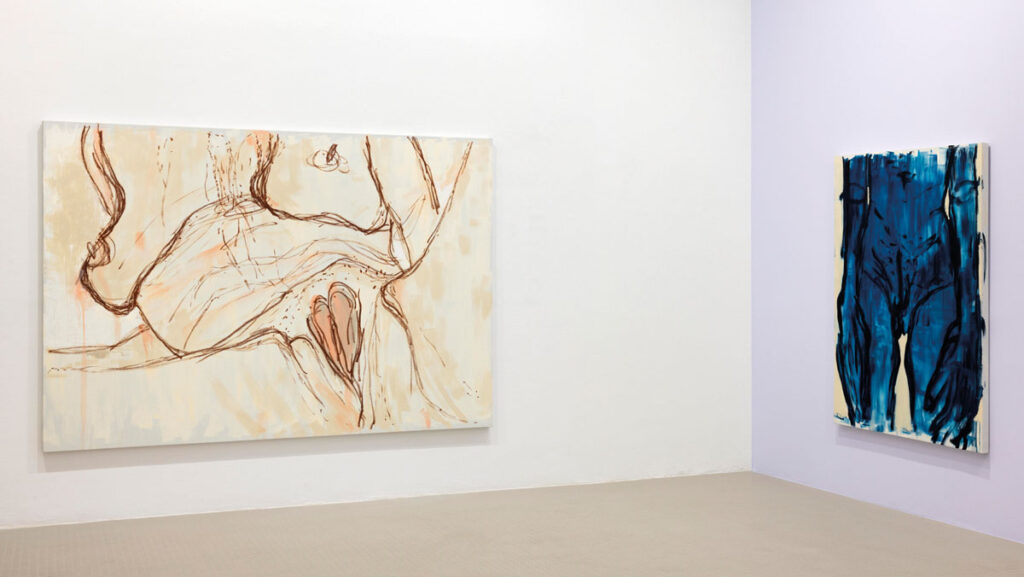
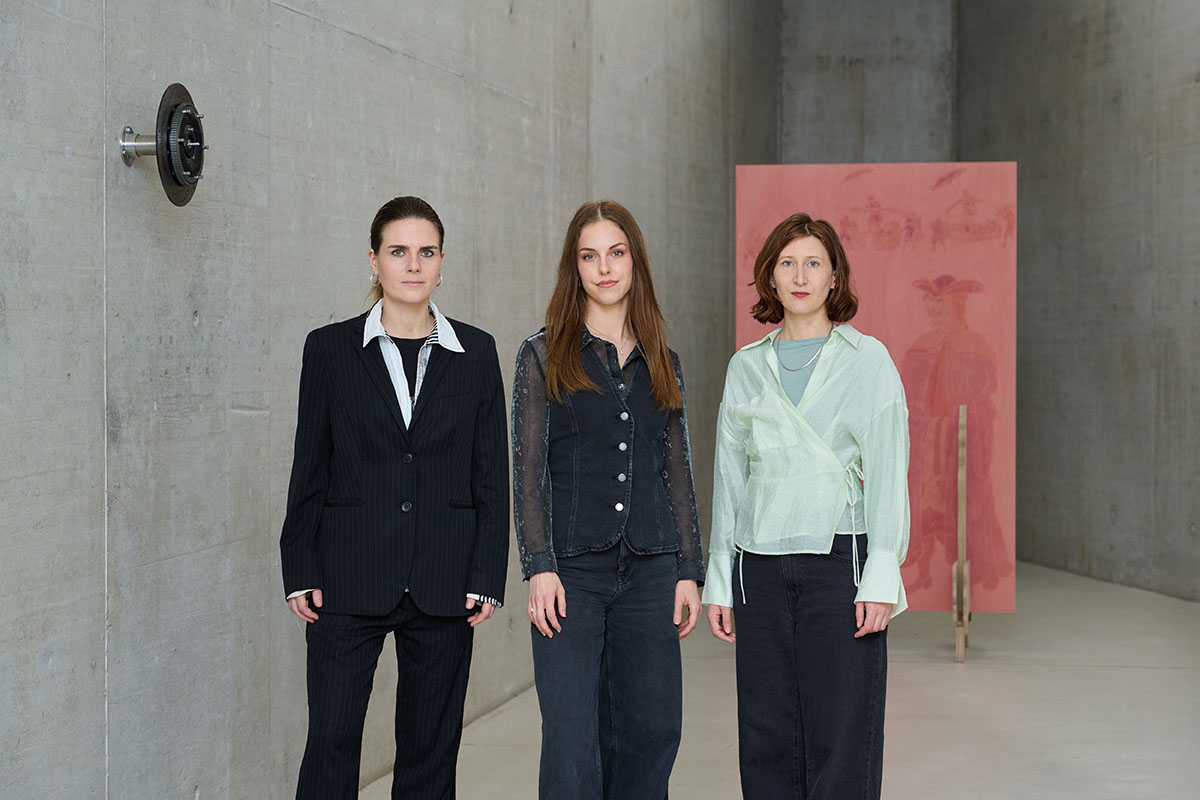
I’d like to start with the exhibition title “For Ever and Forever When I Move”. It’s a playful take on different meanings of similar terms. Could you both talk about how you collaborated and how this title came about, also in connection with the curator Jessica Aydin?
Enya: We actually studied the same year in the Kunstakademie Düsseldorf, so we knew each other, but we had never collaborated before. It was really the curator’s decision to bring us together for this show. We spent quite a long time searching for a title; we needed something that could connect our practices well.
Teresa: The title eventually came from a poem. I initially suggested something inspired by a Chinese poem that referenced Western perspectives. „this heaven is west of the large and small oceans“ (Zhang Xun (1731–89)). It was about something distant, something constantly moving. I wasn’t tied to a specific place, so I was looking for something that captured that sense of openness and movement. Then Jessica transformed it; there was even a small mistake in how it was written at first, and that process led us to the final version. The sentence we ended up with actually comes from Ulysses. Jessica recognized that and pointed it out. What’s nice is that it resonates with both of us: in my case, I work a lot with images and commodities that travel across countries, while in Enya’s practice, there’s more focus on fluidity, viscosity, and movement. So the title reflects this shared sense of motion and transformation.
Enya: The title adds this time dimension. The poem is centuries old, so there’s this sense of time travel: linking past, present, and future. Both of us, in different ways, look back on our work but also forward. The figure of Ulysses, constantly traveling, reflecting, and moving, captures that. For me, this idea of “forever” exists both in the past and the future, and that aligns closely with my work.
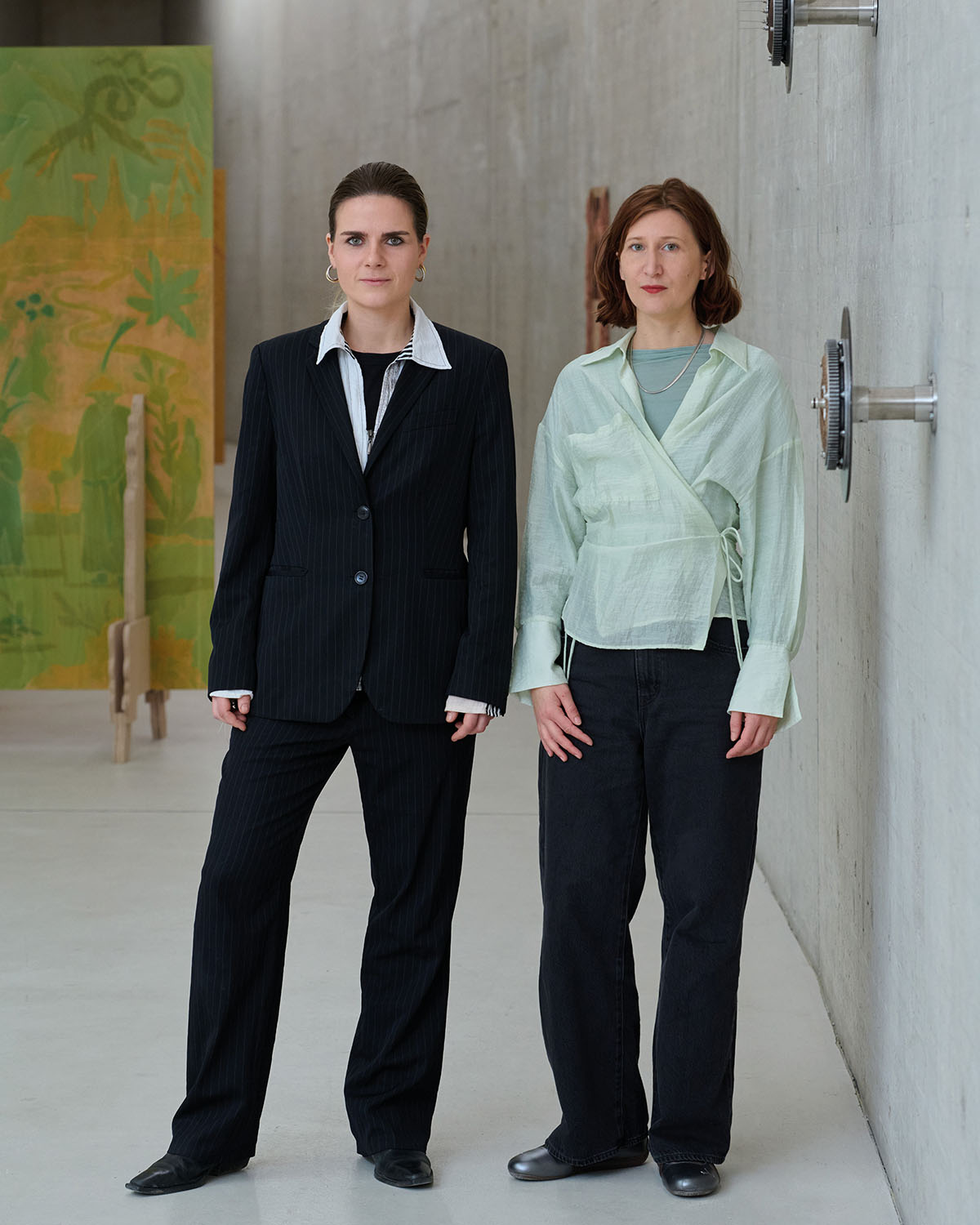
Teresa, you engage with Chinese aesthetics from a specific historical period, but also with how these aesthetics were interpreted through Western perspectives. Can you talk about how you became interested in this topic?
Teresa: My interest started with motifs and forms, especially on textiles. Textiles were often commodities that traveled across the world into Europe. I began noticing that certain motifs kept repeating. That’s how I arrived at chinoiserie, which is a very specific style you can easily recognize in European depictions. You can often trace these forms back to Chinese origins, especially woodcut prints that were imported into Europe and used as models. What fascinates me is how the West constructs both itself and “the other” through these forms. China is particularly interesting because it was itself a powerful empire with a strong self-image. So when Europeans encountered China, they were entering a world that didn’t revolve around them. That must have been quite a shock. It challenged European self-perception in a way that encounters with other regions often didn’t.
I was thinking these days about the early 1900s, during world fairs and exhibitions, where European artists, architects, and designers encountered Chinese and Japanese depictions. They were shocked by the lack of perspective, the flat surfaces, and the geometric play: everything stayed on the surface. This influenced a lot of art we know, also from Vienna, like the Secession movement. Could we talk about these formal differences between the two traditions?
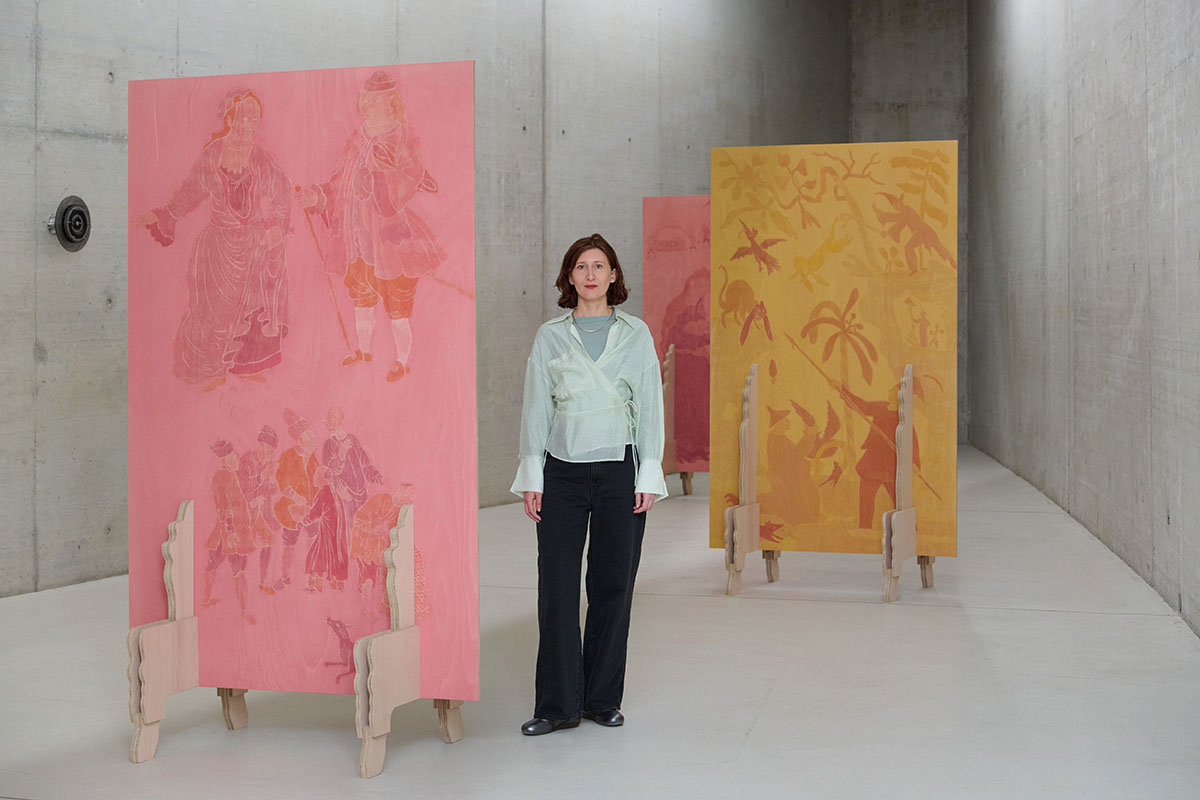
Teresa: In my research, I’m currently focused on the 18th century, the beginning and peak of chinoiserie, as the starting point. Of course, it later evolved into other styles, like the Jugendstil in the 1900s, which you can trace back to these influences. Europeans were fascinated by Chinese popular culture (popular in those times), like woodcut prints that they imported. But they weren’t interested in high Chinese art, such as literati painting, which also had flat surfaces, soft light-dark contrasts, and different perspective systems. Chinese art often used a cavalier perspective, showing parallel timelines in the same image, in long handscroll paintings where you can unfold an entire story. They knew central perspective, but it wasn’t popular. You can see this in paintings where European techniques appear softened or stylized, signaling cultural contact.
Can you give us an example of it in one of your works in the exhibition?
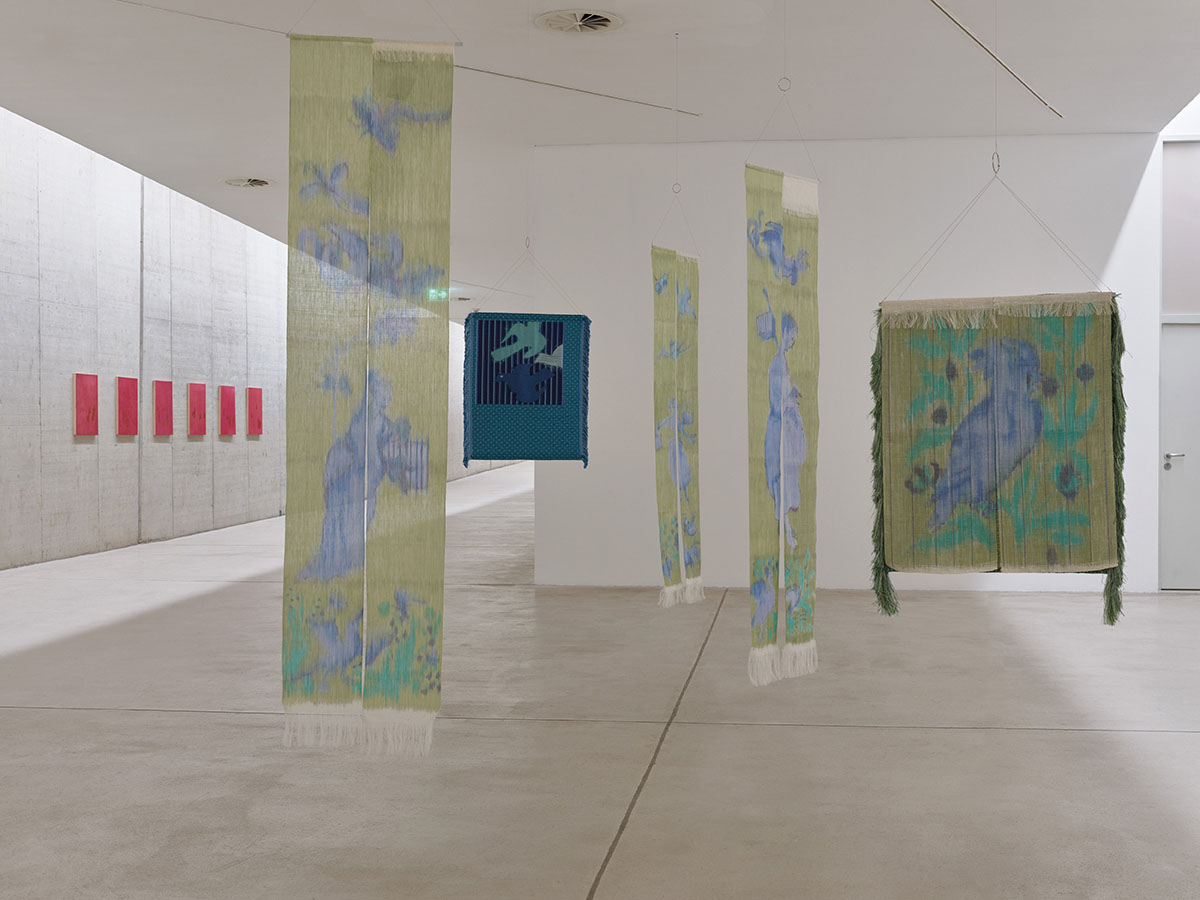
Teresa: Take the small red paintings, for example, there are six of them. They’re based on Chinese woodcut prints from a book commissioned by the emperor as propaganda, showing agriculture and production. These prints were traded to Europe and influenced chinoiserie artists like François Boucher, who was key to the European style. He’d take scenes, but set them in imaginary landscapes: floating islands, plants, ponds, tea sets, furniture fragments. In the originals, it’s working contexts; with Boucher, it becomes leisure, escapism. a compilation evoking „somewhere else nice,“ like early vacation promotion or destination advertising.
The idea of copying is central to your work. We often say „referencing“ or „appropriating“ in art texts, but what do you mean by copying formally?
Teresa: In China, copying is positive: it means engaging deeply, and repetition brings subtle changes toward something new. Inspired by Byung-Chul Han’s essay on how Europeans and Chinese perceive copying differently. For us, copying feels negative: fakes, imitation, originality is tied to genius. I’m not inventing in my practice; I’m sticking to found images to deconstruct how they work in a European mindset today. I literally copy them onto wood and repaint elements without recombining. The titles reference exact sources, so you can search and find the originals, making it clear this exists; I’m shifting the presentation. I’m starting to read about Chinese philosophy, but as a European, it’s hard not to romanticize. Our Christian society emphasizes individuality—a personal connection to God. Chinese thought seems less about interiority, more collective or process-oriented. Repetition through copying engages culture differently.
Have you been to China? How did you start this research?
Teresa: I booked flights for this summer. But I spent half a year in Vietnam long ago; Vietnam was part of China for 1,000 years, so the influence is strong. That experience there sparked my interest in China, but it took years to deepen it. I’m starting to learn Chinese too.
Enya, let’s move to your contribution to the show and your practice in general? Could you elaborate on the definition of abject from Julia Kristeva and how it relates to your work?
Enya: About two years ago, I became fascinated by slime after reading a book that collected all kinds of information about it. It was by the German author Susanne Wedlich: Slime. A Natural History. Slime. It’s such an ambivalent material: hard to grasp, slips through your fingers, essential for life, yet full of bacteria, acting as both a protector and a threat. Through that research, I discovered Julia Kristeva’s concept of the abject. It fit perfectly with slime: fascinating yet disgusting, inside and outside the body at once, once deeply connected with femininity and fear.
I read it not just as feminine, but as queer: uncategorizable, resisting binaries. What do you think?
Enya: You’re right. In patriarchal literature, like Patricia Highsmith, H.P. Lovecraft, or Sartre, slime links to chaos and fear of femininity. But from a feminist view, its uncategorizable qualities undermine binaries, which really drew me in.
There’s this shared notion of „the other“ in both Teresa’s and your practice. Could you highlight one piece in the show that best embodies your research?
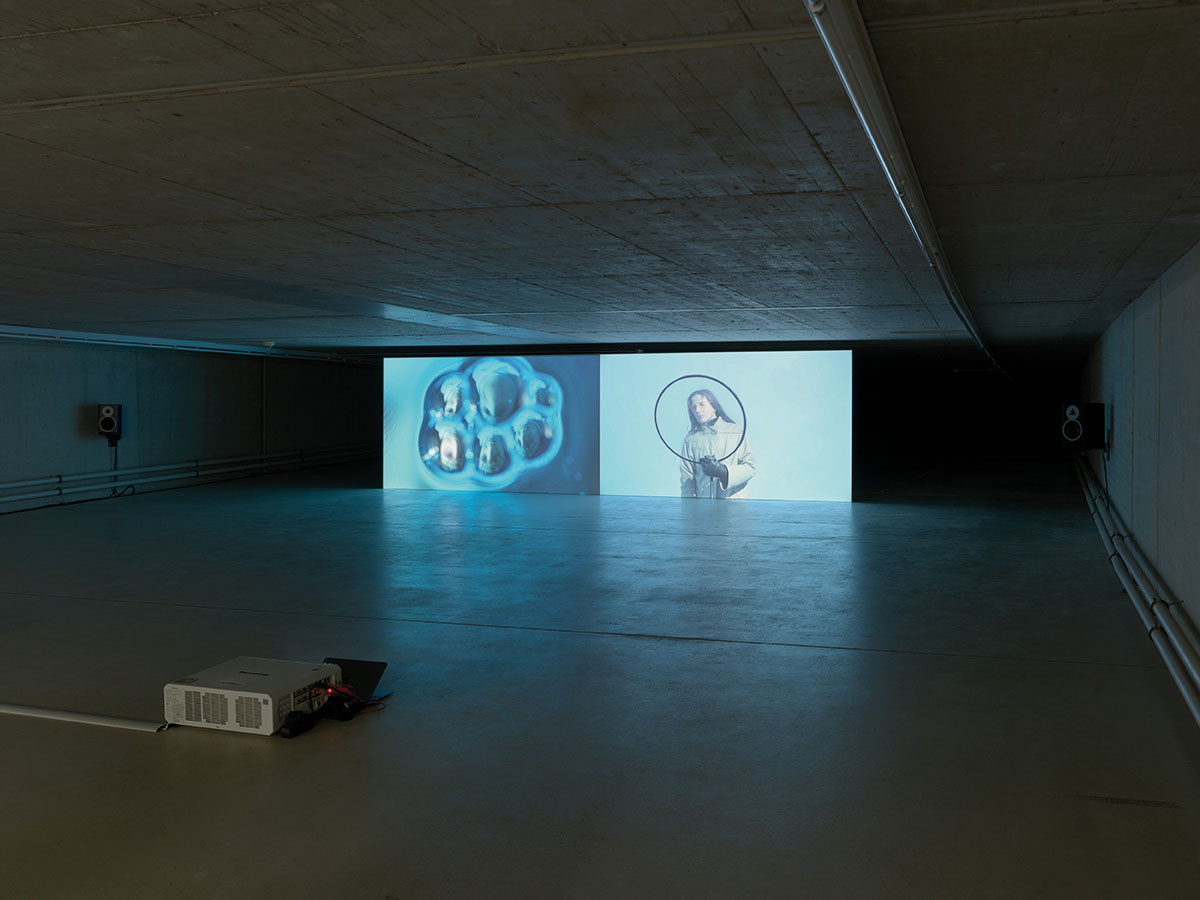
Enya: There’s a video work I did on fluidity, generally Notes on Fluids (2026), and a kinetic installation tied more to primordial slime and knowledge production. The inspiration for a kinetic installation comes from a 19th-century narrative by German biologist Ernst Haeckel, who claimed the deep sea floor was covered in primordial slime, calling it the source of life. In these expeditions, they used sounding lines, long poles with iron weights dropped into the sea. They’d time the descent, measure depth, and retrieve sediment preserved in alcohol. A chemical reaction produced slime, which they called primordial, but it was the reaction. So it turned out it was a total myth. This persisted until the mid-1800s, with deep-sea expeditions on research ships. What fascinates me is how these tools to categorize the deep sea were phallic, made from war materials like cannonballs as weights. Military tech drove knowledge production, a link still relevant today. Science clings to narratives that aren’t always true.
I like that moment where science meets speculation. Historically, art and science were studied together; you needed physics, math, and biology for art training. Both art and science, to the degree that they dive into the void, are uncertain about what’s next. They are divided later by method: science systematizes; art materializes differently.
Enya: Haeckel blurred lines too; his stunning bacteria drawings mixed observation and imagination. But he was also obsessed with categorizing humans into races, leading to dark places.
Yes, that categorizing drive brought us to system-driven culture, rigid structures some call patriarchal, but I think it sadly goes into deeper, foundational ways of how we think and function. Let’s shift for a bit and talk about the fish motif, deep-sea creatures: how you reference that world.
Enya: The big kinetic sculpture builds on the primordial slime story as a starting point, but it’s really an experimental setup exploring knowledge production, its military ties, and phallic penetration imagery. The water rises, circulates, recedes: referencing itself in a loop. There are also readings on knowledge production that are very important, coming from Donna Haraway. They bridge to the fish works too—queering, connections to Astrida Neimanis: Bodies of Water: Posthuman Feminist Phenomenology. Neimanis references a study: medicine flushed into rivers affects fish, making populations of fish more feminine—like Berlin’s, 70% female (Weibifizierung in German, interestingly binary-framed). Residues appear in Inuit women’s breast milk, passed to children. In the video work I did, a protagonist studies her fluids under a microscope, comparing them to landscapes. She visits a fossil field—an ancient seabed with fish fossils. Microscopic and macroscopic scales blur; fish motifs recur. It’s Haraway/ Neimanis inspired. For the installation, I use fish leather collaged with metal, round forms, pipes with fluids running through them, medical spritzers—organic, industrial, non-organic.
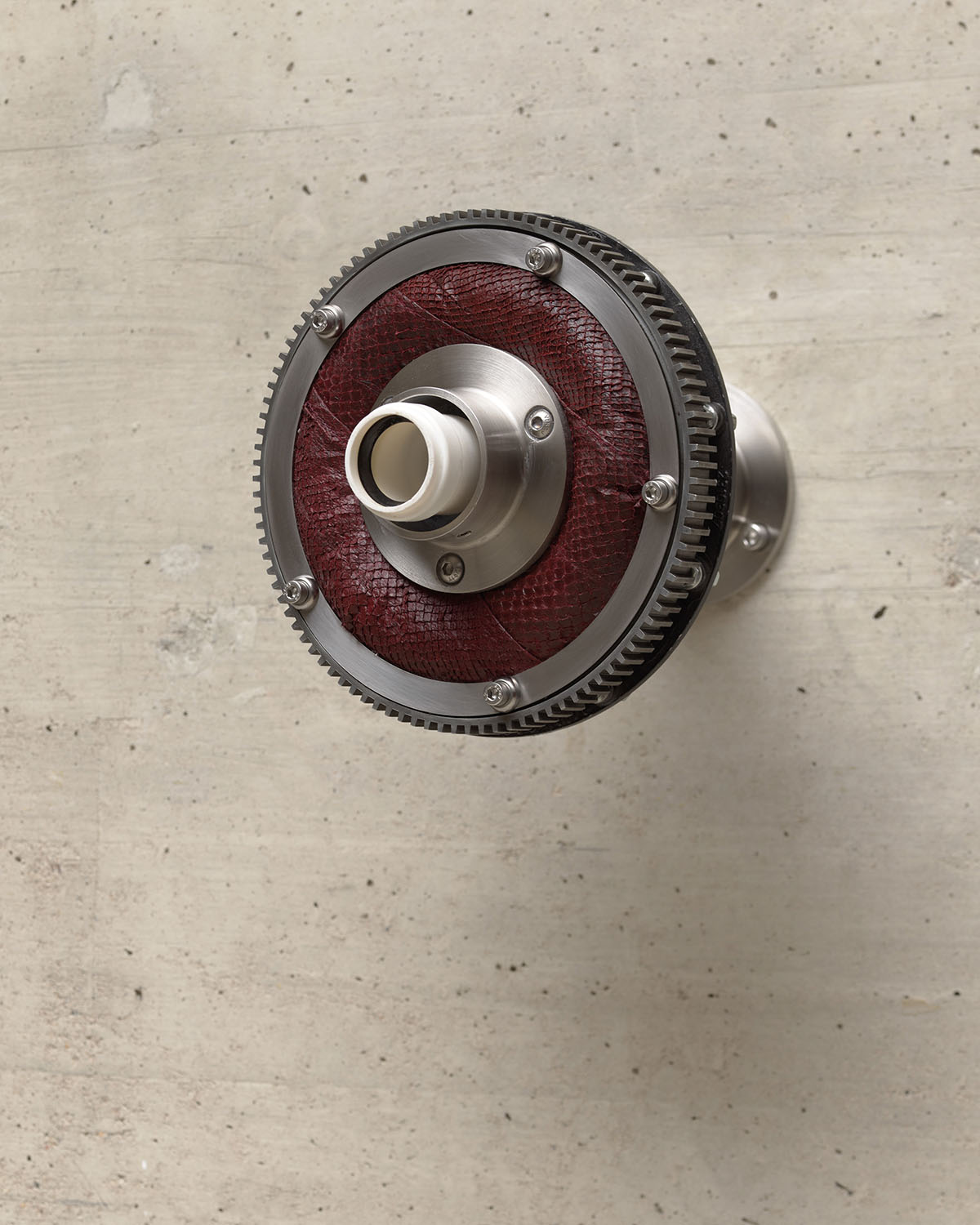
Fish skin is a fetishized material, and it parallels Teresa’s jacquard textiles. Luxury, colonialism, power, and still exclusive today. Jacquard production is very complex and costly historically: affordable only to elites. Like fish skin in fashion: Louboutin’s 2000s collection used it for everything from keychains to shoes. Prehistoric aesthetic recurring. Now with Matthieu Blazy at Chanel, textiles reclaim luxury: we’ve circled back from mass production/silhouette focus to craft, tech, material depth over cheap volume. Final question to tie perspectives: both research-based practices. As artists in their 30s now, why do you think there is this obsession with“digesting“ past problems and engaging and referencing history?
Teresa: For me, it’s personal reasons. People exclude non-European influences, but European history shows development via contact, imports, globalization, nothing new, faster now. No place is secluded, and no identity is fixed.
Enya: I love deep-diving research, especially scientific and historical. It’s a feminist act for me: to learn maximally, and connect info meaningfully. “Digestion” via artistic research, craft your own narratives, escape binaries, queer things. Slime embodies that; it breaks hegemonic thinking.
Exhibition: Enya Burger und Teresa Linhard: For Ever and Forever When I Move
Curated by: Jessica Aydin
Exhibition duration: 28.03.–28.06.2026
Address and contact:
KIT – Kunst im Tunnel
Mannesmannufer 1b
40213 Düsseldorf, Germany
https://www.kunst-im-tunnel.de/