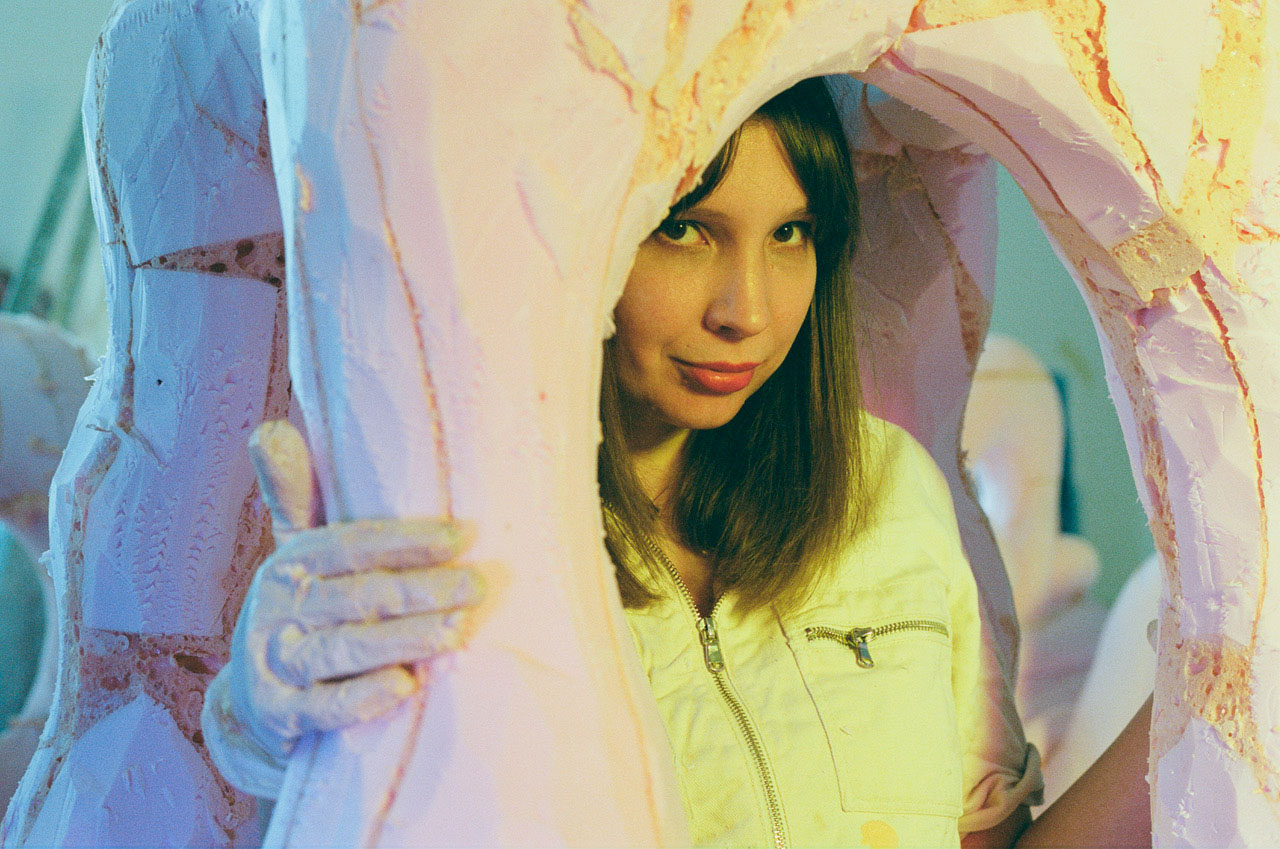
Your debut at Art Basel Unlimited comes a few years after you represented Hungary at the Venice Biennale. Looking back, how do you see the development of your artistic career between these two milestones? What aspects of your artistic language have undergone the most significant changes since then?
The themes of the body, transformation, and interconnectedness have become increasingly prominent in my work. In recent years, I have been deeply engaged with the question of how the body can be conceived not as an independent unit, but as part of a larger, collective organism. Tongues, throats, braids, or various bodily forms have often become points of connection that straddle the boundary between individual and shared experience. My thinking about monumentality has also changed. Although this may sound contradictory at first in the context of Art Basel Unlimited, I still feel that my works have, in a certain sense, begun to shrink.
The period between the Venice Biennale and Art Basel Unlimited brought not only professional but also very significant personal changes for me. After I participated in the Biennale in 2022, my daughter was born, which, of course, completely transformed my relationship with time and work. I became more focused and increasingly interested in processes that are slower, more intimate, and bring me closer to the material.
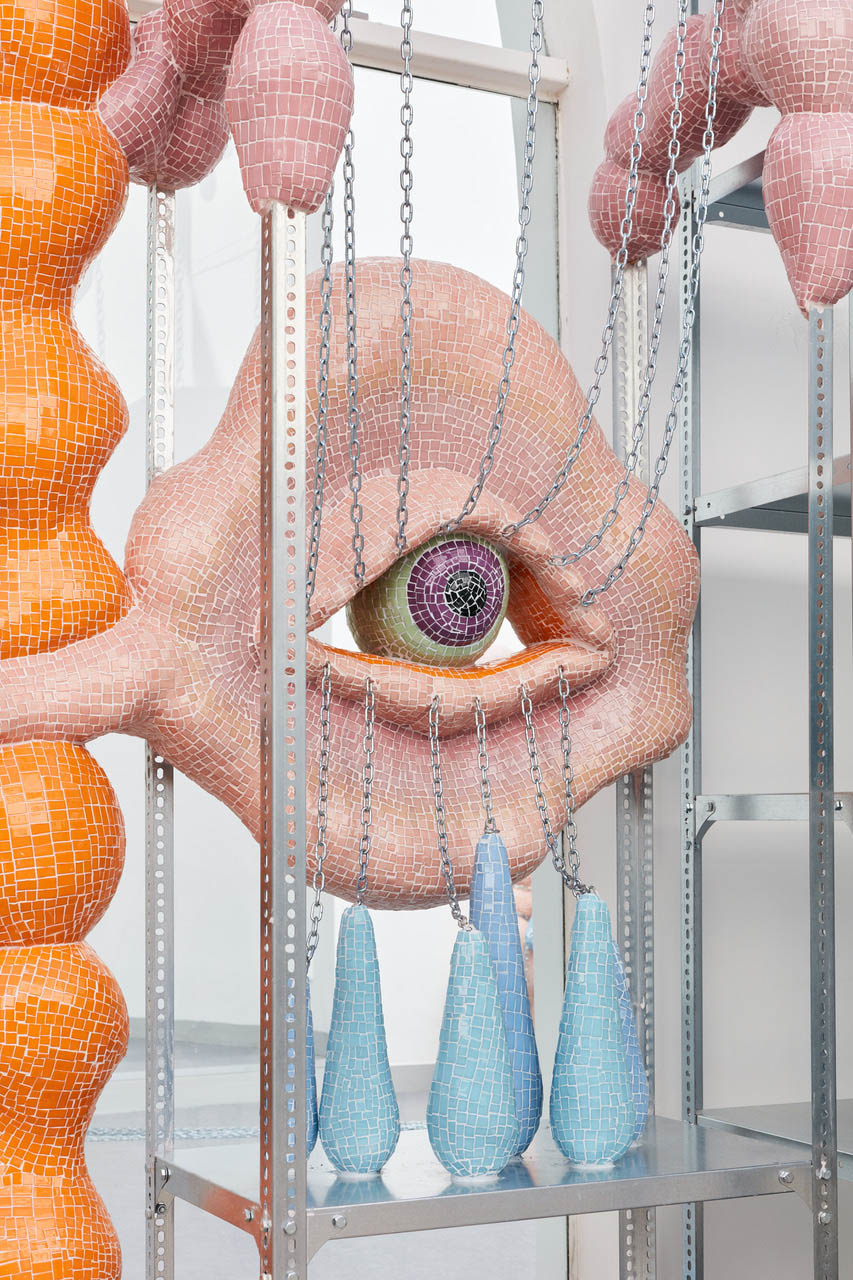
As the first Hungarian artist to exhibit at Art Basel Unlimited, do you feel a particular responsibility representing a country that is otherwise rarely visible at the fair?
I’m very proud to be here as a Hungarian. In my home country, however, I am still finding my place in the art world. As a young artist, partly because conceptual art and hyperrealist painting were in vogue at the time, I first got representation in Vienna, which also opened the door to the international art scene. At that time, I was very drawn to cooler, more structured styles, which I associated with Western art, precision, and professionalism. Now I’m enjoying returning to emotional fragility, contingency, and a personal approach. It’s important where I come from and where I live, and these influence my work.
Visually, objects from before World War II are also an inspiration. My dad deals in antiques, and as a child, I often went to flea markets with him and was surrounded by old objects and textiles. During my college years, I created textile portraits using fabrics I’d picked up at old flea markets. These were the so-called “Zanza Heads.” I like how time shows on the fabrics: the owner’s name, rust stains, and creases. The fabrics carry the traces of their previous owners.
You mentioned that your works have „shrunk.“ What do you mean by that?
My works have indeed become smaller in scale. I used to be fascinated by monumental sculptures and their spatial presence. My sculpture groups at the Venice Biennale struck me as an army. Recently, I’ve been working with smaller pieces and enjoy being able to physically embrace the sculptures. Now they’re more intimate and dominate the space less than my earlier works. My sculptures at Art Basel Unlimited feel closer to me because of this.
Your sculptures often depict bodies in the process of transformation. However, these merging, opening, or closing body parts, organs, and anthropomorphic forms are captured in a hybrid state reminiscent of mythological figures and do not become fully human. What interests you in these transitional states?
Perhaps what interests me most is precisely that they are not yet final. To me, these figures are not heading toward something, but rather represent a state in which multiple possibilities are present simultaneously. I am not so much concerned with the outcome of the transformation, but with the moment when it has not yet been fully decided what will come into being. I therefore do not view transitional states as uncertainty or a lack, but rather as a kind of openness. At such times, the forms have not yet been confined to a single meaning or identity, but are capable of carrying multiple things within themselves simultaneously. They exist on the border between different states, living beings, or body parts.
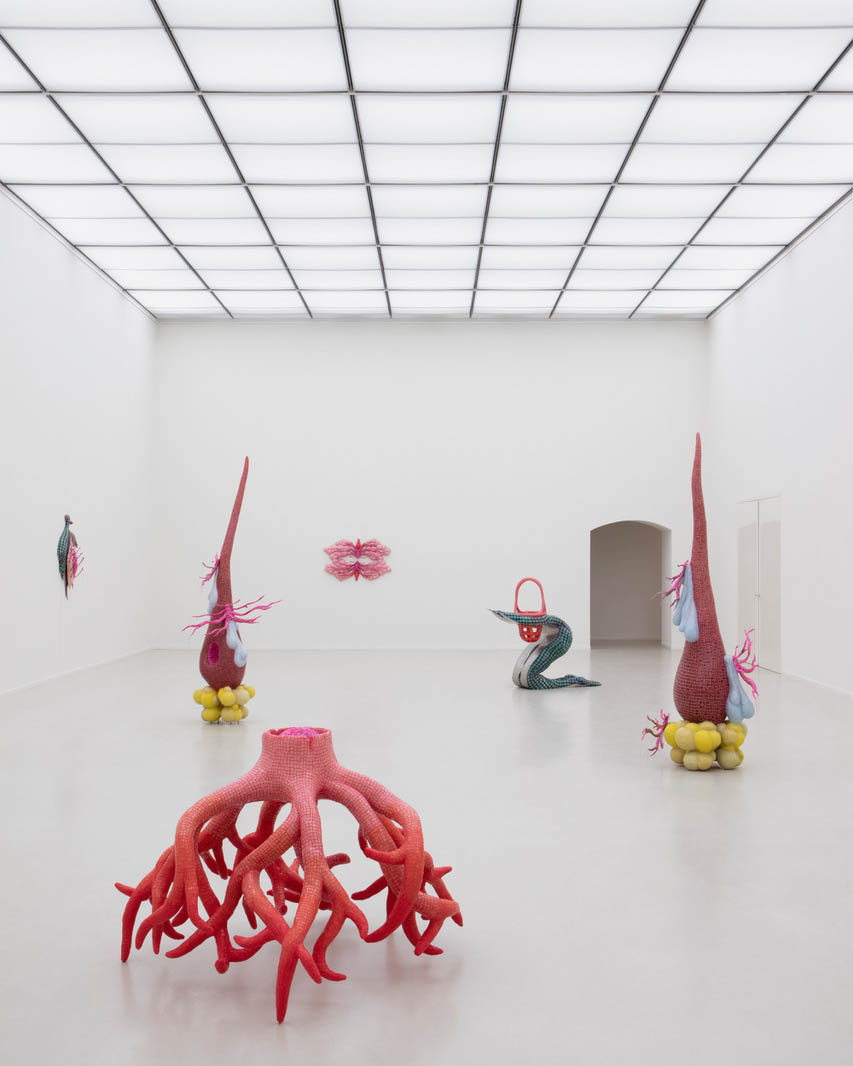
I am also often preoccupied with how to find unexpected connections between things that are far apart. In my work called Cloth Mother I-II, for example, I was interested in the connection between a strand of hair and a tree. Not merely in a formal sense, but also because similar concepts are associated with both. For me, hair is not just a part of the body, but also a kind of protective covering. A medium one can snuggle up to, one that offers protection. A tree hollow carries similar meanings: it is at once a hiding place, a refuge, and an interior space waiting to be embraced. For me, therefore, the motif of metamorphosis does not primarily refer to a biological process. Rather, it represents the possibility that different things may temporarily come into proximity with one another and give rise to new meanings.
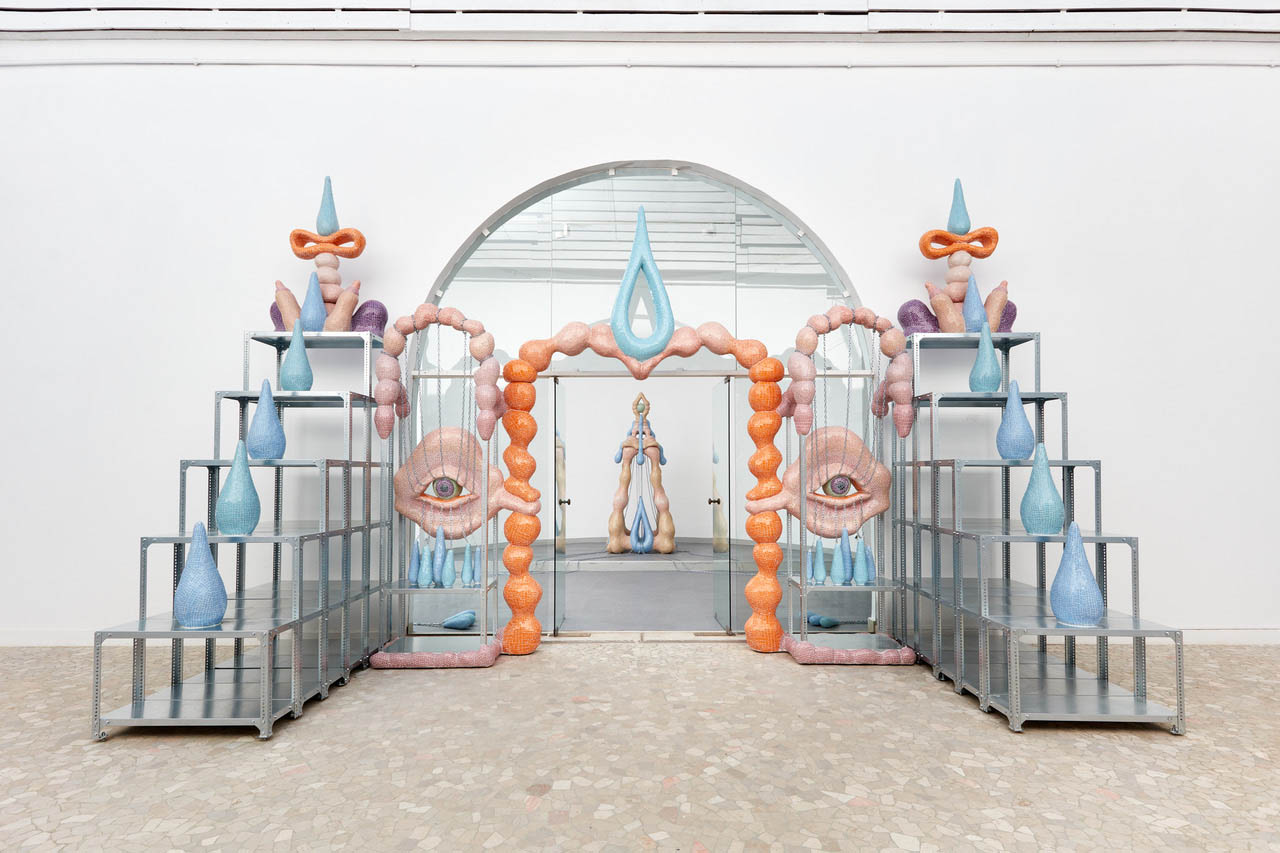
Lately, I’ve been preoccupied with the idea that neither bodies, nor identities, nor relationships are fixed, but are constantly evolving and developing in new directions. Mother Tongue II, currently on view at Art Basel Unlimited, is a good example of this. This work had a smaller-scale predecessor, and I returned to the motif of the throat and tongue because I felt it held further possibilities. By multiplying these forms, I created a structure that resembles a family tree, which to me conveys an image of growth, transformation, and constant change.
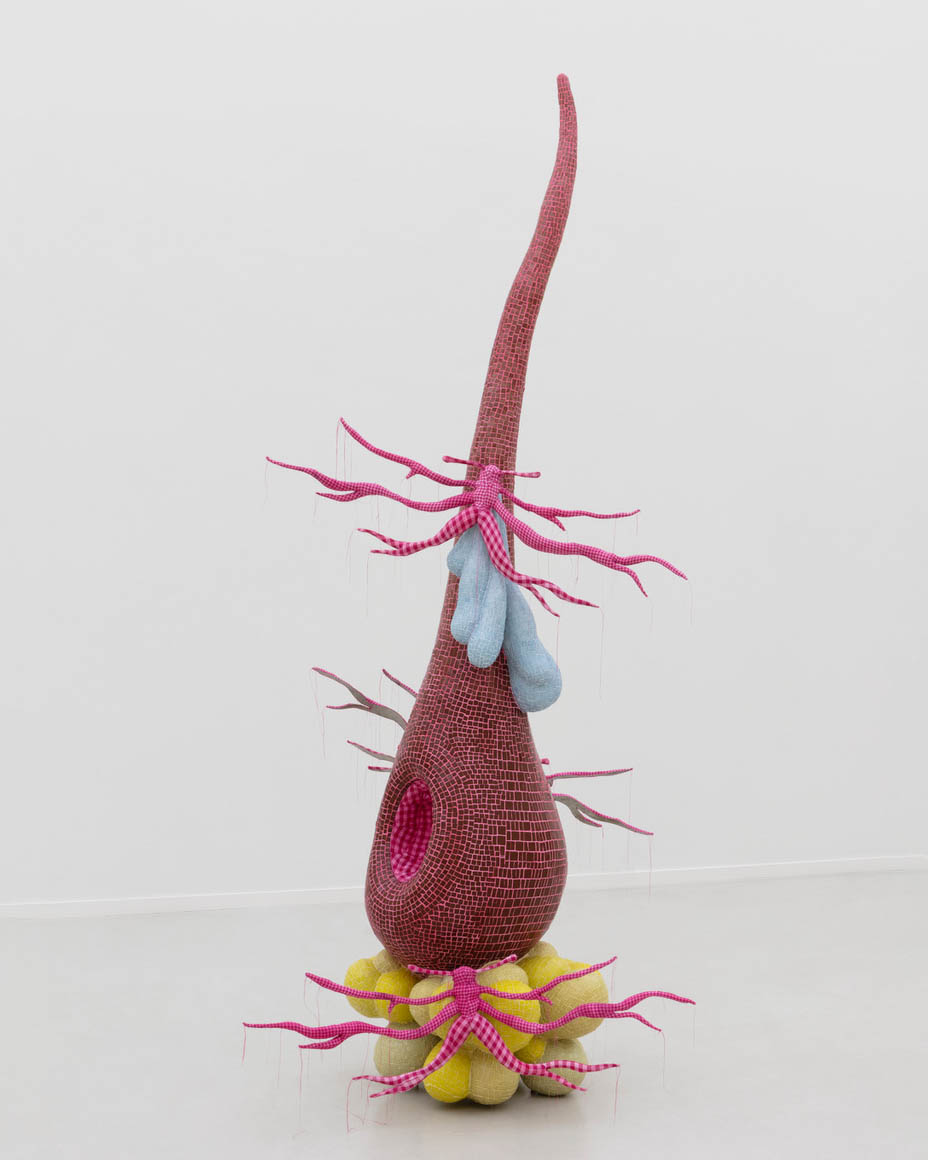
Many of your figures appear both vulnerable and resilient at the same time. They seem to be struggling, yet they persevere. This internal tension is highlighted and intensified by the fact that, while your sculptures are often soft and organic in form, their mosaic surfaces are rigid, hard, and durable. Do you consciously explore this tension? What role does the tension between surface and form play in your work?
Yes, this is a tension that consciously recurs in my work. I have long been interested in states that cannot be described by simple pairs of opposites. I do not view fragility and resilience as mutually exclusive qualities. Often, the very things that appear fragile at first glance turn out to be the strongest. Mosaic is particularly interesting to me because it embodies many of these contradictions. From a distance, it appears to be a uniform and solid surface, but up close, it is composed of tiny pieces, with cracks, gaps, and joints. I have always been drawn to the idea that many separate elements create a unified whole. As I place each mosaic piece, I must pay attention simultaneously to the individual elements and to the unified image they create. In a sense, the pieces must adapt to one another to coexist. In recent years, with the introduction of textiles, this tension has intensified further. Alongside the cold, hard, and durable surface of the mosaic, a softer, more fragile material has emerged that behaves in a completely different way. I am interested in how these two qualities can coexist, and how they are capable of mutually shaping each other’s meaning.
How did you first come to work with mosaics?
A few years ago, when I first began working with mosaic techniques, a friend’s mother was making flower pots decorated with broken pieces of tile. I was captivated by the idea that something new and cohesive could emerge from debris and remnants. Later, for similar reasons, I was also moved by the story of Raymond Isidore, who spent decades covering his own house inside and out with mosaics. The relationship between fragmentation and unity, the whole created from many small details, and the duality of fragility and resilience are the questions that particularly interest me.
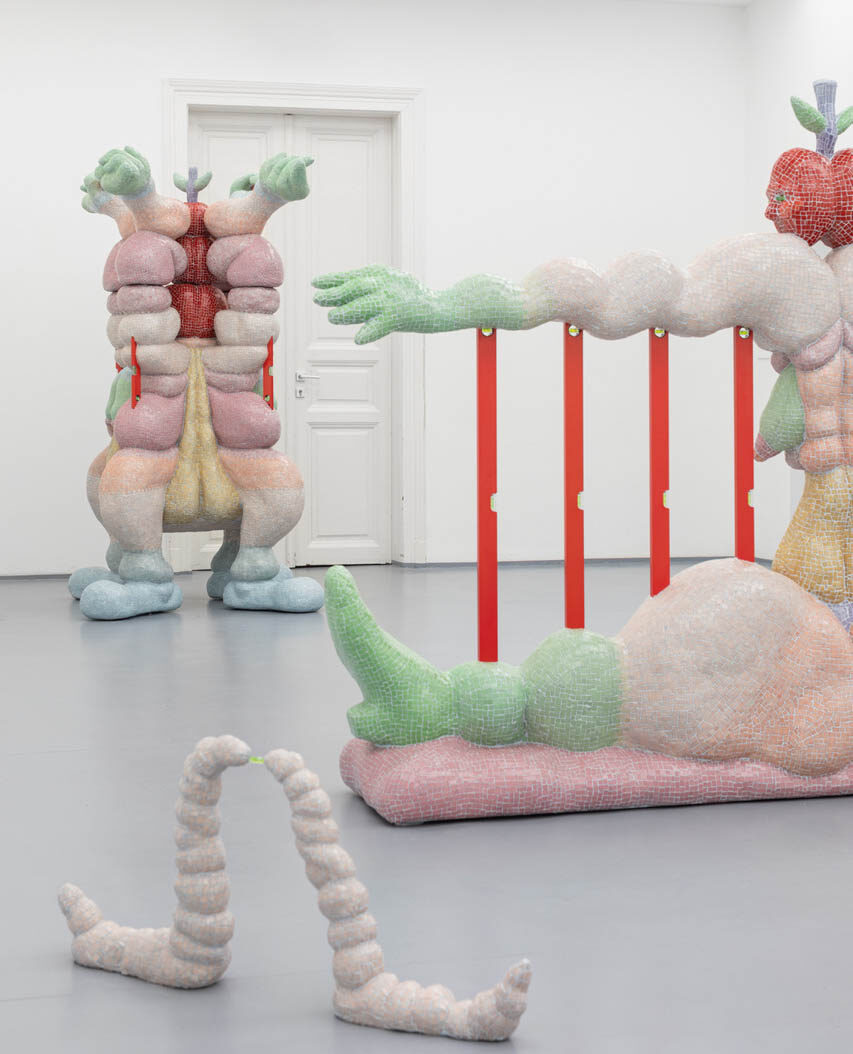
Historically, mosaics were usually composed of irregularly shaped pieces of colored stone and glass, whereas you work with industrially cut, regular-shaped pieces. Is this contrast between the handcrafted mosaic surface and the industrial materials intentional?
I am partly conscious of this tension, though the factory-made form of the mosaic elements mustn’t remain unchanged. During the work process, I break them into smaller pieces, so I am essentially intervening in the original system, disrupting and transforming it. This is precisely what interests me: how a rigid system begins to adapt to something organic and becomes something personal and unique. When I intervene in these systems and begin to break, distort, or rearrange their elements, the material gradually loses its industrial neutrality. It begins to carry a certain human quality, becomes vulnerable, adapts, strains, and connects to other elements. I’m not interested in their industrial perfection, but in how they can be dislodged from their own logic.
In recent years, fruits, especially apples, have become a recurring element in your work. The apple carries numerous symbolic meanings, ranging from temptation and knowledge to fertility and transformation. What first drew you to this motif?
One of my exhibitions was titled In Ethylene Arms, and at the time, I was interested in how living beings interact with one another, how one body or presence can bring about change in another. Ethylene is a plant hormone that plays a role in ripening processes. I was looking for a fruit that emits this gas in significant quantities and thus affects its environment: fruits nearby ripen faster. This kind of invisible interaction was very close to what was on my mind at the time. That is how I came across the apple. It is at once very ordinary yet carries a wealth of associations. In my work, however, I am primarily interested not in its classical symbolic meanings, but in the idea of how one body can influence another, how different entities shape one another without this always being visible.
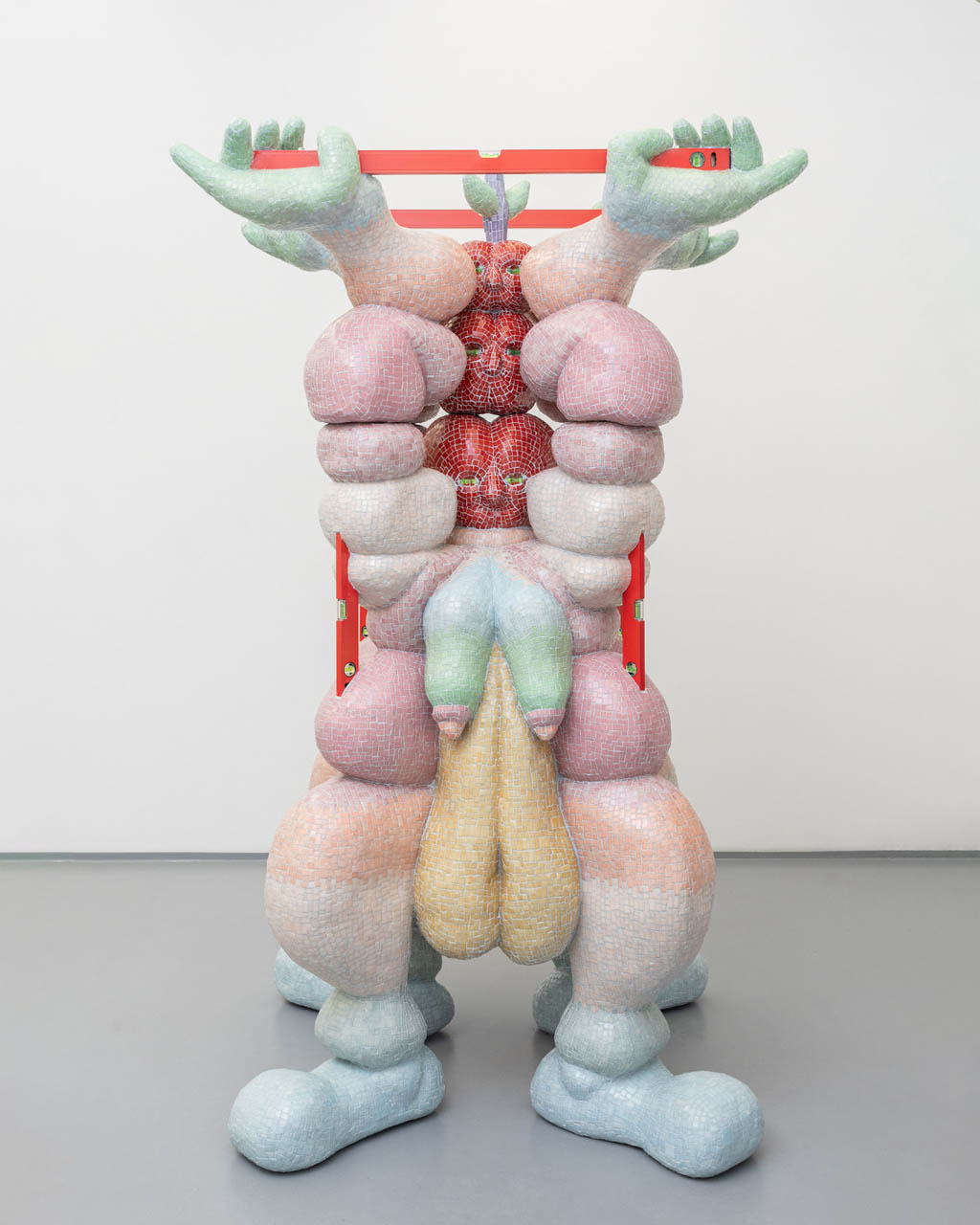
How has growing up and working in Hungary shaped your artistic language? Are there specific aspects of Hungarian visual culture, folklore, or collective memory that are present in your work?
If there is an aspect of Hungarian visual culture or collective experience that has influenced me, perhaps it is the mindset that treats repair, adaptation, reinterpretation, and creative survival as natural phenomena. I often think of my grandfather, who built their summer house with his own hands. This is likely the source of my fascination with improvisation, upcycling, and the unexpected combination of different materials. The memory of my grandmother’s patchwork is a similar experience for me. I find them exciting not only visually, but also because they embody care, attention, and ingenuity all at once. There is something very human about them: they don’t seek to hide the damage, but to live with it and add a new layer to it.
This approach is likely linked to the fact that, in my earlier works, I often worked with found and discarded materials. I have always been drawn to the possibility that an object or material’s story does not end with its use, but continues in another form. A broader cultural experience is also that one must start with the available materials and possibilities, and that scarcity is not necessarily an obstacle, but often a source of creative solutions.
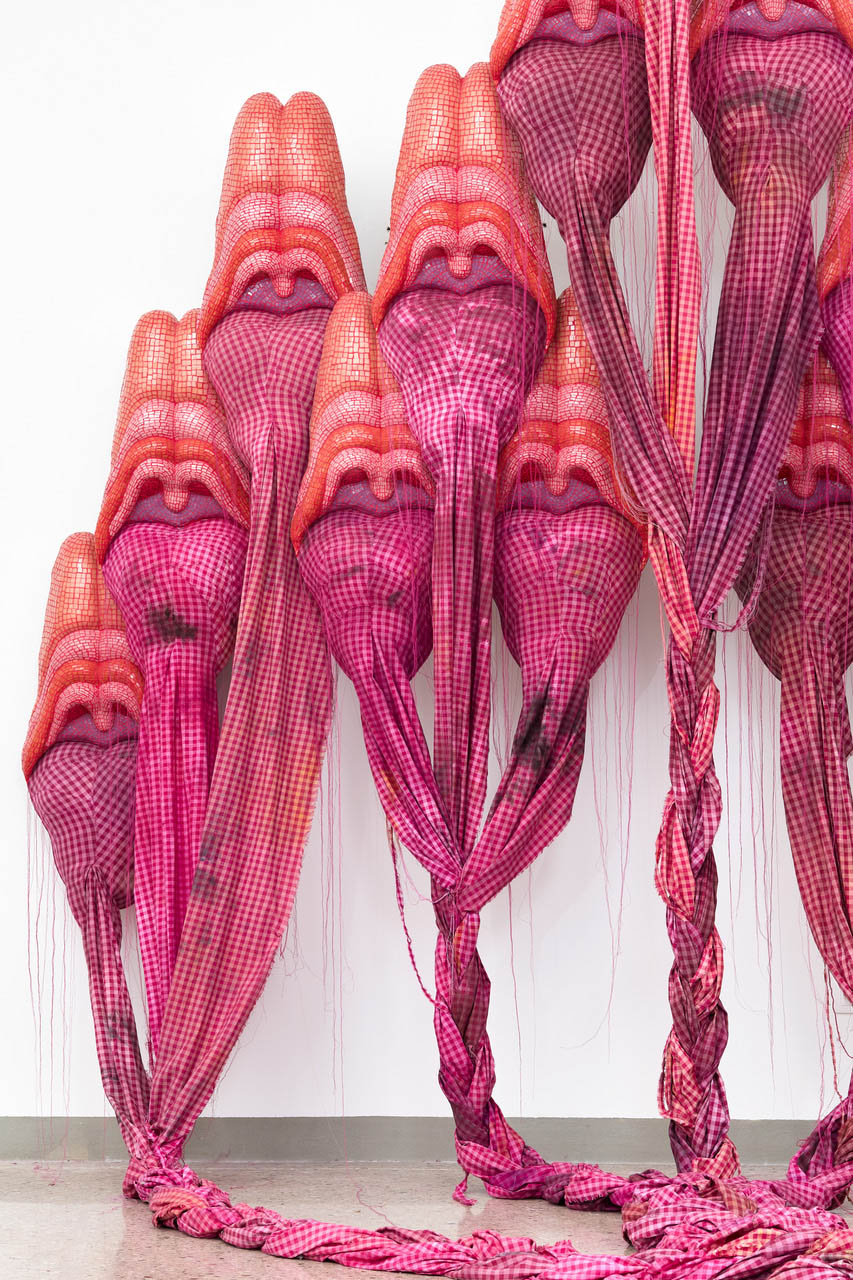
You mentioned that becoming a mother changed your relationship to time and work. Looking back, do you see any connection between that experience and your increasing interest in interdependence and collective forms, such as the family-tree structure of Mother Tongue II?
That’s interesting, I’ve never put it that way before. I’ve noticed that ever since I’ve had a child, I’ve been observing myself: how I handle certain situations. I often see my parents in myself. My grandmother has been knitting since she was 7 and was always “fiddling” with things. I notice the same gestures in my daughter. My grandmother told me a lot about her life and our family’s history; we looked at old photos together. I’m an introverted type, which is perhaps why I’m interested in interdependence and seeking connection so much in my work. At the same time, while previously I wanted to influence every step of the process, now there are elements – such as textile fragments – whose development I leave to chance. Perhaps this also stems from motherhood and letting go of control.
Art Basel Unlimited
June 18–21, 2026
Address and contact:
Messe Basel
Messeplatz 10, 4058 Basel
www.artbasel.com
Zsófia Keresztes – www.zsofiakeresztes.studio, www.instagram.com/zsofiakeresztes/
Zsófia Keresztes (b. 1985, Budapest) is a Hungarian artist whose mosaic-covered sculptures explore transformation, interdependence, and the relationship between individual and collective identities. She represented Hungary at the Venice Biennale in 2022 and, in 2026, became the first Hungarian artist to present work in Art Basel Unlimited. She lives and works in Budapest.