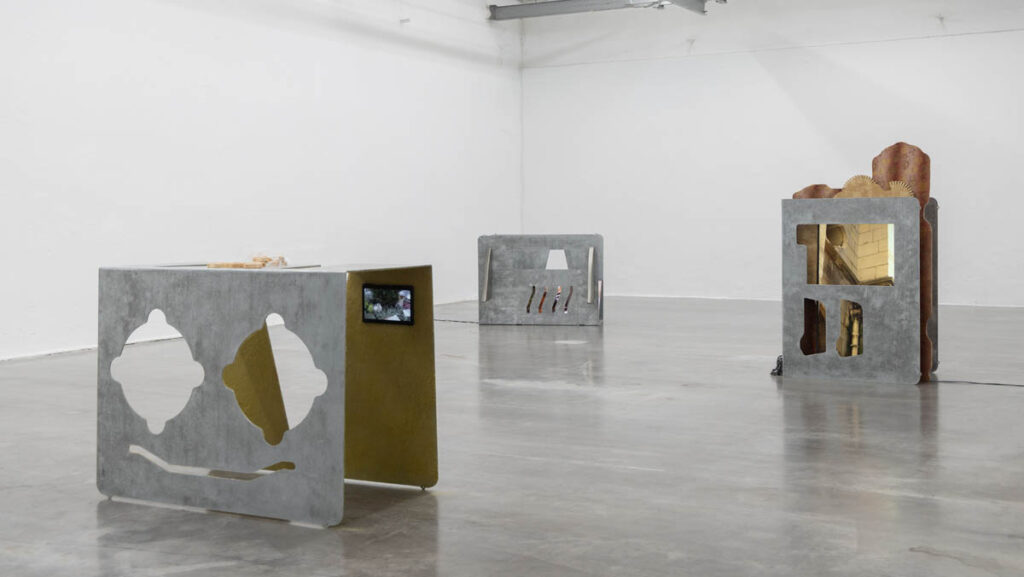
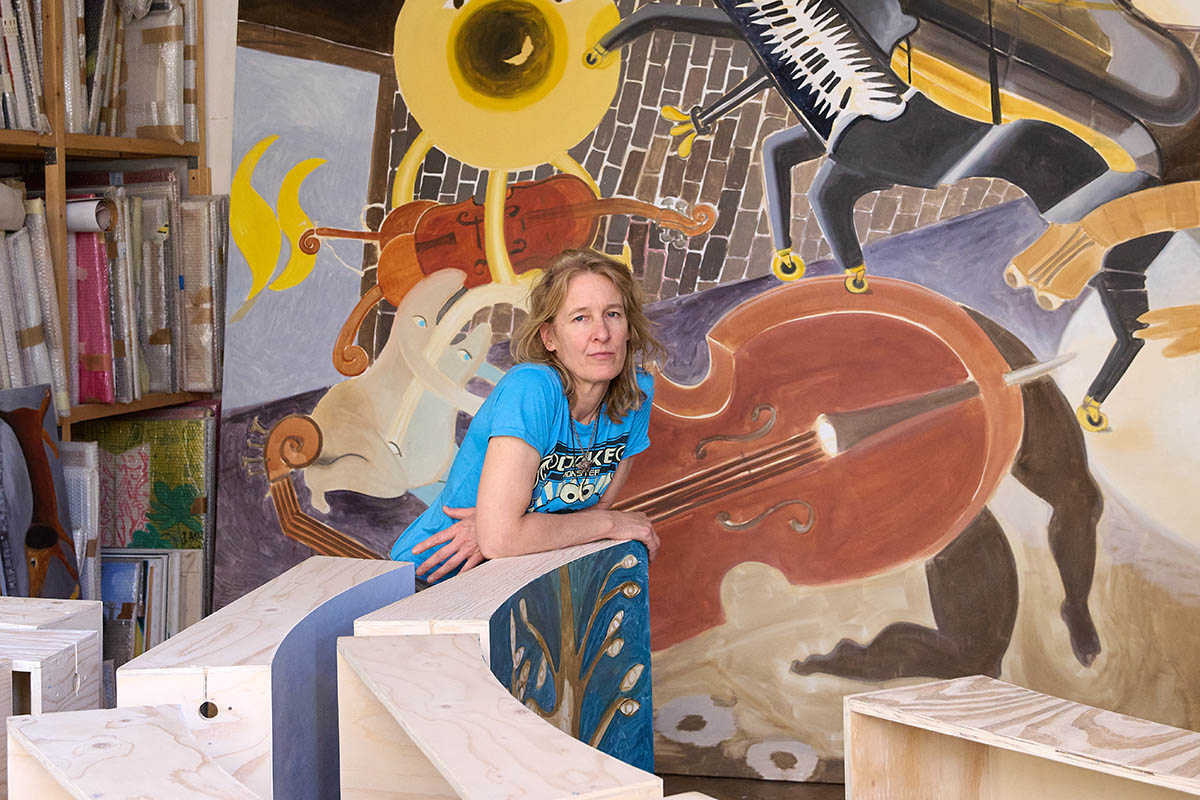
We could say that the solo exhibition “Painting Reality in Surreal Times” at the Lentos Art Museum is indeed a mid-career exhibition, showing the progress you’ve made over the years as an artist. You have already established a practice, but it is still evolving because you work on it every day. It’s a good moment to look back and forward. You were born in Germany and then moved to Austria. You also completed a bachelor’s in social work before studying at the Academy in Vienna. How did that experience influence your practice?
After I finished school, I wanted to get away. I had an agreement with my father; I had to sign it- I would study after I came back from my travels. So I decided to study at Social Academy. After “signing,” I went traveling for a year in America with a friend, in a car and a tent. We went all over the place. This experience impressed me; it shaped me in many ways. I was eighteen. We faked our IDs to get into bars and concerts. It was fantastic. And people were so friendly to us; we were dirty and hungry, and they took us in. We were sleeping in cars and tents. I have a very good impression of American people from that trip. Then I came back, and I was working at the psychiatric institution in Vienna; I did a voluntary year there. And then afterward I started studying regularly at the Social Academy in Vienna.
At the Social Academy, I was working with drug addicts and drug-addicted prostitutes in Rotterdam, Netherlands, and I had the chance to experience different layers of society. I found out that I’m more of an observer; I’m curious, and I want to understand things. I don’t think I would have been a good social worker professionally; it’s sad what you sometimes see, and you have to be strong for that. But this strong interest in people and in topics that concern people stayed with me. During social studies, I saw that my main interest goes into art. I remember I was living in a squat at the time, and I painted figures with big heads on the walls.
So even at the very beginning, you had the urge to leave a mark somehow, and I get the feeling you weren’t interested in the institutional context. What was your first contact with an art institution or a professional who works in one?
Even when I was studying at the Academy of Fine Arts in Vienna, talking about art in this institutional context was unusual. The idea of a curator was quite new back then. I remember an important curator came by once to the academy, but none of us cared. It’s changed a lot since then; now young artists know it’s important to meet curators to be aware of all the layers of the art world. We were not aware of it.
My friends and I, we never ran after anybody, I have to say.
Which is great. I think as long as you have that freedom, not depending on anyone, it’s the best time. Then you can do what you, as an artist, want to do — not what people expect you to do.
Exactly, it’s so essential in the beginning that you don’t have someone in your head- some curator, some gallery- not thinking about who’s coming to look at the works, but about the works themselves.
The Academy has a stable structure, the studio rhythm, your crew there, the everyday essentials, what happened after you finished. Did you immediately get a studio?
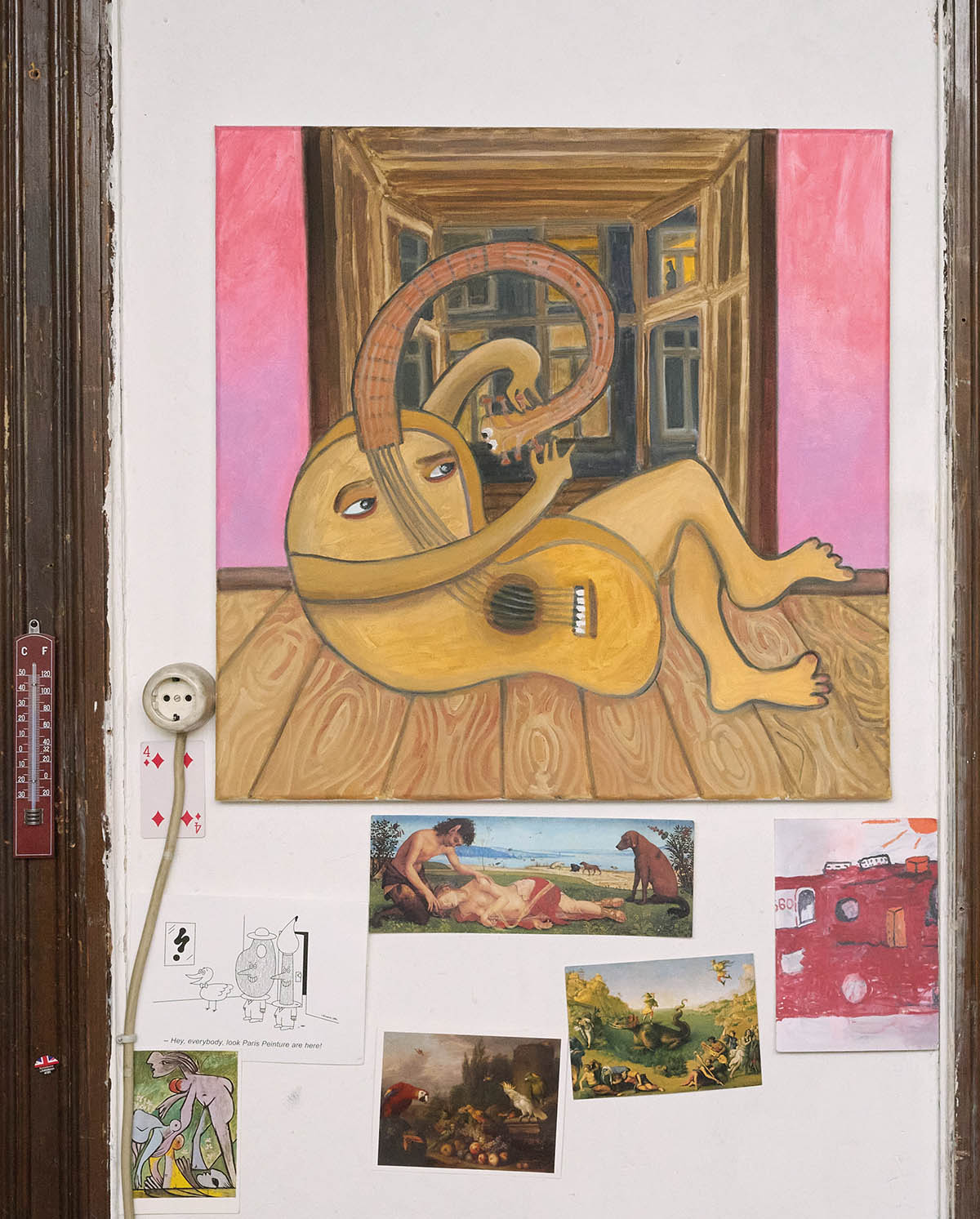
A friend rented an old flat, and we all moved in there together, each with our studio room. We had cheap studio space next to the Vienna Beltway (Gürtel). I was lucky. At that time, I’d been working different jobs in Vienna, which was awful. But I needed to pay for two spaces; it was a lot of pressure, especially for young artists who don’t come from wealth. Then I got a state grant that changed things; I could work on my art practice.
What was your reaction? Did you think, „Okay, from today I’m not working a day job anymore; I’m focusing on my art career“?
During my studies at the Art Academy, I worked night shifts at an overnight accommodation for released prisoners, playing poker with the guys; there were women as well. The main difference was that I was so glad about the grant that I didn’t have to work the night shift anymore. I was in the studio a lot: painting, painting, and painting. I was lucky because, quite early on, I put together some portfolios and approached galleries. Everyone said, “Don’t do it,” but I did it anyway, and I ended up being represented by a gallery.
Do you think your experience has influenced how you approach your students?
I don’t want to judge too much. I want to get them painting so that they feel good in the studio, that they have good friendships with their colleagues, that they like being there, that they learn how to work continuously without somebody having to push them.
My students have to learn how to find out who they are themselves. There’s no formula. They come and go; they’re there for six, seven years, and then they leave. I see it with my colleagues now, some are still busy with art, some ended up doing other things. But those bonds, those friendships you make while studying, are so important. I still have colleagues I talk about art with, who I support and who support me, and that foundation really comes from that time of studying.
The exhibition in Lentos Kunstmuseum Linz opens in September 2026. How long before the exhibition did you start working on it?
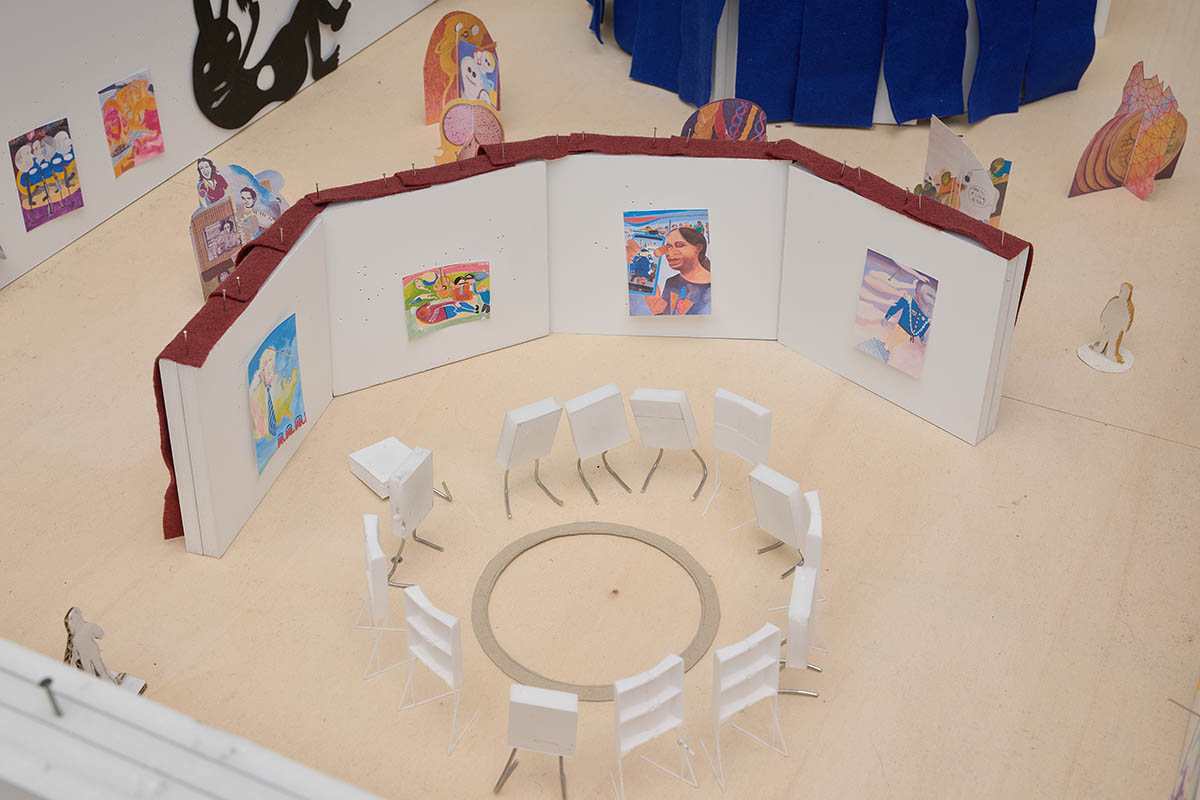
In spring 2025, I got to know about it. I started immediately by building a model and started thinking about what I wanted to show. It’s a new situation for me to make a show about the last fifteen years of work. To bring so many works together. Quite quickly, Hemma Schmutz, who curated the show, and I decided that it’s going to be mostly about painting. We put the focus on painting, even though I’ve also been making other objects over the course of time.
What is the oldest work, and what is the most recent one?
The most recent works were made shortly before the opening of the exhibition. And I guess the oldest is from 2008.
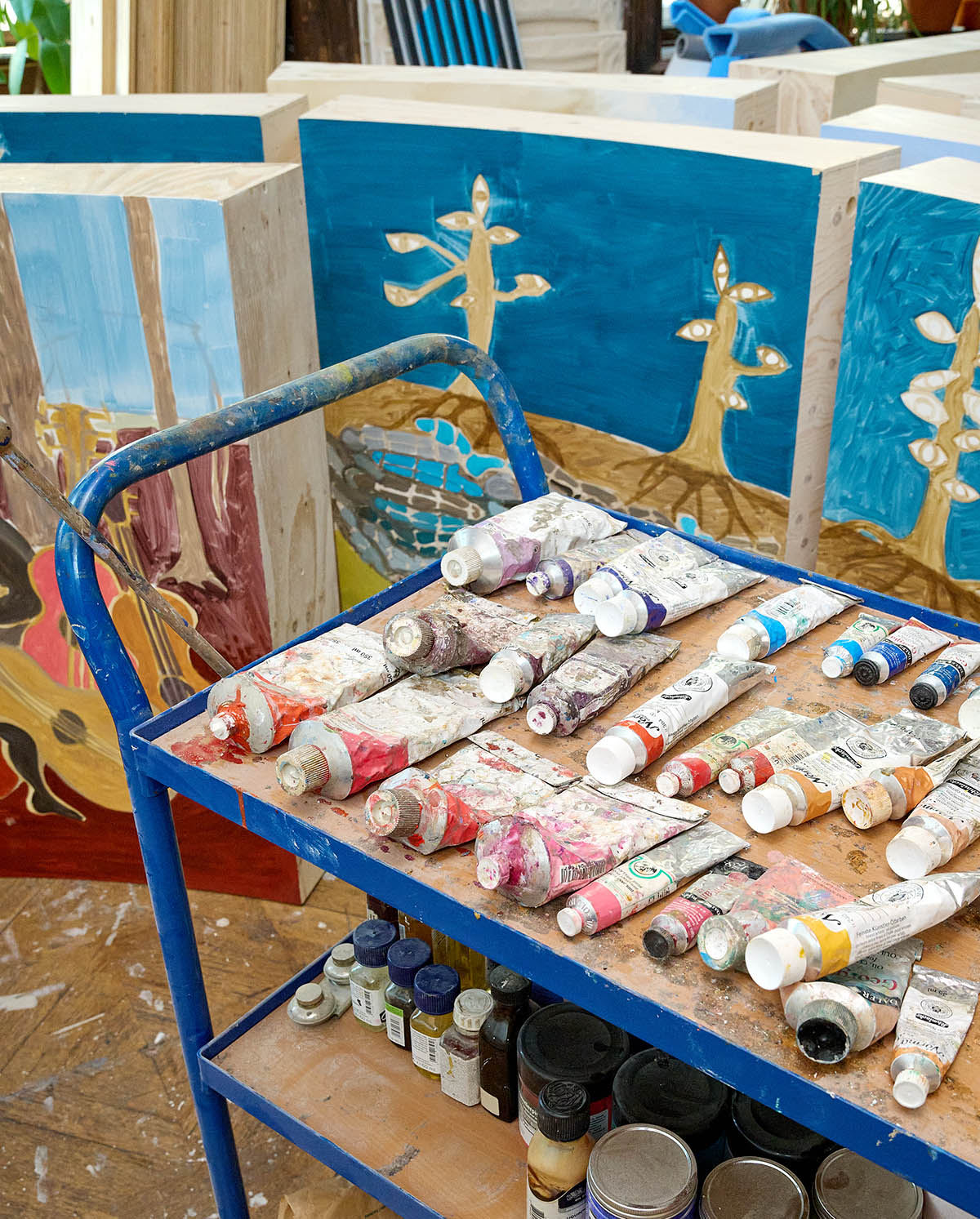
Being in your studio for the first time, I feel like you’re a very practical, hands-on artist. When you have an idea, how do you collect it?
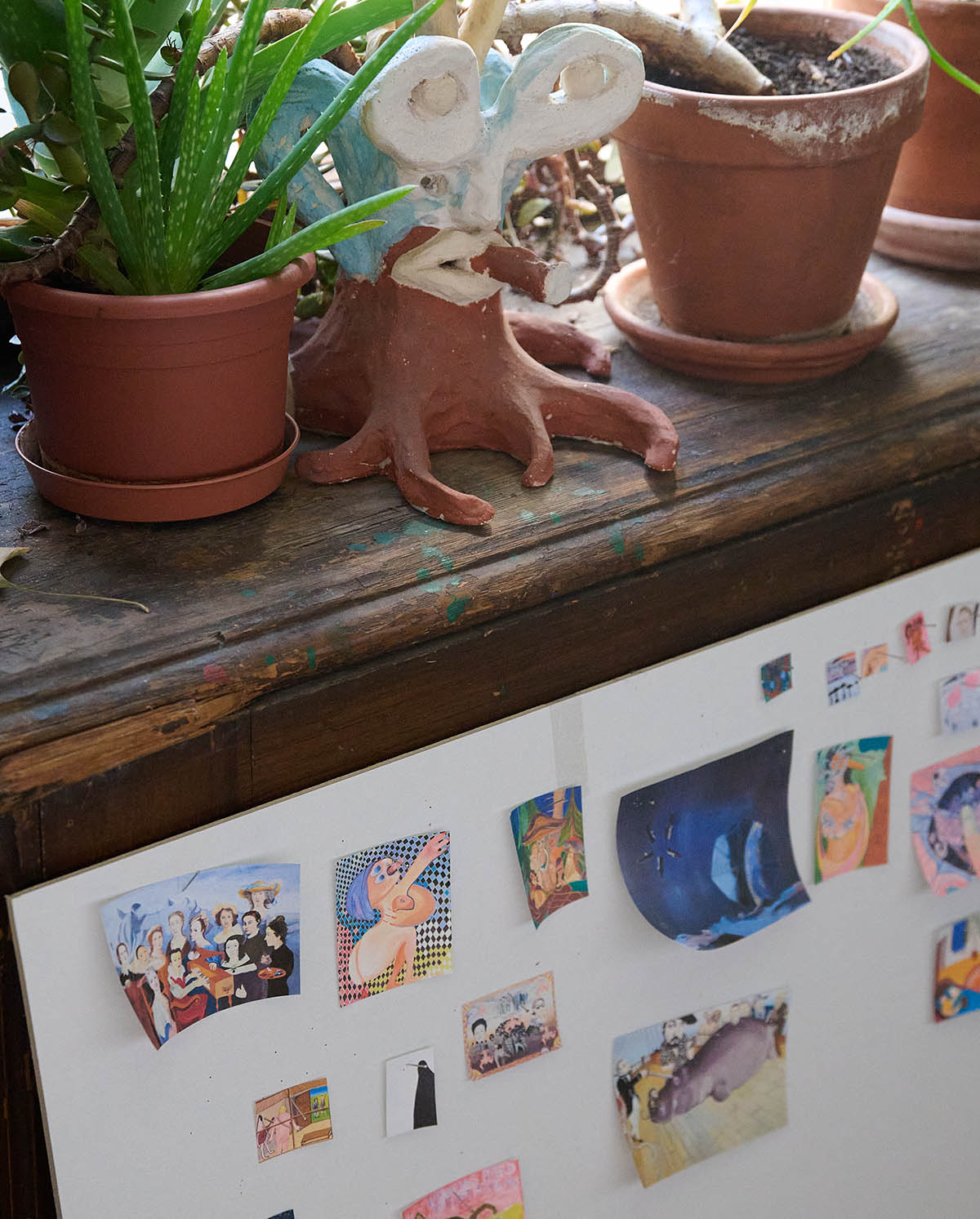
I have a sketchbook. When I started working on this exhibition, the war was present in the media. I thought I wanted to talk about war, about brutalism. I thought brutalism in the context taken from architecture could be a good angle, so as in the architectural sense, but maybe also as a new kind of realism. Is it because our reality is so brutal? Wherever you look now, into digital spaces or into reality itself… But then it felt too sad to make the show only about the war, so I looked at the paintings I had and wanted to make, and I tried to divide them into categories.
I have these chapters now, also in the catalog. One of them is titled „Die GEISTer Welt“ (The Ghost World), about the invisible: digital spaces, social media, death, and also surveillance, which is a big part of it. So that’s the „ghost world“… and probably also the end of our lives, the lifespan we have, which incredibly rich people mostly don’t want to accept. The second chapter is about patriarchy, and everything opposed to patriarchy. I see patriarchy as a reason for the war too. Then there’s another chapter, „The Argument Is Violence.“ This one is about the end of communication, where it becomes hitting, shooting, raping, the method of war, the blackmailing through violence in this world leading to war, and how that runs through this world.
So you think that men can free themselves from the oppressive forms of „being strong“ and all the baggage that comes with being a man?
I think women did that already; now I think men should do it too. Free them from these harsh forms they’re expected to fit into, which come with many awful things attached.
You’re right, women did so much to free themselves from that submissive position, to figure out what they actually want. But the gender gap is still there?
It’s still there. It’s massive. The gender gap in Austria and Germany is still large. I believe that in societies where men and women earn the same, the economy performs better because a much larger proportion of the population contributes to the gross national product than just 50 percent. It is also evident that economies where men and women earn the same are wealthier. This must be in the country’s interest, as it makes the country richer, and it must also be in the government’s interest, particularly regarding pensions and so on.
You are working through the philosophical or economic thread. It all seems connected — you have main themes, but nothing in your work seems separate.
All these technological developments, like gigantic server farms or nationwide satellite networks. They lead to a horrible outcome: a hotter planet, but it seems mostly rich men who got a lot out of it. And then they have no endpoint to what they want, no limit on how much money is „enough“; they lose contact with reality. Just wanting power and money. Did you ever think about why that is?
I think it must be connected to the complex of “lack of something”. You mentioned there are a few islands in the exhibition, places where people can sit and spend time together and with the works. Do you think dialogue between people will open while looking at your work?
Maybe, hopefully. If the seating is comfortable, if it’s not one person sitting alone, why not? Like on a train, if not everyone’s got headphones on. Might be people will take the time to look.
Paintings can be quick and slow at the same time, somehow. It often takes a long time to look at paintings, but to take in the content and to respond,can happen rather quick.
How important is it to you that the audience knows the titles of the works?
Important; sometimes the title is what starts a painting in my process. Sometimes the title raises new questions for the viewer.
Sometimes the title fits perfectly; sometimes it’s more descriptive, but it always adds something to the understanding.
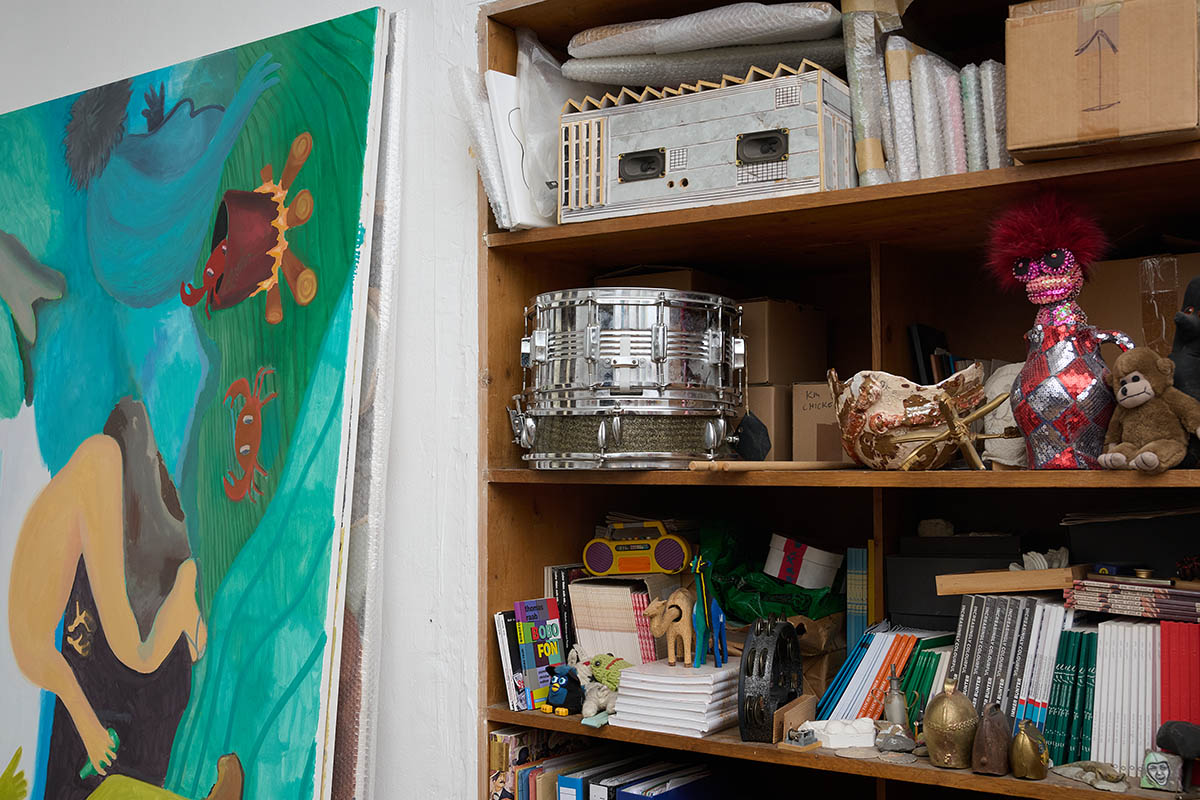
Yes, I write lyrics for our band called Kinky Muppet. For the catalogue that accompanies my solo exhibition, I wrote four short poems, one for each chapter. I hope they add up and aren’t too confusing. They’re quite open, experimental — not too descriptive, more of an open entry point into each chapter.
The chapter: „Die Demo Crazy Weld“ with a soft „d,“ because democracy is at stake, right? It gets difficult when people stop voting, when the legitimacy of democracy isn’t there anymore, because if less than 50% of the population even shows up at elections, then it’s a real question whether voting still works.
I had an exhibition in Stanley Picker Gallery in London, and I read this book “Against Elections: The Case for Democracy“ by David Van Reybrouck h. He wrote about a new system in which citizens will be selected by lot to represent public sentiment and translate it into law as an alternative to voting, as we know it.
How does it work?
There’s a group where anyone can bring in topics; they get collected, and then a smaller group works through them to shape them into potential laws. The group is diverse, so you get a baker, someone from university, a worker off the street, men, women, different kinds of people — and they vote on the topics. It’s an interesting system, and it’s already used in some places: city councils, organizations. You get picked at random from the population, and one day you get a letter, and you’re asked to show up and give your opinion.
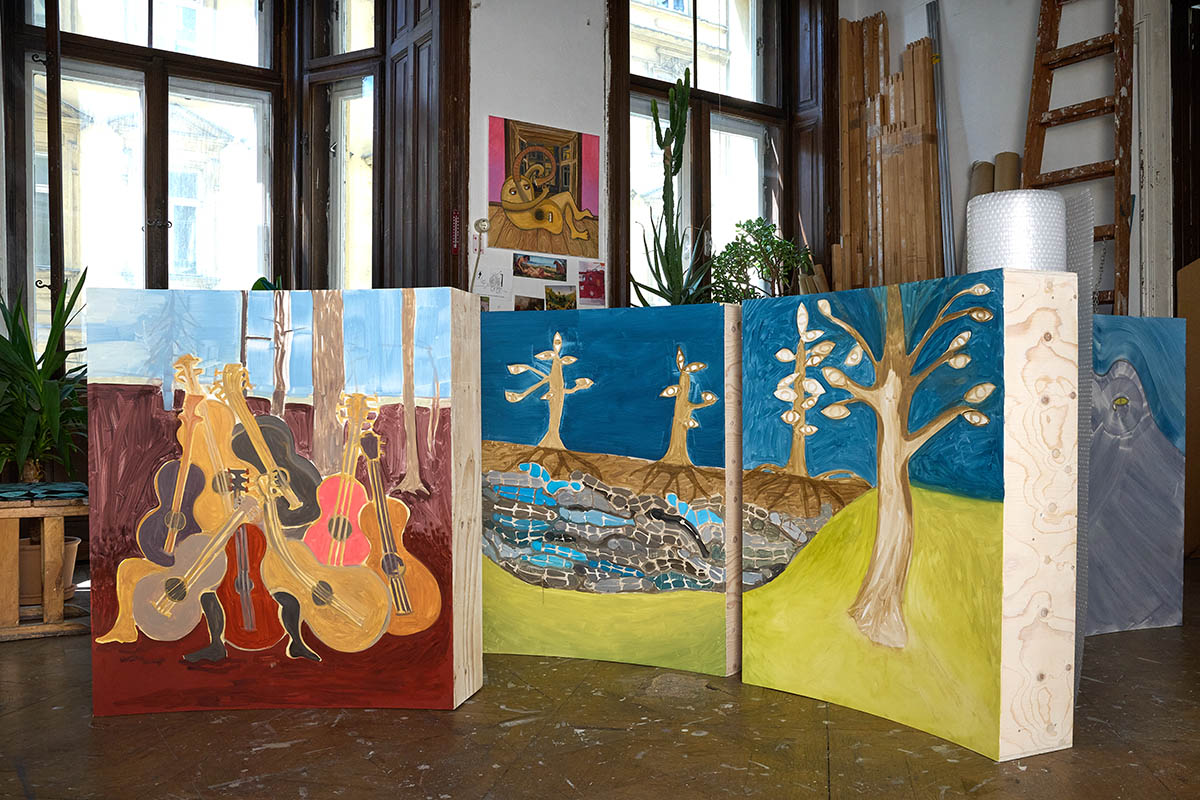
There are many works in the exhibition, and they feel like sequences from one film. Everything feels connected to that thread.
It shouldn’t be a riddle or a mystery; it should be down to earth. The world is complex. I would rather not overstate that, but it has many facets and connections between one chapter and another; all of them pop up within each other. That’s why I see it the way you do, like a scene that’s part of something bigger. Maybe I’m wrong. If you’re talking about democracy, you have people actively working against it; these kinds of people who aren’t interested in democracy because it’s inconvenient for them. Women’s voices, for instance, aren’t interesting to them either. They use surveillance, the „ghost world“, to consolidate power. So it’s all connected.
A lot of your work is also humorous, sometimes dark, sometimes more upbeat. Would you say humor is a way of coping with restriction, or is it something else for you?
Coping with what restrictions? [laughs] I think you’re right, though. You can jump around, share ambiguous things through humor, and it can help you cope with things that are very dark and sad. That doesn’t mean I don’t take things seriously; one doesn’t exclude the other. Having a witty or comical approach doesn’t mean it’s simple. I hope the jokes aren’t too shallow.
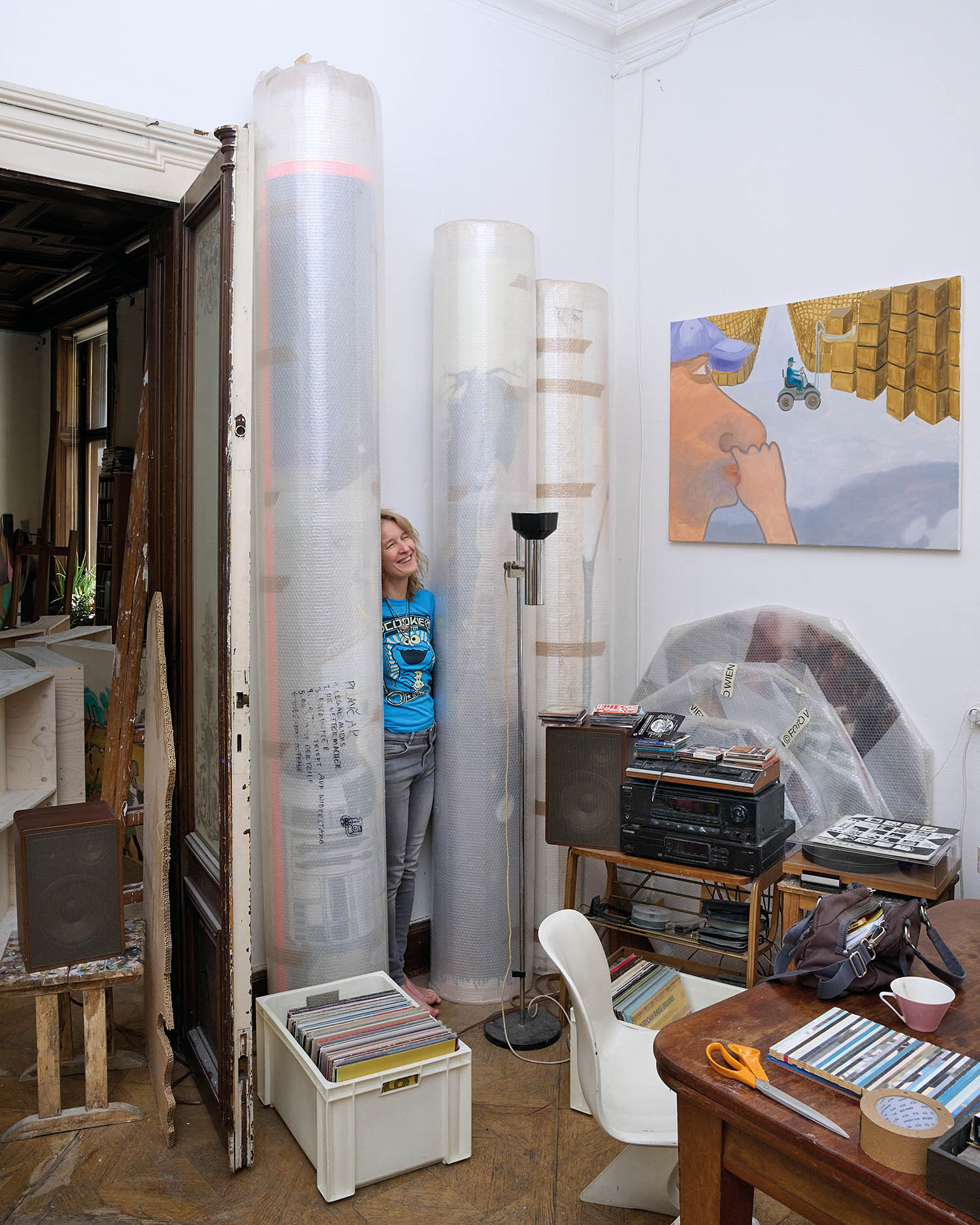
It’s interesting what makes us laugh as humans; it takes a certain amount of context, of information, to find something funny. Education is key in that sense.
I also like color, funny forms, and funny sounds, like in music; abstract things can be funny. A weird instrument sound- why is that funny? It’s quick, it’s surprising, and it triggers something in us. It’s funny because we’re embarrassed; shame is connected to both „bad“ and genuinely funny things. It can be a way in, an easy starting point.
Last question: is punk dead?
NO!
Exhibition: Katrin Plavčak. Painting Reality in Surreal Times
Exhibition duration: 18. September 2026 – 10 January 2027
Opening hours: Tue–Sun: 10 AM–6 PM; Thu: 10 AM–8 PM; Mon: Closed
Address and contact:
Lentos Kunstmuseum Linz
Ernst-Koref-Promenade 1, 4020 Linz
www.lentos.at
Katrin Plavčak – www.katrinplavcak.net, www.instagram.com/katrinplavcak
Upcoming events such as guided tours, talks, … can be found here: www.lentos.at
Katrin Plavčak (born 1970) is an Austrian artist who returned to live in Vienna in 2017 after 16 years in Berlin. She studied painting under Sue Williams and Wolfgang Hollegha at the Academy of Fine Arts Vienna, and also completed the Sozialakademie in Vienna. Beyond painting and sculpture, she is also active in music. Since 2000, she has had numerous exhibitions in Austria and abroad, along with extended stays and study residencies in Mozambique, Sichuan, Chengdu, and New York. She played in the indie rock bands Blendwerk (Vienna) and Erste Stufe Haifisch (Berlin), both of which released several records. She also runs the duo M.O.G. (Mothers of God) together with Ulrika Segerberg, in which they improvise using sewing machines fitted with contact microphones and loopers. Since winter 2017, she has also been part of the trio „Kinky Muppet.“ From 2012 to 2014, she was part of the feminist artists‘ collective ff, and together with Caro Bittermann and Claudia Zweifel, she built the online archive The History of Painting, a growing archive documenting women painters throughout art history. Since October 2022, she has been a professor of painting and drawing at the abk – Staatliche Akademie der Bildenden Künste Stuttgart (State Academy of Fine Arts Stuttgart).