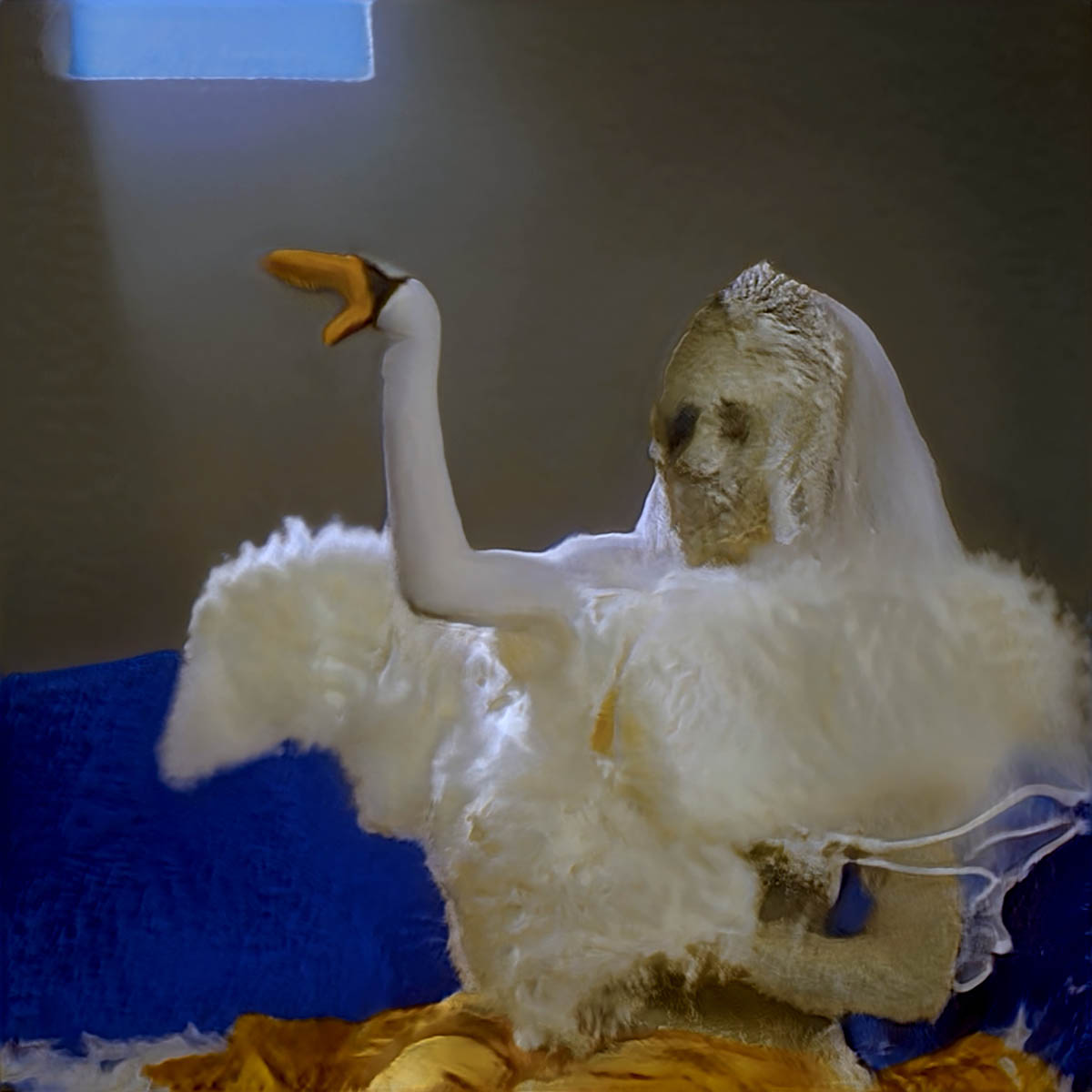
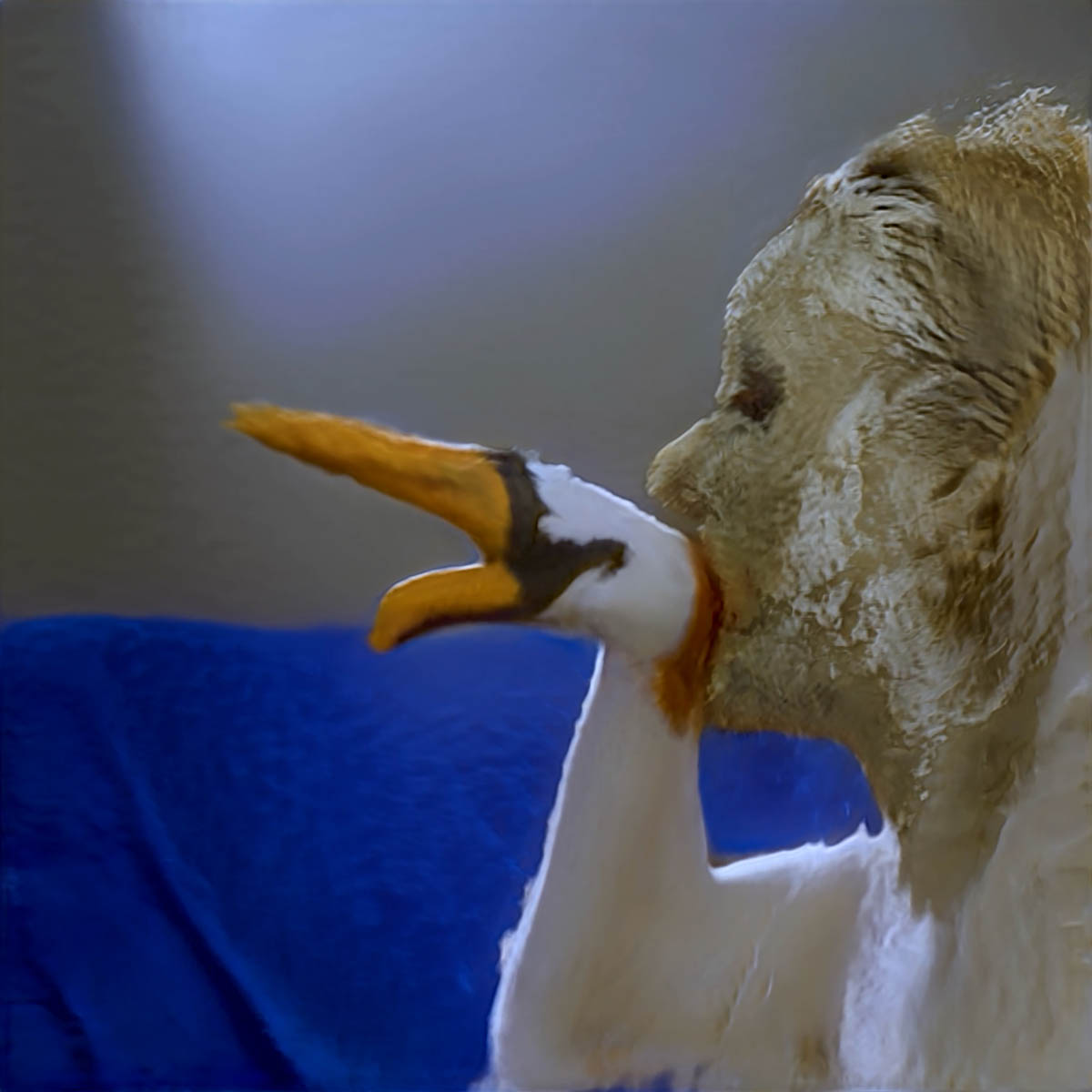
Let’s talk about fashion as a way of expressing identity. Watching your video work, Leda Was a Swan (2025), I had the feeling there must have been a very deep consideration of makeup, costume, and the whole construction and representation of the creature behind it.
For Leda Was a Swan (2025), the costume was derived from a fresco of Leda and the Swan discovered in Pompeii in 2018. I borrowed elements of the mise-en-scène: costume, fabric, drapery, feathers, and textures. For larger-scale films, I collaborate closely with costume designers to build a cohesive world. For instance, in WINNER (2024), I wanted a hooligan gang to insinuate cockfighting, so we designed red sweaters with sharp, plunging necklines that subtly echo the shape of a bird’s beak. The devil is always in the details.
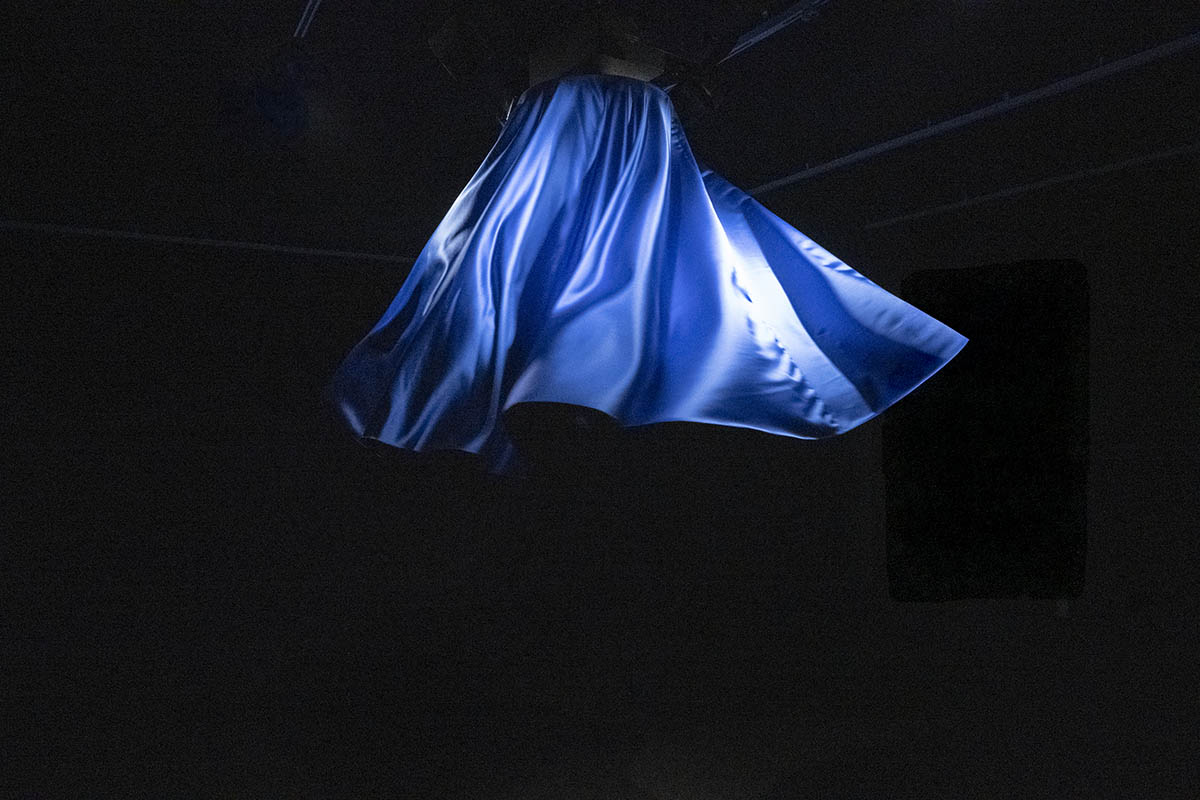
Catherine Wheel (2026) is a motorised spinning skirt, synchronised to the sound of my tortured laughter upon being tickled for four hours. The full-circle skirt first emerged in the post-war period, when fabric rationing was lifted, allowing for greater volume and excess. Suddenly, there was more material to work with, which shaped the silhouette. These historical and material contexts matter to me. The circle skirt was also inspired by the Balkan skirt, the “fustanella”, an ancient costume symbolising strength and courage historically worn by warriors, including men.
I think of fashion as a way of expressing identity. When I perform, I wear different costumes to enter different personas. I’m interested in a fluid understanding of identity, something that can shift depending on mood or context. Even as a kid, I would constantly change my hair colour, makeup, and overall look. People often didn’t recognise me from one day to the next. So fluidity isn’t just in the work: it’s also how I live.
Is there still a surprise effect you want to create in people?
When I was a teenager, I would dress up as a bearded man or an old lady, paint wrinkles on myself, and create alter egos. Then I’d go out into the street to see what would happen. One time, the police came because they thought I was an old lady being harassed, but it was a performance. In my twenties, I shaved my hair off after becoming sick of the male gaze. I like to play with social interactions and toy with behavioural expectations. How one dresses or enters a room can make a big impact.
Also on view now in the Vienna Secession is the work Faint with Light (2016). For this work, you made yourself faint four consecutive times through hyperventilation before a paramedic intervened. It was my first time seeing the work live, and without having known the process you went through, I didn’t understand at first, as it has so much to do with a durational aspect of it. It was mostly for me about this stage, a scene that was naturally opening in the space; it was challenging for the viewer, with both light and sound. It was about staying in an uncomfortable situation and playing with the border of “too muchness“.
It’s a tricky piece because it wants to be many things. It doesn’t quite fit into distinct categories of sculpture, installation, moving image, light, sound, and performance. It embodies many different genres, while it’s composed of very simple materials. It’s both full and empty of narrative because it comes from an impetus of war, trauma, silence, and fainting as a type of survival (my Croatian-Jewish grandfather fainted as he was supposed to be shot, which saved his life). Faint with Light (2016) is about close empathy, the inability to reach someone else’s trauma, and the inability to reach someone else’s happiness, even. The inability to get to another person’s state. And so, by the attempt to faint and collapse and to disappear from the world for a tiny period, and then to return again and again. This is a work about attempts, but not resolutions. The breathing highlights the absence of self, inspired by my grandfather’s Holocaust experience: unbearable, blinding, and linked to transgenerational trauma, which is the deep base of my art practice.
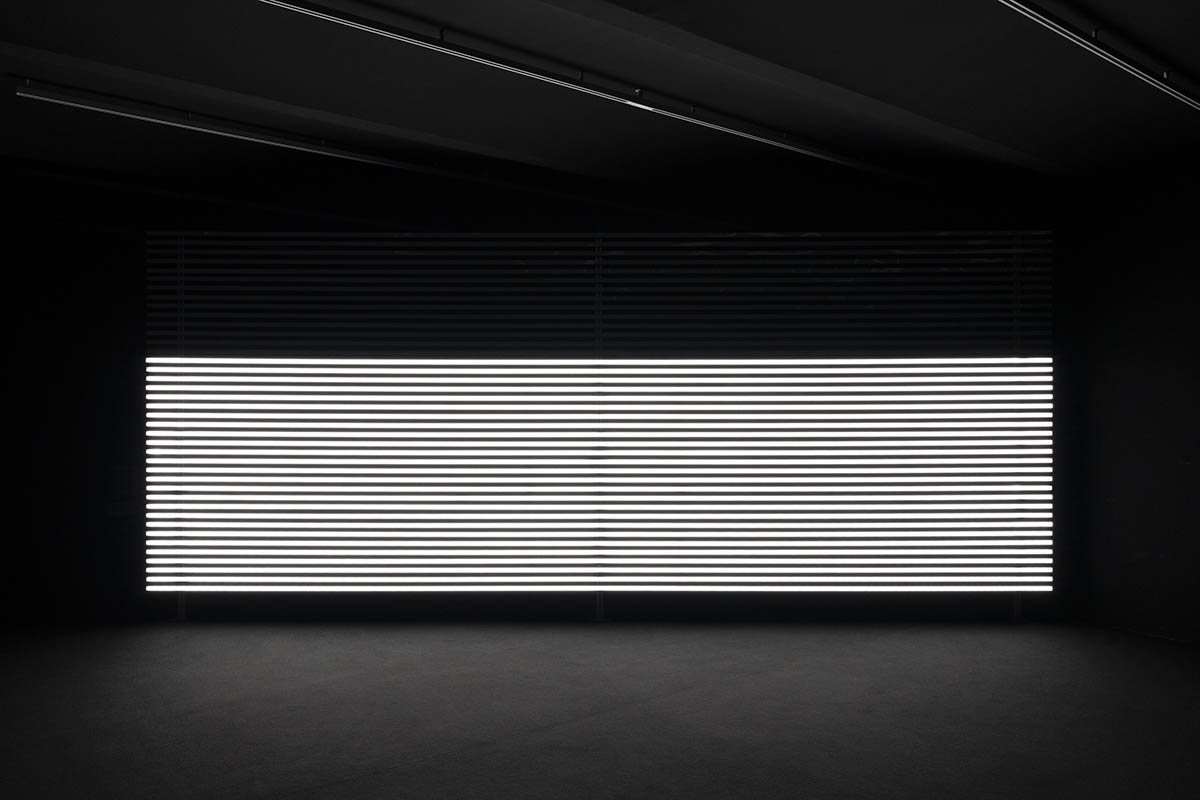
It is also a documentation of a performance; I fainted four times in a row, and each of the fainting episodes is characteristically different. They sound different; they feel different. Some are more anxious, some have sharper breaths, some of them pass out for longer than others, and some of them come back very quickly. It’s a very raw piece. There’s no trickery; what you hear is exactly what happened in real time, save for the moments in which my medic took my blood pressure between each episode.
I feel there is a moment of agony that is happening in between the works in the exhibition Circus; as a spectator, you are not sure what those things are staged with. Who is actually laughing? Who is actually breathing in the sound installations?
I’m not a truth-teller. My job is to make a public experience, not to present reality. And whatever it takes to get there is okay. I also think that there are deliberately high stakes that are a vital ingredient in order to achieve the work I want to make. If you listen to the work, there is a sound produced when I’m unconscious. I don’t think this sound could be easily faked. It’s such a deep, penetrating noise that I wasn’t even aware of at the time because I had blacked out.
The book Dodo Margarine, written by Camilla Grudova and illustrated by you, is a publication that follows Circus in Secession. What’s your connection to Camilla? What does the process of development look like? Someone could say it’s an unusual publication.
I was tired of traditional catalogues that literally describe the show and equally fed up with pseudo-fictional, pretentious press releases. Thinking about the Secession’s tradition of publications, I thought of hijacking the format and turning the catalogue into a complete book—a story—and making it a fourth artwork. The tone of the show is harsh — cold, mechanical, industrial, and minimal, with motors, lights, bars, and sound. So I wanted to create a palette that was a respite, something you could take away, still containing the mood and atmosphere of the show but in a gentler, more literary tone. Camilla is a writer I admire. She’s written collections like The Doll’s Alphabet (2017) and The Coiled Serpent (2023). I was given her name by a friend. I was talking about Circus: its themes of gallows humour, bleakness, and something connoting a bleak past or a frightening future. I told Camilla about the show while it was in process: themes around urine, laughter, tickling, and fainting. She wrote a story, and I responded with illustrations: it was a ping-pong process. I didn’t direct or dictate. It was her story with my illustrations, no strings attached. People do their best work when there is no one watching over them. As a kid, I’d make elaborate drawings for people. I didn’t even know it was “art” yet. Now it’s a central medium in my practice. They are familiar and vital, and they also support the running of my studio.
Drawing is immediate. Images don’t lie. If I’m vulnerable, they show my vulnerability. If I’m strong, they convey my strength. I can’t hide behind them.
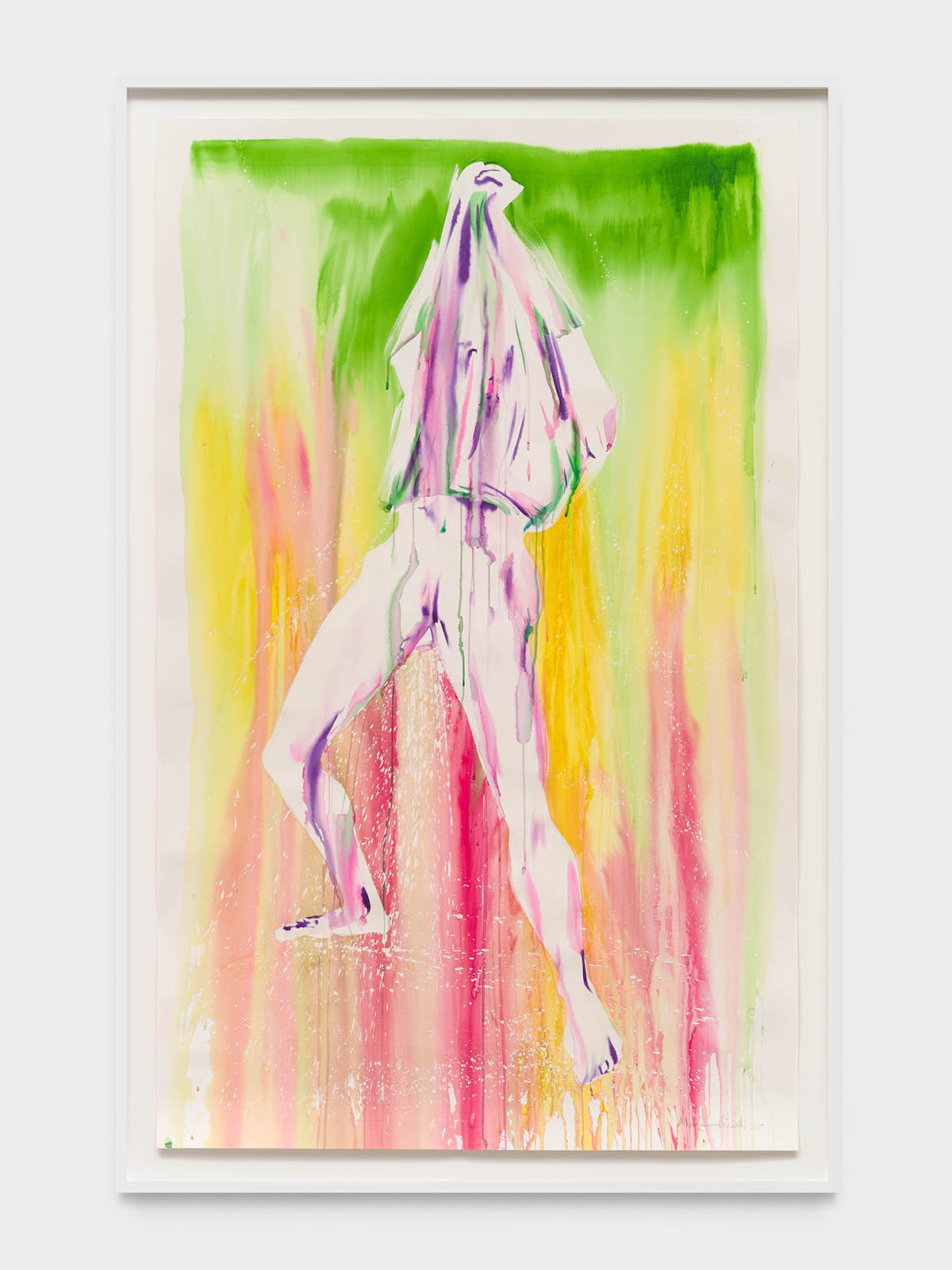
Photo: Trevor Good
Knowledge has never been more available to everyone. I feel that when we witness art today, we immediately try to find the reference to something we have already seen and to relate it to something that we already know. There is so much information coming to us non-stop that I feel this is our mechanism of “understanding”. Speaking of references; My reading of the work Catherine Wheel (2026) made me think of it as a symbiosis between the work Shimmering (2024), a kinetic sculpture by Liliane Lijn, and the audio installation D’Io (1971) by Gino de Dominicis. This audio installation of the artist laughing was unexpected because I ran into it when visiting a museum show. Would you say your works sometimes reference art history? Also, when it comes to your work, Fountain (2026), there is a clear reference to the Fountain (1917) by Duchamp. Am I right?
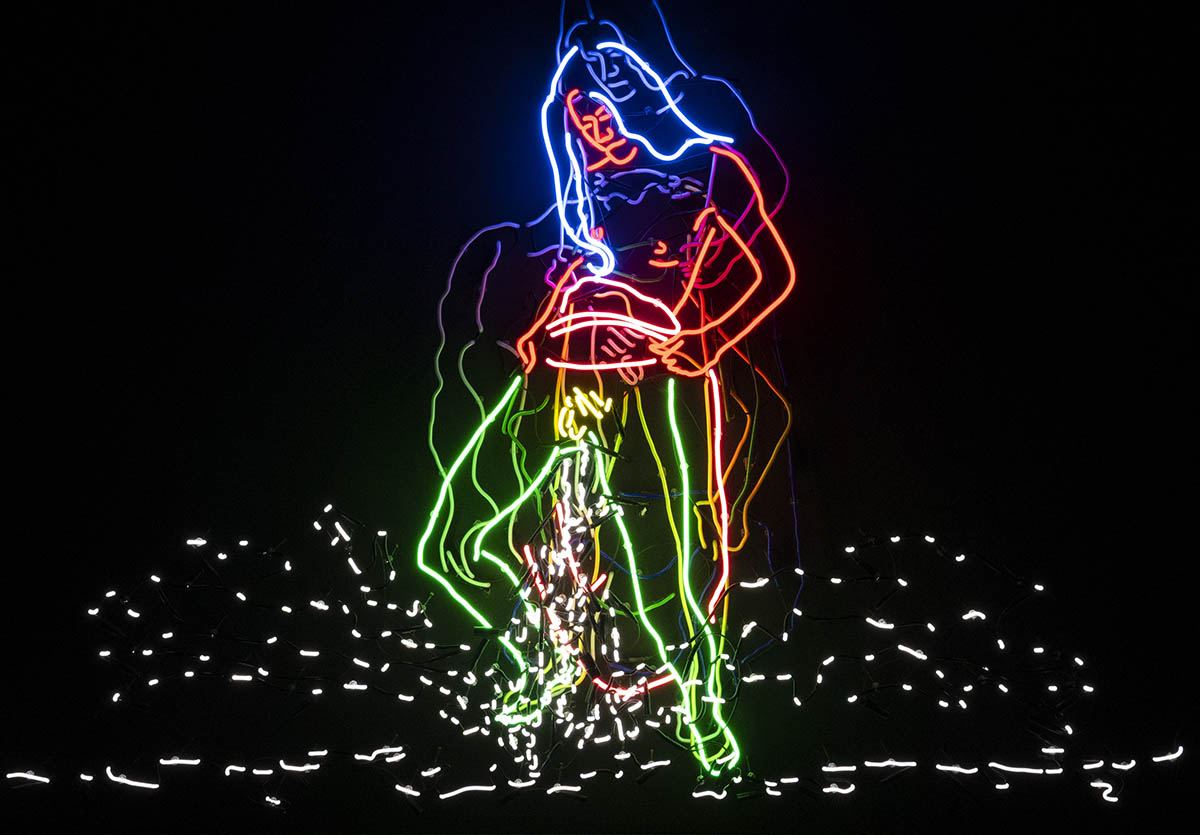
The symbiosis you described is uncannily accurate, but there was no direct influence. I was, however, gently paying homage to Marcel Duchamp and Bruce Nauman whilst twisting their work through my own lens. After Duchamp’s Fountain (1917), Nauman did a self-portrait as a fountain, a photograph of himself with water jetting from his mouth.
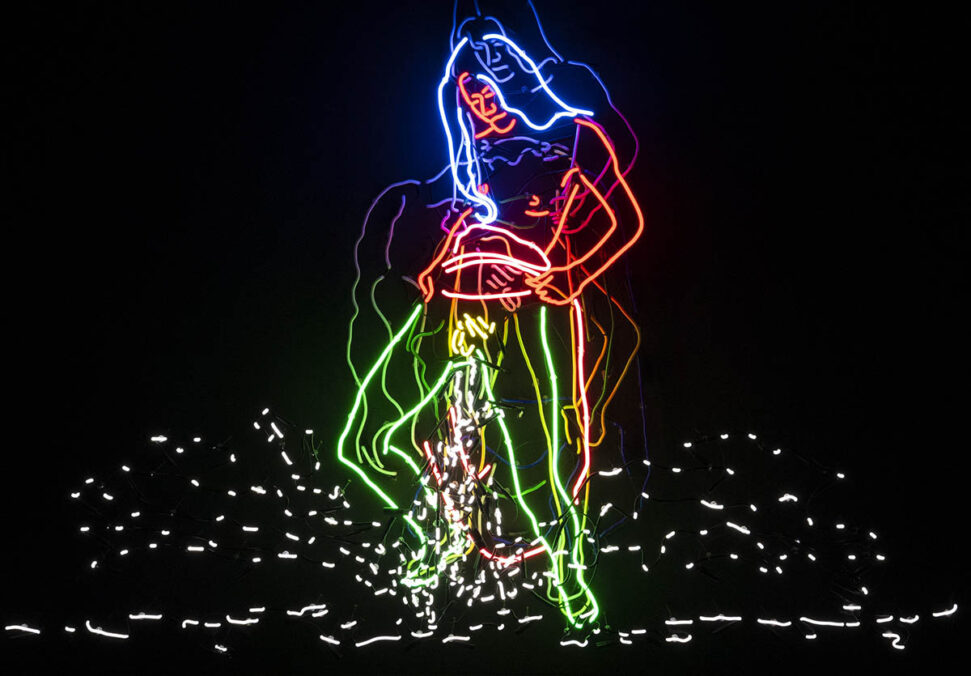
There is a lot of fountain-esque imagery produced by male artists, often with an ejaculatory connotation. So I wanted to have my own jet of urine coming from a female body, using industrial materials, and calling it „Fountain“.
Courtesy of the artist and Société, Berlin. Photo: Sophie Pölzl
It was a provocation of art history. I tend to obsess over an idea and exhaust it across multiple works. I have also produced a series of watercolour “piss portraits”, euphoric images of urinating women. I use opportunities to expand horizons. I also wanted Circus to feel extremely distilled, very much in contrast to some of my other, more baroque, narrative-driven exhibitions with denser content.
Would you say the Headless show in the Max Ernst Museum Brühl (Rheinland) is the “baroque” one?
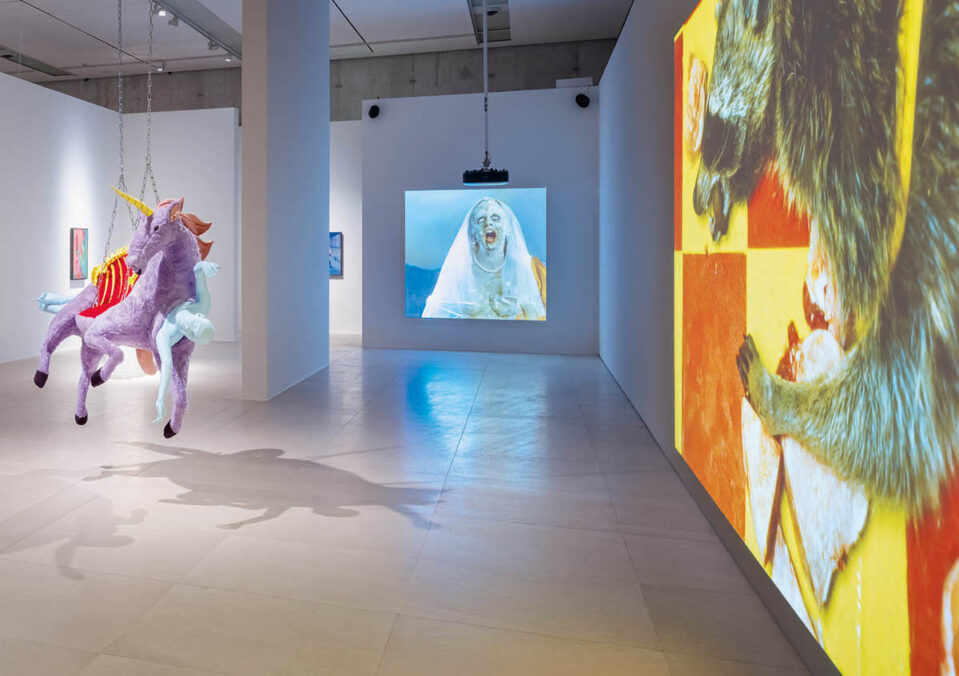
Yes, Headless was conceived in relation to Surrealism—myth, fairy tale, narrative, ornate sculptures, reliquaries, and crowns. It still deals with similar themes around power, control, and the body. But by now, I’m much more interested in avoiding a signature style. I want each show to have its own distinct language. Since the two exhibitions were happening a month apart, I wanted them to feel like twins—one very colourful and vivid; the other almost monochromatic.
Do you speak any languages besides English?
I have spoken Croatian since birth, but I have never lived there; I would visit every summer as a child to see my family. My mother still travels between the two countries, but I was educated in England, with an additional Yugoslav school every Saturday. This morning, I received an email from my aunt describing what it was like for her in the ’90s. I was so young I don’t remember much, and then the Yugoslav school broke up when Yugoslavia did; everything shattered. Now I’m reading books such as Balkan Ghosts by Robert D. Kaplan and starting to understand the complexity of the atrocities.
This brings us to the beginning of our conversation when you mentioned the inability to get to another person’s state. Would you say you’re highly sensitive and that you have strong empathy for people, nature, objects, and the environment?
Empathy is the attempt to travel into someone or something else’s experience. It can be challenging to get there. I am not always capable, but at best art allows me to reach in and understand other worldviews different from my own.
Marianna Simnett – www.mariannasimnett.com, www.instagram.com/mariannasimnett/