
You already have long experience working in big art institutions. Tell us more about it.
I’ve been working within museums for quite some time. In the Stedelijk Museum here in Amsterdam, I have been a curator for Contemporary Art for almost a year now. Before that, I worked as a senior curator at Kunstmuseum St. Gallen, and I also held a curatorial position at the Frans Hals Museum, Haarlem, here in the Netherlands. In terms of my curatorial practice, I initially focused on the digital: thinking about how the internet transforms the way we make and understand art. I was never interested in the digital purely as a technological domain; I approached it as a cultural sphere: something that is deeply entangled with ideology, infrastructure, and broader societal conditions. From there, I became increasingly interested in the structures that shape art-making itself, particularly institutional frameworks. I worked on projects around institutional critique and began to think more about art as situated within and produced through these systems.
The latest exhibition, ‚Beyond the Manosphere: Masculinities Today‘, responds to what I see as a broader socio-political shift: a rise in fascist, conservative, and authoritarian tendencies. This shift is particularly visible in the realm of gender. There is a strong conservative backlash playing out there, and I think it’s urgent to address it, to resist a regression into more restrictive or oppressive models of gender relations, and to keep sight of the progress that has been made, even if unevenly, over recent years.
Do you see this moment as symptomatic? As something cyclical, like a repetition of history, or would you frame it differently?
I think it’s a convergence of several factors. Economic precarity certainly plays a role. These material conditions are further intensified by our current media apparatus, which amplifies and accelerates certain dynamics. If we shift the focus specifically to masculinity, we can see how these forces manifest in particularly extreme ways—for example, in what is often referred to as the “manosphere.” It is a space where economic, technological, and ideological factors intersect quite visibly. However, in the context of the exhibition, I’m not interested in treating the manosphere as a closed or isolated phenomenon. Instead, I want to examine the broader structures and conditions that produce it, while also moving beyond it to consider alternative forms of masculinity. It alludes to patriarchy as a system, but also to the masculine as something that surrounds us in everyday life: something culturally produced that concerns all of us, regardless of how we identify in terms of gender. It is a condition that operates not only on the level of the visible, but also through patterns and systems that are far more difficult to pin down.
I had a conversation about this recently with colleagues, and we kept coming back to the idea that there is a kind of hidden system structuring things, something so internalized that it’s actually difficult to name or fully articulate. There is currently a lot of discourse, across exhibitions, magazines, and public debate, focused on misogyny.
Initially, I wanted to call the exhibition “Manosphere,” but to take the term literally: if we were to consider masculinity as a sphere, what would we actually see within it? What I wanted to create was a kind of landscape, a way of mapping different aspects of masculinity. It was important for me to remain attentive to the fact that masculinity is not simply “the other,” nor merely a system that can be framed negatively. Rather, I see it as a cultural force—one that is not only embodied by those who identify as men, but also something that circulates more broadly.
As Andrea Long Chu writes, “everyone is female, and everybody hates it”. I found this statement often quite challenging. Then the question becomes: what is the male counterpart? How does it manifest, and what kinds of expectations are attached to it?
That is partly the function of the statement: it operates as a provocation. What interests me is the precise way gender is framed there—not as a biological determination, but as an ontological condition, a way of being in the world. Of course, that idea is not entirely new, but it is articulated in a particularly sharp way, especially in relation to desire. Rather than searching for a direct male counterpart, I’m more interested in how masculinity manifests across different registers. In the exhibition, masculinity is presented both as a system and as a lived experience. It appears as systemic patriarchy—a structure of power embedded in visual traditions, religion, and wider socio-cultural contexts. Simultaneously, it manifests as an everyday condition that shapes the experiences of men, women, and people of diverse gender identities, operating as an object of desire, an aspiration, and a form of constraint.
Masculinity appears not only as fixed identity, but as emotion, aspiration, and desire, something one might strive toward, but also something one might try to escape.
Could you give concrete examples of works in the exhibition that reflect these different layers?
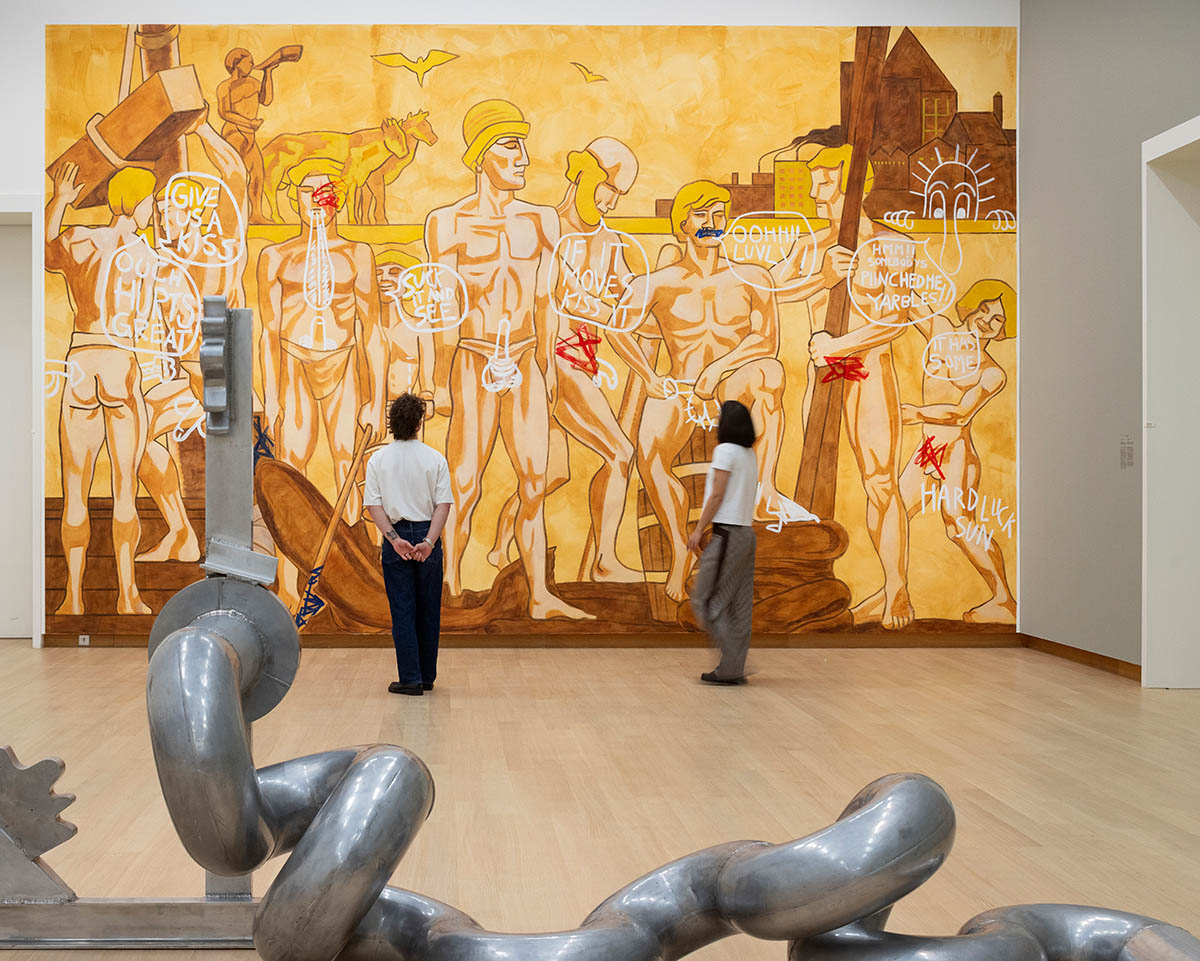
A work that alludes to the ways in which the masculine has been mobilized toward ideological ends through layered visual traditions is Lucy McKenzie’s If It Moves, Kiss It. When entering the exhibition space, visitors encounter, on the right-hand side, a large mural covering almost the entire wall. It is based on an image McKenzie sourced from Stanley Kubrick’s A Clockwork Orange (1971), where it appears within the interior of an apartment complex. The source image used for Kubrick’s set design was itself a mosaic by the Nazi artist Fritz Erler, installed in 1937 at the Reichshauptbank in Berlin.
The mural depicts male figures wearing only loincloths, engaged in physical labor, fishing, and lifting barrels. Rendered in a neoclassical style, the bodies are muscular and idealized, painted in golden and brown tones. It is a clear example of a visual tradition in which the male body is presented as a symbol of power, productivity, and vitality. What McKenzie draws attention to is the way this image was later altered in Kubrick’s film: graffiti is added, speech bubbles appear with phrases such as “Ouch” or “Give me a kiss,” and exaggerated genitalia are drawn over the loincloths. What becomes visible is both the construction of a phallic ideal within art history and its subsequent disruption. The work points to the mechanisms through which masculinity has been visually produced, and to how those constructions have been destabilized.
In the same room, on the opposite wall, there is a painting by the Dutch painter Leo Gestel (Liggend naakt, 1910) from the collection of the Stedelijk Museum. It depicts a reclining female nude, her face covered by her arms, her body fully exposed. The work is a typical example of the female nude as constructed through the male gaze.
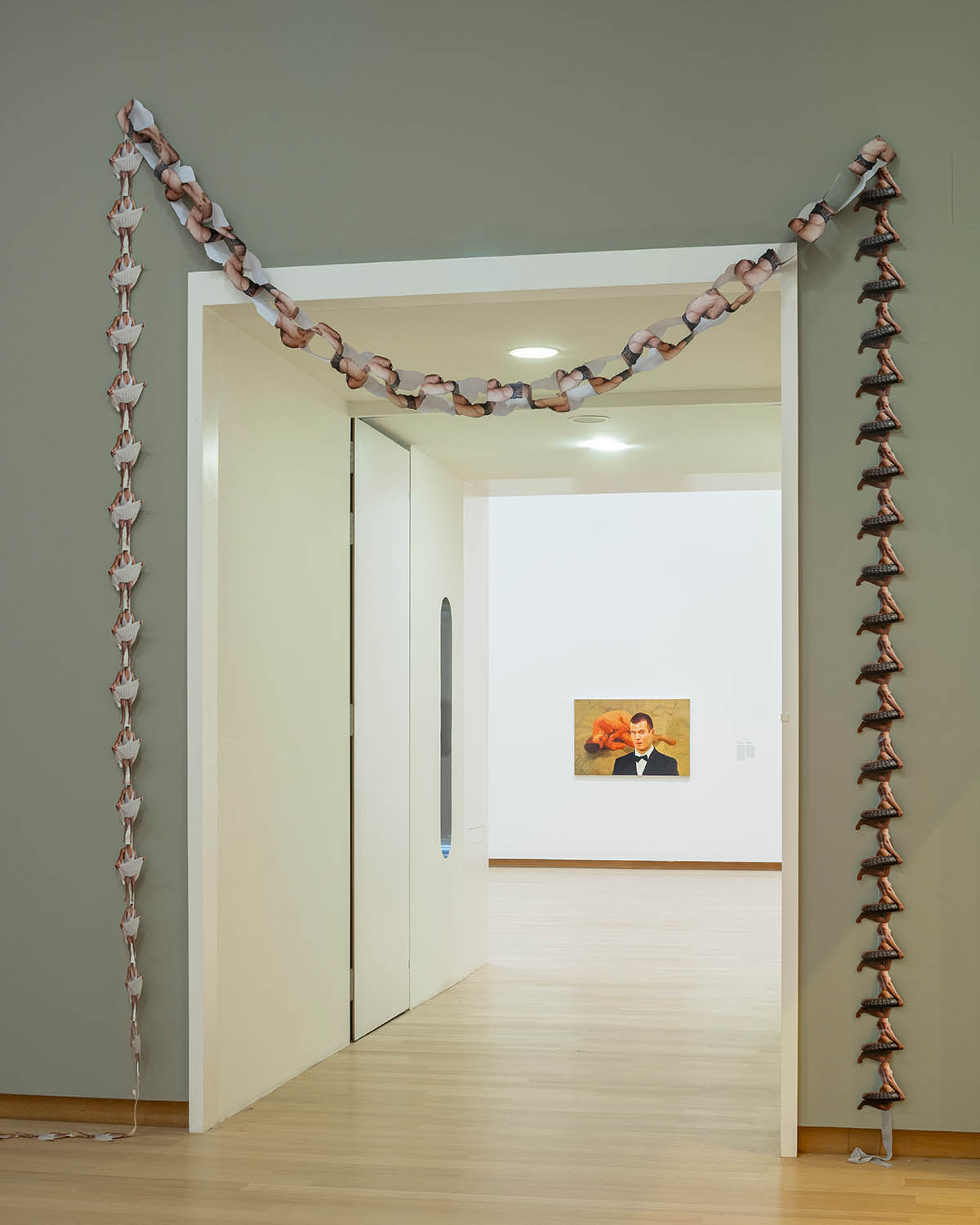
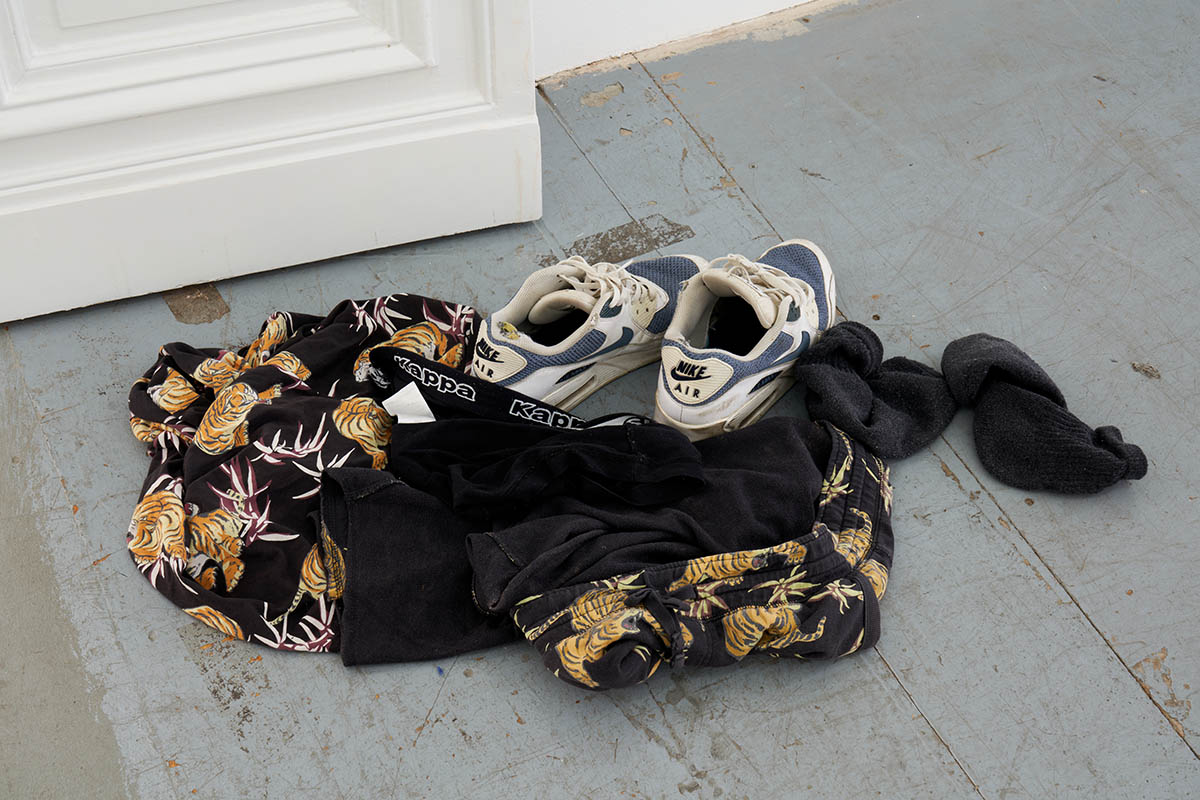
This work was selected by Reba Maybury, an artist who also works as a dominatrix. Her practice engages directly with power, control, and submission, introducing another layer into the exhibition in which masculinity is not only represented but also negotiated, performed, and reversed in different ways. In this particular case, she asked one of her submissives to recreate the Leo Gestel painting using a paint-by-numbers kit. The resulting work is a crude and somewhat clumsy rendering of the original, but that is precisely the point: it comments on the historical depiction of women while simultaneously reversing that dynamic by directing men to produce work for her. Placed in front of the original Gestel painting are garments belonging to her submissives, left on the floor after they undressed at the artist’s command—nudes in their own right. These function as separate elements: two submissives provided garments, while another executed the painted work. Together, these components extend the work into a broader system of relations rather than a single object. This speaks more directly to the systemic dimension of the exhibition. At the same time, these structures inevitably bleed into everyday experience: patriarchy continues to shape daily life in multiple forms, and these layers are not easily separable.
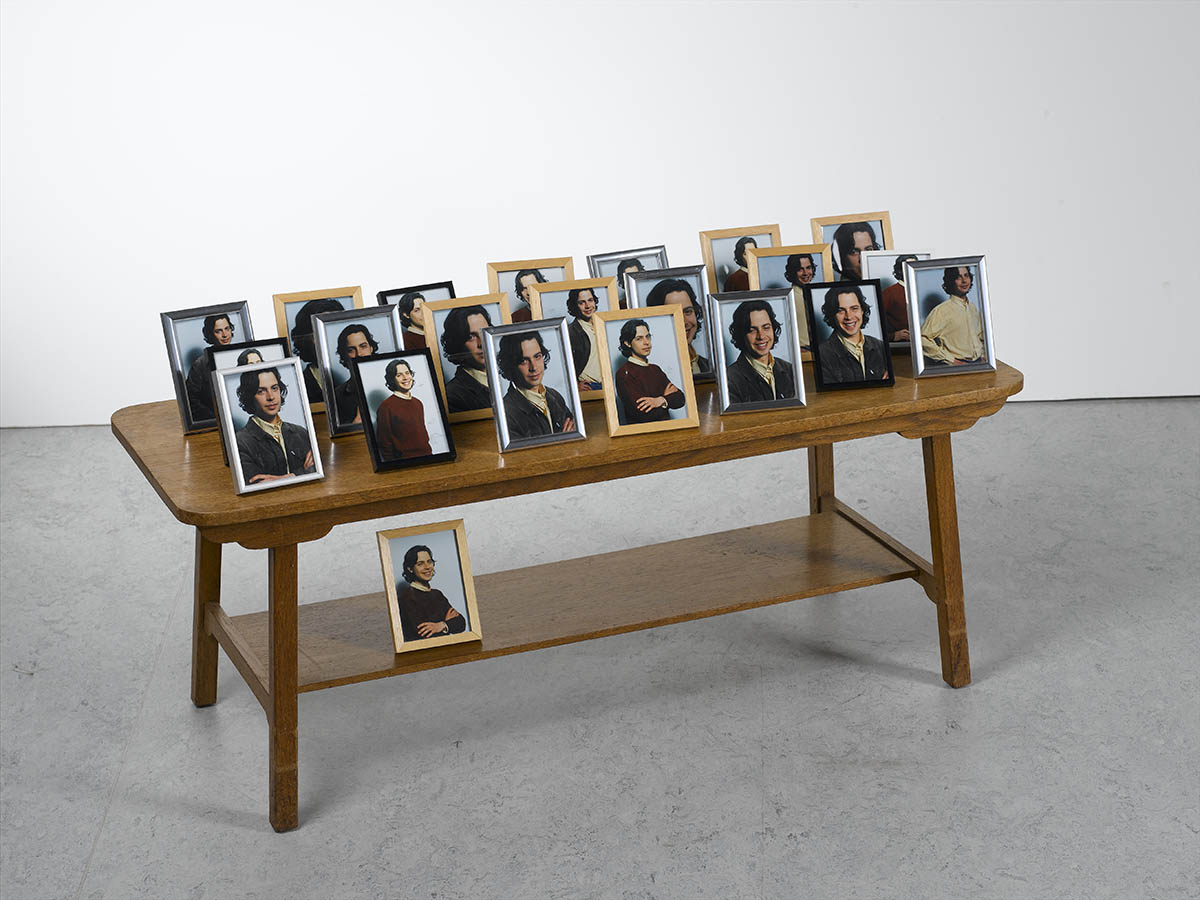
If we move toward masculinity as emotion, desire, and normative force, the works become more fluid in how they operate. One example is the work of Sands Murray-Wassink, an American artist based in Amsterdam. We are showing two of his works. The first is a piece from the 1990s, presented as a coffee table covered with numerous photographs. They appear generic: a young man in his twenties, smiling, well-dressed, posed in standardized ways. The images resemble formats associated with dating profiles or self-presentation within social and professional contexts—ways of entering a kind of socially legible, polite, middle-class normativity. What is striking is the repetition: there are twenty-two nearly identical images. The accumulation renders the presentation almost absurd, exposing the rigidity of these norms and the limited range of acceptable masculine self-representation.
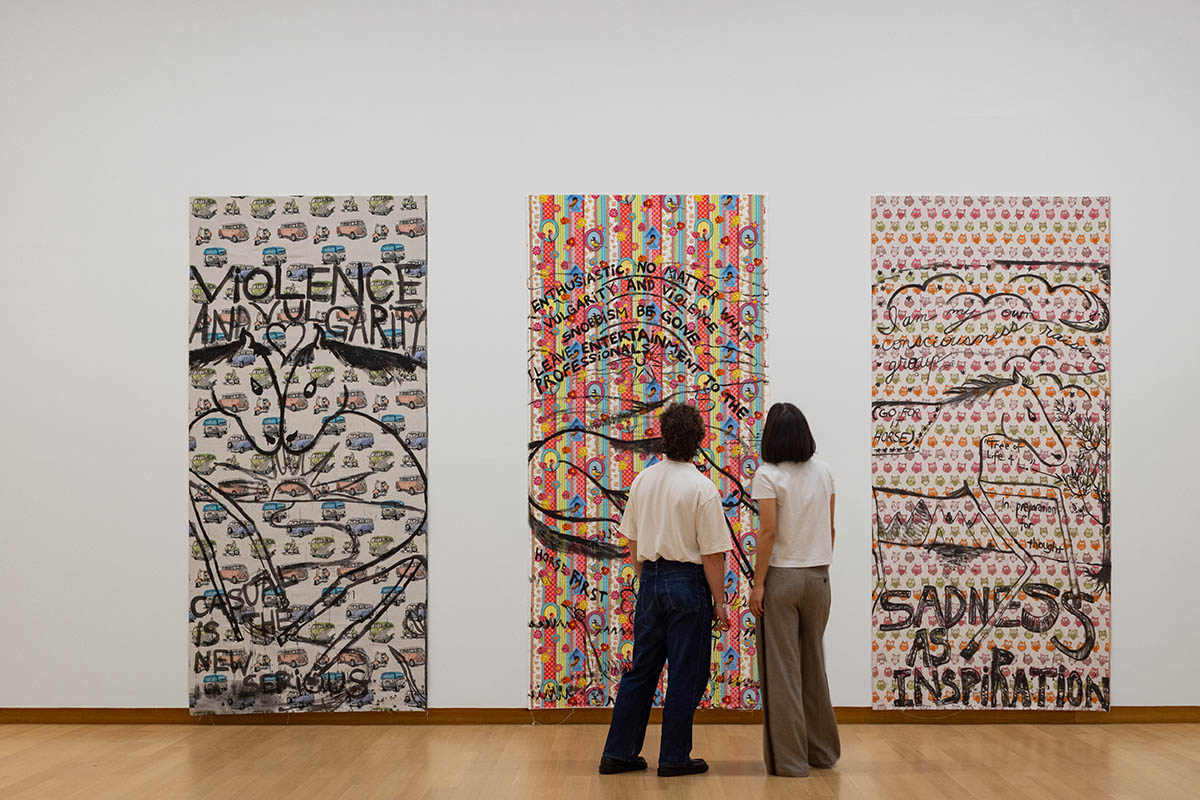
The second work engages more directly with desire and the pressure of gender norms, as well as the impulse to resist them. It consists of three large textile panels depicting horses with text elements, drawn from the artist’s ongoing practice of horse imagery. Sands Murray-Wassink began drawing horses as an act of defiance. As a child, he was told by his grandfather that drawing horses was something only girls did. The act of drawing them became a way of asserting autonomy and self-determination. It is a simple gesture, but it speaks to how deeply gender norms shape behavior—what is considered appropriate, acceptable, or even possible. Some of the works also evoke a sense of tenderness, comfort, and belonging. One example is a sculptural work by Selina Zürrer. It consists of what looks like the entrance to a caravan, with a curtain and a small set of steps leading up to it. On the steps are three pairs of slippers: one large black pair, a slightly smaller pair with a colorful floral print, and one for a child. The work reads as a portrait of a family—intimate, soft, even nostalgic. At the same time, it risks a certain cliché in how it stages these roles. It captures how such structures can be both comforting and constraining, and how one literally steps in and out of them at the threshold between public and private life. There is also a strong sense of nostalgia and emotional comfort embedded in these templates—what they offer, and what they quietly prescribe.
Nostalgia can be a powerful force in reinforcing inherited structures on an emotional level. In that sense, it can also become a ground for manipulation. This connects to a broader question around psychoanalysis. For me, it’s something I find quite difficult. Even though we have moved beyond Freud in many ways, some of the foundational assumptions still feel deeply problematic, particularly in how they position femininity. The historical framing of hysteria, or the idea of femininity as a kind of deficiency, continues to exist. It’s not necessarily that psychoanalysis is simply “masculine,” but it can feel structurally exactly like that/
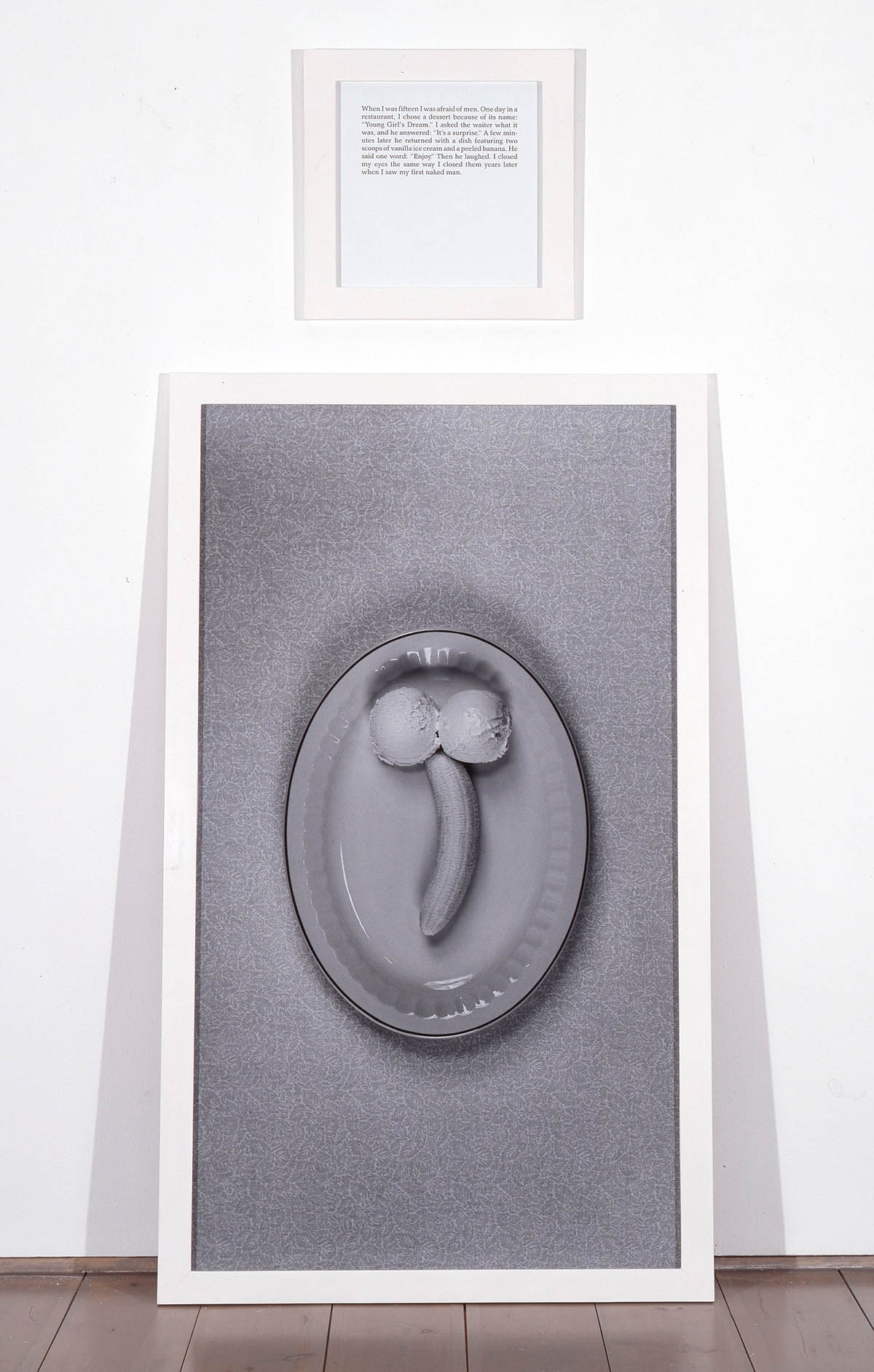
One work that comes to mind in this context is Sophie Calle’s practice, especially in its adoption of a confessional mode of address, which carries the intimacy and depth of the dense, layered memories associated with a therapy session. It operates in a register that recalls psychoanalytic speech: intimate, self-reflective, and structured around memory and narration. Her works address the viewer in a confessional tone, engaging with shame, intimacy, and unresolved emotional states, while also blurring the boundaries between what is real and what is constructed, what is personal and what is staged. In the exhibition, two works are presented: The Bathrobe and Young Girl’s Dream. Both revolve around seemingly personal anecdotes tied to encounters with masculinity. In Young Girl’s Dream, Calle recounts a childhood memory in which, while reading a menu in a restaurant, she encounters a dish of the same name. When she asks what it is, the waiter tells her to wait and see before presenting a plate with two scoops of ice cream and a banana. The gesture meant as humorous is, of course, unsettling, suggesting a sexualised undertone that feels both inappropriate and very familiar to many of us. The Bathrobe, on the other hand, reflects on an object that connects different memories—of her father and of a lover. The work moves between tenderness and discomfort, evoking relationships marked by care as well as latent tension. It sustains a subtle instability between the intimate and the unsettling, between desire and vulnerability.
This raises broader questions about desire itself: what we want, where desire comes from, and how it is shaped by power and experience. I was also thinking how it would be fitting to include the work of Moyra Davey.
With a topic of this scale, choices inevitably have to be made. What becomes important is not completeness, but attentiveness—to one’s own blind spots and to the limits of representation. The subject matter is deeply personal and inevitably means different things to different people.
Visitors bring their own experiences to the exhibition, often shaped by pain, conflict, or trauma. There may be an expectation of recognition—of seeing one’s own experience reflected or even validated within the exhibition. But an exhibition cannot fully meet that expectation; it will always remain partial.
What it can do, however, is position itself as a proposition: an opening rather than a conclusion. The aim is to create a space for multiple ways of thinking, where works engage the topic from different perspectives.
We also need to go back to the fact that in a museum like this, an exhibition such as this one inevitably touches on how museums as structures were historically built through masculine-coded systems over hundreds of years. Perhaps we can approach this through certain artistic positions or through your own perspective. I’m also thinking about how the exhibition highlights minorities in a broader sense — whether from working-class or racial perspectives, or simply through questions of exclusion and visibility.
I could speak to the topic of who has access, and how access itself is gendered. A work that addresses this with humor and sharpness is SoiL Thornton’s Husband Chair. A Husband Chair appears in every exhibition Thornton does, and it always has the exact height of the curator. It is placed so that it blocks one of the principal entrances to the exhibition space.
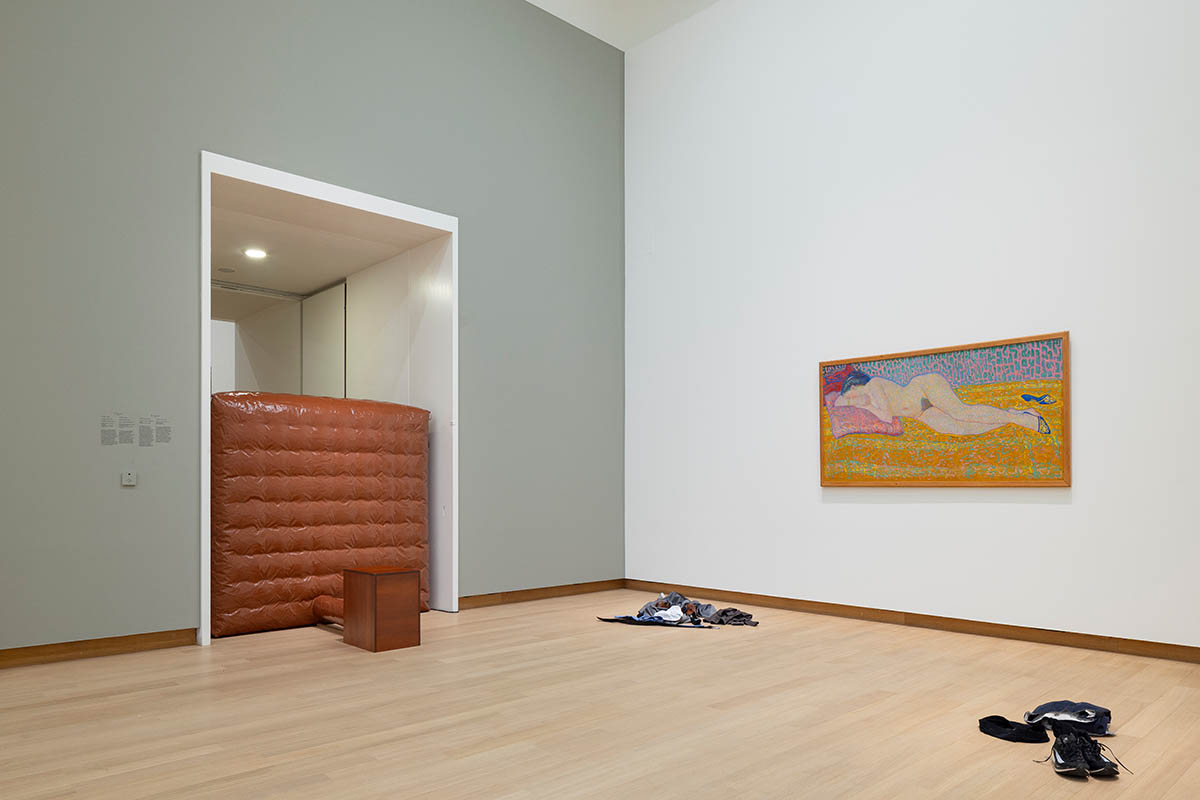
The term “husband chair” already exists in American English. It refers to the chair placed outside fitting rooms in department stores, where husbands wait while their wives try on clothes—watching, judging, and assessing their appearance. Embedded in this object are clear gender relations: the man as observer, evaluator, perhaps even financier, and the woman as the displayed body negotiating fashion, presentation, and desirability.
In Thornton’s version, The Husband Chair becomes an exaggerated and absurd extension of this dynamic. It is made from the same material as inflatable children’s bouncy castles, but abstracted into a large cubic form that literally obstructs access. It is baffling in its presence, resembling an inflated six-pack torso, with a hypermasculine bodily language embedded into the sculpture itself. What I find compelling is that the work makes questions of access explicit, but in a humorous way. Who has the right to enter a room? Who has the right to occupy space? Who has the authority to block an entrance? By giving the object the dimensions of the curator’s body, it directly links these questions to institutional power and authorship—to the people who decide how visibility is distributed within the museum.
Group exhibition: Beyond the Manosphere — Masculinities Today curated by Melanie Bühler
Artists: Arlette, Sophie Calle, Miguel-Ángel Cárdenas, Sam Durant, Hans Eijkelboom, Emirhakin, Hamishi Farah, Sylvie Fleury, Julio Galán, Solomon Garçon, Leo Gestel, Sven Gex, Jasmine Gregory, Amanda van Hesteren, Zhana Ivanova, Mike Kelley, Tetsumi Kudo, Basir Mahmood, Reba Maybury, Paul McCarthy, Lucy McKenzie, Melle, John Miller, Marlie Mul, Sands Murray-Wassink, Eduardo Paolozzi, Paul Pfeiffer, Pope. L, Sara Sadik, P. Staff, Diamond Stingily, SoiL Thornton, Salman Toor, Alex Vivian, Bruno Zhu, Selina Zürrer
Exhibition duration: until August 2, 2026
Address and contact:
Stedelijk Museum Amsterdam
Museumplein 10, 1071 DJ Amsterdam
www.stedelijk.nl
The exhibition Beyond the Manosphere – Masculinities Today is organized by the Stedelijk Museum Amsterdam and curated by Melanie Bühler, in collaboration with the Kunstmuseum St. Gallen, Switzerland, where the exhibition will travel.