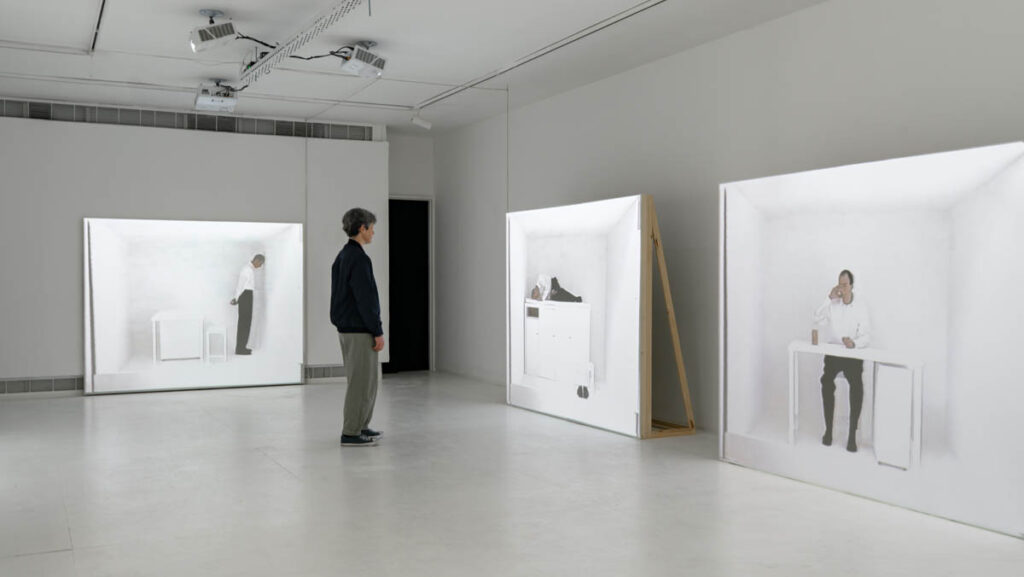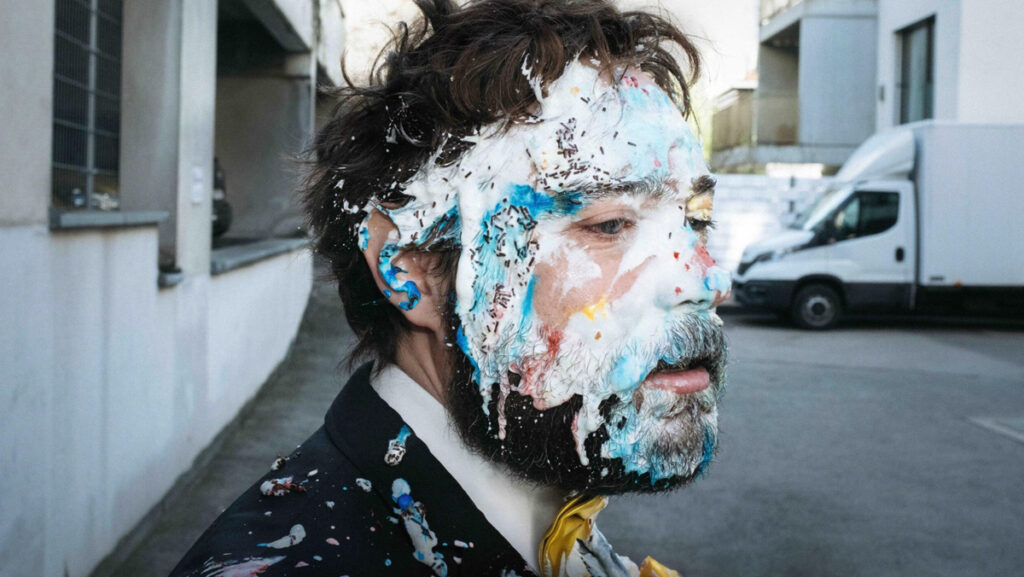

They locate in absence not merely a testimonial record of what was once there, but focus on the conditions for transformation. Forensic logic, as a discipline, proceeds from a foundational assumption: that matter does not disappear. It transforms, migrates, and sediments. What appears absent has not been annihilated, but is energy displaced, and what looks like a blank surface carries the history of contact.
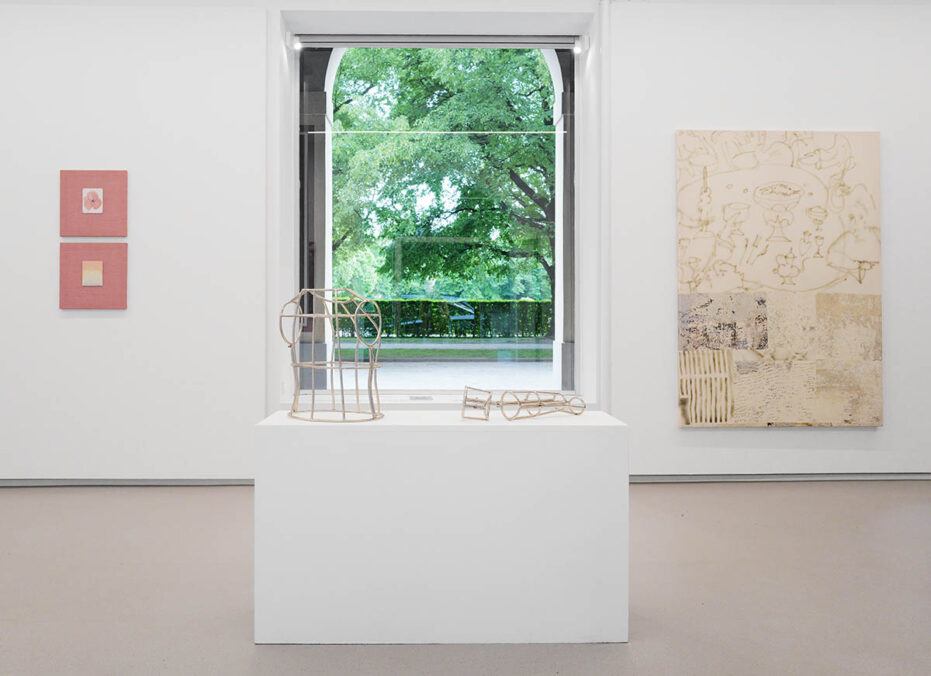
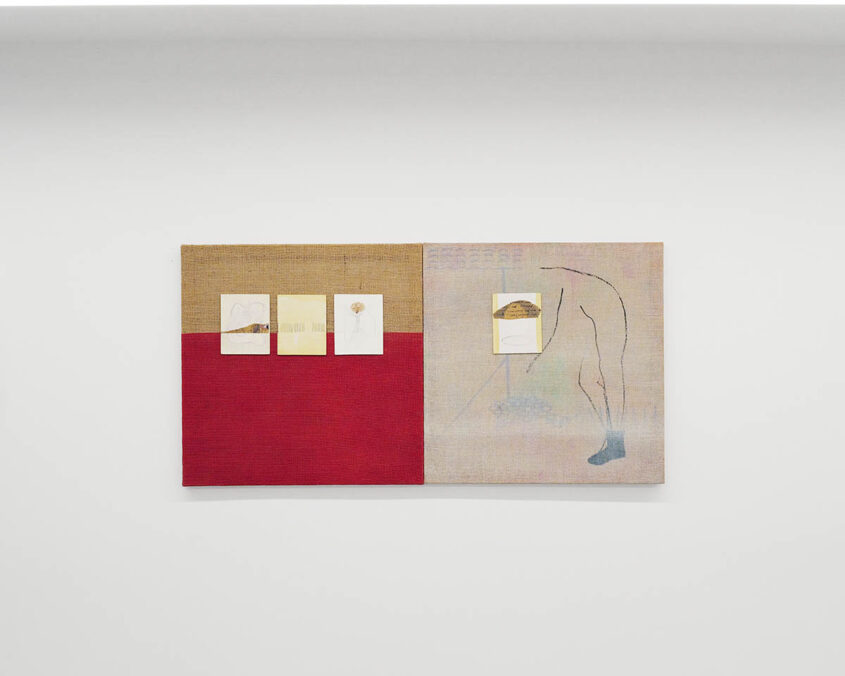
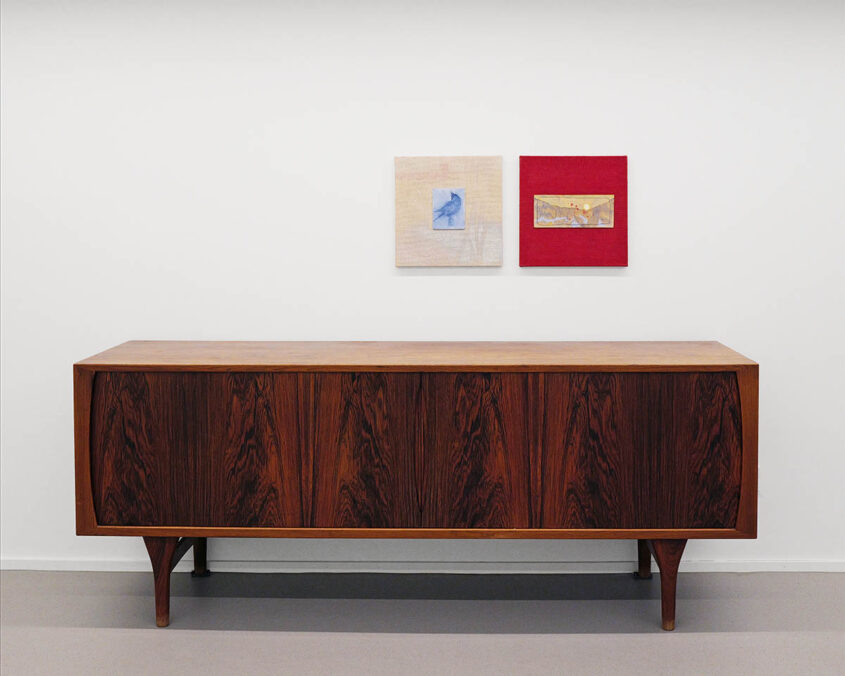
Hashani’s paintings are made on bare jute at a small scale: a constraint that is also a strategy. Jute is not neutral ground. In Kosovo’s rural context, it is an everyday agricultural object, and it carries the indexical weight of a material that has been processed, compressed, and transported as a textile with its own forensic record. What appears spare is dense with prior inscription. Introducing painted bodies into that existing field of prior contact, Hashani decides with surgical precision what to withhold from her landscape as much as what to further embed. What she places into that field are the contents of that world — a deer caught mid-step, a monochrome blue bird, a hen beside an egg, a poppy, a sun setting into grass. The line throughout is quick, notational, and close to a field note. Each is painted on a separate board and mounted onto the jute, a decision that makes physical and measurable the gap between the mark and the ground it sits on. And at the furthest limit of this distance, Now I know what it’s like to look out the flight window abandons the figure entirely: a vertical rectangle of pale sky.
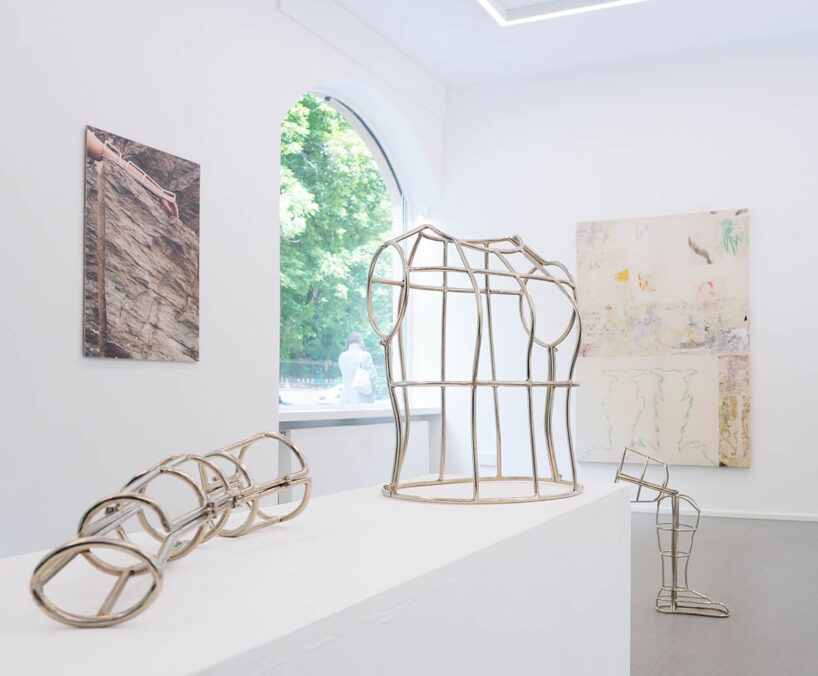
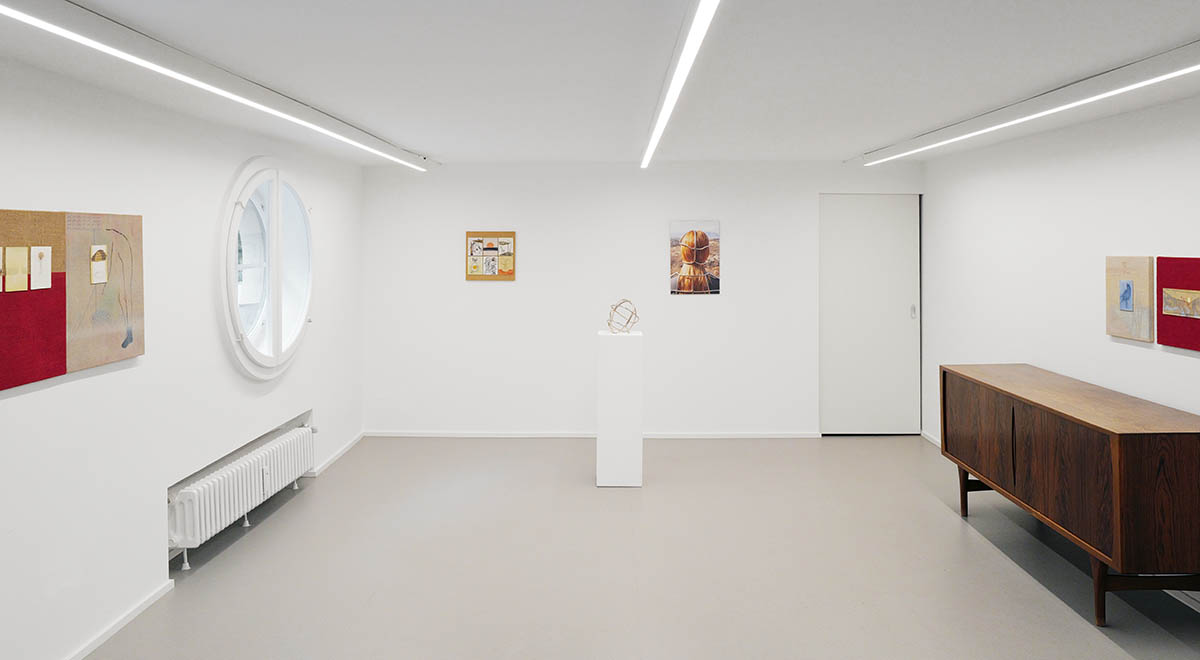
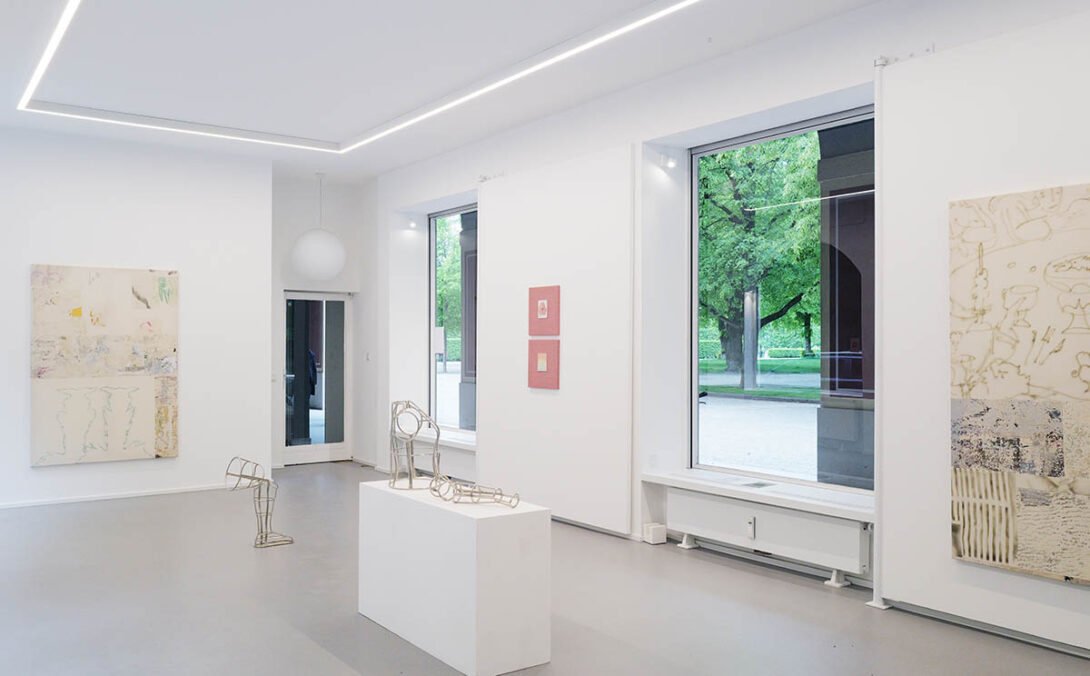
Inescu works at the intersection of adornment, ecology, and disappearance. She creates silver skeletal structures modelled after her own body and wears against landscapes scarred by wildfire, and then presents the objects themselves in the gallery, emptied of the body that wore them and the landscape that framed them. What remains is a triple absence: the body gone, the landscape destroyed, the photograph itself a document of what no longer coheres. Yet Inescu refuses an elegiac register. The skeletal forms are generative rather than memorial; they propose that the stripped-back condition of the body and the ecosystem is also the condition from which new morphologies become possible. Her work asks what kind of growth is legible only after destruction.
Von der Locht performs what she calls deposition: extracting accumulated lacquer, soot, and anonymous residue from the urban walls of Athens and transferring those compressed histories onto sewn textile. The city’s surface is not a backdrop to events — it is itself an author, producing a record it never intended to make. The textile becomes both archive and body: bearing the forensic trace of contact that was never consciously authored, making legible what accumulates without being noticed.
Taken together, these three positions constitute a shared argument about the politics of the surface. They refuse the fiction that any ground is neutral, any absence empty, any mark without prior condition. Forensic Logic names the patient, analytical attention to what matter does when it is displaced, withheld, or stripped down; and to what, under those conditions, it becomes possible to see.
Exhibition: Blerta Hashani, Nona Inescu, Tabata von der Lecht – FORENSIC LOGIC (In collaboration with Mara Projects)
Exhibition duration: 16 May – 25 June 2026
Address and contact:
Galerie Filser & Gräf
Galeriestraße 6, 80539 Munich
www.filserundgraef.de