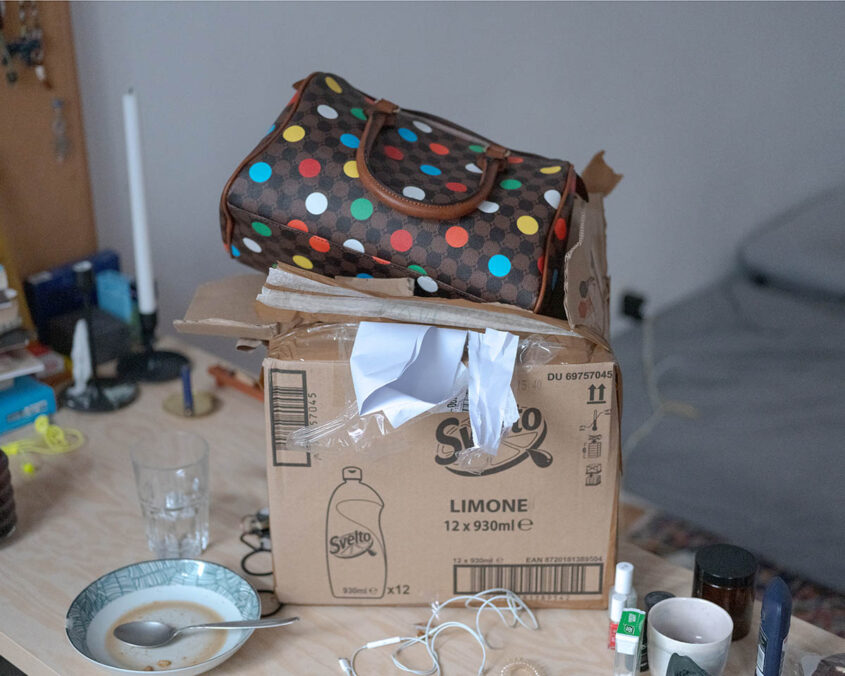
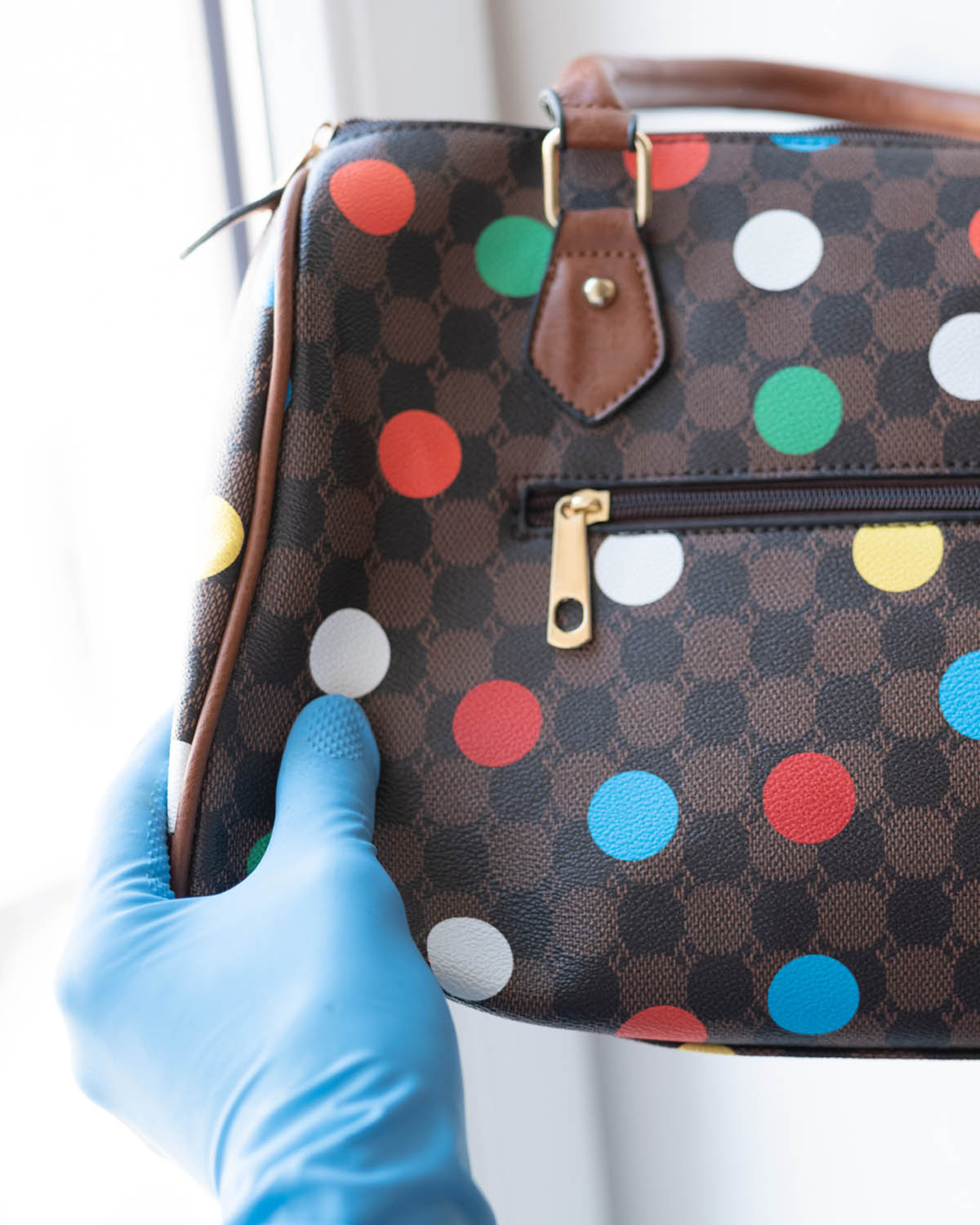
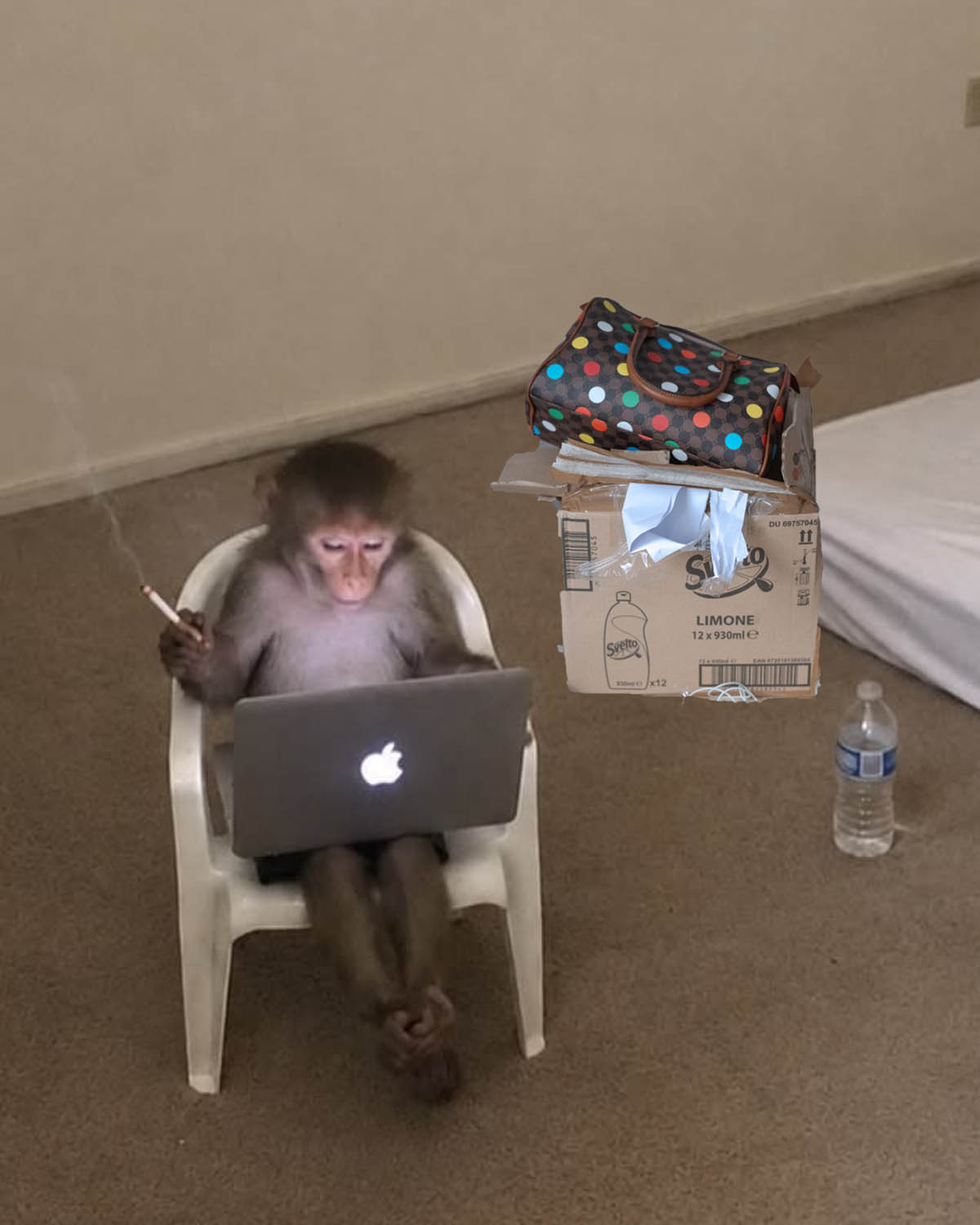
It’s past midnight. I’m lying in my bed and searching for the bag online. The guy that I’m seeing is texting me to come down, have a cigarette, and talk. I would later find out that he is full of shit, but for now I’m fully focused on finding this bag. After using buzzwords and searching for low-cost designer knockoffs on Reddit, I decide to turn to one of the wonders of today’s technology: reverse image search. After a few websites, I turn to Vinted, and there it is, shining on my screen. The page selling it is sketchy; it sells stuff that I would usually find in a boutique in my mother’s hometown in the Balkans, filled with the smell of polyester. There it is, exactly as I imagined it. Dark brown polyurethane handbag with an ambiguous logo pattern and coloured spots in an overlay. Brand new with tags on, the description states. Only three euros and forty cents. Instant buy.
A totally abstract yet so much resembling the Yayoi Kusama x Louis Vuitton Brown Monogram and Multicolour Infinity Dot Speedy Bandoulière. The first time I saw it was on the streets of New York three years ago, sold by a street vendor on the sidewalk. At the same time, there was an exhibition of Kusama at the Gagosian Gallery NY. The collaboration with the fashion house had just dropped. For the occasion, they built a life-size robot replica of Kusama, exhibited in their storefront. Everything was there; the only thing missing was the artist.
To quote Anthony Sullivan, “Though mostly hidden from us by the fetishistic effect of branding, markets, distance and routine, occasionally the shell of (fashion) commodity cracks.”1
It was the proximity of all these elements, the work, the collab, the robot, the fake, as well as the absence of the artist or her agency, that suddenly connected the dots. The sweatshops in the Global South are making fake Yayoi Kusama artworks. It made me ask: did fine art succumb to capitalist modes of production, in which the worker (artist) is alienated, and the product (artwork) is detached from its context and cast into a vacuum where the only thing left is a fetish-commodity?
To understand this analogy, it’s important to look at another component: the fashion industry and its development under capitalism. We have all seen the fast-fashion Shein influencer memes from a few years ago, laughed, and passed judgment, yet the bigger picture of its damage to people and the environment seems to remain out of the frame. What is interesting is that even before the acceleration of neoliberal capitalism in the late 20th century, and the globalization of the market that came with it, this industry has already functioned on a logic that Marx would define as the birth of Capitalism: “separation of production from consumption, and producers from the means of production.”2 What capitalism changed is not its logic of production, but rather the range of opportunities and speed of production, moving it from local to global, accelerating the gruesome violations of workers‘ rights and dignity.
There is a lot of discussion both in academia and mainstream about the relationship between art and fashion. Is fashion art, or is it too superficial?
The historical overlap is never-ending, from artists being inspired by fashion, using it for critical reflection on social topics, or making clothes as an art practice. Fashion designers, in return, are inspired in their designs by their contemporaries or historical artworks. Today’s situation is more blurred and discombobulated, but still on everybody’s mind. Even with MetGala 2026 delving into the same topic. That’s not what I want to focus on here. What I am interested in is not whether we can equate fashion to the status that art has or had, but instead, what happened to art under capitalism, and did it become just another commodity-producing industry, just as grim as the fashion one?
There are multiple interesting and relevant case studies for this analogy. As a review of one of her latest monographs, The New York Times writes: „Yayoi Kusama transcended the art world to become a fixture of popular culture, in a league with Andy Warhol, David Hockney, and Keith Haring.“3
Is this really an achievement? Corporations won’t leave Haring alone, so much so that I feel more people know him as quirky illustrations from Zara socks than as an activist who lived a precarious life and died of aids, only for the same rights he fought for to regress so much in recent years. What strikes me when it comes to the destiny of Kusama and her work is that we have arrived at a point where this sort of mechanism works even while the artist is still alive and producing art, somewhere far outside the view, while there is little to no public knowledge about her own involvement and agency in all of it.
Kusama was born in 1929 in Japan, in a merchant family in a small town. A lot of her early life would later define her artistic practice and philosophy, including abuse and mental health issues that she experienced from a young age. She lived and studied art in Japan until her late 20s, mostly working in traditional painting, but already had her recognisable polka dot patterns as a subject. In the sixties, she moved to New York to pursue her artistic endeavours beyond the conservative and limiting society in Japan, as she describes it. It is there that she would break through and make her most relevant and critically acclaimed work. The work from this period is critical and challenging in more than one aspect. She pioneered avant-garde art forms like happenings and performance that directly critiqued the established art discourse and institutional context. Throughout these forms, as well as paintings, prints, and installations she was creating, the dotted patterns took over as a central part of her practice. These dots derive from her hallucinations that she experienced from a young age, as a symptom of her mental health issues, anxiety and fear, as well as strong feelings of depersonalisation. When externalised in this form, her art can be seen both as a coping mechanism and a protest. After moving to New York, she often faced racism and sexism as an immigrant female artist, pushed up against her male contemporaries on the New York scene. This also became a present element in her work. One work that stands out for me is the Narcissus Garden, a performance she realised at the 1966 Venice Biennale. Although not invited, she installed a field of reflective metal balls on a field, selling each one for 2 dollars to the visitors. After a while, the Biennale officials shut down her “shop,” but the installation remained. This work touches upon many relevant topics to this essay, starting with the direct reference to economies of the art world and the celebrity-like status of the artist. She is critiquing the systems in place in a direct way, by the simple action of inserting herself, along with her identity and politics that go with it, inside of it. The balls very much resembled a fortune teller’s crystal globe, and in a way she really predicted the future, from her selling her art on the floor in the 60s to the street vendors selling the fake bags on the pavement in the 2020s. The rise of her fame and mainstream success is followed by the decline of her mental health in the 70s. She retreats to a private mental institution where she continues to live and work to this day. This change also influences her art, which turns away from the avant-garde formats to object-based practices like sculpture and installation, mostly large-scale and somewhat commercialised at the turn of the century.
How did her polka dot go from being a symbol of resilience and anti-imperialism to an aesthetic pattern on a Louis Vuitton bag?
Mark Fisher writes very clearly about the transformation that culture went through under Capitalism in his book Capitalist Realism. Specifically what he defines as “the turn from belief to aesthetics, from engagement to spectatorship.” 4 All the political changes in the late 20th century, specifically the fall of Communism in Europe, signified the proliferation of neoliberal Capitalism as the dominant socio-political system, which no longer had any alternative to it. Real or, as we are experiencing now, imaginary. The culture moved from modernist and post-modernist to a new state, a certain “end of history“ in which there is no “new thing“ to happen, no belief in the potentiality of change or transgression. What this means is that since capitalism as a form of reality occupies the whole domain of the conscious, there is no other system of value or belief to hold other than that of a monetary value. What it also means for historical or alternative art practices is that they are flattened through this system into mere styles of the mainstream culture.
“When it actually arrives, capitalism brings with it a massive desacralisation of culture. It is a system which is no longer governed by any transcendent Law; on the contrary, it dismantles all such codes, only to re-install them on an ad hoc basis. The limits of capitalism are not fixed by fiat, but defined (and re-defined) pragmatically and improvisationally. This makes capitalism very much like the Thing in John Carpenter’s film of the same name: a monstrous, infinitely plastic entity, capable of metabolizing and absorbing anything with which it comes into contact.”5
It is this logic of Capital that haunts today’s culture, and inseparable from it the visual arts. Not only do things emerge as subversive and critical, only to rise to the mainstream and in the process lose their agency, but there is no such thing as subversive or alternative today. Art is in advance conceptualized with no value other than the monetary one, and everything else is just an aesthetic, a style. As Fisher claims, any other belief simply allows us to continue partaking in the system, while holding our moral high ground.
“So long as we believe (in our hearts) that capitalism is bad, we are free to continue to participate in capitalist exchange. According to Žižek, capitalism in general relies on this structure of disavowal. We believe that money is only a meaningless token of no intrinsic worth, yet we act as if it has a holy value. Moreover, this behavior precisely depends upon the prior disavowal – we can fetishize money in our actions only because we have already taken an ironic distance towards money in our heads.”6
The same goes for the artwork of Kusama when the art world became governed by the same rules as any capitalist industry. Her subversive dot, once acknowledged and praised by the art system, gets hollowed out, flattened into a colorful stain. As such, the only resemblance it has to her early work is the visual one. It becomes a fetish-commodity. A fashionable accessory. A tax write-off. Produced in large quantities.
Unlike other historical authoritarian regimes that thrived on censorship and therefore produced counter-culture, capitalism functions like a zombie virus; it is what “is left when beliefs have collapsed at the level of ritual or symbolic elaboration, and all that is left is the consumer-spectator, trudging through the ruins and the relics.”7
And there I was, trudging through the relics and the ruins, from Yayoi’s large scale sculptures at the Gagosian Gallery, staring at the person selling the knock-off designer bag on the pavement a few streets down, and lastly staring at the robot version of the artist in the LV store front, its hand holding a brush, going up and down, painting in the name of capital. Kusama doesn’t really need to be there at all; she can just relax in a private psychiatric treatment center in Japan and focus on herself.
The bag arrives a week later. It comes in a reused cardboard box from a detergent brand. It doesn’t matter that it’s fake. What even is an authentic Yayoi Kusama?
“The Yayoi Kusama Foundation regrets to inform you that we are unable to provide any authentication services or to respond to inquiries regarding the authenticity of prints.”8
I strut around town, heartbroken. I look cunt. Yes. In my ears is playing the newly released banger by Charli XCX.
Spring Summer 26, when the world is gonna end, no hope for anything.
Yeah, we are walking on a runway that goes straight to hell; nothing’s gonna save us…
Pavle Banović was born in 1998 in Belgrade and is currently based in Vienna. Among others, they have exhibited and worked with spaces in Belgrade, Ljubljana, New York, Vienna, and Novi Sad. They are the 2023 recipient of the YVAA Award for Serbia, as well as a participant in the 2024 Futures Photography programme, nominated by Organ Vida. They were a member of the young artistic collective The Applause Institute, as well as the current project D.U.O – Society of Joint Responsibility. In their work, Pavle explores and tries to reexamine the various forms of existence and action today. Analyzes the relationship between individuals and ideologies and how they can destabilize each other. The last few years have focused on digital video, photography, and other contemporary technologies shaping our daily lives and lived experiences.
Pavle Banović – www.pavvvlebanovic.cargo.site, www.instagram.com/pavvvle/
- Anthony Sullivan, Marx, Fashion and Capitalism (2019), 13 ↩︎
- Sullivan, Marx, Fashion and Capitalism, 13 ↩︎
- Phaidon, “Yayoi Kusama,” Phaidon, accessed August 7, 2026, https://www.phaidon.com/en-eu/products/yayoi-kusama ↩︎
- Mark Fisher, Capitalist Realism (O Books, 2009), 5 ↩︎
- Mark Fisher, Capitalist Realism (O Books, 2009), 6 ↩︎
- Mark Fisher, Capitalist Realism (O Books, 2009), 13 ↩︎
- Mark Fisher, Capitalist Realism (O Books, 2009), 4 ↩︎
- Yayoi Kusama Foundation, “Important Notice: Counterfeit Yayoi Kusama Artworks,” Yayoi Kusama Museum, accessed August 7, 2026, https://yayoikusamamuseum.jp/en/news/news20251201/ ↩︎