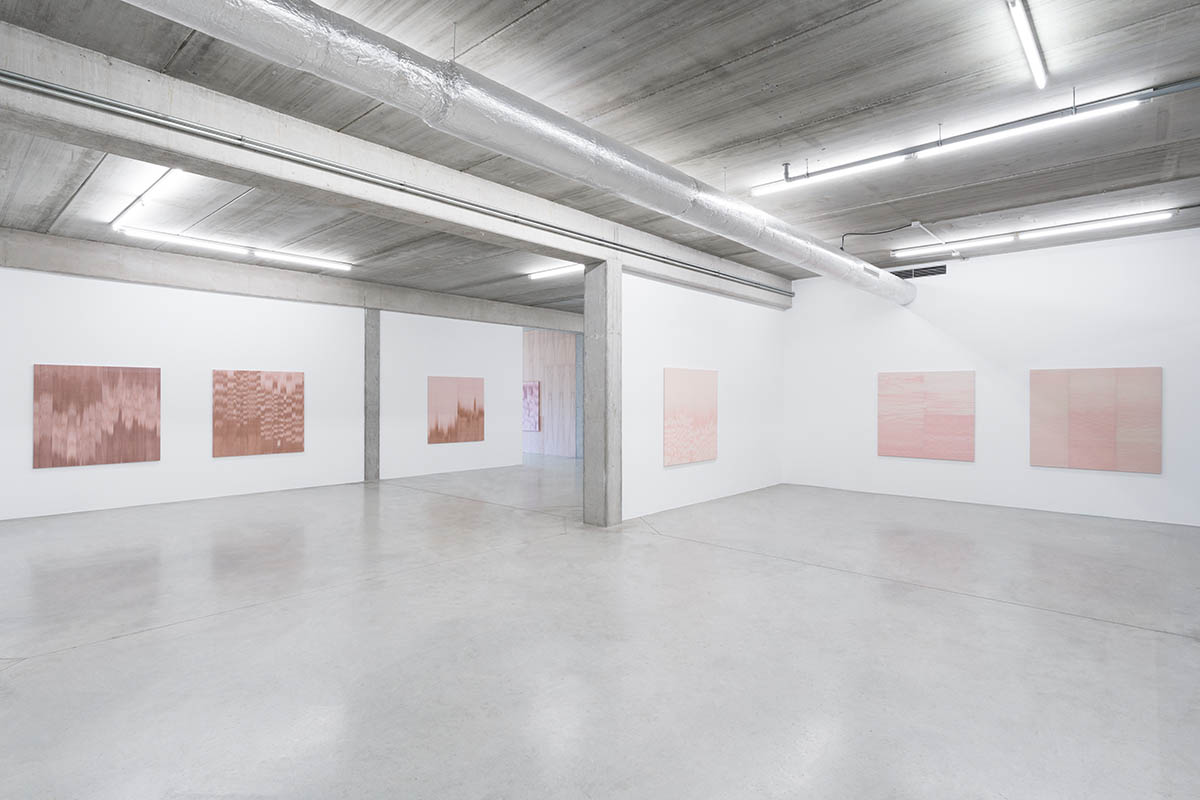
In SHIFTINGS you worked with the site of the IKOB Museum. How long in advance did you know that the exhibition was going to happen before you started setting it up, and how did you plan it?
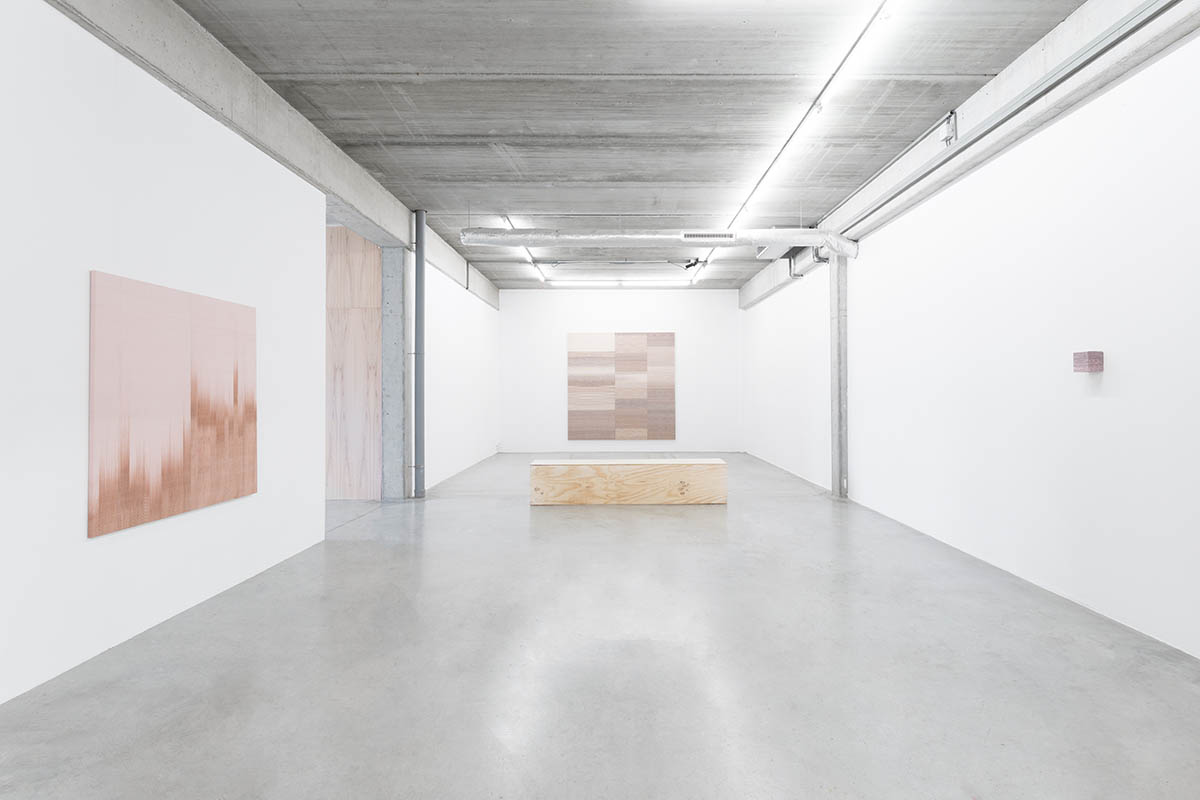
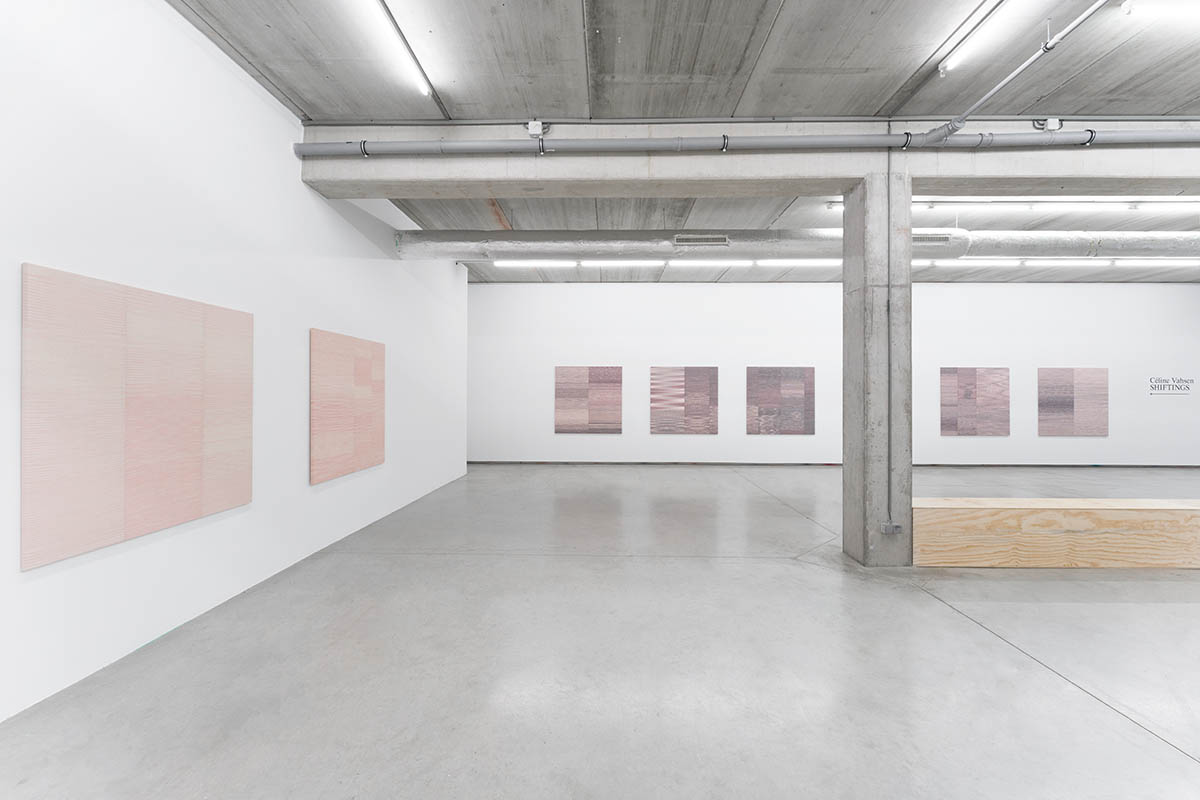
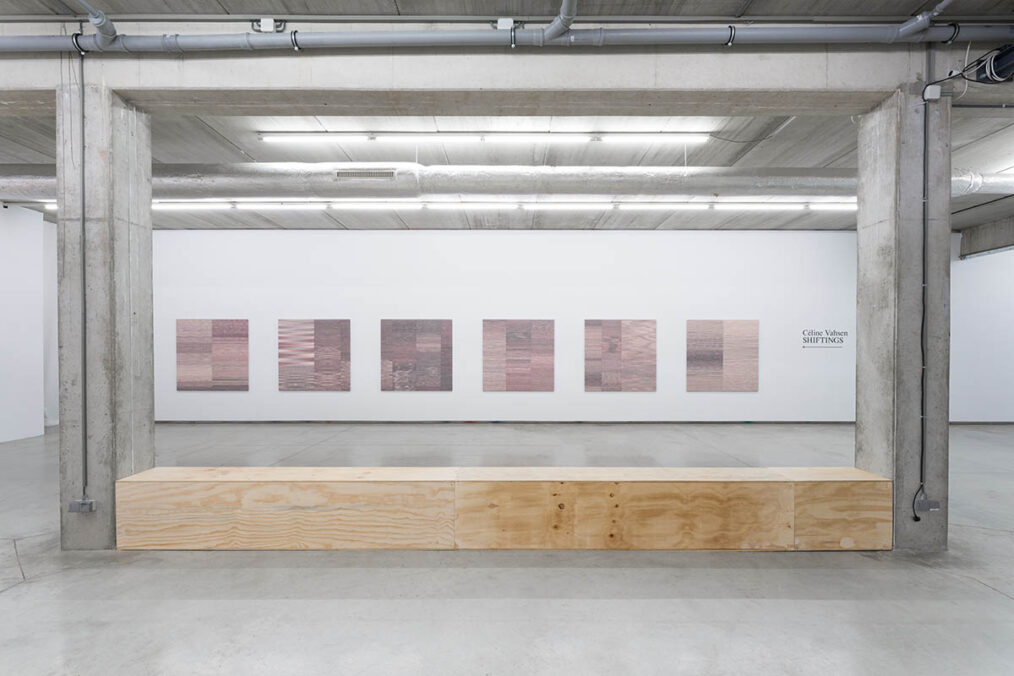
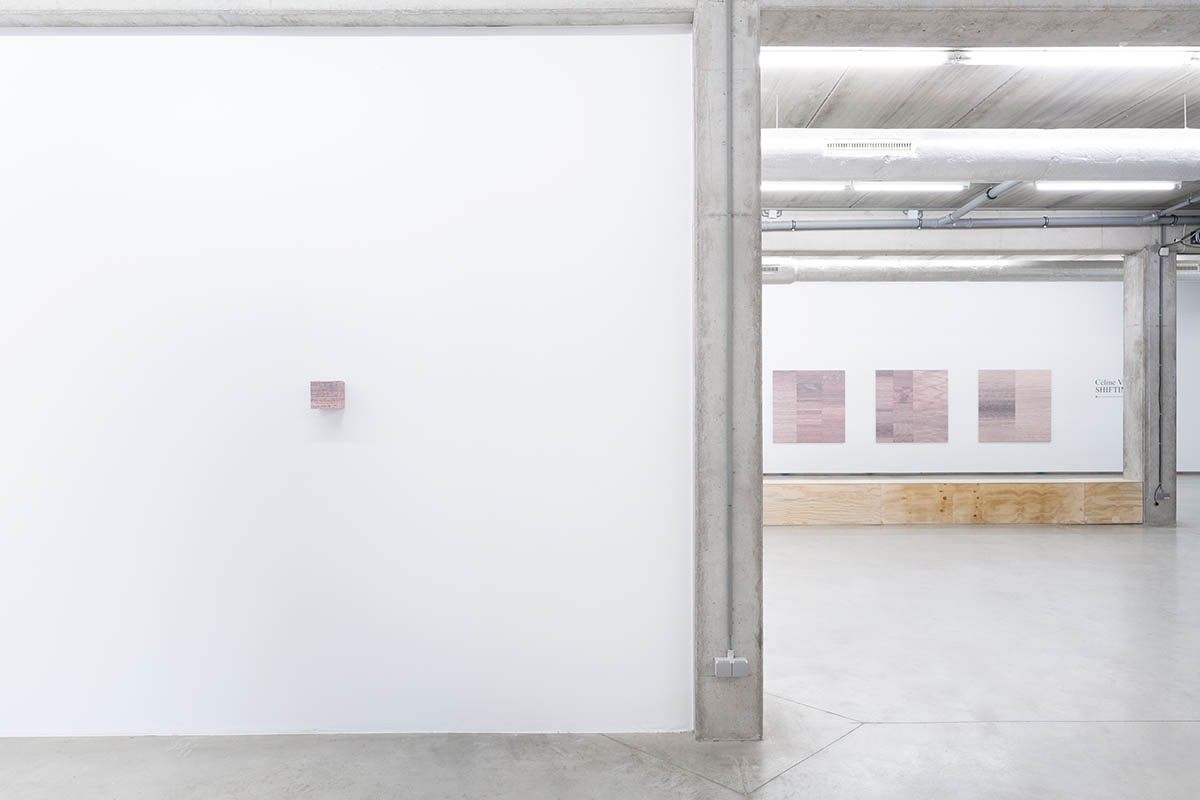
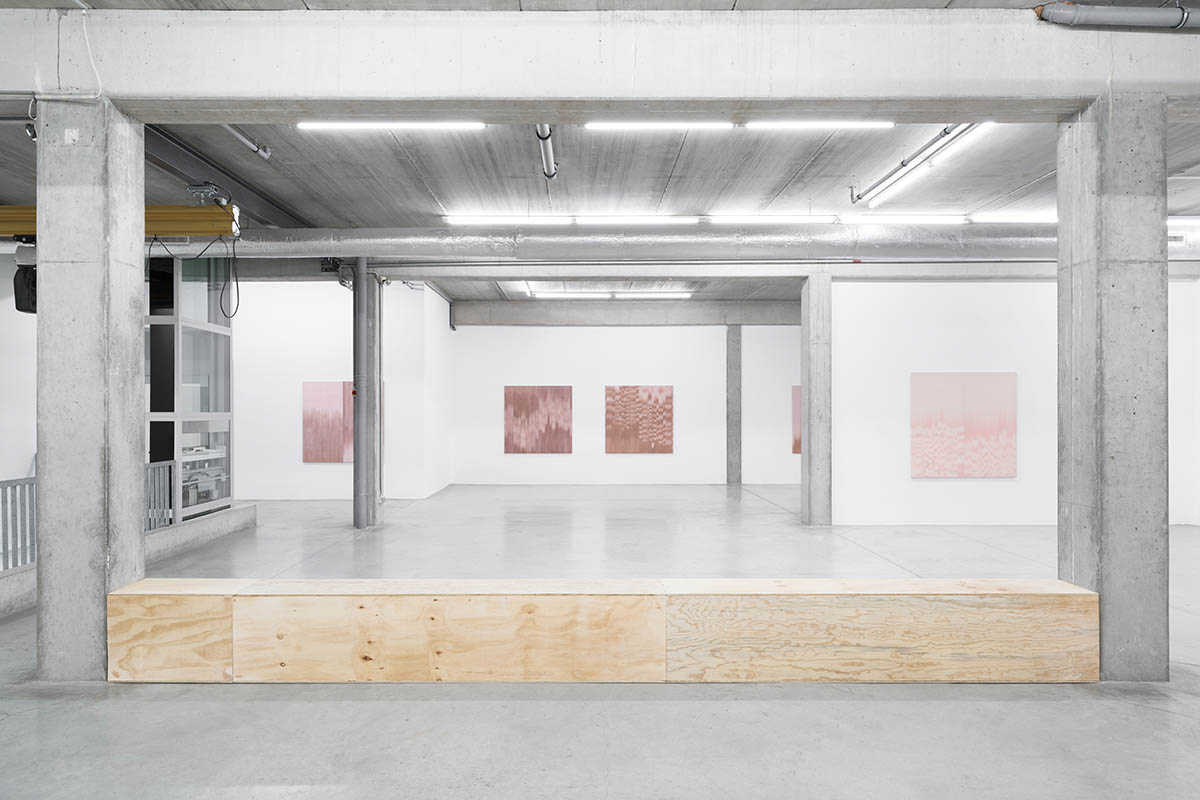
The IKOB Museum is located in the German-speaking part of Belgium, where I’m originally from. Biographically, it was quite something to go back to this place I come from and had left twenty years ago. I already had a group exhibition on the occasion of the IKOB Feminist Art Prize in 2022; therefore, I’m familiar with the space. I knew in April 2024 that I would have the exhibition. For two years, I worked on the pieces, which are now on display in SHIFTINGS. This process, which could be perceived as long, felt natural to me. It is my routine. I work all the time, and mostly in color series. Until the very last moment, I didn’t know exactly which work would be placed where, or how many of them were going to be exhibited in the end; I had about ten works under consideration, works I’d brought along thinking they might work; the setup is part of the process. It was important to create a feeling, an energy, or an aura with the works in the space. I wanted to invite the viewer to sit down and take the time to observe, absorb, or contemplate in front of the works. So I built wooden benches, especially for the rooms.
I seek the space in my square works. I’m searching for a certain type of visual balance: the museum has a few columns and concrete lines that vertically cut the view or sequence the perspective, like the different angles; this is where it became interesting. You can start creating tension and balance and play with the space. I always have an idea in my head of how something should look, the image, the exhibition itself, but then in reality, it feels different, and that’s beautiful.
The square is a recurring format in your work; that is decided for practical reasons, but conceptual ones too. Would you mind explaining what the square represents for you and how the textile relates to it?
When I started using woven strips of canvas as a way to create an image by assembling it. I made many tests. I tried to compose a work by placing separate stretched stripes next to each other. It felt fragmented, and then I started sewing the woven strips together. The minimum is two to four seems. What changes is the width of the fabric. Textile strips and bands are sewn together and put into a composition. The composition element is the one where I have full control. Once I found the square, there was no going back. It was the moment it felt right; that same feeling didn’t come before. The square wasn’t immediately the format of my choice; it was a process over many months. First, I tried rectangles, horizontal and vertical ones, where the interpretation for the viewer comes much more easily as a landscape. But I consider my work as an abstract image. I realized later that the square is strongly linked to art history. In the Minimal Art movement, artists such as Ad Reinhardt and Robert Ryman used the square as an absolute base of their work. I don’t perceive the square as only a masculine form, so I made a take on it from a feminine perspective.
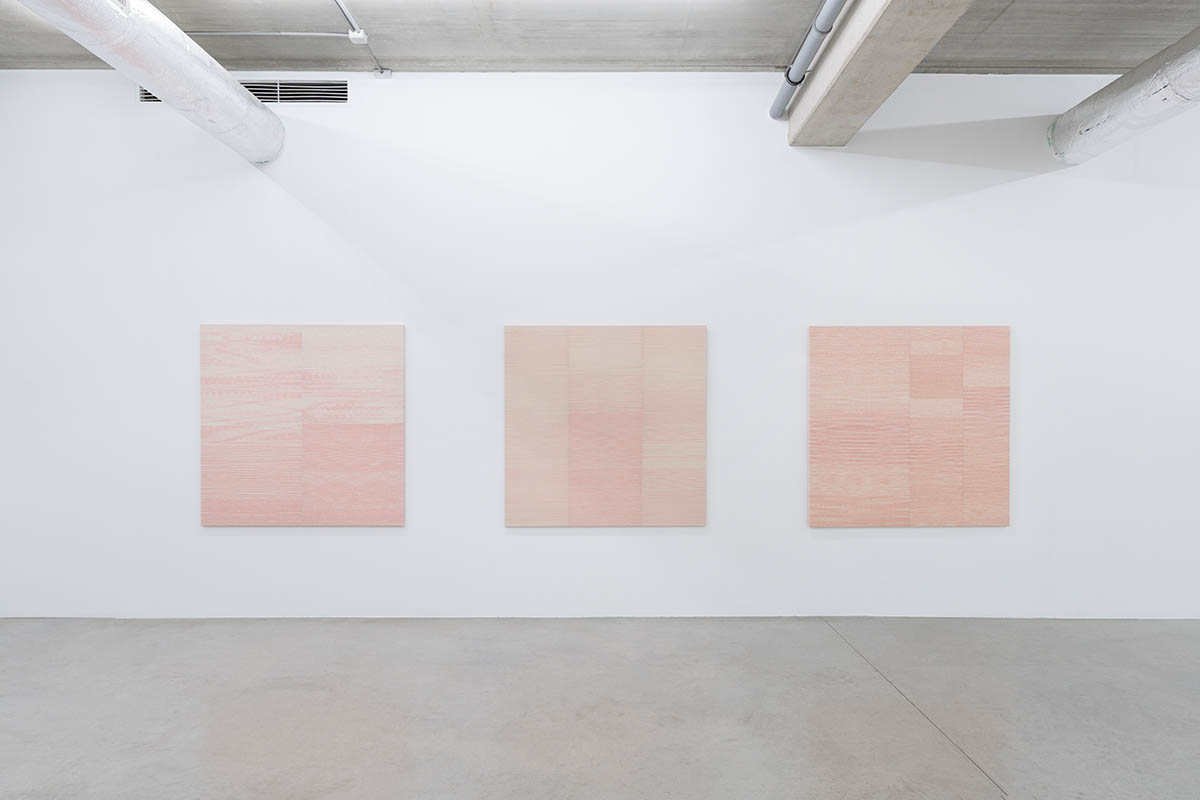
A female artist who used the square was Agnes Martin. She worked at roughly the same size as me: I read in her biography about her works, and mine are 140 by 140 cm. It’s the span of our arms, so there is this body presence to the work. I like that my works are usually that size so I can hold them, and I can transport them myself. Now, for the first time at IKOB, I’m showing a much bigger format, 250 × 250 cm, and there, the square envelops me and moves beyond the size we can physically relate to with our bodies or close to it.
There are so many possibilities and techniques in weaving. How did you come to this foundational way of weaving, the plain weave?
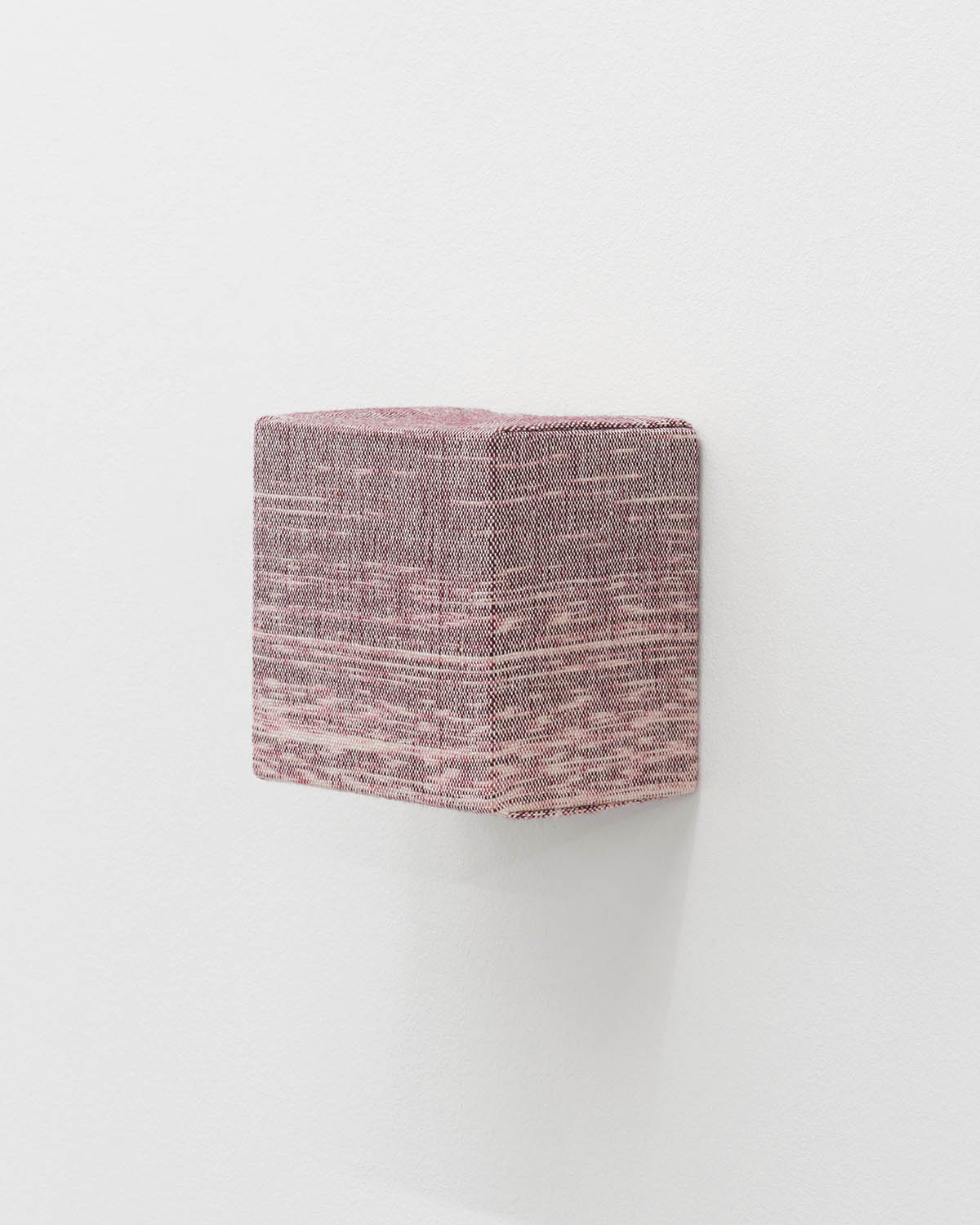
When people see my practice, they think about weaving because of the whole technical dimension, the loom, and the woven surface, and they may notice it’s not painted. But actually, I don’t consider myself a weaver; that’s often misunderstood. As soon as I go into the technicalities of textiles, people get fascinated, but I lose the other elements I want to discuss once it turns into a conversation about weaving. I’m interested in traditional weaving techniques and their implications in society, but the technique itself is not my main focus. I don’t use bindings to create patterns within the surface; I use natural dyes. For me, the color hues are far more important. I am fascinated by the transformation from a plant to a liquid dye or color pigment, the materiality of it, and the time I spend on extracting and making it. Plain weave is a way to generate the image; it’s the simplest and most fundamental way of weaving. I want to create a canvas, and therefore I use this technique—you don’t even need a loom to weave a plain-weave fabric.
There are other historical references in my square compositions. In many traditions and cultures around the world, people wove strips because of the backstrap loom, which limits the width of the fabric through your hips and arms. In my images, the more woven strips there are, the more time I spend on the final canvas, the composition. There’s this dimension of time that I’m searching for: results showing how much time you put into a work. I need at least two months per piece. There’s a strong dedication in my practice, or an obsession, you might say. You can find all these elements in my non-textile works as well: time, transformation, repetition, and gesture. Or then the dimension of Western art history, painters, for example: the Minimalist movement was mostly made by male painters, and I wanted to juxtapose my work with that. For them, the fabric itself was never important—it was a background, the linen you painted on. It was a material largely available in Flanders and throughout Europe; thus, it became the support material for painters.
The colors we see in your works come from naturally dyeing the threads. How does the aspect of color in your work connect to the painting tradition?
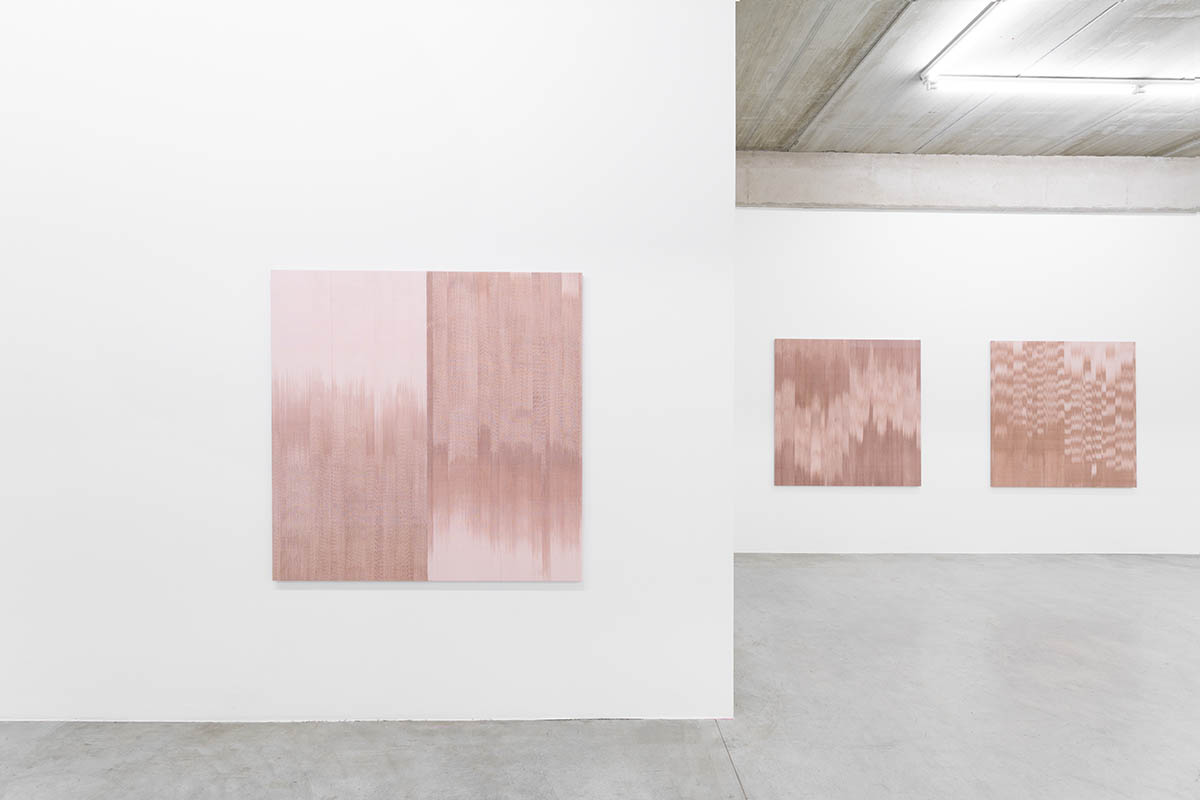
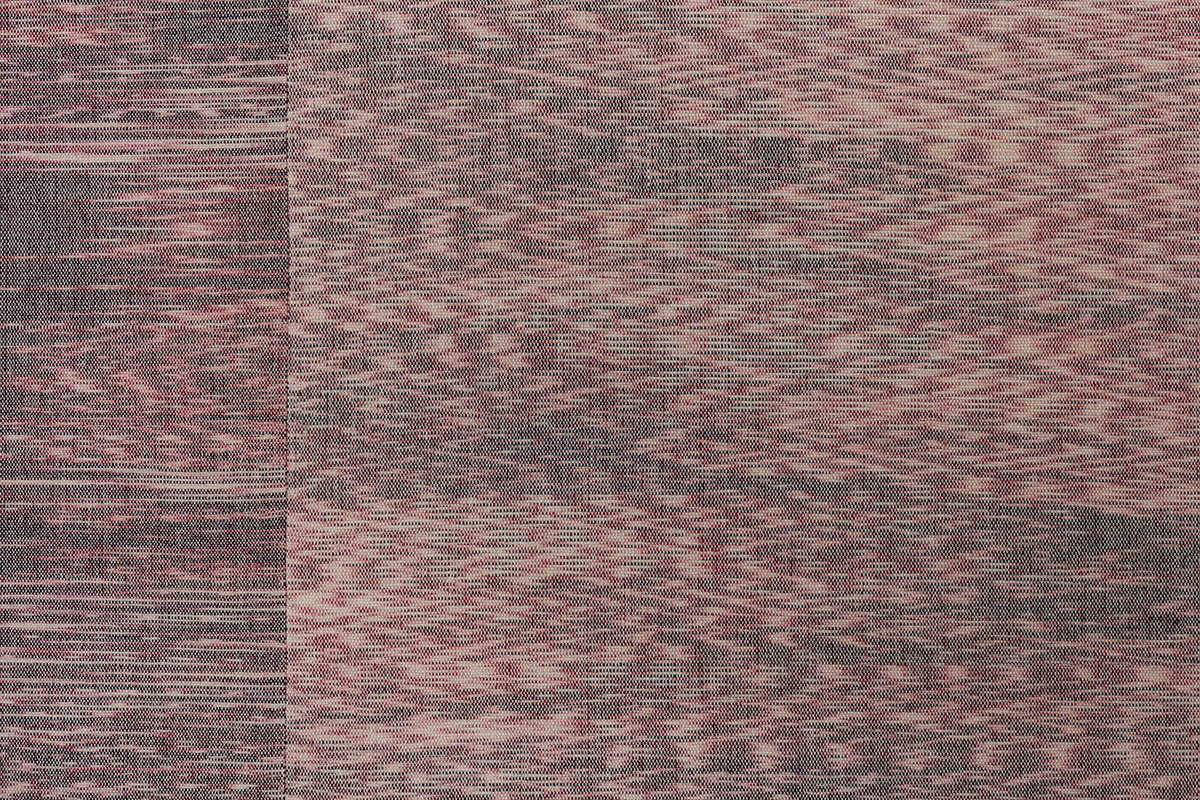
There’s an entirely different history around dyes or paints and how they were produced. Painters had to bind their colors with oil and other substances. For blue, painters have long used lapis lazuli pigment, whereas in dyeing indigo pigment is used. Very different processes, a different idea; here again, painting was considered fine art, and dyeing was a task for artisans. Indigo is a plant, and lapis lazuli is a mineral, a stone. Once you start using plants for your dyes, it does something to you; it brings in this magical, almost mystical part of transformation with it, and there’s that exchange you experience with nature. It’s beautiful. In my canvases, it’s the interplay that’s interesting to me, because once I’ve dyed the threads, I have a certain red tone, for example, but it’s only in the crossing with the other thread—the relationship between them—that this undefinable color emerges within the weave. Some visitors say, when they come to the studio, that the colors are difficult to name. They’re recognizable, and they shift over time; they react; they create variations.
It does raise a question about the paints we know traditionally. In this case, as you said, the threads react to each other in a way paint doesn’t.
Yes, it is about that vibration between them, the dialogue between the vertical and horizontal threads themselves. Paint is applied onto the canvas; my colors are inside the canvas structure.
My colors don’t stand alone; they’re interwoven, and together they create this undefinable color and depth.
I can see in some of your works these disruptions, waves, or frequencies happening. There’s a movement to them, as if you produced them through your bodily movement. Can you say a bit more about this dyeing process, what kinds of plants you’re using, and what it looks like?
Yes, these glitches happen in the dyeing process and by setting up the warp on the loom. I profoundly like that the techniques and the material are always interacting with me. I use many plants, but right now I’m in my „red phase“. I’m trying to find all the different shades of red. I mostly use madder roots and sandalwood, but I use cochineal, lac, logwood, and alkanna, and I use catechu or gallnut, which are tannins. I use them together in one bath to create new formulas. Until the Middle Ages, it was forbidden to mix colors; it was a religious belief. Now I don’t have those restraints. Natural dye was replaced by synthetic dye at one point, so you have to go back to the old books. In those books, they didn’t mix different pigments—you had to work in layers; you had to dye one color first and then dye something on top of it. Now I can mix them in the same pot. I don’t believe there’s anything wrong with that. In the past, you’d have been considered a witch for doing that.
How did you get in contact with those old books? How did your research go?
I started trying things out. I wanted to start a series in blue, and that’s how I ended up doing what I do now, all the reds. It wasn’t planned at all—I wish I could finally finish the red series and do something with blue, but I haven’t had time. I started with indigo and realized how complicated it is, or more like I wasn’t familiar enough at the time with the fermenting process, or with the balance you need within the vat. With blue, there’s an equilibrium: the bacteria, the sugar, the pH, and the vat can shift in all kinds of ways. It’s a feeling. You can follow a recipe, but you have to feel it too. With red dye, it’s more straightforward in that way: you take an amount of plant matter, you extract it, and you dye with it. There’s not much that can go wrong.
One work in the exhibition that looks brown: initially, I had this idea of a dark purple work, and some rose undertone coming from avocado pits. I dyed the wool threads at The Mothership, Yto Barrada’s dyers‘ garden in Tangier, Morocco, where I did a residency last year. The avocados they grow turned my imaginative rose into beige; I guess the soil and the water were different, though, because of their geography. I mixed it with a logwood I’d brought with me and added a lot of tannin, and I don’t know what happened; it turned brown. Which is nice, but it wasn’t what I initially wanted. In the process, I always get frustrated when things don’t dye the color I had in mind, and then become instantly fascinated by their unpredictability.
What’s your reaction when something like that happens? Do you still work with it?
I can’t let something go to waste. In a process like this, you have to adapt, you have to accept, and you have to learn to let it go. Nature is above us; it was here before us. That is what interests me and is still challenging me.
The exhibition is titled Shiftings. How did you decide on the title?
The exhibition is about shifting the medium. From textile to painting, or rather, shifting in-between categories. That connects to the fact that women are much more connected to textiles today. Even though people say we’ve moved on, we’re not that far along. Textiles are linked to domesticity, to female tradition, to gender—we’re still in an old-fashioned framework inside our society. So for me, shifting means altering or transforming something historically linked to labor, craft, hobby, or a utilitarian object into the art world. I stretch canvas onto a frame. I name them painting-like works because they do function as paintings for the viewer. Paint isn’t applied to the surface; it’s interlaced—but there’s color. The idea of shifting in categorization, transformation in color, transforming time and perception—there are numerous kinds of shifts happening in the works you see in this exhibition.
The list of recommended readings following the exhibition is a key component of the exhibition and is famed by many people who saw the exhibition. I’d love to hear more about that.
The museum asked me to give them books that influenced or touched me. I read quite a bit, so it was difficult to select. When it comes to color history, I mostly read Michel Pastoureau, who has historical knowledge, and I like his writing style; he could easily have been on the list. But eventually, I decided to give a list of books from this year because they might have indirectly influenced the exhibition, and I can’t say which one was the most influential overall. One was Slow Down Fast, A Toda Raja, by Camila Marambio and Cecilia Vicuña; this title already says so much. It’s partly about the political situation and everything she’s lived through. A friend recommended it to me this year, and it turned out to be one of the simplest, most beautiful, and honest conversations between a curator and an artist that I’ve read this year.
Then there was a book by the artist Julie Mehretu: Drawings and Monotypes. I saw an exhibition of hers this year in the Museum of Modern Art in Warsaw. I remember the complexity and balance in her drawings, and I needed to add the catalog that accompanied the show. There is one book by the anthropologist Tim Ingold about the relationship between textiles, writing, and language—all the things that grow and pass through lines.
My work is about lines, time, and transformation through material. I like that it creates fragility—you need the other piece to complete the whole image.
When I draw, I draw only lines. In the textile works, the line is physically present: it’s not a suggested or implied line; it’s real. A year ago, I read Entangled Life, by the biologist Merlin Sheldrake, about mycelium. I found it so fascinating; it’s about concepts and systems and how they’re linked because you can’t look at something without context. Then a friend recommended to me a book called Let’s Become Fungal! by Yasmine Ostendorf-Rodriquez, because I was looking for more information about mycelium as a material.
Reading gives me some peace and helps me cope better with what’s going on in the world. If you know there are other people who care as much as you do about nature and the world, not using and consuming things but giving back, it gives me a kind of relief to know that there are other people out there who think this way. But you don’t always come across them in everyday life. You’re mostly facing this system we live in: capitalism, branding, and images telling you what you’re supposed to want. It gives me some comfort to read books by other people, mostly women, who are thinking about how to create differently.
You mentioned consumerism and capitalism in the context of society today. I’d like to ask—how do you deal with the pressure of production in your artistic practice? You do plenty of residencies, you work with groups, and you teach. How do you experience that pressure, career-wise?
It is hard for everyone to find their balance, to find a way to live; it feels almost impossible occasionally. I feel no pressure at all around production, but that’s me. I love working; it’s simply part of what I do, or how I live. I produce constantly; I’ve never stopped creating.
What I did recently was buy an analog clock so that my computer and everything else stay outside the studio. I make myself unreachable because I feel the outside world eats into everyone’s attention span. Normally, I’m good at concentrating; I’ve been drawing since I could hold a pen. I could do it for ten hours a day. But that focus is decreasing now; even for reading books, you get distracted, and it’s hard. I’m often in residencies, and I do work there, but there’s also organizing and moving around. Teaching pulls you away from your practice or your inner center. Even if I love teaching, it can be challenging because the system of the university expects you to be available at all times. I’ve noticed it’s not even always about talent or the work itself. Unfortunately, the reality is you have to be grounded and trust yourself—comparison is the worst thing you can do. I try to tell my students: you can’t let yourself be too influenced. I mean, you can be influenced by artists; then it’s a wonderful kind of exchange. But let it move through you, process it, and let it go. The important things will stay with you; the rest is noise. I even tell my students: don’t listen too much to your teachers.
I learned a lot at art school; because of my short time in Switzerland, I look at textiles differently. Back then, a professor asked me if I had ever tried textiles; I said no, I’m not interested. Textiles are a semantic, historical, and symbolically charged medium. And then I tried it out, and I couldn’t let it go. Afterward, I went back to Brussels and studied in the textile department.
At some point, I made time to really focus on my practice; this was especially during COVID-19. It was a difficult time for everyone, but it gave me this freedom—suddenly nobody had an „exciting life“ on the Internet, and nobody could distract you. That is the time when I went to the square format; I was finally in a state where I could calm down and block everything else out. Now I’m trying to do that deliberately—I do yoga, and I try to give myself space to refine the kind of energy I had as a kid, which is difficult to get back. When I was a kid, I grew up without the internet—I was playing outside or drawing. Nothing could disturb me. Of course, I didn’t have a phone, and I was bored. We definitely need boredom to come up with something and create.
I don’t know anyone nowadays who says, „Yesterday, I was bored.“ That simply doesn’t exist anymore; you watch a film or a series online instead. But you need that time to face yourself without any distraction.
The spatial design, with the benches and these moments of break, does that connect with your general approach to making art? Slowing down, maybe?
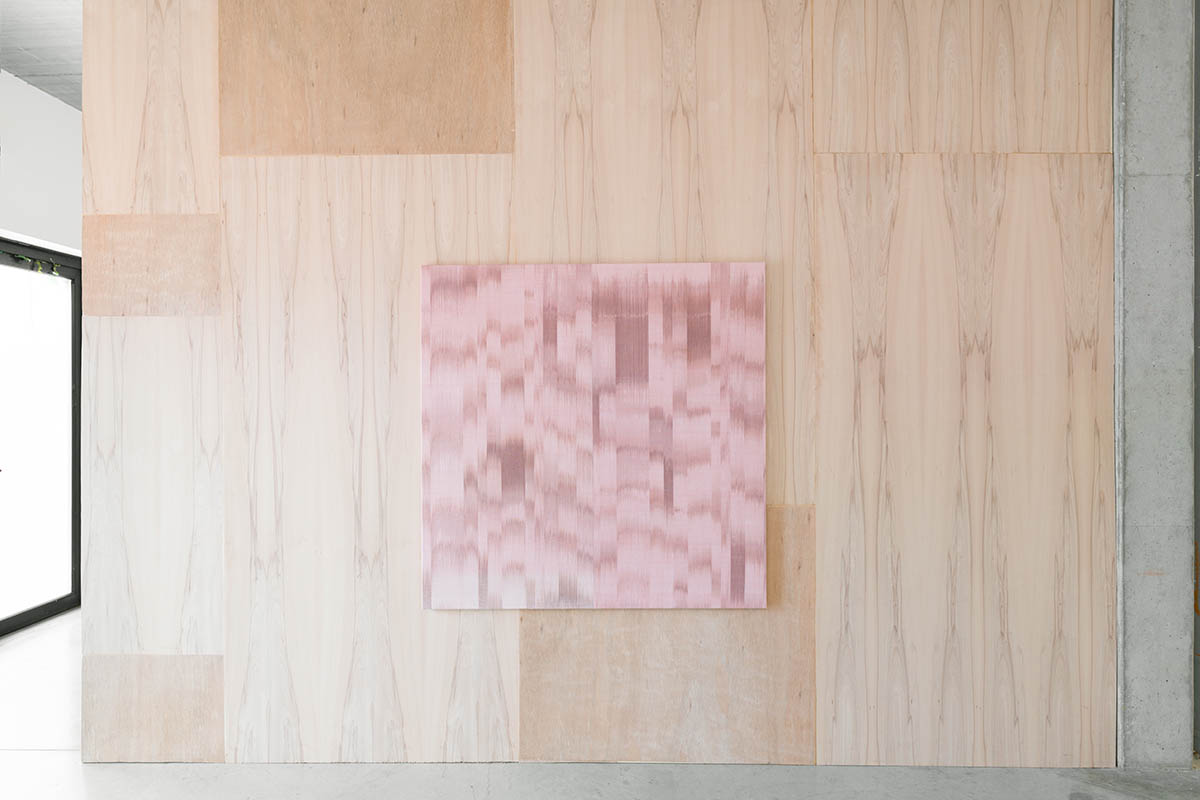
Yes. I built the benches myself in relation to the works. I cut the wooden panels along the tree rings; some are aligned horizontally with the pieces, others vertically. In 2025, I first built a wooden wall for an exhibition at WIELS Brussels. The work I was exhibiting back then felt very liquid, in flux—my works always feel like they flicker or slightly vibrate, but this one felt more fluid, extremely liquid. It felt like it could expand outwards, over the limitational borders of the square, and the wall I built continued the rhythms of the dye. The benches are there indeed to sit down, let the work sink in, and simply allow it to expand in front of you. Here at IKOB, I built another wall because of the spatial constraints. I had ideas going in, but once you see a space, you adapt to it. By then, I knew I had this one work with vertical lines and glitches running through it, and I thought, Maybe I can build a wooden wall with a vertical grain as well. So I went with the technician to the wood workshop, and there wasn’t enough wood. I couldn’t fully control which wood I got, because there wasn’t enough, and I had to accept that. The final wall created these patches, different wood fragments that echoed what is happening in the work itself. That piece creates a link across the different rooms—it ties into one overall feeling. I liked that it turned out different from what I expected, because in a way it repeats what the work itself does.
The IKOB Museum is careful to note in the exhibition text that your use of sustainable dyes isn’t meant as activism but as „self-evident material logic.“ Can you say more about why you resist the activist framing?
When people see my work, it’s first an aesthetic impression. You don’t immediately see all the layers behind it. You see an exhibition with a certain color palette, certain visuals, images, and so on, but you don’t see or hear me speaking directly about ecology. We use terms like „ecology,“ „feminism“, „care, „decolonization“, and so on. These words are definitely important; they carry meaning, but they become increasingly co-opted and overused. Of course, I think about these issues, but I don’t see my work as activism. It’s similar to feminism: I won the Feminist Art Prize there, and I am a feminist, but I don’t actively think about feminism while I work. It is present in a way because I use textiles, but on a very subtle level. Some artists make performances or create work that talks directly and conceptually about feminism as a theme. I don’t do that.
Do you think that’s also a form of protection? Feminism carries so many associations now—it doesn’t mean just one thing. If you called an artist in the ’60s or ’70s a feminist, people knew fairly precisely what that meant. Now these labels don’t function in the same canonical way they used to. So I understand wanting to shift the focus away from the original framing.
Yes. Feminism has evolved in many directions. The word has lost some of its power because it’s used so much. And yet, globally, we need feminism more than ever—which is insane in 2026. Everyone should be talking about it, as it affects every community, not only one culture or one specific social class.
Solo Exhibition: Celine Vahsen. SHIFTINGS
Exhibition Duration: June 23–November 01. 2026
Opening Hours: Tuesdays-Sundays 1:00 – 6:00 PM | Closed on Mondays.
Address and contact:
IKOB—Museum of Contemporary Art
Rotenberg 12/B, 4700 Eupen, Belgium
www.ikob.be
www.instagram.com/ikobmuseum
Céline Vahsen – www.celinevahsen.com, www.instagram.com/celinevahsen
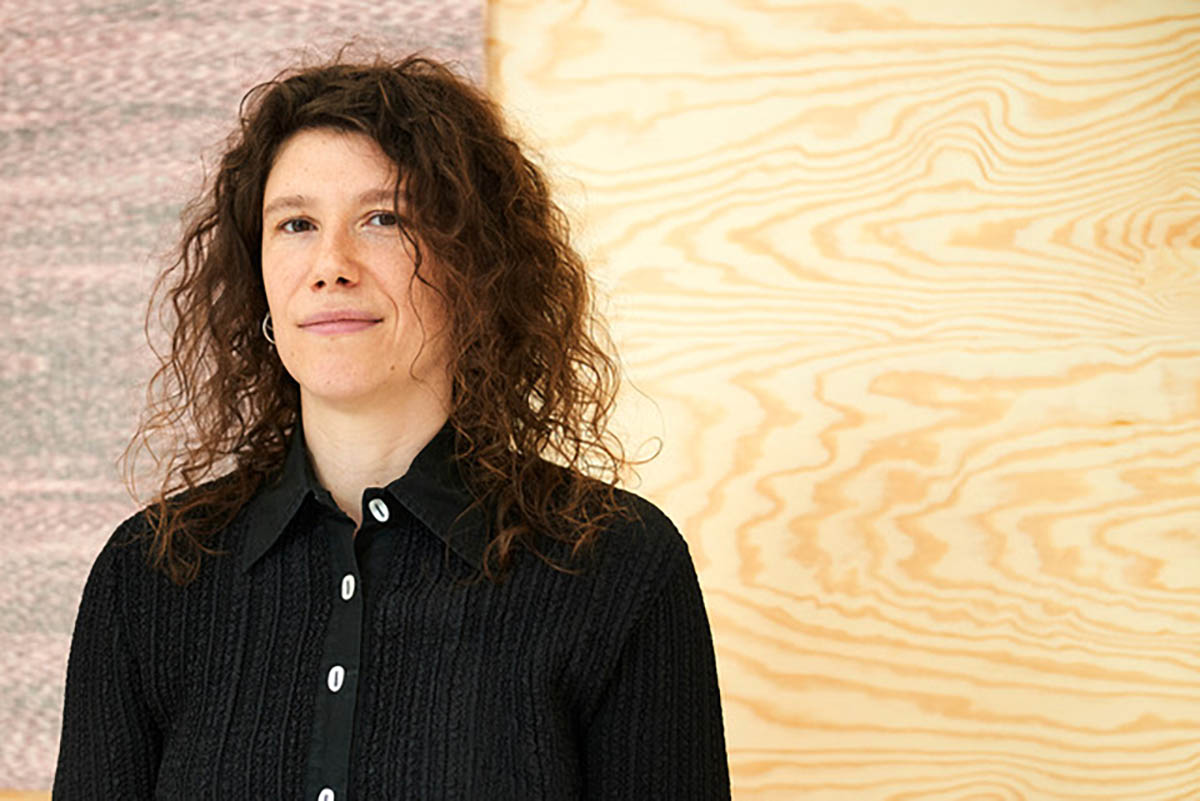
Céline Vahsen (°1987, BE) is a Brussels-based visual artist. Her work has been presented in numerous international group exhibitions, including the 21st Century Museum of Contemporary Art, Kanazawa, Japan; Marres, Maastricht, the Netherlands; Centrale for Contemporary Art, Brussels, Belgium; and the New York Textile Month, in the US. Solo exhibitions include E.A. Shared Space, Tbilisi, Georgia; Saarländische Galerie, Berlin, Germany; and Affiliate, the WIELS project room, Brussels, Belgium. In 2022, she also exhibited at IKOB Museum of Contemporary Art, Eupen, Belgium, where she received both the public and the 3rd Feminist Art Prize. Most recently, in 2025, she was artist-in-residence at The Mothership, Yto Barrada’s dyers’ garden and studio in Tangier, Morocco, as well as at the Cité Internationale des Arts in Paris, France, and at Thread—The Josef and Anni Albers Foundation in Sinthian, Senegal. Previous residencies include WIELS Contemporary Art Centre (Brussels, 2023), iMAL (Brussels, 2022), and CAB Foundation (Brussels, 2021). In 2019, she participated in the Académie des savoir-faire at the Fondation d’entreprise Hermès, Paris, France. Her education includes École Supérieure des Arts St-Luc in Brussels, Belgium (BA 2008), HGK – Hochschule für Gestaltung & Kunst in Lucerne, Switzerland (2007), and HAW Hamburg, Germany (2011-2012). She completed her visual arts studies in the textile department at ENSAV La Cambre in Brussels, Belgium (BA 2011; MFA 2013). Since 2018, she has been teaching at KASK School of Arts in Ghent.