In 1896, the Parisian physician Hippolyte Baraduc published a strange and beautiful book, The Human Soul: Its Movements, Its Lights, and the Iconography of the Fluidic Invisible. Baraduc believed the camera could see what the eye could not. The soul, he claimed, had been demonstrated: “it is experimentally proved that the soul exists, moves, conceives itself; that it is the luminous form of the creative spirit. The soul, therefore, moves and shines.” The silver salts of a photographic plate, he argued, “are converted, not only by what we call exterior solar light and by electric fulguration, but also by the intimate light of the soul.” To distinguish this from ordinary photography, he named his process iconography: in it, “the plate receives, very slowly, no longer by the solar ray… no longer the exterior light of the object, but what is called its internal light, its intimate soul, which it records.” He postulated a fluidic invisible and an Odic liquid that “saturates the organism of living beings and constitutes our fluidic body”. The plates he printed are blurry, comet-strewn smudges, captioned as soul-germs and life-animules.
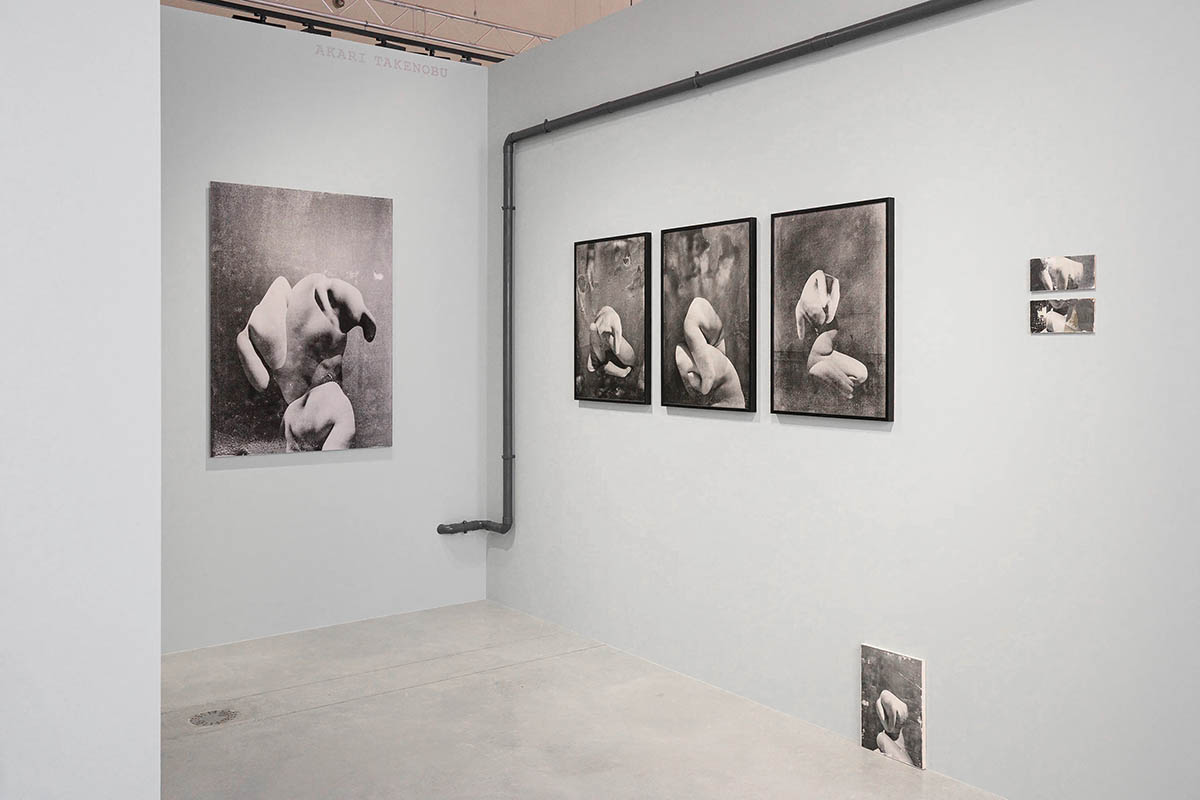
More than a century later, that dream is being reopened, patiently, by a twenty-six-year-old artist in Tokyo. Akari Takenobu (born 1993) is the winner of the ninth Dior Photography and Visual Arts Award for Young Talents, announced at Arles this July for her series Threshold, chosen from ten finalists among 300 dossiers from 24 schools worldwide. Her work was on view at La Lampisterie, LUMA Arles, until October 4, before travelling to OFFSCREEN Paris from October 20 to 25 and to a solo show at the Maison Européenne de la Photographie in early 2027.
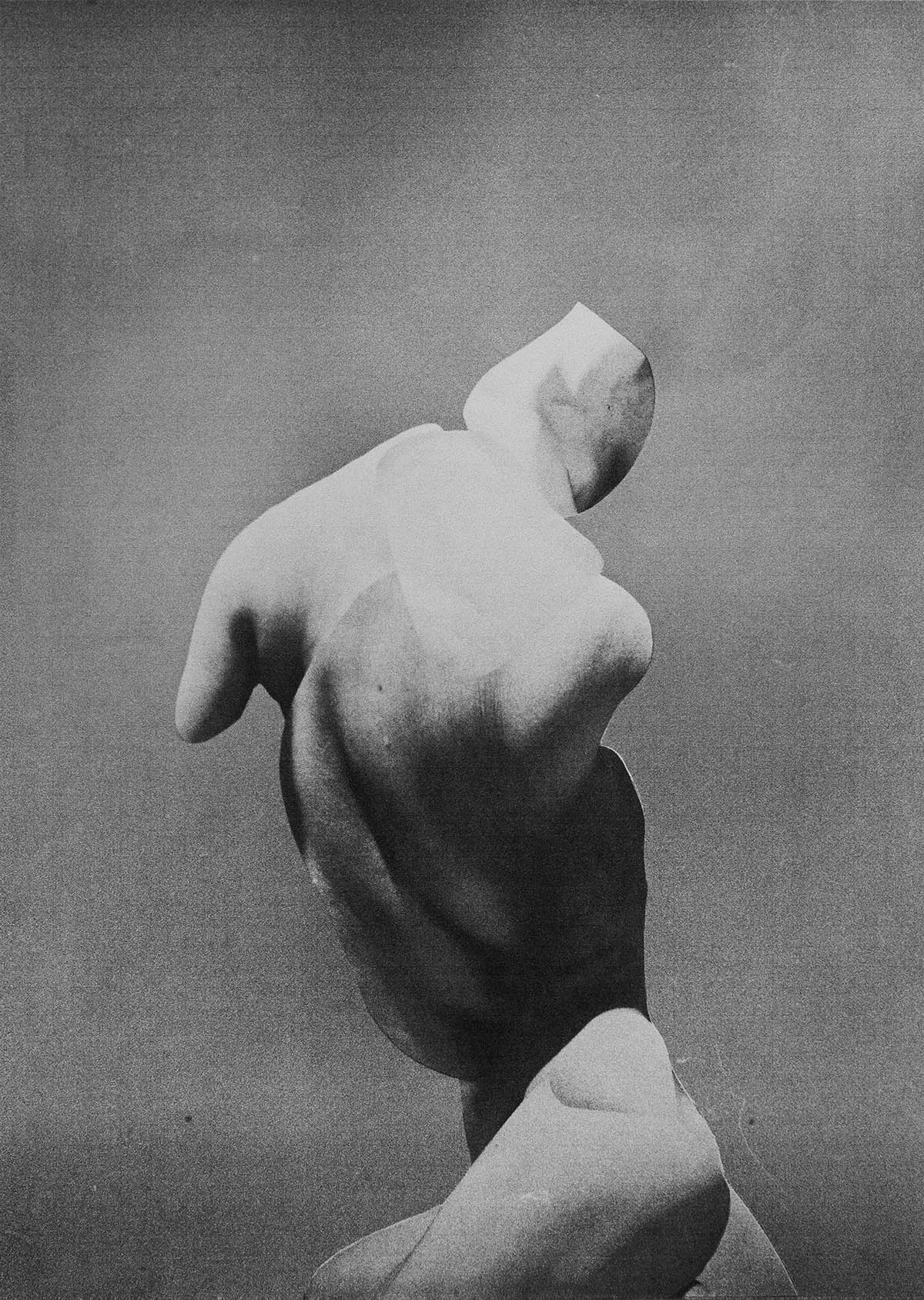
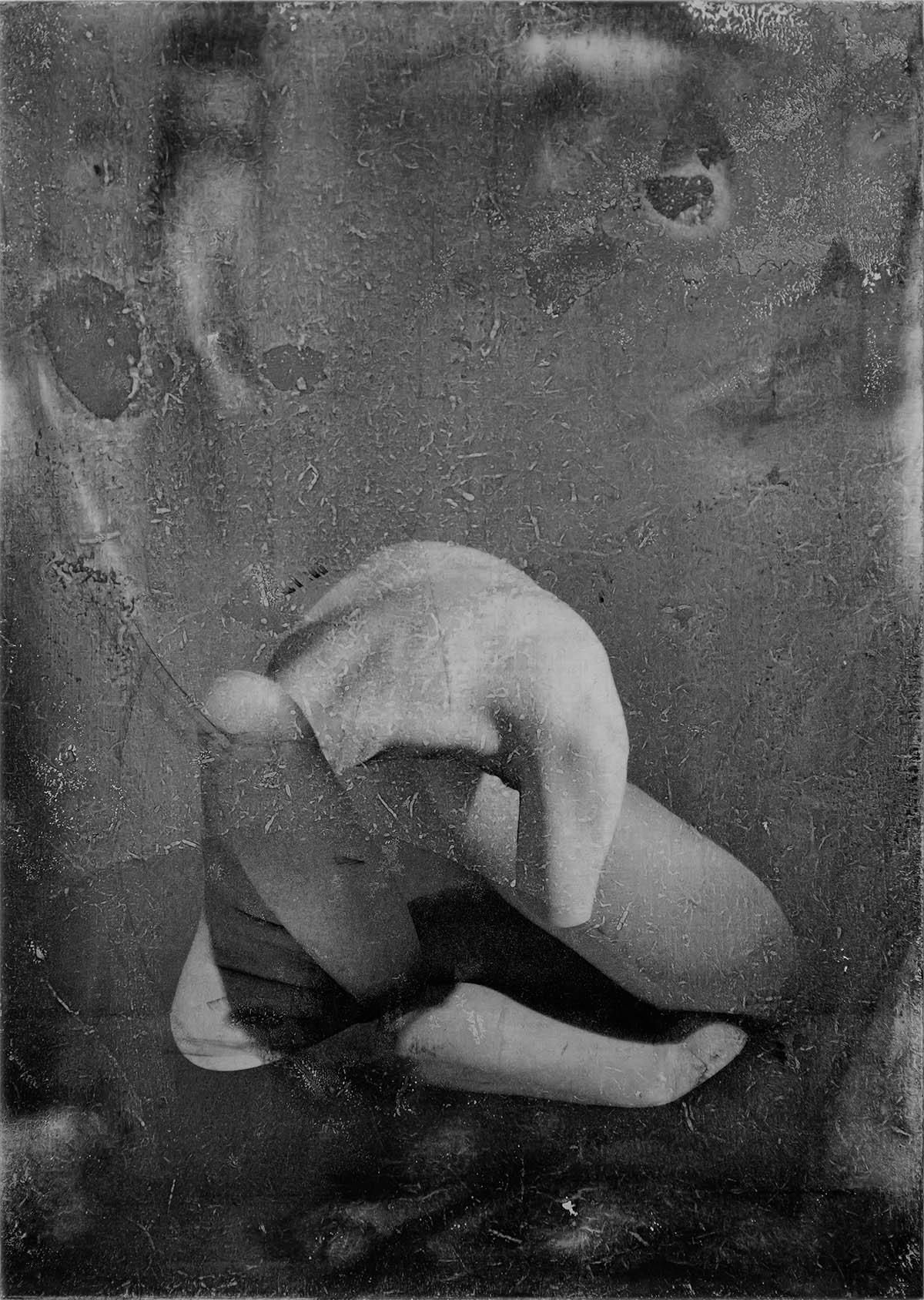
Threshold is a series of black-and-white images in which Takenobu never shows her face. She photographs her own body, cuts the prints apart, and reassembles the fragments into biomorphic shapes that hover between the look of mountain rocks and the microscopic biological plates. The process is circular: “I take hundreds of pictures of my body, disassemble them and cut them into pieces, and then reassemble them to create a digital collage. Then I print it, copy it, and again …” Each pass strips the body of a layer of matter. “Once photographed, the body becomes an image and loses some of its physical reality. I then fragment and reconstruct that image, creating a figure that remains visible but is no longer fully embodied. Through this process, I try to move closer to something ghostlike […] As a human being, there’s the physicality of my body existing as an object, so by removing that substance, the physicality, maybe I can get closer to being a ghost“.
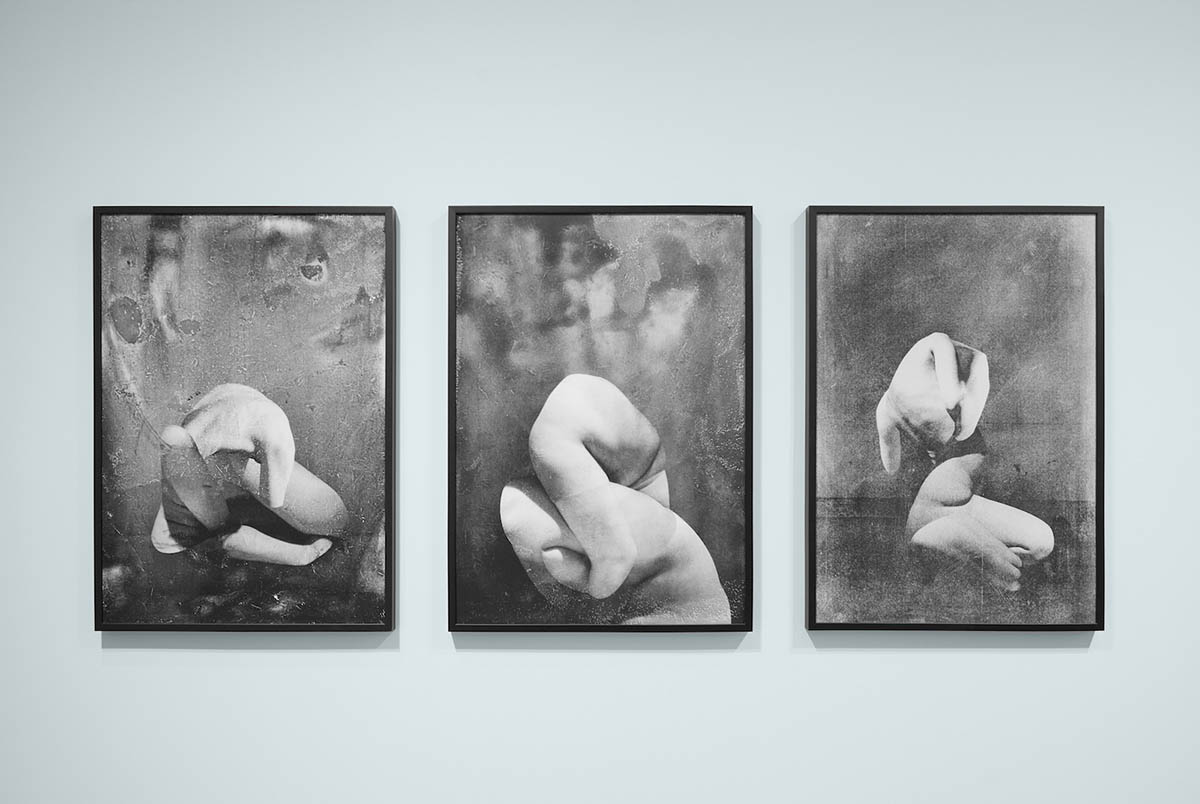
Takenobu’s figures recall the spirit photography that flourished after 1861, when the Boston engraver William Mumler discovered a ghostly extra beside his own self-portrait on a developed plate and went on to sell such apparitions, at ten dollars a sitting, to mourners fresh from the Civil War. The jury saw it too. Peter Philips, Dior Makeup’s Creative and Image Director and a permanent jury member, spoke of “a collision of several eras”, “a little old-school, a bit Man Ray”. But the truer ancestor is less Mumler the showman than Baraduc. José Bértolo and Margarida Medeiros, introducing a 2020 issue of RCL on ghostly media, describe two approaches of ghost photography: a first one, spirit photography, dominated by spiritualism in the United States and England between 1863 and 1880, Mumler’s figurative ghosts, and then a second phase:
dominated by theories of fluids and auras (Hippolyte Baraduc, Luys and David, Ochorowicz, among others), photographic representation becomes abstract and only vaguely figurative, and the images are understood as the depiction of the subject’s interior world, which is ‚directly‘ inscribed in photographic plates.
Akari Takenobu belongs to this later phase, that one might call an iconography of the invisible, as images claim to be less representations than emanations.
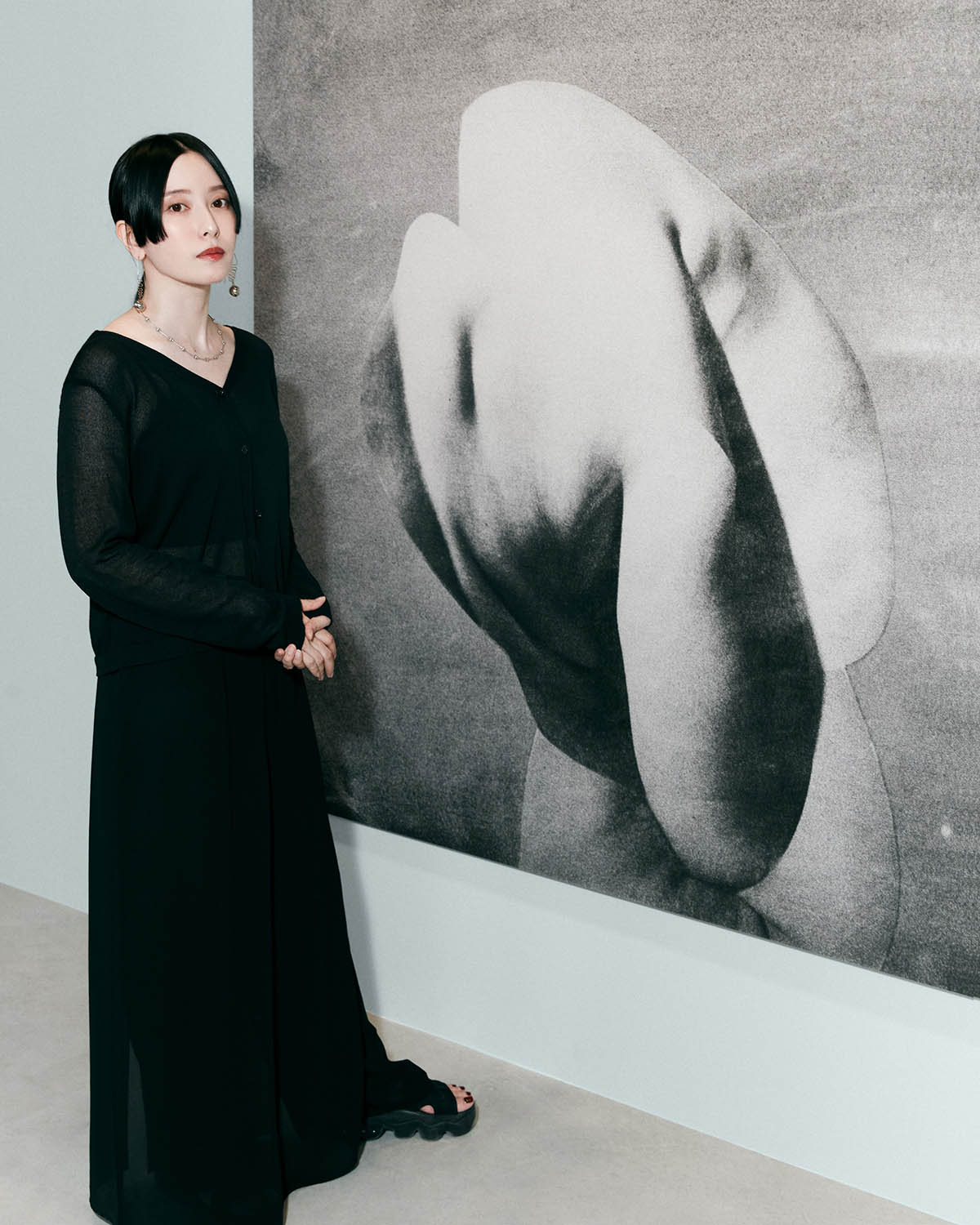
Still, the bodies are enormous. Larger than us, much larger; in a way, they are like colossi that would have to bend down to fit in the frame. They look heavy, and are ghosts made of matter, dense, pressed flat. Nothing here dissolves into mist, nothing, Mumler. I love their strength. In What Do Pictures Want? Mitchell claims images are not inert carriers of meaning but living things, things with “desires, needs, appetites, demands, and drives of their own”. The whole triad: idols want sacrifice. Fetishes want to be beheld, “re-attached to the body of the fetishist”. Totems? Totems want to be your friend and companion. Totems are the equivocal ones, not gods or ancestor figures; they are medium-sized things that bind a community, give names, regulate kinship, pull their power out of animals, plants, minerals, anything but the human face. The figures of Threshold behave in a way like contemporary totems. Made of an ancestor’s flesh (the photographer), so that each silhouette is at once hers and not hers, reconstructed into a form resembling a human figure, yet it is no longer identical to the original self. E-flux devoted an entire issue last year to the séance as a technology of the spirit, and Anton Vidokle put it plainly:
We live through a transformation of life and perception driven by digitalization, algorithmic automation, artificial intelligence, and in response, many contemporary artists are turning, once again, to mysticism, spirituality, and nonhuman ways of knowing to make sense of the present.
That is the strange warmth of Threshold, underneath the disquieting bending of limbs. The mystical here is a social relation. Takenobu’s photographs suggest that the unknown might keep us company. We are not alone!
Group exhibition: Dior Photography and Visual Arts Award for Young Talents 2026
Venue: LUMA Arles, Arles, France
About the exhibition: www.offscreenparis.com/artists/araki-takenobu
Akari Takenobu – www.at-threshold.com, www.instagram.com/at_hazama/
Text by Louise Bouvet-Zieleskiewicz – www.instagram.com/loukiewicz