



While science and technology form our shared world, ‘culture is a natural arena for confrontation, since it is a forge of identity, and in turn, presupposes a minimum of dissent‘(…).1
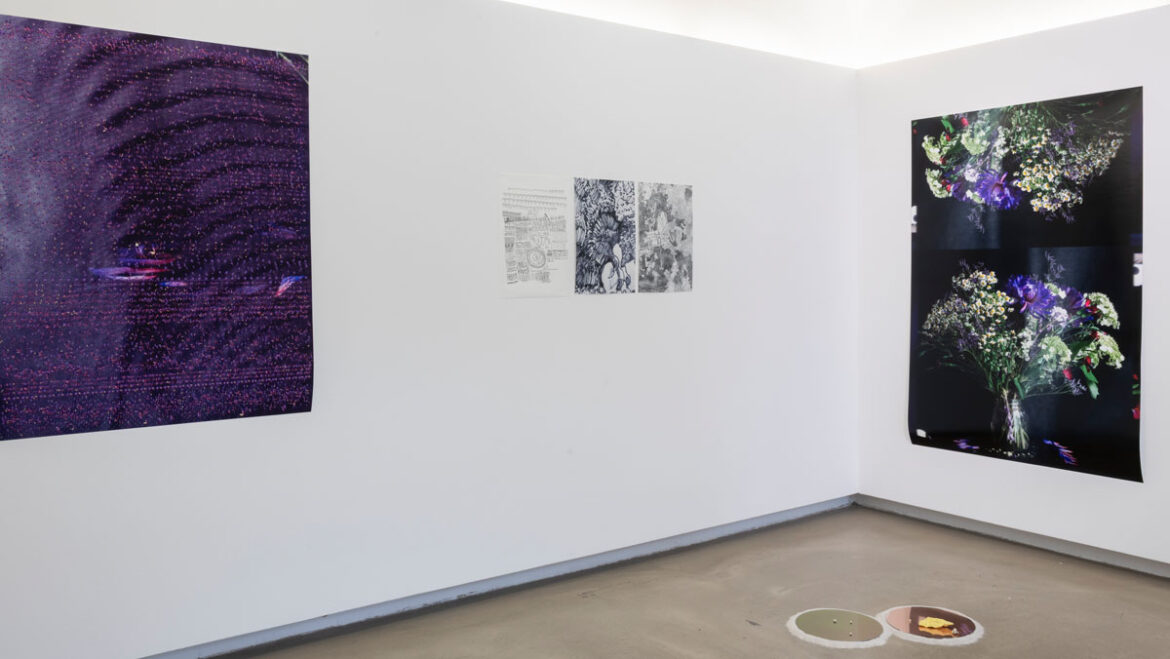
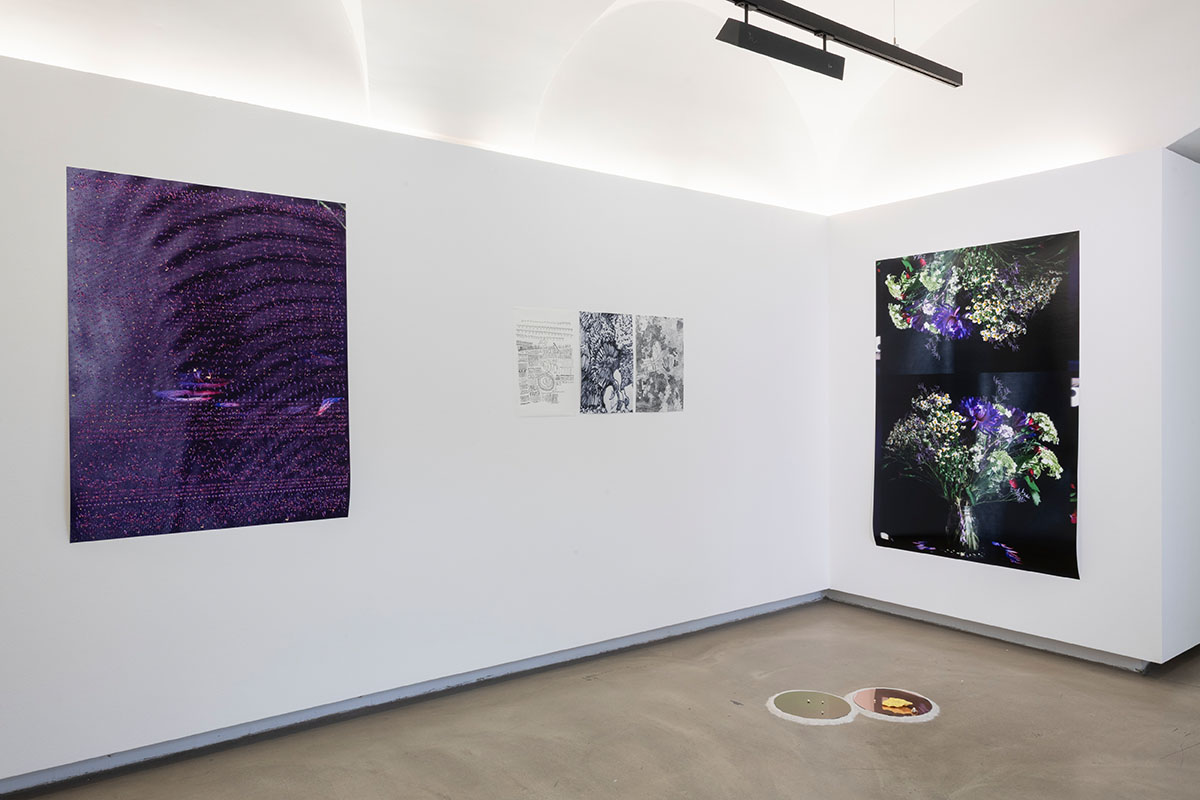
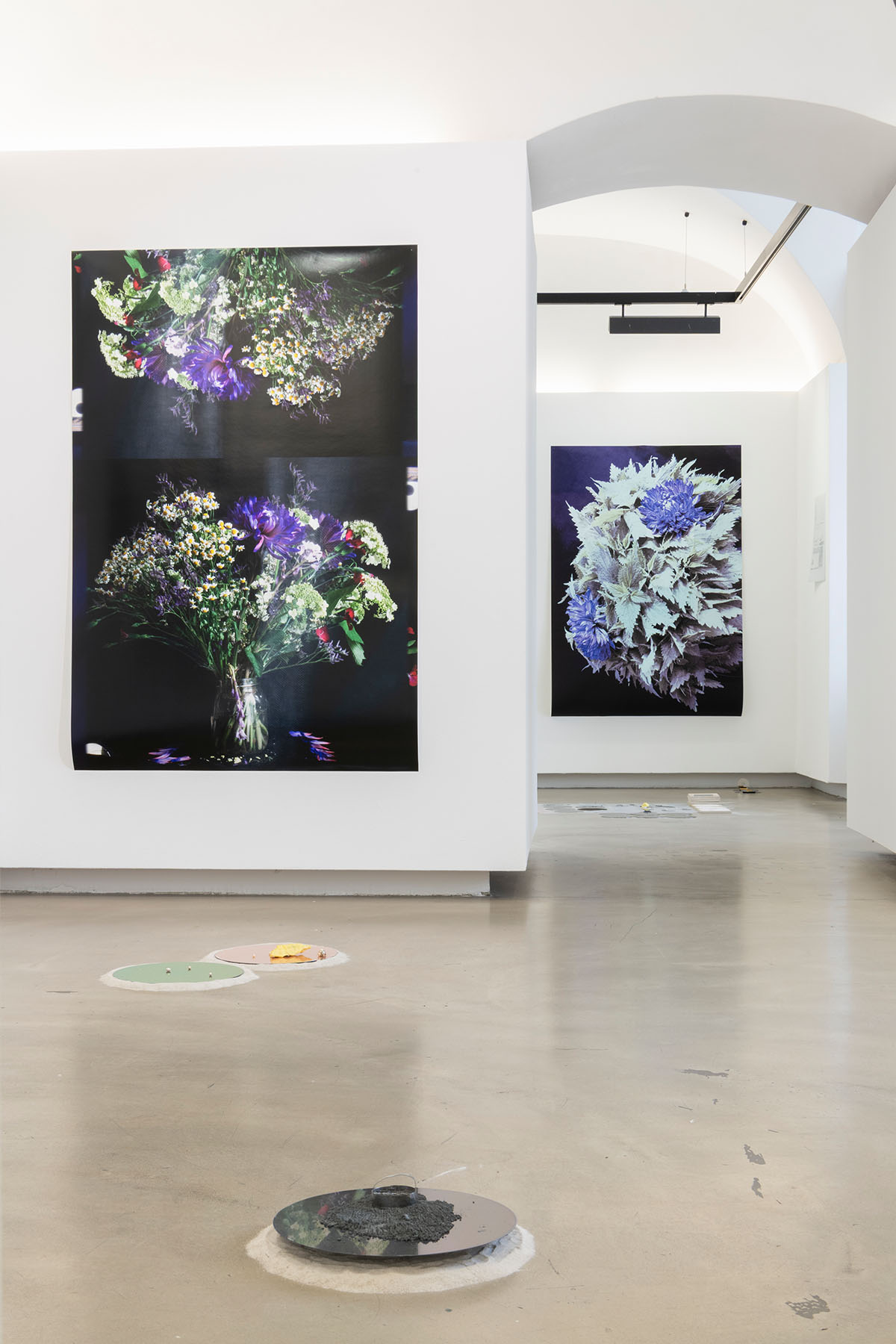
The exhibition is centred on several large-format still-lifes depicting bouquets of flowers, which also serve as a starting point. Initially, we see the work Anasa, a classic floral still-life. It is the act of arranging and designing the bouquet itself that particularly appeals to Stern about this motif—the shapes, colours and rhythm involved in tying a bouquet. The work belongs to the classic art-historical tradition of the floral still-life; on the one hand, the cultural significance of the bouquet lies in nature’s generosity, while the superiority of humanity over nature is embodied through the depiction of different flowers with contrasting needs.2 Floral still- lifes from the Dutch Golden Age symbolize the power of technology—expressed via the cultivation of plants as well as painting itself—and seek to transcend the boundaries of the natural world.3 Stephanie Stern made a rather unusual choice for her still-life Anasa: the nettle, which, due to its stinging properties, is not suitable for touching or arrangement, thus contravening the very principle of order inherent in a bouquet.
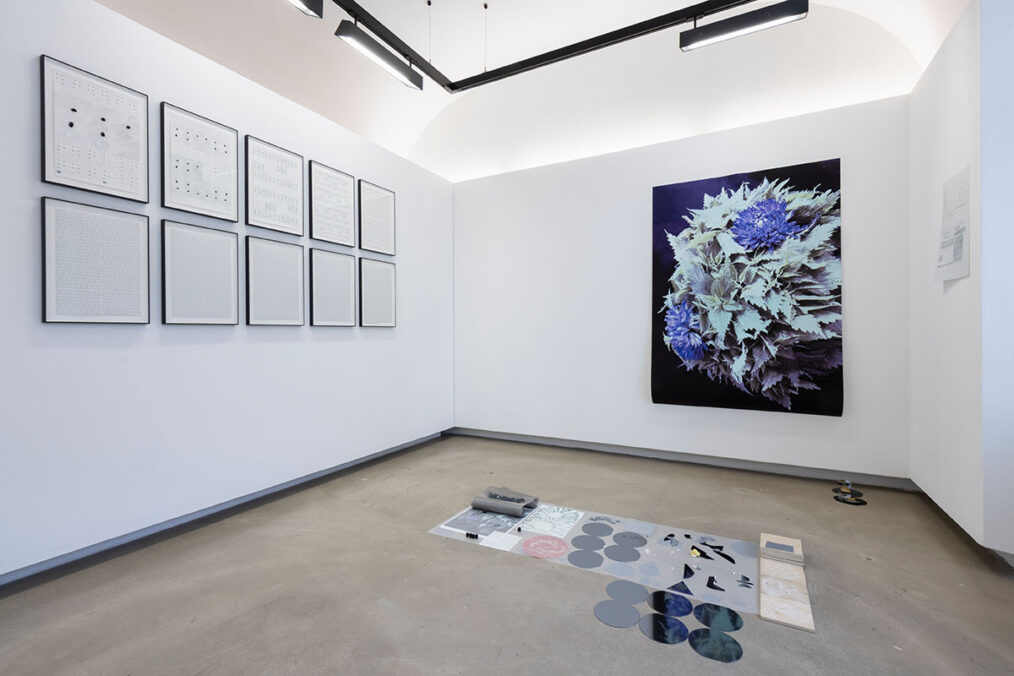
The black background offers no visual distraction for the viewer, leaving no opportunity for inferences about the surrounding space. The image’s high-resolution photography and monumental scale also draw the viewer’s gaze to any subtleties, details and imperfections that may often be hidden. At the bottom of the image, single petals are arranged in a row, as a subtle allusion to the suffering of the two purple ornamental flowers, which are struggling to survive among the stinging nettles. They are complemented by a reflective disc, a silicon wafer, which refers to the artist’s philosophical and material research in her practice. While classical still-lifes exclude any human presence as well as the concepts of order and value established by human beings4, Stephanie Stern signalises her enduring presence with the wafer. Taking Anasa as its centrepiece, the exhibition unfolds in two distinctive ways: through the assemblage that Stern has installed on the gallery floor in response to the photographs, and through the other still-life works on the walls.
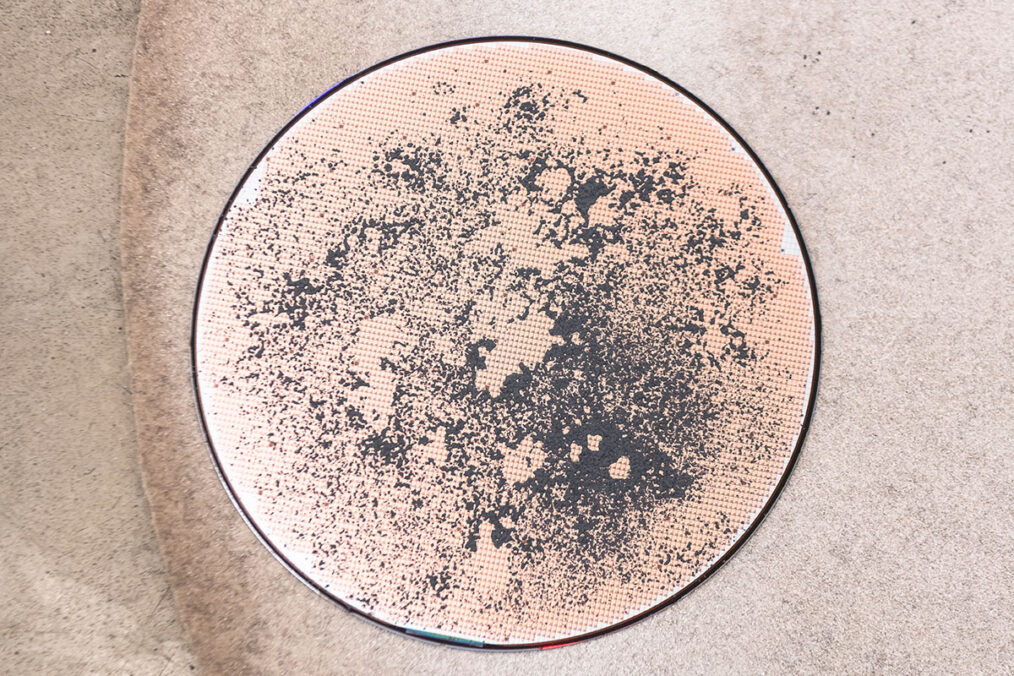
While the photographs in the first room of the exhibition correspond to the classic still-life genre, the works in the subsequent rooms increasingly reflect Stephanie Stern’s artistic practice of deconstructing photography as a medium. New forms of still-life emerge here by means of translation, reflection, repetition, dissolution and compression. In the piece Saana in the rearmost gallery room, the artist has sought to push the deconstruction of photography to its limits by translating the original image into geometric forms and totally compressing its information onto a flat surface. Stern sees image-creation as closely linked to a process of selection from infinite possibilities, order and play. The reordering and reorganization of images, as in Letter to the Nettle or Hithë-Felder, demonstrates the human impulse to arrange and systematise things. The genre of Dutch floral still-lifes occupies the same theoretical field from which cabinets of curiosities emerged: their purpose was to highlight differences, similarities, and fundamental patterns by collecting and arranging natural objects.5
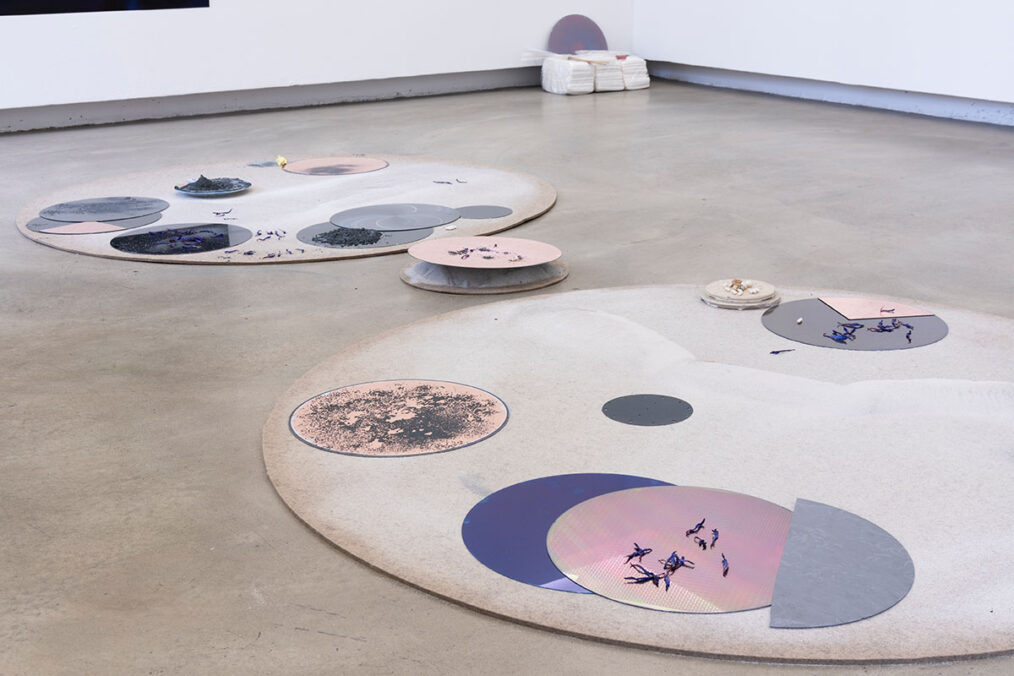
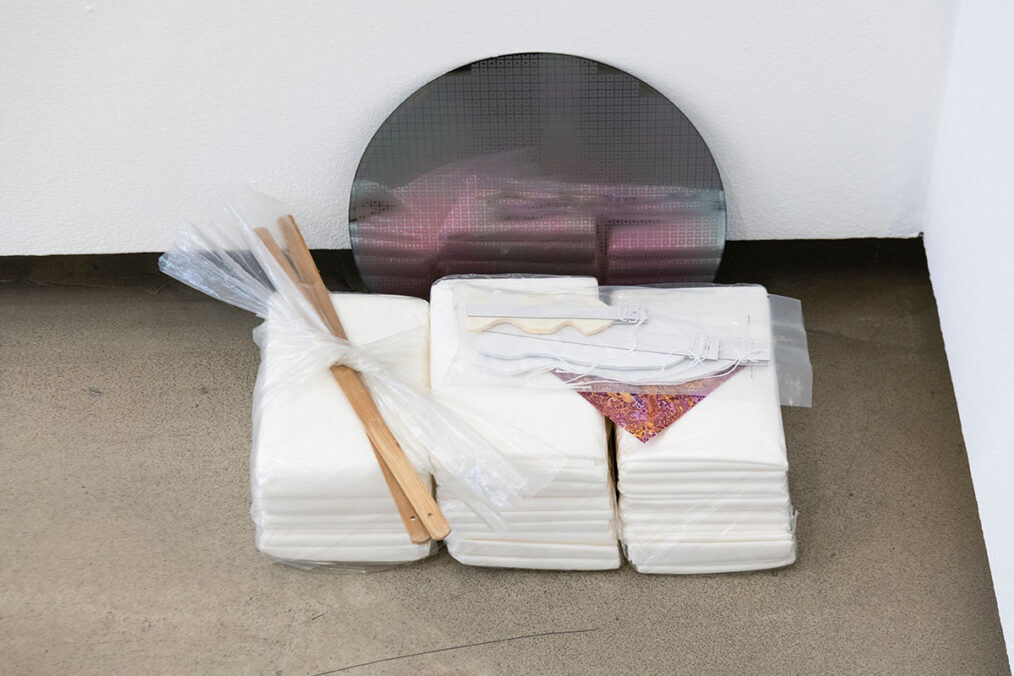
In Stephanie Stern’s assemblage Orders of Glass, created with help from Rozafa Elshan, fragments enter into a direct dialogue with one another, opening up new connections and interpretations, both between the individual elements of the assemblage and in relation to the still-lifes hanging on the walls. By arranging individual objects and different materials embedded within a bigger system, attention is drawn to the encounters, collaboration, and potential transformations of the integrated objects. In addition to materials such as raw wool felt, fabric mesh, disposable cloths, sulphur and wooden beads, as well as artworks by fellow artists (Iklim Dogan, Jamile Azadfallah and Nino Svireli), the assemblage also includes quartz sand, silicon wafers, and molybdenum. The last three elements are closely related to photo-lithography and the semiconductor and chip industry: high-purity silicon is extracted from quartz sand, and used to manufacture silicon wafers—a precursor to microchips, while the transition-metal molybdenum is used as a key material in various manufacturing and coating processes in the semiconductor industry. In the context of the exhibition title Under Pressure. ΔS – Orders of Glass, quartz sand, silicon wafers and molybdenum appear as materials of technological order production. Energy-intensive processes are used to generate precise microsystems from amorphous or loosely structured raw materials. Thus, the change in entropy evoked in the title refers to the permanent transformation of matter into technical order. The dietary supplement capsules containing molybdenum serve as a reminder that these industrial elements are not only encountered daily in technology, but also occur in nature, and even in our own bodies.
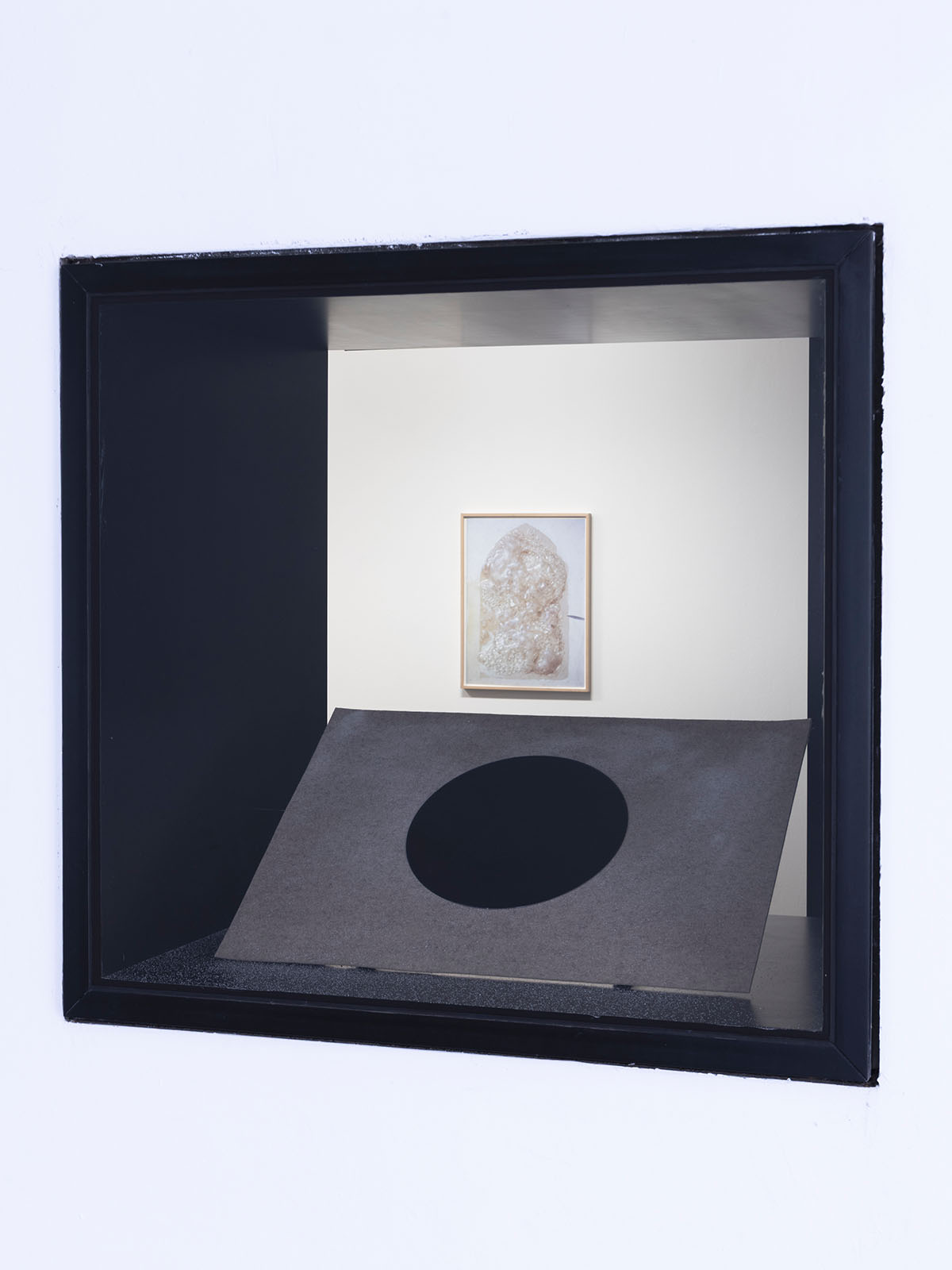
The exhibition is complemented with a number of the artist’s drawings. These often develop from the physical experience of drawing itself, being intuitive and shaped by the gesture of writing. Drawing enables Stern to form and organise her thoughts and inner structures, as well as to visualize patterns and movements, order and chaos. Stephanie Stern understands patterns as an expression of natural and cultural processes and structures. They generate meaning and so help us to make sense of the world. By deconstructing and reconfiguring patterns, the artist encourages us to question our individual perception of structures.
In the exhibition Under Pressure. ΔS – Orders of Glass, Stephanie Stern explores the concept of entropy and, thus, the question of how order and disorder are interdependent. Just as the microchip, characterised by extreme order within the smallest of spaces, does not dissolve its entropy but resets it—into energy, into material, into the processes behind its generation.
Exhibition: Stephanie Stern. Under Pressure. ΔS — Orders of Glass
Curator: Bettina Siegele
Exhibition duration: 13.06.2026 – 08.08.2026
Address and contact:
Künstler:innen Vereinigung Tirol*
Neue Galerie
Rennweg 1, Großes Tor, Hofburg, 6020 Innsbruck
www.kuveti.at
Stephanie Stern – www.stephaniestern.net
Stephanie Stern (born in Austria in 1986) lives and works in Vienna. She studied at the Academy of Fine Arts Vienna, the Slade School of Fine Art in London and the Friedl Kubelka School in Vienna. Her works have been shown as solo exhibitions at venues including the Gabriele Senn Gallery in Vienna and the RLB Atelier in Lienz. Working with drawing, photography and assemblage, she explores the relationships between material, form and image, as well as our perception of the material world. Through processes of translation between different materials and visual systems, such as photolithography, she investigates how these relationships change, shift and are rearticulated. Stephanie Stern has recently been recognized the Prize for emerging artists by the State of Tyrol (2026) as well as one of the two sponsorship awards of the RLB Art Prize (2024).
- Based on a free translation of: Hans Belting, Florenz und Bagdad: eine westöstliche Geschichte des Blicks, Verlag C.H. Beck, 2012, p. 15. ↩︎
- Norman Bryson, Looking at the Overlooked: Four Essays on Still Life Painting, Reaktion Books, 2018, p. 104. ↩︎
- Ibid., p. 105. ↩︎
- Ibid., p. 60. ↩︎
- Ibid., p. 107. ↩︎