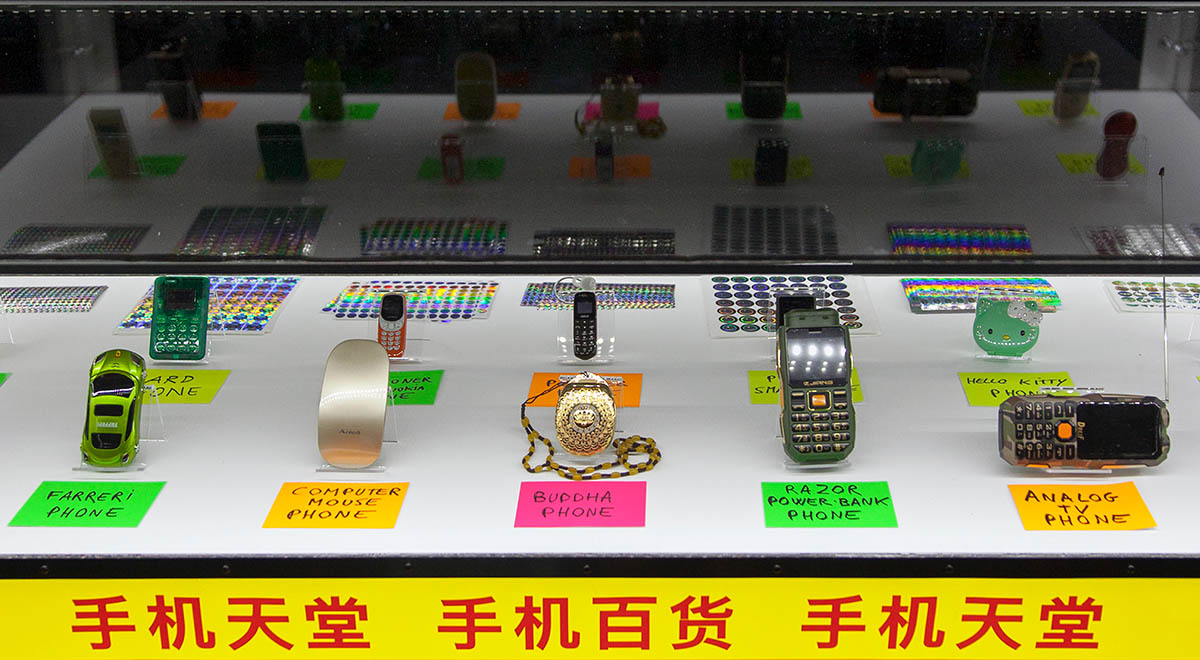
The title INDUSTRIAL: Seidenstraßen 3000 feels very far away but also very „now“ in a sense—very space-odyssey-like, but also very graspable. With “INDUSTRIAL“ we get a frame of understanding; there is a focus on Seidenstraßen: Silk Roads, and then the „3000,“ which I’m guessing refers to the year or the next millennium we’re about to enter.
„INDUSTRIAL“ has a double reference. It belongs to a series of projects I started with Thibaut de Ruyter, beginning in 2013, with a tour through five industrial cities in Poland with a film program we prepared. The series continued with an exhibition at HMKV on the sixth floor of the Dortmunder U called INDUSTRIAL (Research) where we looked at the afterlife of industry. Why, for example, did industrial music develop in those places that lost their industry? At that exhibition, we exhibited mostly research materials, with only one or two actual artworks. That also resulted in a publication.
Each project came with a small pocketbook. The publication we’re now preparing for INDUSTRIAL: Seidenstraßen 3000, the third part of the trilogy, will have the same format, also a pocketbook, and it’ll fit the design of the previous two books. We created a slipcase where anyone interested can get all three publications together.
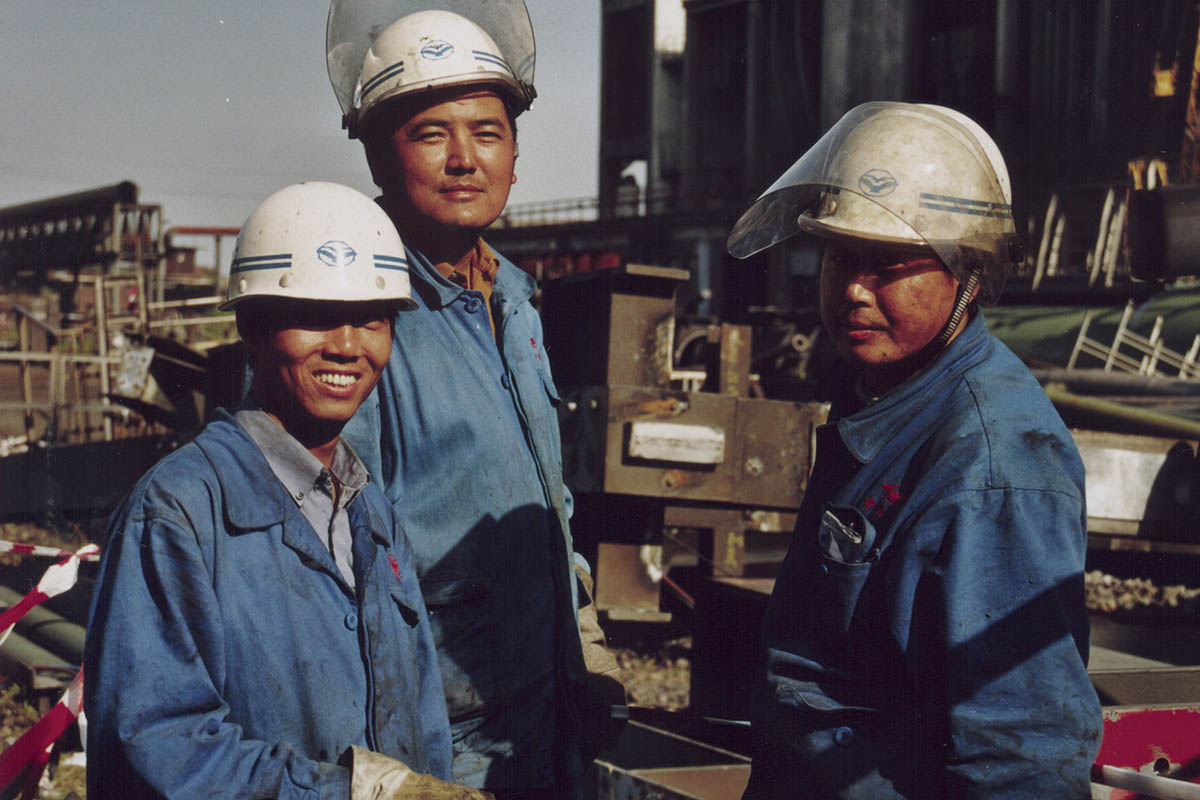
„INDUSTRIAL“ also indicates that we’re not interested in any romantic, historical, or orientalist association with the Silk Road. We’re really looking at the new reality that’s been developing for over ten years now. Since 2013, China has been investing heavily in this giant new global infrastructure. I’m quoting Peter Frankopan, the British historian who’s written at least two books on the history and contemporary situation of the New Silk Roads: „The ‚New Silk Roads‘ are the largest infrastructure project of all time.“ And another quotation I really like: „Once upon a time, all roads led to Rome. Today, they lead to Beijing.“1
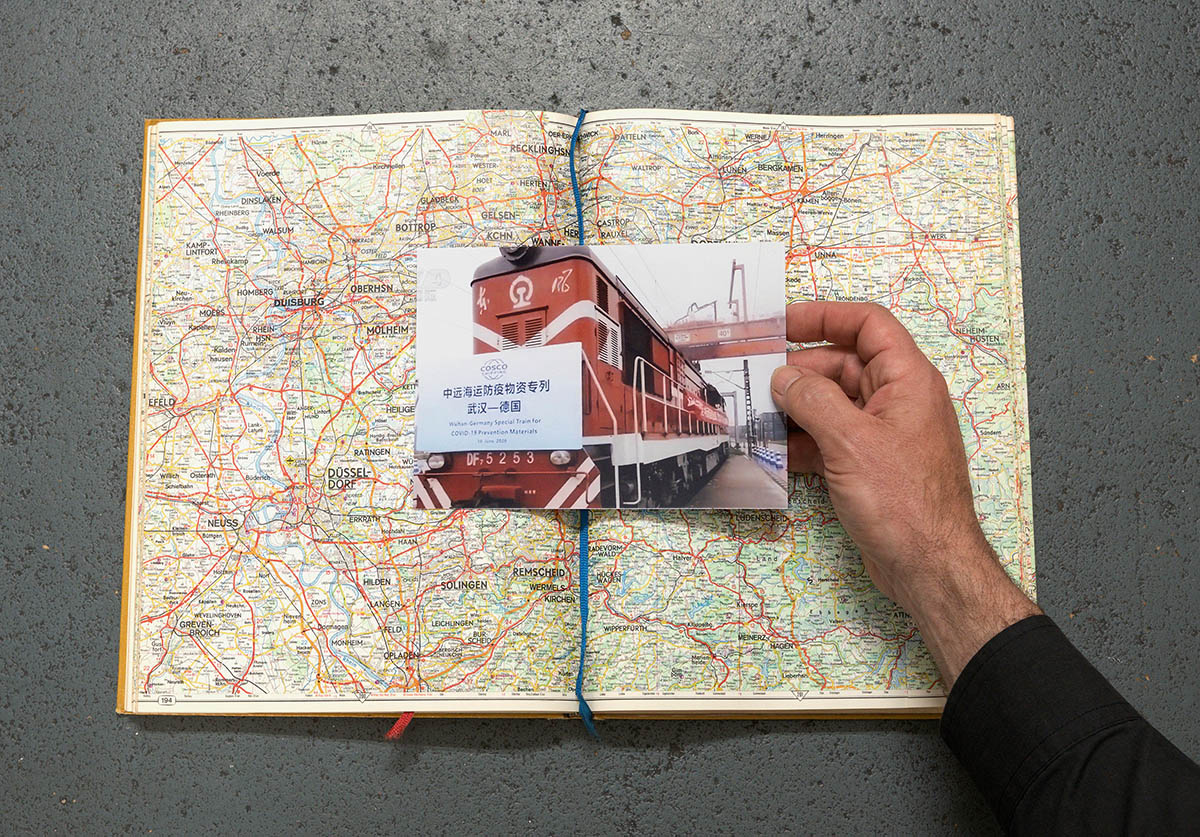
The starting point was realizing that the Ruhr, or more precisely, Duisburg, is actually located at one of the endpoints of the New Silk Roads, where the cargo trains are unloaded onto ships, and from there the goods continue to be distributed to Western Europe. So it is important to note that the exhibition is not about China, but we are looking at the local and also a very broad picture of the Silk Roads in the world.
We selected artists along those new roads. We always talk about the Silk Roads in the plural, because there has never been just one road. It was always different roads, different routes. And nowadays, those routes are changing depending on where passage is possible. Let’s say the route has recently been shifting toward the south because of Russia’s war against the Ukraine; that obviously has to be avoided. And then „3000“ — of course, „3000“ is more like a joke; the year 2000 already happened, so the title is supposed to point to the future.
There is a wide range of artists coming from different regions along this route. I’d say I couldn’t really draw a clear A-to-B relation; it’s more like a map of really intertwined relationships between the countries the artists come from, or where the artworks are made. It’s not really a clear line. For me, it was more about getting to know all the different ways things get brought to us, and how many possibilities there are. There are 23 artistic positions in the exhibition, coming from, by my research, 16 different countries.
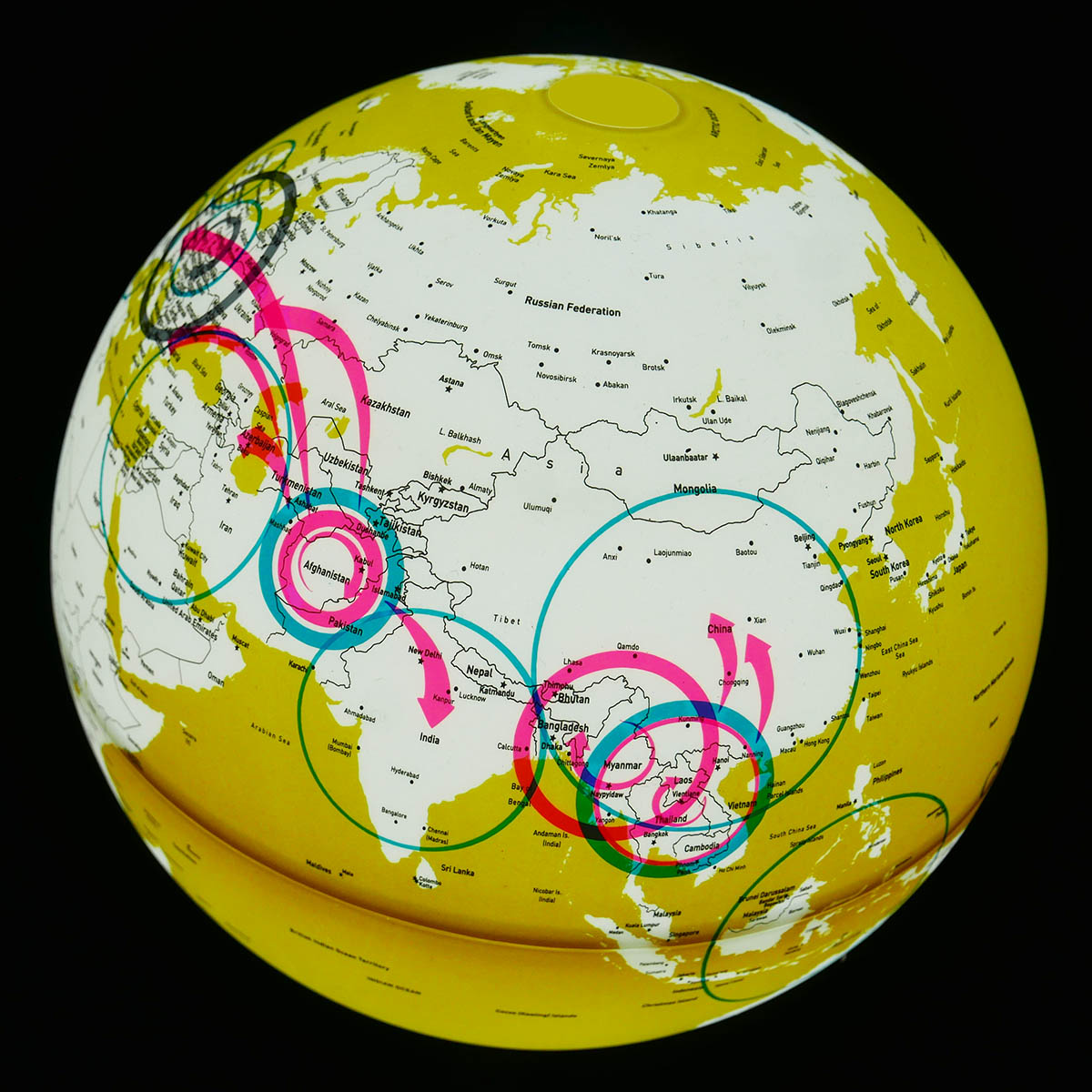
At the entrance, we will start with a customized “map”. Not showing lines of the road, but showing individual dots. We distributed the artists on this map according to the places they address in their work: where they recorded video, or which location the work is talking about. Sometimes the dot represents almost the whole country, like eastern Uzbekistan; sometimes it’s a very concrete place, like the Baku–Tbilisi–Ceyhan pipeline port in Turkey, south of Istanbul. That was a big challenge, figuring out all the positions on the „map“.
You may have heard that this topic was the original proposal for this year’s Manifesta Biennial. When the Manifesta Ruhr developed in a different direction, I thought it would be such a pity to not address this topic of the New Silk Roads. In conversation with the other nine initiators of the Manifesta Ruhr, I decided that the Kunsthalle Dortmund would make this exhibition. I approached Thibaut de Ruyter, who knows the art scene in Uzbekistan and Kazakhstan very well. We’ve both spent time in Central Asia, the former Soviet Union, and Central and Eastern Europe in general. One of Thibaut’s recent exhibitions, „The Name of Samarkand,“ in Samarkand in Uzbekistan. In 2017, we made an exhibition commissioned by the Goethe-Institut Moscow, with artists from almost the entire former Soviet Union. It was entitled “Die Grenze” (The Border). The exhibition looked at the question of where Europe ends and Asia begins (and the other way around). That exhibition traveled to eleven venues in eight countries—Russia, Ukraine, Georgia, Belarus, Germany, Kazakhstan, Uzbekistan, and Armenia. We both have traveled a lot in these regions; it’s been really our long-term interest.
What was the first choice of the work that might become the foundation for the exhibition?
I remember we started not with a single work but rather with a list of works; it was important for us to include artists along the Silk Roads, looking at the realities in different places. For example, there are some older works: Already in 2006, in Kyrgyzstan, Gulnara Kasmalieva & Muratbek Djumaliev made a work about the topic of the Silk Road; back then, the notion of the “New Silk Roads” didn’t even exist yet. In their case, the challenge was technical: how to translate a five-channel video installation from 2006, with a lower resolution, into today’s higher-resolution viewing habits.
There are also works by two artists from Düsseldorf, Katja Stuke and Oliver Sieber, who very early on became interested in the topic of the Silk Roads. They were on a residency in Chongqing and realized they were at the end (or the beginning) of the Silk Road. That resulted in a photographic series and videos about Chongqing and the Silk Road. I found it important to have a work in the exhibition that deals with cartography and globalization. We therefore decided to invite Ingo Günther, who’s been working on a series titled World Processor since 1989. He looks at statistics issued by international organizations, and visualizes these on globes as objects or sculptures. We’re presenting a selection of approximately 20 globes hanging from the ceiling, and each of them displays different kinds of data about globalization. Usually, buying a globe is costly, right? Ingo told me that he started working with those globes in 1989 or 1990, after German reunification, because suddenly all those globes available in Germany became worthless because there weren’t two countries anymore, the Federal Republic of Germany and the Democratic Republic, just one reunited Germany. So that’s when he started buying his first 300 globes.
Sometimes artists you know from your local context come up with something unexpected. Like, for example, Zauri Matikashvili, a Georgian artist who studied at the University of Fine Arts Münster whom I’ve known for a long time and worked with before. It turned out he made a work about his father, who actually does business on his private Silk Road, so to speak.
Is his father a tradesman?
Yes, he’s a trader between Georgia, Germany, and the Netherlands, buying used car parts, or all kinds of used goods, and transports them to Georgia to sell them there. So for the last 30 years, Zauri’s father has constantly been (and still is) on the road. One trip from Germany to Georgia is 4,800 km long. That’s what Zauri’s short video is about. You could say that Zauri’s father runs a sort of Silk Road in the opposite direction, from the West to the East. Suddenly, these and other links pop up that show us how the goods we buy (many of them) come via the so-called New Silk Roads.
The quality of the goods we buy now is in question. Back in the day, what made it special to buy or own the products coming from different continents was mainly lying in their immaculate quality, the attention to detail, craftsmanship, manufacture, and the art of it. Now, globalization has flipped that; quality sits at the opposite end of the chain. Can you give us an example of that notion of manufacture in some work in the exhibition?
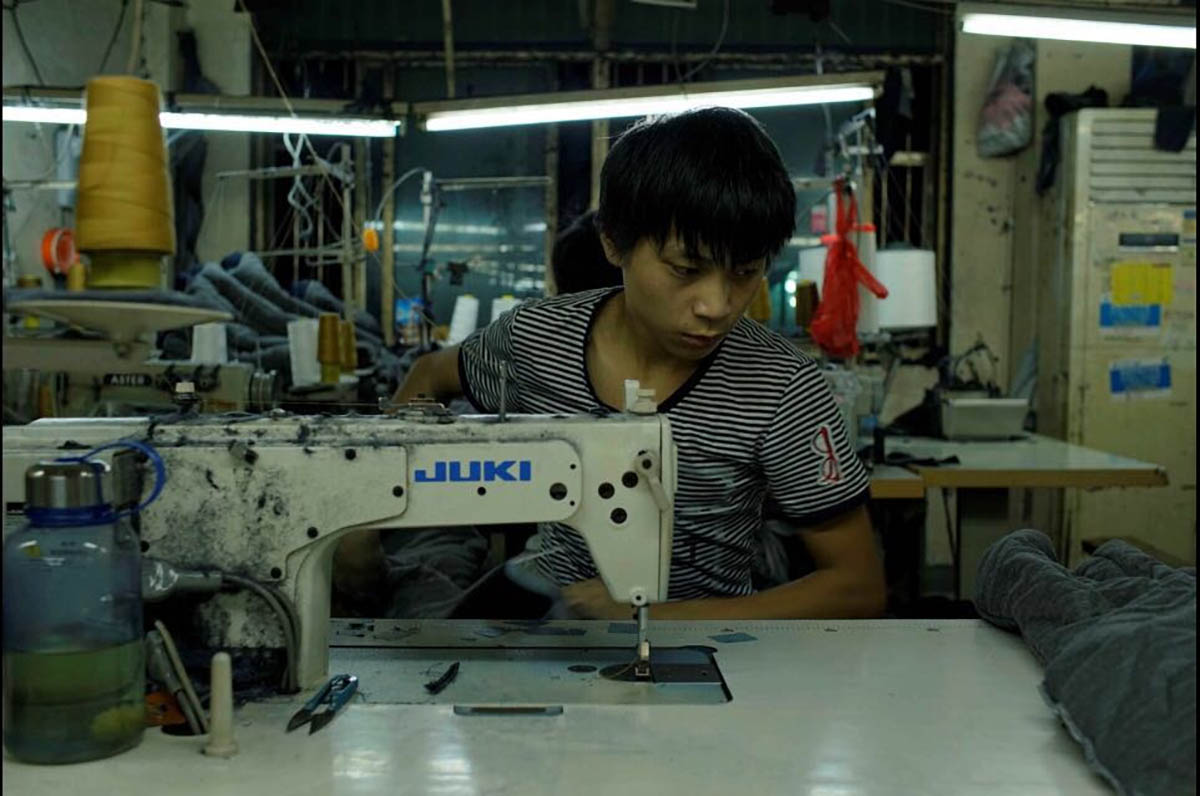
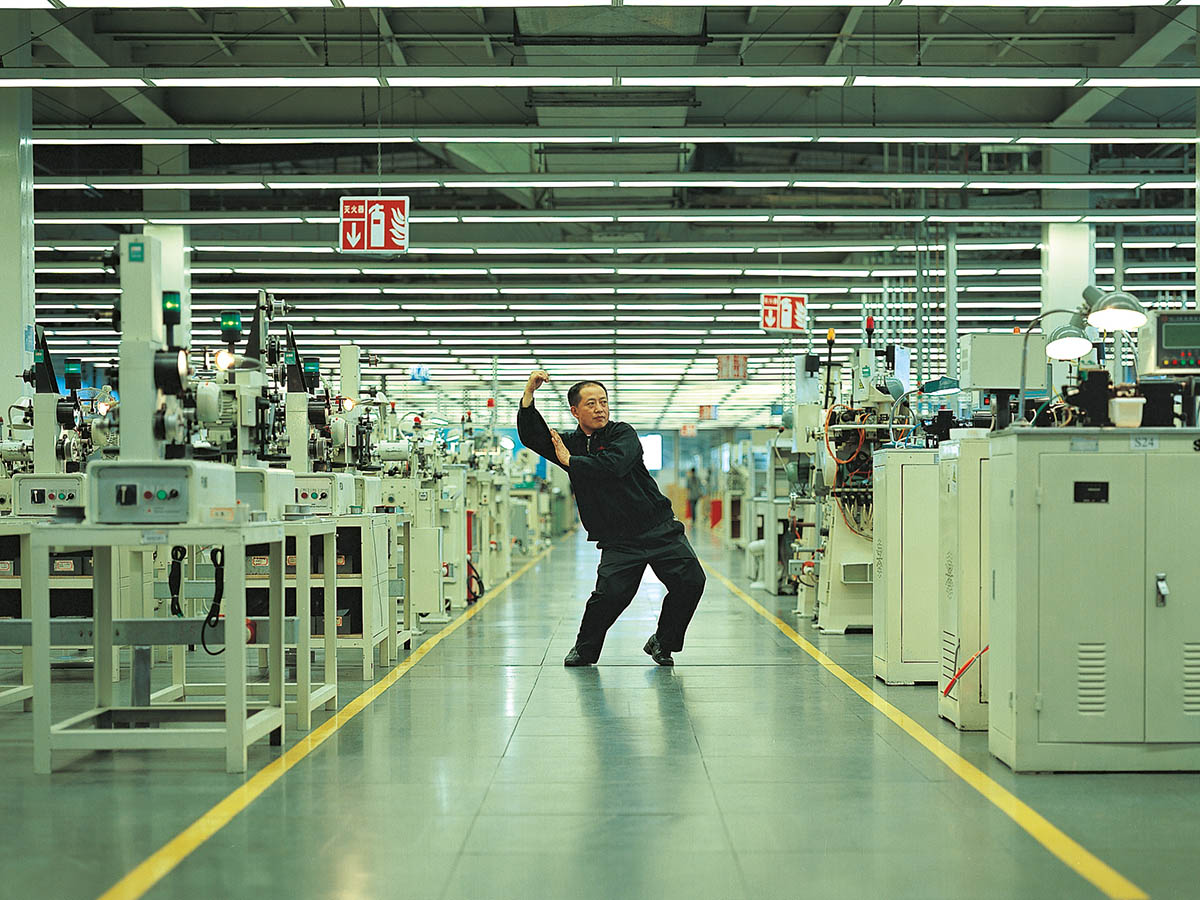
We included a film by the Chinese documentary filmmaker Wang Bing. The work 15 Hours (2017) is actually 15 hours long. It documents one full working day of several workers in the textile industry in China, specifically at the company producing children’s clothing. There’s no commentary in the film; it simply starts in the morning and follows the workers at the sewing machines. You just hear the noise; it’s noisy the whole day. It documents the entire working day, which is 15 hours.
Not to forget, the topic of logistics is also super important for the Ruhr region itself. Following the decline of the mining and steel industries, logistics was poised to become the region’s major new employer. The Ruhr region offers significant locational advantages for this purpose due to its central location in Europe, its post-industrial sites (particularly former coal mine sites), and its dense transportation networks (highways, railways, and inland ports such as Duisburg). The logistics sector certainly created new jobs for semi-skilled and unskilled workers and helped limit mass unemployment, thereby cushioning the impact of structural change—but it fell far short of compensating for the loss of hundreds of thousands of (well-paid and permanent) jobs in heavy industry. Approximately 1,800 people work at the IKEA logistics center in Dortmund-Mengede; 1,500 work at the Amazon logistics center south of the former Westfalenhütte steelworks in Dortmund, which opened in 2017. Logistics was a pragmatic tool for revitalizing land and securing jobs—but it does not replace the higher-value-added economic activity that people had actually hoped for from structural change.
Through one of the windows in the exhibition space on the 6th floor of the Dortmunder U you can see an elongated, gleaming white structure to the northwest. From up here, it looks small, but up close it’s as big as downtown Dortmund: the highly automated IKEA logistics center in Dortmund-Mengede, which opened in 2003. Approximately 1,800 people work there. It is one of the furniture company’s largest and most important logistics sites in Europe. Czech photographer Zdeněk Porcal (who is in the show) photographs logistics centers like this in Central and Eastern Europe.
In China, people are working in the production villages, living in these insanely large worker dormitories or blocks, where they have just a room with one bed and nothing else. I read a book by Dana Thomas, “Fashionopolis: The Price of Fast Fashion and the Future of Clothes.” There I found such information. But it followed one story about a worker in China, 19 or 20 years old, for whom this was her only way to leave her family and live in the big city. The book is really about sustainability in fashion. I was also wondering, in terms of material and space restrictions, how complicated was it to exhibit all the works together in the space?
The exhibition occupies two floors with approximately 2,000 square meters. We are presenting the exhibition in as open a space as possible. However, video, or rather audiovisual works, always include sound, which can be difficult in an open space. Therefore, we are using a system where every visitor gets a receiver and headphones (not the cheap ones). The receiver automatically logs into the soundtrack of whichever video you’re standing near. That allows us to work in a very open space while providing excellent audio quality and undisturbed movement. The scenography makes use of logistical elements—we use glass transport racks (on which we mount the projection screens or the flat screen) and Monobloc chairs, the world’s best-selling piece of furniture, manufactured in China; we got them on loan from an open-air film festival in Bochum.

There’s an Eastern European block considered „Balkan.“ I find it interesting that things from Germany aren’t only distributed westward, but also to Eastern Europe, which is neither fully on the Russian/Asian border nor Western. Is there any work with a Balkan basis?
There isn’t a work specifically about the Balkans. But there are two other works I’d like to mention. One is by the Czech photographer, Zdeněk Porcal (mentioned above), who made beautiful photos of logistics centers sitting in the middle of the countryside, at night. Another work that comes to mind is Pavel Brăila’s piece „Shoes for Europe,“ which looks at the border between Moldova and Romania, where trains have to get new chassis because the rail gauge in the former Soviet Union is wider than in Western Europe. So all the trains have to be disconnected from their chassis and fitted with new ones that match the different gauge. I’ve actually been on such a train myself. I think it was in 1991, after returning from my stay in Leningrad (now Saint Petersburg), I took the train to Berlin, and at the border (Brest-Litovsk), our wagon was disconnected from the chassis, lifted into the air, and fitted with new ones.
The exhibition at the Kunsthalle Dortmund right now clearly brings together many topics and opens up many questions for discussion. I have a feeling that art discourse in Europe now is very much focused on politeness, on drawing careful conclusions. How do you think Europe, as a kind of central point in this globalized picture, misses the point?
I don’t think Europe is a center anymore. I think Peter Frankopan de-scribes this really well in his books—we simply haven’t understood that the center has shifted elsewhere, and we’re now at the periphery. That’s something I sometimes find hard to grasp myself, but it’s something to be very aware of—and it’ll change even more drastically in the years to come.
That’s an interesting observation: that people are directing their activism toward things that are far away. Even the topics people choose to spend years researching, years working on, are often much further away than what’s happening right here. On that note, the exhibition we’re preparing for next year will look into lithium mining in Europe.
Something that feels important currently, in this autumn-to-winter transition, after people’s travels over the summer, part of globalization that feels like everyone liked. There’s this return to reality: back to work, back to family, back to everyday life. The everyday aspect of consumerism is also worth mentioning. Is there a specific work or position in the show that deals with consumerism?
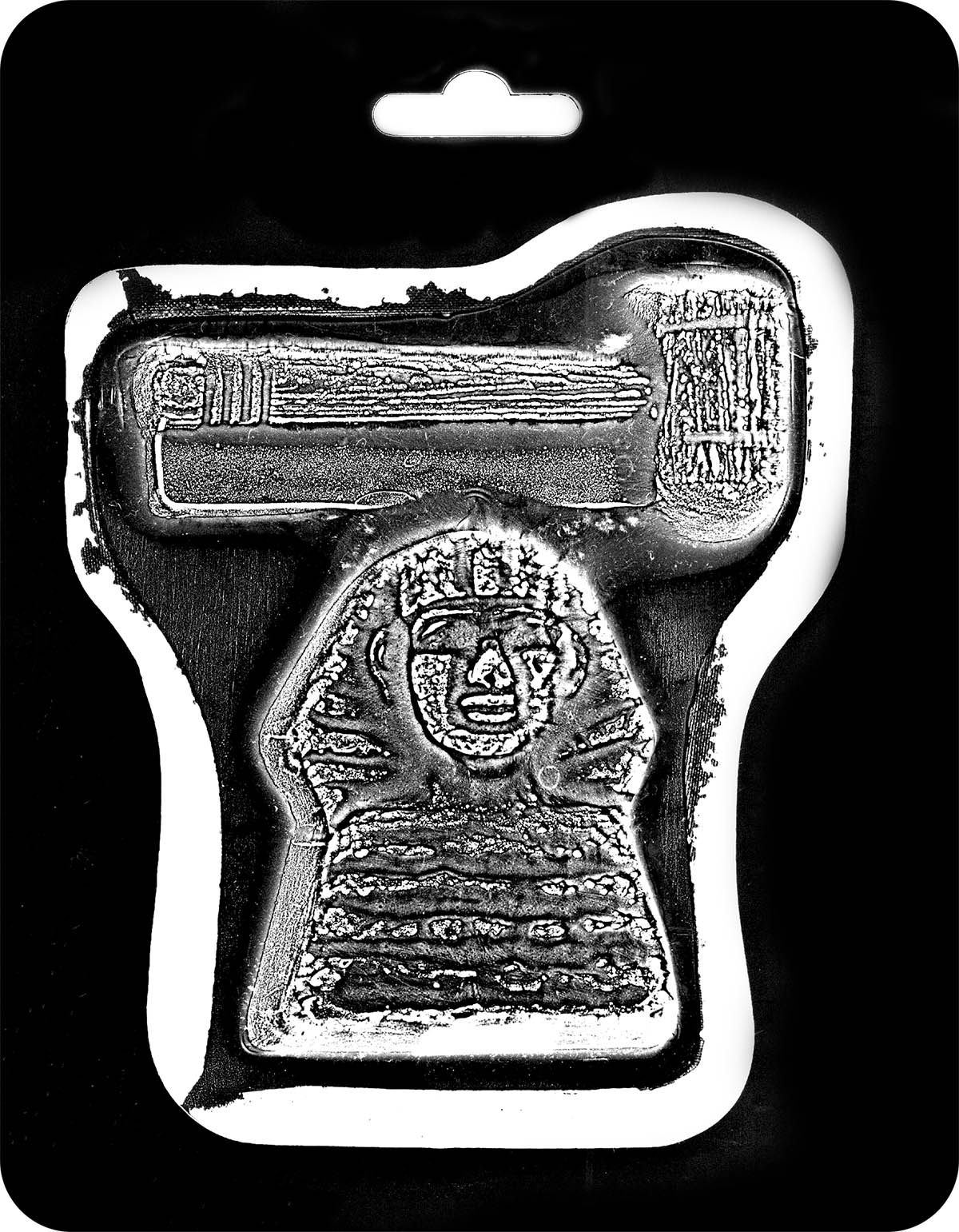
Ida Kammerloch’s work definitely looks at this aspect. In one part of the installation, she uses the shrink wrap from toys to make photograms. The objects become ghostly shadows of everyday consumerism: toys, which nowadays are mostly produced in China. They’re a bit like ghostly apparitions of the things we throw away. She’s showing two works: the video Made in China (2025) and the photogram series titled Membrane of the New (2024).
HMKV Hartware MedienKunstVerein was officially renamed Kunsthalle Dortmund in July, on the occasion of its 30th anniversary. How did this change come about? When did the idea first emerge, and how was the new name received in Dortmund?
The idea had been sitting in my head for ten years. It really started as a joke between friends ten years ago, in the golden bar of the Haus der Kunst in Munich. I was with colleagues and Thibaut de Ruyter, with whom I am as well now co-curating the Silk Roads project. We were discussing our name. And then, out of that discussion, suddenly emerged the idea: why not rename HMKV to Kunsthalle Dortmund? He even sketched a logo at the time, which was different from the one we have now, but the idea has stayed in my head ever since. I’m pleased that we finally took this step now. I had to finally get it out to create space for new ideas. I have to say, I had expected to receive much more negative, critical feedback, which didn’t happen. Our program isn’t changing at all. We’re keeping the same path; our location is the same; it’s just the name that’s changing, and this new name makes it a bit easier for a broader, more general audience to understand what we’re doing.
In the context of the continuation of the program focused on new media art, digital art, and technology, and also the history of the location, would we in the future see an exhibition with exclusively paintings at Kunsthalle Dortmund?
Our understanding of „media“ is very broad. In every show you will find a broad range of analog and digital media. Paintings and drawings are definitely part of it. Mind you, already back in 2012, we hosted a solo show of the British artist Suzanne Treister, who mostly exhibited drawings and paintings dealing with the history of technology in the 20th and 21st centuries—and its links to esoterical and subcultural knowledge.
I’m curious about the dynamic between the institution and the city of Dortmund, and how it played into changing the name. Kunsthalle carries a certain status in every city that has one.
The decision was made by the members of our association. That decision was taken at the end of last year. Then it was a matter of communicating it to the city: basically to our two main funders, which are the City of Dortmund and the Ministry of Culture and Science of the State of North Rhine-Westphalia. I informed them; together with our head of communications, we made a presentation with our new logo and our „Kunsthalle Dortmund spirit,“ and their response was extremely positive. The name also adds a lot, because in this building, Dortmunder U, we have a mix of „partners“. There is the Museum Ostwall, the city’s museum of modern and contemporary art. There is an entire floor dedicated to the education through the arts (uzwei). There is a branch of the Technical University and the Dortmund University of Applied Sciences and Arts, and there’s a cinema as well. So with HMKV becoming Kunsthalle Dortmund, I think there’s now even more reason for the Dortmunder U to be an important venue in that context.
Exhibition: INDUSTRIAL: Seidenstraßen 3000
Curated by: Inke Arns and Thibaut de Ruyter
Artists: Umida Akhmedova, Pavel Brăila, Cao Fei, Choy Ka Fai, Choy Ka Fai & Lin Pei-Ying, DISNOVATION.ORG, Ingo Günther, Tamami Iinuma, Sven Johne, Ida Kammerloch, Gulnara Kasmalieva & Muratbek Djumaliev, Ali Kazma, Ulrike Franke & Michael Loeken, Zauri Matikashvili, Stanislaw Mucha, Zdeněk Porcal, Solveig Qu Suess, Anne Samat, Katja Stuke & Oliver Sieber, Wang Bing
Duration of the exhibition: 12 September 2026 – 10 January 2027
Opening: 11 September 2026 from 18:30 to 22:00.
Address and contact:
Kunsthalle Dortmund
at the Dortmunder U, Level 3
Leonie-Reygers-Terrasse
44137 Dortmund, Germany
www.kunsthalledortmund.de
View all upcoming events here.
Inke Arns, PhD, curator and Artistic Director since 2005, and since 2017 Director of HMKV Hartware MedienKunstVerein, from July 2026 named Kunsthalle Dortmund in Dortmund, Germany. She has worked internationally as an independent curator, writer, and theorist specializing in media art, net cultures, and Eastern Europe since 1993
- Peter Frankopan, The New Silk Roads: The Present and Future of the World (London: Bloomsbury, 2018) ↩︎