

The exhibition is based on the museum’s collections and reflects on the exhibition’s conceptual side. Focusing on what makes photography the medium itself, not only in terms of materials, but also in other core elements. In your text, you referred to these as “parameters of the medium.” Could you talk about that?
At the very beginning, there was the idea of creating an exhibition for this year’s jubilee—200 years of photography —and of working with our collection. This idea originally came from our artistic director, Hemma Schmutz, about two years ago, when she asked if I would be interested in developing such an exhibition. I’ve been the head of the photography collection department in Lentos Art Museum since November 2024, so this felt like a great chance to dive deeply into the collection and better understand it as a resource.
From the start, the idea was to work not only with our own collection but also with the Nordic City Museum Linz collection, since both institutions are part of the Museums of the City of Linz. What’s particularly interesting is that the collections are different. The Nordico City Museum Linz has a strong collection of historical photographs from the 19th century, from the very beginnings of the medium. For me, it was important to include these works, even though they’re not what we typically define as “art photography.” Still, since the exhibition is about photography as a medium, they are essential.
Rather than building the exhibition around a specific theme, I wanted to focus on the medium itself: what defines it, what makes it relevant today, and how it connects to its history. I asked myself: how can an exhibition bring all of this together? I wanted to identify certain “red threads” across the history of photography, and highlight the elements that were already important in the 19th century and are still relevant today.
This led me to define five thematic chapters, which I call “parameters” of the medium: essential elements that bring photography to life. The exhibition was structured around the following chapters: Light, Material, Reference, Time, and Apparatus. From there, I looked into the collections and selected works that fit within these parameters.

If we take one of these parameters, like light, were you looking at more technical or formal aspects, or more narrative-driven approaches?
When we talk about light, it may seem obvious because photography, whether analogue or digital, cannot exist without light. But I tried to go beyond that obvious level. I found photographs where light was essential to the artistic idea and to the final visual result: how the image actually appears.
One of the oldest works in our collection, from 1839, from the Nordico City Museum Linz collection. This work comes from a time when the term “photography” didn’t yet exist; they referred to it as “photogenic drawing.” These early works were essentially photograms. Then we also included photograms from classical modernism—artists like Man Ray, or László Moholy-Nagy, who worked with this technique together with Lucia Moholy, who introduced the term “photogram” in 1925. Alongside these more historical positions, we also show contemporary positions. It was important to demonstrate that the photogram is not only at the very beginning of the medium—perhaps even predating lens-based photography—but that it also remains highly relevant to contemporary artists. Photograms fit particularly well within the chapter on light, because they directly embody this idea of indexicality: light creates the shadow of an object on a light-sensitive surface. But I didn’t want to limit this to abstract works. I also included more figurative approaches—Alexander Rodchenko, who worked extensively with light and shadow, in an artistic way, to create a specific atmosphere. So the aim was to bring together these different approaches and create a dialogue between historical and contemporary positions within the chapter.
I’d like to understand how you managed these different formats and visual appearances. I imagine that could be quite challenging.
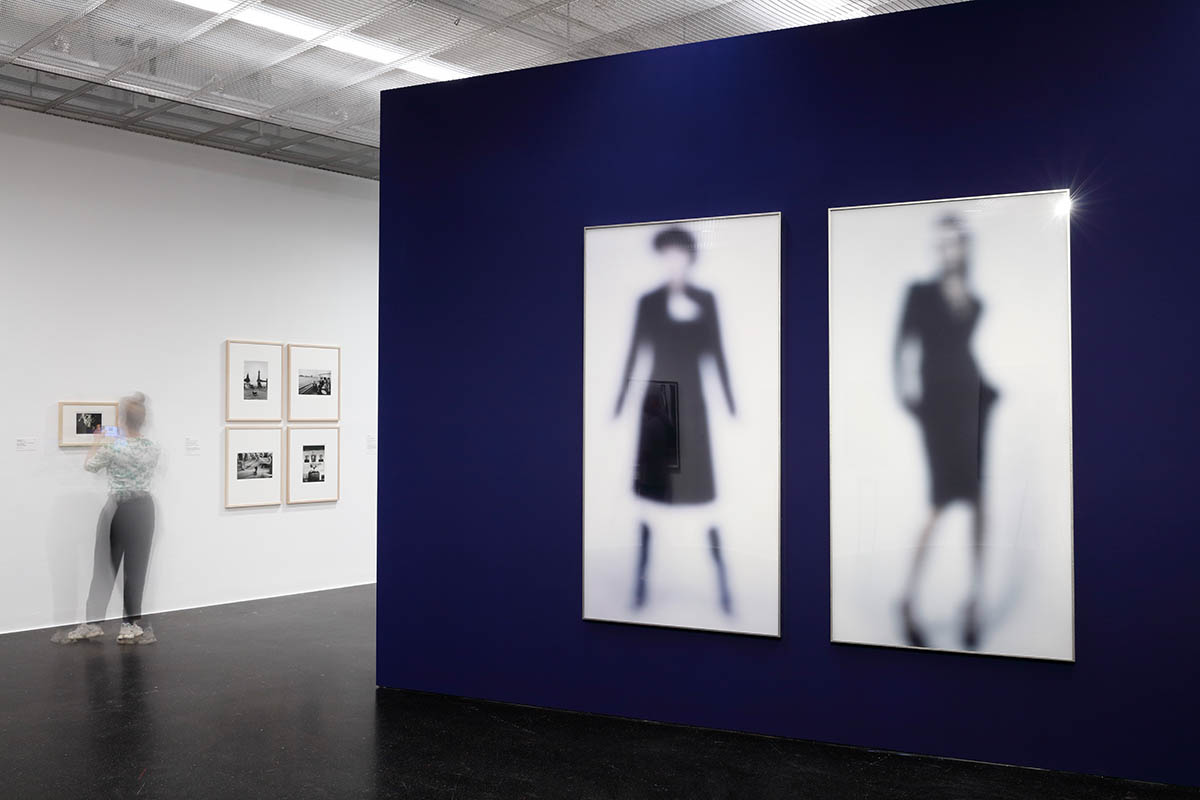
Yes, often this was the reason why certain works could not be included. In the end, it’s not only about the concept; the works also have to function together visually in the space. I made some very conscious decisions. I tried to group black-and-white photographs. And it’s fascinating, when you look at them side by side, you start to see so many visual parallels, even if they are not coming from the same time, nor the same artists. You might have, for instance, abstract rhythmograms by Heinrich Heidersberger next to works by Otto Zitko, who worked with light senses. Even though they come from completely different periods and contexts, visually they resonate with each other in surprising ways.

I also worked with wall color. Blue walls are used in certain sections, and color photography is placed there to create a specific visual focus, not in every chapter, but in selected ones. I think this worked quite well, but it also required a lot of discipline. Many other works would have fit conceptually, but in the end, you have to be strict. These different aspects, at first, may sound like too much for such a small chapter, but I think it works when you are in the room. You start to see these dialogues between the works, and I hope that visitors will also experience this.
Since we are now talking about the visitor experience, what about the booklet that was provided to accompany the exhibition? At the end, you include a glossary that explains the terms used in the exhibition texts. How important was this educational component, this idea of accessibility, for you in helping visitors understand both the positions and their historical context?
I wanted visitors to have an experience, encountering both historical and contemporary works, and getting an impression of the wide range of photography over the last 200 years. Of course, it can only be a small glimpse, because the history of photography is much broader than what we can show. At the same time, I didn’t want to make it naive. Every medium, every technique, has a complex history. And especially in photography, the technical aspects are important for the development of the medium. If you think about cameras, certain artistic styles only became possible with specific technologies, such as the 35mm camera and the rise of photojournalism. I was aware of this, but I didn’t want to make the exhibition itself overly educational. The booklet is more like an offer for those who want to go deeper into the history and the terminology.
In the chapter Material, where I introduce the wide range of materials used in photography, you can simply look at these beautiful daguerreotypes in their golden frames and appreciate them visually. But if you want to know more, how the technique works, when it was invented, you can refer to the booklet.
Photography had a long struggle to be recognized as an art form. Can you think of examples from the historical works in the exhibition that were not understood in their time, the way we understand them today?
If you think about the 1920s, the avant-garde movements, and the experimental approach. The institutional recognition came quite late. The first museum with a dedicated photography department was MoMA, around 1940. So before that, a lot was already happening in photography as an art form. There were always people who recognized it as such, and collectors who supported it, but it took longer for institutions to fully embrace it.
One movement that tried to establish photography as an art form was Pictorialism around 1900. But they did this by making photographs look like paintings—using techniques like bromoil transfer prints or combining negatives. Then in the 1920s, there was a major shift. Artists began to explore the specific possibilities of the medium itself: photo collage, New Vision, artists like Rodchenko or Moholy-Nagy, working with what photography can do, rather than imitating other art forms.

What about this question of status? We know that photography was not immediately considered a “high” art form, and now its status is “shaken”, with digital technologies and especially smartphones over the last 20 years, we are again surrounded by an overwhelming number of images. What defines photographic value today? What makes a photograph something that belongs in a museum, rather than just stored somewhere in the cloud and forgotten? Is this question addressed in the exhibition?
I understand what you mean. I think in the contemporary field, things have shifted. Many artists today work across different media—photography is often just one among others. At the Lentos Art Museum, many of the photographic works we acquire are by artists who don’t define themselves exclusively as photographers, but as artists more broadly. Still, photography has clearly established itself as an important artistic medium. And I think it carries certain expectations, especially its relationship to reality. It has this specific connection to reality, and with that come many layers: social, psychological, political. It’s actually difficult to define it through just one aspect, because the range is so wide.
Could you give an example of a more contemporary or younger artistic practice included in the exhibition?
Huda Takriti is one of the young positions, and, interestingly, her contribution to the show is not only a photography work but an installation- a paravent, from her series Revisitation. In Three Acts. Her work is part of the chapter on time. In this chapter, there are many historical positions that approach photography as a way of documenting and capturing a moment for the future. In this context, I chose her work because she engages with photographs from her family archive: images of her mother and grandmother. Her mother was an artist working in Kuwait, and there is a rich archive of family photographs. She reworks these images, printing them onto textile and arranging them spatially within the paravent. It’s a very beautiful installation, but it also raises questions: how does photography function as an archive of memory, of identity, of cultural identity? Contemporary artists like her reflect critically on photography’s role as documentation and archive.

When it comes to photography as an archive of memories, I was also thinking about how often photography is not necessarily a product of experimentation, but rather an attempt to capture history. How do you see this border between something private, something personal for the artist, and something that becomes public, presented to an audience? And how does that shift into something political, as in Huda Takriti’s work?
Her installation begins with a personal history: her own family history. But within that, there are layers: migration, the histories of the countries her family lived in, and so on. Through this, the work opens up into a much broader narrative. It creates the possibility to reflect on political aspects, which are relevant for contemporary societies. And that’s what makes the work so powerful. On the one hand, it’s very intimate and personal; on the other, it raises important political questions that emerge directly from that personal history. That combination is one of the reasons why the piece is so strong.
Creating dialogues between historical positions and younger or contemporary artists was important for you. I want to ask more personally: not in terms of the institutional framework, but your own motivation. Why was this important for you?
It was a natural way of working. When I went through the history of photography, I had the feeling that many questions and aspects reappeared again and again, every ten or twenty years. This recurring idea that photography might be “dead.” This discussion already existed in the 19th century, when new technologies made photography more accessible, and suddenly, many people could afford it. There was this fear: what will happen now? What is the future of photography? We saw similar debates with the rise of digital photography, and now again with AI-generated images. So there are many repetitions in these discussions. But also in artistic practice—like with photograms—artists across different periods return to similar approaches. And not only in a theoretical or scientific way, but also visually. Sometimes works placed next to each other don’t have a direct historical or conceptual connection in a strict academic sense, but visually they resonate strongly. We show a photograph by Édouard Baldus from the early 1850s: an architectural image made with a very long exposure time, which was necessary at that moment due to technical limitations. Directly beneath it, there is a photograph from the 1980s by Leo Schatzl, also using long exposure to create a similar architectural structure, only with the traces of light. Visually, they look strikingly similar.

Of course, things change, but at the same time, they don’t. We can trace similar concerns across the last 200 years, which is actually not such a long time. You mention these recurring fears—whether photography is still alive as art, who has the right to use it, and so on. It almost feels like art in general goes through these cycles of crisis every decade, this constant questioning of what art is. And somehow, it always re-emerges.
Yes, exactly. And I think if you look at the history of photography, every new technical development leads to new forms of experimentation. Artists use these innovations creatively to expand the medium. At the same time, these developments always provoke the same fundamental question: what is photography? And today, we are again at such a moment, with social media, the constant flow of images, and AI-generated visuals. It’s once again a point where we need to reflect on what photography is, and what remains important.
Exhibition: Traces of Reality: 200 Years of Photography from the Collections of the Museums of the City of Linz, curated by Sarah Jonas (Head of the Graphic Arts and Photography Collection, Lentos Art Museum Linz)
Artists participating: Laurien Bachmann, Édouard Baldus, Herbert Bayer, Gottfried Bechtold, Dietmar Brehm, Julia Margaret Cameron, Inge Dick, Johann Carl Enslen, VALIE EXPORT, Sissi Farassat, Trude Fleischmann, Katharina Gruzei, Ilse Haider, Caroline Heider, Heinrich Heidersberger, Assaf Hinden, Franz Hubmann, Judith Huemer, Dagmar Höss, Birgit Jürgenssen, Dora Kallmus (Madame d’Ora), Leo Kandl, Anton Kehrer, Herwig Kempinger, Mathias Kessler, Brigitte Kowanz, Heinrich Kühn, Erich Lessing, Franz Linschinger, Estefanía Peñafiel Loaiza, Inés Lombardi, László Moholy-Nagy, Julie Monaco, Inge Morath, Gaspard Félix Tournachon (Nadar), Shirin Neshat, Olena Newkryta, Waltraud Palme, Ingeborg G. Pluhar, Man Ray, Oscar Gustav Rejlander, Alexander Rodtschenko, August Sander, Leo Schatzl, Eva Schlegel, Edward Steichen, Felix Benedikt Sturm, Huda Takriti, Mathilde ter Heijne, Sophie Thun, Robert Waldl, Anita Witek, Otto Zitko, u. a
Exhibition duration: May 29- August 16, 2026
Opening hours: Tue–Sun: 10 AM–6 PM; Thu: 10 AM–8 PM; Mon: Closed
Address and contact:
Lentos Kunstmuseum Linz
Ernst-Koref-Promenade 1, 4020 Linz
www.lentos.at
Upcoming events such as guided tours, talks, … can be found here: www.lentos.at
Some 200 years ago, the French inventor Joseph Nicéphore Niépce succeeded in permanently capturing the view from his study on a specially coated pewter plate. Today, this event is regarded as one of the defining moments in the birth of photography. Since then, the medium has not only transformed our perception of the world, but has also had a profound impact on the way artists produce images and practise their craft. To mark this anniversary, the exhibition places works from different historical periods drawn from the collections of the Museums of the City of Linz in dialogue. The exhibition explores the fundamental conditions of the medium itself. Focusing on five core themes, it explores the parameters that are key to creating a photograph. Technical aspects of photography are just as important as the choice of subject matter. As a result, viewers are given a rich insight into the various approaches adopted by artists to using the medium in their image-making processes since its inception: from the earliest photographic methods of the 19th century and darkroom experiments of classical modernism through to contemporary works that exploit digital processes.