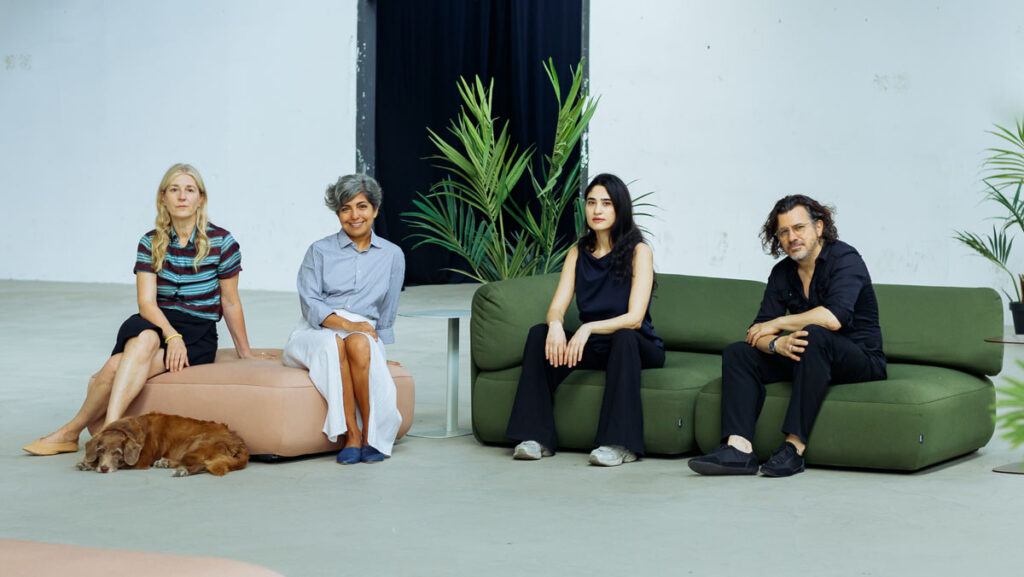

The Alfred Ehrhardt Foundation is based in Berlin, and it’s dedicated to preserving, researching, and exhibiting the works of Alfred Ehrhardt. Can you tell us about the foundation’s structure?
Stefanie Regina Dietzel: Dr. Jens Ehrhardt, Alfred Ehrhardt’s son, founded the foundation in 2002. His vision is to preserve his father’s artistic work, conduct scholarly research on it, and make it publicly accessible. Alfred Ehrhardt was a multidisciplinary artist; he made films, including cultural documentaries, as well as photography, paintings, drawings, and graphic work. We have about 20,000 silver gelatin prints, about 12,000 negatives, and around 2,500 glass slides. He was an extremely productive artist. We inherit in our foundation everything Alfred Ehrhardt did, created, or was connected to.
How many exhibitions does the Alfred Ehrhardt Foundation hold per year?
Stefanie: In our exhibitions, we want to showcase the full range of Ehrhardt’s work. We hold three to four exhibitions a year. We invite contemporary artists who work on themes of nature and structure because Ehrhardt turned to photography after he was no longer allowed to pursue teaching painting under National Socialism; his work was considered too abstract. He switched to photography and started focusing on natural surroundings. We exhibit artists who worked during his time or younger artists exploring similar themes to participate in exhibitions, and we bring these perspectives into dialogue with Ehrhardt’s work.
Dr. Christiane Stahl, the foundation’s director, manages the exhibitions and develops the curatorial program. I’m the Head of Archives, and I organize and manage the contemporary exhibitions. I handle preservation and archiving since new documents still come in regularly. It’s not only the photographs and artworks but also all the documents, contracts, and letters Ehrhardt ever wrote, which is a fantastic source of information for us.
How did the collaboration with Ramona Schacht come about, and what led to the idea of bringing her work into dialogue with Alfred Ehrhardt’s?
Stefanie: I was familiar with Ramona’s work and thought it could be a good fit since she formerly worked with industrial archives. This opened up the opportunity of showing a lesser known part of Ehrhardt’s work. We provided her with access to all works. She was most interested in Alfred Ehrhardt’s series about tobacco production he did as a commissioned work for the company Reemtsma., which became the basis of the exhibition.
What interested you most about Ehrhardt’s work? Were you already familiar with his work?
Ramona Schacht: Yes, I was familiar with his work before. What interested me most was not simply working exclusively with Ehrhardt’s photographs, but rather developing a more comprehensive research project that links his work with other archives on the tobacco industry. For example, in Hamburg, there’s a large archive, Reemtsma Cigarettenfabriken, which holds an extensive photo collection. I visited a few times to look at other tobacco industry images and put them in dialogue with Ehrhardt’s work.
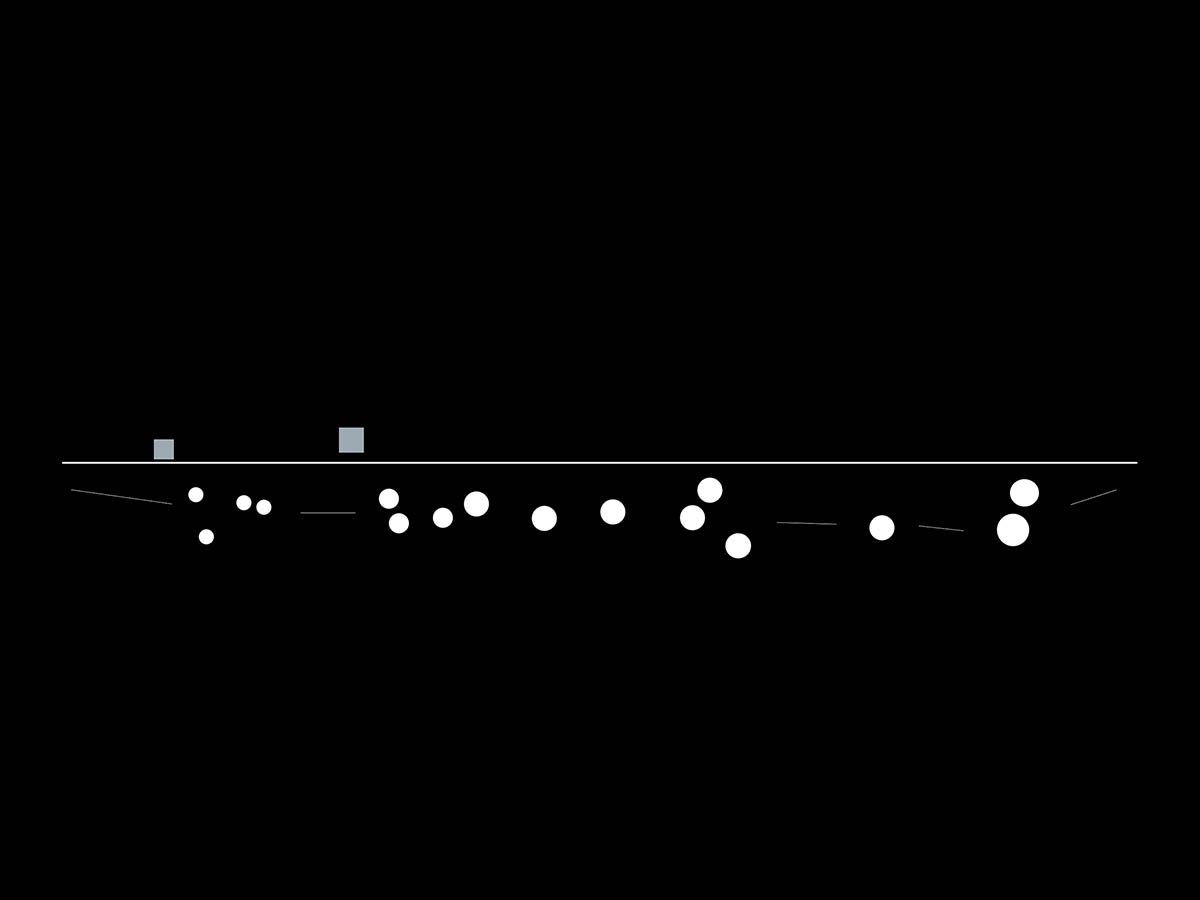
The exhibition title is Ramona Schacht: From the Bauhaus to Crimea. A Visual Examination of Alfred Ehrhardt’s Tobacco Series: My series inquiry into Ehrhardt’s tobacco photographs. Ehrhardt studied at the Bauhaus for about half a year, around 1928–1929, and that was a significant part of his biography, something that also shaped how his later work has been received and understood. I was genuinely interested in the way Ehrhardt is typically framed as a formally trained photographer known primarily for his natural and formally composed images. Considerably less attention is given to his commissioned photography and film work for the tobacco industry.
Crimea became part of the research through the history of tobacco production: a major publication deals with tobacco production and forced labor. It examines the German occupation of Crimea from 1941 to 1944 and therefore also addresses complicity within the National Socialist occupation regime. That work was a major influence and source for my research. My research spans German photography of the tobacco industry from the 1920s through the 1950s. I am focused on how visual patterns and ideas about labor shifted across different historical contexts.
The title of the series of works I produced for the exhibition is Photography’s Claim to Property. It references different forms of ownership and control operating on several levels: the industrialist’s claim over workers‘ labor, the photographer’s claim over the representation of the workers, and the industrialist’s position as commissioner, who holds a degree of control over both the photographer and the images being produced.
What I found compelling, when you look at these relations, is that photography doesn’t simply document or record labor; it also extracts a fragment from a complex situation, organizes bodies within a frame, and makes them available to particular ways of seeing.
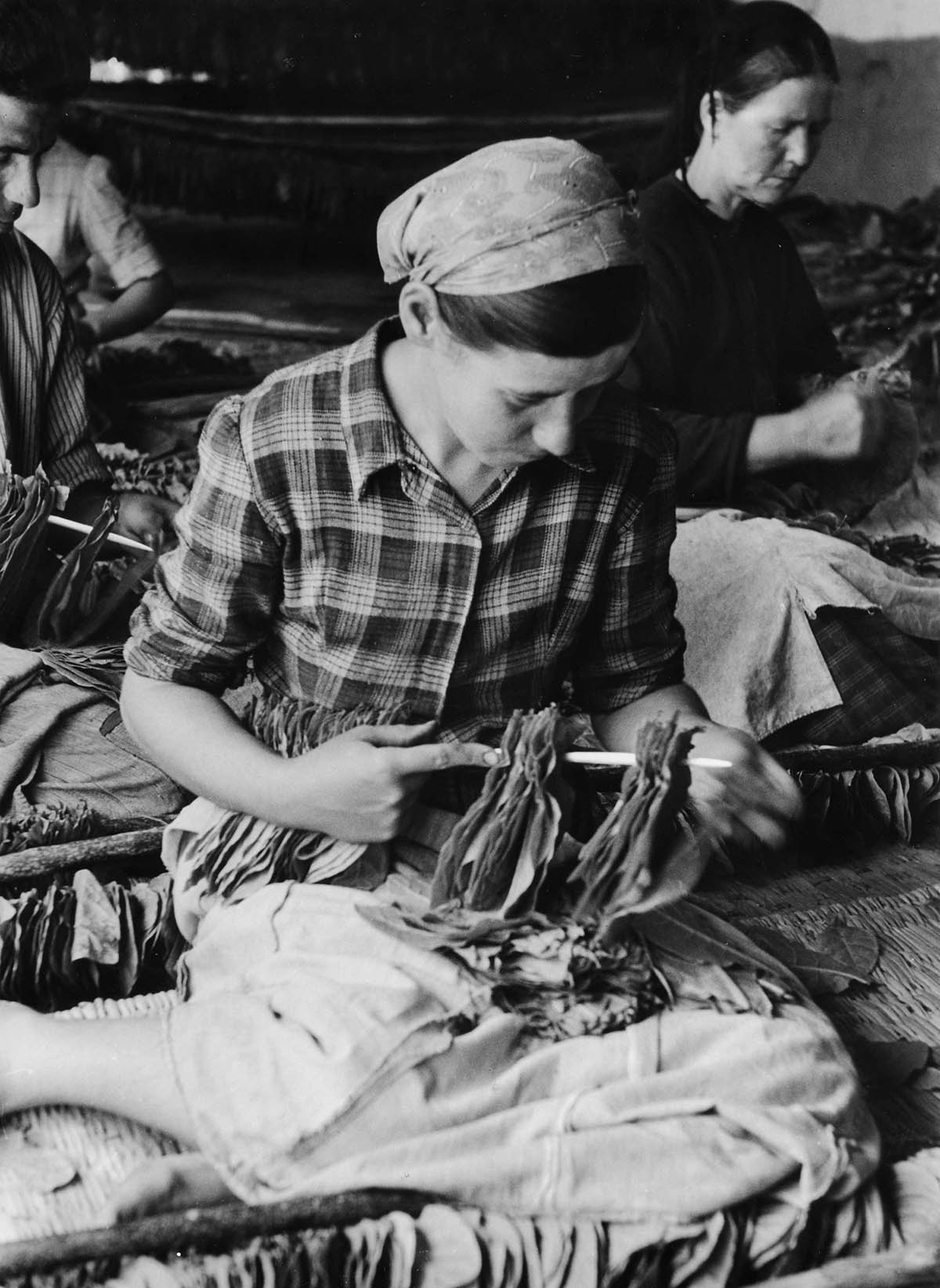
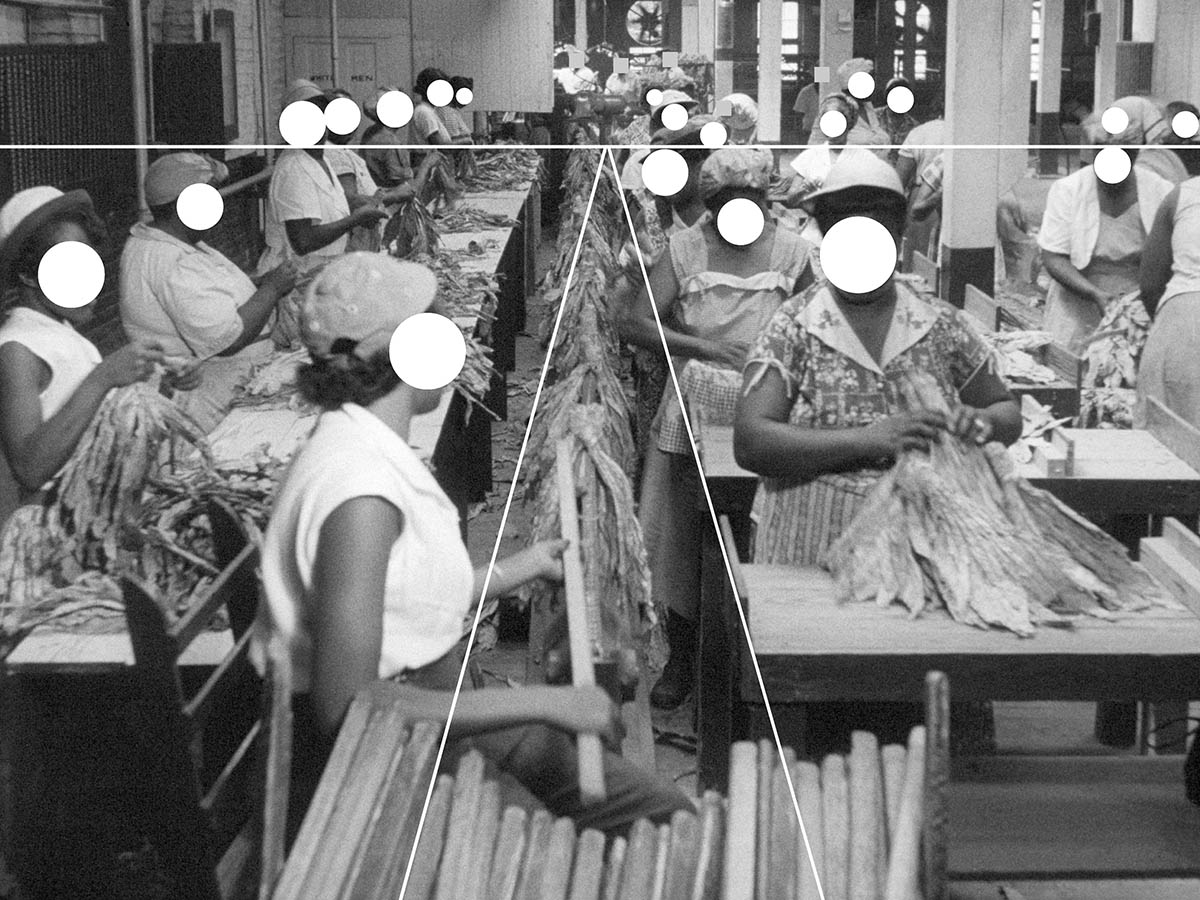
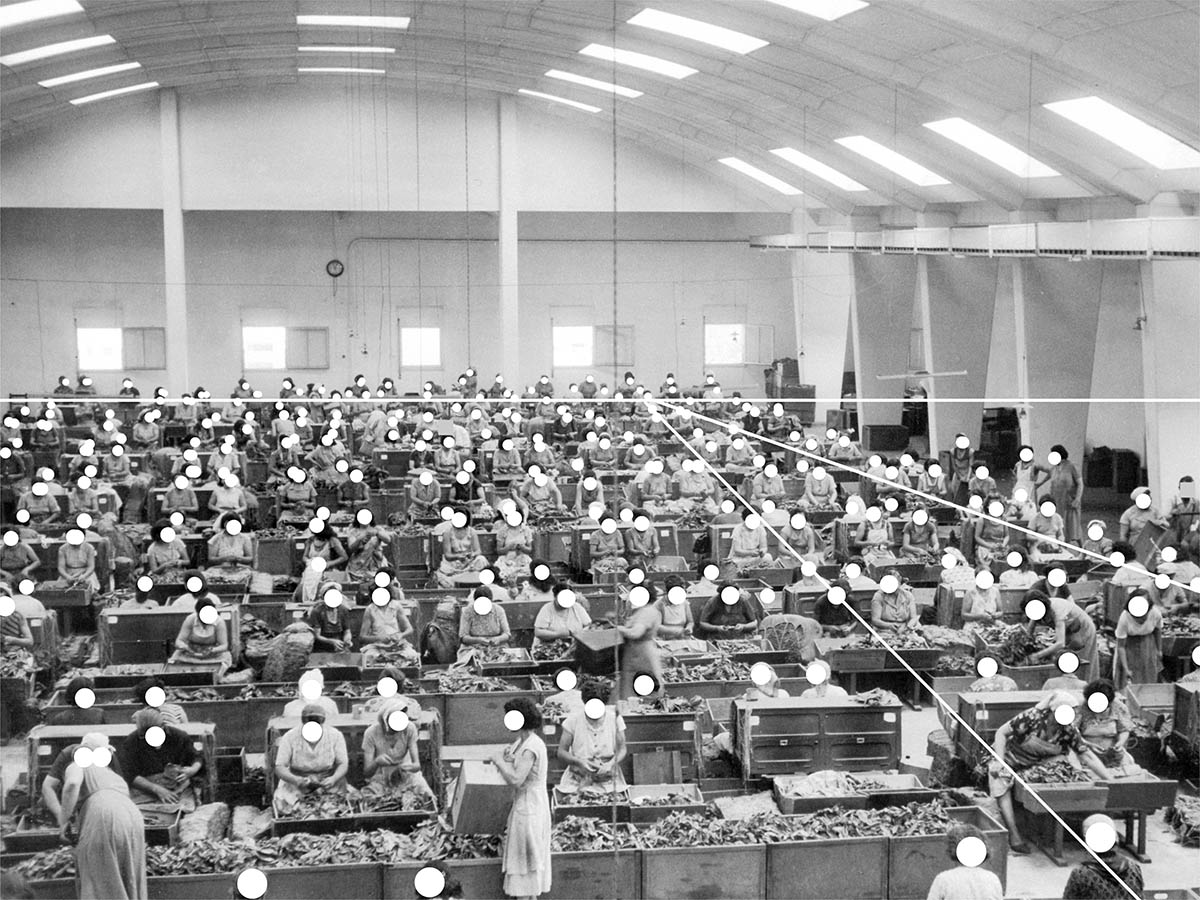
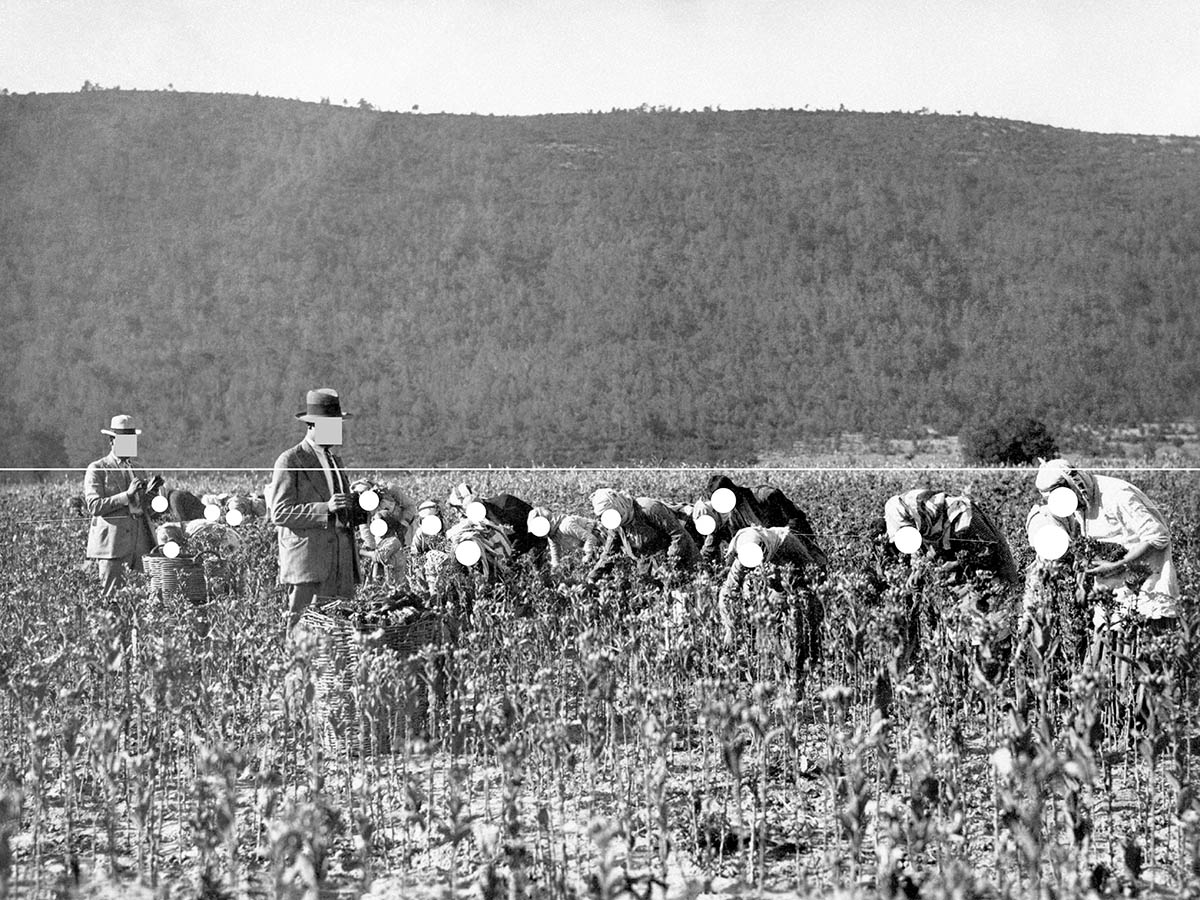
The photographer decides on perspective, framing, and the moment of exposure; the commissioner, in turn, influences which images are needed, published, circulated, and archived and ultimately which become part of history and how we come to see it. So alongside the economic claim over labor, there’s also a visual claim over the people performing the labor, over the images, and over the story those images are permitted to tell. This is also why I resist making individual biography the primary framework for reading these images, as individual stories can themselves be mobilized within corporate or political narratives. In some works, I therefore obscure facial identity to shift attention towards the structures of representation — how bodies are positioned, which roles recur, and how social relations are organized within the image.
In the exhibition, there’s also a shift from photography to tapestry. As a third component, there are tobacco plants that you planted yourself as part of the installation, which is also a metaphor for the labor and care. Can you explain a bit how you arrived at these different methods of working with the topic?
Ramona: For me, it’s important to show the structure behind the photography and not center the biography and personal story. Biographical framing is often used by commissioners and in other political contexts, and in the process, the underlying structure gets lost.
My work doesn’t usually start with a fixed idea. I research, review the available materials, and find what kind of works I could produce from them. Then I’d go back to the studio with all the material and start making cuts, adding lines, and working on the pieces.
What I noticed in the historical images of tobacco production was a particular visual pattern: women are everywhere, in the fields, in the factories, sorting, harvesting, and bundling, and yet as individuals they seem to recede or get lost. Their bodies are arranged in rows, repeating the same movements, bent over or kneeling among the plants. Men, by contrast, are often positioned differently in the image: standing upright, observing, directing, or occupying supervisory roles.
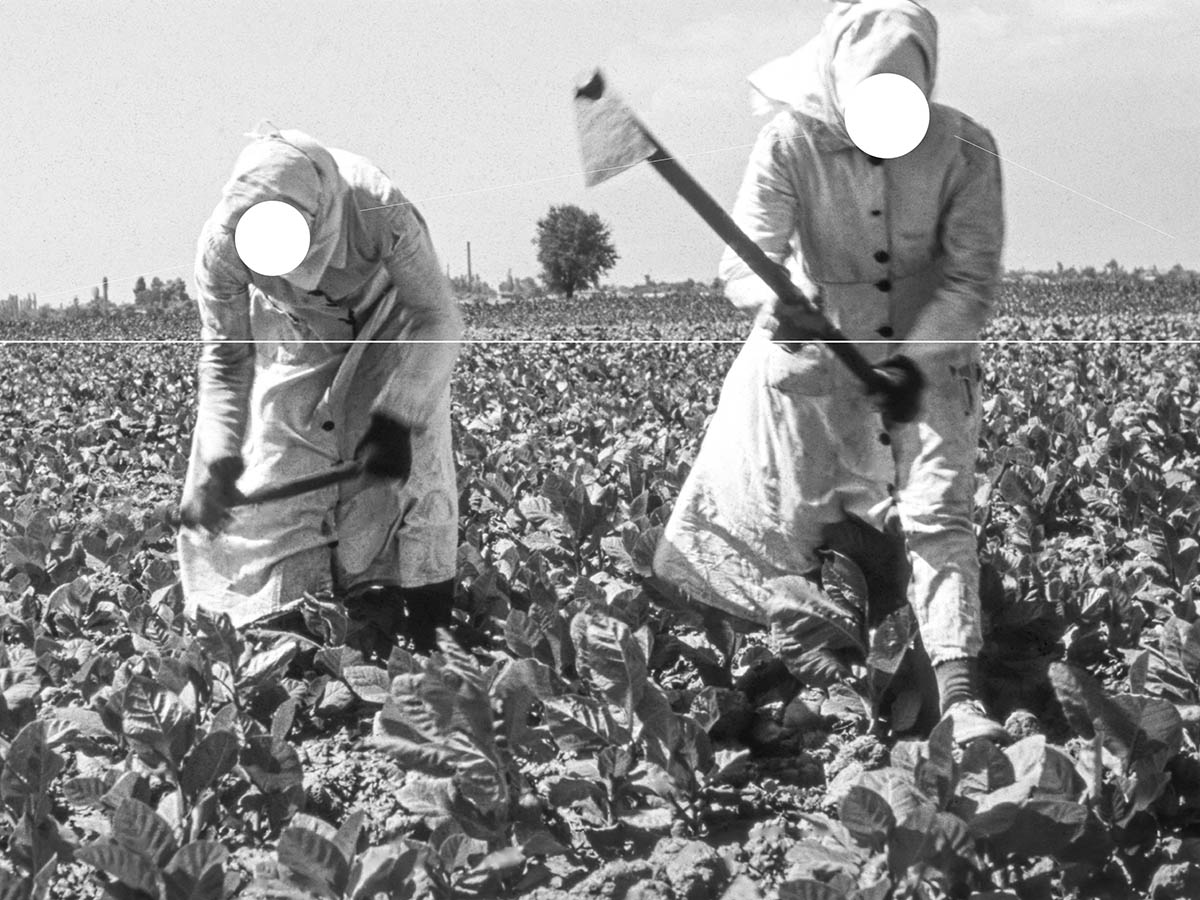
That’s the point where the visual order becomes political for me—social relations become embedded in body posture, and posture becomes part of the image’s composition. What labor does to the body shapes posture, and posture shapes how we receive the image.
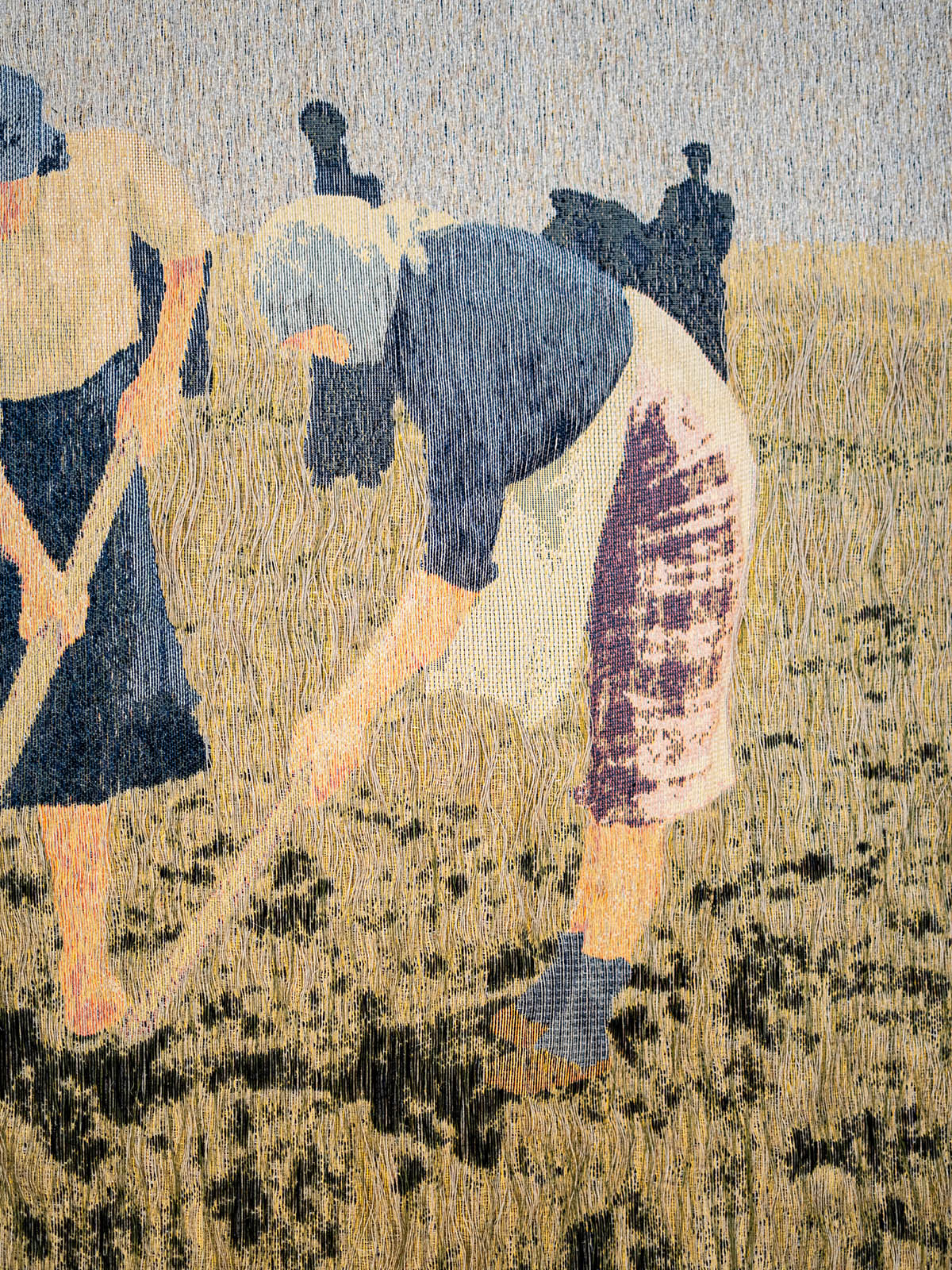
The tapestry is based on a photograph I found in the so-called Crimea Album. It’s also connected to bent bodies: this „tableau“ of workers in the tobacco field, bent over the plants. The photograph kept reminding me of Jean-François Millet’s The Gleaners—an image I grew up with because a reproduction hung in my grandmother’s living room. But for me, it also shows how deeply certain visual forms of female labor become embedded in our visual memory. I didn’t consciously realize it, but these bent bodies are lodged deep in me. I was interested in how the photograph is framed within the album itself. It’s essentially a reproduction, but the caption says something like, „The workers cultivate the land to secure food in their spare time,“ referring to the conditions of the German occupation. This wording makes the work seem voluntary and self-evident. So the album isn’t a neutral document; through selection, arrangement, and captioning, it also shapes how the labor is written and understood. This connects back to what I said earlier about the title, Photography’s Claim to Property, and the question of who controls the labor involved, as well as the image’s interpretation.
I kept thinking about historical violence and about how I could transport this kind of image into another form. That’s when I decided to make a tapestry, because a tapestry is historically deeply connected to representation and power. One example that became important to me was a monumental tapestry commissioned from the Gobelins manufactory in Paris during the German occupation. For me, this example shows how historically intertwined the medium of tapestry is with representation, ownership, and power.
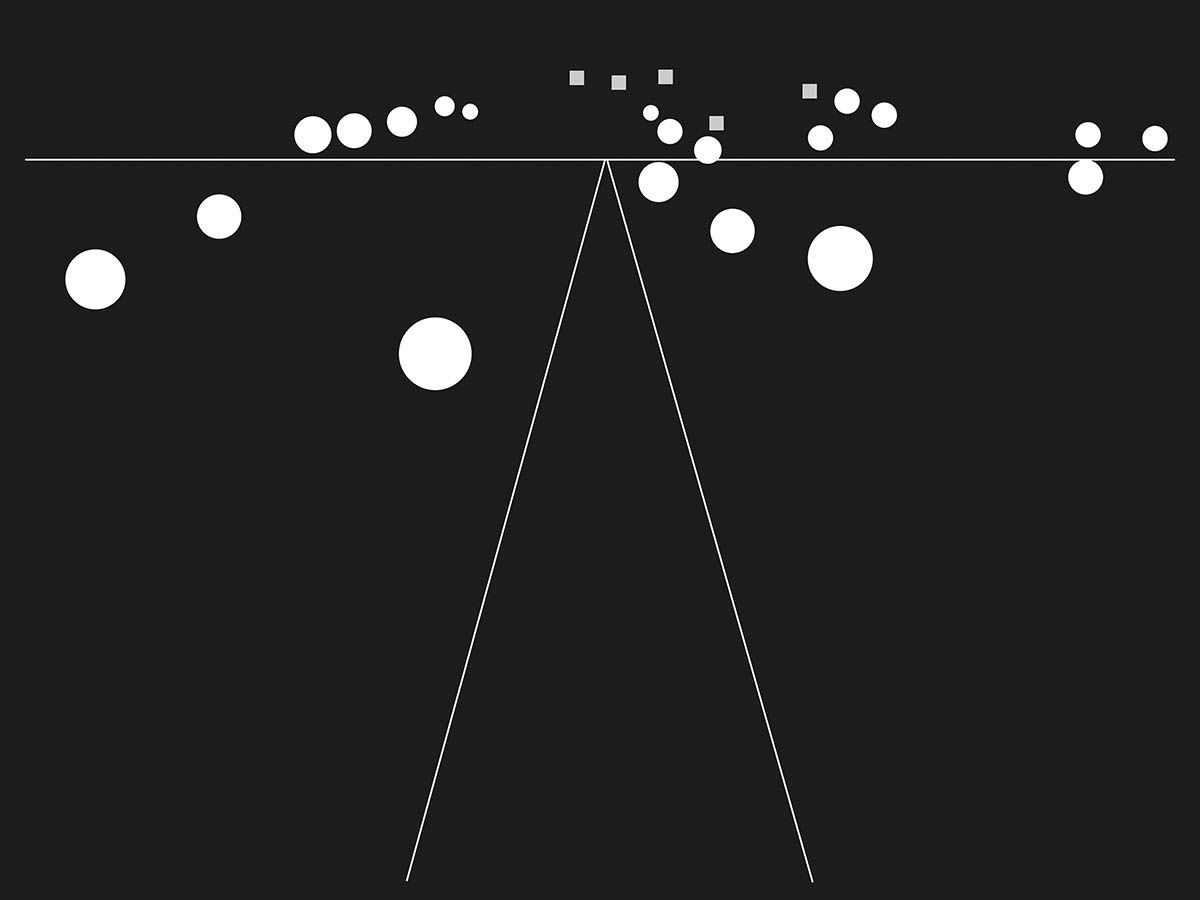
That’s what interested me: what happens when this historically coded form is repurposed differently? Instead of heroic figures, territories, or claims of power, the image presents women workers from occupied Crimea. I see the work as a kind of counter-tapestry: a critical appropriation and reoccupation of a pictorial space historically associated with power and representation. The medium’s ambiguity stayed with me; it brings me back to the question of what happens when labor, inequality, or violence is translated into order and beauty.
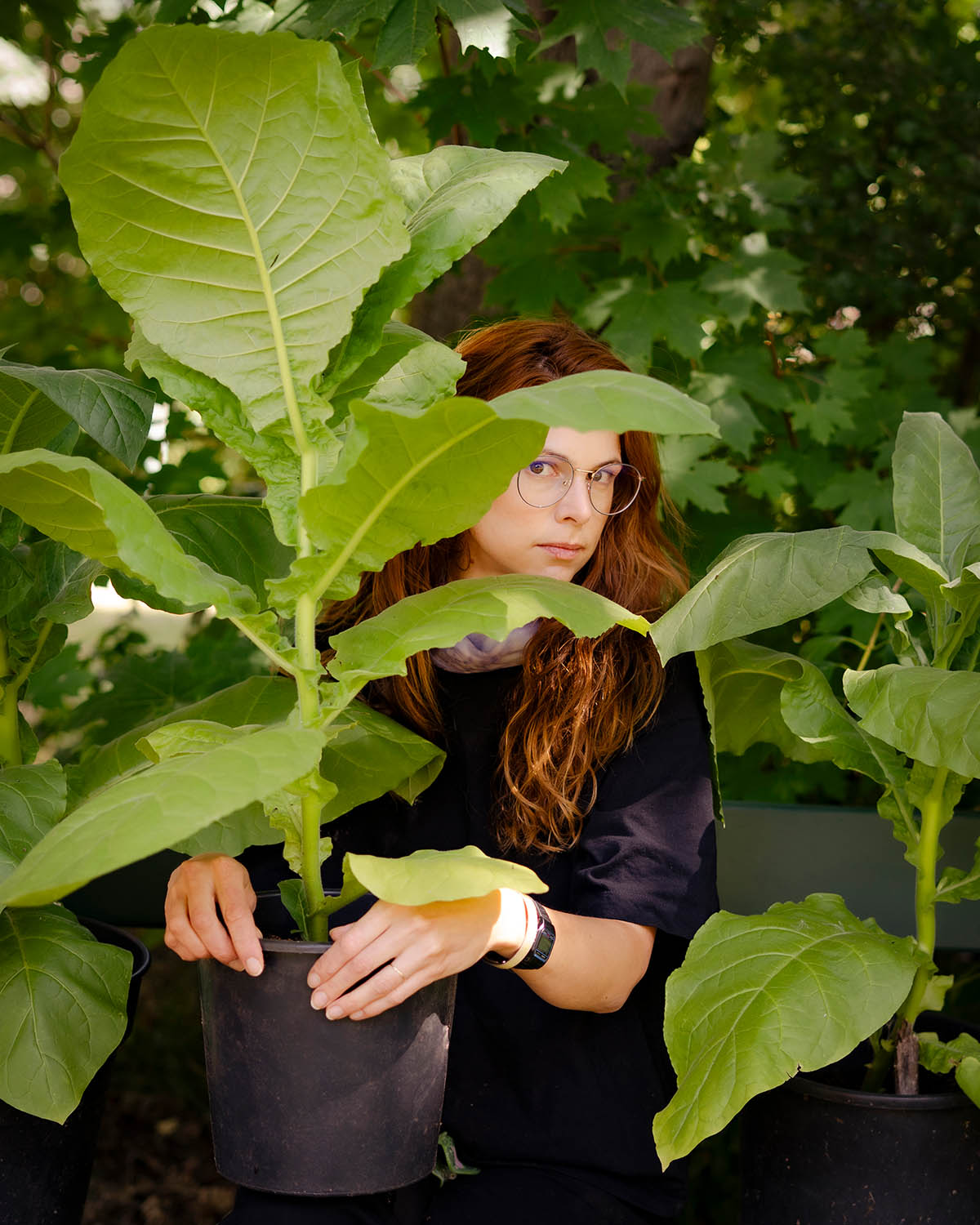
I did a lot of research into how to grow and present the tobacco plants. In the exhibition, we’re planning to have somewhere between 13 and 20 plants of different sizes, partly to show the range, from small to huge. Including pieces for the exhibition that guests could feel tactically was crucial. They can touch them if they like. For me, these plants have work behind them and people behind them as well.
Can you elaborate more on the meaning of labor that becomes inscribed in the posture?
Ramona: Not only labor but also different relations of power are inscribed in these bodies. I isolate the visual structures: lines, postures, repetitions, and spatial arrangements, and place them into new constellations. That’s when things become visible that the photographs don’t necessarily foreground at first glance. Inequality, or something openly violent, doesn’t have to be visible in an obvious way; instead, it can be translated into rhythm, symmetry, and a kind of formal beauty.
When I first looked in the archive, the first thing I saw was the picture itself: the symmetry and beauty of how it was photographed. That’s a central tension for me: an image can be extraordinarily beautiful, and beauty can make a social order start to seem natural or self-evident. For me, beauty or aesthetics doesn’t simply conceal these relations; it’s actually part of how we process and interpret something.
Aesthetics is never outside the political; it’s part of it. We see that today too. That’s also what my work is grappling with. I’m not trying to avoid beauty. I’m trying to work precisely with that ambiguity.
Can you tell us a bit about how Ehrhardt produced the pictures? Did he work alone or with assistants?
Ramona: People in Ehrhardt’s inner circle were specifically engaged to accompany him on these trips, including several photographers who were well known in their own right. In the archive in Hamburg, there are various albums belonging to fellow photographers, in which you can often see how they photographed one another. Big companies were invested in controlling the narrative of the pictures for their advertising, which is why they spent so much money and energy to get high-quality images. There was a sense that something needed to change, that advertising needed to be pushed further.
On the subject of advertising, Stefanie, there’s obviously a program of events and tours following the exhibition, after the opening. Can we go ahead and share/announce the events here?
Stefanie: We put together a diverse program of talks. Ramona and I will, of course, give a guided tour through the exhibition together to share both our perspectives. On one of the tours, we’ll also have sound and installation artist Kyoco Taniyama with us. She has a beautiful sound installation where she takes sounds from industrial settings and makes her own recording, played back on a kind of self-built gramophone. It’s not only aesthetically striking, but the story behind how she records the sound and the manual labor involved in playing it back over and over adds another layer to the exhibition.
We also have our ongoing series, Literature House of Photography. This time we’ll have Melanie Aufenvenne, who wrote Need a Light?, reading from her book, followed by a discussion. The book examines the cultural history of smoking. We’re not aiming for a „smoking is great“ angle. Just as Ramona takes a critical look at the images, we also want to critically examine the act of smoking itself.
We’ll also have a conversation between artist Oliver Heise and Prof. Dr. Steffen Siegel, Professor of the Theory and History of Photography at Folkwang University of the Arts, Essen, about current marketing strategies of the tobacco industry. Last but not least, there’ll be a lecture more focused on women workers; the lecture by, Dr. Katerina Korola, Assistant Professor of Film & Media, University of California, Berkeley. The presentation is titled Labor as Image, Gender as Medium: Women’s Work in the Industrial Archive, from the Filmfabrik Wolfen to Ramona Schacht. Korola takes a more academic approach to how female labor has historically been depicted in industry, which will add another nice layer.
Exhibition: Ramona Schacht: From the Bauhaus to Crimea. A Visual Examination of Alfred Ehrhardt’s Tobacco Series
Curated by Stefanie Regina Dietzel
Exhibition Duration: September 12 to December 20, 2026
Opening: Friday, September 11, 2026, 7:00-09:00 PM
Opening hours: Tue–Sun 11 AM–6 PM. Closed on public holidays
Accompanying events:
Thursday, September 24, 2026, 6 PM: Guided tour of the exhibition with artist Ramona Schacht and curator Stefanie Regina Dietzel
Thursday, October 8, 2026, 7 PM: In conjunction with the Literaturhaus der Fotografie series: „Need a Light?“, Reading and discussion with Melanie Aufenvenne on the cultural history of smoking, moderated by Julia Vismann
Sunday, October 11, 2026, 2 PM: „Das neue Rauchen: Ein künstlerischer Blick auf die Gegenwart der Tabakindustrie“, talk with photographer Oliver Heise and Prof. Dr. Steffen Siegel, Professor of the Theory and History of Photography at Folkwang University of the Arts
Thursday, November 26, 2026, 7 PM: „Labour as Image, Gender as Medium: Women’s Work in the Industrial Archive, from the Filmfabrik Wolfen to Ramona Schacht“, slide presentation by Dr. Katerina Korola, Assistant Professor of Film & Media, University of California, Berkeley (in English)
Sunday, November 29, 2026, 4 PM: Guided tour of the exhibition with artist Ramona Schacht and curator Stefanie Regina Dietzel, featuring a sound performance by Kyoco Taniyama
Address and contact:
Alfred Ehrhardt Stiftung
Auguststr. 75, 10117 Berlin, Germany
www.aestiftung.de
Ramona Schacht – www.ramonaschacht.com, www.instagram.com/ramona_schacht/