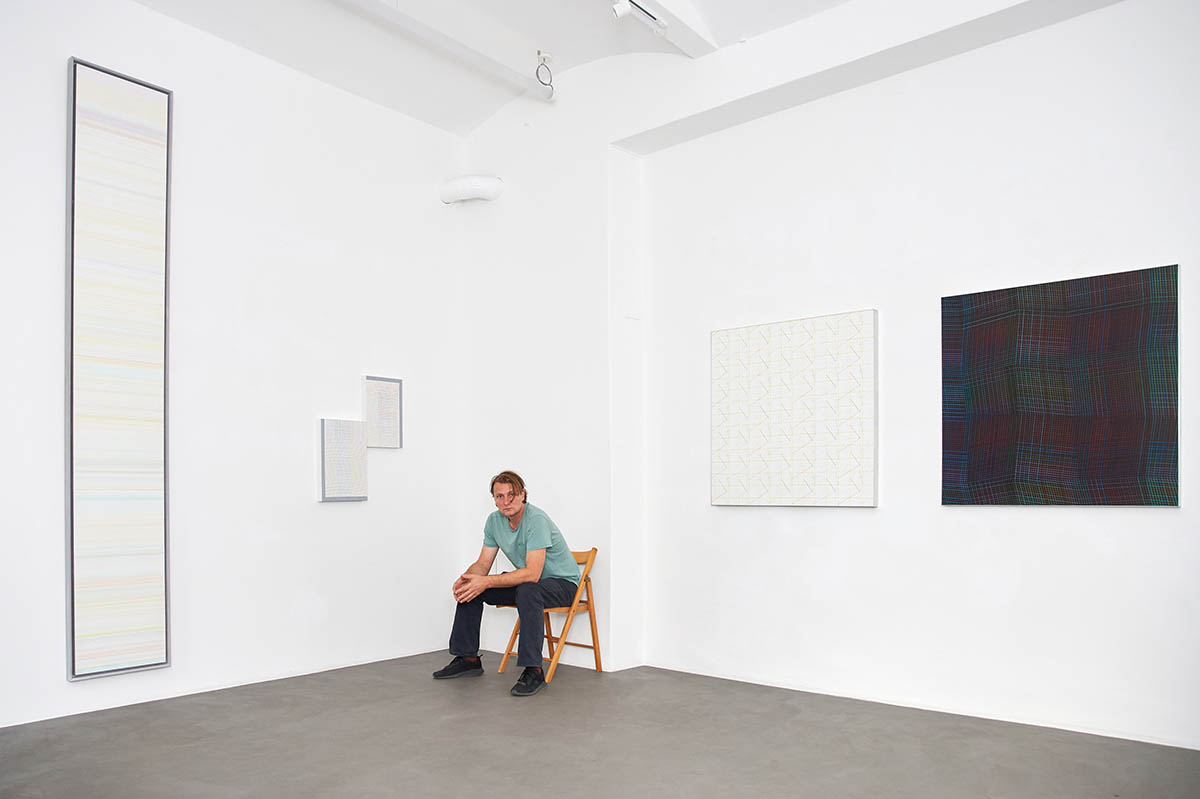
Tell me about your background and where you are based at the moment?
I’m from Hungary, but I have lived in different countries in Europe since I did a PhD in art in France in 2003. Since 2019, I live in Como, Italy, but I keep travelling often to Budapest and, luckily, also to Vienna. Art has always been a part of my upbringing and everyday life. When I came to live in Vienna in 2012, I was amazed that quite a few people in the art world had extensive knowledge about the Hungarian art scene, history, and its strong tradition tied to geometric art.
In your solo exhibition at gezwanzig gallery, you show works from 2010 to the present, all created with colored pencils. What has fascinated you about this material from the very beginning?
I have been working with colored pencils more or less since 2002. But I first came across it accidentally. It didn’t sound like a professional tool for artists to me. I never considered using it until I received a set for Christmas from a distant relative. First, I was embarrassed. Why would you give an artist a drawing tool or a painting tool for Christmas?
Let alone colored pencils, which are supposed to be for kids. I would have preferred chocolate. Or was this gift meant to be sarcastic? But then I got fascinated exactly by its simplicity, its unpretentious nature, and I started using it. I liked that it’s a low-tech, kind of old-fashioned tool. There is nothing new or anything fancy about it.
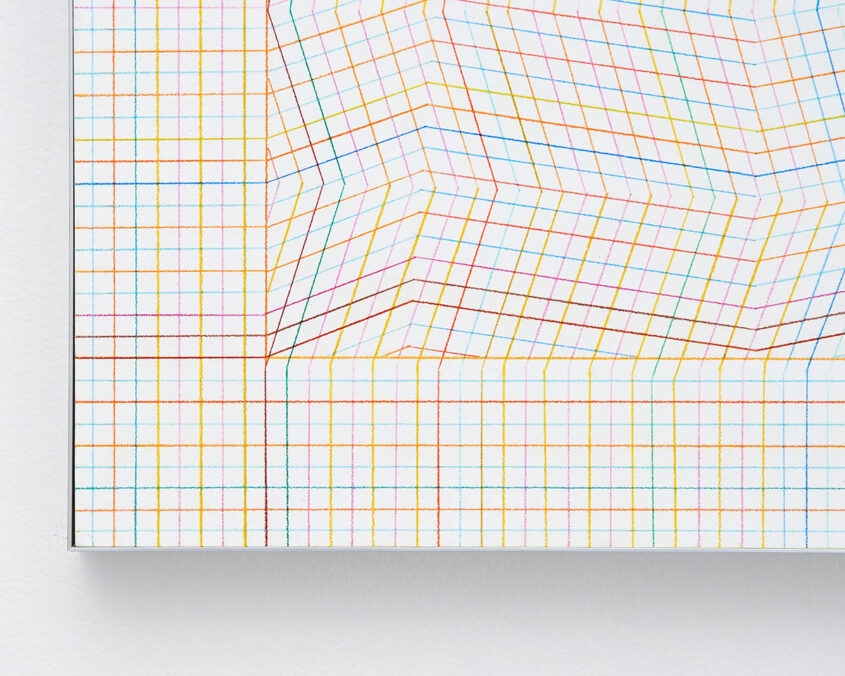
I then discovered the professional ranges of colored pencils of Faber-Castell, Caran d’Ache, and some other brands. At the end of the day, I think that colored pencil is a profoundly intimate painterly tool. I also liked the idea that by using it, my work would not simply stand out due to a cutting-edge or extravagant technique. If it will stand out, it will do so only due to its deeper artistic values. Colored pencils are a subtle tool; they express color in a gentle, silent way, and back in the day I thought this was exactly what I needed to counter a “noisy” and somewhat aggressive world and society that we humans live in. I had the feeling art started to behave and operate more and more with the antics of publicity – aiming at the more primal levels of perception. I was happy to find a tool that made sure I stayed outside these tendencies. I kept using colored pencils ever since, to this day, but never exclusively, and with breaks—leaving them aside even for longer periods to explore other technical and artistic possibilities within my aims.
Why do you still love to work with it today?
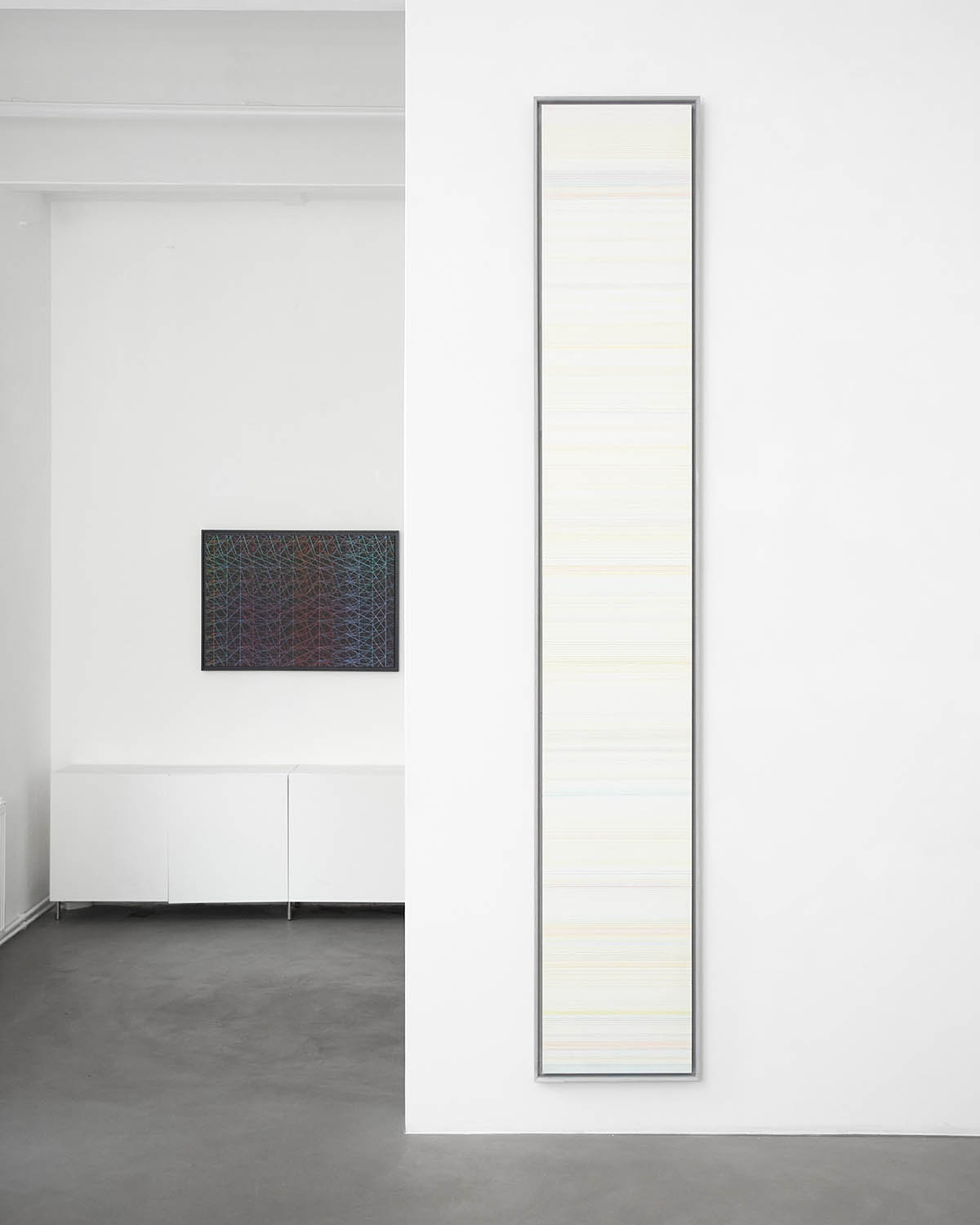
I kind of feel like I use colored pencils as a monastery, a meditative space to return to over and over again. I could never fully decide whether art belongs to the world or is meant to exist outside, or at least regardless of it. Art wants to mingle with all that is happening around us or just wants to be beyond it. I still haven’t solved this dilemma and probably never will. So I think my other works, be it my acrylic paintings or installations or even public art interventions, have always rather accepted that art is part of the world, the society we live in. The artwork needs to establish a dialogue in some way with this very complex, both pleasant and unpleasant, network that we call reality. But then the need to exit, to be totally out of it, returns at times, and then I tend to take my colored pencil collection out of the drawer.
My color pencil works are leaving the messy world and retiring into a milder, more metaphysical state of existence.
Can you tell us a little about the process?
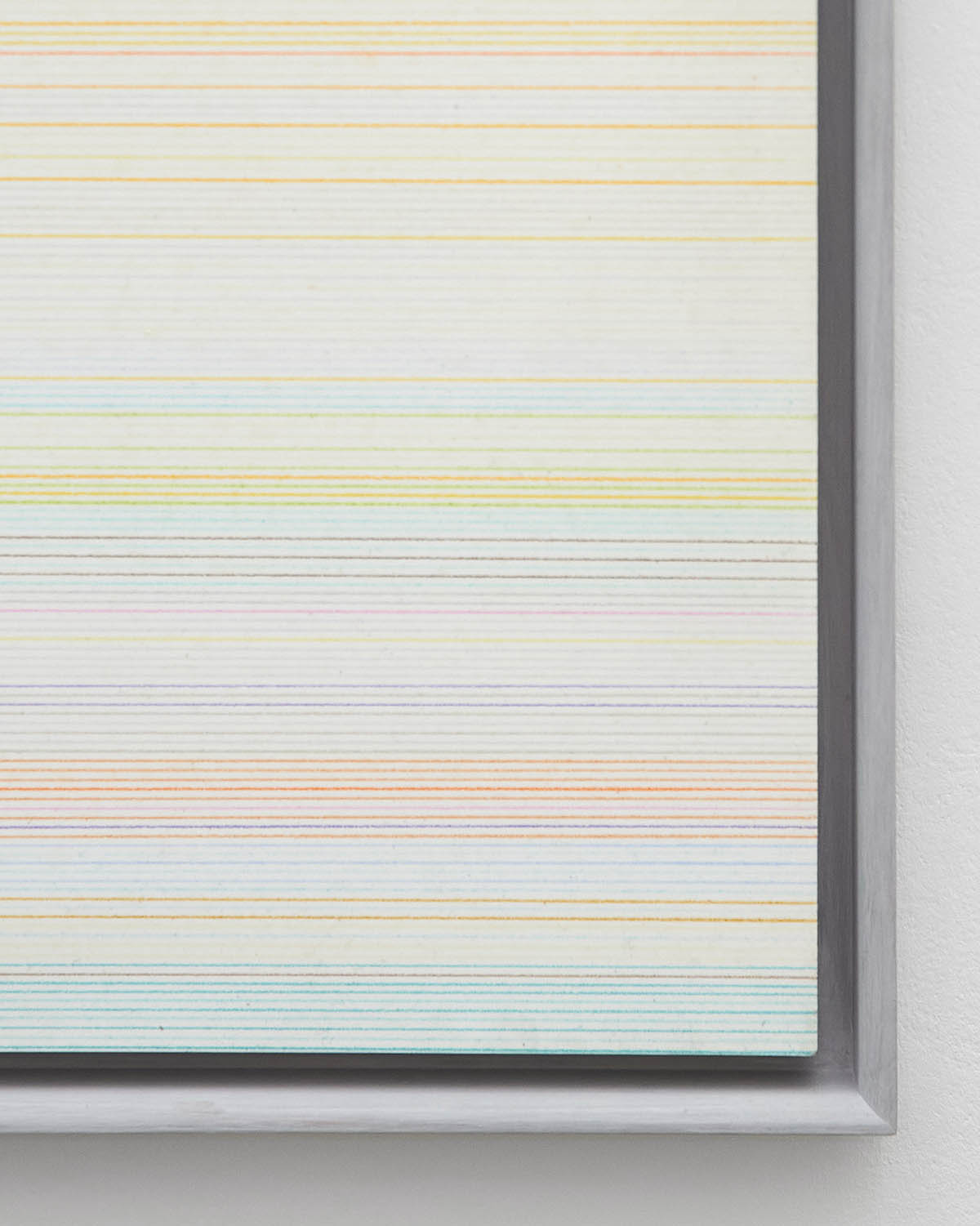
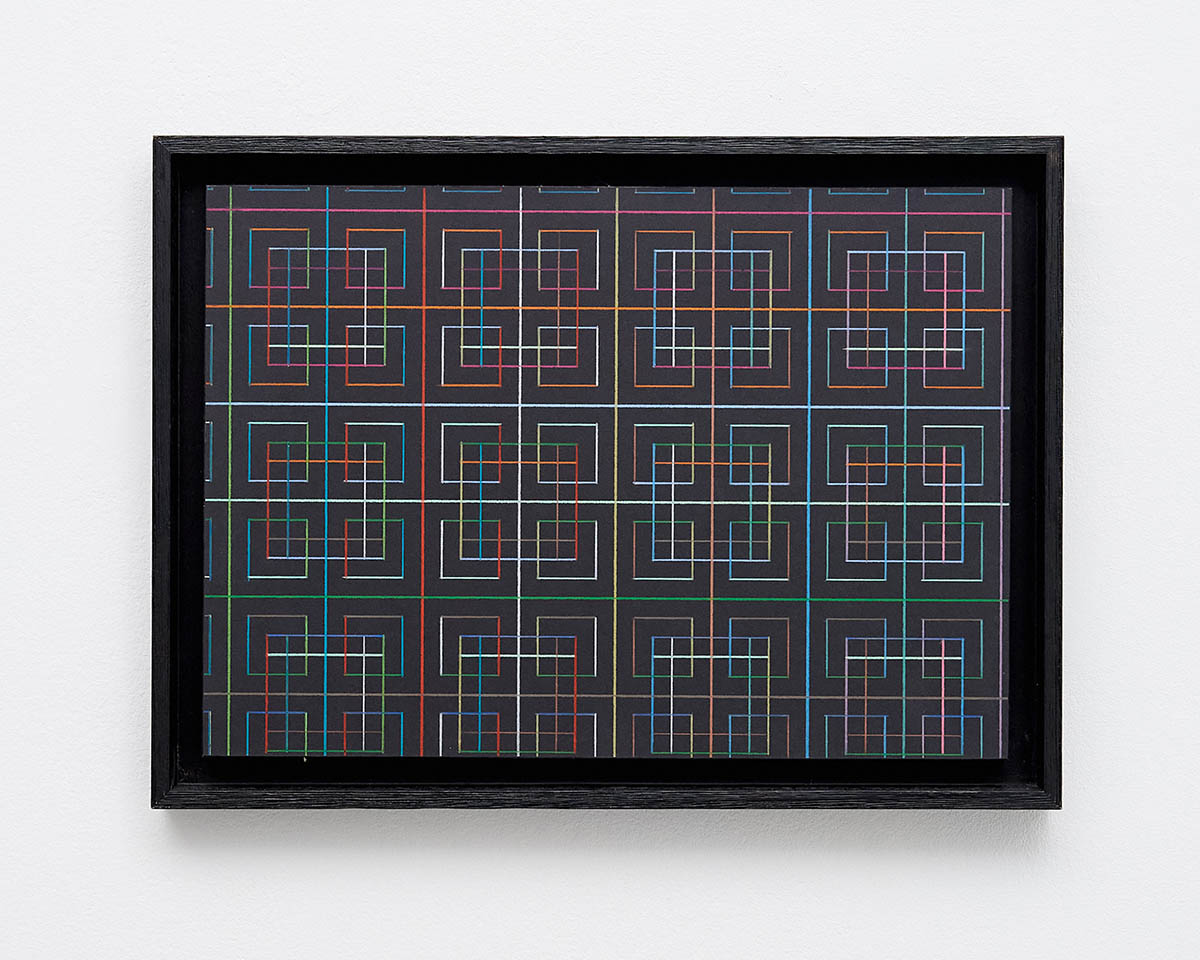
I suppose we can talk about the process from two different aspects: the technical and the intellectual. Technically, working with colored pencils requires quite some patience and care. In opposition to graphite or acrylics, or even oil, you have no right to error. I mean, once a line is drawn with a colored pencil, that line can not be erased or changed in shape. So you need to make decisions upfront and hope they are the right ones. This also puts you in “autopilot” mode, which I don’t mind. This brings us already to the intellectual, or artistic aspect. Here I must say that I really liked the idea that whilst traditional minimal art tended to use industrial colors and materials. I, on the other hand, wished to mix an extremely minimalistic idea of form (the repeated straight lines) with a quasi-childish tool and the intimate expression of color(s).
How do you feel during the process?
I switch off. It’s a meditative state of just doing. I’m really out of time while I am working. For me, it is a compliment when people say that my colored pencil paintings look like a print; I like the idea that I invest a lot of time in realizing these works, and therefore go one more time against the rather conventional and popular notion of the “genius“ who just “gets it done“ with one impulsive stroke. Many lines also mean lots of time. I like the idea that my paintings are charged with time, and therefore also with some invisible energy.
Repetition plays a central role in your work. What do you see as results from it?
I think repetition links us with the universal, with the deeper realities of our existence, and with joy and fear. I might be talking to you here and now, saying different words and making different gestures, but underneath, my heart just keeps beating, and my lungs just keep inhaling and exhaling with the same rhythm. I believe there is something very deeply rhythmical to life, to existence. David Bowie said that in pop music, the drum beat stands for the eternally sexual. I think the drum beat in music, or the repeated lines in my work, connect us with these deeper layers of our existence. In the case of the drums, it might be more sexual, sensual; in the case of the repeated straight lines, it might be more metaphysical and intellectual. The Earth rotating around the sun is also a repetition. There is a lot of repetition going on both on the macro- and micro-universal level. Repetition is both fun and deep, both human and universal. It probably also expresses some “horror vacui“, the fear of the vacant. Of course, repetition can also be a punishment, but self-chosen repetitions are more likely to be related to joy, to contentment. But no question, there is obsession to it, and that might not be for everyone.
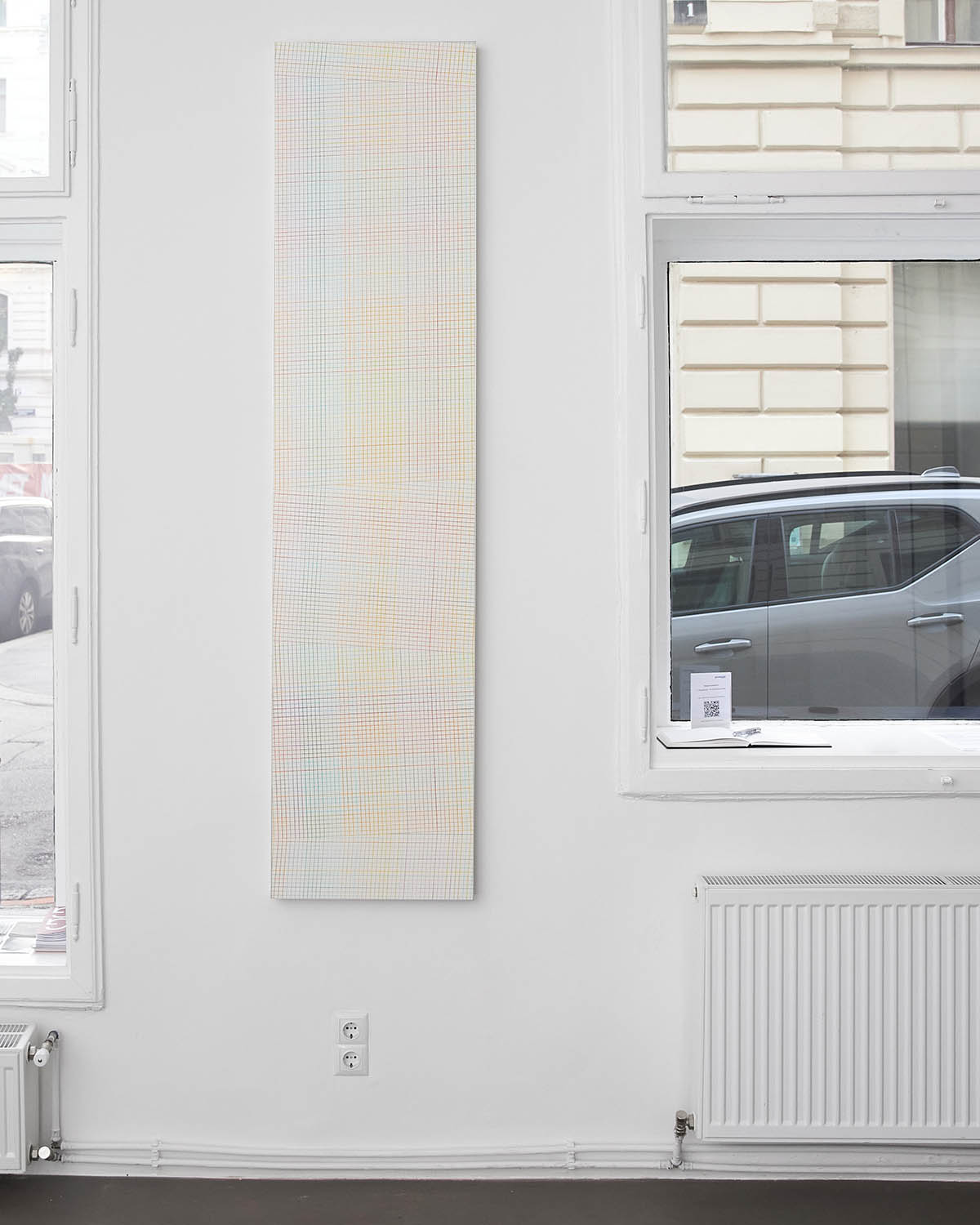
Your work has continued to evolve: from the strictly parallel lines of your early years, through the 1-cm grid and the Criss-cross Series to the Wave-grid Series. What influenced this progress?
The original idea using the colored pencils was related to an extreme way of minimalism: the repetition of straight lines, hundreds, thousands of them, and where the formal aspect or the composition of the painting would exclusively result from the usage of color. After going on for almost a decade, I felt I needed to change. I felt like it’s not my aim to be one of those completely obsessed artists who do “the same painting“ all the time again and again. So I was searching for a change, but a change that would not abandon the aim of using a minimal, impersonal, repetitive tool or structure. I concluded that it’s more reasonable and even more fun and even visually more vibrating (and hence ethereal) if I work with a grid instead of just repeating the horizontal line. And that’s when I came to the one-centimeter grid, which I have used ever since. A grid of horizontal, vertical, and (often also) diagonal lines, the ultimate strategy to employ a “neutral“ formal field to enable the colors to express themselves in the possibly most metaphysical way, at least in my eyes. The tight 1-cm grid also allows for the eye to be challenged in its perception. Our capitalist society is about accumulating more and more precisely defined objects in precisely circumscribed space. I love that painting is not an object in this sense but more an anti-object, a pseudo-object, which questions the physical world rather than adding to the physical world. The Criss-cross Series is also based on the grid, just like my Wave-grid Series, and I allow myself to go back and forth between these series. Due to the slow and long executional process, I tend to make few works at a time, so I tend not to get to the end of these series easily.
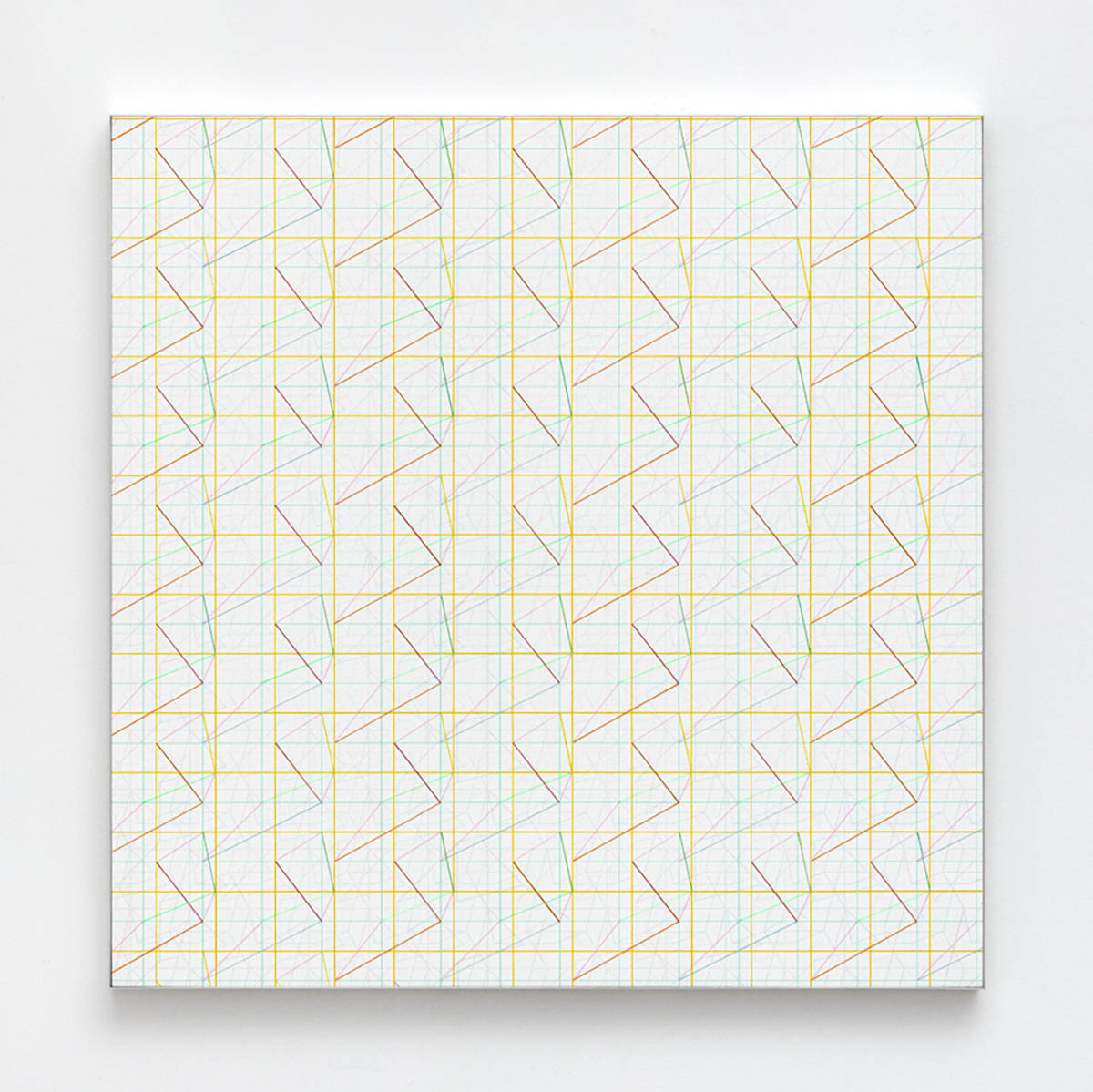
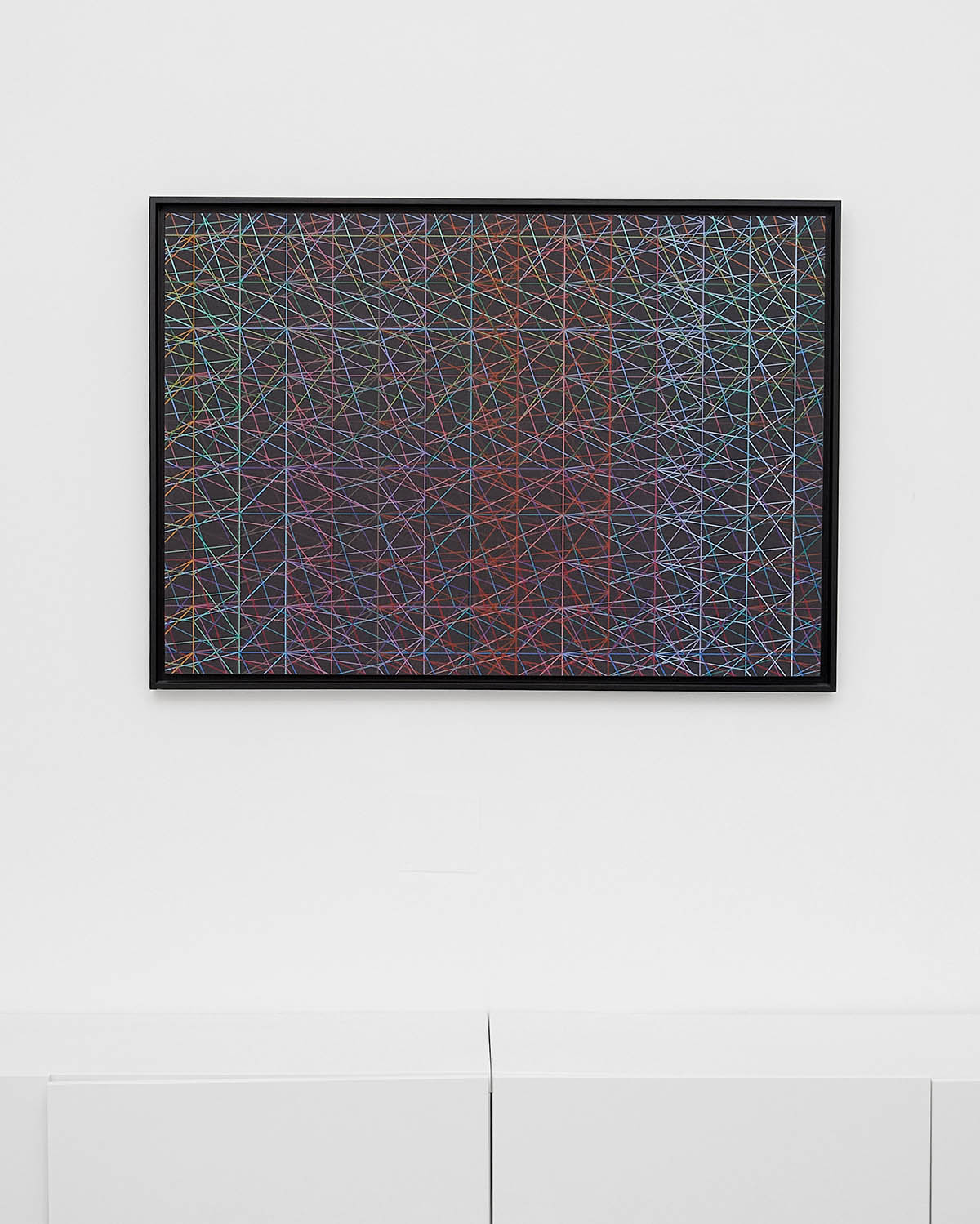
Could we talk about the work Relax (2021)? There are so many things coming together in it; I find it interesting.
The lines go from different junctions to other junctions, and they are simply repeated. So from every green junction, you see this red line going to another, to the green-yellow junction, and then from there, there is another one. Basically, it’s a pseudo-mathematical field, which at the same time appears to be very messy and very constructed. Therefore, the two things at the same time. This is one of the “emptiest” works I have ever done within the Criss-cross Series, but also one of the most subtle. There are some extremely faded, hardly visible line structures that the viewer will perceive only from very close. This is one of the reasons it is called “Relax”, apart from paying tribute to Frankie Goes to Hollywood’s mythical tune.
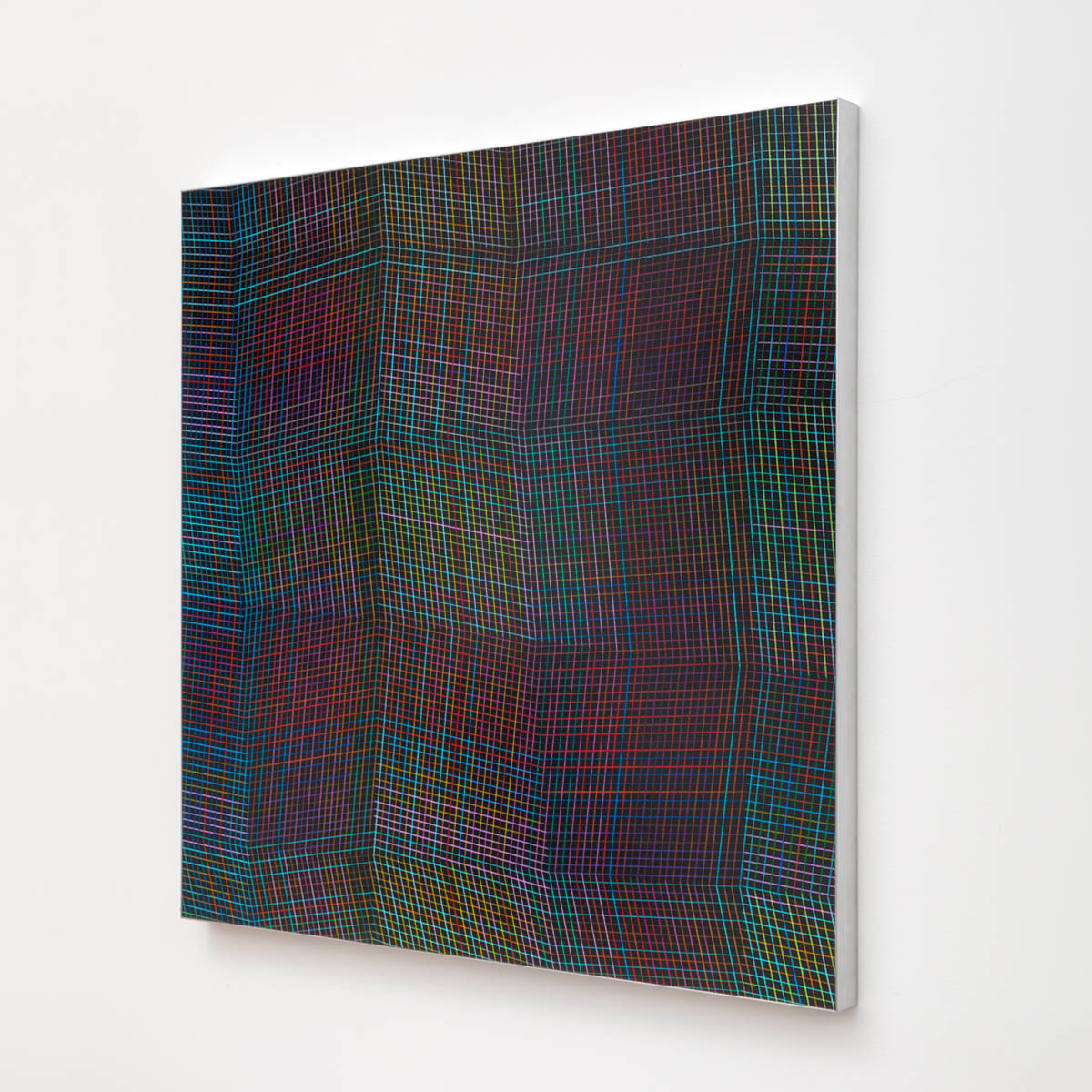
How does the work change when you look at it from different distances and perspectives? I find it fascinating that when you move closer, you start to focus increasingly on the details.
When I used the term “anti-object” or “pseudo-object”, this is very much related to this aspect. With these colored pencil works, you perceive entirely different things from five meters than from fifty centimeters. It must be like that to be an “anti-object”. The layers or lines that are hardly visible—they definitely serve this. We certainly see the faded parts as something very messy. And only from close, one starts to understand that it’s part of the structure and the network.
That brings us to color. How has your relationship with color changed over the years?
Color is present in our lives, let’s say sixteen to eighteen hours out of twenty-four every single day. As soon as you open your eyes, you see colors in the morning, and even in the evening there are colors. Therefore, we could presume that color is one of the more banal aspects of our existence. However, at the same time, color—together with light—is also one of the most immaterial, ethereal, metaphysical phenomena, something you cannot hold in your hand and that changes around you all the time.
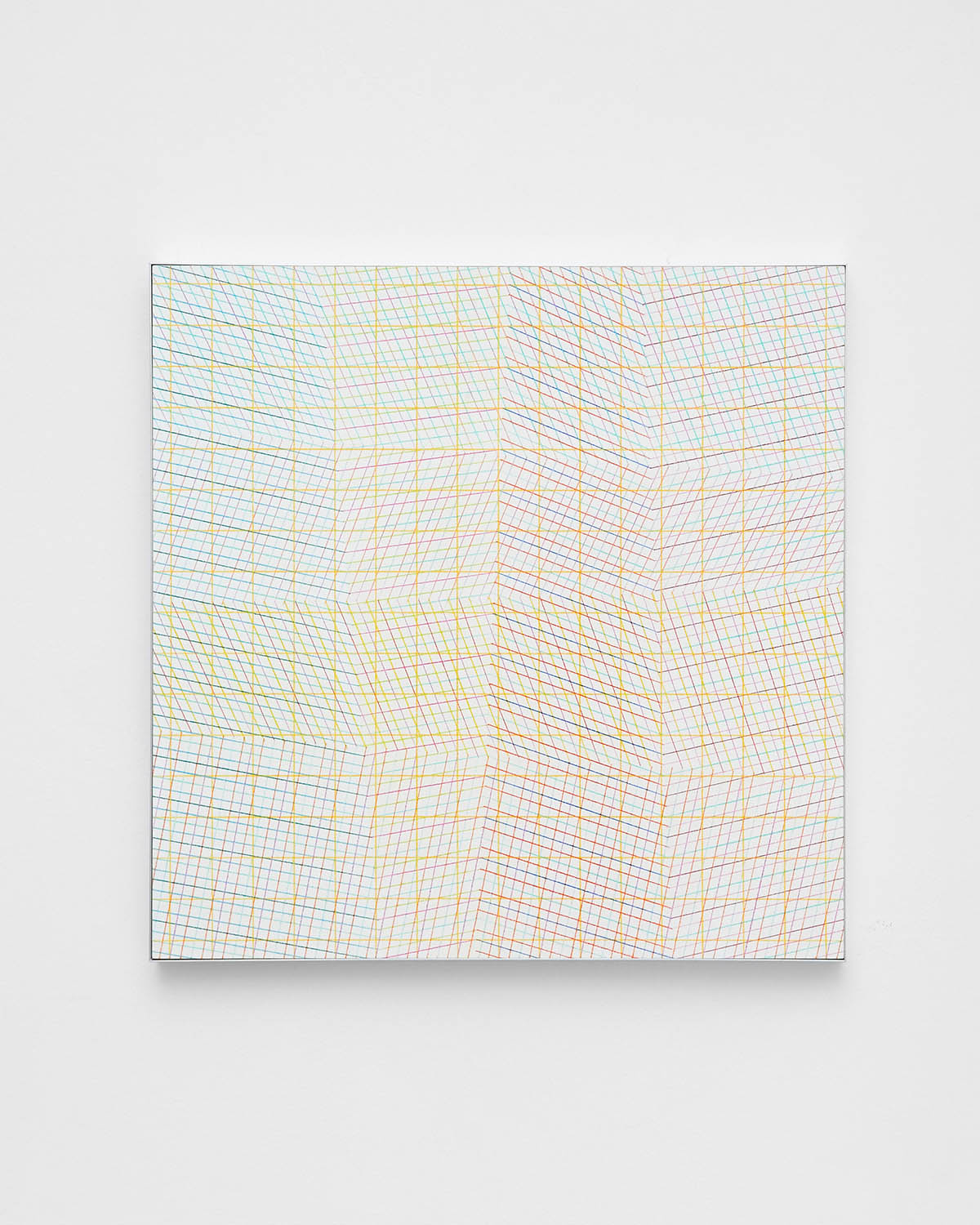
So what I try to do with color is to invent – or at least catch – glimpses of subtle, metaphysical realities. Realities that I (and hopefully you neither) would not see/find on the street or in nature. For sure, I feel that working with color – and especially with colored pencils – means also dissolving the physical reality of both the painting and the architecture that holds the painting. I think in a world and society that seems to become more and more material, we artists might want to contribute with stuff that is rather intellectual and even rather spiritual than material. I always consider my paintings to be some kind of ghosts; an immaterial phenomenon that flirts with the three-dimensional world and the four-dimensional people that are themselves only temporary guests here. But to answer your question properly: my perception of color has not really evolved. Colors are like the ABC, or like the notes in music; you do not exclude them upfront, you use them based on your actual needs. I hope I can have the same freedom as pop musicians: I can come up with a “ballad” and a hard-core “dance tune” within the same disc (exhibition), even if this time, here at gezwanzig gallery, I stayed mostly in the field of meditative minimalistic music, like, let’s say, Arvo Pärt. You see, I wanted to explain to you color, and I ended up talking about music. But as I believe Robert Ryman once said: you can never define with words what a painting really is. You can only circumscribe it by trying to say what it is not.
Solo exhibition: Tamás Jovanovics – Farbstift-Serien
Exhibition duration: September 3 – November 13, 2026
Opening times: Wednesday to Friday: 11 AM–6 PM and Saturday: 11 AM–3 PM
Tamás Jovanovics explores the image through line, color, and geometric precision. His examination of perception and space continues to shape his geometric-abstract visual language to this day. Straddling the boundaries of painting, sculpture, and spatial installation, he creates works that play with illusion and the perception of depth—monumental steel and aluminum sculptures as well as painterly works that pit order against perception. It remains unclear whether we actually perceive space and structure or merely believe we do.
Address and contact:
gezwanzig gallery
Gumpendorfer Straße 20
1060 Vienna, Austria
www.gezwanzig.com
www.instagram.com/gezwanzig.gallery
Tamás Jovanovics – www.tamasjovanovics.weebly.com, www.instagram.com/tamas_jovanovics/
Tamás Jovanovics, born in Budapest in 1974, is a Hungarian artist known for his work in the field of abstract art. He studied at the Hungarian Academy of Fine Arts in Budapest, at the Université de Provence in Aix-en-Provence, and at the Slade School of Fine Art in London. This academic study of art theory and perceptual phenomena significantly influenced his later artistic practice. Over the course of his career, he has developed a distinctive visual language that relies heavily on geometric abstraction and the exploration of space and time. As part of the Magyar Universitas program, Jovanovics created monumental steel and aluminum sculptures for three dormitories in Nyíregyháza, Hungary. His works have been presented in numerous solo and group exhibitions both in Hungary and internationally. For example, he exhibited at the Várfok Gallery in Budapest and took part in exhibitions at the Vasarely Museum in Budapest.