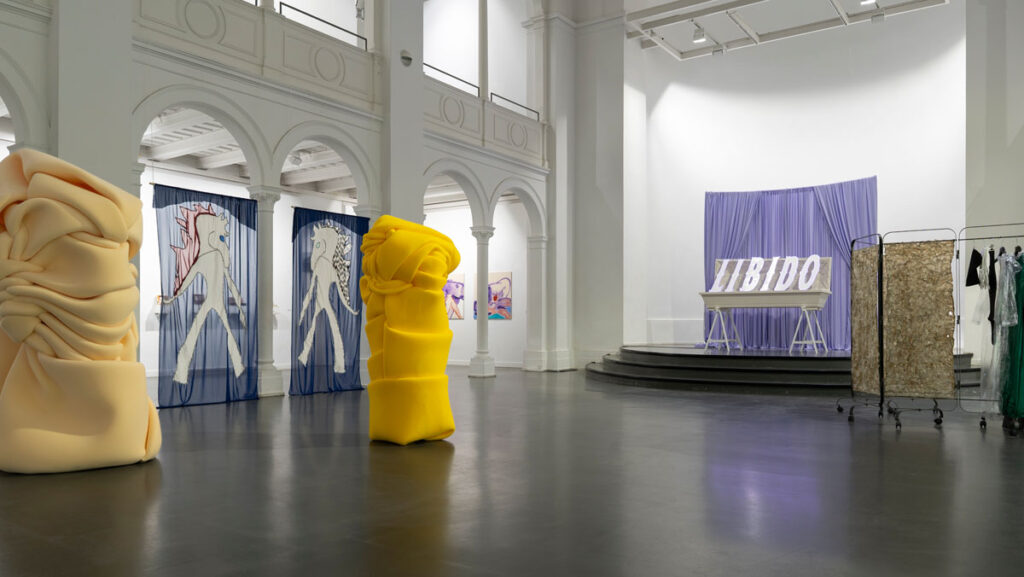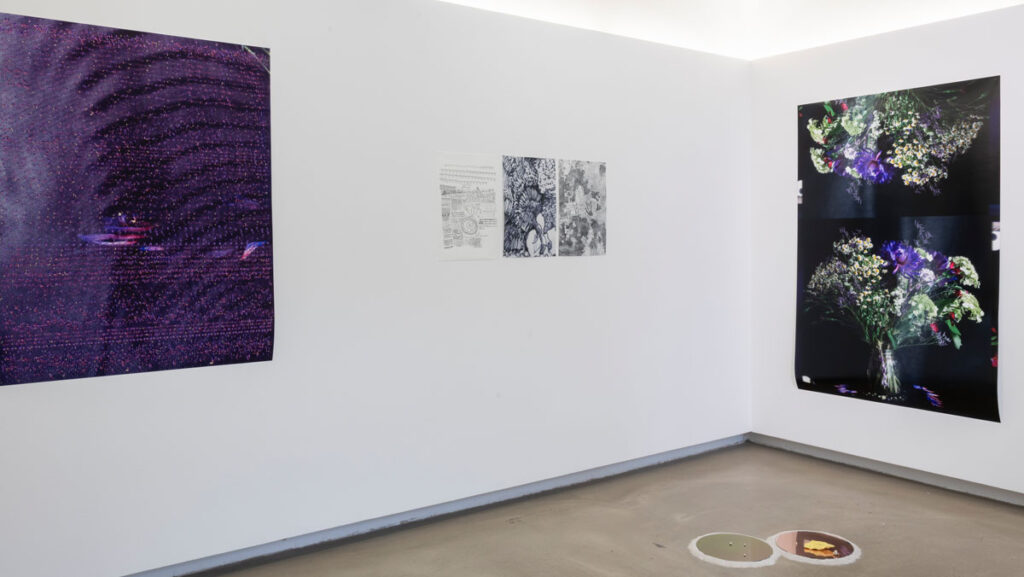

Working from distinct geographies and political urgencies, the artists approach landscape both literally and metaphorically: as one of the last remaining old-growth forest areas; as wetlands and peatlands across the European territories of the former Soviet Union; as architectural remnants of a former Gulag system. Landscape appears here as a multilayered terrain shaped by pasts and presents of violent militarised border zones, ecological extraction and imperial expansion but also, equally, as a corporeal and affective field — taking the form of bodies and gestures. It extends to public squares and streets charged by political unrest, from Enghelab Street — literally ‘Revolution Street’ in Tehran — to the protests at Gezi Park in Istanbul, where the situated body itself becomes a site of resistance and collective memory. Across the exhibition, landscape thus emerges not as passive scenery for contemplation, untouched nature or a distant historical backdrop, but as something inhabited, inscribed and contested: a terrain that has been, and continues to be, transformed by extraction and dispossession, as well as by survival and revolt.
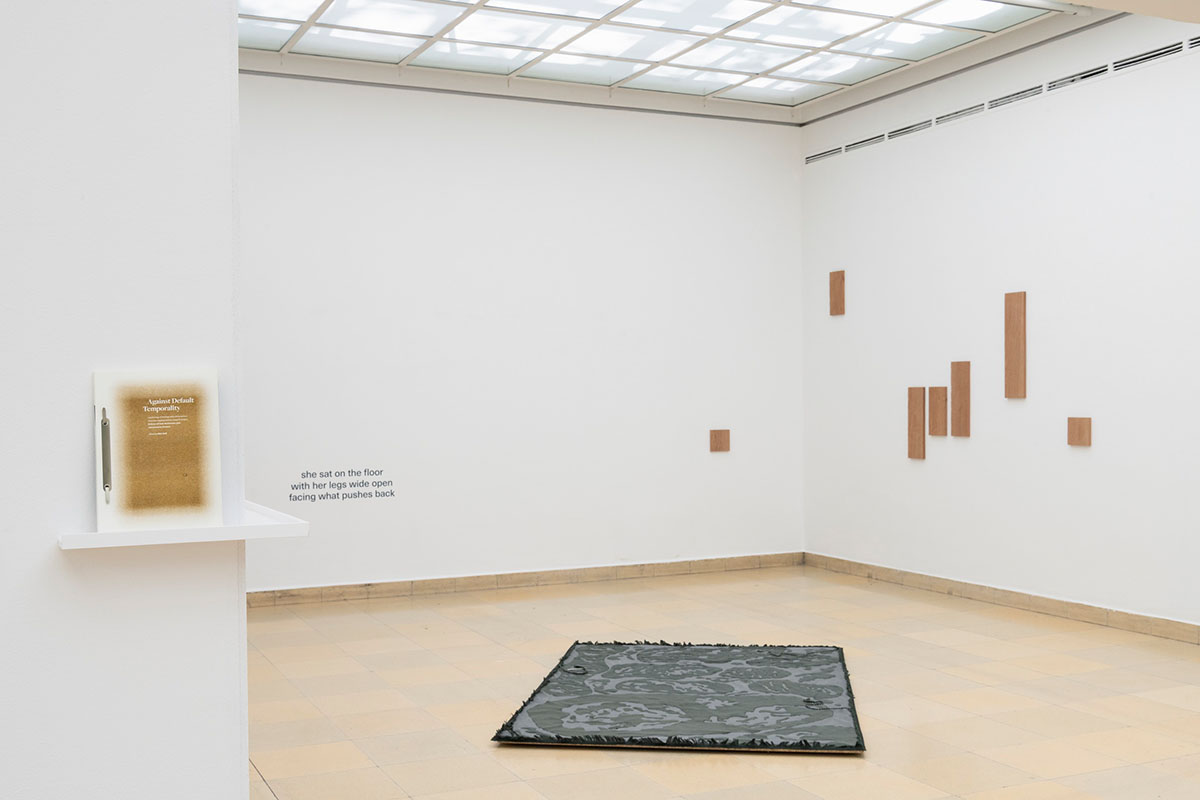
If landscapes throughout the exhibition appear as being marked by political and historical forces, they also emerge as choreographies: as bodies occupying space, refusing movement, repeating gestures and unsettling established orders. The exhibition departs from the scale of the human body – Bita Bell’s poetic sentence, ‘she stood here holding a gesture’, installed on a plinth on the floor outside the Kunstpavilion – asking how acts of resistance can become inscribed in collective memory and how a single gesture might reverberate beyond its immediate moment of appearance.
Bita Bells’ contribution to the exhibition unfolds across three interconnected works—performance, publication, and spatial text installation—each emerging from her ongoing artistic research project Echoes of Solo Resistance and Autonomous Protest. Situated between expanded choreography and queer feminist theory, the project investigates individual acts of protest in public space: gestures performed by single bodies under conditions of urgency and precarity. Unlike mass demonstrations or organised movements, these autonomous actions often appear without institutional support, collective protection, or guaranteed visibility. They emerge in moments of rupture—sometimes lasting only seconds—yet continue to repeat through images, recordings, and reenactments. Bita Bell’s research asks how bodies claim public space, how gestures confront authority, and under which historical, racialised, gendered, or geopolitical conditions one body can become tangible and legible.
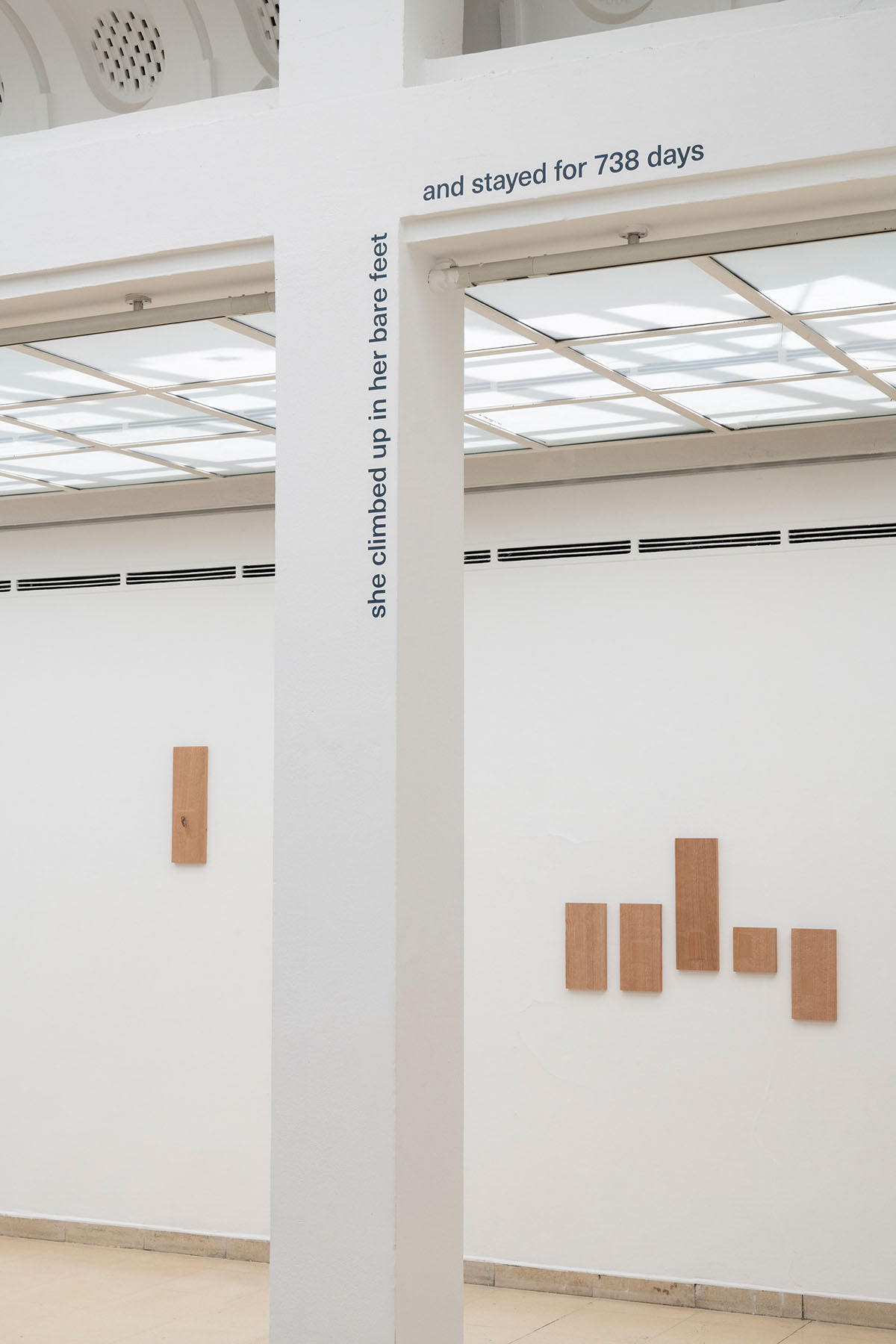
Installed throughout the exhibition space and designed spatially with Peter Oroszlany, becoming a living monument translates six selected protests into short poetic sentences—part instruction, part invocation, part choreographic score. Distributed across walls, corners, entrances, and thresholds, these fragments call bodies into relation: to stand, to wait, to elevate, to refuse, to remain. They reference historical acts of resistance while simultaneously proposing present and future ones. These choreographic scores draw from charged historical images: the anonymous ‘Tank Man’ facing military columns during the Tiananmen Square protests; Erdem Gündüz’s Standing Man during the Gezi Park protests; Julia Butterfly Hill in the Redwood Forest of California, where she occupied endangered landscapes; and Naked Athena, a protest in Portland, where a naked female body confronted militarised police lines during the Black Lives Matter uprisings of 2020. Yet Bita Bell’s research is equally concerned with the uneven afterlives of such visual documentation. Why does one gesture become collective memory, while another remains an isolated image? Which bodies are granted power and which remain symbolic?
Presented in public space at the square beside the Tiroler Landestheater and the Kunstpavillon, Bita Bell’s performance If not me, then you? embodies this research into a live performative encounter. Rather than reenacting protest as spectacle, the work traces a constellation of ephemeral actions that have emerged globally over the past decade, allowing archival gestures to reappear through the body. Monumental and fleeting at once, the artist’s movements oscillate between stillness, suspension, confrontation, and disappearance—between the body in centre and the body at risk. The title itself carries both invitation and challenge: if one body refuses to move, who follows? If one body takes the risk of appearing, who bears witness and joins? The performance draws from specific acts of resistance whose circulation has shaped contemporary political imaginaries. One of its central references is the protest of Vida Movahed in Tehran, who in 2017 stood elevated on a utility box, silently holding a white headscarf above her head in protest against compulsory veiling. Her gesture— simple, vertical, unmistakably visible—sparked a chain of repetitions which led to the movement The Girls of Revolution Street, transforming an individual act into an international feminist symbol. Bita Bell reactivates this gesture in front of the Kunstpavillon, allowing it to become what she calls a ‘living monument’: not fixed in bronze or stone, but carried through bodies willing to repeat it.
These issues continue in the publication Against Default Temporality, written and edited by the artist during her fellowship at the Büchsenhausen Program. The publication combines theoretical framework, fabulative texts, archival materials and practice-based dialogues and conversations with artists including Biba Bell, Alireza Khosroabadi, Giulia Damiani and Sebastian Blasius. Designed by Peter Oroszlany, the book functions not simply as documentation, but as an extension of the choreographic research itself—an expanding archive of gestures that refuses the linear temporality of news cycles, social media feeds, or institutional memory. Rather than commemorating protest as a finished event, Bita Bell’s work insists that resistance is choreographic — something that must be embodied, repeated and continuously reactivated in relation to bodies and the environment in public space. Across performance, publication and installation, Echoes of Solo Resistance and Autonomous Protest asks not only what one body can do, but how the afterimage of a single gesture might continue to move others into action. Yet the exhibition also asks what happens when resistance no longer persists primarily through the visible body in public space, but through quieter forms of transmission: through ruins, fragments, songs, architectural remains and dispersed material traces. If Bell’s work follows the afterlife of gestures through repetition and embodiment, the other works turn towards landscapes that remember differently — where memory becomes embedded in objects, infrastructures, architectural and ecological sites whose histories continue to reverberate across time. Here, acts of remembrance — carried through oral histories, songs, minor objects, fragmented architectures and embodied forms of knowledge — become forms of resistance against the violent omission and denial embedded within hegemonic narratives.
For instance, Kandis Friesen’s research unfolds through what the artist calls the ‘dispersed monumental’: a form of memory that refuses the permanence, fixity, scale and singular authority of conventional monuments. The dispersed monumental moves through bodies, songs, buildings, objects, stories, banners, ruins and everyday acts of transmission. It exists as something portable, grafted and relational—capable of being carried across generations and geographies, while remaining anchored in specific histories of violence and survival. For Friesen, this concept offers a way to think through the tension between official state memory and informal, intimate, fragile and interior forms of remembrance. It is an ephemeral monumental form— scattered, yet able to circulate across absence as much as presence, through fragments as much as totalities, through the rhythm of what remains half-spoken, inherited or withheld. Her work composes from these unstable elements, composing an exilic grammar of memory in the making: diasporic, layered and resistant to closure.
Developed during her fellowship at Büchsenhausen, Karaganda, Karaganda extends this research through an investigation into the afterlives of Karlag, one of the largest labour camp complexes of the Soviet Gulag system, located in the Karaganda region of Kazakhstan. Operating between 1930 and 1959, Karlag incarcerated an estimated one million prisoners, many sentenced as so-called ‘enemies of the people’. Artists, poets, musicians, intellectuals and dissident party members were among those first incarcerated there, exiled from across the Soviet Union and Soviet Kazakhstan. The construction of Karlag was concurrent with the Asharshylyk of 1931–1933, during which nearly half of the nomadic Kazakh population died through forced sedentarisation, alongside wider mass displacements, famines and repressions. The city of Karaganda itself was built by the forced labour of Karlag prisoners under brutal conditions, as Karlag functioned as a colonial-industrial infrastructure supplying labour to the expanding industries of central Kazakhstan, including the Karaganda coal basin. Much of this infrastructure remains in use today: trees, canals, roads, fields, mines and processing plants; yet despite the Gulag’s central role in the Soviet system, its afterlives are fragmented—camps dismantled, repurposed or left to deteriorate, their histories partially preserved through hegemonic museum narratives.
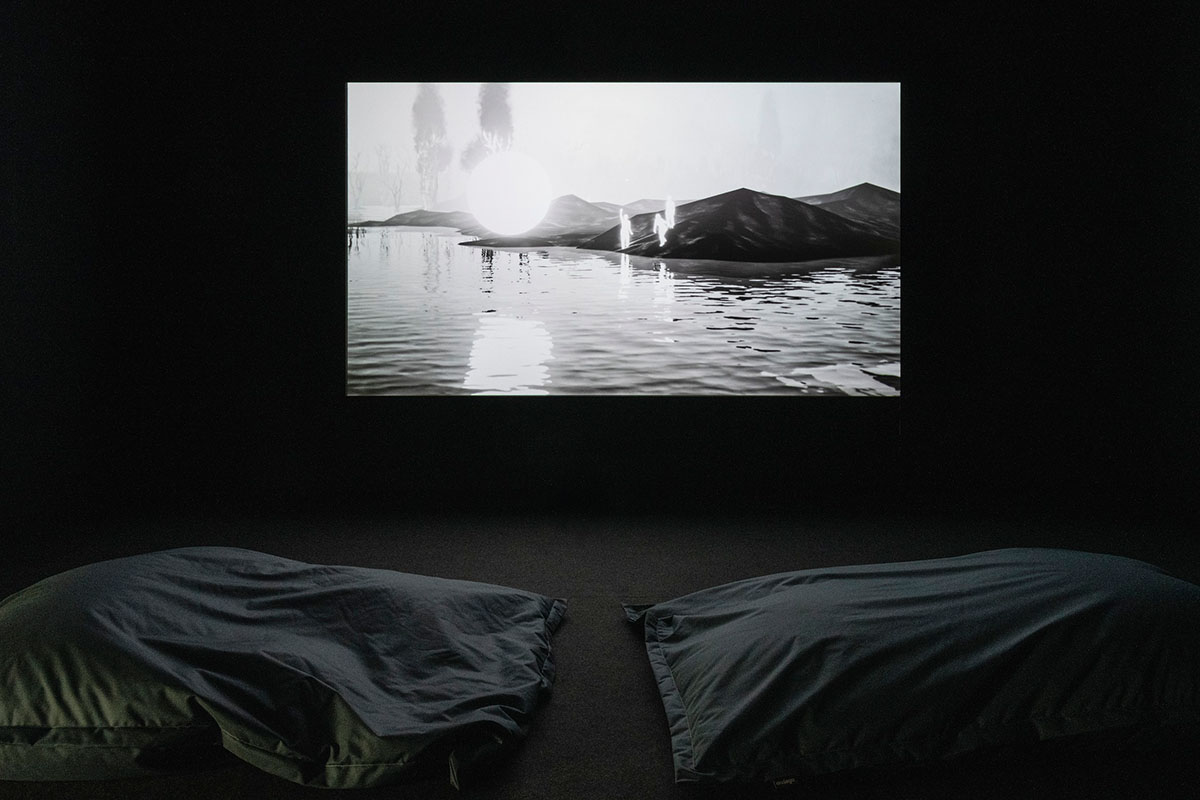
Karaganda, Karaganda takes material form in the Kunstpavillon exhibition through two works: a sculptural series composed of approximately twenty-one carved wooden panels distributed across the exhibition walls and a single-channel video work. Moving through the site almost as an archaeologist of the present—yet equally as a listener attentive to what continues to resonate from the past— Friesen approaches Karlag as an unfinished social, political, cultural and architectural landscape. While its histories remain fragmented and obscured, shaped by politically mediated forms of preservation, the artist turns toward more fragile and informal traces of memory: oral histories, songs and sounds, repurposed infrastructures, found fragments of Soviet-era mosaics and minor material traces through which lives, losses and acts of survival continue to circulate.
Installed throughout the exhibition space, ABTTP (2026) unfolds as a variable sculptural composition of sixty carved panels made from Eurasian cherry wood. Each panel corresponds to a single fallen mosaic tile collected by the artist from a rooftop directly beneath Art Belongs to the People, a seemingly anonymous Soviet-era mosaic on Nurken Abdirov Avenue in central Karaganda. Created in the 1970s, the mosaic stands apart from the grand socialist realist monuments that define much of the city’s visual landscape. Modest in scale and materially fragile, it depicts weavers, dancers, musicians and a sun-bird motif, accompanied only by a small Vladimir Lenin quote: ‘Art belongs to the people’. Unlike many monumental Soviet works authored by celebrated artists, this work appears to have been collectively or anonymously produced and has been left to quietly disintegrate. For each displaced tile, Friesen has produced a corresponding relief carving: subtle plateaus in wood that register the contours of what has disappeared. The resulting panels function as both transcription and transposition—a new constellation built from the displaced fragments of a monument whose author, history and conservation remain uncertain. Installed in responsive arrangements that shift with each exhibitionary context, the panels resemble a fragmented visual score—an abstract notation system that allows for a spatial and poetic reading through appearance and disappearance, dispersal and reconstruction. Carved in cherry wood, the work also evokes another layer of Karlag’s material history—the tens of thousands of trees planted by forced prison labourers across the Karaganda steppe.
The accompanying video work, Dolinka Shyoti, Score for Abacus (2026), offers another form of accounting. Filmed in the village of Dolinka—once the administrative centre of Karlag—the seven-minute video centres on the right hand of Irena, a local cashier and descendant of Gulag exiles, as she performs a mathematical score on her inherited wooden abacus. The numbers she counts are drawn from statistical panels in the nearby Karlag museum: deported ethnic groups, hectares of forced agricultural labour, confiscated livestock, crop yields, choirs, orchestras and production quotas—ingredients of a bureaucratic language of state violence, coercion and control. In the intimate space of a neighbour’s living room, these numbers are translated into another rhythm: the soft clicking of wooden beads, whispered counting, pauses, corrections, breath. A temporal score emerges—a sonic calendar tracing extraction, displacement and survival, brought back into the scale of the human hand.
Rather than monumentalising Karlag’s inheritance through analytical closure or historical containment, Friesen decomposes and recomposes a non-monumental, archival, ephemeral and poetic texture through the dispersed monumental—fragments, gestures, materials, sounds and rhythms through which memory evolves as contingent, relational, provisional and tentative acts of mnemonic artistic labour. Another register of memory and unrest emerges through landscapes shaped by soil – sand, silt, clay and deposited sediments; by water – surface water, groundwater and seasonal flooding patterns; by vegetation – mosses, grasses, sedges and reeds; as well as by organic matter and microorganisms. Histories of extraction and violence become sedimented within environments whose surfaces are unstable and porous, compressed into geological and material layers that continue to carry traces of forced labour, extractive practices and political and ecological transformation.
Jeanna Kolesova’s experimental documentary In Zombie Fire (2026) is the first chapter of an ongoing trilogy examining European peatlands as ecological, political, and cultural witnesses to histories of extraction, environmental violence and imperial transformation. Shot in black and white and moving between speculative fiction, archival research and experimental documentary, the film approaches wetlands as living archives—terrains in which political ideologies, economic infrastructures, and embodied labour have left lasting marks. Spanning sites across the European Part of the Soviet Union, In Zombie Fire traces how peatlands have been repeatedly transformed in the service of energy production, agricultural expansion and statebuilding, while asking how these landscapes continue to shape the present.
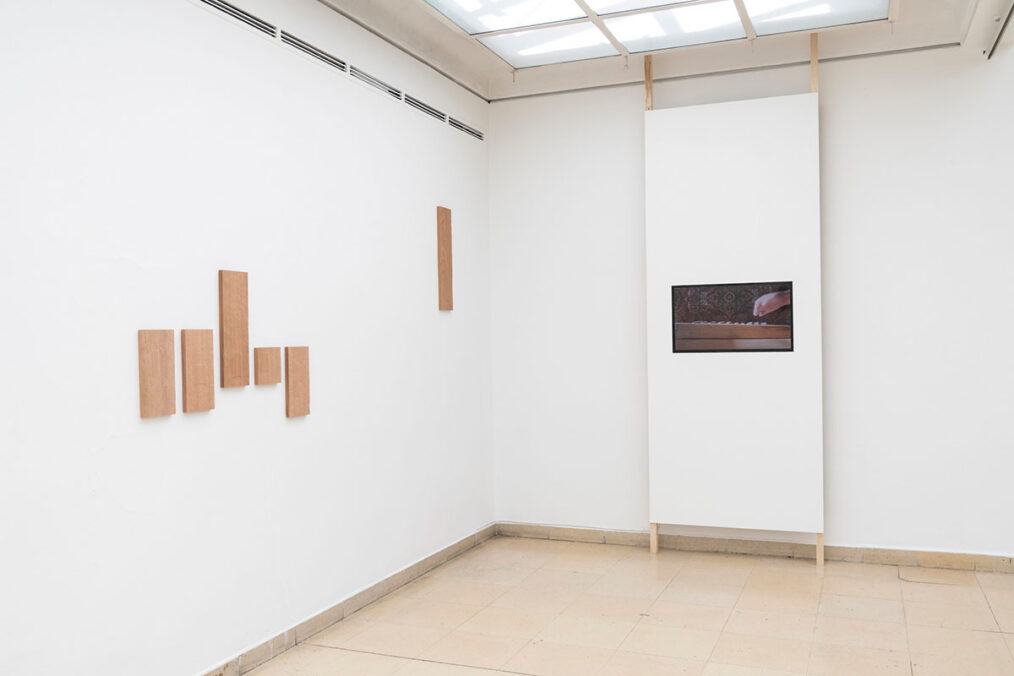
Peatlands occupy a paradoxical place within European environmental imaginaries. For centuries, bogs and marshes were framed as unproductive wastelands— territories to be drained, cultivated, industrialised or militarily secured. Peat is the dense, carbon-rich layer of partially decomposed plant matter that accumulates over thousands of years in waterlogged ground, making peatlands among the largest natural carbon stores on earth. Under Soviet modernisation, peat became an especially important fuel source, and wetland extraction was tied to broader projects of electrification, industrial labour and territorial control. Draining bogs promised progress, productivity and conquest over ‘wild’ nature. Yet these infrastructures of extraction were never only technological; they were deeply gendered. Women from rural areas— among the most economically and socially disadvantaged— were recruited into physically brutal peat labour, their bodies integrated into systems of production that mirrored broader ideological demands around socialist labour, reproduction and collective sacrifice. In Kolesova’s film, the gendered body becomes a central site through which these histories of environmental transformation and political violence are made legible.
At the centre of the film are three female peat workers, exhausted by repetitive labour and the dehumanising rhythms of extraction. Moving through drained wetlands, industrial ruins and unstable terrain, they encounter an uncanny presence in the bog: the Swamp Spirit, a speculative entity developed by the artist to embody memory, loss, and ecological resilience. Neither ghost nor mythological creature in a conventional sense, the Spirit emerges as a more-than-human witness—a testimony to landscape memory against the violence of national hegemonic history. Through this encounter, the workers are confronted with a revelation: their labour has not only transformed the land but has also implicated their bodies within this landscape—infrastructures of extractive conquest. The film’s central tension emerges here—between complicity and refusal, between inherited systems of violence and the possibility of aligning with other forms of life. The title refers to the phenomenon of ‘zombie fires’—peat fires that continue smouldering underground for months, sometimes surviving entire winters before reigniting on the surface. Kolesova invokes this ecological phenomenon as a political metaphor. Just as peat can retain heat and combustion beneath layers of soil, histories of extraction, imperial ideology and environmental violence persist beneath contemporary narratives of sustainability, energy transition and restoration. Today, peatlands are increasingly recast as ‘carbon sinks’, ‘climate superheroes’, or even strategic natural barriers in times of military conflict. Yet the film suggests that such narratives often leave unresolved the deeper histories embedded in these landscapes: colonial land management, industrial exploitation, gendered labour and the afterlives of state violence. Rather than offering a documentary account of ecological restoration, In Zombie Fire inhabits the unstable territory between myth, political memory and environmental testimony. Through the figure of the Swamp Spirit, the film asks what landscapes remember, what histories continue to smoulder beneath official narratives and what forms of solidarity might emerge when the human is no longer positioned at the centre of ecological history.
Installed alongside the film, Kolesova’s textile work Wetness (2026) extends these questions into another material register. Composed of embroidery on reflective polyester, muslin and cotton, the large-scale work imagines peatlands as seen from above—an aerial view of saturated wetlands shaped by memory, distance, and embodied recollection. Inspired by landscapes the artist grew up with or can no longer physically access, the work translates marshes, bog pools, and fragmented vegetation into a constellation of reflective surfaces and stitched green forms. The reflective material evokes the mirror-like quality of water in flooded peatlands, while the embroidered ‘islands’ suggest ecosystems suspended between submersion and emergence. Created in parallel to the film, Wetness also reflects Kolesova’s process of making: embroidery becomes a meditative and bodily counter-practice to the digitally intensive labour of research, editing and postproduction. If the film excavates wetlands as archives shaped by extraction and violence, the textile offers another mode of relation—slower, tactile, intimate—through which landscape becomes not only a site of analysis but of embodied remembrance, orientation and imaginative regeneration. Elsewhere, political and ecological histories become entangled within landscapes shaped by multiple histories of violence and survival. Traces of war, displacement, forced movement and contemporary violent border regimes coexist within terrains marked by precarious forms of passage, refuge and resistant inhabitation.
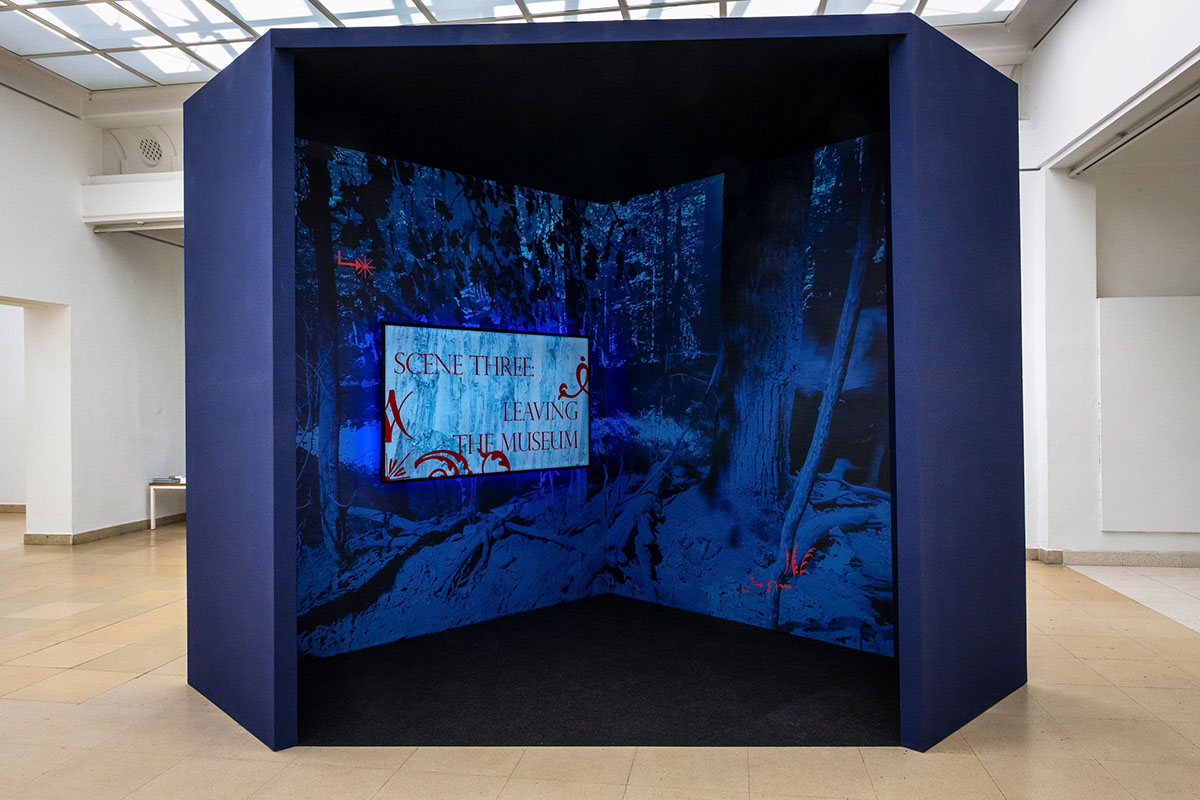
Olia Sosnovskaya’s film Fog is the Bison of History unfolds in the Białowieża Forest, one of Europe’s last remaining primeval lowland forests, yet the film quickly makes clear that this landscape is not approached as untouched wilderness. Rather, the forest emerges as an archive—dense with political contestation, ecological extraction and embodied histories that resist linear narration. Moving between essay film, poetic testimony, documentary research and performative text, the work examines Białowieża as a site where imperial violence, conservation regimes, forced migration and contested memories overlap. Borrowing its title from Valzhyna Mort’s poetry collection Music for the Dead and Resurrected (2020), the film enters into Mort’s larger inquiry into how histories marked by censorship, propaganda and political erasure can be mourned, remembered and spoken after silence. In Mort’s writing, Belarusian landscapes—forests, fog, animals, soil— become witnesses to lives omitted from official histories. Sosnovskaya extends this gesture into the moving image, treating fog not simply as atmosphere but as a medium through which displaced histories persist: elusive, layered and resistant to capture.
Stretching across the border between Poland and Belarus, Białowieża Forest is both a UNESCO World Heritage site and a heavily mediated political landscape. As one of Europe’s last old-growth forest ecosystems, it is central to biodiversity conservation and climate research; yet its ecology remains inseparable from histories of extraction, occupation and state violence. During the twentieth century, the forest was logged under imperial and military rule, became refuge for partisans and a site of mass executions during World War II and was later divided by the postwar border between Poland and the Soviet Union. Today, as an external frontier of the European Union, it has become a militarised border regime, where surveillance, pushbacks and selective mobility expose the forest as both ecological sanctuary and racialised infrastructure.
Structured in three movements—entering the forest, walking and leaving the museum—the film begins with a simple proposition: every story starts with an action. To enter the forest is also to cross a border, although, as the narration suggests, a border often appears only once one has already reached its end. The opening scene stages this threshold through the language of instruction: tourist signage, rules of entry, warnings and official designations. Addressed as ‘Dear tourist’, the viewer stands before the gate to an ‘extraordinary forest’, introduced at once as protected wilderness, national heritage and regulated territory. In the second movement, walking becomes both method and political gesture—a way of reading traces, of moving through landscapes marked by violence, migration and acts of local care. Walking becomes the film’s central method and metaphor. To walk in Białowieża is to move through overlapping temporalities, tracing what remains visible and what has been made to disappear. One might search for tracks, excrement, disturbed soil—signs of animal presence. Local residents search with reluctance, fearing they may encounter the bodies of refugees who attempted to cross the border. Graves of Jews, Soviet soldiers, Belarusian and Polish partisans and unnamed dead punctuate the forest floor, transforming landscape into an unstable memorial. Walking thus becomes both research and witness, a choreography of survival, state violence and care.
The figure of the bison operates as both ecological fact and political metaphor. Once hunted nearly to extinction by empires and monarchies and later reintroduced as an object of conservation, the bison embodies histories of control disguised as protection. Parallel to this is the concept of tuteishy—‘those from here’—a category used by people in Belarus as well as in Poland, Ukraine and Lithuania to describe a form of local belonging that refuses fixed national identity. Like fog, like animal traces, tuteishy remains difficult to classify, map or govern.
Throughout the film, the forest appears in deep blue, violet and pink-tinted images whose visual texture recalls thermal cameras, night-vision systems and negative exposures, while also evoking the display aesthetics of natural history museums. Drawing on visual languages of ecological observation, scientific classification and surveillance technologies alike—used by forestry offices, research institutions, environmental agencies as well as police, border guards and military infrastructures—the images render the landscape estranged, as if already captured, archived and organised through systems of observation and detection. There is no voice-over; instead, the film’s narration unfolds entirely through text layered onto the image in large capital serif letters, accompanied by ornamental graphics of leaves, roots and almost hieroglyphic signs. The screen becomes both field guide and coded archive: poetic text, bureaucratic inscription and tracking interface at once. A dense, atmospheric soundscape reinforces the film’s central motif of fog—not as meteorological backdrop, but as a medium of history: shifting, opaque and resistant to capture.
Only in the final scenes does a human voice emerge, through a reworked and remixed version of the Soviet-era song Belovezhskaya Pushcha (1975), composed by Aleksandra Pakhmutova with lyrics by Nikolai Dobronravov and later popularised by the Belarusian ensemble Pesniary. Commissioned from Zosia Hołubowska and performed with Sosnovskaya’s own vocals, the reworking shifts the song from its original Russian version sung by a male voice into a Belarusian translation, introducing yet another layer of historical narration—one shaped by Soviet cultural mythmaking and reopened in the film through acts of translation, citation and displacement. Reframed through the film, the line ‘I understand your centuries-old sorrow, / Belovezhskaya Pushcha, Belovezhskaya Pushcha’ is stripped of its Soviet pathos of heroic landscape and national belonging, becoming instead a question of what it means to mourn a forest shaped by extraction and extinction, by massacre and political erasure, by displaced bodies, militarised borders and histories that remain unequally remembered—or deliberately left unspoken—after a century of occupation, propaganda and silence.
A queer-feminist, queer-ecological, anti-imperial, anticolonial and materially grounded sensibility runs through the exhibition: an attentiveness directed towards bodies placed at risk, terrains marked by colonial and capitalist violence and the subtle ways in which resistance and unrest are enacted through performative movement, listening, storytelling, speculation and artistic fabulation. Rather than offering singular narratives or fixed positions, the artworks operate through shifting scales, echoes, glitches, repetitions and poetic gestures. They move between visibility and obscurity, testimony and opacity, monumentality and ephemerality. The exhibition returns to the multiple and entangled histories of violence, extraction and displacement, not in order to stabilise them but to remain with their ongoing reverberations. Landscapes and the bodies moving through them emerge as living archives of struggle, carrying unfinished histories that continue to accumulate, shift and demand new forms of care, attention and listening.
Exhibition: Landscapes of Unrest: Bodies, Memories, Revolt curated by Barbara Mahlknecht
Artists: Bita Bell, Kandis Friesen, Jeanna Kolesova, and Olia Sosnovskaya
Exhibition duration: 22.05. – 01.08.2026
Address and Contact:
Künstler:innen Vereinigung Tirol*
Kunstpavillon
Rennweg 8a, 6020 Innsbruck
www.kuveti.at