To what extent does its scenography in the exhibition space in MAK influence the perception of the work?
Soft Image, Brittle Grounds deals with the “surface” of contemporary Western technologies, the “lamina” through which this computational regime presents itself to us. It traces what remains when the world is reduced to numbers and data, when assemblages of lives become mere vectors within a statistical control space, something to be captured, manipulated, and controlled.
The clean, impeccable surfaces and interfaces of technological corporations convey an appearance of rationality, objectivity, and neutrality. The aesthetic is strategic: it masks the violent and extractive realities, the labour and resources, from which these corporations profit and upon which they depend.
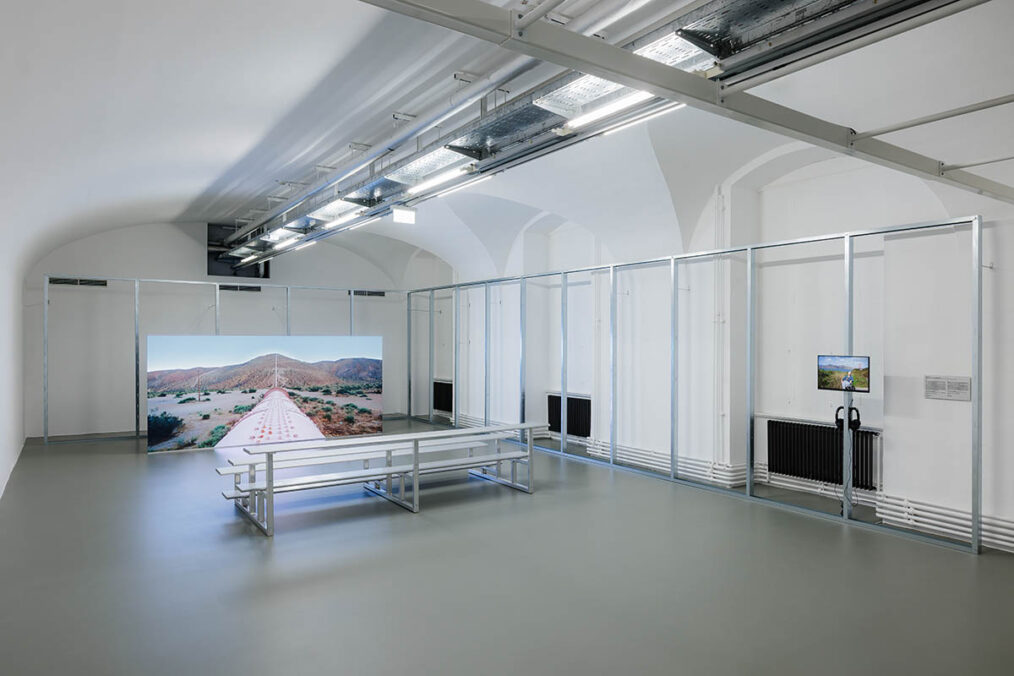
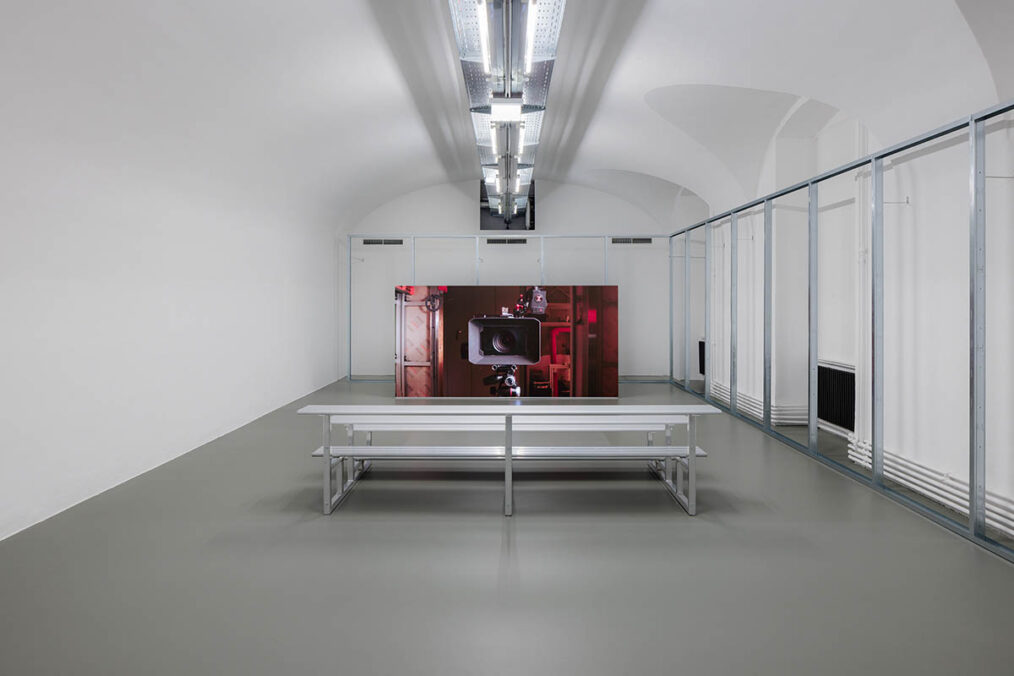
At the MAK, the film Brute Force and the three-channel video installation Valley of the Heart’s Delight approach this context at two different scales. Brute Force addresses the planetary consequences of contemporary extractivist practices in image and knowledge production. Valley of the Heart’s Delight shifts to the local and situated, addressing the colonial history, violence, and genocide that underlie today’s “Silicon Valley”. The installation grew out of the stories and lived experience Gregg Castro kindly shared with me. Gregg is the culture director of the Association of Ramaytush Ohlone and one of the few remaining Indigenous voices native to this land.
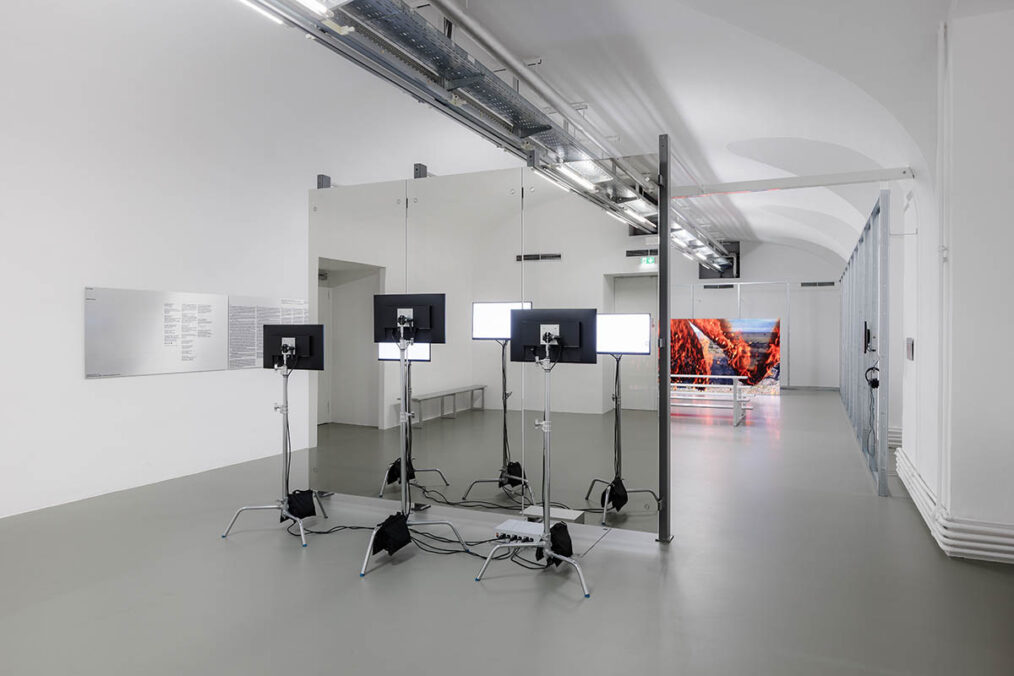
Composed of a fragment of an industrial glass façade, the installation references the sleek, mirrored exteriors of tech campuses. The overall exhibition design, a stainless-steel bench, metal plaques, and vertical C-profiles arranged at regular intervals, extends this corporate architectural language across the space. Usually hidden inside plasterboard walls, the exposed metal profiles form a structure that is reminiscent of a cage. For me, the metal and glass, the cables, and artificial light create an alienating scenography in which the visitor almost feels like a foreign body.
![Felix Lenz, Brute Force [Exhibition Cut], 2025, co-directed by Ganaël Dumreicher, film still: West Desert Sinkhole, Utah, USA, © Felix Lenz / Stella-Joya Puelache](https://www.les-nouveaux-riches.com/wp-content/uploads/soft-image-britte-grounds-07.jpg)
film still: West Desert Sinkhole, Utah, USA, © Felix Lenz / Stella-Joya Puelacher
What was your experience collaborating with Ganaël Dumreicher on the artistic direction? Tell us more about the process, including filming days and production details.
I invited my friend and colleague Ganaël to co-direct Brute Force with me since I believe that our approaches to cinema complement each other well. Ganaël has a background in narrative and experimental film, while I am used to working with essayistic and research-led methodologies. In a way, the work reflects this. It doesn’t sit neatly within any particular genre. It makes image production itself its central question and is situated somewhere between documentary and essay film, while using constructed and fictional elements in some scenes. But more generally, I don’t believe in the lore of the single—or, in this case, duo—artistic mastermind. And I believe this is particularly true of film, at least in the way I work within the discipline. Film relies on the ideas, hands, and skills of many people, and this work is the result of a collage of many voices. Spoken by poet Day Eve Komet, the film’s narration, for example, interweaves insights drawn from conversations with feminist theorist and physicist Karen Barad, media artist Vladan Joler, and geologist Diego P. Fernandez. Laura Stöckler, Dunia Sahir, and I expanded upon and shaped it into the voice-over. And, of course, many more people were involved in shaping the image, sound, scenography, and so on. The range of locations we chose follows a similar methodology. Rather than centring the film around a single place, we brought together a collage of different locations and landscapes. Brute Force emphasises the relationships between these places rather than focusing on the specifics of any one location. We shot across data centres, scientific research and nuclear facilities, mines, production sites, Superfund sites, salt lakes, and deserts across the US, Germany, France, and Austria. We traced what our computational regime leaves behind; we followed its material imprints. In a way, we approached the landscape and sites themselves as archives. Terminal lakes, for instance, preserve a geological record, a kind of “memory” of their transformation, in their sediments and residues. The greatest challenge was accessing some of these places. It’s obviously not in the interest of certain companies and stakeholders to expose these traces. This brought us into some quite tricky situations, and under the current political climate in the US, for example, I would no longer feel comfortable exposing a team to the same risks.
What role does the queer lens play in your examination of extractivism and power dynamics within technological systems?
Most algorithms, statistical models, and neural networks are built on systems of classification, arbitrary, often racialised categories, and binary logics. Their underlying datasets reflect the assumptions and biases of a white, privileged minority. Even on a technical level, they merely reproduce the limitations of what can be mapped and captured in the first place, disregarding everything that lies outside what technology can quantify and process. Once these biases and arbitrary lines are embedded within the “black boxes” that are our technologies, it becomes difficult, if not impossible, to reconstruct why our models continuously reaffirm dominant structures, while so-called “outliers” are disregarded, rendered improbable, silenced. What we could call “queering the dataset” can therefore be a way of challenging these binary logics and diversifying normative structures, categories, and terminologies. In Brute Force, we take this idea one step further. Drawing on a conversation with and the work of queer-feminist philosopher and physicist Karen Barad, the film argues that acts of measurement and observation do not simply reveal a pre-existing, determinate phenomenon or state; they participate in producing the conditions under which that phenomenon can emerge. There is no neutral position from which knowledge can be produced; no pre-existing thing, state, category, or class waiting to be measured and defined. The way we look at the world, the way we “intra-act” with it, is an active participation in its formation. This understanding of relationality is, of course, neither new nor revolutionary. Indigenous knowledge systems have long understood the world through relationships rather than as a collection of discrete states and entities. In my conversation with Gregg, also seen in the exhibition, he speaks about the sciences’ relentless urge to remain “detached” and “objective” from the knowledge they produce. His people, in contrast, meet the world as a relative, as something with which to be in relation. I believe the discussion should shift from attempts to express our world through discrete states, datasets, and statistical models towards a relational ontology that prioritises the ways in which we move through and with the world. Feeling, lived experience, discourse, and the relationships that nurture our lives shouldn’t be secondary considerations, but central to how we produce knowledge and meet the world.
How does the work contribute to broader discussions on the climate crisis and social disparities, particularly as it was first presented at the 24th Triennale Milano and now at the MAK in Vienna?
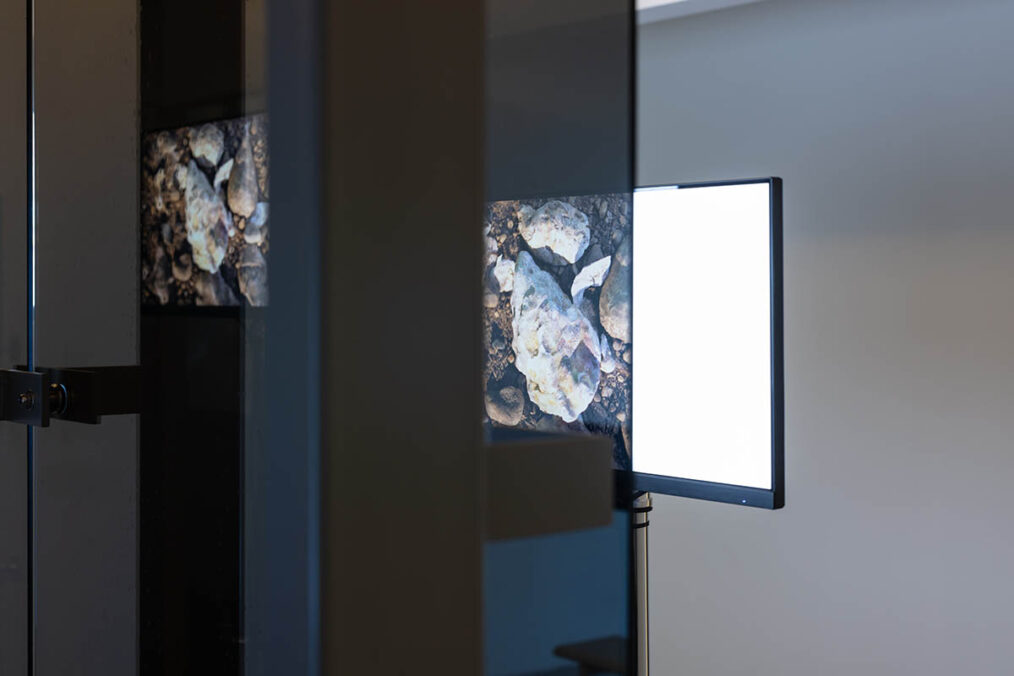
Technological infrastructures, rapidly expanding through the AI boom, have grown into a metabolic organism that competes with the Living World—not only for minerals but for the most fundamental resources such as water, clean air, land, and energy. Local communities living in proximity to data centres, mine tailings, fields, or rivers have understood this for quite some time. They hear it in the air, saturated with waste gases and the buzzing of fans; they feel the nights getting unbearably hot, the soil changing its consistency, crops ceasing to grow, rivers changing in colour and odour. The consequences span the planet, yet their distribution is unequal. The Majority World bears the costs of a wealthy minority. I visited headquarters and production sites of the high-tech industry in Grenoble, France, and San Jose, California—Silicon Valley, as they call it. There, the power to decide how rocks are extracted and refined was concentrated behind mirrored façades. So was the power to shape how hands move and how labour is organised and exploited. During my field research, merely photographing the exterior of one such facility led to my temporary detention and the forced deletion of the footage. Even on satellite imagery, some chip-producing factories dissolve into blurred clouds, their surfaces rendered clean, dull, and unrecognisable by Gaussian masks. This strategic opacity is mirrored in the way the exhibition reveals itself to the viewer. In Valley of the Heart’s Delight, depending on where you stand, the three video channels are either concealed or revealed. From the front, the screens and their reflections appear as featureless white sources of light. It is only from behind this fragment of a glass façade, looking through its specially coated glass, that the images become visible. On screen, captured through the lens of an industrial robotic arm, images of soil and crushed white shells evoke the sacred shellmounds of the Indigenous Ohlone people: burial grounds and remnants of ancestral life that now lie hidden beneath corporate headquarters. The installation connects these histories of displacement and erasure to the present-day architectures of technological dominance. The industrial robot becomes an unknowing witness to the abrasion and sealing of the very ground upon which it was built. It marks the continuation of a violent legacy rooted in racialised forced labor, resource exploitation, and the genocide of the Indigenous Ramaytush Ohlone people. They have lived in the San Francisco Bay Area for millennia, long before the arrival of the newcomers.
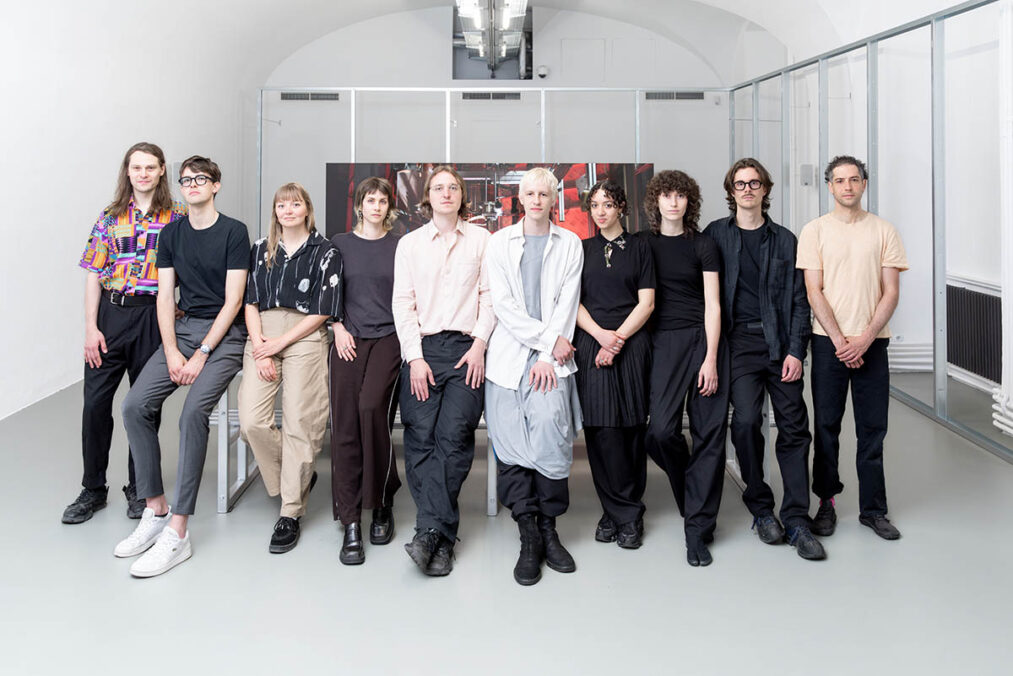
), MAK Galerie © Vincent Forstenlechner/MA
These past and present tenses cannot be separated. The climate crisis and its unequal effects, the strategic opacity of technological corporations and their centralised structures of power, and the continuation of colonial and neo-colonial practices are all expressions of the same extractive system. One that prioritises the wealth and power of a few over the Living World. As my friend and colleague Brooklyn Pakathi elaborates in a commissioned essay for a new book I’m currently writing, I want to re-emphasise that feeling has to become a legitimate way of knowing. A way of reading the world through the body, through relationships, and through the consequences of our actions. And as Raymond Williams writes in Structures of Feeling, art can be a particularly productive way of articulating and structuring these forms of knowledge.
Exhibition: Felix Lenz – Soft Image, Britte Grounds
Exhibition duration: 11 February 2026 – 4 October 2026
Address and contact:
MAK – Museum of Applied Arts
Stubenring 5, 1010 Vienna
www.mak.at
Felix Lenz – www.felixlenz.at, www.instagram.com/_lenzflare/