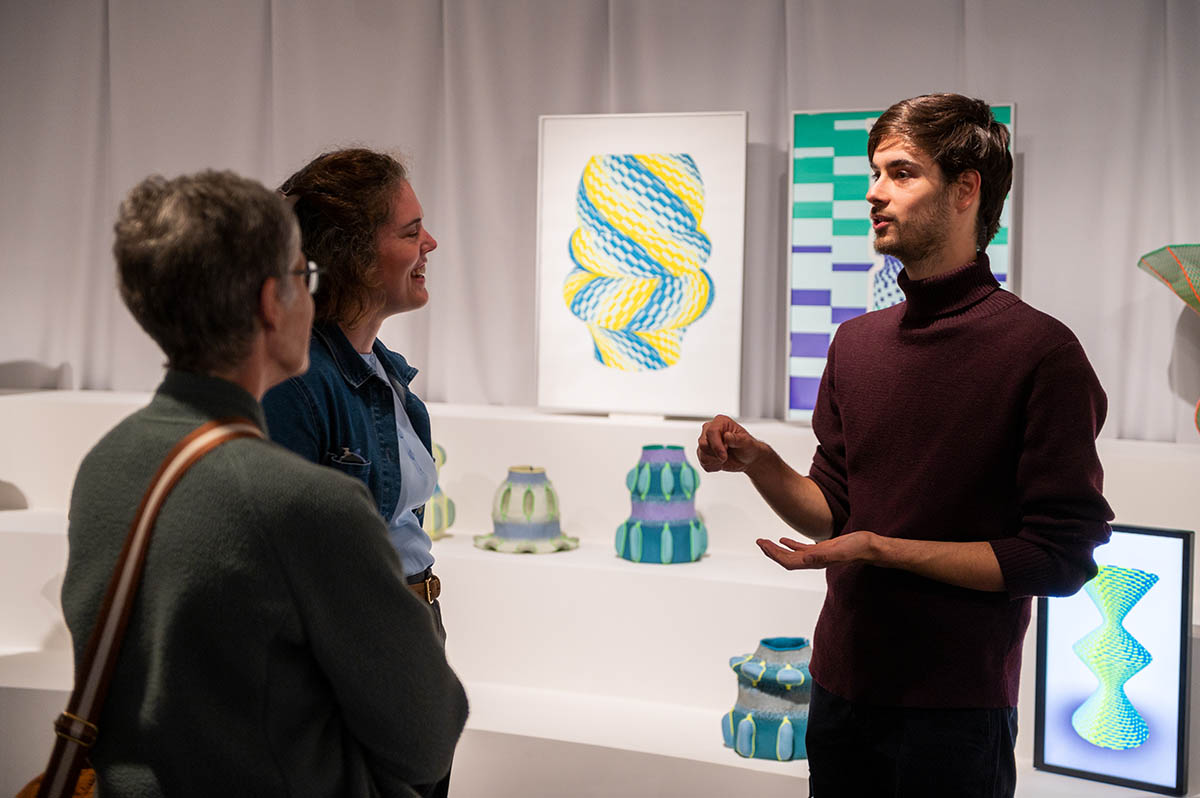
How would you introduce your practice?
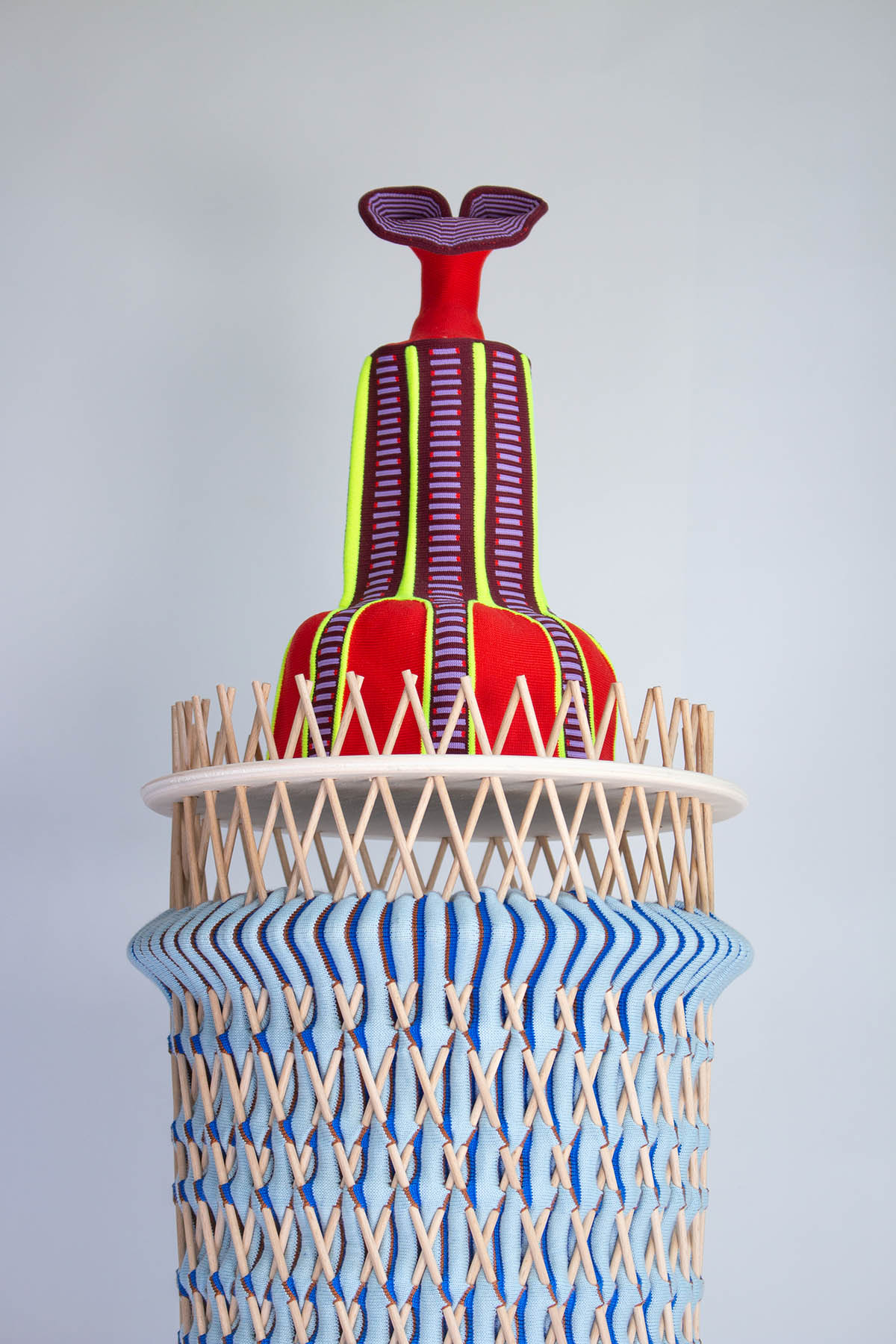
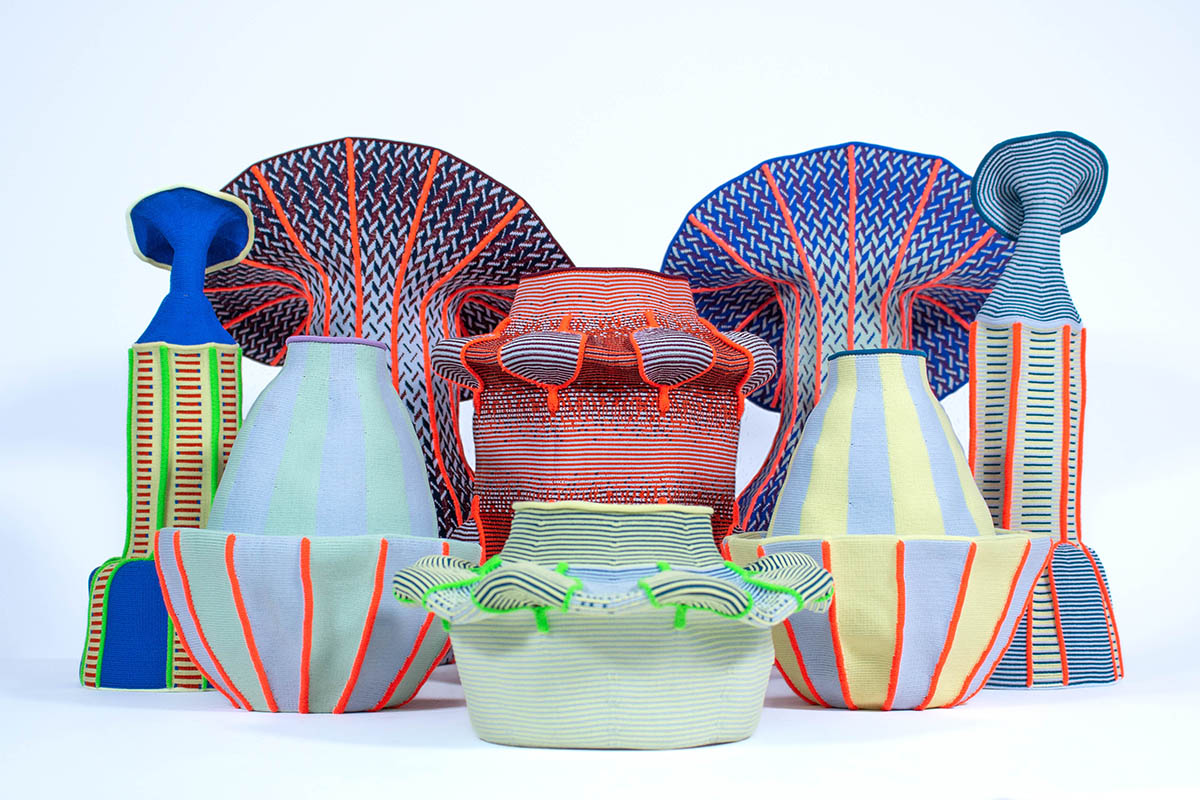
I work with textiles as a material and, methodologically, with textile knowledge: rhythm, use of color, and patterns. I try to envision objects with the know-how and the knowledge of a textile designer, because I trained in textiles and specialized in knitting. My research focuses on knitting techniques, shaping, and volume, similar to 3D printing technologies.
Textiles often cover or form finishing layers and materials in furniture and sculpture, but I want to emancipate textiles by making them part of the object’s very structure.
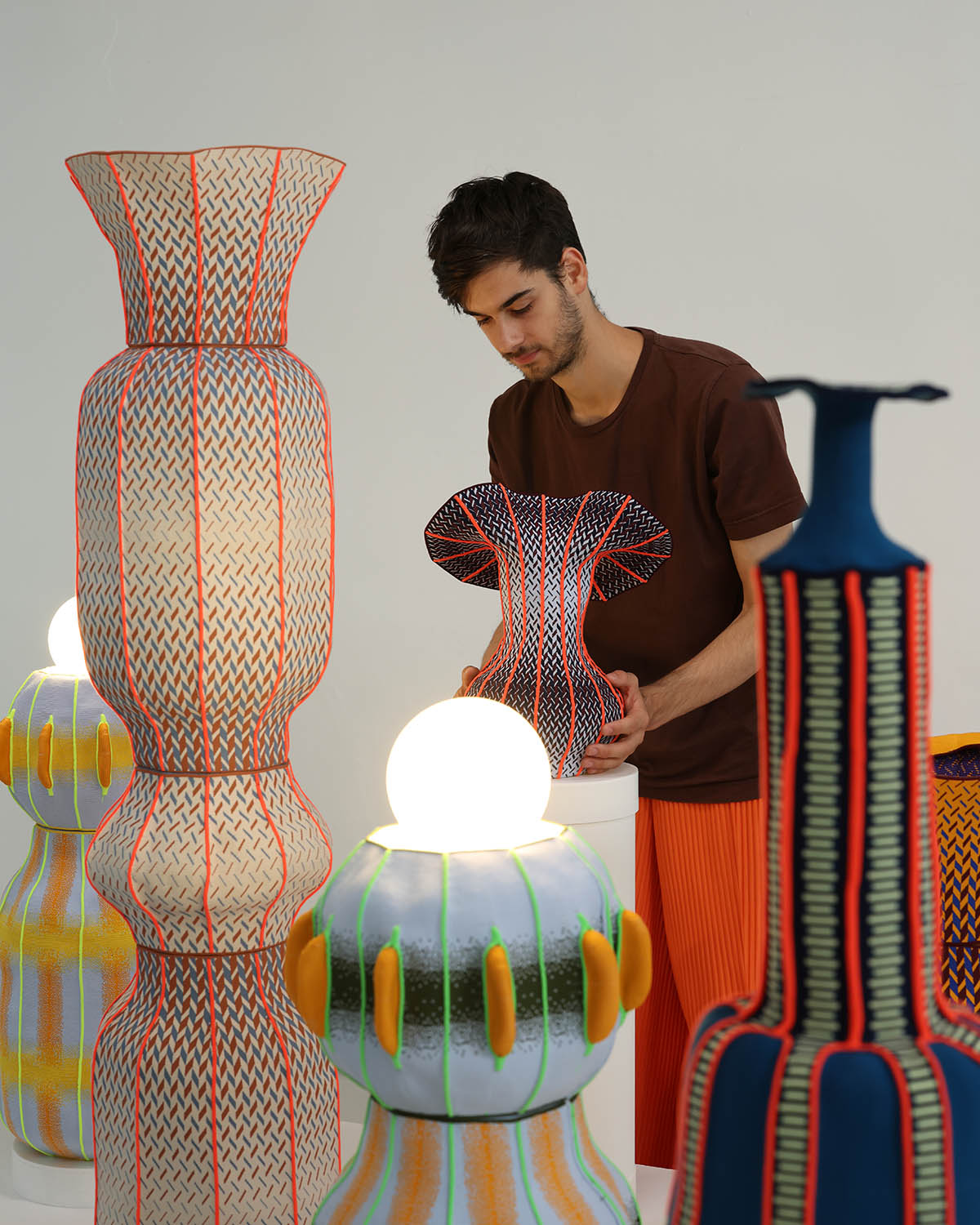
The objects you make trick the eye into thinking and questioning the material. How do you decide on their function?
My work is on the edge between art and design (prospective design). I’m using state-of-the-art techniques, such as technical knitting. I use basketry patterns, and I mix them with other techniques. My work should flirt with functionality. For example, my vessels can’t hold water, but if you use them as vases, you can place a glass container inside, and it works perfectly. So while my object suggests a function, it doesn’t necessarily have one and goes more into the field of art.
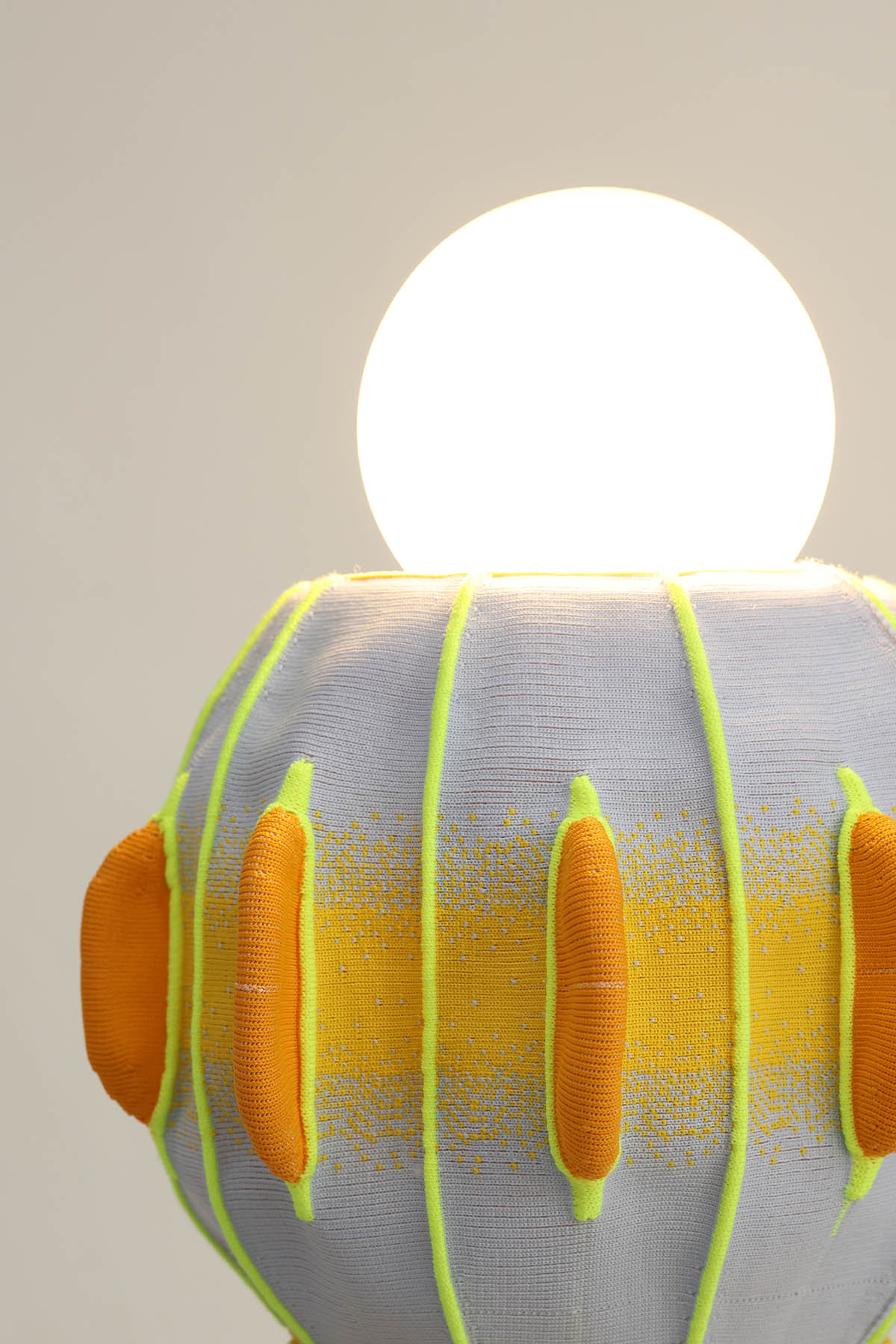
What kind of threads do you use as a material for the objects and furniture pieces you make?
For the furniture pieces, it’s always a cotton thread. For the objects, I use recycled polyamide, which is strong and thick, and I can put it under a lot of tension. Polyamide also helps me get a very saturated color.
Next to the object-based works, you have made many drawings and two-dimensional works. How do you balance working in different ways? Do the drawings also serve as sketches for the objects later?
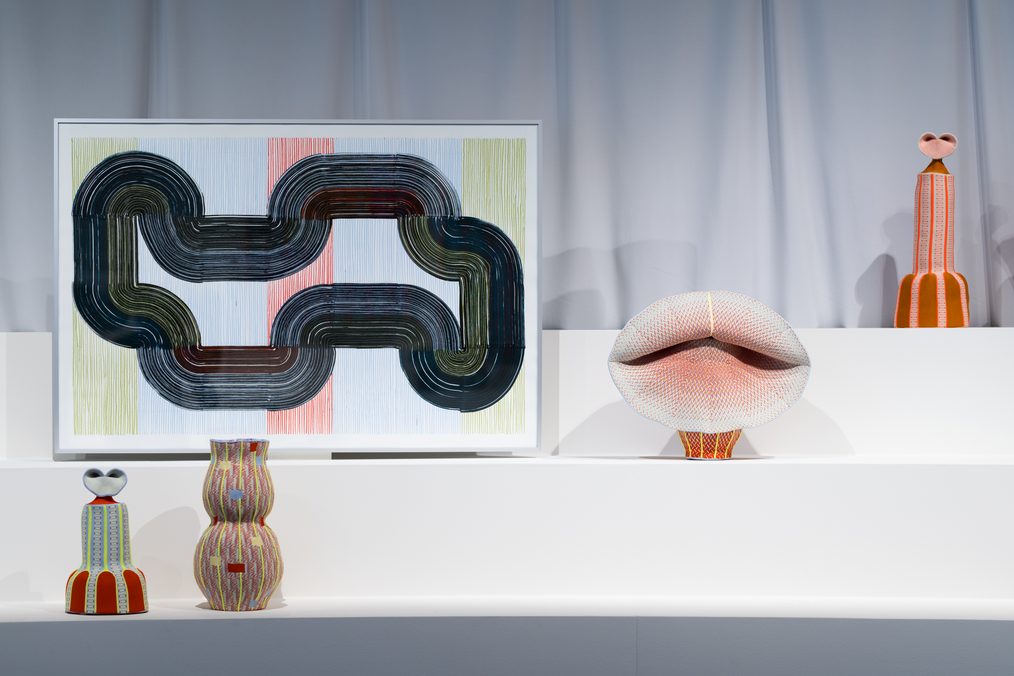
To me, they are really connected, and the drawings are artworks in the same league as my other works; I don’t see them as sketches on the opposite end. When I’m drawing, I use a plotter and produce a computer-programmed mechanical drawing. I work with a drawing in the same way I knit on a machine, with pre-coded movements.
I would like to convey the idea that programming is also a craft, a digital craft. My practice is indeed a merge of digital crafts and old techniques. There is something I’m deeply convinced of: traditional techniques should not be left to the conservative people.
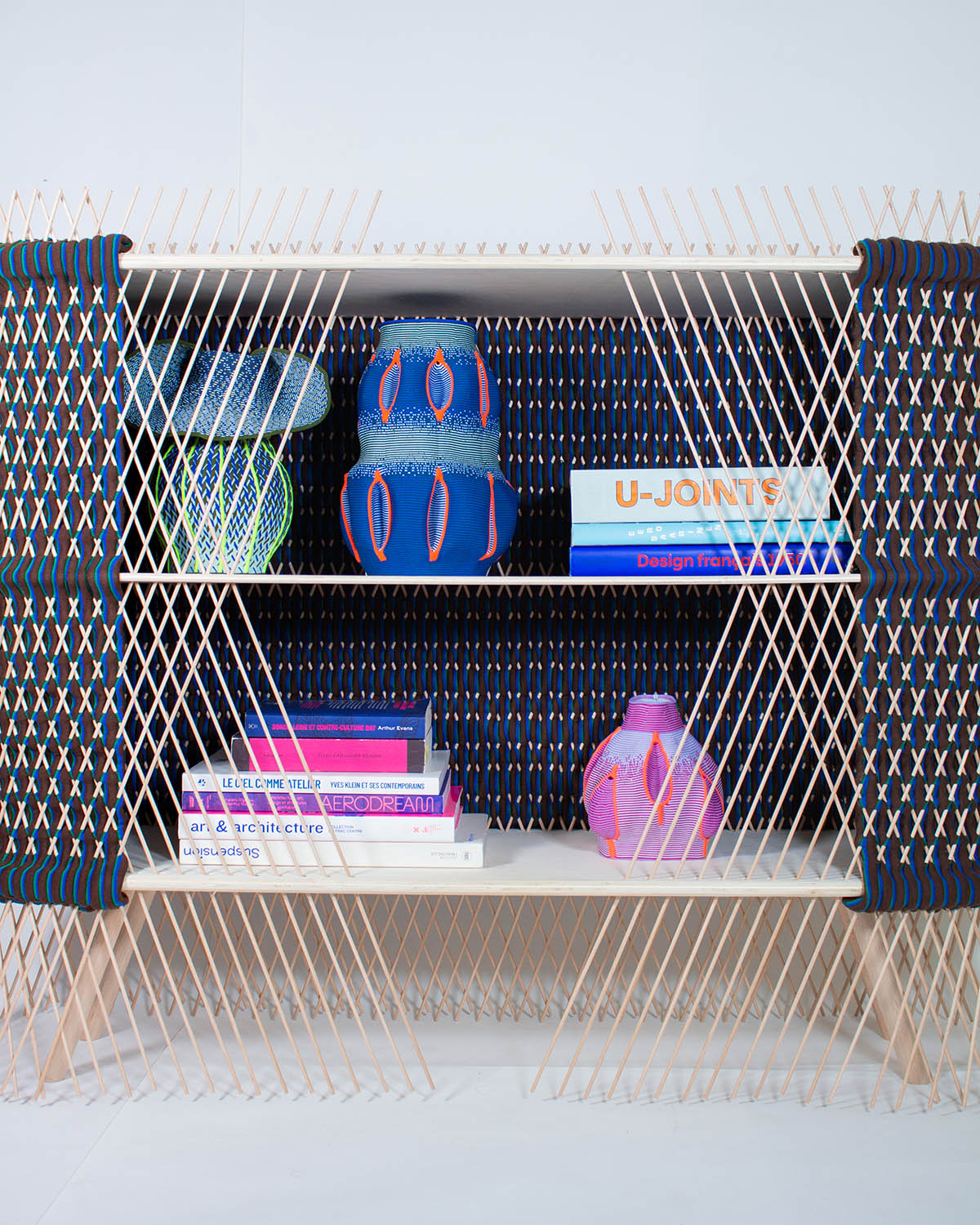
We need to evolve these traditional techniques constantly. My vision is to make them contemporary, update them, evolve them, and connect them to other scientific and technological parts of research.
Producing samples in textile work and industry is similar to programming.
Indeed, in some sense. Jacquard and the history of textiles are closely entwined with the development of binary code-based computers.
Do you have someone assisting you?
I am working with an intern for the first time.
What was your experience of the first part of the Unternehmen – START Program, and did it meet your expectations?
The program consists of three parts. The first took place in November 2026, when we visited many places in Paris, Clermont-Ferrand and Lyon. The second will take place in March 2027, when we will presumably travel to Berlin and Munich. Some of the places we visited are usually closed to the public, such as the GOBELINS in Paris, where extraordinary tapestry making takes place. It is a privilege to enter these places and see what often remains hidden. The other great thing about the program was meeting other designers. We are at the same stage in our careers, so we wonder about the same things, from basic issues to more complex thoughts and observations. We have been able to exchange our experiences and discuss practical things, as well as more open and profound questions.
What questions are you all asking presently?
I think a lot about the times we are living in. This period is not easy, as the current conditions are challenging in many ways. Securing funding and establishing connections within the industry can be particularly difficult. And there is also a paradox: the industry strongly needs the ideas, knowledge, and technical skills of designers, yet often expects them to work for free or for very little pay. Many designers want to help the system evolve and make it more valuable, fairer, and more supportive for everyone.
And what are your expectations for the next step of the program: Munich and Berlin?
I hope to visit factories and gain insights into the textile industry there. I’ve heard that the area around Munich has a strong textile heritage, and I hope this program will give me the opportunity to explore it further and establish valuable connections within the industry.
You have quite a commercial success. Do you plan your work with the idea that it should be saleable?
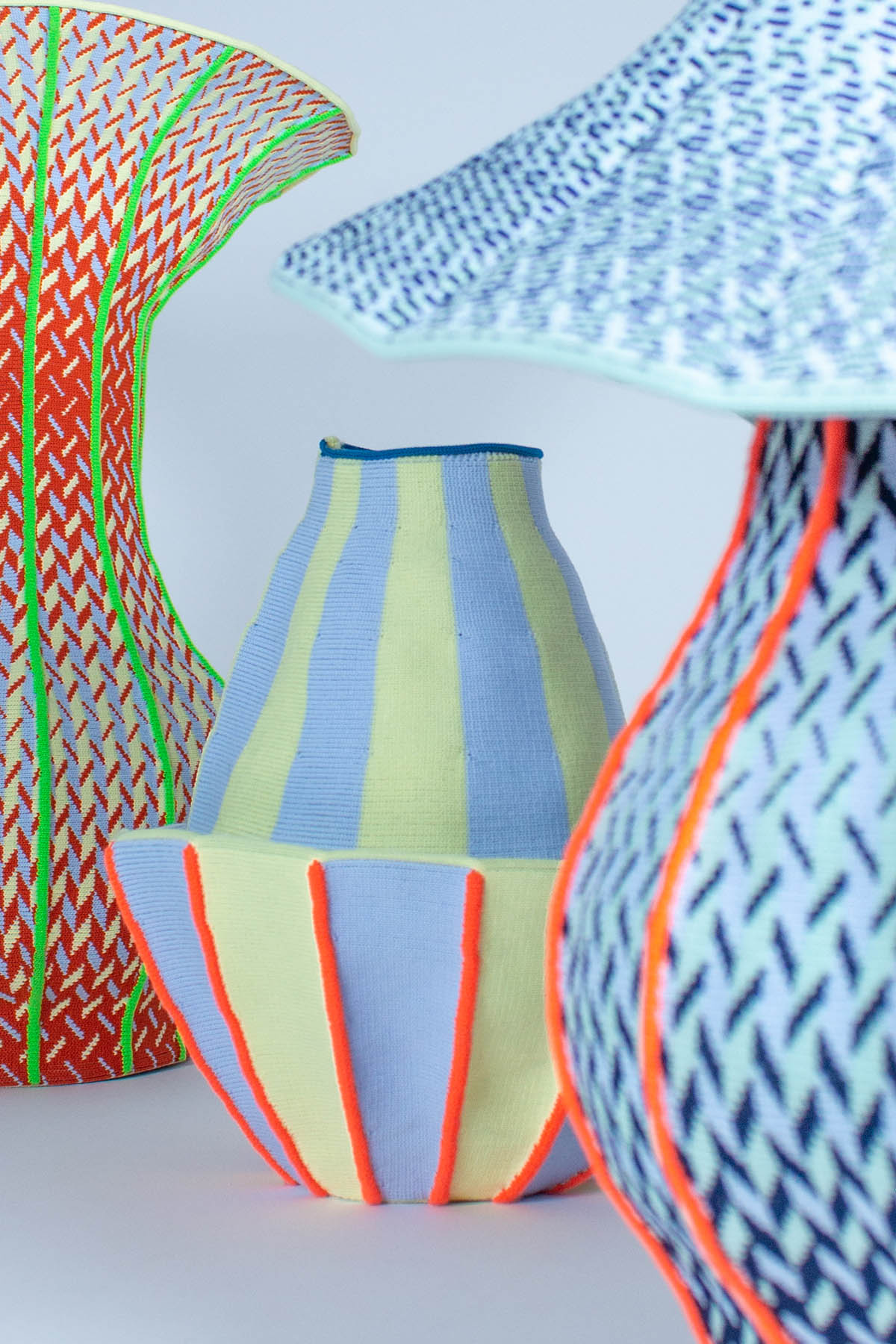
I’m more driven by what I like, and I make what I like, and then I’m happy if it sells. I stay consistent with my use of color; I want to bring colors to people’s lives and living spaces. If we look, colors are gradually disappearing from our daily lives; in contrast, in the ’70s, they were all around.
Colors in sports clothing inspire you. Where else do you find color inspiration?
People often ask me if I have a recipe, but I don’t. I pay attention to the colors in everyday life. For instance, I have spools of colored yarn in my studio, and I constantly move them; they meet each other, and I say, “Oh, nice color combination.” In the street too. I fell in love with Mexico and Mexico City because color is everywhere, and they have an entirely different use of color, which I find completely fascinating. I feel that in Europe, we are a bit scared of color.
Do you think people in Europe are disconnected or shy about expressing themselves through color?
People are often afraid that color might not be considered chic. So they choose white and gray because they think it’s safe. In my opinion, color can be very chic. For example, in the Middle Ages, we used natural dyes and pigments, and we lost this culture. The colors were nuanced, not chemical, and we sadly lost this knowledge.
Where can we see your work currently, and what is coming up?
I currently have a solo exhibition, Soft Objects. A Colourful Play, at the Texture Museum in Kortrijk, Belgium. The Texture Museum is dedicated to textiles, textile history, and textile design. The exhibition is on view until 14 February 2027. Additionally, in collaboration with Mustache Paris, my mirror piece will also be available soon.
Gaspard Fleury-Dugy – www.instagram.com/gaspard.fleury.dugy
Unternehmen – START 2026/27 is a several-month-long German-French mentoring program for young textile designers and craftspeople, with study trips to Paris/Lille (November 2026), Berlin/Munich (March 2027), and a third country (May 2027), plus workshops and project mentoring.
This year’s participants are Johanna Rogalla, Nena Ellermann, Vera Bracklo, Viviana Losacco, Paolina-Luna Kühr D’Urso, Alice Etheimer, Julie Merlino, Marion Gouez, Vorlette Fakhri, and Gaspard Fleury-Dugy.
More information about the program: www.goethe.de/ins/fr/de/kul
Gaspard Fleury-Dugy is a Paris-based designer and visual artist. His practice is nourished by textile techniques and the graphic vocabulary they unfold. For him, loops, stitches, and lines become the elements of a vibrant and joyful language. Celebrated internationally for his knitted sculptures, he is also a trapeze artist and likes to view his work as a sequence of supple and colorful pirouettes. Trained at the École Duperré in Paris and at the Swedish School of Textiles in Borås (Sweden), he developed from early on a distinctive universe where machine, digital technology, handcraft, and mind converge. For Gaspard Fleury-Dugy, knitting is building. In 2021, at just 22 years old, he distinguished himself by his ability to hack the industrial knitting machine—his “pencil”—to invent a new language in which yarn becomes volume, structure, and architecture. His knitted sculptures stand at the crossroads of technological innovation, fine craftsmanship, and imagination.