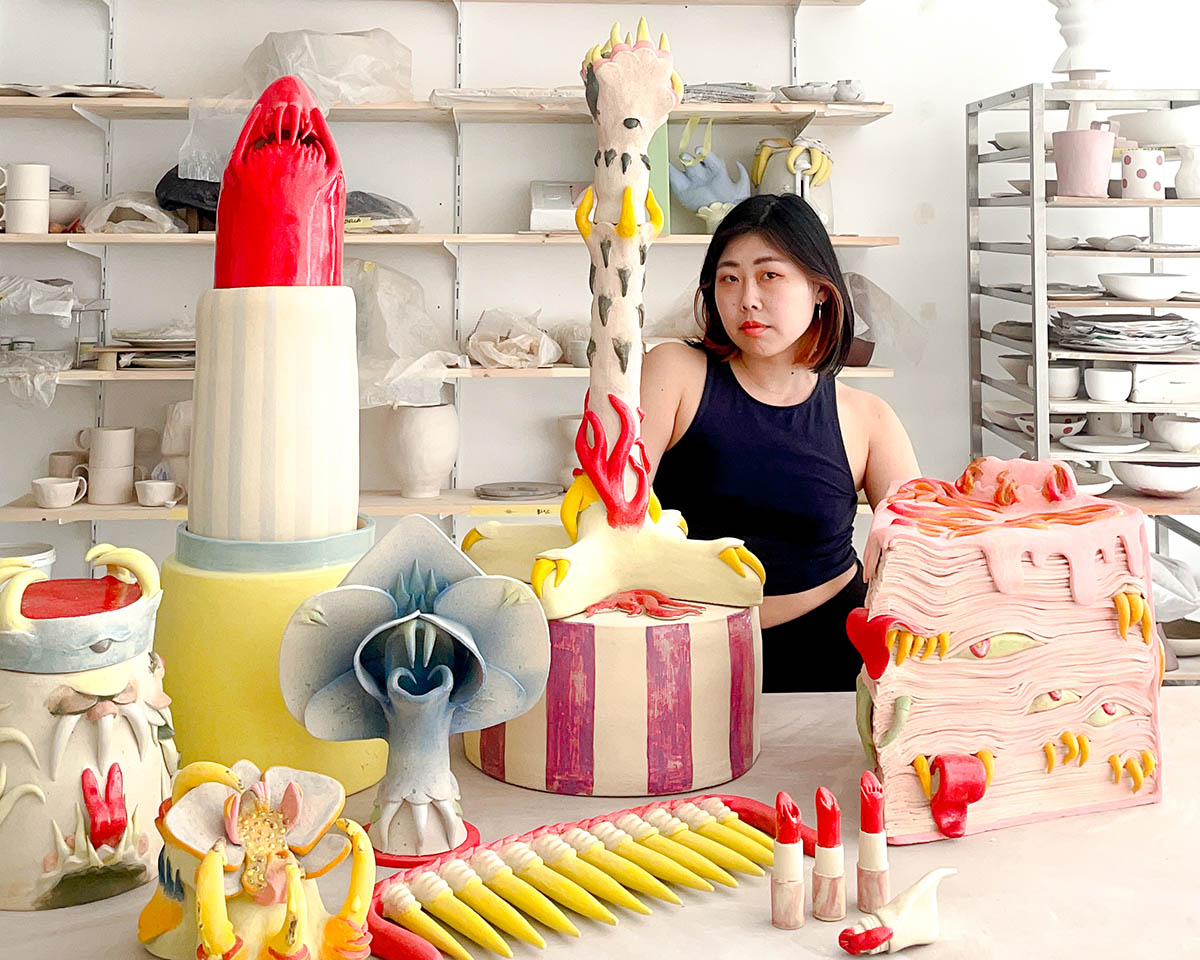
Before becoming a ceramic artist, Maeda spent years working as a graphic designer and project manager in branding and advertising, partially in the cosmetics industry. That sensibility for visual communication, for expressing meaning through shape, color, and form, carried naturally into her art practice. Today she works from her studio in the 18th arrondissement of Paris, building what she calls her army: monster-shaped ceramic sculptures that are, above all, here to protect.
Which aspects of your personality keep showing up in your work?
I am someone who is constantly questioning the rules I was taught. I keep redefining them, pushing back against the ones that feel like they are keeping me small. Furthermore, I also struggle to put my emotions into words. There are too many things at once, all pressing together, impossible to separate into a single clear line. The sculptures are how I express what I cannot say out loud. And that is probably why I am so drawn to surrealism, to the way it takes something deeply familiar and makes it suddenly strange. Unsettling but resonating. Humor is essential to me too. I genuinely believe you can discuss the most serious things in the world and still make people laugh while you do it.
What is more important to you: concept or intuition?
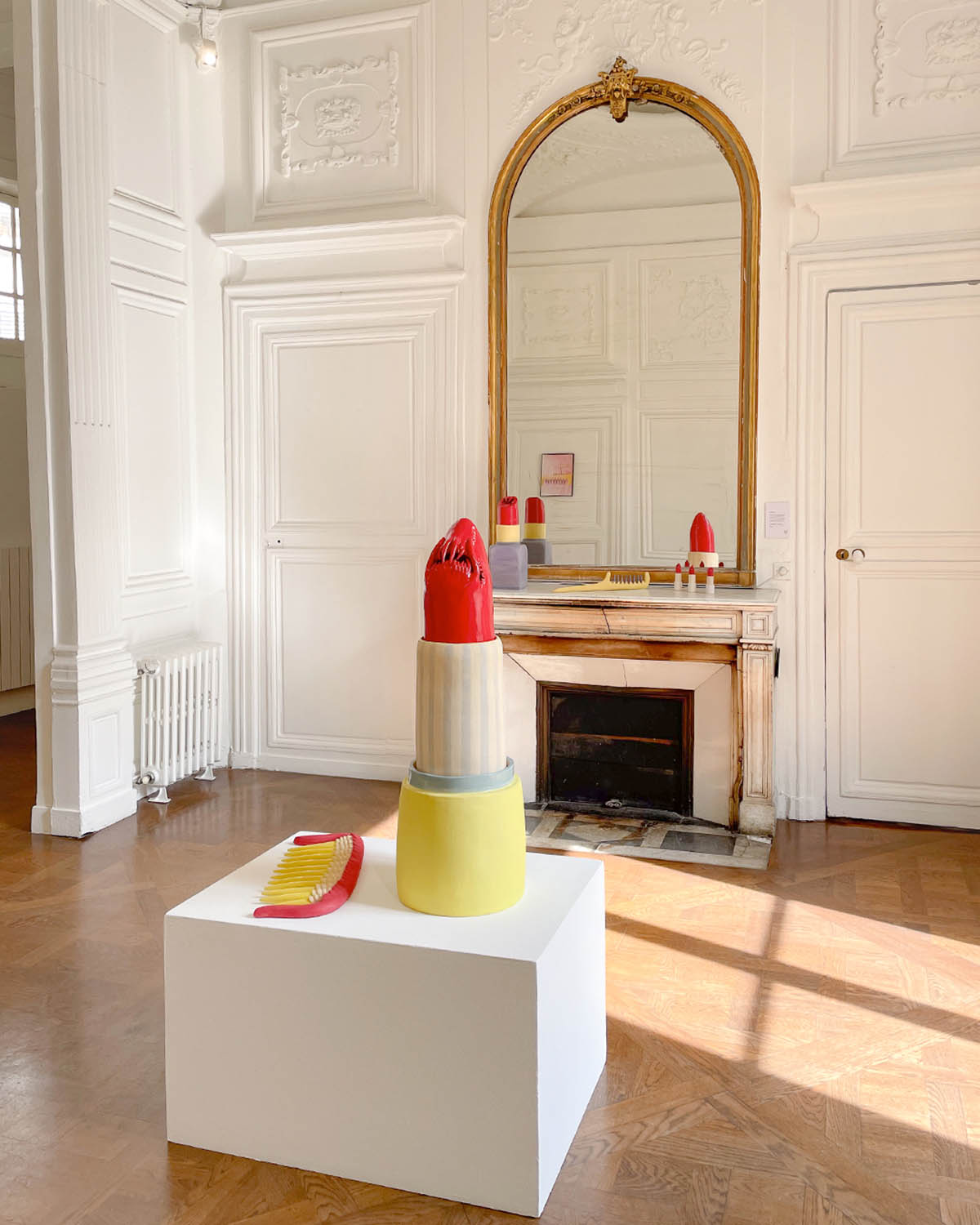
Both, but they usually arrive together. My ideas come from daily life, not from a studio exercise. I look at a table, a wall hanger, and a flower, and I see a monster. Not because I planned it that way, but because I genuinely see it. The messaging of the work comes after, once I start to analyse why I see the monster in that particular object. What does it represent? What belief is it carrying? The monsters become a rebellion against the beliefs we accept without questioning, the things we live with every day without ever stopping to ask, “Is this still serving me?”
So the monsters start as intuition. The meaning reveals itself through the making.
How significant is the space to your work?
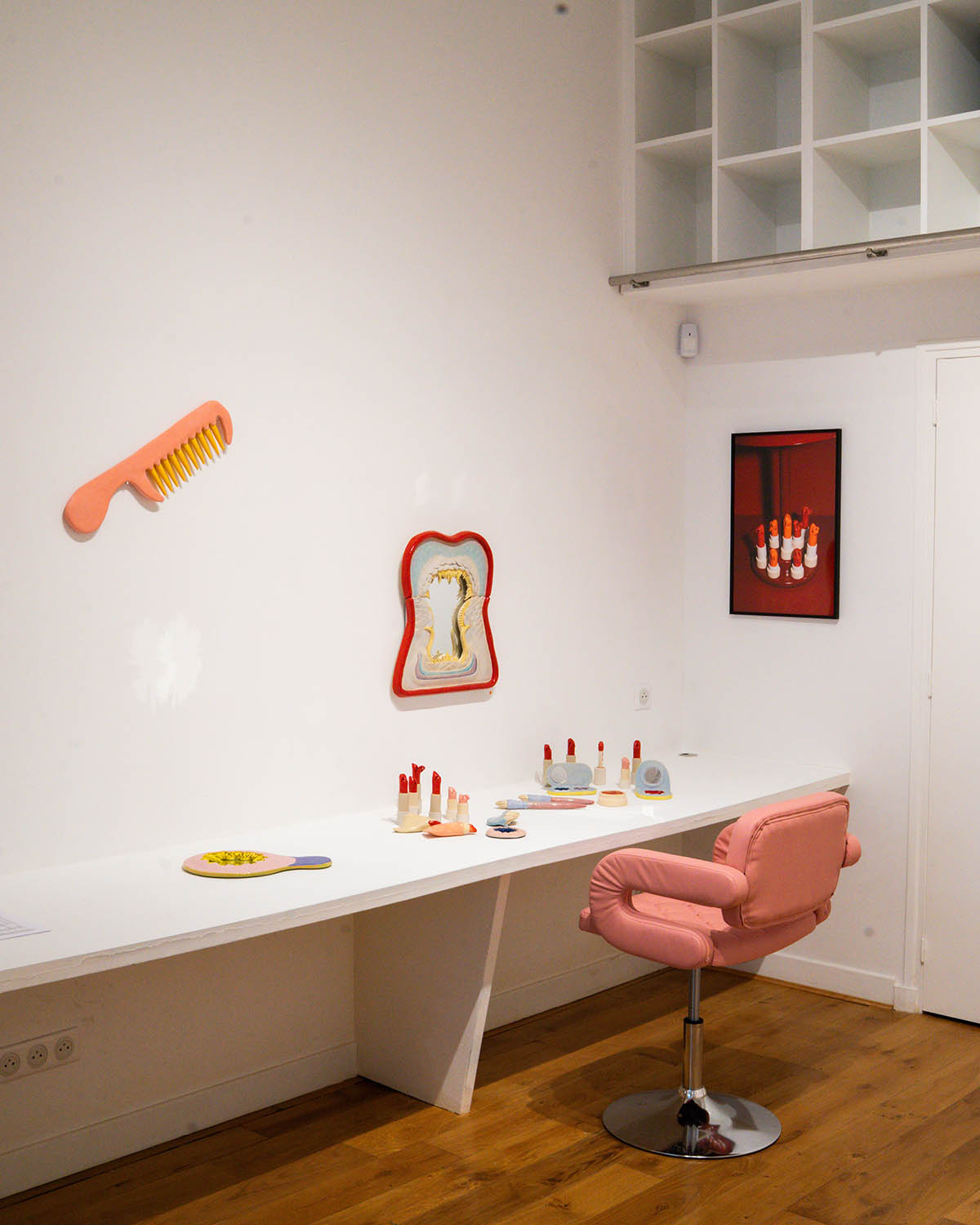
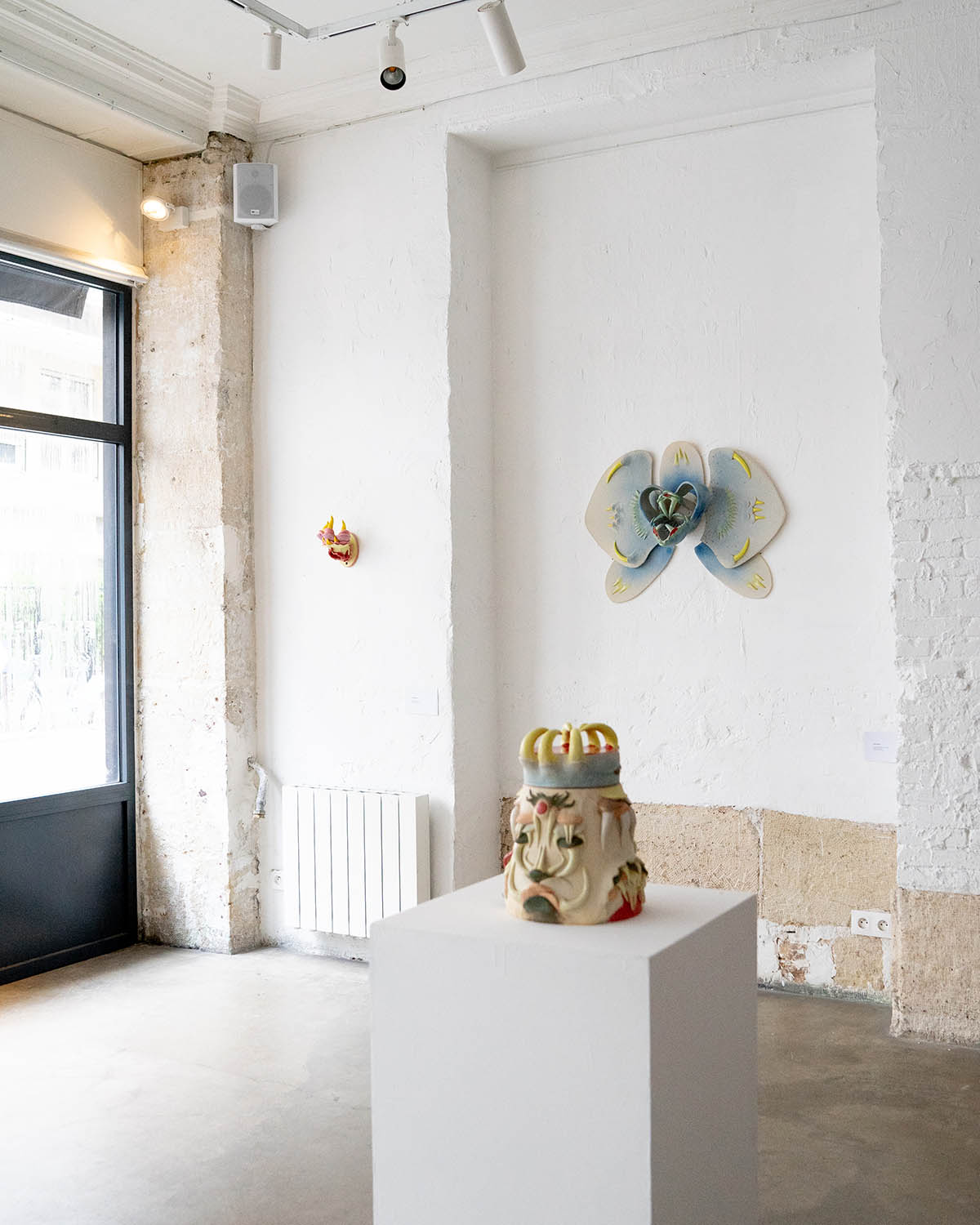
Very! I consider exhibitions to be a form of storytelling. Since my sculptures are monsters that used to be everyday objects, I want the audience to feel like they have stepped into their apartment or their own daily life, but something is slightly off. I want to make them think, and smile, and laugh. And then make them question. That moment of „huh?“ followed by „aha!“ is what I am going for.
You often appear in photos together with your sculptures. What does this shared presence mean to you?
Because the monsters are here to protect me. I think of them a little like gargoyles on the outside of a cathedral or the guardian statues you find at the gates of shrines and temples. They look frightening at first, but that is precisely the point. They look that way because they are protecting what is inside.
Are there any social pressures that you find yourself thinking about a lot?
Being a mother and being an artist is sometimes difficult. Being a foreigner in Paris, on the other hand, is something that pushes me forward. These two things live side by side in my life. The pressure feeds the work, and the encouragement allows me the room to make it.
How do you think the move to Paris has changed your works?
Japan gave me comfort. Paris gave me permission to be my person and to create my work as an artist. In my social circle growing up in Japan, there were no artists around me. Craft was considered more precious than art, I felt. There was this sense that art does not really serve people, that it was somehow selfish to want to be an artist. It was treated as a hobby, not a serious path. I did not feel like I had the choice to be an artist. Living in Paris changed that.
And in a way, the monsters came with that change. They carry all the old beliefs I am still fighting and all the freedom I discovered when I finally stopped listening to them.
Have you ever been to Vienna?
Not yet, but I would love, love, love to! Being part of Vienna’s art scene and showing my work there one day is something I dream about.
What does a typical workday look like for you?
There is not really a typical day for me. Every day looks a little different depending on which season I am in. I work in seasons: a research and sketching season, a making season, a documentation season for catalog and portfolio updates, and a networking season. The rhythm shifts around exhibition dates and projects.
My studio is in the 18th arrondissement in Paris, on a calm street. An opera singer lives nearby, and I can often hear her singing through the walls. There is beautiful direct sunlight during the day. This space is very precious to me, and I am so grateful to have it.
What are you working on right now?
I am working on a piece that changes over time. Every hour, the work looks a little different. Ceramic sculpture is usually still, permanent, and fixed, and that is something I wanted to challenge. I wanted to create something that shifts so that the audience sees something different each time they come back to look at it. Even the material I love most has rules I want to challenge.
Eri Maeda – www.instagram.com/erimaeda.art/