In 2027, two international galleries will present Philip Grözinger in major solo exhibitions: Choi&Choi Gallery in Seoul, South Korea, in May, and Mikael Andersen Gallery in Copenhagen, Denmark, in August.
Philip, your art is situated at the intersection of pop culture, art history, and black comedy. Do you see yourself in that description?
Yes, and I could say black comedy describes my work best. I come from a family that’s half British and half German, so the various cultural influences have been there. We lived in Braunschweig, right on the border with the GDR at the time. As a result, we were exposed to GDR influences and could watch things you couldn’t see anywhere else, such as Russian science fiction films. Driving to the GDR border with my relatives was quite an unusual experience; there was a lot of bitterness in Germany. Black humor helped me make sense of it all as a child and teenager. In the ’80s, „No Future“ was the mood and nuclear annihilation the fear. Then Chornobyl happened. I still feel that gloom.
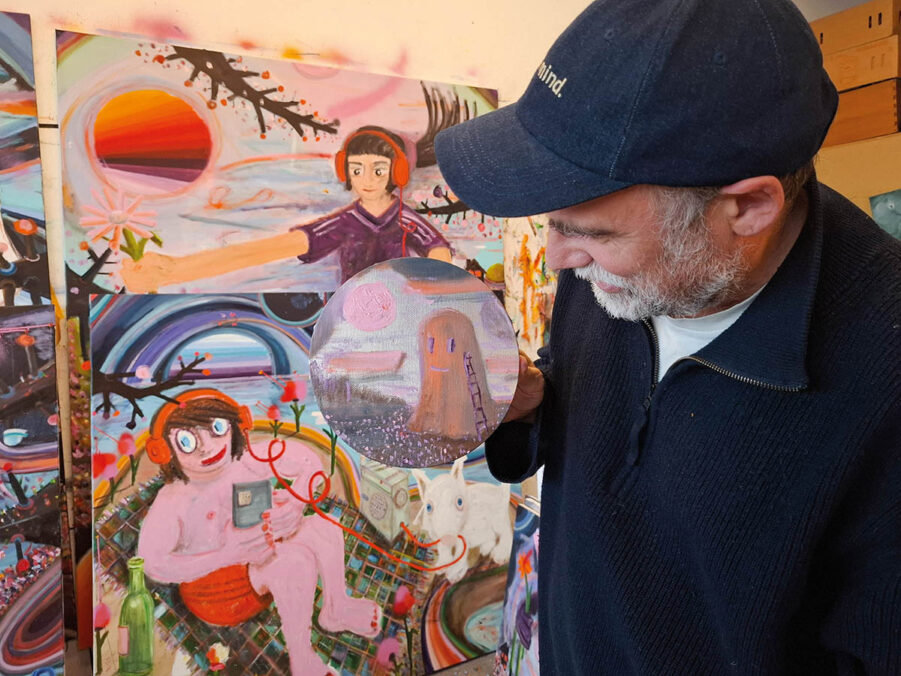
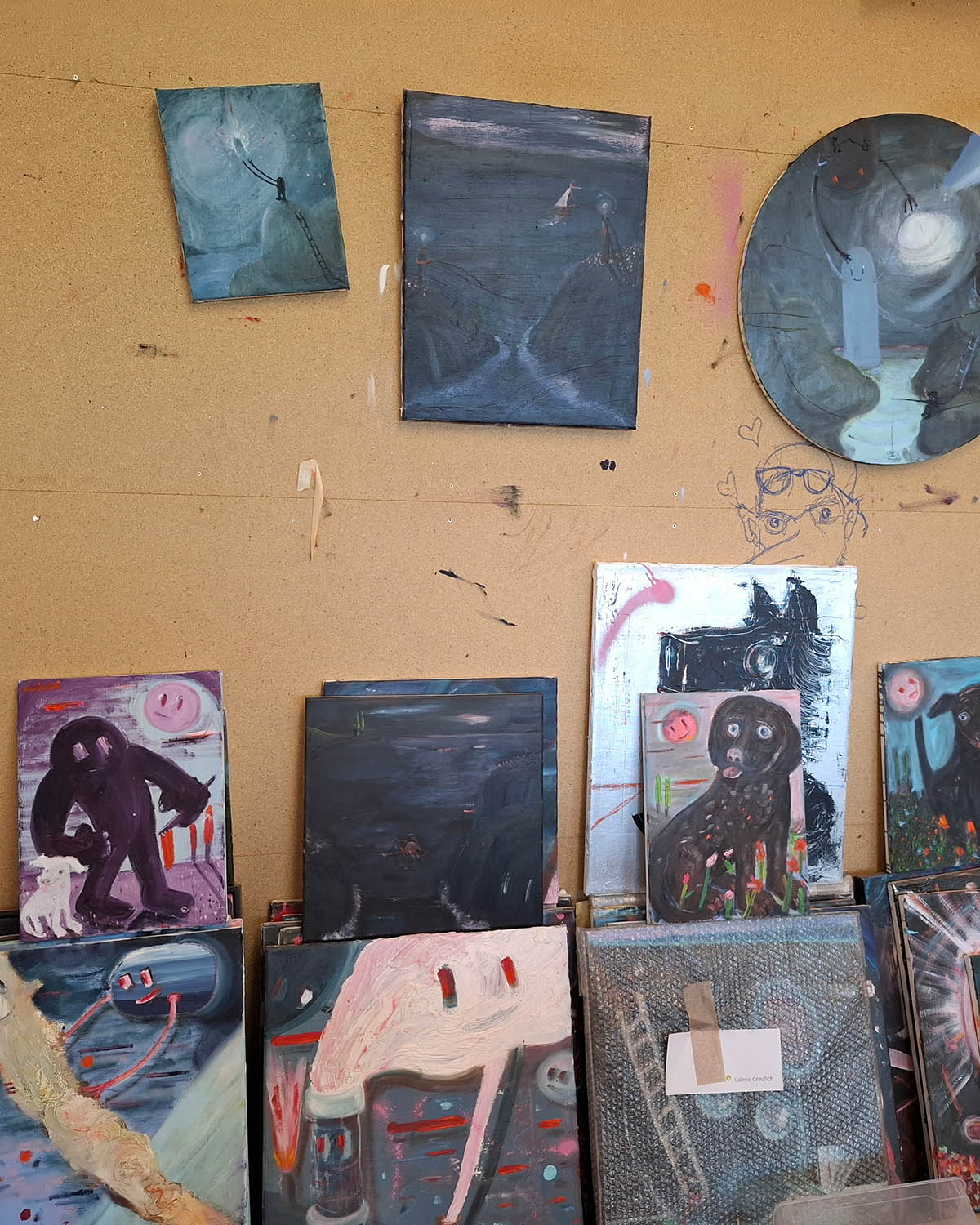
Your paintings are also about Greek mythology, aren’t they?
Yes, I grew up next to the Anton Ulrich Museum in Braunschweig. Its famous Hercules frieze was my introduction to Greek mythology, and it has fascinated me ever since, Prometheus in particular and what he stands for today.
What does Prometheus represent?
Prometheus gives humans fire, and with it intelligence and free will. Before that, they were merely the gods‘ creatures. But what does free will do to people? Some turn away from the gods. Zeus punishes them with Pandora’s box, from which every horror pours out, and Prometheus is chained.
If there were a modern-day Prometheus, what would he look like? What do AI mean and do for us? Is AI more a Pandora’s box or Prometheus? We’re facing intellectual competition. What does it all mean?
Do you explore these fundamental questions in your work?
It is never boring to think of those questions. People have always tried—and continue to try—to find answers to them.
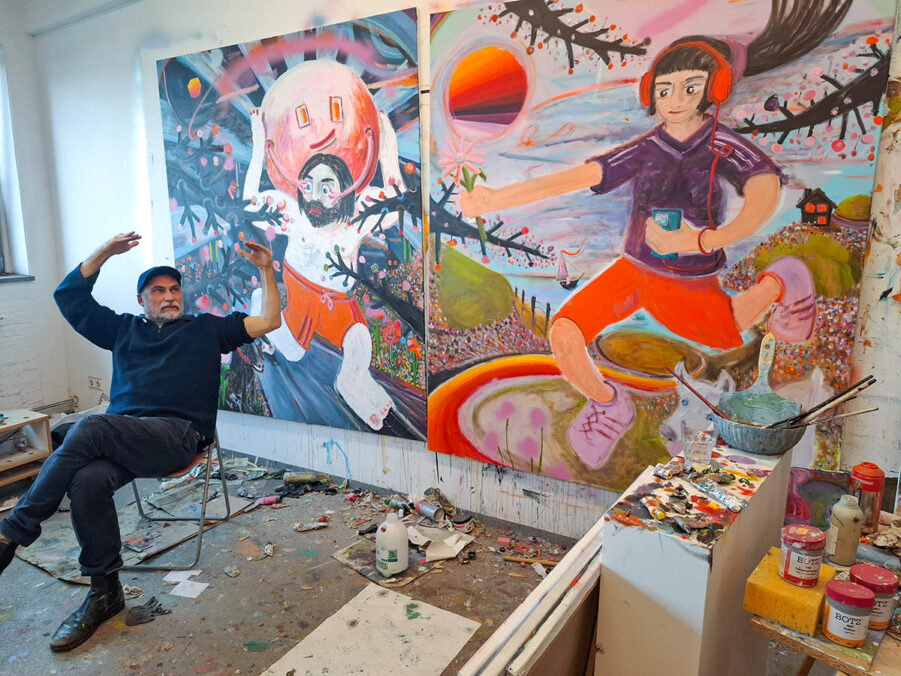
One of your most recent works poses these questions clearly…
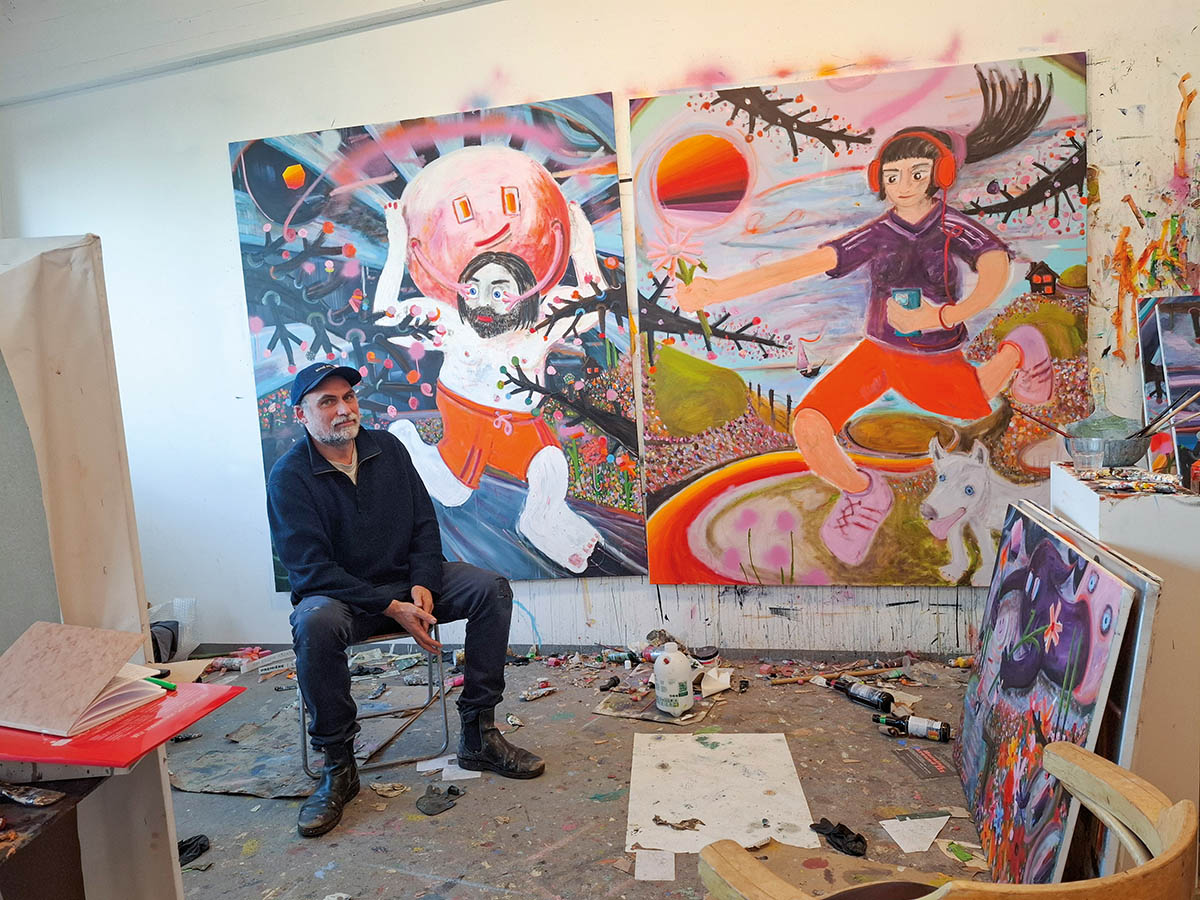
Yes, in this painting (see image above, left), a figure is running away from his problems. It’s a playful take on Greek mythology; you can wonder whether it’s about Hercules or Atlas. Both figures appear frequently in art history; it’s a beautiful symbol for the present day, marked by so much trauma, stress, and the so-called “world on fire.” I would rather not depict these themes literally; I want viewers to be drawn into the image and come to their own conclusions.
You work in many other media, next to painting, right?
Yes, in addition to painting, drawing is vital to me. Next to it, I work with ceramics and film. I used to work with printmaking as well. I feel that working with different media influences my painting.
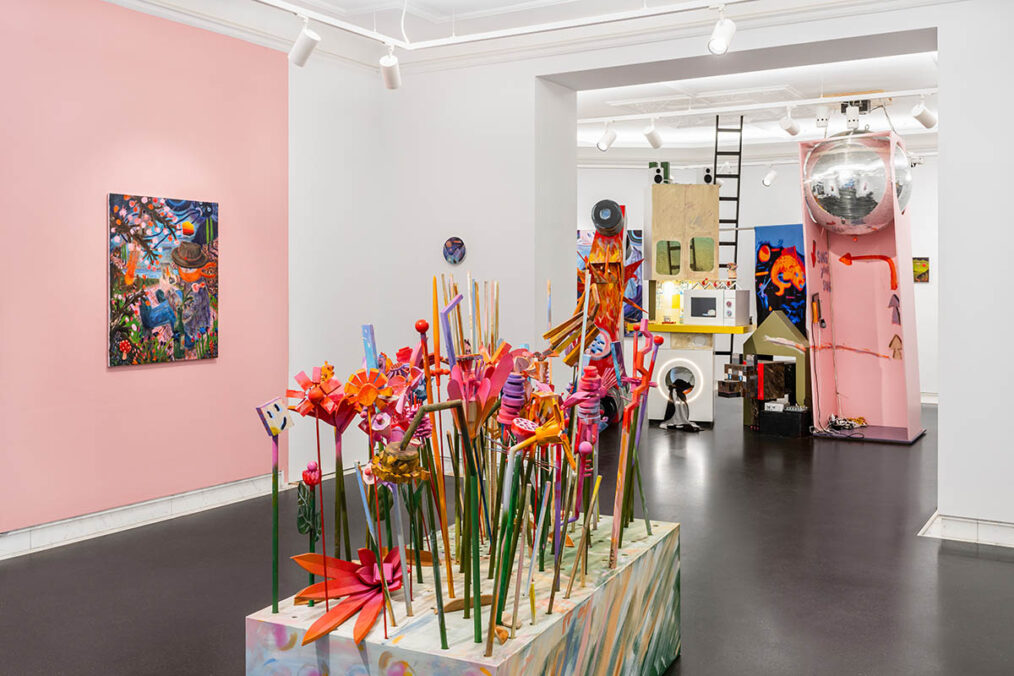
You’ve really taken your practice to the next level. Do you now design spaces as 3D images?
Lately, I am focused on immersive spaces; I design spaces as sculptures and immersive installations. This draws viewers deeper and deeper into the exhibition. Painting plays an essential role, but it’s only one part of the overall artwork. I make huge floral carpets out of wooden flowers, or a space of washing machines from which knitted images emerge, or a hundred ceramic mushrooms scattered across the gallery floor. The mushrooms also appear in my paintings, so everything comes together again.
GALLERIES REPRESENTING THE ARTIST:
Mikael Andersen Gallery, Bredgade 63, 1260 Copenhagen, Denmark
www.mikaelandersen.com
Choi&Choi Gallery, 48-10 Yeonhui-ro 11ga-gil, Seodaemun-gu, 03707 Seoul, Republic of Korea
www.choiandchoi.com
KORNFELD Galerie Berlin, Fasanenstraße 26, 10719 Berlin
www.kornfeldgalerie.com
Philip Grözinger – www.philipgroezinger.com, www.instagram.com/philip_groezinger/
Philip Grözinger (born in 1972 in Braunschweig, Germany) studied fine arts at the Braunschweig University of Art, graduated as a master student of Professor Karl Schulz, and later taught painting at the Weißensee Academy of Art in Berlin. His works have been exhibited at the Berlinische Galerie in the retrospective exhibition “Paint it All. Contemporary Painting from Berlin” (2022/23), at the Künstlerhaus Bethanien in “Dissonance. ‘Plattform Germany’” (2022), at the Kunstverein Bamberg (2022), and at the Galerie Kornfeld in “Manntje, Manntje, Timpe Te” (2026), as well as in many other institutional and gallery settings across Europe, Asia, and the United States.