
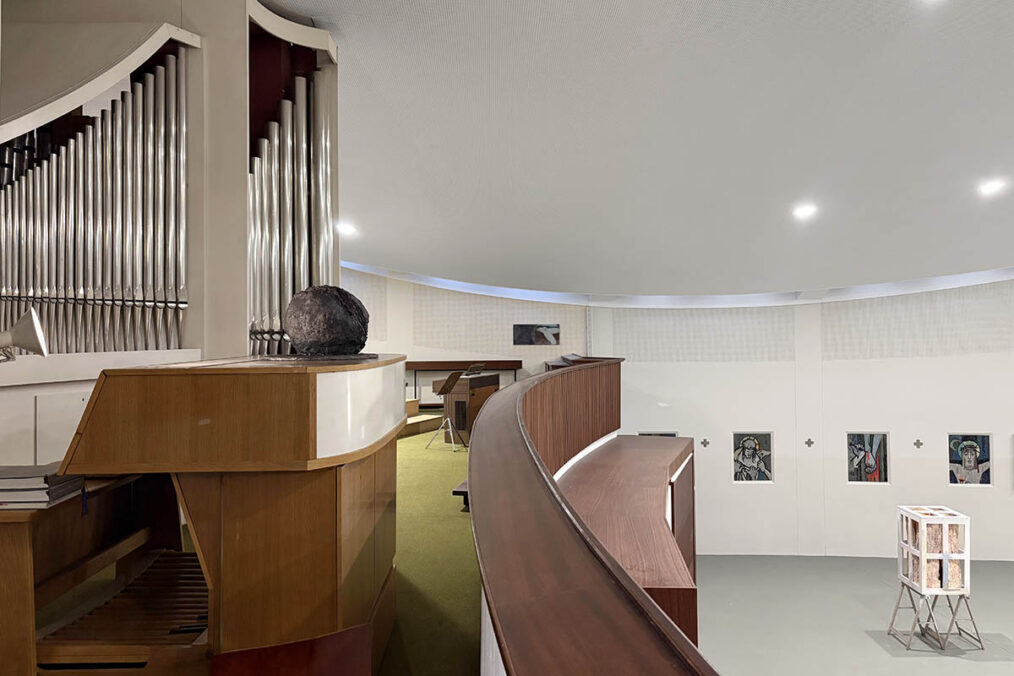
In a similar vein, 1,01 is envisioned as embedded in the space; mass and community kitchens will take place during its course, fusing art and life. Extrapolating from Carol Duncan’s theory of museums as sites of ritual, 1,01 plays with the modern transference of spirituality from the sacred to the secular realm of aesthetic experience. While the artists do not conceive of their works as exalting objects of aesthetic contemplation – and indeed, do not shy away from ‘ugliness’ –, they nonetheless strive to foster some form of transformative experience through their work. As Monsignore Otto Mauer, a progressive priest who became an unlikely pillar of the Viennese avant-garde, declared: ‘Artist, liturgist, saint – perfectors of our cosmos, mystagogues of a coming world!’
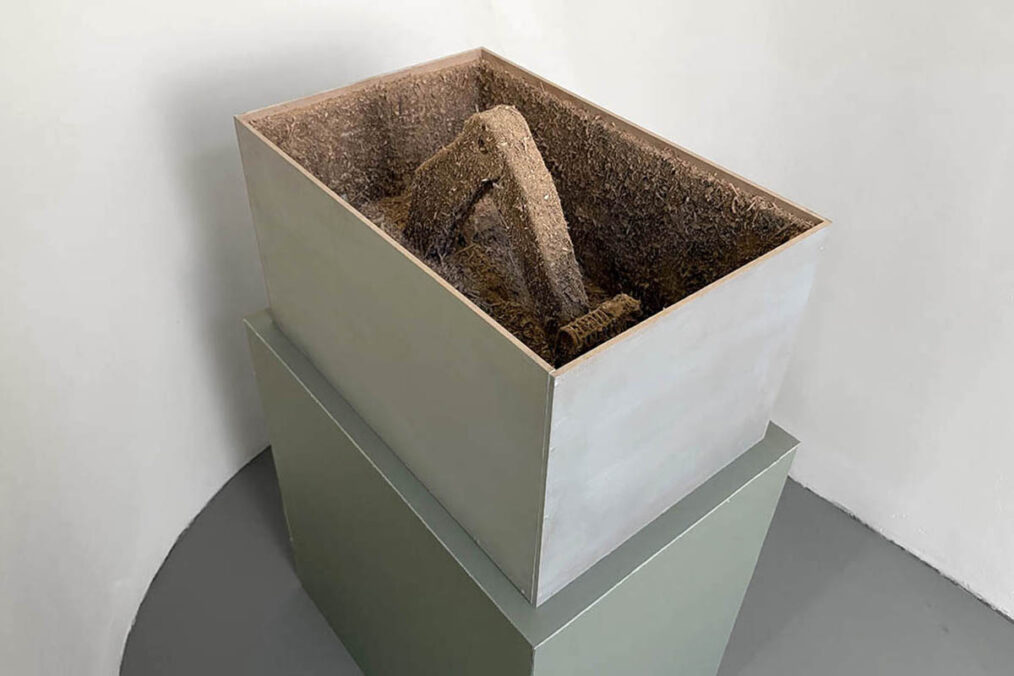
Awkwardly installed in the nave, Vilmer Engelbrecht and Ata Sander’s Raum may initially be confused with a confessional. The viewer can glance inside the impenetrable, cramped chamber through a wooden lattice that opens onto a cloudscape traversed by slivers of bright-blue sky. Barely perceptible from the small aperture, an amorphous plaster sculpture seems to have fallen to the ground, melding with the floor in a chalky puddle. The artists tore away parts of the painted wallpaper to show the bare wall beneath: the interior’s interior. A posteriori, Ata Sander and Vilmer Engelbrecht came across René Magritte’s Act of Violence (1932), which, in a strangely prophetic mise en abyme, depicts a similarly contained sky and other artworks that resemble those exhibited in 1,01. In their collaborative Untitled Edgar, the artists sought to create a grave for a digging machine. Subverting its very purpose, Vilmer Engelbrecht and Ata Sander buried the excavating device in sawdust (which abounds in their borrowed sculptor’s studio in Paris), until it communed with the recycled fibres in the sepulchral box.
Lurking behind a church pew, Ata Sander’s Isoklin figur inevitably catches the viewer’s gaze. The work was inspired by the carved baboons that adorned the pedestal of the Obelisk of Luxor which was gifted by Egypt to France in the 1830s. While the Obelisk was prominently erected on the Place de la Concorde in Paris, the French monarch judged the creatures’ nudity obscene and dispatched the monolith to the Louvre, where it has remained ever since. Ata Sander rehearses the sacred simians’ intriguingly upright posture and open, venerating palms, yet his primate embodies his sustained exploration of materiality. He modelled the work in plaster before coating it in beeswax which lends it a haptic, lump-ridden texture. Its face, delimited by latex like a mask, is animated by pallid tones of green and purple as well as subtle bursts of glitter that lend it an intriguing, slightly disturbing presence. Metal rods emerge from the animal’s legs, exposing the work’s structure, while its feet dissolve into spatters of matter on the residue- laden platform. For the artist, the work is ‘half-monument, half-alive.’
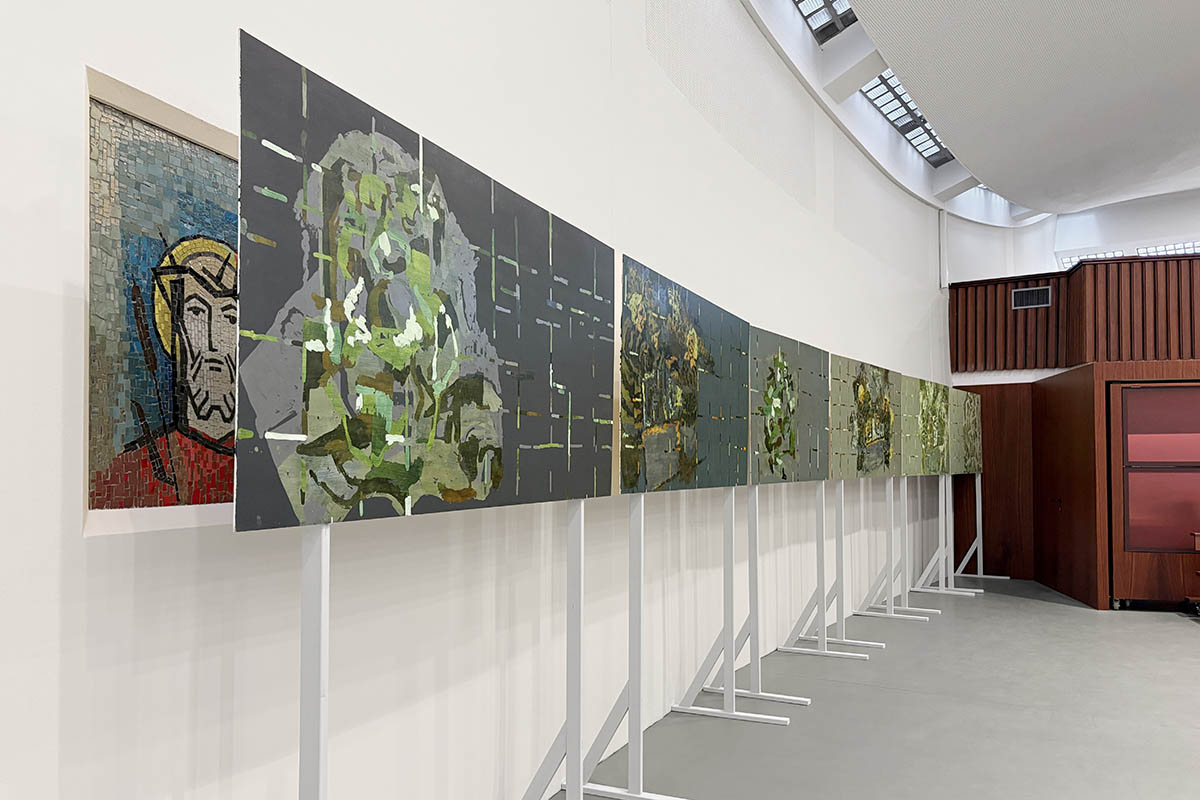
Vilmer Engelbrecht’s conception of art-making verges on the mystical; he seeks to enact himself through his practice. Laying bare his unrelenting investigation into both material and form, More or less 1, 2, 3, 4, 5, 6 represents the same, ever-so-slightly different scene across six panoramic panels. Two figures point at each other amid luxuriant foliage, gradually merging with their surroundings until they are entirely subsumed into an abstract maelstrom of verdant washes. Grappling with Leon Battista Alberti’s foundational conception of painting as an ‘open window,’ Vilmer Engelbrecht sees the work as a ‘closed window.’ The matrix of imperfectly straight lines that spreads across each panel ties them together, like blown-up threads in the weave of a singular canvas. The artist painted each panel in one colour before sealing some of its sections with wax and painting afresh. Inspired by the likes of Pierre Bonnard (who would deliberately blind himself with sunlight to render its perceptual dazzlement), Vilmer Engelbrecht obfuscated his own gestures with the wax, relinquishing control over the final painterly outcome. This restrictive process also mirrors his acute interest in xylography and the irreversible carving of wood in particular; adding rather than subtracting material, each gesture is irrevocable. Once he attained a dense topography of wax and paint, the artist scraped the surface of the painting to reveal the work to himself.
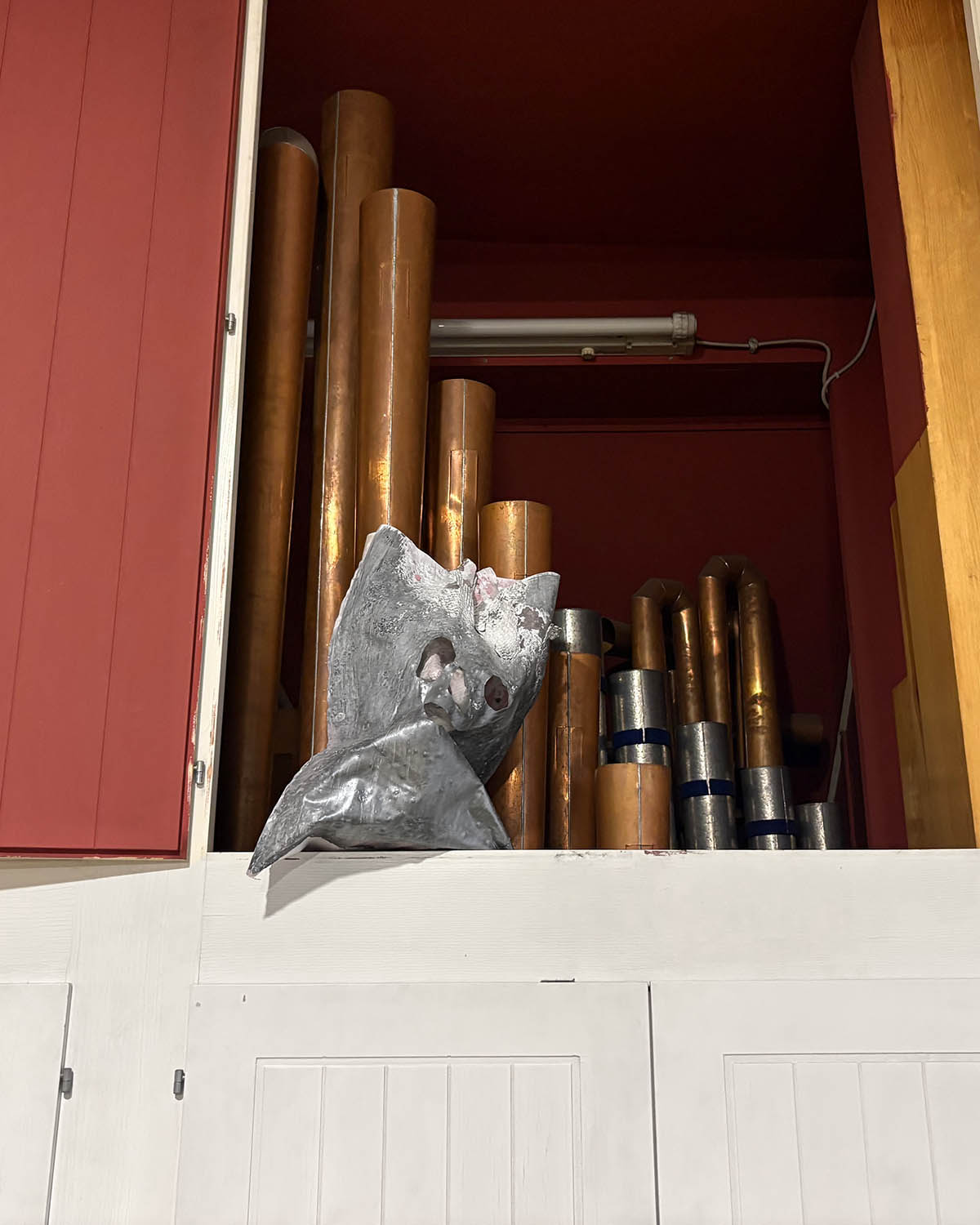
Sitting atop two unassuming trestles, Ata Sander’s Four frames Mariana enjoins the viewer to peer inside its fenestrated walls. Each window functions like a frame, producing four paintings that evolve as the spectator inches closer. The diorama-like installation encloses tree trunks whose liquescent skin betrays the artist’s alchemical mix of wax, plasticine and lacquer. The bark’s ridges and furrows have imbibed his palette of beguiling metallic tones and signature sallow hues which blend into unsettling iridescence. In the dark, narrow space between them, the trees transubstantiate into bricks. Daubed in wax, the glossy brickwork catches glints of light, while also exuding an alluring smell (which enticed many a bee in the course of its creation). Petrifying into a pile of bricks, the trees are but a ‘fraud,’ explains the artist. As such, Four frames Mariana captures Ata Sander’s abiding interest in the inherently illusory, and indeed often deceptive, nature of art.
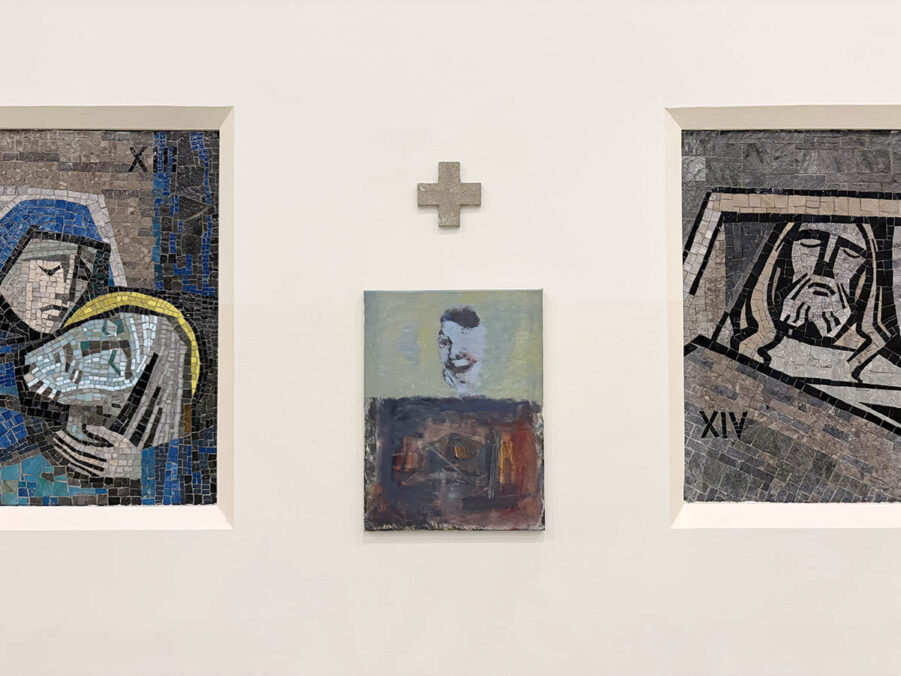
In Vilmer Engelbrecht’s Untitled (after Étant donnés), the artist renders the splayed, faceless nude of Marcel Duchamp’s seminal peephole tableau in morbid tones, as though the figure’s flesh were on the brink of putrefaction. In a playfully irreverent act, the artist re-interpreted Duchamp’s final masterpiece as a painting: the epitome of ‘retinal art’ that the Conceptual master claimed to condemn. As Vilmer Engelbrecht puts forward, ‘despite stopping painting, Duchamp’s oeuvre was about painting until his very last work.’ This painting contrasts sharply with Ata Sander’s own reclining figure, Spejlet figur. Carved in wood and smeared with plasticine, shellac and beeswax, the cut-out is featureless, but for a three- dimensional tie and fig leaf, yet he imbues the monochromatic figure with remarkable expressivity. As 1,01 highlights, both artists have an ambiguous, seemingly fraught, relationship with the figure. In Empty shells for canned snails, Vilmer Engelbrecht depicts a sinister, disembodied and slightly disfigured face (his mother’s likeness) floating amid gleaming pastel strokes, while an inferno appears to engulf the elusive, abstracted scene below. In Vilmer Engelbrecht’s Spejlboks, meanwhile, a devilish face transpires through the illuminated foil, harking back to the tormented figure lurking in Edvard Munch’s Jealousy paintings or James Ensor’s eerie depictions of masks. While the works themselves do not stem from a religious impulse, they are nonetheless transformed by their display in the Pfarrkirche Auferstehung Christi.
Exhibition duration: 12 September – 2 October 2026
Venue: Pfarrkirche Auferstehung Christi, Siebenbrunnenfeldgasse 22, 1050 Vienna
Open by appointment only: leon.janowski@yahoo.com
Vilmer Engelbrecht (b. 2000, Copenhagen, Denmark) has been studying at Kunstakademie Düsseldorf since 2023. Ata Sander (b. 2003, Copenhagen, Denmark) has been studying at the Beaux-Arts de Paris since 2024. Leon Janowski previously worked at Thaddaeus Ropac in Paris and MEYER*KAINER in Vienna. 1,01 is his first independently curated exhibition.