



But how do gazes and reveries shift when the perspective flips? When one no longer sits warm and dry, observing the world outside, but stands outside, in all weathers, observing the inside? Stalker, peeper, spy? Or perhaps the Protestant ideal of large street-facing windows, curtains drawn back, proudly showing the outside world that there is nothing to hide.
Eliza Wagener’s small-scale paintings, exhibited at Noah Klink Gallery (December 6, 2024 – January 11, 2025), capture various perspectives of these gazes, rendering the observed scenes blurred, dancing hazily before the viewers‘ eyes. Various depicted scenes show moments or direct glimpses of window frames as seen from the outside. Figures move across the images, bathed in mystical green and blue light, in almost monochromatic scenes, as if they aim to draw one into the space—both the exhibition and the pictorial space. Come closer, we are here, and you can look at us. Consciously or unconsciously, staged, or casual gazes?


The figures and scenes oscillate, emphasized by the translucent layers of Wagener’s painting technique, between dystopia, sacred imagery, and everyday, intimate moments. These moments are contradictory. A figure in blue light with bright green glowing patches on parts of their body leans forward—a gesture perhaps of self-care, seduction, or being completely with themself. Does the act of viewing reveal one’s own voyeuristic gaze?
The exhibition Windowpecking seems to play repeatedly with this question. Observing the gestures and scenes in the paintings places the viewer in the role of the observer—precisely what art, in its genesis, challenges us to do. Watch me. Go ahead, spy; I am here and meant to be seen. A similar challenge arises from an entire genre of window paintings that draw on the notion of the image as an object, its frame, and, not least, the act of observing, peeking, or longing.


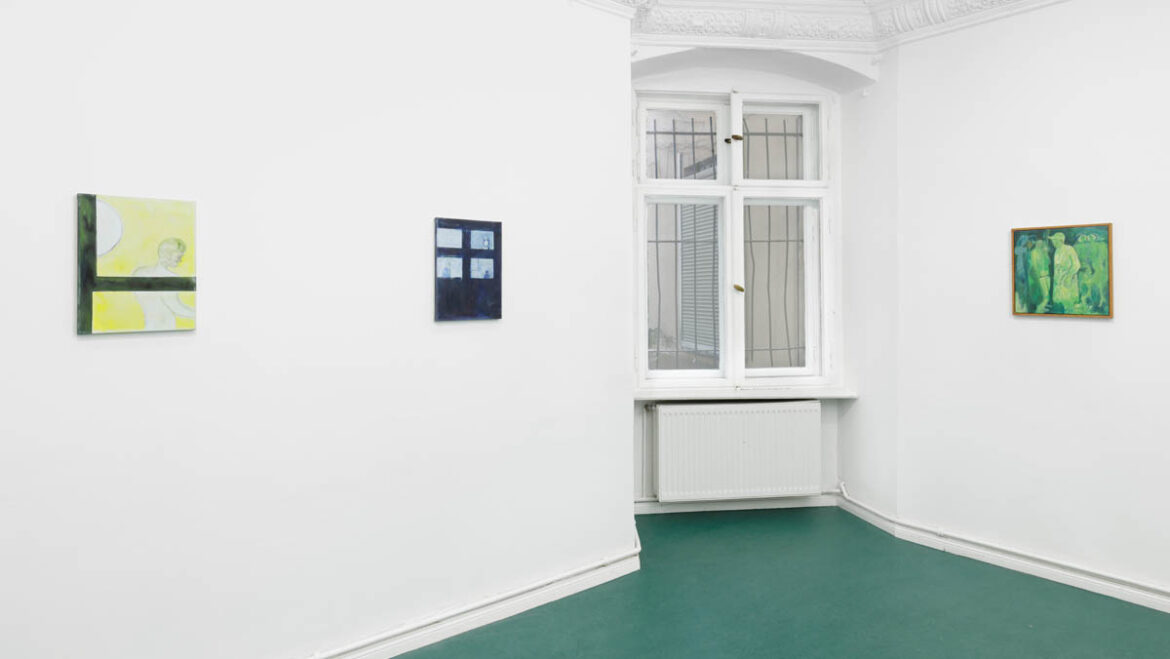
On entering the gallery space at Noah Klink, one of the exhibition’s four smallest-format paintings awaits on the left, alone and centered on a wall. With a yellow colour scheme, it depicts a segment of a brick wall, a hairdresser cutting a person’s short hair, and another figure, larger and prominently positioned in the foreground, crouching on their knees. Gazing at their hands, the figure appears childlike, and melancholic, as if the act of hair-cutting were a loss or an unattainable yearning. Does the figure sit outside the window, like us, observing the scene? Or are they all in the same room, the supposed window a mirror reflecting the figures to the opposite side of the image—perhaps exactly where we are standing. In this case, we, as viewers, might bring the figure sadness or at least become part of the event. Once again, there is uncertainty between a formal moment of self-care and time-for-oneself and a dystopian scene with ambiguous interpretation. This tension successfully runs through the many „windows“ in Eliza Wagener’s painterly world.

Time and again, the amorphous figures blur into their surroundings, melding with both the foreground and background. Eliza Wagener’s painting practice revolves around streaks on the canvas, which emerge during the initial priming process and are deliberately cultivated by the artist. Organic, droplet-like structures form the foundation for both background and foreground shapes, which are taken up by the motifs in their own logic. These shapes intertwine in their fluid bodies and defined contours, flickering and dancing with one another. Through a dynamic interplay of applied and removed paint, cutouts, and integrations with the streaks and poses, fluid moments emerge that resist gendered ascriptions. Skirts and trousers—clothing known to give no indication of a person´s identity—appear throughout. Eliza Wagener’s characters seem, with a wink, to evade societal categorizations and connotations, retreating into a more abstract, ghostly world that promises a utopian fading out of gender or even hints at a different temporality altogether.
Exhibition: Eliza Wagener – Windowpecking
Exhibition duration: 06.12.2024 – 11.01.2025
Address and contact:
Galerie Noah Klink
Kulmer Str. 17, 10783 Berlin
www.noahklink.com