


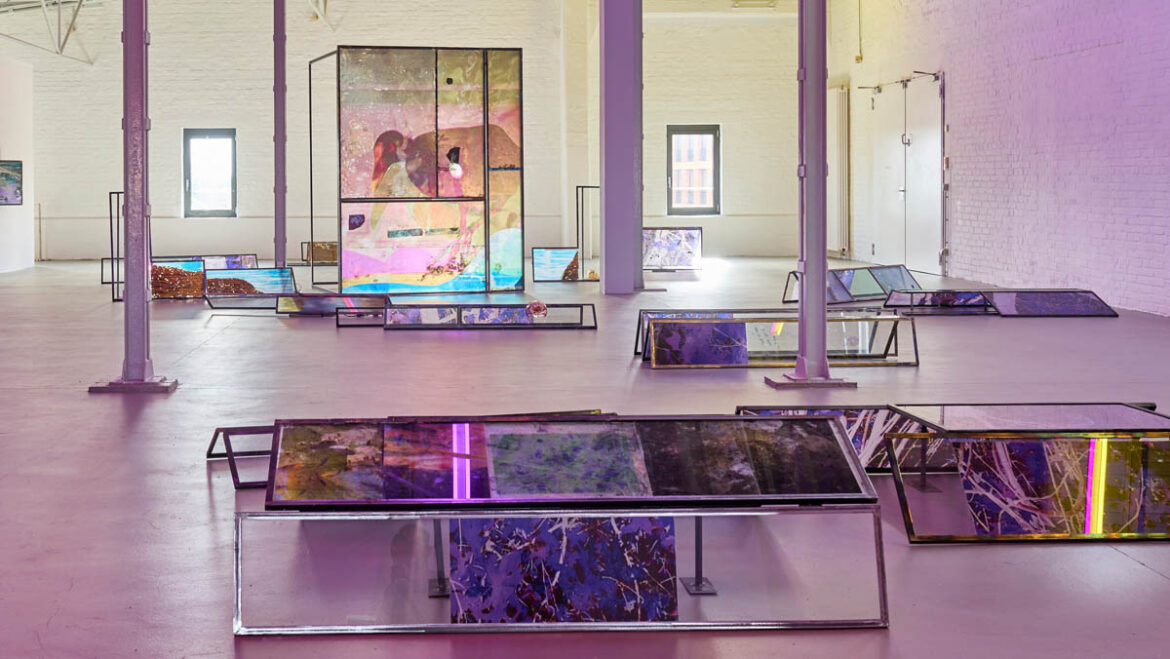
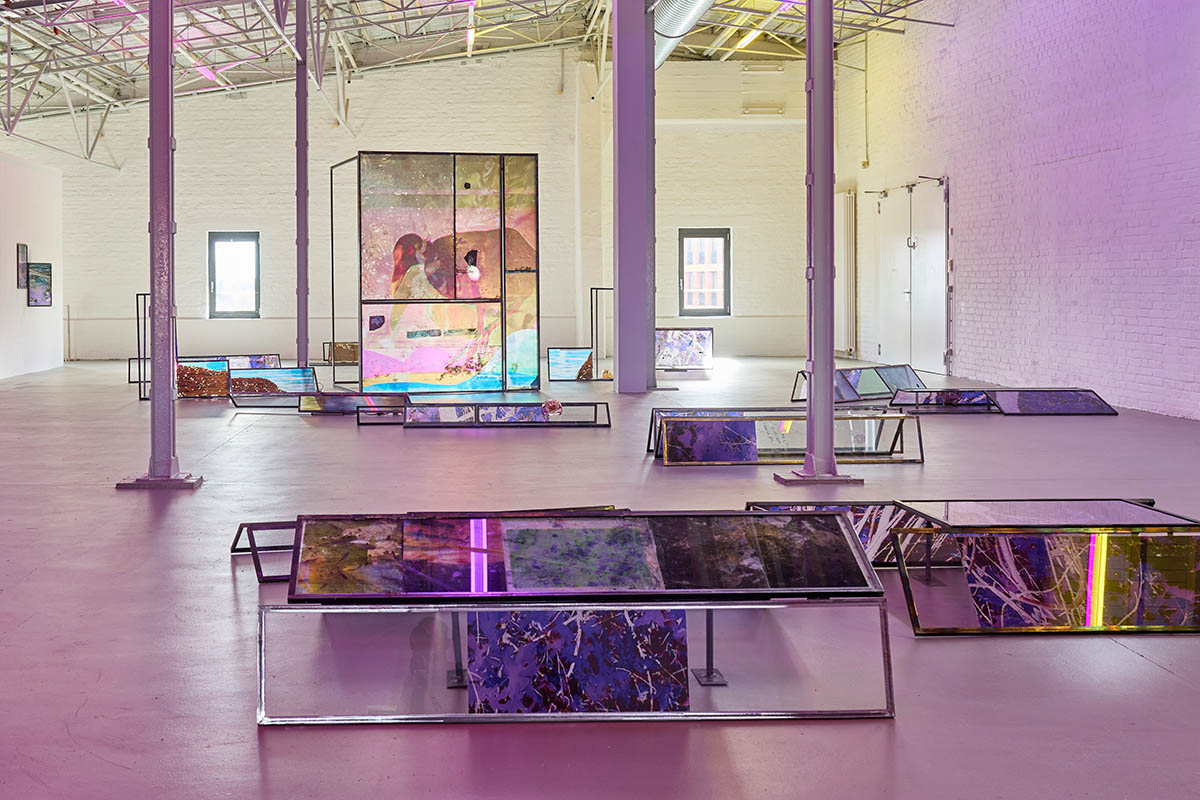
It has now reached what is, at least for now, its final location at the Kunsthalle Münster, where it occupies the premises of the former grain warehouse. The existing works have been supplemented by a new piece that the artist developed on site.
Euridice Zaituna Kala’s work originates from an in-depth deconstruction, manipulation and reconstruction of cultural and historical metamorphoses. It invites us to engage with the historical and cultural transformations of personal and collective memory. A particular focus lies on the complex relationship between colonialism and post-colonialism, as well as post-colonial memory. In order to address the extensive history of erasure and silence, and trace the remnants of invisible subjectivities and communities, Kala has developed an impressive method. The artist examines the ambivalence of historical narratives, follows up on the constant rewriting of history and probes its gaps.
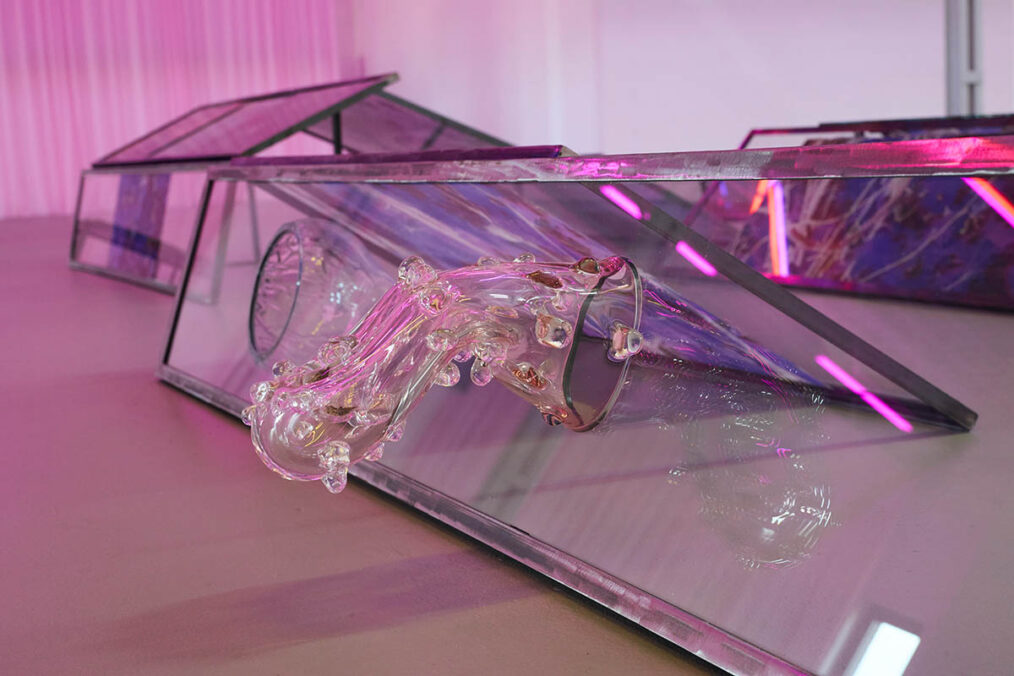
Kala combines the findings of her research with personal memories. In line with the concept of daylighting—the process of uncovering previously buried watercourses and restoring them to their natural, above-ground state—Kala unearths stories overlaid by other narratives, thus rendering them perceptible. She evokes memories embedded within the land and nature. She raises the question: what is revealed when a surface is cracked open? In her photographs, installations and sound works, she explores inherent connections between water, nature and human experience—with the aim of encouraging a reflection on ancestry, ecology and landscape as a living archive. The process involves both collective and individual experiences. Stories emerge from dialogues with ancestors, decolonial interpretations, and the concept of “dérive”: an aimless journey through the city as a shaped space. Daylighting: aber es ist Wasser, das spricht poses the question: what kind of world emerges when we reveal the water that flows beneath our feet? This artistic quest opens up a space where one can delve into forgotten stories—whether individually or collectively—and simultaneously consider why these stories were forgotten in the first place, and what consequences this memory loss (whether conscious or unconscious) has entailed. The artist invites visitors to become part of a circle of shared stories.
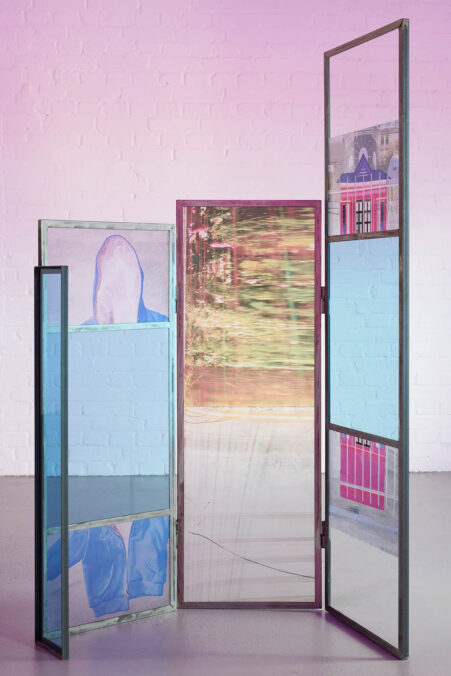
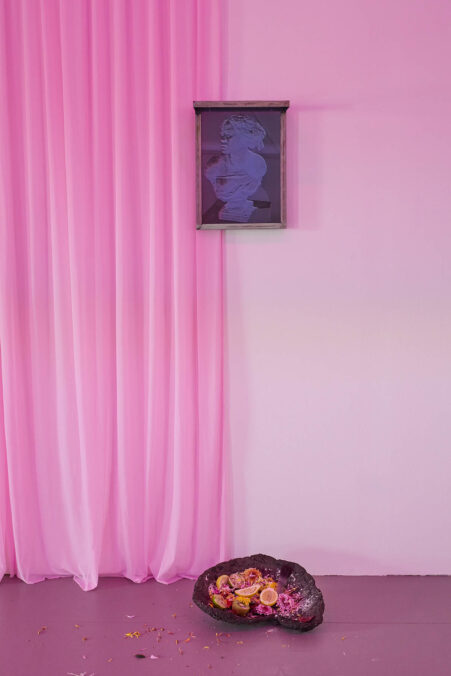
Euridice Zaituna Kala (born 1987 in Maputo, Mozambique) lives and works in Maisons-Alfort, France. Kala trained in photography at the Market Photo Workshop in Johannesburg from 2010 to 2012 and at the Asiko School in Maputo in 2015. Kala has staged numerous performances, including Ritual as March as Protest, HKW Haus der Kulturen der Welt, Berlin (2023); Sea(E)scapes: Listening Session, Jeu de Paume, Paris (2022); Tœtra, Centre Pompidou, Paris (2021); Stranger, Danger: Wait, it’s just a prayer Room, Centre Pompidou, Paris (2019); Mackandal Turns into a Butterfly: a love portion, La Galerie – CAC de Noisy-le-Sec (2018). Her recent exhibitions include En quelques gestes: as if two suns were setting, galerie anne barrault, Paris (2024); Echos der Bruderländer, HKW Haus der Kulturen der Welt, Berlin (2024); Prémio Paulo Cunha e Silva, Galeria Municipal, Porto (2023); Indigo Waves and Other Stories, Savvy Contemporary, Berlin (2023); Sea(E)scapes DNA: Don’t (N)ever Ask, Galerie Salon H, Paris (2022); Fata Morgana, Jeu de Paume, Paris (2022); This Is Not Africa – Unlearn What You Have Learned, ARoS Museum, Aarhus (2021); Je suis l’archive, I the archive, Villa Vassilieff, Paris (2020). In 2024, she was invited to participate in the exhibition Passengers in Transit as part of the 60th edition of the Venice Biennale.
Exhibition: Euridice Zaituna Kala – Daylighting: aber es ist Wasser, das spricht
Curator: Merle Radtke | Curatorial Assistant: Heiko Lietz
Exhibition dates: 10 October 2026 – 24 January 2027
Opening hours: Tue–Sun, 12–6 pm (free admission)
Address and contact:
Kunsthalle Münster
Hafenweg 28, 5th floor
48155 Münster, Germany
www.kunsthallemuenster.de
View all upcoming events here.