

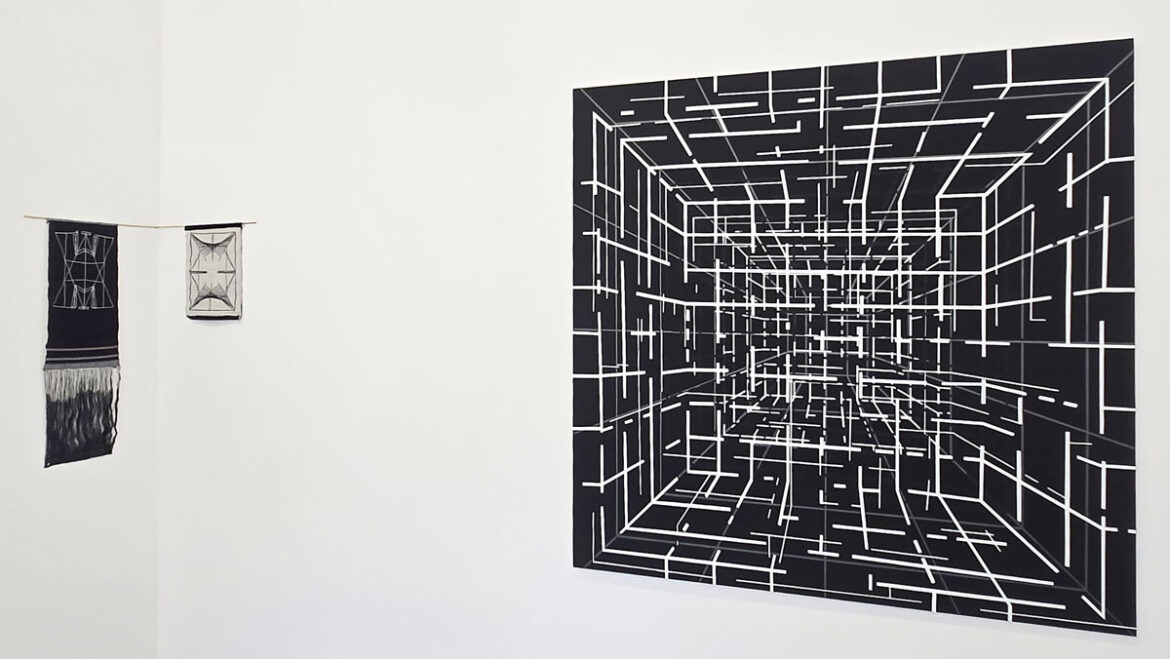
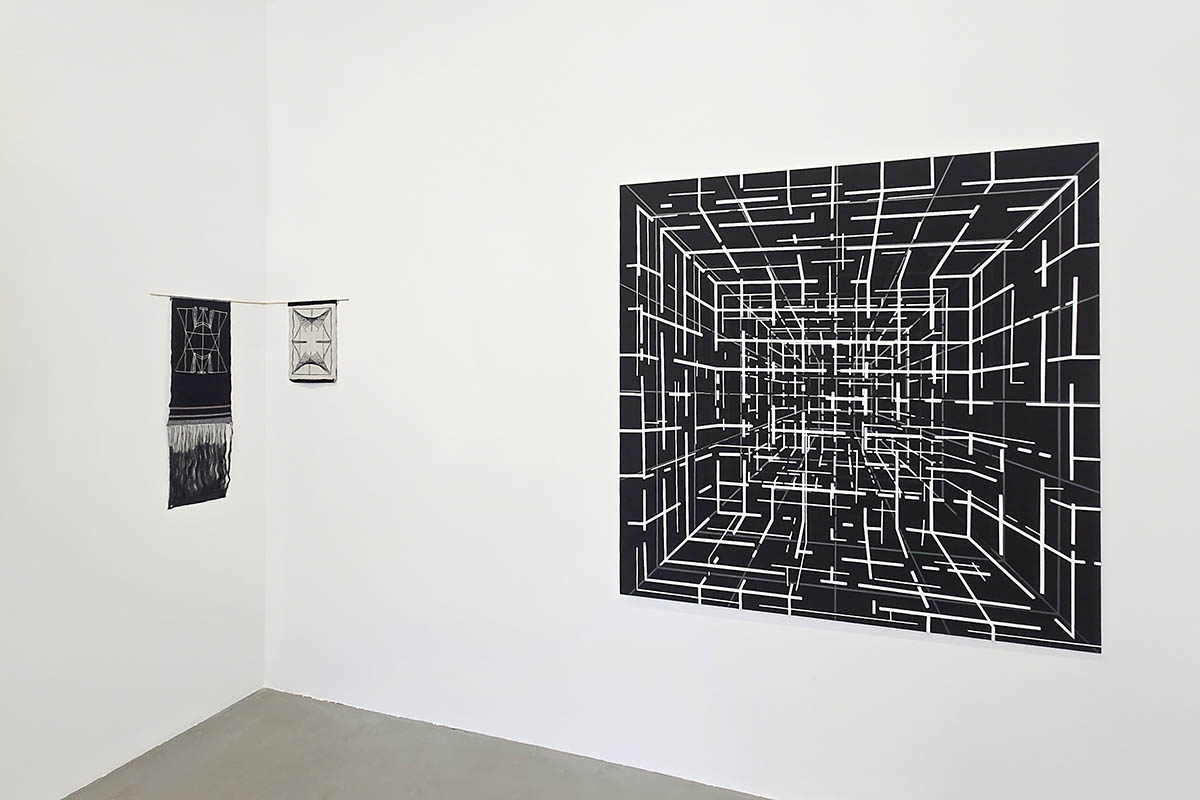
Your solo exhibition ritual studies is on view until 7 November 2026. Textile works take up a substantial part of the exhibition, and there is one painting as well. I want to start with the title. What does it mean to you personally, and how did you arrive at it?
The title ritual studies refers to the processes I return to again and again in my work. Through repetition, I observe how things shift and transform in response to my actions. All the works shown in the exhibition are built on an essential earlier piece of mine, The Garden (2023).
The work The Garden (2023) is part of the series of works A Long Journey Into Darkness. Can you tell us about it?
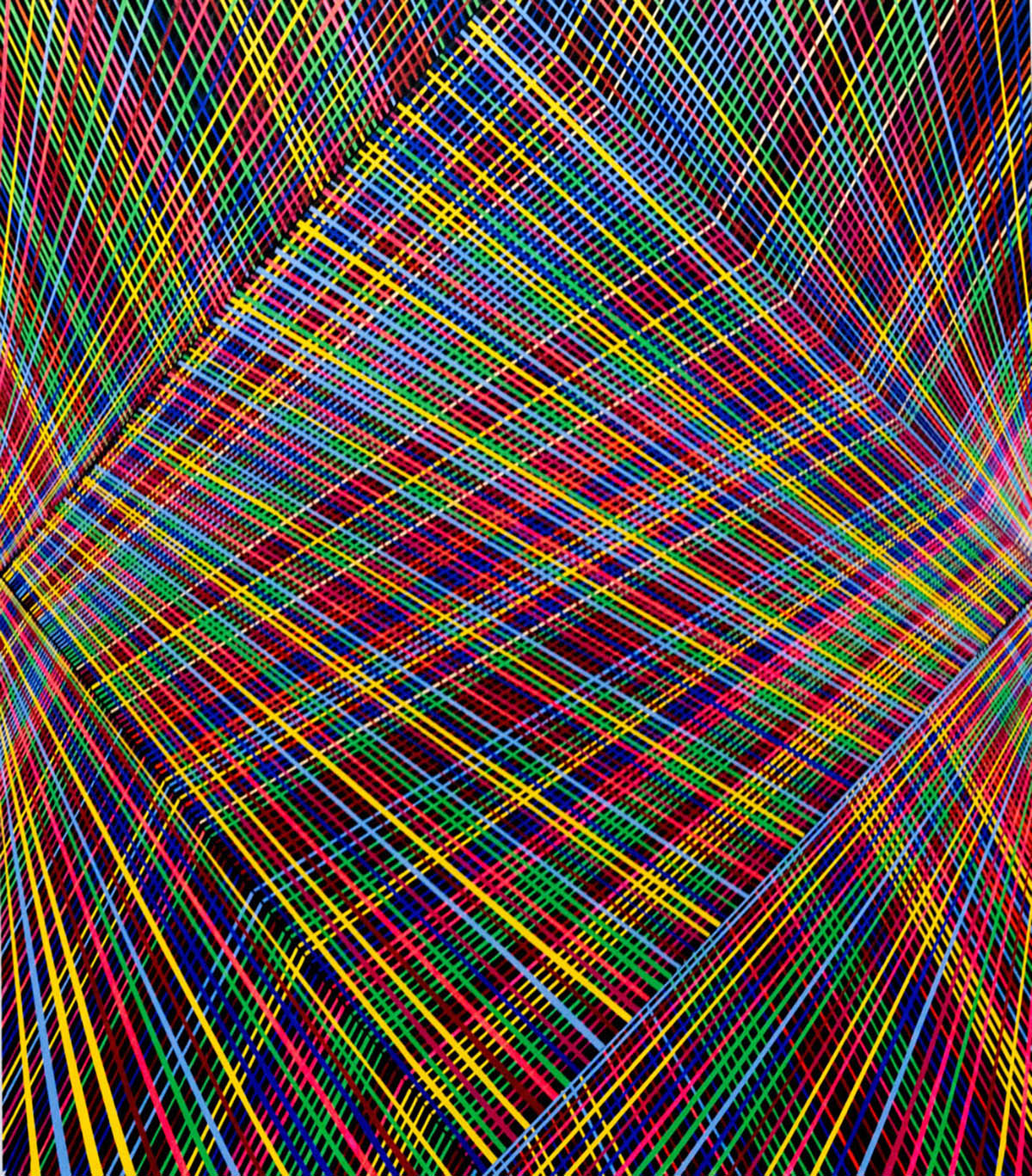
The Garden is a drawing done in acrylic color on cotton; it is made up entirely of colorful lines. It consists of five geometric shapes, composed only of lines. I doubled these five parts to create a space without perspective. The space appearing in this work is nothing graspable, no particular surface or object. What emerged from this process was so compelling, so I kept working with the individual parts, recombining them again and again, repeating, mirroring, distorting, or reassembling them. I wanted to see how many forms are already contained within a single form and, ultimately, how many images are already embedded in one image.
How does the work on one of your drawings look in practice, from the first sketch to the finished work on canvas? What role do the digital processing and hand transfer play in your work?
The process begins with hand drawings, which I then digitize and develop further in the computer program. Since the construction lines are part of the drawing and part of the digital structure, they play an important role in the process. The designs are developed digitally, then printed out and used as a template for my work on canvas. For the transfer onto canvas, I deliberately work without exact measurements. I mask off each line with tape and then paint it by hand. This results in differences in the length, thickness, and spacing of the lines. These imprecision are a crucial part of the work.
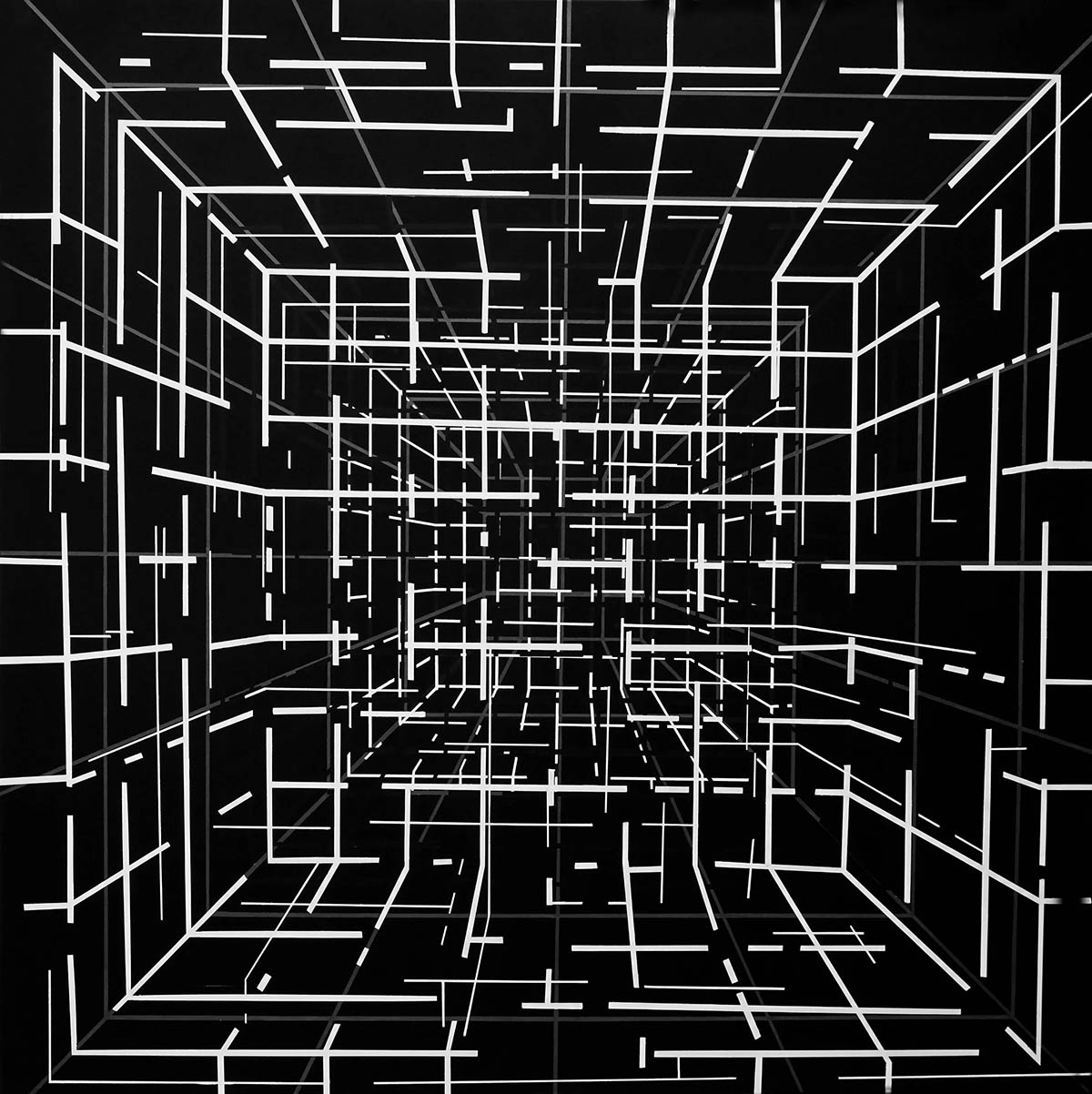
A perfectly precise execution would make the image feel lifeless. It is precisely the deviations that give the painting a natural and human feeling.
When a visitor enters the exhibition, their eye is immediately drawn to your work, The Hidden One, a painting that forms a central element of the show. What can you tell us about this work and its significance for the exhibition?
The Hidden One was almost a precursor. Back then, I was searching for my surface in tensions between the lines and abstract spaces. I can trace the interlacing and the woven structure within it, which definitely influenced my work with textiles.
Alongside the paintings, the exhibition also features numerous textile works. You moved to Norway in 2020, where weaving is a deeply rooted tradition. How has working with textiles changed your view of artistic practice?
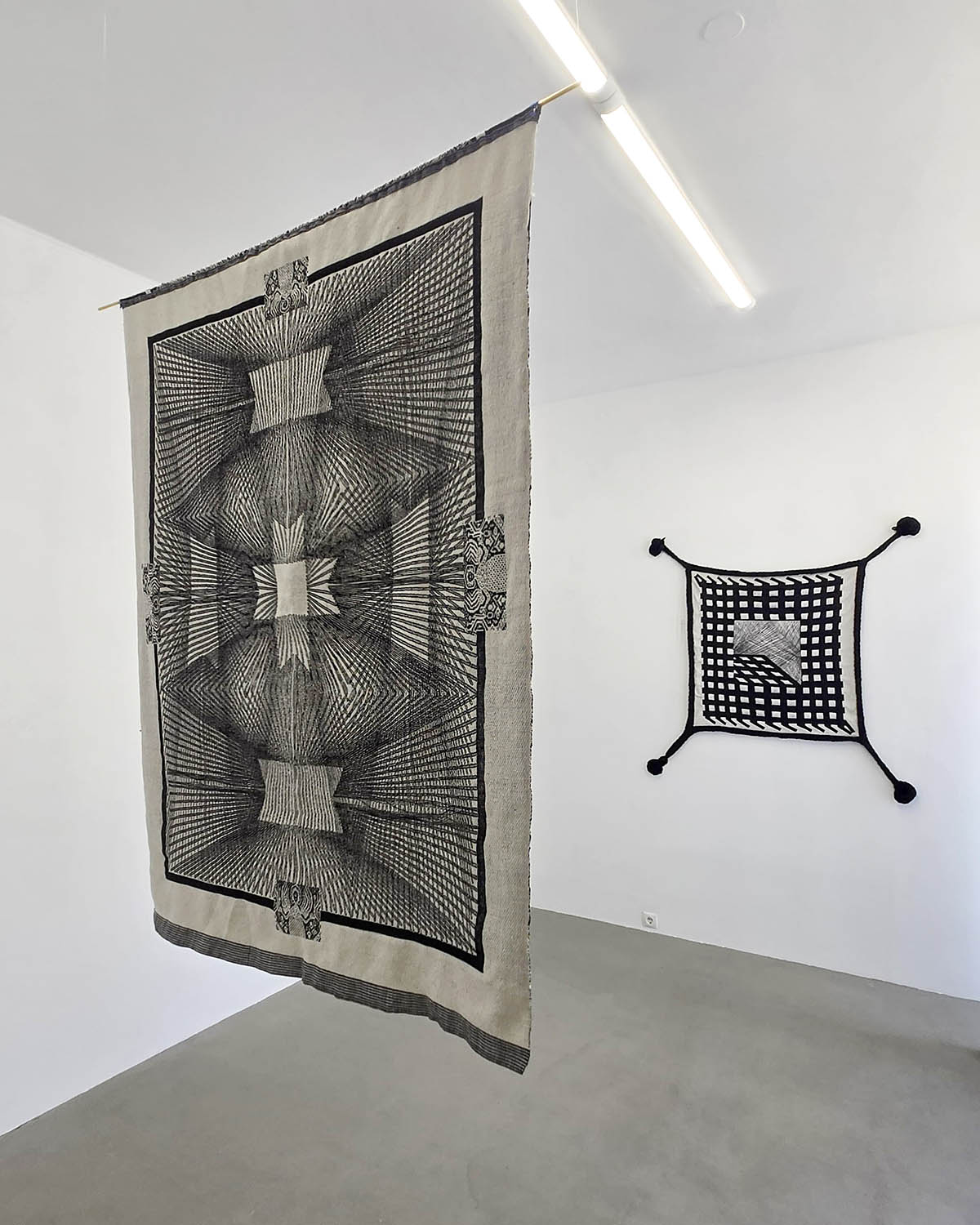
My textile works are made on a digital Jacquard loom, the TC2. I do the weaving myself. I became aware of the possibility of working with this medium through other artists, who recommended the course to me. I took it and was surprised by how many possibilities this medium opens up. In my painting, I work with very strict rules. The lines are as straight as possible, and I largely avoid soft forms. Working with textiles, I noticed how these rules dissolve. With yarn and thread, it is impossible to create a completely rigid form; even a straight line moves. It was unfamiliar at first, but it did bring my work further.
Which textile works are you showing in the exhibition, and what connects them? Is there a work you would like to talk about?
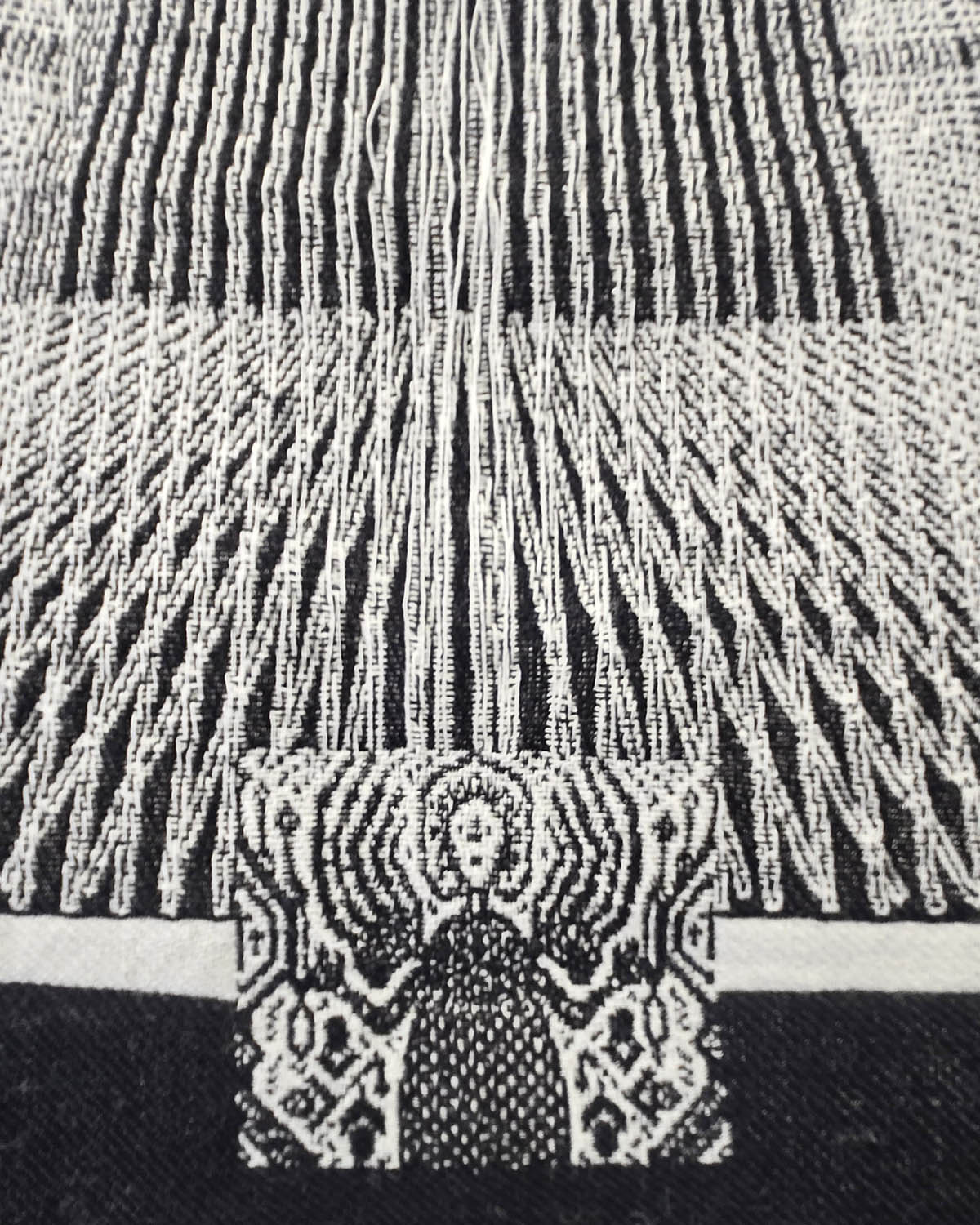
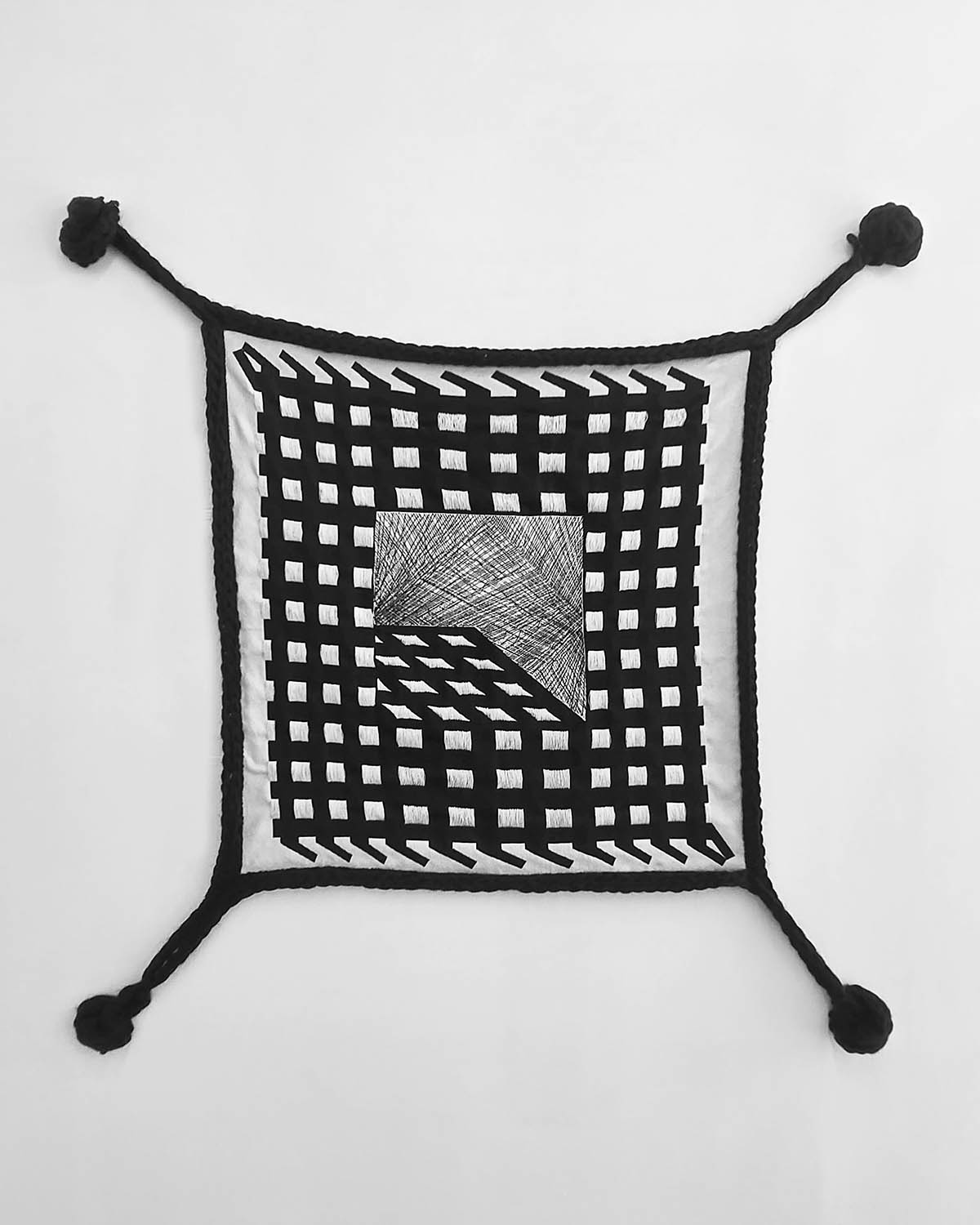
The exhibition in Innsbruck shows a selection of my works from the past few years. With my first textile works, the backside was not particularly important to me yet. I initially took my cue from my painting: the front was black, and the back showed its negative. This changed with one work The Doll’s Ritual. Through its crossings, the piece’s structure feels very sacral. As a contrast, I took up a figure from a historical book on handweaving, which at first reminded me of a witch.
In the process, I also looked into the history of witch persecution in Tyrol. While weaving, it turned out the figure actually depicts an angel. When I took the finished textile off the loom and saw the back, the negative created an entirely different impression: while the front shows the angel, the back is reminiscent of a witch. As a result, both sides have become an equal part of the work for me.
You can sense how much joy there is in experimentation in your working process. What was the greatest challenge at the beginning?
The possibilities of weaving are almost limitless. This variety overwhelmed me at first, because I still had to learn how the structure works. With traditional looms alone, it took me about a year to understand the shaft. I always had the feeling in painting practice I was working too slowly and had to produce more; with weaving, I deliberately chose an even slower medium. The process is very time-intensive and shaped by experiments, trials, and constant testing.
Does the meaning of the forms in your work change when their material changes?
I’m still finding out myself. I do believe that the meaning of a form changes with the medium. For me, textile is a body, while painting is an image applied on the textile, in this case, a canvas.
The concept and depiction of a grid remain a central element throughout your work. What continues to fascinate you about it?
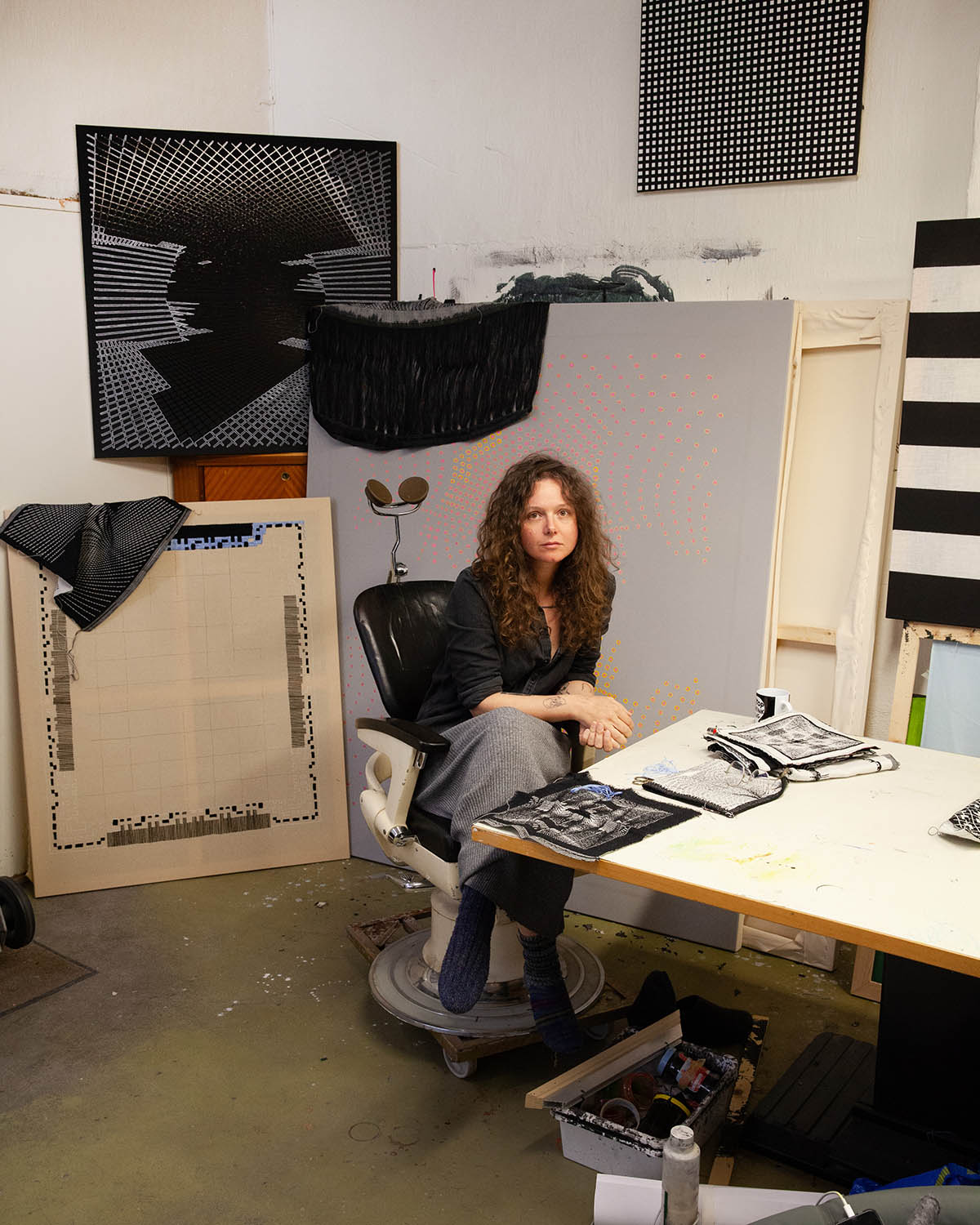
Our minds are often full of chaos. On the other hand, the grid embodies pure structure, order, and calm. At the same time, it has something beautiful and elegant about it, with a certain pull. Themes such as construction, development, the future, existence, and clarity also occupy me in my work. I have read a lot about the grid, and I keep trying to question or refute existing theories for myself, to find out what other possibilities there are. I am especially interested in when a grid becomes a structure, when it breaks apart, and in challenging whether it can develop further. I also find myself wondering what influence the grid can have beyond art, on social structures and sociocultural discourse.
Current exhibition in Innsbruck:
Solo exhibition: Linda Ebert – ritual studies
Exhibition duration: September 16 – November 7, 2026
Opening times: by appointment
Venue: gezwanzig showroom | Leopoldstraße 41, 6020 Innsbruck, Austria
Ebert’s works are characterized by her exploration of themes such as darkness and emptiness. Her works often emerge from a deep black, which she uses as a metaphor for antimatter. Ebert describes black as “total nothingness”, from which she develops lines and shapes that ultimately create space. Her work thus goes beyond mere color experiments and addresses existential questions about space, absence, and the conditions of human perception. In one of her major exhibitions in Kiel, she also addressed climate change. With gloomy, dystopian motifs, she illuminated the ecological and geopolitical effects of the environmental crisis, lending her art a socio-critical dimension.
Address and contact:
gezwanzig gallery
Gumpendorfer Straße 20, 1060 Vienna, Austria
www.gezwanzig.com
www.instagram.com/gezwanzig.gallery/
Linda Ebert – www.lindaebert.com, www.instagram.com/lindaebert0/
Linda Ebert is a German artist specializing in painting, installation, and graphics. Her works explore the relationship between space, surface, and perception, working with geometric structures, grids, and the color black to create spatial illusions and conceptual depth. After graduating, Ebert gained valuable practical experience as a studio assistant for the artist Esther Stocker in Vienna (2019). This collaboration deepened her understanding of minimalist and architecturally inspired art forms. Ebert studied at the Muthesius Academy of Fine Arts in Kiel, where she completed her Bachelor of Fine Arts in 2017 under the guidance of Prof. Antje Majewski and Petra Maria Meyer. This was followed by a Master of Fine Arts in 2019, where she was also supervised by Sophie Reinhold. During her academic career, she intensively explored the interaction of space and surface and developed her characteristic reduced but conceptually complex visual language. She currently lives and works in Bergen, Norway, where she continues her artistic research and presents her works in international exhibitions.