

Category

Mailand

Category
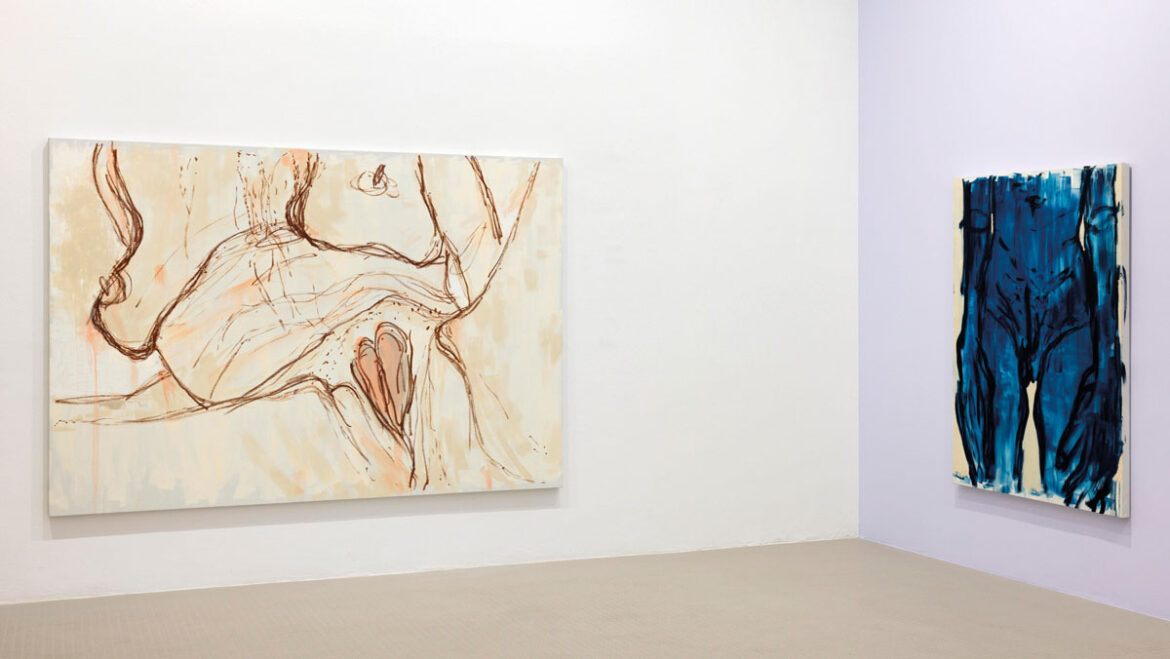
Exhibition view: Gabrielle Goliath – Bearing, Raffaella Cortese, Milan, 2026. Photo: Andrea Rossetti

While trauma is often sublimated through silence and breath in Gabrielle Goliath’s most famous video and sound productions, the body assumes an unprecedented pictorial incarnation in this new series of works. Hosted by the Raffaella Cortese gallery, the exhibition Bearing is articulated across the three Milanese spaces on via Stradella. The polysemic verb to bear, which in the title embodies the meanings of carrying, and supporting, reveals an existential condition that the artist intends to subvert through the dissident force of portraiture and eroticism. Using oils, watercolours, and pastels, the artist highlights the corporeal dimension of the subjects, marking a significant new direction in her artistic practice.
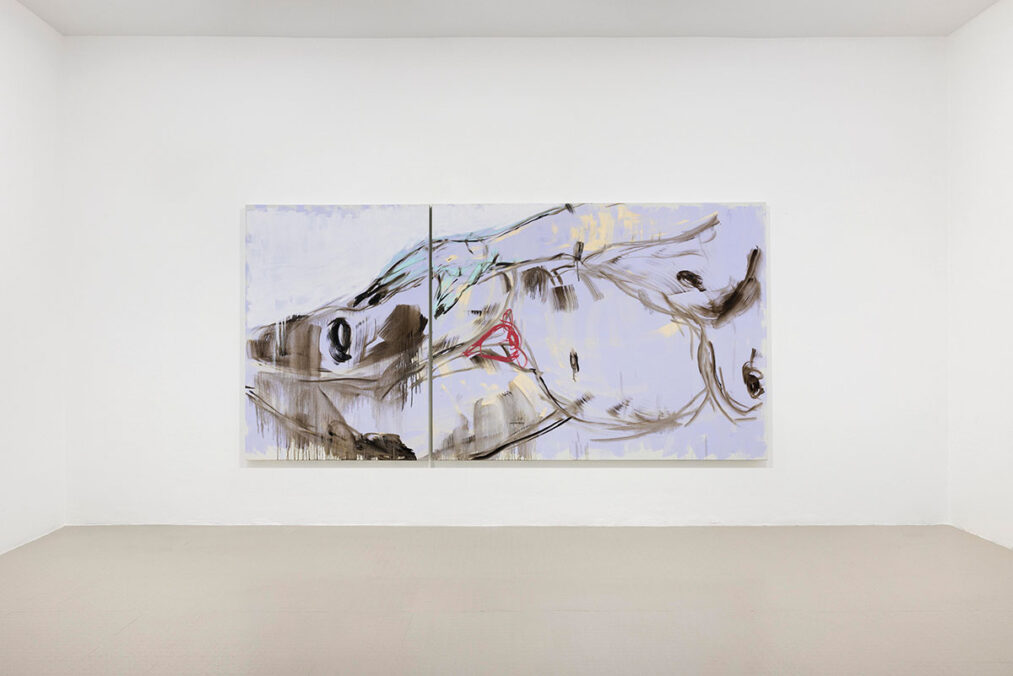
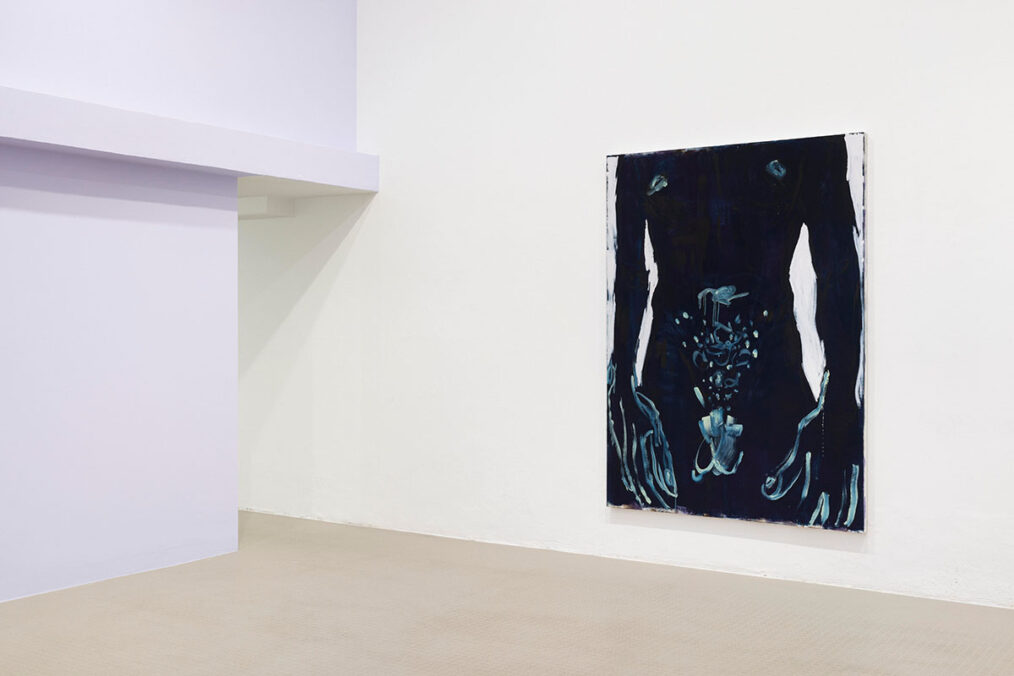
At the centre of Goliath’s reflection is what she defines as «the impossibility of black femme representation», a consequence of an intentional social clouding that relegates the subjects to the shadows. The artist reacts to this erasure by using painting to restore the body’s erotic and dissident force. By depriving the figures of faces and specific connotations, Goliath transcends individual specificity: the work allows a personal plane to coexist with a collective one, transforming the body into a territory of political reclamation.

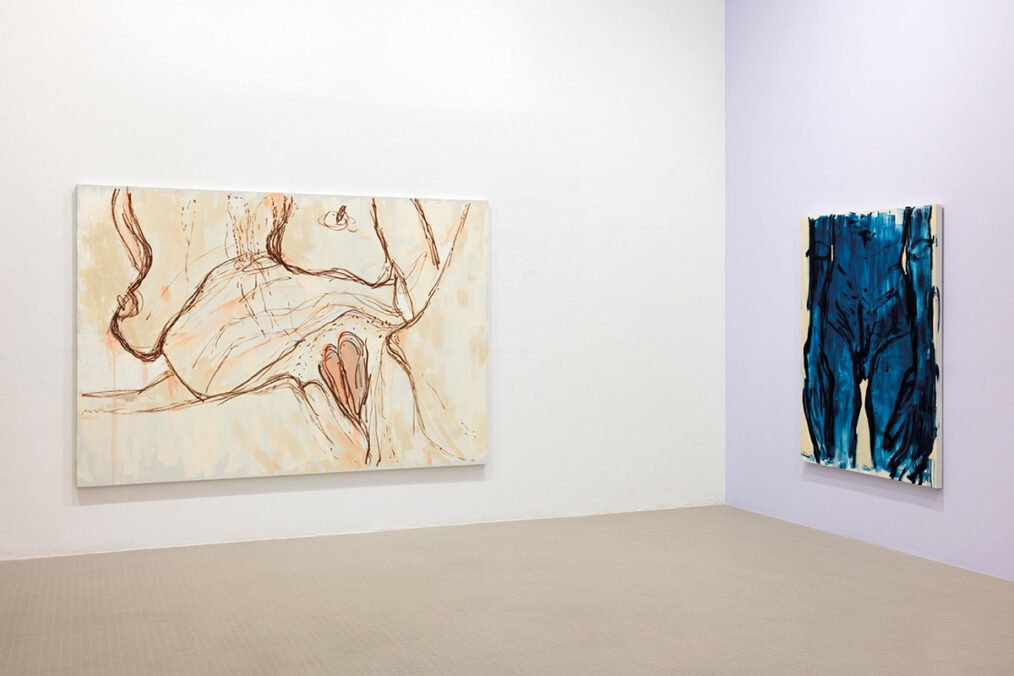
The explicit exposure of the genitalia serves as the point of origin of this reaffirmation; visually emphasized by dense brushstrokes and sanguine hues, it becomes the fulcrum of a vulnerability that, when proudly exhibited, is transformed into power. Goliath’s portraits do not depict explicit autoerotic acts; rather, they are imbued with an intense individual awareness. Here, eroticism is an act of internal perception, an expression of an intimate relationship with the self, and a private pleasure through which the subject perceives its own fullness.
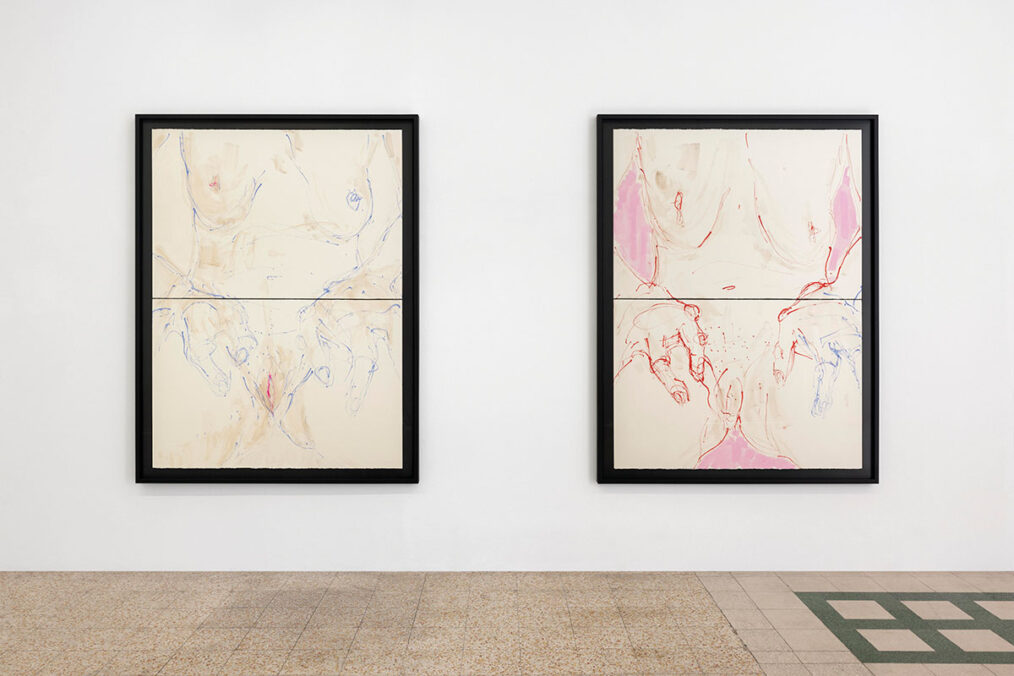
Exhibition view: Gabrielle Goliath – Bearing, Raffaella Cortese, Milan, 2026. Photos: Andrea Rossetti

The only exceptions among the subjects, yet still central to the same representational inquiry, are the works exhibited at via Stradella 4. Here, a face in watercolour appears alongside two mirrored images of a pregnant woman, the latter serving as a reclamation of reproductive freedom. The decision to articulate the exhibition across the gallery’s three distinct locations forces the visitor to exit, re-enter, and metabolize the intimacy of the works in the urban context; this fragmentation reflects the pursuit of freedom as a non-linear process.
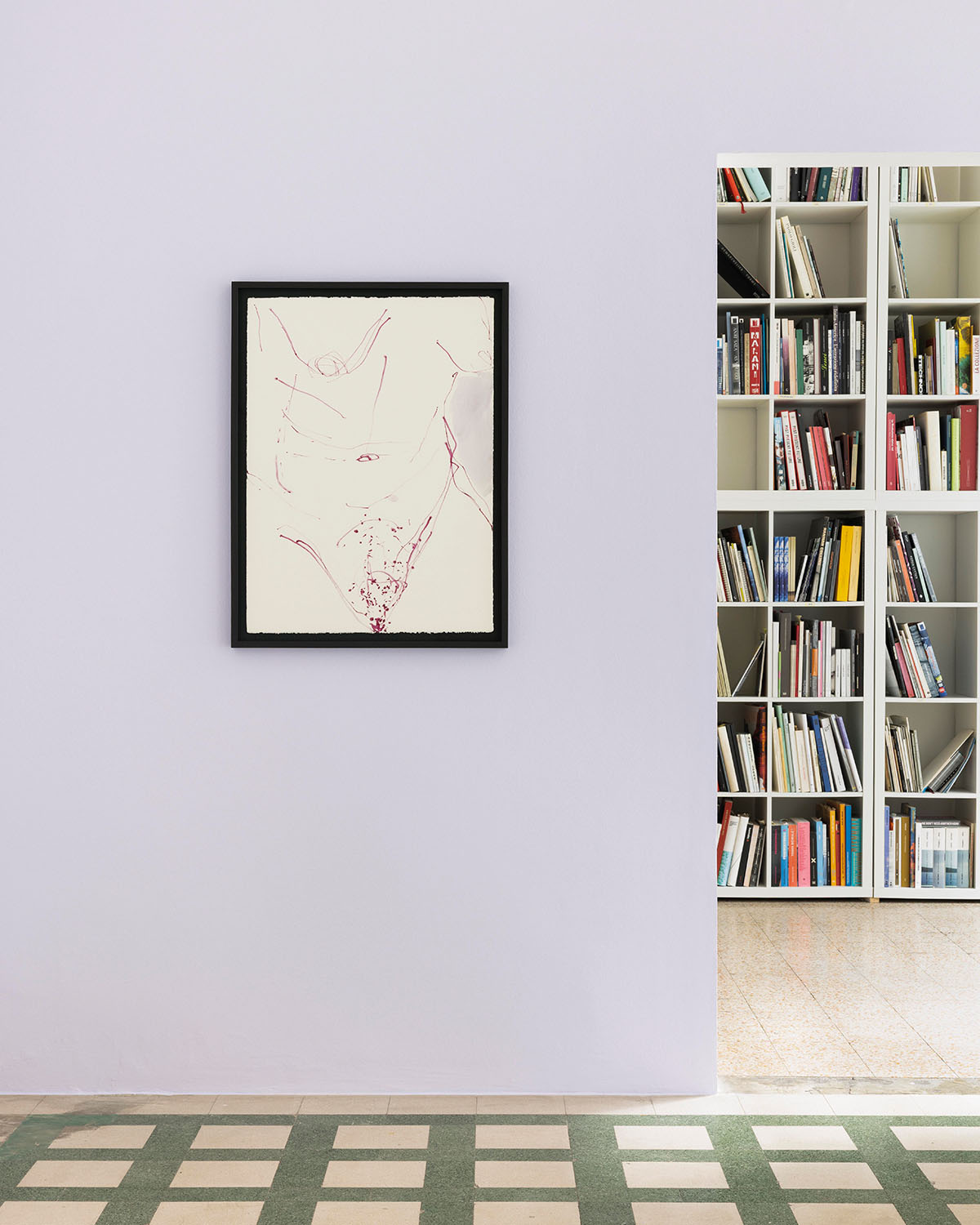
Exhibition view: Gabrielle Goliath – Bearing, Raffaella Cortese, Milan, 2026. Photos: Andrea Rossetti

The Milanese exhibition also serves as a prelude to the video installation Elegy (2015 – ongoing). Despite the project’s exclusion from the South African Pavilion at the Venice Biennale, it will be presented independently in the Church of Sant’Antonin on May 4th. While the works in via Stradella claim the body’s presence through painting, Goliath’s practice in Venice will return to the media of breath and ritual song, reaffirming the urgency of giving voice to every black, femme, and queer life violated and dehumanized, both in the past and today.

Exhibition: Gabrielle Goliath – Bearing
Exhibition duration: April 16th – September 3rd 2026

Address and contact:
Raffaella Cortese
Via Alessandro Stradella, 7, Milan, Italy 20129
www.raffaellacortese.com

Gabrielle Goliath – www.gabriellegoliath.com, www.instagram.com/gabriellegoliath


Gabrielle Goliath (b.1983) lives and works in Johannesburg, South Africa. Through the ritual, sonic and social encounters of her art practice, she attends (and tends) to histories and present-day conditions of differentially valued life, reaffirming ways in which black, brown, femme and queer practices of possibility perform the world differently. Each of her works convenes a coming-to – a tenuous community – collapsing the presumed remove and privileged subject position of representation (as white, male, heteronormative) and calling for meetings in and across difference, on terms of complicity, relation and love.

Romero Paprocki returns to miart with a booth bridging Paris and Milan, presenting works by Carbonne, Jacquot, Mo Rielly, and Mesnil, exploring collecting, risk, and dialogue.

On Beginnings, Objecthood, and Milan in the 1980s. In-depth about material agency, mechanical choreography, and aesthetics & functions of display in Anna Franceschini’s expanding body of work.

In conversation with Marilisa Cosello, an artist working across performance and photography, we explore her practice and ask whether the real medium might ultimately be the body itself.

Terraforma Exo 2025 turns Milan into a sonic lab—an open-air journey exploring how sound reshapes our bond with the city, unfolding across gardens, bodies, spaces, and ecologies.

“Air, oh l’air!” the boxer and poet Arthur Cravan had exclaimed in the early 1910s, also on a sofa while having an imaginary conversation with his uncle, Oscar Wilde. Helga and I meet at Cantina Isola.

Threes was honored to present the Italian debut of WINDOWS TO LOOK IN, a groundbreaking project by Lorenzo Senni, one of the recipients of the twelfth edition of the Italian Council (2023).

Colonial trauma has no linear trajectory, and neither does memory. It seeps and sinks into the fibres without a temporal pattern, crossing generations, back and forth between past, present & future.

Curating, writing, and teaching brings An Paenhuysen to many places in the art world, from an artist studio in the 22-story tall Meritomi in Helsinki to a senseless residency in Milan.

Erjola Zhuka’s aim is to celebrate human potential, forge new ways of being, and challenge normes imposed by contemporary societies. The phrase „As if you know nothing“ captures …

“Time/space”, Helga Franza says. We’re debating the title of a sculpture she created at the banks of the Danube. Time comes first, according to the artist: “If you change time, reality collapses.”

This text had been blurry in my mind for months, but only now has it gained meaning. Perhaps because night has fallen, and I’ve come to understand that despite people are used to leaving.

Thomas Berra, born in 1986, is part of the emerging wave of Italian painters. Having worked in various studios, including one in Finland, he has now returned to his former studio in Barlassina.

The review recounts a visit to a monographic exhibition in PAC Milano. The critic gets obsessed with eight expanded monitors, which show a cycle of works of Ancarani entitled Memories for Moderns.

Nina Carini was born in Palermo in 1984 and her education took place between the Academy of Fine Arts of Verona and Milan and the École nationale supérieure des beaux-arts of Lyon.

By redefining perception, and exposing the relationships and boundaries between subjects, substances, systems, and worlds, we perform this ongoing immersive act. You might need to find a way to ‘enter’.

Liu Xuanzhu graduated from the Mural Painting Department of China Academy of Art with a Bachelor’s degree and graduated from the Painting Department of Venice Academy of Fine Arts.

Galleria Raffaella Cortese is delighted to present The Ongoing Story, Alejandro Cesarco’s third solo show with the gallery. In the artist’s own words: “The exhibition is a selection of recent works.