

Category

Stadt

Category
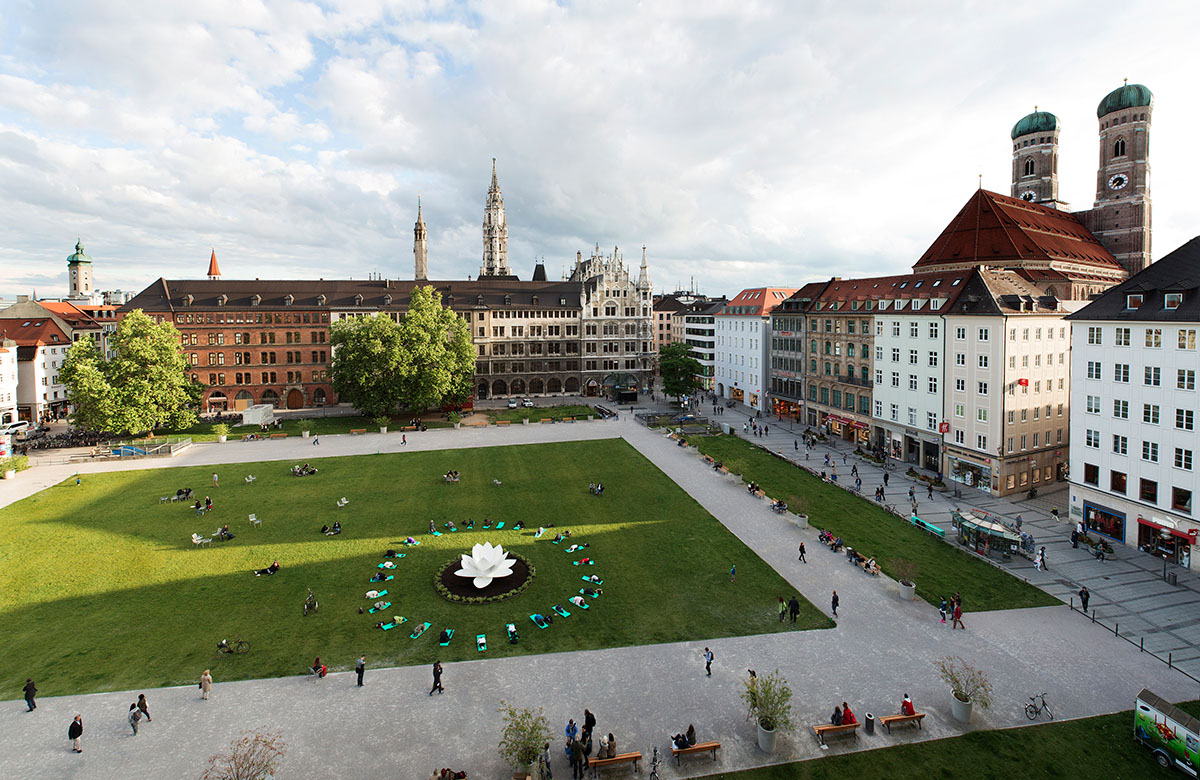
Weißer Lotus – ein unterkulturelles Ritual , München 2015 Dieses Werk steht für Frieden und Toleranz jenseits von Religion, Kultur und Ideologie. Aluminium , 550x550x240cm  Foto: H. Reichenwallner
Weisser Lotus (White Lotus) – a intercultural ritual , Munich 2015. This work stands for peace and tolerance beyond religion, culture and ideology. Aluminum , 550x550x240cm Photo: H. Reichenwallner

Hyon-Soo Kim grew up in the countryside of South Korea in a traditional Confucian family. After studying applied arts, she worked as a goldsmith in Seoul. The early death of her mother and the reading of Kafka and Nietzsche led her to the decision to study in Germany in the early 1980s. She studied at the Academy of Fine Arts in Munich, where she worked and lived for many years. She currently lives and works in Berlin.

How did you get into art?
My mother died very suddenly when I was in my mid-20s, which was a deep impact on my life. I decided to go my own way, to learn about the mysteries of life and the world and to express myself, so I chose the path of art. Actually, I had trained as a goldsmith, but I felt limited by that in the work and decided to go into liberal arts. So I ended up in the painting class at the Academy in Munich. I made my portfolio in three days, but Professor Hans Baschang accepted me right on the spot.
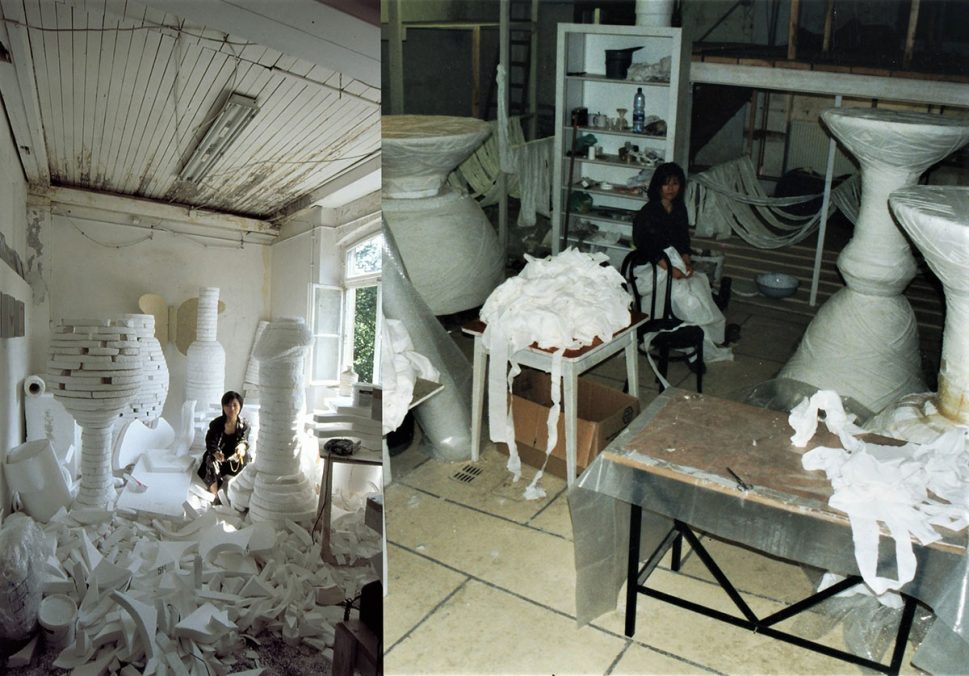
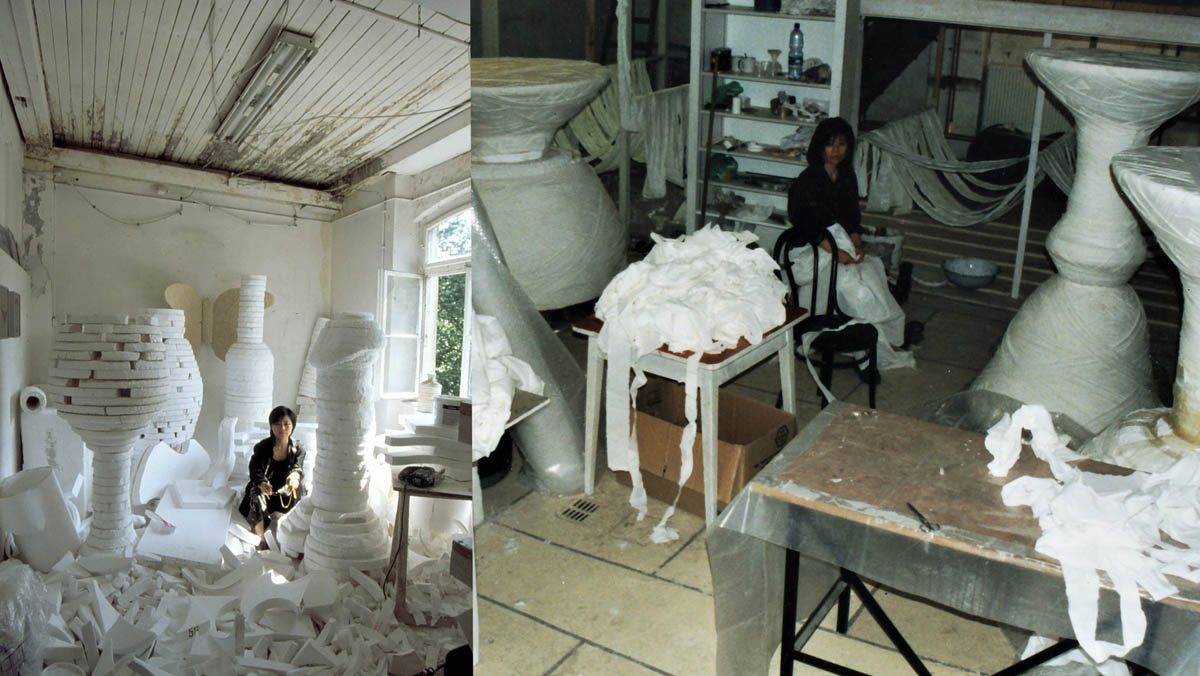
Atelier auf Praterinsel, München 1999/2000
Studio on Prater Island, Munich 1999/2000

What inspires you in particular? What themes do you deal with in your art?
Togetherness, nature and emptiness and void. While my work used to revolve a lot around the cycle of life and impermanence, today I focus on the now, on „living in the moment.“ Every moment is important. Emptiness and voidness are essential components of Buddhist philosophy. My work „White Lotus“ is a turning point here: it is a communal performance. Through 108 collective bows, we free our minds from illusions and unite in humility, meeting in emptiness.

What techniques do you use?
Currently I often use randomly found materials from the street or from my surroundings: flowers, leaves, twigs, but mostly things we have used and thrown away in our everyday lives and fragments of things, often barely recognizable, no hints of what they used to be or what they belonged to, yet still parts of themselves and ourselves. I try to leave things as they are and make them look new together, so I use different techniques.
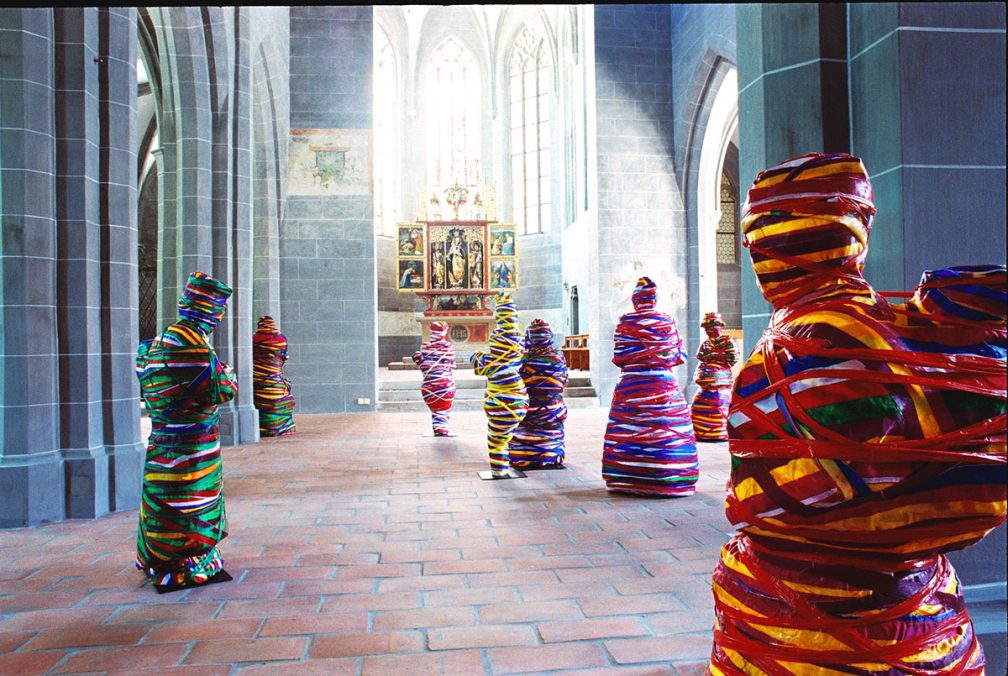
M.A.R.I.A“ – “To all Mothers of the World, Diözesan Museum Freising 2003 14 lebensgroße Figuren mit Kindern aus verschiedenen Kulturen. Das Bild der Mutter ist in sämtlichen Kulturen in Zentral. Die Mutter spendet nicht nur das Leben, sondern prägt es und formt so die jeweilige Kultur mit. Ihre Liebe kennt keine Grenzen, weder räumlich noch zeitlich Foto: C. Knoch
M.A.R.I.A“ – „To all Mothers of the World, Diözesan Museum Freising 2003 14 life-size figures with children from different cultures. The image of the mother is central in all cultures. The mother not only gives life, but also shapes it and thus helps to form the respective culture. Her love knows no boundaries, neither in space nor in time. Photo: C. Knoch

Were there any outside factors that influenced you? 
As a divorced Korean woman, raising a daughter and working as an artist in Germany in the 80s and 90s was often lonely and quite difficult. But it also strengthened me and I processed it a lot in my earlier work. When I came to Germany, people hardly knew anything about Korea, they often  didn’t take me serious when I talked about racism and sexism experiences in Germany; that has changed.

Did you have a mentor?
My life, my mother and my daughter.

What significance does art have in your life?
For me, art is everyday and very ritualistic and at the same time meditative. I fill the empty space, at the same time I let thoughts and feelings go, they become part of the art. So it is part of me and yet it always shows me new aspects of life. As a child I often had the feeling of being speechless, a feeling that runs through my life, in Germany, but also in Korea. For me, art is a means to overcome this speechlessness. For me, art begins where language ends.
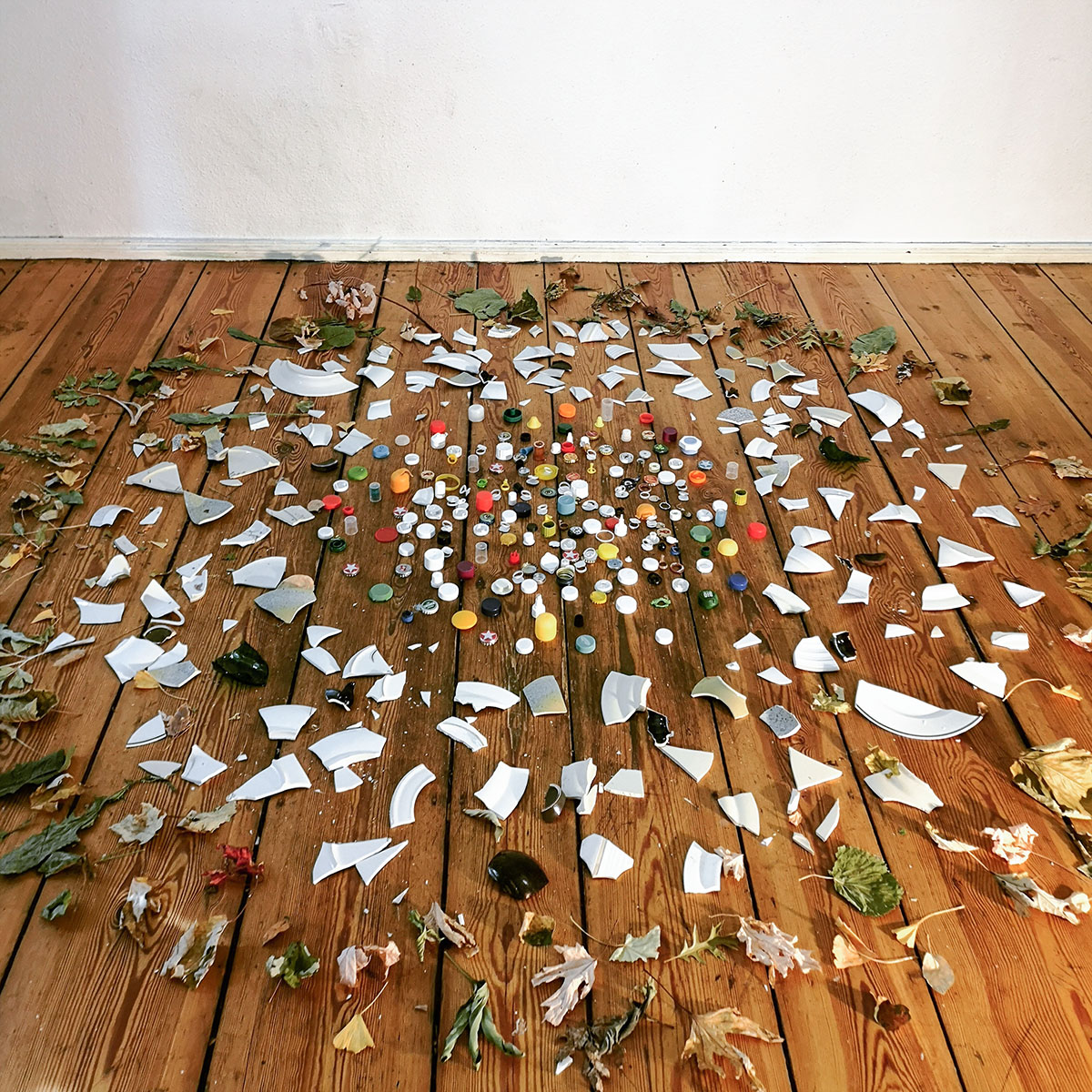
5 The fragments - everything counts - found fragments, Berlin 2021
The fragments – everything counts – found fragments, Berlin 2021

What are you working on right now?
Right now I’m on my way to Seoul, because the „Weisser Lotus“ (White Lotus) will be shown there again in Gwangju, and I’m working on paper and installation works for an exhibition that has been postponed several times due to the pandemic. I already have the title: Die ganze Welt ist eine einzige Blüte“ (The whole world is one flower)

Hyon-Soo Kim – www.hyonsoo-kim.com, www.instagram.com/kim_hyonsoo/

Simon Kubik ist ein 1998 geborener Künstler und Kommunikationsdesigner, er lebt und arbeitet in Wien. Nach dem Abschluss an der Graphischen machte er seinen Zivildienst in einer Künstlerwerkstätte mit Menschen mit Behinderung, er ist als Kommunikationsdesigner in Agenturen, wie selbstständig tätig und ab 2022 studiert er bei Jakob Lena Knebl, Transmediale Kunst an der Universität für Angewandte Kunst.

Der Ursprung Ihrer Kunst liegt in der Malerei und Tapisserie, wobei sie mit ihren Werken in die Welt des Abstrakten eintaucht. Ihre Arbeiten entstehen auf einer Schnittstelle zwischen Kunst und Technik.

Pati Baztán is a Spanish artist, based in the middle of the countryside near Barcelona. She paints as she lives, with wild abandon. She is more interested in being led by the desire, emotion, and primal instincts.

Elke Foltz is a French painter. Her work is a search for balance within a constant chaos. All the elements aim to be in harmony and in perpetual renewal in spite of the prevailing disorder.

It was William Burroughs who, in the early 1960s, in his eponymously named cut-up novel, described the human body as a ‘soft machine’, constantly besieged ‘by a vast, hungry host of parasites’.

Die Landjäger Kürzestfilm Festspiele, das Festival für 12 Sekunden kurze Filme, haben sich für ihre Verhältnisse eine bizarr lange Auszeit genommen – wegen Geldes, Cannes, Corona, you name it.

Olga graduated on the Academy of Fine Arts in Bratislava and has also studied at the Vienna Academy of Fine Arts. She has realized dozens of solo and group exhibitions in Austria and in other European countries.

Nach einem abgeschlossenen Studium der Betriebswirtschaft an der sowie einem Studium an der Kunstschule Wien mit dem Schwerpunkt Druckgrafik und Keramik lebt und arbeitet die Künstlerin in Wien.

Florian Donnerstag aus Oberösterreich hat bis 2015 in Innsbruck Architektur studiert. Interdisziplinär zu seinem abgeschlossenen Architekturstudium befasste er sich mit bildender Kunst und Kunstgeschichte.

Jan Böhmer (1990) ist ein österreichischer Künstler aus der Weststeiermark. Seine Arbeiten sind dynamisch, neu und nonkonformistisch. Als Atelier dienen Räumlichkeiten eines ehemaligen Bestattungsinstituts.

In ihrem Spiel mit der Wirklichkeit nähert sich MUTA NATUR der Polarität von Natur und Kultur, ohne eine Antwort zu erzwingen. Weder wird behauptet, dass eine unberührte Natur unmöglich zu beweisen.

Due to the fusion of digital life with the physical they have become part of our lived reality. The inability of consciousness to distinguish reality from a simulation of reality is addressed through artistic positions.

Statement: Toni Faber, Dompfarrer St. Stephan. Nicht nur im Stephansdom, sondern auch rund um das Wiener Wahrzeichen lässt sich neben religiösen/sakralen Bildern auch zeitgenössische Kunst finden.

Feels so warm that you can walk around with your transition jacket. We are invited by the artist Nives Widauer to her studio, and I arrive there with Cornelius, who backs me up in documenting this conversation.

Kim Dorland pushes the boundaries of painted representation through an exploration of memory, material, nostalgia, identity and place. Drawing heavily from the Canadian landscape.

Sich die Hände zu reichen, zeugt vom Entstehen eines Miteinanders, das sich nicht im Satz »ich bin bei dir« auflöst, stattdessen ein Mehr suggeriert. Dieser Akt ruft ein solidarisches Wir hervor (raise).

In Impuzzibil, there are these bodies struggling and folding and stretching in stacked boxes. They didn’t disappear but they’re not fully there either. And there is no magician present to help out.

From one art fair to the next, from Vienna to Milan. Therefore, the impressions of the second edition of SPARK reach the reader a little late. I deliberately visited the site of the art fair three times.

Faye Wei Wei’s paintings feel like they are wearing lingerie, draped in a body of delicate sensuous marks. The colors, often posed against a white background of exposed untouched canvas, are transparent and fleeting.

A dominating motive theme in her work is using the unexpected to create tension. Playing with the viewers expectations, she broaches the issue of moments paired with distorted items of her imagination.

Mela Diamant zeigt in ihren Arbeiten märchenhaft und modern schwere Geschichte und luftigen Tod, Jahrtausende entfernt und doch ganz nah und heute. Man sieht Frohsinn und Leichtigkeit.